Showing posts with label Barbara Gardner. Show all posts

Monday, April 28, 2025

The Enigma of Miles Davis - Barbara J. Gardner

© -  Steven A. Cerra - copyright protected; all rights reserved.


This feature about Miles Davis’ career after he made the move to Columbia Records in 1955 is part of a continuing effort to highlight the work of other Jazz writers on this page.

Barbara J. Gardner, a talented writer who was based in Chicago, was a contributing editor for Down Beat primarily in the late 1950s and 1960s.

In addition to the lengthy work on Miles that follows and which appeared in the January 7, 1960 edition of that magazine, she also wrote profiles on Joe Williams and Abbey Lincoln for Down Beat.  Other examples of her writing can be found on VeeJay Records, a Jazz label based in The Windy City, for which she contributed liner notes for some of its LP’s, including Wayne Shorter’s earliest recordings as a leader.

“There is no room for the middle stance. You choose up sides, and you play on your team. He is either the greatest living musician or he is just a cool bopper. He is handsome and a wonderful individual or he is ugly and a drag. His trumpet prowess is getting greater every day or his scope is becoming more and more limited.

Any current jazz discussion can be enlivened simply by dropping in the magic name — Miles Davis.

Yet these arguments can be mystifying in the frequency with which the opponents switch positions. A musician in a conversation with fellow workers is likely to blast Davis. The same musician discussing Miles with his dinner host and hostess may change tunes in the middle of the chorus and sing nothing but the highest praise for the trumpeter.

Unaware of the chain of events they were beginning, Dr. and Mrs. Miles Davis, on May 25, 1926, named their first son Miles Dewey. Miles, his parents and an older sister, Dorothy, moved from Alton, IL to East St. Louis, IL in 1927. There, Miles' brother Vernon was born. The first 12 years included all the usual brother-sister squabbles. Yet, though there were normal childhood frictions, Miles was gregarious, amiable, and had many friends.

Musically, his career began uneventfully on his 13th birthday when his father gave him a trumpet. Only his immediate attraction and dedication to the horn gave an indication of the mastery of the instrument he would later achieve. Even his family admits that in the beginning, the growing pains were considerable and Miles was no instant threat to any trumpet player.

"We still have a record packed away someplace that he cut with some rhythm and blues outfit," his sister recalled. "He was pretty awful. They don't even mention his name."

But the woodshed was nearby, and Miles used it.

By the time Billy Eckstine brought his big band through East St. Louis in the early 1940s, the worst was over. Dizzy Gillespie and Eckstine convinced both Miles and his father that the quiet, reserved youngster should continue to study music. While the band was in town, Miles had the exciting experience of sitting in. He was so awe-stricken by Charlie Parker and Gillespie that he could hardly play.

Miles pulled up stakes in 1945 and at 19 made the trek to New York City, where he enrolled in the Juilliard School of Music to concentrate on theory and harmony. At this time, the idol of the jazz world was Charlie Parker. Miles, too, was under the spell. He spent his entire bankroll searching the clubs and hangouts, trying to find Bird.


While his relationship with Parker, Eckstine, and Gillespie had been discomforting for him in East St. Louis, it was not nearly so overwhelming as being surrounded by the giants who inhabited 52nd St. in the mid-'40s.

The same Dizzy who had invited him to sit in with the band in East St. Louis, who had encouraged him to come to New. York and study trumpet, now sternly advised the newcomer to study piano so that he might learn how to build an effective solo.

The helpful and understanding Bird, who advised him to leave the woodshed and break into his own with the public, was making such departures in improvisation, rhythm, and harmony that Miles was bewildered. It was no wonder that the frustrated neophyte, just in his 20s, would quit every night. Fortunately, he returned every day.

He underwent the usual influences. His first idol had been Roy Eldridge, a musician whose influence spreads throughout the contemporary trumpet tradition. Once having heard Gillespie, however, Miles decided to draw from this man his major inspiration. For a while there was a period of complete absorption, and Miles Davis seemed destined to become a second Dizzy Gillespie.

But by 1947, Davis had filtered from the Gillespie-ish playing all that was not natural to himself.

During that two-year period, he had worked with Parker, Eckstine, Benny Carter, and Coleman Hawkins. He had so impressed the listening jazz public that he was voted Esquire new trumpet star of 1947.

Davis made his debut as leader in 1948. The first small group was replaced within months by a nine-piece unit whose exceptionally high musical caliber was captured on records. These celebrated 1949 recordings featured Lee Konitz, Gerry Mulligan, J. J. Johnson, Max Roach, Kai Winding, and Kenny Clarke. Musical pre-eminence, however, was not enough to salvage this experimental group. The gig folded after two historic weeks, and the group disbanded, its members spreading their messages on separate paths.

Davis went to Europe. In 1949, France got its first glimpse of 52nd St.'s new trumpet star. He played the Paris Jazz festival.

But when he returned to New York, Miles passed into comparative musical
obscurity. For a while illness plagued him, financial difficulties mounted, and musical appreciation and satisfaction made a sharp and rapid decline. This bleak pattern was brightened only by three noteworthy events: he won the Metronome readers poll each year from 1951 to '53; he made the Jazz, Inc., tour in 1952, and, above all, the musicians were still listening, learning, even copying.

It is this last fact that perhaps is most significant. It is the thing that, more than any other, explains the sudden reappearance and pervading eminence of the forgotten patriarch.


In 1957, there had come to be established a new sound in jazz, a new school of trumpeters, a new concept in communication in music. People began listening for the familiar characteristics and searching for their source. Re-enter Miles Davis, rediscovered, new star.

After throat surgery in 1957, Davis captured every coveted trumpet award in the United States and Europe. Readers of Holland's Muziek Express, Hamburg's Jazz, Echo, Paris' Jazz Hot, London's Melody Maker, all awarded Miles first or second place on trumpet in 1958 or 1959. In the United States, he has been voted outstanding trumpet star by Metronome readers and has won the Down Beat Readers Poll Award every year since 1954, excepting 1956, when he placed a close second behind his former mentor, Dizzy Gillespie.

As Davis now stands at the pinnacle of his musical career, he stands simultaneously at the nadir of sociability.

Ask any jazz fan who Miles Davis is. Most will say, "He's a fink, but he sure can play." Ask any club owner where he has worked. Most will say, "He's a headache, but the customers flock to hear him." Ask any musician. He probably will say, "He's an evil little bastard, but he certainly can play." In other words, two points seem glaringly in evidence — Miles is a difficult person to deal with, and Miles can play his instrument. Among his closest friends, and he has many, it is the consensus that Miles carefully cultivates both contentions.

The major accusation levied at him is indifference toward and lack of consideration for the audience.

Wearing what the well-dressed man will wear next year, Miles saunters diffidently onstage. Usually squinting through smoke from his cigarette, he briefly surveys his audience, chats momentarily with his sidemen, and idly fingers his horn. Snapping off the beat, he assumes his characteristic stance, drawing the muted trumpet inward. He shoves the mute tight against the microphone and breathes out the notes, placing each sound just where he wants it. He hovers there for several choruses, then drops his horn, and casually ambles away, off the stage sometimes, out of the room . . .

"No stage presence!" the customer will exclaim.

The appearance is certainly that he disinvolved himself from activities on the stand. But musicians who work with him deny this emphatically. The wily trumpeter is able to dissect every tune played during the set. Each musician's work is analyzed at the next rehearsal.

Why Davis chooses to wander about while the rest of the group plays is still as much a mystery as it was when he began doing it 10 years ago. It is by no means a newly acquired habit. Miles has never attempted to be a crowd pleaser, although these very eccentricities serve almost to transform him into a showman whose behavior, though often resented, is nearly as much a part of his audience appeal as his musical performance.

The quality of music that is presented is the major concern with Davis, and neither money nor threats can force him to compromise on this point.

During the spring of 1959 the Miles Davis Sextet, featuring John Coltrane and Cannonball Adderley, was contracted to play a Milwaukee nightclub. Adderley was hospitalized a few days before the opening. Davis agreed to go with the rhythm section and Coltrane. On the morning the five men were to leave New York, Coltrane contracted a virus infection and could not leave. The club owner insisted that Davis keep the engagement. Davis said, "No." The owner threatened to sue. Miles used his favorite unprintable epithet. The club owner sued — but Miles did not play the date.

There are few persons more noted for the use of flat, bold definitives than Davis.


Only an inconspicuous withdrawal or reversal of a celebrated position will belie the assertiveness of his original proclamation. "I shall never work here again" was hardly dry on the printed page before he was back at work in the same club.

Among his most flagrant asserted positions is dislike for the ofay. This generalized overt exhibition of racial prejudice, however, has been undermined in practice throughout the entire pattern of his adulthood.

Since 1948, when he formed his first group, Davis has hired competent musicians regardless of race. Among his closest associates are white politicians, actors, actresses, musicians, and citizens of many countries and many walks of life. He is no embittered hothead on this issue. His attitude has been arrived at because he has endured a series of cold, degrading, and demoralizing experiences.

An instance: arriving in Chicago during the summer of 1959, Davis rolled his imported Ferrari into a motel on Lake Michigan's shore only to be told there was a mix-up in the reservations. Sorry. Jazz great or not, there was no room available.

His refusal to accept publicly a poll award from a national men's magazine was prompted by his dissatisfaction with the discriminatory policies of the publication. Davis talked, as well as corresponded, with the publisher, explaining why he could not, in good faith, accept any commendation from the publication. In spite of the best efforts of the publisher, he has been unable to sway Davis' attitude.

This adherence to principle runs through his relationships. Once he has made up his mind, and cast his lot, he is more than reluctant to change his position. This is especially true regarding sidemen working with him. Both his present pianist and his drummer went through periods during which Miles had to adjust to and acquaint himself with their styles of playing.

"Miles thinks there is only one drummer in the entire world," a musician said at the beginning of 1959, "and that one is Philly Joe Jones." Miles seemed to give credence to this idea long after Jones had been replaced by Jimmy Cobb. Several times, he recorded only when he was able to secure Jones as his drummer. Gradually, this attitude began to fade, and Cobb at last was free to function without the ghostly sizzle of his predecessor behind him. Several months ago, questioned about Miles' affinity to Philly Joe, the same musician expressed amazement. "Well, Miles has that clean-cut Jimmy Cobb sound in his ear now," he said.

The exact pattern was followed when pianist Wynton Kelly replaced Red Garland. For months Miles was attuned to the blockish Garland swing, and he couldn't hear it in the melodic, stylish Kelly. But, sticking by their personal styles, and drawing from Miles' subtle hints in technique and execution, Kelly and Cobb came to be highly regarded by their employer.

Davis' ability to pick top musicians as sidemen is unerring, and the influence he wields over their musical expression is almost phenomenal. Sometimes by subtle suggestion, at times by brutal frankness, Miles whips a musical unit into a cohesive, tight-knit, power-generating single voice.

Not only does he usually walk away with top trumpet honors in trade polls, but like a powerful politician, he carries the ticket, and individual members of his group wind up well inside the first 10 of their categories.

This has been referred to as the "Miles magic." What are some of the elements that form the man and the magician in this trumpeter?

There is an undercurrent of loyalty and dedication to conviction that runs well hidden beneath a temperamental guise. Examples of his generosity and loyalty are described throughout the industry.

Earlier this year in Chicago, a man wielding a knife appeared backstage and began threatening the trumpeter. A prominent New York musician — unexpectedly out of work, down on his luck, and hung up in Chicago — was nearby. Seeing the man with the knife move in on Miles, the New Yorker knocked him cold with an uppercut.

Miles walked calmly away without saying so much us "thank you." Some bystanders were annoyed. Wasn't this more than adequate proof of Miles' insolence and ingratitude? Few if any of them knew the reason the New Yorker was present.
Miles, hearing the man was in financial trouble, had invited him to play the date with his group. He had no need of the man, but offering a handout would perhaps have hurt the New Yorker's pride. The fee Miles paid him was big enough to get him out of town and on to the next gig.

A contributing factor to Miles' attraction is his show of freedom and individuality. This exhibition strikes a chord within many persons who, on the surface, are critical of his attitude. He seldom allows anyone to bore him with small talk. A chatterbox is likely to find himself talking to empty space as Miles walks quietly away.

Although there are several individual writers and disc jockeys among his personal  friends, as a profession, Miles has little use for persons in communications. He seldom gives interviews to writers and almost never appears for radio or television interviews. One reason he will not do them is that he is, in his speech habits, impetuously profane.

But perhaps more important than that is his extreme sensitivity about the loss of his normal speaking voice.

After a throat operation a few years ago, Miles was told by the doctors not to speak at all for several days. Someone provoked him, and Miles blurted out a retort. The damage was done. Now he speaks in a soft, rasping, gravelly voice. It is curiously attractive, when you become accustomed to it, and strangest of all, it somehow resembles the tightly restrained sound of his muted trumpet.

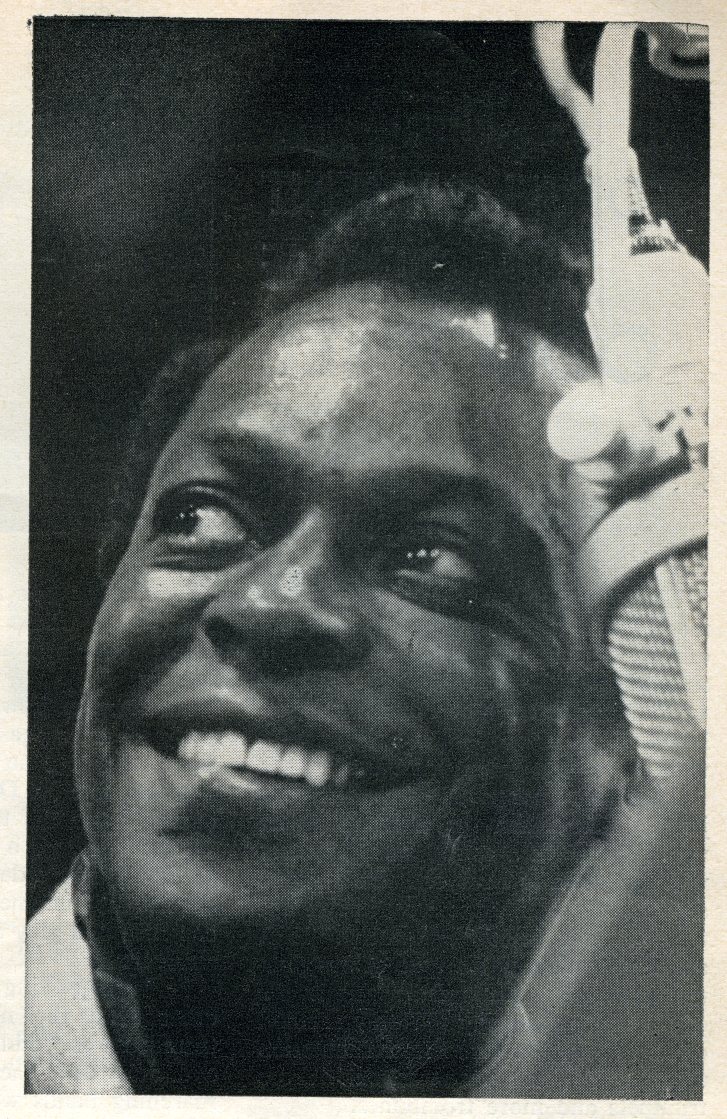
The  striking,  delicate-featured man who stands in almost shy uneasiness, mute against the microphone, is the antithesis of the confident, self-contained offstage Miles. There are those who believe this restless musician is the real Miles. Certainly his exquisite—at times even fragile—playing would not seem to be the expression of a braggart or a bully.

Standing somewhere between the unapproachable loner and the onstage lonely trumpeter is Miles Dewey Davis. At present, Miles is unwilling to share that person with the public. He expresses his conviction that each person has a right and a duty to live an independent existence.

If this attitude rubs many persons the wrong way, his popularity evidently rises with each disparagement.

It was not surprising that Miles in the past few months has won both the Down Beat International Jazz Critics poll and the magazine's Readers poll. What is surprising, however, is that despite all the criticism of his stage manner, the readers also voted him jazz personality of the year.

Apparently a club owner was right when, not too long ago, he threw up his hands in exasperation as Miles sauntered offstage after a solo. After reciting to Miles a list of his sins, he said: "The trouble with you is that everybody likes you, you little son of a bit**."”                                          


Monday, April 8, 2024

Ramsey Lewis "Soul Survivor" - The Barbara Gardner Interview [From the Archives with Additions]

 © -Steven Cerra, copyright protected; all rights reserved.


Signifyin’ and testifyin’ and other ritualistic elements of the Sanctified Church are important elements in helping Black people cultivate and interpret themselves as a collective community. Historically, they have also helped to enable the search for a deeper spiritual meaning and power in relation to the troubles, sorrows and pain of Black life.


Testifyin’ and signifyin’ sometimes are expressed in the music that’s played and sung in the Sanctified Church [an association of holiness Christian churches headquartered in Nashville, Tennessee. The members and clergy of the churches are predominantly African-American. The official name of the body is The Original Church of God or Sanctified Church, General Body].


The music itself was given the casual name of “Soul Music,” and not surprisingly, it found its way into Jazz in the late 1950’s and early 1960’s with Cannonball Adderley, Horace Silver and a host of other “soul groups” emphasizing this influence because Soul Music’s pronounced rhythmic nature and straight-forward melodies were appealing to a broader audience.


However, many Jazz critics and Jazz purists dismissed Soul-inflected Jazz, in part, because of this wider appeal, or, if you will, due to its “commercialism” - a dreaded word in Sanctified Jazz World.


This background perhaps lends some clarity to the full title of this feature - “Soul Survivor: Ramsey Lewis Discusses Soul, Funk, Critics, Jazz As A Business, And Success with Barbara Gardner” - which appeared in the May 6, 1965 edition of Downbeat.


“To the embarrassment of Jazz's critical hierarchy, Ramsey Lewis will not close his piano top and go away. Seven years ago, he was typewritered and dismissed as a flash in the pan.


Today that flash glows steadily, and he has achieved some remarkable things as a jazz artist. He is the pivotal member of a tightly knit unit that has remained together since its inception. The group works steadily to expanding audiences, and its record sales run into five figures annually.


Ironically, the pianist — who is sometimes praised, sometimes damned as a purveyor of "soul" — has his roots deep in the European classical tradition. In 1941, when he was 6 and shooting up with the tall weeds on Chicago's west side, his older sister began studying piano, and Ramsey Emmanuel Jr. cried to go along.


Convinced it was a childish whim, the elder Lewis permitted his son to begin. Six months later his sister dropped out. Ramsey continued studying classical piano with the same teacher until he was 11. After high school, he attended Chicago Musical College and later studied music at DePaul University.


Lewis wanted to be a concert pianist then, and he never seriously considered popular music as a career even after he had begun playing dance dates on the city's west side with a seven-piece group called the Clefs. Eldee Young played bass and Isaac (Red) Holt was the group's drummer. Beyond the world of the west side, the Korean conflict was heating up, and by 1952 Uncle Sam had raided the Clefs and tapped three members, including Holt. The rest of the band drifted off. Lewis, at the time, was in his second year of college and clinging to his aspirations to "concertize and tour the world," as he jokingly remembers.


But first, he married.


"Now, I figured you get married . . . two people can live as cheaply as one and all that, right?," he laughed as he recalled this. "Are you with me? I could finish college.”


The wife would work full time, and I could work part time. You know . . . have my cake and eat it too! But I forgot about old Mother Nature. Jerrie got pregnant, and I had to get out of school and get a job."


He went to work as manager of the record department of Hudson-Ross music store. In addition, he and two other musicians went into rehearsal, and he began moonlighting as a part-time entertainer. This arrangement was soon altered.


"Eventually," he recalled, "my nighttime work overcame my daytime work. ... I couldn't get up to go to work."


End of management career in record department.


The original Ramsey Lewis Trio included bassist Young of the Clefs and Butch McCann on drums. Their major jazz-circuit debut was made as featured attraction with vocalist Bill Henderson at Chicago's Sutherland Lounge. Holt returned from the Army and became the trio's drummer. The group continued working clubs in the Midwest, attracting among their following a Chicago policeman (whose name Lewis has forgot) who was instrumental in securing the group a record contract. The first disc was cut and promptly shelved for months. A Chicago disc jockey, Daddy-O Daylie, heard them and finally persuaded the record company to release the record.


This first album was pompously packaged . . . the three men were tuxedoed in the cover photo. . . and titled Gentlemen of Swing. With plugs from Chicago disc jockeys, the trio gained a substantial following. They were booked into Chicago's SRO Room for six months. There followed two years in the city's Cloister Inn, interrupted once by a two-week engagement at New York's Birdland.


The most indelible memory Lewis has regarding New York is pragmatic; before Birdland, the group was enjoyed though officially unheralded at the Cloister, but after two weeks at the "jazz corner of the world," the trio returned to a blazing marquee announcement of that fact and a doubled salary.


New York still has not officially dealt with the Ramsey Lewis Trio. The three young, intelligent, healthy musicians went to the city not to prove themselves but to perform, not to seek acceptance but to entertain, not to apologize for their Second City origin but to meld naturally into the mainstream of professional jazz. This is an attitude New York has seldom dealt with graciously, even though in his case Lewis remembers that, individually, members of the New York jazz establishment were warm and very helpful.


Another characteristic the trio took to New York was a definitive solidarity, allowing little room for technical alteration and no place at all for any tampering with its style and approach. A prominent jazz saxophonist who had liked and lauded the trio in Chicago was frustrated when the unit went to New York.


"For me, it was kind of a drag, really," he said. "I dug him so much in Chicago, and his thing sounded exactly right then. So I went around telling all the cats, 'Man, look out for this group from Chicago.' But I don't know. When he came to the Apple, somehow it was different. It was still altogether, but it wasn't 'New York'."


Lewis still isn't New York, and, further, he does not consider such identification and acceptance essential. He has no idea of ever living there unless forced to do so because of musical demands. He summarized his view of the city: "There's a lot of good cats there — but New York is just another stop on the circuit to me."


ONE OF THE SIMPLEST METHODS of assessing the unknown is to relate it to a well-known. This technique was employed with the new Lewis trio. It often was tagged a copy or an offshoot of the other major Chicago trio, that of Ahmad Jamal.

"In a way, I was flattered because Ahmad is one of my favorite musicians," Lewis recalled. "I could understand how the comparison might come up. First, we're both piano trios, and then, in expressing our own ideas, we might have crossed tracks one way or another. .. not on the same track mind you. Ahmad loves to be lyrical and beautiful with his melodies, not too much embellishment. So do I.


"Still, nowhere can you sit down and listen to one of our records and say, This is like Ahmad.' Ahmad has a completely different concept about music. Often he will be light and suggestive where I like to lay it out and play with all the depth I can muster.

"Then, of course, our books are very different. I could never do his tunes, and he would probably not be comfortable with some of mine."


Lewis has gone through a wide range of influences. The pianist's father was a jazz enthusiast and tried to saturate his son with the sounds of Art Tatum.


"At first I didn't understand Art Tatum," Ramsey explained. "He was playing too much piano. Then I grew older, studied a little more, and grew to love Art Tatum — probably even more than my father."


The tall, lean musician sat back, stretched his legs and his memory to pull together all the early influences.


"Oscar Peterson was tremendously influential on me at the beginning," he said. "Then I went through a stage where John Lewis could do no wrong. Then Erroll Garner came into my picture and then Bud Powell. I guess all pianists go through a phase when Bud Powell is God. After that I started widening my scope and listening to everything. I fell in love with Horace Silver and so many of the really good current musicians. But I would say John Lewis and Oscar Peterson were my most lasting influences."


Perhaps it is the technical mastery and effective use of classical references that most attract Lewis to these particular artists. Often his own approach incorporates the hint of Old World dynamics and progression to a climax. Still, underlying all is the consistent fusing of powerful, contrasting dynamics, and earthy, straightforward projection. This is the quality that marks a performance as distinctively Ramsey Lewis Trio. And, loosely applied, this quality has earned the trio a reputation as a "soul group."


Surely the most recurring criticism leveled against the pianist is that there is something pretentious about his playing. One critic, within the space of 50 words, termed Lewis' contribution as "pop jazz . . . semiclassical schmaltz and stylized funk." Lewis' customary defense against such attack is to cite the evidence of his increasing night-club and record audience. This time, however, he minced no words in his assessment of critics.


"There may be a couple — not more — who really know what jazz is all about," he said. "Either the others know music pretty well and have no idea of how to give good criticism, or they know how to write a good critique but don't know anything about jazz. What really gets my goat is their arrogant stamp of finality . . . their this-is-it attitude. They could express their views, then leave it up to other people to do the same, you know."


When asked to give an objective appraisal of his work in connection with such criticism, Lewis differentiates between what he is trying to do and superficial commercialism.


"To me 'soul' represents depth and great feeling," he explained. "I know some pianists today where everything they play comes out, not with depth and feeling exactly, but downright funky. Now, when everything you do comes out funky, that's trying. . . that isn't really soulful."


He thought further and then continued, "I don't try to play funky all the time, but there's a certain depth and feeling I try to portray no matter what I'm playing."

Lewis rejects the idea that his group can be defined strictly as a soul group, explaining, "To me, Ray Charles is a soulful musician ... all the time. Not the piano playing so much, but his singing. He makes me feel the story he's telling. And he does it in a simple form ... all the time. Now, that's real soul."


Again Lewis paused cautiously in an effort to achieve the impossible — absolute clarity not subject to misinterpretation.


"I want to have the depth and feeling there always," he went on. "There's a certain amount of it that I got from playing in the church for years, and I can never get it out of my system. Still, in some tunes, I try to alter the character of the tune, project another mood other than outright funk . . . another kind of soulfulness that comes from way down inside. You see, often funk becomes a vehicle . . . just a combination of blue notes certain musicians learn and keep using to carry their ideas in ... to try and create soul. Well, if it's really soulful, it's there in the depth of everything you do — you don't need so much help to get it across."


FORTUNATELY, LEWIS FOUND two musicians with similar musical concepts. Young and Holt are more than fellow workers. They are major contributors to the unit's success.


"Our trio is a partnership," Lewis said. "Everything is literally split up in thirds. Salaries, expenses, organization responsibilities are divided equally. The trio uses my name only because when we first started, the guy who set up some things for us thought a person's name would be better than a group title.


"Musically, we're different from most trios because the pianist does not monopolize the music. We try to distribute the musical duties equally. In one given arrangement, I might have a melody, Eldee may have a countermelody, and Red will have a definite drum pattern designed to emphasize each segment. He's not just back there keeping time. He's there for a reason, to build the whole thing to a certain point.


"After you listen to a couple of our sets, you know that everybody is featured about equally. You don't go away with the feeling that the pianist is all right and maybe the bassist or the drummer would be if you could hear more of them. Everybody gets a chance to stretch out." He laughed. "In fact, the best proof I can give of that is that Eldee has come closer to winning many more polls than I have."


This complementary relationship has been building constantly since the inception of the trio and has yielded a solid bond of musical awareness of individual and group potential. It has precluded the possibility of group expansion, according to Lewis.


"Certain fellows have sat in, and it's just too hard for a fourth musician to feel what's happening," the pianist said. "The three of us really have a thing, and it's pretty tight. I don't think we could make another notch there."


The exception was the late vibraharpist Lem Winchester.


"Now Lem came close to fitting right into this groove," Lewis said. "He's about the only musician I can think of who seemed to be able to anticipate along with us, fill that little slot. Vocalists? That's another thing altogether."


The trio has recorded with other artists, more often with vocalists than instrumentalists. Argo, the company for which it records, has a penchant for tagging the group onto fledgling, waning, or one-shot performers on the label, perhaps hoping to infuse the material with a sales-booster shot.


The Lewis trio has worked in person with many outstanding vocalists. More than one have offered the group steady employment and the chance to team up as a vocal-instrumental unit. The offers do not appeal even slightly to the pianist.


"No good," he said. "There're only a couple I dig playing for under any circumstances, and I don't think I could make it as regular accompanist for anybody. So many singers are just not together with their music. Things like arrangements, keys, pace — these things just don't seem to mean that much to a lot of them. They just expect to walk right in and have everything fall into place. Well, it usually doesn't happen like that."


The implied need for attention to technique and training is most explicit in the preoccupation with rehearsals and study in the unit. They have recorded 16 albums for Argo, utilizing more than 100 compositions, many of which are originals. Most of these are by Lewis though Young and Holt are free to offer for rehearsal and possible recording any original material they feel is good for the trio.


"We try to consolidate our ideas for the group," the leader said. "But there's still room for individual expression outside the unit. Each man has his own record date in which he can do anything he wants to do. Eldee, for example, has many, many ideas of his own beyond the group. Eventually, we get everything worked out so everybody has had his say."


There is plenty of time for experimentation, for this is a relatively young group. In spite of its impressive track record, the average age of the trio members is less than 33. On May 27 Lewis will be 30.


There is a mundane solidarity in the lives of these three musicians who earn their livelihood in the razzle-dazzle of night life. Each man is married to a high-school or childhood sweetheart, and, aside from the extended tours, the performers continue to participate in community activities and civic affairs throughout Chicago.


Jazz is a business to Lewis, not a way of life. Currently his business is making possible a most agreeable way of life for his family.


"I admire Armstrong and Duke and Basie," he said thoughtfully. "But I can't see staying out on the road all my life. I want to get to the place where financially I can afford to stay home. I think I know my failings and my abilities. I wouldn't say that I'm so different from every other pianist and I know I'll make it; but I like to believe I have sort of an original style and a good chance."


Humility is admirable, but cold fact must tell the man that he has become an important, bread-and-butter commodity in at least two of the shops that guide the trio.


While Argo hedges a direct answer, the most casual survey of the company's recording activity in recent years reveals that the consistently selling trio is prime, valuable stock in the jazz department of a record company primarily and profitably pop and rhythm-and-blues based.


The group's personal manager, John Levy, molder of many stars, is currently struggling through a phase, unfortunately all too familiar in entertainment — artistic disenchantment resulting in the explosive or unexpected exodus from his fold of the money-makers. Ironically, while the time period between obscurity and stardom can be considerably shortened by a knowledgeable personal manager, frequently, the artist's mental grasp and business acumen develop by leaps and bounds. Once there, the artist finds he has "outgrown" the need for the same personal manager. Lewis has declined to join the stampede.


"You just don't forget," he stated. "On our second trip to New York, John Levy stepped into the picture, and I learned how important a real manager can be. And for us, John was the best. All we had to do was go to work. Before I saw the room, I knew it was all right. I knew the piano was right. He saw to it that that was part of the contract. . . . All the details, he handled. So now, we just can't walk out."

A rare loyalty in the music business.


The trio works continuously now, which indicates a growing audience and an entry into broader markets than those offered by jazz. They are on the road approximately 42 weeks a year, play Chicago four, and vacation the rest. That's a good year.


Ultimately though, the pianist has other ambitions.


"Ideally," he explained, "I would like to work six months a year, take a break for a couple of months, then seriously woodshed three or four months. I try not to draw only from jazz, maybe because I studied classics — but there's so much meat there and in folk music and naturally the old masters. I'd like to experiment with these ideas a while."


Until this is achieved, he travels, listens to records whenever he gets a chance, steals time from music for recreation with his family, and very occasionally plays tennis. Though the grind is tough, he said he still prefers the hubbub of night clubs to concert work because "usually concerts have so many artists or you're allotted only a certain amount of time. You go on cold. Now, it's a cinch you have to warm up. Before you know it, your time is shot and you often haven't done your best. So I guess I'd rather work night clubs until the right kinds of concerts come along."


This, too, is in the offing. Things could hardly be better now. . . . Well, yes they could. Take away the stings of the typewriters, and Ramsey Lewis will be a happier man.”


Thursday, February 16, 2023

Harry "Sweets" Edison - The Barbara Gardner Interview [From the Archives]

 © -Steven Cerra, copyright protected; all rights reserved.


“Bravo, Barbara!
I want to congratulate Barbara Gardner for the splendid work she's done on articles interviewing jazz vocalists. So far I've read articles about Sarah Vaughan, Carmen McRae, Nancy Wilson, and Joe Williams, and all of them were great.

Miss Gardner is a sensitive, engrossing writer, with a beautiful fund of wittiness and charm and humor. I hope in the future, she will continue to write inspiring, warm-hearted articles on vocalists as she has so beautifully done in the past.
Roy E. Lott
St. Louis, Mo.”
- Chords and Discords, January 28, 1965, Down Beat

The following interview appeared in the January 28, 1965 edition of Down Beat and while it does not involve a vocalist, it does involve Barbara’s assured and eloquent way of putting the person she is interviewing at ease which allows for a flowing almost conversational style of interviewing.

It’s always a pleasure to feature Barbara’s work on JazzProfiles most particularly in this case because the editorial staff has wanted to do a piece on Sweets Edison for some time, but couldn’t seem to find a vehicle that would do him justice.

Following Barbara’s interview, you’ll find YouTube videos that features Harry Edison’s quartet with Arnold Ross on piano, Joe Comfort on bass and Alvin Stoller on drums. The group was formed to work the Tuesday night sessions at The Haig, which for a time, was the busiest Jazz club in Hollywood. The music on the video is from a Pacific Jazz LP entitled ‘Sweets’ at The Haig: The Harry Edison Quartet [PJLP - 4] which was recorded in 1953 on portable Ampex equipment [which accounts for the poor audio quality; you may have to crank up you speakers].

“THE "IN" MAN of the time was the President of the tenor saxophone, Lester  Young.   He  watched and listened to the 21-year-old musician.

"We're going to call you Sweetie-Pie," said the president jokingly to the talented, but young, trumpet player.

In a few months the nickname had been shortened to Sweets, and from that time until now, the given name, Harold Edison, seldom has been heard.

The name Sweets has stuck, as has the purity and clarity of his trumpet tone, unimpaired since the day he joined Young and other leading jazzmen in the Count Basie Band in 1937. The more than 20 years intervening have been marked by a surprisingly even level of acceptance and security. He remained almost without interruption with Basie until the 1950 collapse of the big band. For the-next few years, he toured the country, either as a single or as a star attraction with such performers as bandleader-drummer Buddy Rich and entertainer Josephine Baker.

In 1953 he decided to make a stand on the West Coast. This was a courageous decision, for the West Coast then was riding the crest of the "cool" movement. Modernists and experimentalists were setting the tone, and it was a tribute to Edison's ability as a musician that he, a swing-era trumpeter, was able to survive in this environment.

In fact, he actually prospered and came to enjoy an economically sound footing not easily found in jazz. For the next five years he was the master "soul bearer" of the West Coast. Frank Sinatra never recorded without him. Nelson Riddle's trumpet section swelled with his stinging, swinging horn. The movies Man with the Golden Arm, Pal Joey, Joker Is Wild, House Boat, The Girl Most Likely all boast the steady, lyric trumpet of Sweets Edison on the soundtrack. He was on first call at two of Hollywood's major film studios.

In September, 1958, Edison put the West Coast cushion of financial security and musical acceptance behind him and moved east to resume the unstable, roving life he had led for 15 years — that of a traveling musician.

"I think anybody used to traveling — they get that urge, you know?" he said. "Just want to get on the road — see some of your old friends."

When he formed his own quintet, he found that traveling the nightclub scene was not without change. The first twang of unfamiliarity he heard was in the ever-changing, driving Basie band sound.

"Different band . . .," Edison murmured. "Different band altogether. The band Basie has today is more rehearsed. They don't have the soloists like he had in the old band: Lester Young — the president of the modern style — Hershel Evans, Jo Jones, Buck Clayton — all these guys were the epitome of their profession. There were none greater in those days."

It is interesting that while he makes this statement as unequivocally today as he did in 1958, the personnel of the Basie band has undergone numerous changes in the last six years and more than 75 percent of current Basie-ites have joined the band in the last three years. In singling out individual members, Edison pays special attention to one trumpet player who left the band a few years ago and who has been hailed repeatedly as an Edison disciple.

"I liked Joe Newman with that band," Edison said. "I like him very much. Now, about any influence I might have had on the younger guys. ... I guess Joe Newman plays more like myself than anybody. Of course, we played together for quite some time in Basie's band. He's a good trumpet player. He might use a few things I use, but he's got his own style."

Newman, told of this remark, smiled and shrugged expressively.

"Sweets was a great influence on me musically," Newman admitted. "I listened to him while I was growing up—musically. But now, I just play like myself, I think."

THE TENDENCY to disclaim emulation in music goes perhaps as far back as the tendency to accuse itself. Edison is included. Every leading critic or writer who has attempted to analyze his work has come up with the assertion that in the early days of his career Edison was a Roy Eldridge emulator. Edison has his own thoughts on this:

"I never tried to emulate him. He adapted himself to playing in the high register of his horn — this I never do. I usually play in the bottom register of my horn, which may be poor, but I try."

Eldridge is not listed among his current favorite trumpet players.

"Miles is a good trumpet player," Edison said. "I like him very much. He has a good style — a very relaxed style. I like Dizzy Gillespie, who I think is just — well, he's just marvelous on his horn. And, naturally, Louis Armstrong to me is the daddy of all the trumpet players because if it hadn't been for him, I don't think we'd have known what the trumpet would have been all about."

Edison looks paternally on the younger generation of musicians.

"The younger musicians are not like the older generation, naturally," he said. "Discipline is one thing most of them don't have nowadays. Like anything else—in other areas besides music — the young people don't have that discipline. Even in school, they're not like we used to be. But some people — the worse they act, the more publicity they get. And some others, the better they act, they never get any. So who knows? Who's to say who's right and who's wrong? You never know."

As a successful transitional trumpeter, Edison is sensitive to the various attempts to categorize jazz.

"They keep saying 'mainstream jazz' and 'progressive jazz,' but I think music is music," he declared. "All these names are just new names for music. If it sounds good, and if it is good, then it's just music."

He is not bothered by the various tags and names, and the trend to change the name of the music from jazz to "modern music" or "progressive sounds" has no validity for him.

"I can't find another name for jazz — no more than just good music," he said.

As for his own style, Edison states it simply:

"I like to play on the beat. I like to swing. Anything I play, I like to play at a tempo that's not going to drag people — it's not going to drag myself. I think it should be danceable, and to play something danceable, you have to stomp it off at a dance tempo."

A bit of the subtle Edison wit was discernible in his comment on a critic's remark that he plays occasional cascades of notes.

"Umm . . . 'cascade,' " he mused. "I've never run across that word musically. . . .
But evidently, the writer must have had something in mind. They're always bringing up new words for music, maybe that's a new one. As long as it was favorable, I hope he — whoever wrote it — I hope he enjoyed it."

THE GOOD OL' DAYS bear resplendent memories for Edison, and he still clings tenaciously to thoughts of the period when he was surrounded by undisputed giants of his profession.

"We had more fun then than they do nowadays," he reflected. "Well, it has to do with the taxes. You have to make so much money now to exist. In those days you could make a little money and live like a king. If you made $2 a night, that would last you two or three days. Now, $2 won't even buy you cigarettes for a day."

Did Edison ever actually work for $2 a night? He threw back his head, clapped his hands, and exclaimed:

"Are you kidding? Two dollars a day was big money— that was room rent and food for a week."

While most musicians have preferences in types of music or places to play, Edison regards these preferences only as other whims of the pampered generation.

"If they were playing from 9 to 4," he said, "they would say, 'Certainly would like to get some concerts— get something easy for a change.' Then when they play concerts, they say they are not getting a chance to play. So I just say if you play any place, you're blessed — with so many musicians out of work."

His personal experience with unemployment has been mostly quite brief. He joined forces with singer Joe Williams for a while but then left to drift around New York and points east as a single or a recording artist. Finally, he returned to the West Coast to settle into the same groove he was in before he went east in 1958. He works the studio jobs, some club dates, flits across the country on special assignments for the major labels or studios.

Having spent so much time as a favored musician in an environment conducive to democratic living, Edison has developed a balanced, middle-class attitude toward Jim Crow and its opposite, Crow Jim.

"Well, I really don't like to talk about the race question," he said, his soft, rather gravelly voice dropping. "Because I really don't have any qualms about it at all. I think a person is a person."

Discarding the Crow Jim premise that only Negroes can truly play jazz, he continued:

"God made us all the same — so if one man's got a soul, then why shouldn't another person have one?"

He thought the matter over a second and concluded, "We've [Negroes] had more misery than anybody else, so naturally we play the blues better than anybody.
That's typical race music. That comes from being sad. You have money today — tomorrow you might get put out. That's all in your music."”