Showing posts with label Barry Harris. Show all posts

Monday, April 7, 2025

Barry Harris - Impressions - Part 3

 © Copyright ® Steven Cerra, copyright protected; all rights reserved.
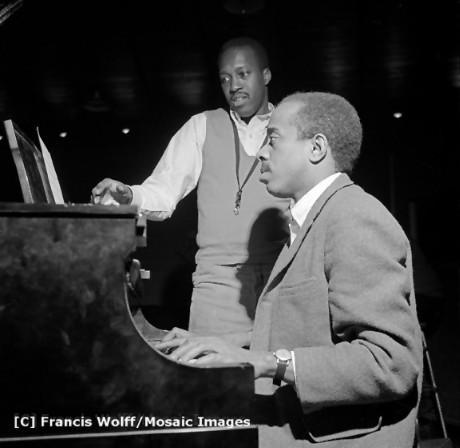

“Harris is unquestionably the foremost exponent of the music of Bud Powell, Tadd Dameron and Thelonious Monk, and is one of the few Jazz musicians of the late 20th century [and early 21st century] who can teach and play the music with equal clarity.”

- Bill Dobbins, Barry Kernfeld, ed., The New Grove Dictionary of Jazz


“The career of Barry Harris suggests a self-effacing man for, although he is among the most accomplished and authentic of second-generation bebop pianists, his name has never excited much more than quiet respect among followers of the music. Musicians and students - Harris is a noted teacher - hold him in higher esteem. One of the Detroit school of pianists which includes Tommy Flanagan and Hank Jones, Harris's style suggests Bud Powell as an original mentor, yet a slowed-down, considered version of Powell's tumultuous manner. Despite the tempos, Harris gets the same dark timbres from the keyboard.


His records are perhaps unjustly little known. There is no singleton masterpiece among them, just a sequence of graceful, satisfying sessions which suggest that Harris has been less interested in posterity via recordings and more in what he can give to jazz by example and study. Nevertheless, he cut several records for Prestige and Riverside in the 1960s, and most are now baek in the catalogue.” 

- Richard Cook & Brian Morton, The Penguin Guide to Jazz, 6th Ed.


“When Barry Harris recorded this album for Prestige in 1967, the controversy surrounding the jazz avant-garde and the emerging fusion of jazz and rock made the pianist's loyalty to the music of Bud Powell and Charlie Parker appear somewhat old-fashioned. Harris has always been true to his own muse and high musical standards, however, and time has proven that modern jazz of his stripe never goes out of date. For his first album as leader of a sextet, Harris spotlighted Slide Hampton, Junior Cook, and Pepper Adams, three power players who explode on the pianist's originals and two Powell classics. They also perform the richly concentrated arrangements with deep feeling, and provide a cushion for two brief ballad tracks that find Harris equally convincing in a romantic mood. This is one of the great overlooked sessions of the Sixties, proof that even during its commercial decline bebop lived.

- Luminescence! The Barry Harris Sextet Featuring Junior Cook, Slide Hampton, Pepper Adams, Bob Cranshaw, Lenny McBrowne. [Prestige P-7498; OJCCD 924-2].


In the 1960s after he moved to New York from Detroit, Barry Harris made five albums for Riverside as a leader under the auspices of Orrin Keepnews and three for Prestige Records which were produced by Don Schlitten.


Here’s a closer look at two of my favorites from this grouping as we continue the JazzProfiles tribute to Barry who died on December 8, 2021.
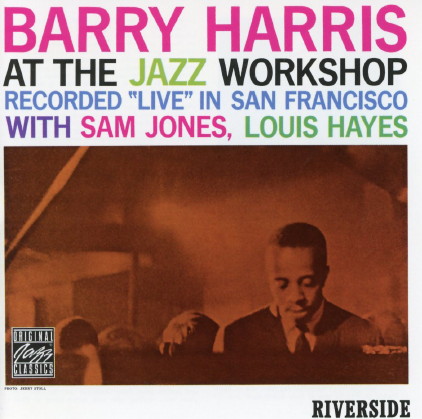


Barry Harris at the Jazz Workshop [Riverside RLP-1177; OJCCD-208-2 - “recorded ‘live’ in San Francisco with Sam Jones and Louis Hayes, May 1960].


“To any observer of the current jazz scene, two facts about Detroit musicians stand out sharply. One is that in recent years there has been a remarkably heavy and steady flow of jazz talent surging out of that city (a quick and undoubtedly incomplete list would include Pepper Adams, Donald Byrd, Paul Chambers, Yusef Lateef, Curtis Fuller, Kenny Burrell, Tommy Flanagan, the Jones brothers — Hank, Thad and Elvin; and so on). The second fact is that just about every such Detroiter will, on the slightest provocation or even with no real excuse at all, rave on at length about the very considerable abilities and strong influence, both musical and personal, of a pianist named BARRY HARRIS.


After a while, Barry Harris began to take on the qualities of a myth, and since he only rarely and fleetingly left Detroit, most people had no opportunity to check legend against facts. So one could be pardoned for a growing belief that either (a) there was no Barry Harris, or (b) he was at least middle-aged and © couldn't possibly live up to his verbal reputation.


Then, early in 1960, Cannonball Adderley made a telephone call to Detroit. He was in need of a replacement for his quintet's original pianist, Bobby Timmons. Barry accepted the job, and the myth was blown away. Harris stood revealed as a small, somewhat graying (but quite prematurely: he was barely thirty years old!) human being. But one key fact remained — he had every bit as much to say on the piano as had been claimed for him.


This album offers quite a bit of testimony to that effect. It was recorded after Barry had had about three months in which to succeed in meshing fully with his two superb colleagues in the Adderley rhythm section, SAM JONES and LOUIS HAYES (the latter, incidentally, being still another young comer from Detroit), who provide his backing here. It was also, by deliberate choice, recorded as a 'live' performance during the Adderley band's return engagement at The Jazz Workshop, scene of their triumphantly best-selling first album  — The Cannonball Adderley Quintet in San Francisco. And the enthusiastic response to the pianist's work on the part of the very hip Workshop audience, which can be heard on these grooves, suggests strongly that this club will be something of a lucky-piece for Barry, too.


This debut album for Riverside showcases his basically lyrical and thoroughly swinging style in an impressively varied repertoire. There are three Harris originals: Curtain Call, a catchily-Latinish Lolita, and Morning Coffee (the latter a blues titled in honor of what is about the only available beverage in San Francisco after the two-in-the-morning closing time). There is a highly funky version of Louis Jordan's one-time pop hit, Is You Is Or Is You Ain’t. . . (one of several tunes to feature brilliant Sam Jones bass solos) ; a rich ballad treatment of Don't Blame Me; another effective touch of Latin rhythms on Star Eyes; and two notable tunes by modern jazz giants: Gillespie's Woody'n You and Parker's Moose the Mooche.


Barry was born in Detroit in December of 1929; his mother was a church pianist from whom he learned his first piano piece (a church tune) at the age of four. After this early start came private study and then the high school band, with a growing interest in jazz dating from about 1944. Not too long thereafter he won first prize in an amateur show at the local Paradise Theater, solidifying his decision to turn pro. Over the next several years Barry developed into the city's top piano man, working with such native talent as Thad Jones and Billy Mitchell, and playing on the Detroit engagements of such passers-through as Lester Young, Lee Konitz and Sonny Stilt. In the early '50s he worked locally with Miles Davis for about three months. And for one memorable set one night he sat in with Charlie Parker — whom Harris names, along with piano greats Art Tatum and Bud Powell, as the most important formative influences on his style.


It was during these same years that Barry also became a focal point for the Motor City's younger-set jazz activity. As he explains it, his very sympathetic mother had a lot to do with making it possible for musicians like Adams, Chambers, Doug Watkins and such, all of whom had grown up with Barry, to come to the Harris house to play at almost any hour. (This would also seem a good place for me to heed Barry's request to clear up a rather widespread misconception that he "taught" pianist Tommy Flanagan. Pointing out that Flanagan and he are almost the same age, Barry adds that "Tommy was wailing at 14 or 15, way ahead of me.")


Harris left Detroit only once — for three months on the road with Max Roach in '56 — before Adderley's call. When asked why he had suddenly broken his anti-travel pattern, Barry noted that he had long admired Cannonball and the others and had known Lou Hayes in Detroit, but then just shrugged and added: "I don't really know why, except that I just figured it was time." On listening to this album, I think a lot of people are going to agree that it certainly is time for Barry Harris!”


—ORRIN KEEPNEWS 


Notes reproduced from the original album liner.
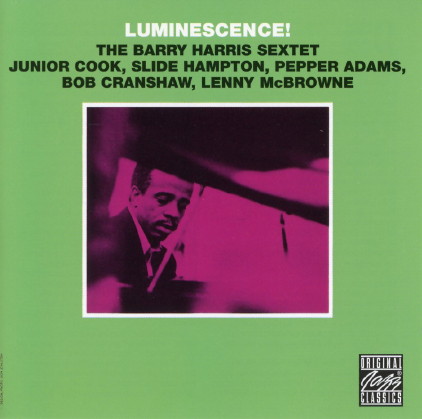


Luminescence! The Barry Harris Sextet Featuring Junior Cook, Slide Hampton, Pepper Adams, Bob Cranshaw, Lenny McBrowne. [Prestige P-7498; OJCCD 924-2].


Drummer Roy Brooks, in talking of Barry Harris in a recent Downbeat article (8/10/67), described the pianist as "an excellent musician, teacher and philosopher. He's one of the few musicians who has really captured the essence of Bird's message— not only the rhythmic quality but the expression."


Brooks is not the only musician to speak of Harris this way. All the Detroiters, like Brooks, who learned from Barry as they were coming up in the jazz world, echo this in one way or another. The New Yorkers who have become aware of his great knowledge and musicianship have added their praise.


Players fortunate enough to work with Harris receive the full benefit of his subtly inspirational guidance. Barry is a perfectionist who demands much of himself. While he is not a martinet with others, he manages to elicit performances of a very high caliber from any group he heads. This album is a case in point. Certainly, the work of the hornmen, Junior Cook, Pepper Adams, and Slide Hampton, has never flowed with more ease, and the great spirit that pervaded the studio on the afternoon of the recording comes right through the grooves. The latter accomplishment is due in no small part to the empathic engineering of Richard Alderson, who has brought some new conceptions to jazz recording.


In recent years many advances have been made in recorded sound, but for some strange reason jazz recording techniques have remained static since the Fifties. With this album producer Don Schlitten begins a series of collaborations with Richard Alderson which they feel will remedy this situation. If there be something called the "jazz sound" Mr. Alderson has captured its essence and brought the immediacy of each performance into every-man's speaker.


This is Barry Harris's debut as a leader for Prestige. He has recorded before for this label as a sideman. This is the first time, however, that he has ever headed a sextet in the studio. Not only are four of his songs included but

all seven numbers are his arrangements. The two originals which are not his come from the pen of Bud Powell, one of the most fertile minds ever to grace jazz and, along with Charlie Parker (the "Bird" in Roy Brooks's statement), Harris's strongest inspiration.


"Luminescence," which opens the set, is Barry's construction based on the song that was virtually the anthem of 52nd Street in the 1940s, "How High the Moon." The punching, stop-and-go theme leads into a direct, big-toned solo by Junior Cook, reminiscent of early Sonny Rollins. Cook, best known for his work with the Horace Silver quintet and, more recently, with Blue Mitchell's group, reveals a new maturity in this album. His phrases, spun out with such assurance, connect in a manner that lets you know that not a note has been wasted. Rhythmically, melodically, harmonically — everything melds perfectly.


Slide Hampton has had his own bands, served as musical director for Lloyd Price, and is well respected for his arranging, but for some reason people seem to sleep on him as a trombone soloist. I know he woke me up in a set he played with a quartet at the Village Gate in the midst of a marathon benefit for radio station WBAI in December 1965. Now he is with Art Blakey, helping to power the Messengers. His solo on "Luminescence" finds him in complete command of his instrument, drawing forth the fluidity and tonal quality we used to associate with JJ. Johnson. Slide gets a French horn effect which can be described as a fist wrapped in velvet, although in reality it is a felt beanie hanging over the bell of his horn.


Speaking of tone, a friend of mine once called Pepper Adams "Carborundum" and not unkindly. Pepper, an old Detroit confrere of Barry's, has been one of the mainstays of the Thad Jones-Mel Lewis band from its inception, and has graced many a recording session on the New York scene. On "Luminescence" he rolls right along, gathering no moss and strewing a few petals (from a


Devil's Paintbrush) as he gets into high gear.


Harris picks up the surge in Adams's choruses and carries it straight ahead. Barry's playing always has marvelous vitality (energy) and a lift that carries you along with it. Through the 1960s, Barry has sporadically led a quintet. In 1967, however, he has divided his time between Coleman Hawkins's quartet and his own duo, the latter most often in residence at the lower West Side soul food emporium known as West Boondock. In this album the sextet format and surroundings have inspired him to achieve some of his best solos. The solid support of the rhythm team of Bob Cranshaw and Lenny McBrowne, quite obvious from the opening bars of "Luminescence," but most pronounced behind Barry's solo, is a great aid throughout all the tracks.


The horns are utilized only in stating the theme on "Like This!" but they are wisely used by Barry, their textures setting off his short, wistful gem of a solo perfectly. "Like This!," an adhesive melody, is Harris's theme song.

The closer on side A is the third of the four Harris originals, "Nicaragua." A Latinate line with shifting accents, it puts one in mind of Charlie Parker, vintage mid-1940s. Slide has the bridge as the rhythm goes into 4/4. The Latin lope is also abandoned when the main body of solos begins with Barry's thoroughly relaxed inventions. After Junior, Slide, and Pepper have had their say, the theme returns with the rolling Latin beat. Harris has the final bridge.


Bud Powell's "Dance of the Infidels" opens side B. This version is slower than the way Bud used to play it. Barry has gotten into an early-morning groove on the song and limned its inherent character of lament. His solo helps solidify the mood, and each hornman carries the spirit in his featured spot. Adams cues the band back into the line with some furious double-timing.

The tempo goes up for the second Powell original, "Webb City," first recorded by Bud with a group called the BeBop Boys in 1946. It is a line like the Green Bay Packers offensive unit [American professional football team], sweeping everything before it. Everyone steps out on this one with the rhythm section especially strong. Listen to Cranshaw and McBrowne behind Harris's high voltage solo. The two then contribute some short solo bits before the theme.


Next follows a lovely exposition of Richard Whiting's "My Ideal." It is a feature for Barry with the horns playing organ in the background and introducing pieces of the melody. Harris wouldn't record this number until his sometime leader, Coleman Hawkins, arrived at the studio. (Hawk recorded this ballad in 1943.) After it was done, Hawk and everyone else nodded their approval. Although there were three equally good takes of "My Ideal," Barry was partial to one with a Charlie Parker quote but settled for the one you hear with its misterioso quality. Harris insists on complete takes and will not allow splicing, another testimony to his integrity.


The last of Harris's compositions, "Even Steven," is a question and answer affair with Barry doing the asking and the band telling it to him like it is. The solos are a pattern in tonal contrasts but each one has the joyous pulse going that is one of the most rewarding experiences in jazz. I'm one of those people who believe that if music can make you feel better it is doing something very essential. I come away from listening to this album feeling good every time.


Barry Harris has learned well from Parker, Powell, and Monk. Long ago he proved that he is an accomplished, exciting soloist. Now he shows that he is an excellent composer-arranger and organizer as well. Luminescence pertains to the emission of light. This particular Luminescence sheds much light on the astral talents of Berry Harris.”

—IRA GITLER


These notes appeared on the original album liner.


Wednesday, April 2, 2025

Barry Harris - Impressions - Part 2

 © Copyright ® Steven Cerra, copyright protected; all rights reserved.


“For nine decades, a lonely outpost held out defiant hope for the return of the diminished chord. Jazz pianist Barry Harris, who died last week, was born in Detroit in 1929, heard the Big Band era in person, and devoted himself to a lifetime of bebop. …


Harris had discovered some of those secrets himself, like mathematicians sometimes discover new properties of numbers all of us have known since birth. There are 12 chromatic notes. Every three notes is a minor third, and after four, that brings us back to “do.” Play all four minor thirds at once, and you have a diminished chord. There are only three diminished chords, but between them they modulate smoothly to any of the twelve tonics. Diminished chords are flexible. …


Detroit jazz critic Mark Stryker, who observed him closely for a lifetime, has described Harris as the music’s “conscience.” Though Harris’s diminished chords may never return to common practice, future generations still have a chance to warm themselves with his deep wisdom—and, perhaps, keep a piece of that old-school conscience eternal.”

-Ethan Iverson writing in The Nation, 12.15.2021


“He is the Flaubert of Bop Pianists.”

- Owen McNally, The Hartford Courant


“He is the leading living exponent of the piano style established by Bud Powell. A model of musical integrity in an era of compromise and apparently incapable of delivering an indifferent performance.”

- Bob Blumenthal, Boston Phoenix


“Harris is the consummate Bebop piano player. Drenched in the Bud Powell tradition, he is nonetheless one of the most distinctively, individual keyboard artists.”

- Doug Ramsey, Radio Free Jazz


This is a second in a series of “Impressions” about pianist Barry Harris. For someone who was so influential for so long as a model of consistency and creativity, there are relatively few in-depth interviews and discussions about Barry and his music in the Jazz literature.


Thankfully, a number of his recordings over the years do contain informative and insightful insert notes about Barry’s style and significance, both as a player in his own trio and as a sideman on recordings by Sonny Stitt, Dexter Gordon, Coleman Hawkins and many others.


In a way, though, while many Jazz fans applauded the release of the 1975 Dameron tribute by Harris - a kind of tribute to an ultimate bebop composer by an ultimate bebop pianist - author Ted Gioia raises an interesting question about this bebop association in the following excerpt from his The History of Jazz [First Ed., 1997]:


“... Tadd Dameron was, for his part, an unlikely modern jazz player. Was Dameron a real bebopper? His compositions are often cited as model bop pieces — but many of the best known were written in the late 1930s before the new movement had crystallized. His early roots straddled musical idioms: as an arranger, he was equally comfortable working for swing bands such as Lunceford's and Basie's as he was writing for modern jazz ensembles led by Gillespie and Eckstine. Moreover, his approach to the piano had none of the telltale signs of bop: it lacked the insistent linear drive of a Bud Powell as well as the hypermodern harmonic sense of a Thelonious Monk. Instead, Dameron favored a compositional approach to the keyboard—not surprising given his overriding interest in writing.”


Perhaps the Harris-Dameron connection comes less from bebop and lies more in the lyrical and sensitive approach that both had to the music?


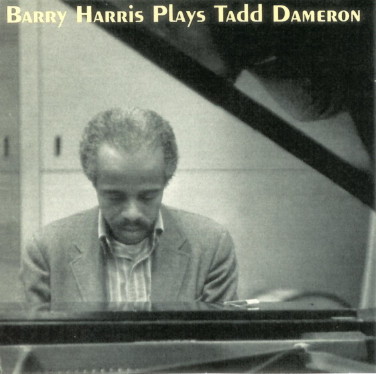
In any case, here are the notes from what has to be considered as an ideal treatment of the music of Tadd Dameron by Barry which, unfortunately, quietly came and went, as one of Don Schlitten’s marvelous Xanadu 1970s LPs and which has thankfully seen a reissue in recent years as one of the Zev Feldman-produced Xanadu Master Editions [2015]. 


The original sleeve notes are by Mark Gardner's and I’ve also included his recap for the Zev Feldman-produced Xanadu Master Editions CD.


You also find a number of YouTubes at the conclusion featuring tracks from Barry Harris Plays Tadd Dameron.


“It has been 10 years since Tadd Dameron died [1965]. His passing left voids in jazz composition and arrangement which have still not been filled. Nobody has surfaced in the Dameron tradition with the talent for melodic originality and harmonic acuteness coupled with the ability to score uniquely that Tadd possessed. Worse than this, however, is that most contemporary jazz players are either unaware or uncaring of Tadd's legacy which contains so many musical gems. The neglect of this great artist's works is scandalous. A few of his songs are still played and remembered by a minority, but many other pieces have been relegated to an unworthy limbo, awaiting rediscovery. It takes a Barry Harris to reveal again the miraculous beauty of Tadd Dameron's writing, to show us how Dameronian structures were magical vehicles for improvisation. It takes a Barry Harris with the courage, knowledge and singular ability and commitment to tackle such an assignment and bring it off with absolute sincerity and deep conviction.


Barry Plays Tadd Dameron is a dream realized. It has long been a pet project of Mr. Harris and producer Don Schlitten whose association with this master pianist dates back to 1964. In those 11 years Don has produced four Harris-led sessions and twenty one (as of this date) on which Barry was at the keyboard. They have built a lasting relationship based on trust and understanding, a rare rapport between artist and producer has been achieved.


When Mr. Schlitten founded Xanadu Records, the team entered a new and significant phase. Barry, naturally enough, became Xanadu's "house pianist" and he can already be heard enhancing three important albums: Sonny Criss' Saturday Morning, Sam Noto's Entrance! and singer David Allyn's remarkable Don’t I Look Back. Now it is Barry's own turn and time for him to pay a heartfelt tribute to bebop's finest composer.


Barry's enthusiasm for Dameron is not surprising. Like Tadd, Harris is a pianist who shares Tadd's vision of lyrical and logical art. You won't encounter an ugly phrase in any Dameron melody or arrangement; the same is true of any Harris performance. At a Harlem club called Diggs' Den, Barry once addressed some well chosen remarks to the audience "You've all! heard of Abraham Lincoln - right? Then you should also know about Tadd Dameron. If you don't, check the history books... but you won't find him there."


You won't even find Tadd Dameron in many of the so-called histories of jazz [obviously this was written over 20 years before Ted’s book]  yet he was almost as vital in the development of the music as Bird, Dizzy and Monk. Tadd was probably the pioneer in putting bebop on paper. He was certainly the first composer-arranger to adapt the language of small group bop to the big band format as you can appreciate from the charts he supplied for the Eckstine, Gillespie and Georgie Auld orchestras. By comparison with Duke Ellington, Tadd's output may seem relatively small — I would guess at no more than 50 compositions — but they are all superbly crafted pieces, mostly sparkling miniatures save for a couple of extended works (Fontainebleau, Soulphony). Dameron shaped each melody carefully and then came the task of scoring it for a large or medium-sized ensemble. Because he was so far ahead of his time Tadd was dubbed "The Prophet" by his fellow trail-blazers. He was a teacher and encourager of young stars like Fats Navarro, Wardell Gray, Allen Eager, Benny Golson and Clifford Brown. Barry Harris served in a similar capacity to colleagues in Detroit during the 1950s.


Harris, needless to say is a faultless interpreter of Dameron's tunes and he lends them a new dimension through his brilliant extemporizations. Not for Barry any note-for-note repeats of other men's solos a la Supersax. That route can be exciting, interesting and helpful to the young listener but it is not the path for a mature soloist of the Harris calibre. No, he offers us the first all around piano trio tribute to Tadd Dameron. How Tadd would have appreciated the gesture! Dameron never thought much of himself as a pianist (although he could and did play some very pretty solos in a personal "arranger's style") because he was limited technically. Barry is the soloist that Tadd's music deserves.


The drummer on the enclosed sides is Leroy Williams who moved from his hometown Chicago to New York in 1967. He played with the late Booker Ervin, Sonny Rollins and Clifford Jordan and has recorded with organist John Patton, alto saxophonist Charles McPherson and others. He has been working with Barry on and off since 1969. "He can really syncopate. He really feels that off-beat thing," says the pianist.


Bassist Gene Taylor is a seasoned professional who was a pivot in one of Horace Silver's best bands and appeared on stirring silver collections like Finger Poppln', Blowin' The Blues Away, Horace-scope and The Tokyo Blues. Horace said of him: "Gene never has to be coaxed to really work." I'm sure Barry will echo those sentiments. Gene's preferred bass men are Ray Brown and Oscar Pettiford. Two of his early inspirations were Slam Stewart and Johnny Miller of the Nat "King" Cole Trio.


Barry, Gene and Leroy work together the way a trio should ... three minds meeting and working as one exploring the infinite possibilities of each piece in close-up. Within the discipline of Dameron's compositions a freedom is afforded to the musicians. In formless music, freedom may be craved and the players might even think they have found it but they are under a delusion. Given a solid foundation the Harris Trio does not merely scratch the top-soil but penetrates the rich under-layers in Tadd's progressions. There is melodic, harmonic and rhythmic variety and cohesion here in plenty. The music pulsates with good vibrations, disclosing, among other things, that Dameron's writing is as valid today as 30 years ago and Harris' piano style is equally timeless. An honourable tradition is being carried forward. It is living and breathing music, vital and relevant in our present troubled era as it also was in the uncertain post-war years. Every age requires beauty to nourish its spirit.


Fittingly the first track, Hot House, is one of the earliest and most crucial of the bebop repertoire. It was initially recorded by Bird and Diz for Guild on May 11,1945 but, curiously, Tadd never made a record of the tune himself. Neither did he arrange it for a large orchestra so far as we know. The composition is. of course, based on the What Is This Thing Called Love? sequence. Barry plays an improvised solo lead-in to prelude the melody. He sketches three fluent choruses at a medium tempo and then enjoys some brisk conversations with Leroy and Gene.


Soultrane is a vintage 1956 Dameron original which he waxed with tenor saxophonist John Coltrane at a quartet session for Prestige. The only other version I know of was made by Chet Baker in 1964. Barry accords it a dignified, tender treatment. The melody is as memorable as that of If You Could See Me Know and it cries out for a good lyric. Barry's sensitive rendition will, hopefully, inspire somebody to fit apt verbal sentiments to the line.


The Chase, a joyous little song, is unrelated to the Dexter Gordon/ Wardell Gray speciality of the same name. Tadd premiered it at a 1947 Blue Note recording with a sextet which included Fats Navarro and Ernie Henry, it takes an AABA form and is typical of Dameron in that it is cute, unselfconscious and engaging. Following the Harris intro, the eight-bar opening of the melody and repeat, Taylor takes the bridge and Barry the reprise. Gene "walks" a beauty and Leroy's brush work is inspired. Ladybird, one of Tadd's most adhesive tunes, was cut by the composer at another Blue Note gathering, this time in 1948 when the Dameron Band, then resident at the Royal Roost, sported the tenors of Wardell Gray and Allen Eager plus the effervescent trumpet of Fats Navarro. Charlie Parker broadcasted an unusual version with a French orchestra on a visit to Paris in 1950. The piece is a jazz classic and Benny Golson used it as the basis for another original, Stablemates and Miles Davis did the same for Half Nelson. Barry relates it briskly but not brusquely. It won't make you hear a whir of wings and see red spots but this Ladybird will lift you into a fast, fluent flight down a road called Invention. The interaction between the trio is stunning.


Casbah, to quote Ira Gitler, is Tadd's "jasmine-scented, night-wind line" on Out of Nowhere changes. Composed for a Capitol date by a 10-piece Dameron ensemble and recorded in January of 1949, the original version made use of Rae Pearl's straight soprano voice and Fats Navarro's trumpet most effectively. It merits the detailed inspection that Barry Harris affords it here. This is how a solo should be developed over a steady 4/4 pulse, the life-beat of jazz. Barry's poetry in sound on piano puts me in mind of Evonne Cawley's poetry in motion on the tennis court. They share a lissome grace, an unforced ease: There's always time to play the shot and place it to perfection. Casbah is a juicy, fresh peach, full of flavour, every bite a mouth-watering delight. Barry's solo sparkles with wit - his reference to Tico Tlco, his closing quotation from Buttons and Bows, his echoing of a Taylor phrase behind the bassist in Gene's sturdy solo. These 8 1/2 minutes affirm: "We are happy - share the feeling with us!"


If You Could See Me Now has a verse (they don't write those today) but this one is actually the bridge of the tune cleverly transplanted by Barry. The song is certainly one of the most attractive ballads ever published. Dameron wrote and arranged it for Sarah Vaughan and conducted her interpretation for Musicraft in 1946. The last measures are Dizzy's coda to Groovln' High On her recording Miss Vaughan was supported by a large orchestra with strings, the silver-toned trumpet of Freddie Webster, the sonorous baritone sax of Leo Parker and the piano of Bud Powell.


The arrangement has never been surpassed. Barry approaches the song with delicacy and respect. He sounds appropriately blue as he pilots a course through the haunting changes, swinging gently in a subtle, delayed-action manner.


I can't recall hearing a single non-Dameron version of The Tadd Walk. The composer made it for Savoy in 1947 with a quintet (Fats Navarro, Ernie Henry, Curley Russell, Kenny Clarke) and often played it at the Roost because several airs hots of it exist dating from the fall of 1948. Nobody else has seen fit to revive this intricate and melodic bebop challenge until now. The Tadd Walk is a jaunty, hip strut for which a rig of suede shoes, brown chalk stripe, Mr B. collar, florid tie. bebop cap and shades would seem to be essential. Barry and company catch the mood after Harris has tapped out the theme with expert precision. The piano solo unfolds !like the dextrous flutter of a magician's kerchief. The abrupt conclusion epitomises the bop shock, the sting in the tail.


Our Delight is yet another Dameron first. It was the first side to be cut by the Dizzy Gillespie Orchestra at its debut session for Musicraft on June 10, 1946. Tadd did it with a sextet on September 26, 1947 and revamped the original score for his last LP (February 27. 1962). Our Delight has been exactly that for more than 29 years. It remains a remarkably durable, compressed statement of the best jazz values. The progression makes a soloist stretch, and Harris does that all right in a darting and daring statement. cheered by Gene's fast picking and Leroy's swashbuckling swishing. The combination of Tadd Dameron's music and the Barry Harris Trio is a natural. The album helps us to recall and puts out front again the peerless artistry of Tadd Dameron 10 years after his death. It also enables us to bask in the warmth of an extra special bright radiance emitted when the hands of Barry Harris establish contact with a piano keyboard.


Coincidence note: On returning from my honeymoon in the Isles of Sicily in March 1965 I picked up the Melody Maker and read with disbelief the terrible news that Tadd had died. Coming back from a holiday in those fortunate islands in 1975 I find a tape of Barry Plays Tadd awaiting. A more joyful homecoming! Thank you Tadd, and rest in peace Thank you Barry, Gene, Leroy and Don for capturing a dream. They do come true after all!”

MARK GARDNER (1975)


HISTORY WAS IN THE MAKING

Barry Harris Plays Tadd Dameron was a landmark album, being the first repertoire tribute to the composer since his death a decade earlier. It was also the first programmatic piano treatment of Dameron melodies — entirely apt since Tadd, for much of his band-leading career, directed operations from the keyboard.


No better interpreter of Dameronia could have been chosen than Barry Harris, a longstanding admirer of Dameron and an insightful performer of his works. Barry's respect for his fellow musician was reflected by the tune dedication he wrote in 1960. Barry's piece, entitled Tadd was recorded by Nat Adderley in that year. And that tribute came when Dameron was still alive and able to appreciate it.


Harris and producer Don Schlitten had been close associates and firm friends for more than 11 years when Don founded the Xanadu label. At Prestige, Don produced three outstanding Harris sessions, employing the pianist as a sideman on ten others with the likes of Charles McPherson, Carmell Jones, and Illinois Jacquet, not forgetting jazz singer Eddie Jefferson.


The relationship continued when Don produced albums for Muse and MRS, At Xanadu, Barry rapidly became unofficial house pianist. It was at Schlitten's suggestion that Barry consider an overdue celebration of Dameron's musical contribution. Great minds think alike, because Barry had been mulling over just such a project.


Don recalls giving Barry a cassette including a comprehensive bunch of Tadd's songs: "I wasn't too surprised when Barry came back with his choices which were the older, classic tunes, nearly all! of which were composed in the 1940s when Dameron was in his prime." The one exception was the beautiful "Soultrane", dating from 1956 and a remarkable meeting of minds between Tadd and saxophonist John Coltrane.


"We had a wonderful working arrangement over more than 20 years," Don remembers. "Barry knew what I wanted and I understood his objectives so there was always a congenial atmosphere at our sessions."


The presence of drummer Leroy Williams was a given. He had been Barry's preferred percussionist since 1969, and they still work together from time to time. Bassist Gene Taylor (1929-2001) was an excellent choice to complete the trio. His playing with pianists Horace Silver and Duke Pearson also fitted Harris's approach like a glove.


Before retiring to Florida in the 1990s, Gene contacted Don Schlitten to request some copies of Barry Plays Tadd to take with him. Taylor

told Schlitten; "That was the best album I was ever on." Quite a statement in light of many successes with Horace Silver.


Don, too, regards the session as among his most satisfying productions. "It's one of those dates you can listen to again and again, and it sounds great every time. Everyone was so relaxed and swinging."


In the 39 years since this recording, Barry Harris has continued to play, teach, and flourish, carrying the messages of Charlie Parker, Bud Powell, Thelonious Monk, Coleman Hawkins, and Tadd Dameron to younger generations. History was made on that day in 1975, and the music remains.”

MARK GARDNER (2015)


Here's a video of the full album.


Saturday, March 29, 2025

Barry Harris - Impressions - Part 1

 © Copyright ® Steven Cerra, copyright protected; all rights reserved.


"Barry was revered," said Michael Weiss, one of the many pianists Harris mentored. "He orchestrated his melodies and constructed his improvisations in a lyrical, unhurried and free-flowing manner. His codification of the bebop language stands apart from most of the trite attempts at jazz theory in the academic world, because it goes to the heart of what makes a melody."


“The essence of Harris’ individuality was his storytelling expressions, spontaneous flow of melody and harmony and the intensity of his swing. On romantic ballads, his ear for color and the eloquent movement of one chord to another lent his performances the lyric glow of a Shelly Ode.”


Harris’ passion for teaching grew out of an analytical mind and a lifelong quest for knowledge and self improvement. He put the virtuoso improvisations of Parker, Gillespie and Powell under a microscope, discovering the musical grammar that makes bebop work - scales, chords, chromatic passing tones. He then organized a set of rules that helps musicians play like natives, without an accent.”

- Mark Stryker, NPR Obituary


“Barry Harris

PIANO

born 15 December 1929


The grandmaster of bebop piano and one of the great teachers in the music, Harris was a leading player in the strong Detroit circle of jazz musicians in the early 1950s, and he was busy enough there to resist the temptation to move to New York - until the end of the decade, when he joined Cannonball Adderley's group for a brief spell and then settled in New York. He made five outstanding albums for Riverside early in the 1960s, and three more for Prestige later in the decade, which showcased his huge authority on bebop material: the prevailing soul-jazz movement had no impact on his playing, and Magnificent! (1969) is a textbook exercise in the timeless qualities of bop as a creative idiom. Coleman Hawkins favoured Harris as one of his last piano players (and told him, 'I don't play chords, I play movements'), and Harris helped care for Hawkins during his final illness. In the later 1970s, the pianist went to live with Thelonious Monk in the Baroness de Koenigswarter's home, and remained there after both passed away. Though he dislikes travel, he has toured widely, and became known as one of the premier teachers in the music: he opened the Jazz Cultural Center in New York in the 1980s, and students have always spoken of his teaching methods in the warmest terms. He came back after suffering a stroke in the early 1990s, and is still playing handsomely: 'I'm a bebopper. I believe strictly in Diz and Bird, I don't think the music has gone any further.'”

- Richard Cook’s Jazz Encyclopedia:


Barry Harris died on December 8, 2021 a week short of his 92nd birthday.


I thought it might be fun to remember him on these pages in a multi-part feature by cobbling together some excerpts from the Jazz press about his background and significance and center these around information and videos about some of my favorite recordings by Barry.


My first exposure to this ultimate Bebop pianist was his playing in alto saxophonist Cannonball Adderley’s group in the early 1960s..


During this period, Cannon had some remarkable pianists in his combo including Bobby Timmons, Victor Feldman and Joe Zawinul. What impressed me most about Barry’s playing was that he fit alto saxophonist Phil Woods’ description of baritone saxophonist Pepper Adams to a T: “He was a Bebopper down to his socks.” If you love Bud Powell’s approach to Jazz piano then you would have loved Barry Harris because they were in the same vein.


Barry somewhat faded into obscurity on the larger Jazz scene with the advent of Free Jazz, Jazz-Rock and Electronic Jazz, all of which increasingly dominated Jazz in the last quarter of the 20th century.


But it would be a mistake to think that he “left town,” so to speak.


Where straight-ahead Jazz with a Bebop orientation was prized, either in clubs, concerts or festivals, at home or abroad, one was more than likely going to find Barry Harris playing alone or with his trio in the tradition started by Parker, Gillespie and Powell.


Increasingly, too, as time went on Barry would move into the classroom where as a teacher he could continue to spread the word and influence a new generation on the interesting and unique [and demanding] qualities and characteristics of Bop, a form of the music that never left his heart.


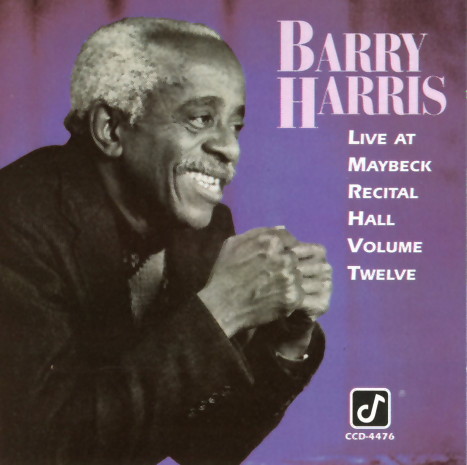
Time-marches on, but I caught up again with Barry with the purchase of Baryy Harris: Live at Maybeck Recital Hall, Volume 12 [Concord CD 44-36.


Here are Andrew Sussman’s insert notes to this great solo piano CD.


“When Barry Harris' name is mentioned, other pianists usually react with awe. This is esteem which has been earned over a lifetime of making exquisite music; since he was the house pianist at Detroit's Blue Bird Club nearly 40 years, Harris has commanded the stature and respect due the consummate artist. (He was part of the Detroit renaissance that also produced Tommy Flanagan, Roland Hanna. and Hank, Elvin and Thad Jones among others.)


As a pianist who is in constant demand, Harris has performed and recorded over the years with everyone from Cannonball Adderley, Dexter Gordon, and Coleman Hawkins to Lee Morgan, Johnny Griffin, Benny Golson, and Yusef Lateef. He was granted a NEA Jazz Masters Award in 1989, and his eclectic talents and versatility are probably best illustrated by the fact that he has also composed music for strings and (according to his manager Louise Billotte] is even working on a musical comedy -"about a sock"!


Often viewed as the quintessential bebop pianist, his playing does maintain the tradition of Bud Powell and Thelonious Monk. However, his consistency, grace, energy, and style transcend the bop idiom. Barry Harris' approach is polished and insightful, and there is a humanity and warmth in his music that truly touches the heart, even when he's playing at a breakneck tempo.


He is also a highly respected educator, who travels around the world performing and giving intensive workshops (he was in Spain, on his way to Holland at the time these notes were written). Students flock to Harris wherever he is because of his talent and reputation and his singular ability to communicate. He enjoys the teaching process, and conveys that spirit and his love of music directly to his students.


That same spirit is clearly evident in his playing, and never more so than at this concert at the Maybeck Recital Hall. His first recording on the Concord Jazz label, it shows the full spectrum of his talents, highlighting the softer, introspective side of his art with numerous ballad interpretations as well as displaying the electrifying speed with which he can construct a magnificent solo (no one can carry the furious pace of a bebop chase with more aplomb).


The concert opens with a sensitive rendition of It Could Happen To You, in which Harris' tone somehow exudes a poignant empathy with the human condition.


He then sets the stage for All God's Chillun' Got Rhythm with an announcement - "I have a special tape of Monk... I'm going to start it out like that and then play it fast." And with that warning, we are treated to a slow and twisting introductory tribute which captures Thelonious Monk's spirit perfectly before breaking out into some exuberant bebop.


Bud Powell's I'll Keep Loving You takes the pace back to the lyrical, with fluid wit and discerning sensitivity.


She is a George Shearing composition, taken at a medium tempo in which Harris captures a touching mixture of soulful and bittersweet.


A standard by almost any definition of the term, Cherokee was first popularized by Charlie Barnet in 1939, but it quickly went on to become a jazz classic in the hands of Charlie Parker and Clifford Brown. Harris' interpretation here is lightning fast and reminiscent of that later tradition while still sounding fresh and imaginative.


Gone Again is a hauntingly beautiful ballad which once again inspires Harris' expressive, unpretentious lyrical grace before the pace is stepped up again for Lucky Day, with fervor.


Harris' keen sense of humor is given free reign on the medley. Who else would even think of segueing a reflective rendition of Richard Rodgers' It Never Entered My Mind into hard-driving versions of two of the most popular TV themes of all time - (Meet The) Flintstones and I Love Lucy? It would have never entered their mind...


Buyers of the CD format are treated to a wonderfully laid back, funky version of Parker's Mood in which Harris seems to contemplate each note after it's been played with soul and grit.


Would You Like To Take A Walk? vividly portrays a light-hearted stroll through the neighborhood. Listen to the fluid, almost Tatum-esque way in which Harris moves between graceful multi-note flurries and glissandos and an effortless stride style.


In talking about the Maybeck Recital Hall (which only houses 50 people). Concord president Carl Jefferson noted that "the place is conducive to making a good performance, because of the intimacy and the room itself." 


Of Harris and this concert, he remembered that "everyone went away with this wonderful feeling about what a wonderful gentleman he was. He's a class act, and I felt very proud to have him included in this series." I should point out that the series itself is fast gaining a reputation as one of the more intriguing collections of music to be produced in recent years.


A masterful pianist, a tasteful program of tunes, an enthusiastic audience, an excellent piano, and a marvelous recital hall which seems to inspire the very best out of all who enter its fold. All of the ingredients are here for an outstanding concert. With Barry Harris at the helm, all you have to do is sit back and enjoy.”


ANDREW SUSSMAN

Fanfare