Showing posts with label Bix Beiderbecke. Show all posts

Tuesday, February 13, 2024

Bix Beiderbecke - Indiana Twilights by Richard Sudhalter

© Copyright ® Steven Cerra, copyright protected; all rights reserved.
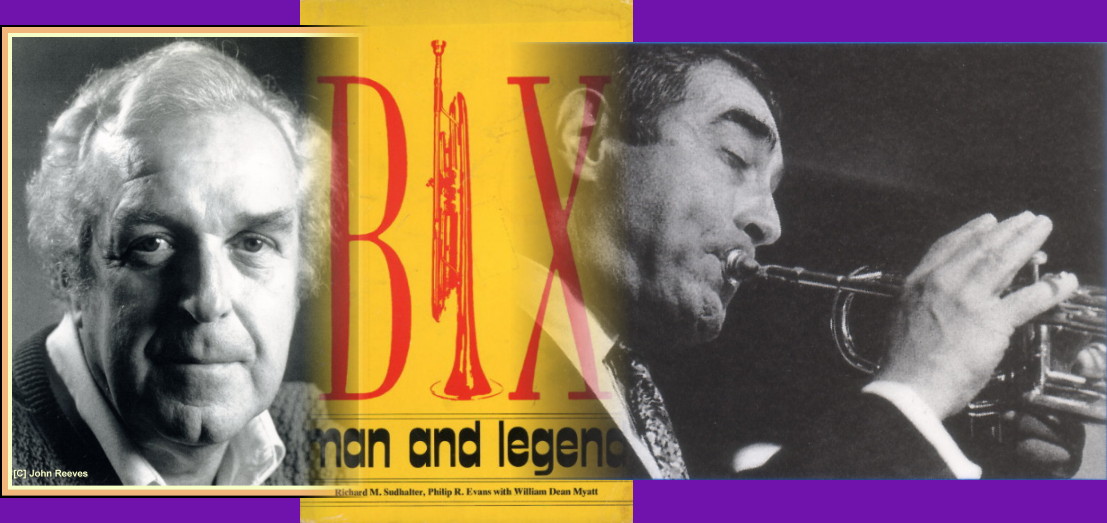


This piece appeared in the February 1983 edition of Gene Lees’ Jazzletter which he began writing and publishing in August 1981.


Without going into details, Gene was frustrated and was considering aborting the publication. [And not for the first time, either, in the almost 30 year history of the publication.]


Of course, this solicited many “Say it isn’t so ‘Letters to the Editor’” which took many forms, one of which was the following from Richard Sudhalter, a distinguished Bix Beiderbecke scholar and a fairly adept cornet player who would later go on to write full length biographies of Bix, Hoagy Carmichael and the seminal Lost Chords: White Musicians and Their Contribution to Jazz, 1915-1945.


The decade of the 2020s marks the 100th year anniversary of many of the earliest developments in the formalization of Jazz as we have come to know it including the advent of the leading voices in the music - trumpeters Joe “King” Oliver, Louis Armstrong and Bix Beiderbecke.


Bix’s short-lived career barely survived the decade and, as a result, a great deal of “Young Man with a Horn Dies Young” hagiography became associated with it.


Richard Sudhalter would have none of that nonsense. Instead, he spent years in research documenting who Bix really was, both as a person and as a musician, and the following piece is an example of the quality of his efforts.


Sudhalter’s letter also contains some interesting reflections of some rarely observed or discussed influences on early Jazz from some unlikely sources which makes it a fascinating read from this perspective alone.


Sadly, the passing of both Sudhalter [2008] and Lees [2010] is a reminder that Jazz is rarely discussed in such erudite terms these days.


Indiana Twilights By Richard M. Sudhalter, New York.


“I suppose it was inevitable that I would want to discuss Bix with you [Gene Lees]. A crucial point is sometimes missed — that Bix never stopped being his parents’ son, a product of that upper-middle class environment and ethic so clearly expressed through the Beiderbecke family and their life in Davenport. Yes, he coveted parental approval and never got it. But at root he didn't want that approval for being a jazz cornet player. Far from it. He was awed and intimidated, impressed to tears, with what he found in Whiteman's orchestra - with virtuosity and theoretical excellence and compositional skills. For him, on the testimony of friends and acquaintances, most of them long gone now, Bix had kind of grown outside his infatuation with hot jazz by 1925. He came more and more to consider it a manifestation of adolescence. In his view, the people who clung to it were either musically stunted or, as in the case of Louis Armstrong, “native geniuses.” 


Bix saw himself — wanted to see himself - as a “legitimate" or “respectable" musician, a composer, someone who could create something musically enduring and, in his view, worthwhile. His solos on the records? He liked some of them, didn't like others. Some — particularly the early Wolverines efforts — embarrassed him. It was a very revealing moment, that meeting with Sylvester Ahola which we describe in the book. Hooley remembered with lasting astonishment Bix's demeanor: looking at the floor and mumbling, “Hell, I'm just a musical degenerate.” He meant it. To him, the writing of Ferde Grofe and Gershwin and Bargy and the rest was class. It was accomplishment, Kultur, if you will. Not for nothing did he all but forsake the cornet in the last year of life. He just didn't give a damn about it anymore. He wanted to compose, to excel as a “real" — his quotation marks more than mine —- musician. 


But that was half a century ago. No dropping out to take a few courses at Berklee or Julliard or Manhattan. No chance to get his primal scream out of his system with some Park Avenue shrink. No “support system" of friends to whom he could talk. Just Hoagy and Challis, both of them wrapped up in their careers, plus a bunch of jazz guys whose adolescent mentality would remain rooted in their systems far into old age. Imagine discussing inner aesthetic and socio-musical conflicts with Wild Bill Davison, Eddie Condon, or George Wettling. Dave Tough, maybe — but then he was off in Europe somewhere playing Bohemian. “Hell, there are only two musicians I'd go across the street to hear now," Bix said to Richardson Turner. “That's Louis and LaRocca." LaRocca for auld lang syne and Armstrong because Bix recognized him for the apocalyptic figure he was. By then jazz seemed almost irrelevant to him. Yet he was caught very securely in a classic trap. If he dropped out, went home, took any kind of left turn, he'd lose the prominence, the adulation of the musicians and the kids who formed the core jazz audience of the time. It would have constituted a loss of face and of what small self-esteem his quick rise to prominence had granted him. He had to hang on, to keep proving and proving and proving - to himself as well as to the rest. “I'm not worthless," he might have said, had he had to express it verbally. 


Eddie Miller [tenor sax and clarinet] tells of a date he worked at Yale with Bix, Bunny and Bill “Jazz" Moore — a light-skinned black working in white bands — as the brass team. Eddie was just a kid then. He said he had looked forward with anticipation and wild surmise to working with his idol. Yet Bix not only didn't play all that well; he seemed alternately indifferent to the music and sullen. It was Eddie's impression that he regarded [Bunny] Berigan as a threat (and in one sense, if you subscribe to the jazz adversary system, the polls and tallies and other gladiatorial paraphernalia, he was) and resented his energy and dash and sheer strength. It is one of the more piquant ironies of that phase of the jazz story. Bix was not a revolutionary, a jazz rebel. He was a nice, middle class boy who never succeeded in bringing his prodigious musical gifts and aspirations into line with the realities of his life. Had he lived — ah, the eternal teaser! — had he lived, I am convinced he'd have ended up either writing for the movies, if the commercial lures had snared him; a significant American composer, following through what Gershwin wanted to do but couldn't because of his imperfect grasp of the native American jazz idiom; or out of music entirely.


By the way, I have always doubted the authenticity of the story wherein Louis takes out the mouthpiece and hands his horn to Bix. By then Louis was playing trumpet. Cornet — and Bix never played anything else takes a different— sized mouthpiece. His wouldn't have fit Louis's horn. It makes good legendry, but sober considerations of fact suggest that it never happened. Your [Gene Lees] discussion of French Autumn Syndrome prompts thought. 


[In the preceding October, November and December edition of the 1982 Jazzletter, Gene ran a three part piece entitled “The French Autumn Syndrome” by which he meant the unquestioned conviction held by the French that their country culture and language are stylistically superior to all others. Any discussion of art is freighted by a vast complex of unexamined assumptions that one might call the French Autumn Syndrome. Praise one musician and someone will take up the heated advocacy of another one as his better.]


And that's all to the good. No matter how heated the disagreements that such writing arouses, it has performed an invaluable service by stimulating thought and feeling. How much writing within what we rather foolishly called “jazz criticism" even approaches doing that? Strip away the opinion-mongering and what generally is left? Onanism [self-gratification], elevated through sheer energy to the level of art. Life and love, taste and emotion and style, seem to be matters of infinite gradation -  the crowd as usual made up of individuals. 


Language is at best an approximation, an arbitrary method for identifying things, concepts, feelings to be communicated and shared. The danger is built in. Who's to say that our own understandings of the things we try to express will correspond to the understandings of others? They seldom do, especially in those areas of experience which rely heavily on subjective response and emotional involvement. Music especially sets up all sorts of snares. Why do we enjoy what we enjoy? What penetrates the walls, scales the battlements of daily defenses and how? Each response is custom built, formed out of a lifetime of experiences. Consensus helps a little — but its aid is deeply suspect. In the end, music is one of the eternal mysteries, reliant on personal chemistry, perception, need, and all the other variables that make us a planet of quirks and accidents. With that in mind, can you defend your case for the nature and/or politics of the traditional jazz audience? Would you want to have to furnish corroborative proof that the “admirer of ‘modern’ jazz is inclined to respect the earlier styles of the music," while the lover of the earlier styles displays only contempt for latter-day developments? . Not that all those attitudes don't exist. Of course they do. 


But to draw such general inferences from your experience with them puts you and I on rather shaky turf. Consider this. Consider one man's view. It's that of a man who doesn't belong to the Flat Earth Society, doesn't know any cops or rednecks, doesn't vote Republican (as a matter of fact usually doesn't vote, but that's another story), and loves to be challenged by life. He argues: It is possible to perceive the jazz which emerged from this culture ‘during the '20s and '30s as a final expression of late Nineteenth Century Romanticism. Its aesthetic foundation, manner of harmonic and melodic organization, sound, and sonorities, all seem less a part of what we've come to identify as Twentieth Century motivation than echoes of an earlier time. Indeed, the very yearning quality which finds its most explicit form in Bix, but is by no means confined to him, bespeaks lavender, lilacs, and fin-du-siecle twilight. 


What about Bix, with his layering of jubilation and melancholy, the bittersweet after echoes and temps-perdu atmosphere of his work both on cornet and at the piano? Its sound and emotional atmosphere are redolent immediately of the French Impressionists — and more directly of the salon piano idiom of this century's first two decades, themselves warmed-over Romanticism, Nineteenth Century thoughts and feelings viewed through a soft-focus lens. 


Listen, with these thoughts in mind, to the large body of popular and light-classical piano music written in the 1920s, including Eastwood Lane's Adirondack Sketches, Willard Robison's Rural Revelations, and such Rube Bloom confections as Soliloquy and Suite of Moods. They provide a context within which Beiderbecke's ruminations at the piano seem very much the expression of a Zeitgeist. What is most remarkable about In a Mist and the rest, I think, is not what they are viewed objectively, they are charming but in some respects unremarkable — but who wrote them and how. The notion that a self-taught hot cornet player brought these pieces into being says much about him, even more about American music in the early Twentieth Century. 


Armstrong. What did Louis really do? What made him so extraordinary? At least one man's answer comes readily: he created a distinctive, individual model for a solo style, both on his instrument and all others, a style with its own integrity and logic, aesthetic coherence and emotional arc. Yes, but listen to bel canto singing, especially in the tenor repertoire, throughout French and Italian opera of the late Nineteenth Century and early Twentieth. Play a record of Pavarotti singing Gelida Manina from Boheme back to back with Armstrong's final chorus on the Okeh When You're Smiling. Compare the gathering intensity and the inner cry of Willie the Weeper or the bravura stop-time chorus on Potato Head Blues with climactic moments in Turandot, Tosca, Norma, Lucia, and the rest. The language, the frame of reference, is the same. 


At one minute after midnight on January 1, 1900, nobody closed a door, lowered a trunk lid, or erased a blackboard. Things went on as usual, with all sorts of expressions of hope that the new century would improve on the old and usher in some kind of golden age which would wed the accumulated wisdom of ages and the wonders of technological progress. No one knew what to expect, and it took, I would submit, a couple of decades or more for the character of the new century, in particular the effect of burgeoning technology, to assert itself. In the meantime, music of all sorts simply continued to do what it had always done: to express aspirations, strive for excellence and beauty. 


Why should jazz have been any different? If anything, it was slower than many other forms to explore the implications of a technologically-dominated world. Jazz musicians during the 1920s were still fooling with whole-tone scales and parallel ninth chords fifteen years or more after Stravinsky unveiled Le Sacre and The Firebird. In sum, I believe that the Nineteenth Century and its aesthetic priorities saturate early jazz. And I would submit that there are many, many people who listen to that music, love it, lobby for it, and for just that reason. Whatever their individual reasons, many of them (or us, since I would include myself) respond more vigorously to the stimuli and aspirations of that age — identify with, as they say nowadays, values and ideas rooted in those times. We still perceive a coherent and enduring set of aesthetic standards in the music of those years, a set of standards which seem to look better and better as the Twentieth Century grinds its angry, violent way along.  


We are discussing an age which had not yet shifted from idealizing life to reflecting it, an age which asked art to stimulate imagination, to reach out and up. In the context of those values, that age, it is possible to ask, “Why should art simply reflect life? Isn't life (reality, if you like) prosaic and demoralizing enough, frustrating and downright ugly enough, without being reflected and projected again through music, painting and literature?" It is a basic philosophic difference that pervades every level of this culture. It's Webster's International (prescriptive) vs. Webster's Third International (descriptive); Fred and Ginger (idealized) vs. Taxi Driver (descriptive). I believe it took jazz close to forty years to catch up to the heartbeat of the Twentieth Century. I believe that bebop was the result. It said, in essence, “Why waste your time mooring and dreaming? That's not life, this is life. Life is full of tension and nervousness and angst. Life shatters dreams into fragments, then reassembles them according to the moment and the mood." 


For a long time, romanticism all but disappeared from modern jazz (or whatever else one feels like calling the jazz which grew out of the war years). Without reaching too far for a point, it is possible to conclude that World War II really dragged popular art kicking and screaming at last into the Twentieth Century. The first war, the Great War, the “war to end war" — had been endured; the nation heaved a vast sigh of relief on Armistice Day and vowed that now we knew better and it would never happen again, not like that. Let us not forget the ability of music to move us. For many years, jazz — and I think part of the grievance of many traditional jazz lovers can be traced to this —— seemed to have collectively forgotten this. Or rejected it. The music impressed its listeners: no dearth of complexity, technical mastery, harmonic and melodic inventiveness, sheer ingenuity. But there is something quite else in the ability to play a note, a phrase, and bring  tear to the eye of the guy sitting at the corner table. Remember that feeling, when you ache and exult and tremble and suffer, all at once, because of something somebody played or sang? A lot of us live for those moments, the moments that allow us to leave the scene of the experience just a bit different from what we were when we arrived. Far from wanting not to be challenged, this in a sense is the ultimate challenge — not to the head but to the heart, not to knowledge and skill, which we acquire at no cost to ourselves, but to our innermost reservoirs offeeling; the things we guard and keep secret and defend. Bix Beiderbecke reached me on that level the first time I ever heard him on a record. For all my years of hearing and growing and broadening and understanding my world, he still does. And I'm very very glad of it. Eddie Condon and his close associates suffered now and then from a kind of selective musical myopia. And their pronouncements — especially Eddie's, in that he was among the most vocal and compulsively articulate of them —— occasionally did harm. Red Nichols is a case in point. Few — least of all Red, were he still living — would make a case for him as a jazz soloist of towering resourcefulness and originality. What he was, however, deserves recognition. He was a superb, well-disciplined trumpet player, an organizer of excellent bands, and an energetic promulgator of good jazz. He managed to get work, good record opportunities, and exposure for good musicians. He was responsible for a large and still impressive body of fine recorded music, in a sense the modern jazz of its day — musically literate, harmonically and melodically varied, and sometimes fascinating in its ingenuity. It didn't swing much. But, as has been proven again and again, it don't mean a thing if it ain't got that swing. It had its own integrity, and established a standard. The efforts of Mole, the Dorseys, Livingstone, Schutt, Rollini, McDonough, Vic Berton, and the rest — and of Red himself — were a model to an entire generation, black and white. It was not, as many have claimed with the luxury of hindsight, merely wrong-headedness. Nichols and the musicians with whom he surrounded himself were far and away the most accomplished jazz musicians of their time. Some day, when racial parochialism from both camps has spent itself and the guilt paroxysms of the 1960s and '70s have subsided, perhaps we'll be able to enjoy a balanced, comfortable, and fair appraisal of the roles of white and black musicians in the formative jazz years. Artie Shaw, for example, is quite right: the Casa Loma Orchestra was indeed the pioneer force among white swing bands. More than that, it is interesting to listen to records by the Mills


Blue Rhythm Band and others of that period, to hear how very influential the Casa Loma band was. ' Two decades after the war to end war, it not only happened again but it happened worse. No more time for dreams and backward looks. Too much grubby reality staring us all in the face. No wonder the jazz of those days said “Screw you, Jack," in almost its every note and phrase. There are no absolute realities, no truths save perceived ones. If our century has adopted, at last, an aesthetic quite different from that of the century that preceded it, let us remember it is only that: different. Not better or worse, only different. It's only too comprehensible. Not the full story, of course. Nothing's ever that simple. But as you fill in the details, they all seem to fall in place. l Yet humanity always confounds the experts. Despite the times, despite the realities and the atmosphere and the prevailing attitudes, people insist on growing up listening to the voices within their heads. How else to explain a middle-class boy from Newton, Mass., who spends his teen years full of dreams of Hoagy and Willard Robison, Bix, Tram, Red, and Miff, Indiana twilights and country lanes and the scent of lilacs in summer dusk. I apologize for running on so long. But that, my friend, is the effect the Jazzletter has. And you want to hang it up?  —RMS


Friday, August 13, 2021

Bix Biederbecke and Dick Sudhalter, Part 2

 © Copyright ® Steven Cerra, copyright protected; all rights reserved.


“The tragedy of Bix Beiderbecke, if his early death and lapsed potential can be viewed as tragedy, lies not in the allegedly corrupting influence of Whiteman land his associates, not fas Pee Wee Russell and others have contended) in the hard-drinking "friends" who wouldn't let Bix alone; not in any of the other putative villains invoked to explain Beiderbecke's steep descent and destruction.


More convincingly, the tragedy lies in Beiderbecke himself, in the Aristotelian notion of greatness undone by flaws within itself. By inner conflict, perhaps having little to do directly with music, which he simply lacked the strength of will or character to resolve.”

- Richard Sudhalter, Bix Beiderbecke and Some of His Friends in his Lost Chords: White Musicians and Their Contributions to Jazz, 1915 - 1945 [1999] 


As noted in Part 1 of this feature, I first became aware of Dick Sudhalter's extensive research and commentary on Bix Beiderbecke 1903- 1931] when I acquired a copy of his Lost Chords: White Musicians and Their Contributions to Jazz, 1915 - 1945 [1999].The section of the book entitled Individual Voices begins with the essay Bix Beiderbecke and Some of His Friends and it is a succinctly superb overview of Bix’s life and music.


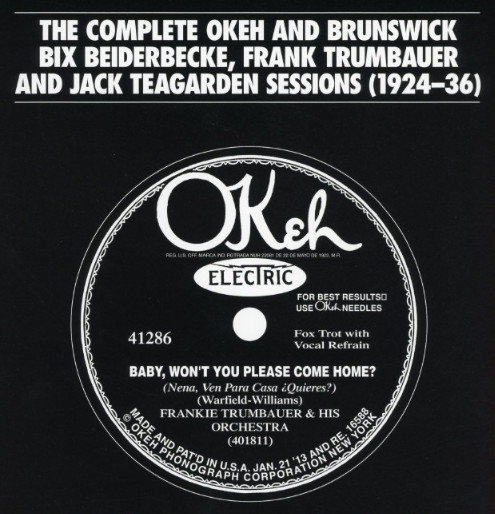
But what really solidified the connection between Bix and Dick was my acquisition of the Mosaic Records set [MD7-211] The Complete Okeh and Brunswick Bix Beiderbecke, Frank Trumbauer and Jack Teagarden Sessions [1924-36] first issued in 2001.


Long out-of-print and with Richard Sudhalter’s passing in 2008, we wrote to Michael Cuscuna at Mosaic Records and he granted us permission to present the first two pages of the insert booklet for the set.


© Copyright ® Mosaic Records, copyright protected; all rights reserved; used with permission.


UNION SQUARE STILL LIFE: HALCYON ADVENTURES

OF BIX BEIDERBECKE, FRANK TRUMBAUER

AND JACK TEAGARDEN


Friday, February 4, 1927, dawns quiet and only moderately cold, under overcast skies. The temperature in New York City is expected to hover around the mid-40s, with some chance of rain later in the day. A front-page story in the morning's New York Times reports the Senate deadlocked over whether the United States can legally prevent radio transmitters in Canada and Mexico from broadcasting on wavelengths already claimed by U.S. stations. Another item announces George Bernard Shaw's intention to sue a press agent over publication of some private Shavian letters.


At Union Square, between 14th and 21st Streets and bounded east and west by Third and Sixth Avenues, in lower Manhattan, two men emerge from the entrance to the Brooklyn and Manhattan Transit (BMT) subway station. They've ridden downtown from their midtown hotel, perhaps on one of the brand-new three-part D-type trains being introduced that month on various stretches of the BMT lines.


Their eyes behold a Union Square very much in transition. Originally part of a farm, it has been, at one time or another, a showplace for New York's high society and part of the "Ladies' Mile," one of the most fashionable of shopping areas. After a few years of seediness around the turn of the century, the neighborhood has renewed itself as headquarters for the International Ladies' Garment Workers, the American Communist Party, the American Civil Liberties Union and other organizational arms of the labor movement.


The Amalgamated Bank, founded in 1923 by the American Clothing Workers Union, dominates the Square's west side, facing a statue of George Washington on horseback, and it's in this direction that the two arrivals now turn, chatting lightly while walking toward the OKeh-Odeon building, farther down the block. Erected in 1870—71, it houses the downtown recording facilities of the OKeh Phonograph Corporation. Since its introduction in 1918, OKeh has become a sort of industry standard, a leader in capturing the new popular music styles known variously as ragtime and "hot jazz."


Artist scouts Ralph S. Peer and Tom Rockwell and a crack team of musical directors have stocked the mainstream and "race" catalogues with dynamic performances by singers and instrumentalists, among them Bessie Smith, Louis Armstrong, King Oliver, Red Nichols, Sippie Wallace and dozens of others. Some have been recorded in Chicago, or even in locales as far-flung as Atlanta and New Orleans, using mobile equipment.


But despite artistic successes and an affordable 75cents-per-disc price, OKeh has been operating at a loss. No surprise, then, is founder Otto Heinemann's late-1926 decision to sell the whole operation to the far more prosperous Columbia Graphophone Company, staying on as President and General Manager at OKeh's 24 West 45th Street administrative offices. Though the new owners have made their comfortable Western Electric facilities at 55 Fifth Avenue and 1776 Broadway available to OKeh, as of early 1927, Heinemann's label is still using Union Square for much of its New York recording, usually under the watchful and expert eye of recording director Charles Hibbard.


This particular OKeh Friday morning belongs to a small instrumental unit out of Jean Goldkette's admired midwestern dance orchestra, currently wrapping up a two-week engagement at Roseland Ballroom, on the corner of Broadway and West 51st Street. They first appeared there last October, outplaying Fletcher Henderson's resident outfit in a widely publicized two-band "Battle of Music," and putting in two days' recording at Victor. Now the Victor Talking Machine Company is determined to record them even more extensively, scheduling four days of long sessions ending Thursday afternoon.


OKeh, eager for a piece of the action, has reserved its Friday session for Frank Trumbauer, fronting Goldkette's band for the Roseland engagement. Widely admired among dance band musicians, "Tram" (as Trumbauer was known) excels on both the E flat, alto saxophone and its popular near-neighbor, the C-melody. A native of Carbondale, Illinois, he'd starred with the bands of Gene Rodemich, Ray Miller and Don Bestor, before hooking up with Goldkette's Detroit-based organization. Along the way, he'd also recorded with William "Red" McKenzie, whose falsetto singing through comb-and-paper forms the basis of a successful novelty group he's been calling the Mound City Blue Blowers, after his St. Louis birthplace. That record sold nicely, and McKenzie, a hustler to his toes, lost no time touting Tram to OKeh executive Tom Rockwell.


Until this February Friday morning, Tram has never had his own record date, and he's determined that the debut be an auspicious one. Among his Union Square companions is his cornet-playing bandmate and friend Leon Beiderbecke, known to colleagues and hot music fans across the country as "Bix." They'd met in 1924, first recording together later that year, when Beiderbecke had just left the Wolverines, a band of young midwesterners which had first brought him to public attention.


(Two 1924 Arkansaw Travelers titles from session A — GEORGIA BLUES and LOST MY BABY BLUES — afford a glimpse of what must have impressed Beiderbecke the first time he heard Trumbauer: smooth tone and execution, slight angularity of rhythmic attack. Overall, a degree of sophistication equaled by no other saxophonist of the time, except perhaps Loring McMurray, who died young and suddenly in 1923 or '24.)


Bix and Tram have been working together regularly since 1925, their musical partnership the talk of the dance band business. Trumbauer's dryly elegant manner and humorous delivery seems an ideal counterweight to the silvery tone, heraldic attack and earnest approach characteristic of Beiderbecke's cornet. From Boston to Bakersfield, fellow musicians have been learning about them, faithfully copying their solos, flocking to hear them in person.


One by one, the others begin arriving at Union Square. Bill Rank, on trombone, is a Goldkette regular, as is pianist Paul Mertz. Restrictions in recording technique prevent drummer Chauncey Morehouse from bringing more than a couple of cymbals. Jimmy Dorsey, on clarinet and alto, has been subbing for an ailing Don Murray in Goldkette's reed section, alternating with talented Midwesterner Danny Polo. The only outsider in this septet of Goldkette men is guitarist Eddie Lang, and he qualifies immediately as an honorary member. His violin-playing pal Joe Venuti has just done all four Goldkette Victor sessions, and the pair — much in demand as New York freelancers — has been featured in a rousing guest spot during Tuesday's date.


At this point, at least one aspect of the historical narrative breaks down. Posterity knows that the records made that February day constitute a pivotal moment in the early growth of American jazz. 


Diligent inquiry, both during and since the lifetimes of the participating musicians, has established the lineage and nature of the music, and its effect on others working in the same field. 


But what of the exact circumstances surrounding this and other key recordings? What, exactly, did OKeh's Union Square studio look like? How did the company's engineers, working with electric techniques that were still brand new, solve the many problems inherent in achieving a balance between full band and soloists, horns and rhythm instruments? 


OKeh and its competitors divulged little about their methods. Even Talking Machine World and other trade journals of the 1920s are silent on such matters. An article in the December 1927 issue of The Phonograph Monthly Review, for example, offers a photograph of Hibbard and his assistant Peter Decker at work over a cutting machine, but carefully avoids discussion of the recording process itself.


(B) FRIDAY, FEBRUARY 4, 1927


Taken together, the three numbers scheduled for recording m t OKeh this day form a useful musical guide to the nascent Beiderbecke-Trumbauer partnership. TRUMBOLOGY, for example, is a saxophone display piece in the fleet-fingered manner of popular virtuoso Rudy Wiedoeft. Heard widely on records and radio, Wiedoeft was among the most imitated instrumentalists of his time; even saxophonists with "hot" aspirations learned much from his tone, vibrato and attack, both in such balladic "salon" pieces as DANS L'ORIENT and such novelties as SAX-o-PHUN, SAXOPHOBIA and SAXARELLA. TRUMBOLOGY falls neatly within the latter category. The arrangement, little more than a sketch with background chords for the other horns and a jam ensemble at the end, appears to have been the work of pianist Mertz.


As surely as TRUMBOLOGY is designated to feature Trumbauer, the Original Dixieland Jazz Band stomp CLARINET MARMALADE bespeaks the prerogatives of Bix Beiderbecke. As a boy in Davenport, Iowa, he'd learned cornet by playing along with ODJB records, and salted the Wolverines' repertoire with such items as SENSATION, FIDGETY FEET, LAZY DADDY and the inevitable TIGER RAG. Based on a routine apparently worked out during a nine-month residency with Trumbauer at the Arcadia Ballroom in St. Louis, MARMALADE combines solos and jam passages with just enough organization to provide shape. Tram and Bix take 16 bars each, sharing a spirited cat-and-mouse break in the final ensemble.


Though a performance of great energy, it might have profited from inclusion of a bass instrument. Part of what sold the full Goldkette orchestra to its audiences was the driving beat laid down by New Orleans—born string bassist Steve Brown. Why, then, not bring him along to Union Square to slap and snap such numbers as CLARINET MARMALADE to maximum intensity?


Victor had worked out how to record Brown's bass in 1926, but smaller companies getting used to the new methods seem to have lagged behind: most technicians feared that too powerful a sound from a slapped bass or most parts of a standard drum kit would knock a cutting stylus out of its groove, ruining a recording. Only toward decade's end, in groups led by Eddie Lang, Luis Russel and others, did Hibbard and his New York OKeh staff finally solve such problems.


However good CLARINET MARMALADE may have been, it is the third title, another Dixieland Jazz Band creation, that inscribes this Friday in the hot music history books. Indiana-born J. Russell Robinson had joined the ODJB after the sudden death of its pianist, Henry Ragas, quickly emerging as a formidable songwriter. The band's 1920 record of his hit, MARGIE, also introduced SINGIN' THE BLUES (TILL MY DADDY COMES HOME). From a commercial point of view, at least, such repertoire choices now seem quaint: if TRUMBOLOGY stood a chance of popularity as a novelty, CLARINET MARMALADE harked back to post—Great War days, and SINGIN' THE BLUES had never been widely performed. Neither, certainly, seemed aimed at a record-buying market attuned to MY CUTEY'S DUE AT TWO TO TWO TODAY, WHEN THE RED RED ROBIN COME BOB-BOB-BOBBIN' ALONG and other ditties being played and sung in the first days of 1927.


Still, the coupling of SINGIN' THE BLUES and CLARINET MARMALADE did well enough to be cited in OKeh advertisements later that year as one of the firm's four best-selling records, alongside performances by Sophie Tucker, pianist-singer Seger Ellis and organist Sigmund Krumgold, rendering the Rudolf Friml operetta favorite INDIAN LOVE CALL.


As played by Tram and Bix, SINGIN’ THE BLUES consists of a four-bar introduction, two full-chorus solos and an ensemble, played at a relatively brisk medium (quarter note = 138) tempo. Both Trumbauer's and Beiderbecke's solos are melodic paraphrases, each widely scrutinized, adapted and quoted for many decades after its creation. Together, whatever the tempo, they can be said to have introduced the concept of the ballad solo into hot jazz.


It's perhaps hard to imagine something so integral as a jazz ballad as having had a discrete, identifiable beginning; but here's the evidence. Before SINGIN' THE BLUES, there was simply no such thing in hot jazz, at least on record, as an introspective solo on a popular song — blues solos are a phenomenon apart — played to lyrical effect. Between them, Beiderbecke and Trumbauer (and Lang, for a melodically alert combination of rhythmic and single-string accompaniment) share credit for having pioneered this approach.


Both choruses created great stir when SINGIN' THE BLUES was released; veteran jazzmen everywhere, among them Benny Carter, Lester Young and Rex Stewart, happily confirmed the extent to which it affected them. Arranger Bill Challis, close friend of both Bix and Tram, adapted the entire performance in an arrangement for the Goldkette and Paul


Whiteman orchestras. Fletcher Henderson's band recorded it twice, with Trumbauer's solo arranged for the reed section and Stewart playing an interpretation of Bix's chorus.


(Historians and discographers have always taken it for granted that Trumbauer's instrument on all these titles was the C-melody saxophone, then at the apex of its 1920s popularity. But critical listening by various latter-day scholars and by such musicians as saxophonist Dan Levinson, a popular performer on the G-melody instrument, has introduced the possibility that he may have used alto in some instances. Scott Robinson, who also uses C-melody frequently, hears that instrument on the February 4 session, but agrees — on the basis of the instrument's register "break," and of various passages between notes — that Trumbauer may be using alto elsewhere.)


Thursday, August 12, 2021

Bix Biederbecke and Dick Sudhalter, Part 1

 © Copyright ® Steven Cerra, copyright protected; all rights reserved.


"Hearing Bix for the first time was like waking up to the first day of spring."

- Nat Hentoff


"All I've ever called the dear boy was Bix . . . just that name alone will make one stand up—also their ears. And when he played—why, the ears did the same thing . . ."

- Louis ARMSTRONG, 1954


“By the mid-1950s an alarming, though inevitable, development made it clear that time for writing a factually documented book about Bix was running short. The natural laws of attrition were beginning to catch up with the generation of the twenties, and the men and women who had known Bix Beiderbecke were starting, slowly, to die off. They were the primary sources, the only ones whose combined accounts, weighed against one another and pieced together, puzzle-fashion, could dispel the contradictions and half-truths.”

- Richard Sudhalter


I’ve already taken a stab at the subject of Bix Beiderbecke and his place in Jazz history as part of a feature entitled King, Pops and Bix in Chicago from "We Called It Music" by Eddie Condon which you can locate in the archives by going here.


But I wanted to return to this topic in a more specific way, not the least of which is due to the fact that we are in and moving ahead with the decade during which Jazz came into existence 100 years ago - The Twenties - or, if you will, The 20s!


Sadly, while it was the beginning for the music, it would become the beginning and the end for Bix as he would be dead less than two years after the decade was over [1931] at the ridiculous young age of 28 due to another cultural characteristic of The Roaring Twenties - overindulgence in alcohol.


I also wanted to delve into Bix and his music because I’ve finally caught up to more of the details of his life thanks to the work of his biographer - Richard Sudhalter - who passed away in 2008 at the age of 69.


I came to the writings of Dick Sudhalter rather late. It wasn’t until I read his Lost Chords: White Musicians and Their Contributions to Jazz, 1915 - 1945 published in 1999 that I became aware of his extensive skills as both a researcher and excellent narrative writer on the subject of Jazz and its makers.


I was delighted when Dick’s Stardust Melody: The Life and Music of Hoagy Carmichael was published in 2002 because, not only did it provide insights into Hoagy’s music, but it also helped me understand the close connection between Carmicheal and Biederbecke when the former was a student at the University of Indiana and Bix was in a band that played gigs in and around the campus. Not surprisingly, Hoagy’s adoration of Bix was reflected in the many beautiful melodies he wrote over the years, including Stardust, which some allege was based on an actual Bix trumpet solo that Hoagy memorized after hearing Bix play it in person at a party or a dance.


But what really solidified the connection between Bix and Dick was my acquisition of the Mosaic Records set [MD7-211] The Complete Okeh and Brunswick Bix Beiderbecke, Frank Trumbauer and Jack Teagarden Sessions [1924-36] first issued in 2001.


My copy came in 2002 with booklet notes by - you guessed it - Richard Sudhalter.


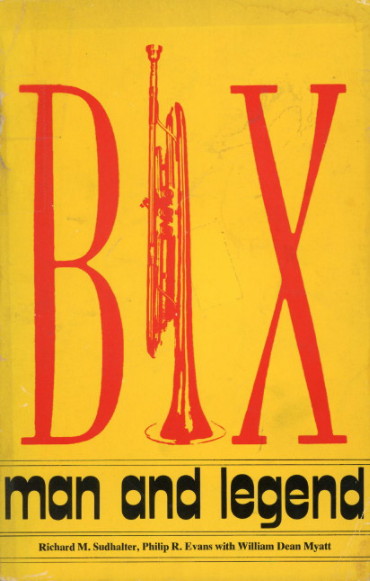
And that’s when I discovered where Bixology all began for Richard Sudhalter for in 1974 he along with Philip R. Evans and William Dean Myatt published the definitive biography - Bix Man & Legend.


Although the book came out forty years after Bix’s death, the research for it began much earlier when many of Beiderbecke’s family, friends and  contemporaries were still alive to participate in interviews and share their recollections. 


Here’s the Introduction from the Sudhalter/Evans/Myatt Bix Man & Legend which will kick off a two-part series on Bix and his music on these pages.


“Leon Bix Beiderbecke played jazz on the Bb cornet and a variety of music, some of it defying categorization, on the piano. He came from Davenport, Iowa, and died at twenty-eight in New York of a combination of pneumonia and the effects of alcoholism. 


He flared briefly and brightly in the popular music world of the 1920s, and departed before he was able to explore any more than a fraction of his native talent. He was only on wide public view for about three years, yet his memory and influence among musicians still survive after nearly half a century.


This is the outline of the story. Beyond introducing Bix, it tells us nothing. Leave it, rather, for a veteran saxophonist of the era to hint at the rest:

"I remember the day we heard Bix was dead. It went around the musicians in whispers, as though nobody dared say it out loud. We couldn't believe it—it was like saying the Pope was dead. If it was true, if Bix was really gone, what the hell were we all going to do?"


The springtime years of jazz produced many outstanding players, some of them colorful personages in their own right. Why, of all of them, did the passing of this quiet, deferential young man provoke so widespread a feeling of almost apocalyptic bereavement among those who knew him or even merely admired him from afar? And by what process did the succeeding years turn him into what the British critic Benny Green has aptly termed "Jazz's number one saint?"


Part of it, of course, rests with his music. Phonograph records, relatively few of them, have left some indication for later generations; yet even they, according to the now grey and wistful emeritus flaming youths who heard him in the flesh, are but pale echo of the real thing. They hint at a blindingly silvery tone, tempered by melancholy even in moments of joyous abandon. There is ample evidence of a faultless ear and a contemplative, sophisticated musical intelligence. Perhaps most significant, they suggest the capacity to reach a listener and move him emotionally even at first contact.


But an understanding of why there had to be a Bix Beiderbecke legend comes only through matching up the musical legacy with the facts of his life, background and character. Inevitably, this means hacking away more than 40 years of underbrush, destroying the popularly accepted image to get at the person of fact, flesh and blood.


Not to fault the legend-spinners. Certainly jazz, as an artistic outgrowth of the 19th-century romantic tradition, had to have its tragic heroes, and Bix had all the qualifications. He appeared—and died—at the right time. He was different, revolutionary from a musical point of view. He was good-looking, personally charming and widely loved. And he was sufficiently incomprehensible to the majority of his fellow-jazzmen — no thinkers, they — to take on instant enigma status even in his brief lifetime. Enlightening, in this context, the trumpeter Wingy Manone's remark that Bix "was always wanting to try this or that, play over figures . . . never wanted us to have any fun."


So, for a while, Bix Beiderbecke became jazz's Keats and its Rupert Brooke. But the 20th century has not been kind to the romantic tradition. For better or worse, the century's near-cataclysmic events have tempered even nostalgia with an unmistakable skepticism, a new spirit of inquiry. Nothing accepted out of hand, not ideas or personages, and least of all legends. Challenge and question—and categorical dismissal of whatever doesn't stand up.


As a result, even less remains in half-light. Within the past year excellent, unsparing biographical studies have already dispelled much of the ambiguity surrounding the lives of such seminal figures as blues singer Bessie Smith and Charlie Parker, saxophonist and architect of modern jazz. Their biographers, casting off the trappings of conventional myth, have revealed people far more human for their flaws, far more extraordinary for those elements of their lives which are recognizably fallible, flesh and blood.


Inevitably, there were bound to be attempts to unravel the "young man with a horn." Otis Ferguson, writing in the magazine New Republic within a decade of Beiderbecke's death,1 [see footnotes at the end of the posting] was able to articulate much of the feeling evoked by listening to Bix, lacing in some background information gathered from the cornetist's boyhood friends in Davenport. Edward J. Nichols’ chapter in the pioneer anthology Jazzmen 2 soon after took a stab at documentation — but came to grief in its acceptance of some of the standard half-truths and rumors bandied about among musicians. Numerous "reminiscences" in such magazines as Down Beat and Metronome further clouded the issue by presenting often confused, fondly exaggerated nostalgia as fact.


By the late 1950s, when Charles Wareing and the late George Garlick of Britain compiled their biography, Bugles for Beiderbecke,3 the situation was hopelessly muddled. Working at a remove, and with limited budget, Wareing and Garlick had little choice but to rely heavily on previously-published material — and in so doing compromised their own work from the start. But for all its shortcomings, Bugles was a courageous book. It sought, with the well-ordered logic of attorney Wareing's mind, to make sense of apparent contradiction, and to set Bix in a musical and social perspective.


Wareing was the first to perceive in print that Beiderbecke's membership in the Paul Whiteman orchestra was far from the commercial sellout and source of musical frustration which more parochial jazz scholars had always assumed it to be. He devoted space to careful examination of Bix's

impact on fellow-musicians, to cornetists who absorbed facets of his innovative style.


Another Briton, the critic Burnett James, contributed a series of valuable musical insights in a brief book of his own, published in 1959 by Cassell in their "Kings of Jazz" series.4 Though hindered by the by now more-or-less standard factual inaccuracies, James did display acute understanding of Bix the musician.


There have been other writings, some more successful than others. Richard Hadlock's treatise on Bix's records in Jazz Masters of the Twenties5 contains many astute observations. Gunther Schuller's Bix chapter in Early Jazz6 is especially good in its musicologist's defense of the Whiteman orchestra. A recent work from Italy, The Bix Bands,7 offers painstaking discographical work marred by some faulty scholarship, not all of it the fault of the authors, who used previous writings as source material.


Autobiographies of the musicians themselves, among them Eddie Condon, Mezz Mezzrow, Bing Crosby and Hoagy Carmichael, offer generally colorful but not always strictly factual accounts of a jazzman's life during the 1920s. Their chief value is in their power to evoke the thoughts and feelings of the springtime years.


By the mid-1950s an alarming, though inevitable, development made it clear that time for writing a factually documented book about Bix was running short. The natural laws of attrition were beginning to catch up with the generation of the twenties, and the men and women who had known Bix Beiderbecke were starting, slowly, to die off. They were the primary sources, the only ones whose combined accounts, weighed against one another and pieced together, puzzle-fashion, could dispel the contradictions and half-truths.


With this in mind, Phil Evans and Bill Dean-Myatt began work in 1957, Dick Sudhalter the following year, contacting first the musicians whose names appear on the record personnels, then the Beiderbecke family, finally other figures known to have played with Bix or to have employed him. Our paths inevitably crossed, but it took several years for Evans and Sudhalter to get together as a partnership. Dean-Myatt, of Walsall, England, had attracted Evans' attention at the outset with a Bix discography in the British collectors' magazine Matrix. He and Evans soon agreed to work together.


Initial response was encouraging. Paul Whiteman offered help. Jean Goldkette, Hoagy Carmichael, Red Nichols—all were willing to talk, and to submit to endless, detailed questioning. All supplied names and addresses of others who "might have a thing or two to add," though their connections with Bix might not be so well-known.


So it began an unending, ever-widening process of letter-writing, travel and interview, reading, phoning and taping, which consumed the next 15 years and still continues as this volume is published. For Evans, especially, it meant devotion of the best of his adult years to learning more about Bix Beiderbecke than any other single person on earth. There would be no reliance on past writings, though all had to be carefully read and absorbed to clarify the seams where fact blends into myth. All sources were to be primary — the story told, where possible, in their own words. Each account of an event to be weighed against the others, often by bringing narrators into direct contact with one another for the first time in years, to resolve apparent contradictions in their recollections.


There were unexpected benefits. For many years, alumni of the Paul Whiteman orchestra held annual parties at the home of Ferde Grofe in California, during which they reminisced freely about the early days. It was Evans’ good fortune to be invited to several of these otherwise exclusive gatherings, and to be present as groups of Whiteman musicians discussed an event among themselves, catching one another up on errors and inaccuracies until a consensus emerged. At these parties, Evans was able to question at length men who had been reticent in correspondence about points of detail, or who simply preferred not to answer letters at all.


Similarities of attitude emerged, both here and elsewhere, chief among them a pronounced desire to protect Bix's name and reputation against denigration, especially over his alcoholism. Almost all displayed undisguised affection for him; detractors were few and far between. All were at pains to stress that the drinking should not be allowed to obscure a clear picture of the whole human being.


This kind of research also meant a closer and deeper understanding of Bix's music. It meant acquiring full, complete collections of Bix's recordings, issued and unissued. Sudhalter was able to bring to bear experience as a jazz cornetist and trained musician in investigating the harmonic and melodic implications of Beiderbecke's piano compositions and recorded solos. Together the triumvirate, as it evolved during the 1960s, was able to investigate every lead which had even vaguely pointed to Bix's presence on a record. In each case, one of the three would acquire the disc in question through collector sources and disseminate tape copies to the other two; then discussion would begin. When the authors of The Bix Bands discovered a possible Beiderbecke solo on a Marion McKay Gennett recording made in late 1924, Dean-Myatt quickly came up with a copy, Evans found McKay still living in the Midwest, and Sudhalter went to work both cross-checking the solo against Bix's other work of the period and exploring the possibility that it might have been the work of another cornetist.


As information rolled in and a picture of Bix began to take shape, it became clear that a special style would have to be evolved for the writing of the book. It would have to combine the reportage and quotation techniques of journalism with a quantity of more technical discussion not ordinarily of interest to the non-specialist reader, but indispensable all the same to the understanding of Bix and his impact. Frequently, moreover, sufficient information was available to reconstruct dialogue; this was done, then checked by submitting relevant passages to either persons directly involved or, where this was not possible, to sources close enough to them to know whether things happened as depicted.


Frequently, such portions would come back with marginal notes—corrections, additions of other information evoked in the reading. If, as was the case on one or two occasions, there were objections that a remark or action was out of character for the person described and would have to be changed, it was, and the passage was resubmitted to the critic.


Such techniques, and the time-lag involved in transatlantic collaboration, often cost valuable time and ran the constant risk of misunderstanding. That there was a minimum of friction, and very little crossing of wires, is all the more amazing in view of the fact that Sudhalter and Evans did not meet face to face until April 1972. Evans and Dean-Myatt have never met. Yet a singularity of purpose united us, bound us together in pursuit of a common goal. On those few occasions when disagreement occurred —usually over interpretation or presentation of information, never over matters not directly concerned with the mechanics of writing the book— someone was prepared to compromise in the interests of harmony.


Such teamwork extended into the actual writing of the book. Over eleven months, Evans fed a constant stream of raw material through the post to London, all the while keeping up a full volume of correspondence with sources and slotting new information into the shipments as it became available. A copy of each completed chapter would then be mailed to him, for copying and distribution among its sources for checking. Once critical comments were in, they were relayed back to me and my copy of the chapter in question would be duly amended. Far from being a particularly cumbersome process, this method quickly established its own rhythm.


Several editorial decisions were difficult to make. Whether, for example, it was necessary or even desirable to examine some of the more familiar bits of nonsense surrounding Bix's life, and marshal evidence to refute them. In the end it was decided not to: our primary purpose was to tell Bix's story. If an anecdote was based in fact, it would appear, correct, in its proper place in the narrative. If not, its omission would speak clearly enough. Too much space devoted to disproving mistakes, we decided, would hold up the flow of an already long book. Did Bix, for example, actually insert that Charleston figure in "Goose Pimples" to ruin an unsatisfactory take? The record itself, and a little musical common sense, offer answer enough: the two notes are harmonically correct, and coincide with the same figure as played on the piano by Frank Signorelli; there are no discernible "goofs" up to that point; and Bix leads out the final ensemble with a passion which hardly bespeaks dissatisfaction or an attempt at sabotage.


Some questions were not so easily resolved. Years of inquiry, for example, have shed no light on accounts of a reported friendship between Bix and Babe Ruth, home run king of the New York Yankees during the twenties. Knowing the Beiderbecke love for baseball, it is not hard to imagine him spending occasional afternoons at Yankee Stadium watching the Bambino, Lou Gehrig and the rest of Miller Huggins' stable of temperamental stars go through their paces. But of Ruth's alleged visits to the 44th Street Hotel, barely able to squeeze his massive bulk through the doorway, there remains no evidence.


The discography, too, presented some questions, usually of a technical nature. Our adoption, with some modifications, of Brian Rust's system of label and instrument abbreviations is based on the preeminence now accorded Rust's Jazz Records 1897-1942 and other books as the standard reference works in their field.


We have restricted ourselves to 78 RPM issues in the discography, making exceptions only in those cases in which a selection has appeared for the first time on LP. LP issues are a continuing thing, and any attempt to keep an up-to-date listing, with records being produced in more countries than ever before, is doomed to be out of date by tomorrow. Sufficient, we feel, to have it known which selections have been issued, and to provide, through notation of significant solo passages, a handy key through which multiple versions or "takes" of the same number may be distinguished from one another.


A word, too, about photographs. We have attempted to include in the present volume as many hitherto-unpublished —or at least rarely-seen — photos of Bix as were obtainable. We have deliberately omitted many of the more familiar shots, in the conviction that no purpose would be served through inclusion of every available Bix photo. Special thanks in this area must be extended to Paul Mertz, who made available to us the stills from the exceedingly rare home movie shot by Charlie Horvath during the Jean Goldkette orchestra's travels in the east.


There are other photos, as yet unpublished, in existence. Some were all but impossible to trace. In at least one case, a rare shot of the Wolverines during Vic Berton's summer tenure with them, the owner asked a price for its use far beyond what the authors felt fair or reasonable. In another, the only extant print of an informal Wolverines pose was of such poor quality as to defeat any effort to reproduce it.


Bix research is, like the output of the sorcerer's apprentice, a continuing phenomenon. The authors would therefore welcome additional data unearthed as a result of publication of this book, with an eventual second edition in mind.


Our eternal thanks to all those, both living and dead, who have assisted us over the years with patience, generosity and a near-universal love for Bix Beiderbecke. It is to them that this book must be dedicated.”


Richard M. Sudhalter London, England November 5, 1973


1.  Ferguson, Otis. "Young Man with a Horn," New Republic, LXXXVII (July 29, 1936), 354. Ferguson, Otis. "Young Man with a Horn Again," New Republic, CHI (Nov. 18, 1940), 693-95.

2.  Ramsey, Frederic Jr., and Smith, Charles Edward. Jazzmen. New York, Harcourt, Brace and Co., 1939. pp. 143-160.

3.  London, Sidgwick and Jackson, Ltd. 1958.

4. James, Burnett. Bix Beiderbecke. London, Cassell & Co. Ltd., 1959.

5. New York, Macmillan. 1965. pp. 76-105.

6. New York, Oxford University Press, 1968. pp. 187-194.

7. Castelli, Vittorio, Kaleveld, Evert, Pusateri, Liborio.  The Bix Bands. Milan, Raretone, 1972.