Showing posts with label Blue Note. Show all posts

Saturday, July 30, 2022

Dexter Gordon - "Landslide" - The Blue Note Years Part 10

© Copyright ® Steven Cerra, copyright protected; all rights reserved.


“Dexter Gordon was a year or two behind me [at Jefferson High School in Los Angeles, CA], but my impression was not unlike many others', I guess. As you know, Dexter was quite tall, and he talked slowly, moved slowly, always had a big, beautiful smile on his face. Due to the fact that he was a little younger than me and his musical training started undoubtedly a little later in his life than some of the rest of us— He had all of the soul and dedication and feeling and total commitment to jazz that a person could have, but his training was a little late, so he was what we might call second-string. But when it came to sincerity, he was totally committed. And his playing always reflected his bodily actions in a sense. Even today, when you listen to his records, it's always laid-back just a little bit, as though, "Look, I'm not in a hurry. I'm going to say what I want to say, how I want to say it, and nobody can rush me." But, you know, Dexter loved this thing so much that it was his life. If you love anything, you just live it, sleep it, and eat it. And it seems to me that I've heard Marshal say that Dexter told him once, as a very young man—Marshal [Royal] said that Dexter's ambition was to become a junkie. He was so committed to music—well, jazz music—and he felt that the epitome of being what he wanted was to be a junkie musician. In other words, I guess he felt that the dope was going to help him be a more completely formed musician. And Dexter apparently experimented a little too much with narcotics.”

- Jack Kelson [multi-reed artist aka Jackie Kelso], oral interview in Central Avenue Sounds: Jazz in Los Angeles


“My enthusiasm for Gordon's playing on this LP knows very few bounds. It is not enough to say that he plays as well as he ever did, for he plays better and on some tracks shows a sustained emotional cohesion and directness that is rare. …


I take deep pleasure in the periodic rediscovery that players like Jack Teagarden, Emmett Berry, Pee Wee Russell, Coleman Hawkins, Buck Clayton, Ben Webster (I am not naming enough of them) are still committed and creative jazz musicians. I take the same kind of pleasure in hearing Dexter Gordon on this LP.”

- Martin Williams, Downbeat review of Doin’ Alright
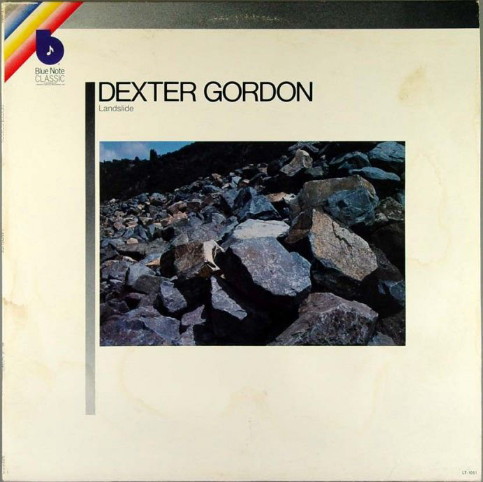


Recorded in 1961 and 1962, but not released until 1980, Landslide [LT-1051/CD TOCJ-50289] is the last of the three Blue Note recordings belately issued following Dexter Gordon’s 1961-1965 association with the label.


Perhaps not as well known as the above cited Martin Williams or the often recognized Ira Gitler, Nat Hentoff and Leonard Feather, Robert Palmer has long been a favorite of mine among Jazz critics for his educational and informative commentaries. After reading them, I always come away having learned something new about the music and its makers.


Aa a case in point, “storytelling” is commonly used as a reference point regarding Jazz soloing, but rarely is it explained, if it is explained at all, as well as Mr. Palmer’s description of it in the following insert notes to Landslide.


“Dexter Gordon is a weaver of spells and a teller of tales. He begins weaving his spell even before he's played a note, with his radiant, room lighting smile, his velvety speaking voice and the sheer magnetism of his presence.


In interviews, he’s often stressed his interest in musical storytelling He once explained his infatuation with the playing of Lester Young by asserting that "Pres was the first to tell a story on the horn” and of the trumpeter Roy Eldridge he remarked. "I used to got the same thing listening to Roy as I did

listening to Lester - the same ‘story' feeling."


"Telling a story" is such a cliche of "jazz talk" that one rarely thinks about what it really means On one level, it's a survival of an altitude common in blues, in which the guitar or harmonica often “talk back to" the singer, or answer his vocal lines, and that attitude in turn is a survival of the close connections between music and speech found in many African cultures. 


Among the many African peoples who speak pitch-tone languages, a musical phrase may literally tell a story, it may have a verbal meaning, which most [native] listeners can easily decipher in its pitch configuration. There’s a great deal of this marvelous tale-telling quality in Dexter Gordon’s playing. He’s an unusually expressive saxophonist and often he quotes the lyrics to a standard before improvising on it, drawing an explicit connection between the import of the words and how he will shape and develop his musical ideas.


Jazz improvising is a “language” in another equally interesting sense. A musician who develops his art in the way Dexter did - studying harmony and theory initially, picking up pointers from older musicians while serving an apprenticeship during big band section work, listening to the idioms recorded masterpieces and studying their details and construction - eventually creates his own individual style out of these diverse influences and experiences.


But the original influences are never entirely subsumed in an individual’s particular stylistic synthesis. A musician will retain phrases, personal timbers, and even entire solos associated with the many players he has listened to somewhere in the recesses of his memory, just as he retains the melodies and chordal layouts of a number of standard tunes and jazz compositions. In the course of an improvisation, which is a kind of spontaneous composition using a prearranged framework, the musician will draw on the information he has filed away in his memory bank. When the listener “hears the influence of” another player, what he’s actually hearing are either ideas found in the work of the other player or the improviser’s personal but still recognizable transformation of those ideas. In this sense, a superior, seasoned jazz improviser “tells a story” every time he solos, a story of the music’s rich traditions and of his own encounters with the bearers of these traditions.


There’s an interesting example of this aspect of Dexter’s story telling on “Love Locked Out,” the second of seven previously unreleased performances on this welcome new album. Dexter has never been thought of as a Coleman Hawkins disciple. He himself says that he loved Lester Young's playing more than that of any other tenor saxophonist, and of course his style was shaped further by Charlie Parker and the advent of bebop; he was the first really authoritative tenor stylist. But as we’ve noted a Jazz musician absorbs something from just about everything he hears, and like any other young saxophonist of his era Gordon listened carefully to Coleman Hawkins the undisputed tenor boss before Lester Young and a major architect of jazz ballad playing. Hawk's way with a ballad entailed various combinations of warm melodic exposition with arpeggiated playing; he would '”spread" a chord by stating its notes in sequence, almost as one might do when practicing an instrumental exercise. In his ballad performance "Love Locked Out", Dexter begins with a very straightforward melodic exposition, employing a plaintive, veiled sound, and then, as he begins to develop the melody, he works his way through a succession of arpeggiated phrases clearly acknowledging Hawkins’ contribution to ballad playing and to his own evolution.


I’ve emphasized this aspect of Dexter Gordon’s music because Landslide, drawn from three different 1961-62 sessions, gives a particularly good account of it. When Dexter is at work, he seems to access the material in his memory bank very directly, so that his playing reflects with unusual honesty the mood he’s in at the moment. I’ve heard him, for example, quote a single fragment - “Here Comes The Bride,” say - two or three times in the course of a single evening, and return the following night to find him in a very different frame of mind. For this reason, Dexter Gordon albums drawn from a single session tend to have a unity of mood, to present their own distinct perspective on the Gordon style. This album has more variety. Gordon is caught on three different days, telling different kinds of stories.


The early sixties must have been an uneven period for Gordon emotionally. After establishing himself as a modern master in New York during the forties, he spent much of the fifties back in his native California, where he had to overcome both a drug habit and the indifference of a jazz public that was preoccupied with the so-called “cool school.”


He returned to New York in the early sixties to record some of the finest albums of his career for Blue Note. Landslide, written by Dexter with fellow tenor saxophonist Harold Land in mind, is an unreleased tune cut at the second session of these albums: Dexter Calling. Making these albums, after having recorded very sporadically for a decade, must have been extremely satisfying, and in concert and at occasional night club appearances, Dexter was very warmly received. But the cabaret card law, which forced entertainers working in places that served liquor to apply for cards and routinely denied cards to anyone who had been in trouble with the law, especially on drug-related charges, kept Dexter from working steadily. In the study of Gordon included in Jazz Masters of the Forties, Ira Gitler suggests that Dexter’s failure to obtain a cabaret card was one of the main reasons he left for Europe later in 1962 and decided to stay there.


After the exuberant, hard-toned tenor solo on Landslide, the saxophonist’s work on the next three numbers sounds somewhat subdued. In part this difference can be ascribed to the difference in the accompanying groups. Landslide features the extroverted rhythm section of Kenny Drew, Paul Chambers and Philly Joe Jones. On Love Locked Out, You Said It and Serenade in Blue, Willie Bobo, better know as a conga player, is on trap drums; Bobo also plays traps on Blue Note Sessions by Grant Green and the much underrated tenor saxophonist like Ike Quebec during this period [Herbie Hancock’s Inventions and Dimensions, too.] Sir Charles Thompson [pianist], who now lives and works in Switzerland, had appeared on several Blue Note Sessions during the forties and returned to the studio to record for the label in a 1959 Ike Quebec date. Together with bassist Al Lucas, Bobo and Thompson provided spare backing on this date, and on the two ballads played gently and sadly, with deep feeling.


You Said It, a Tommy Turrentine composition recorded several months later by the trumpeter’s brother Stanley Turrentine and available on Jubilee Shouts [Blue Note BN LA 883], is more “up.” Dexter’s solo begins with tumbling strains that cascade downward, pulling at times against the forward push of the rhythm, and then opens out into expansive, intelligent eight-note patterns. The tune’s composer, making his only appearance of the set, solos briefly and Thompson’s solo includes reminders of both Bud Powell and Thelonious Monk.


Phill Joe Jones is back on drums, the estimable Sonny Clark is the pianist and Ron Carter’s bass provides a big, hard bottom. Dave Burns, the trumpeter, has been featured on three, earlier Blue Note sessions - James Moody 1948, George Wallkington 1954, Leo Parker in 1961. A veteran of the early Dizzy Gillespie big bands, he is an individual, assured player and this date provides a welcome chance to hear him improvise at some length.


The material is varied and cleverly arranged, Dexter plays with a tougher tone and a more aggressive attack than on the previous session. Blue Gardenia sounds like a small band version of a big band arrangement, with its harmonized verses and unison bridge. 


Six Bits Jones is in 6/8, although the way Philly accents it makes it sound almost like a straight waltz at times.

Here Dexter echoes Burns’ theme statements of the minor key melody in chase fashion before jumping into the first solo, one of the best of the album. The way he cuts across the bar lines, building his improvisation out of chunky phrases of unequal lengths and making use of his lower buzz-saw register, is a delight.


Second Balcony Jump was recorded by Dexter again two months after this session and issued on his classic Go [Blue Note BST 84112]. But this version doesn’t take a back seat to the later one. Dexter’s sound is scorching, and he swaggers through his solos, scattering blues riffs, downturned inflections, jagged runs, and bottom-of-the-horn honks. Yeah! Here Dexter isn’t just telling a story, he’s preaching it, weaving that almost mystical spell of his. This performance alone is worth the price of admission.


It’s our great good fortune that Dexter decided to return from Europe, after a decade in exile, so that we could hear more like this.”

- Robert Palmer


Dan Morgenstern Sessions Notes from the Boxed Set Booklet -


(B) MAY 9,1961


LANDSLIDE, the session opener, was not issued until years later Dexter named this 32-bar original at the time of release because the line reminded him of Harold Land. It opens with three tenor choruses at a medium-up tempo. Drew's crisp, light touch is prevalent in a solo that includes some cleanly executed octave doubling, with prominent and typical Philly Joe rimshot accompaniment. Chambers takes a pizzicato solo that shows why he was in such demand in the studios; immaculate conception and beautiful sound. Dexter's concluding theme statement is authoritative, climaxing with a high note—as always, in tune.


(C) MAY 5,1962

Almost a year has passed. The supporting cast assembled here for Dexter is somewhat odd, and the session didn't yield enough material for an album; the three acceptable tunes were shelved and did not see the light of day until 1980. They proved worth waiting for, after all. Trumpeter Tommy Turrentine, born in Pittsburgh in 1928, is the oldest brother of tenorman Stanley. He hit the road with Snookum Russell's territory band in 1 945, graduated to Benny Carter a year later, and spent two years with trumpeter George Hudson's St. Louis-based outfit. His big-band days over, he joined Earl Bostic, then emerged with Charles Mingus in 1956, and worked with Max Roach and Lou Donaldson. His recording career peaked around the time of this date. Pianist Sir Charles Thompson, born in Springfield, Ohio in 1918, started on violin, turned piano pro at 17, toured with territory bands, and came to California in 1940, where he hooked up (and recorded) with Lionel Hampton. In New York, he was in Lee and Lester Young's band on 52nd Street, where he joined Coleman Hawkins for a round-trip to the west coast; back in the Apple, in 1945, he presided over a record date that included Charlie Parker and a young Dexter Gordon. He then hooked up with Illinois Jacquet, did frequent gigs as a soloist, recorded for his fan John Hammond at Vanguard and Columbia, and had recently returned from a European tour with Buck Clayton at the time of this session. Bassist Al Lucas, born in Windsor, Ontario in 1916, spent most of the '30s touring with the Sunset Royals, then worked in New York with Coleman Hawkins, Stuff Smith, Mary Lou Williams, Eddie Heywood, Ellington (briefly), Erroll Garner and Jacquet before settling into studio work. (He'd appeared on Blue Note with James P. Johnson.) Lucas died in 1983. Drummer Willie Bobo was born into music as Machito's band boy, played with Perez Prado and Tito Puente and Mary Lou Williams (who named him Bobo) and did long stints with Cal Tjader and Herbie Mann before leading his own groups from 1963 until his death 20 years later.


SERENADE IN BLUE, from the prolific pen of Harry Warren, was introduced by Glenn Miller's band in the 1942 film "Orchestra Wives." This is the tender Dexter, but even at his most gentle, there's a firmness to his phrasing that keeps his ballads from becoming somnolent. This tune has a particular!!/ well-wrought bridge that is stunningly reshaped by Dex in his second chorus, where he also goes way low during the first four bars. He had remarkable range—remarkable for the fullness and accuracy of both his top and bottom notes. The extended ending is lovely, as is this entire all-Gordon performance.


YOU SAID IT is by Tommy Turrentine, in minor, and sounds a bit like the title repeated three times. After the unison head, Dexter dips into low range; his solo is phrased more tightly than usual, making little use of space. The composer expresses nice ideas from a Fats KD Brownie bag, slightly shaky in execution, and Sir Charles pares things down, in his epigrammatic be-bop-Basie style. Bobo's accents sometimes reveal his Latin ancestry.


LOVE LOCKED OUT is a great 1933 Ray Noble tune—Dexter's reservoir of good songs was deep. Throughout this performance, he uses his sound and range with impressive imagination—what a craftsman he was, and what care he took with every note's shape and duration and color. He opens in a warm and pensive mood, well backed by Lucas, as he unfolds the melody, then embellishes it with arpeggios. Sir Charles takes the second bridge, showing that he can do a Teddy Wilson, and when Dexter returns, he comes close to singing the melody, going way up, with that great control and sound. Another ballad masterpiece.


(E) JUNE 25,1962


Except for Philly Joe Jones, all new faces surround Dexter here, but this is another session that failed to meet Alfred Lion's expectations and remained shelved for almost 20 years. Trumpeter Dave Burns, born in New Jersey in 1924, was thoroughly schooled in music before joining the Savoy Sultans in 1941 and leading a band in the U.S. Army. Upon discharge in 1946 he became a member of Dizzy Gillespie's big band, spent some rather anonymous time with Ellington, and was featured with James Moody's fine little band from 1952 to 1957. At the time of this date, he was with the Billy Mitchell-Al Grey group. Pianist Sonny Clark, born in 1931 in a small Pennsylvania town, started on piano at four and added bass and vibes while in high school in Pittsburgh. His professional career got under way in California in 1951, where he worked with Wardell Gray, Vido Musso, Oscar Pettiford, and Buddy Defranco (1953-56), with whom he visited Europe. He came to New York with Dinah Washington in 1957 and formed his own trio, also recording prolifically. He had less than seven months to live after this date. Ron Carter, the baby of this band, was born in 1937 in Ferndale, Michigan, took up cello at ten, attended Cass Tech in Detroit, where he took up bass, played his first professional gigs in 1955, and graduated from the Eastman School of Music in 1959, the year he joined Chico Hamilton. Work and recordings with Bill Evans, Cannonball Adderley, Eric Dolphy, Jaki Byard and Mal Waldron preceded his 1963 hiring by Miles Davis.


BLUE GARDENIA, the theme from the eponymous 1953 film, written by Bob Russell and Lester Lee, was put on the map by Nat King Cole and Dinah Washington. Dexter and company take it above the customary ballad tempo — a Basie-like mid tempo — and the arrangement reshapes the bridge. Philly Joe's accents add much to the total effect. Dexter starts his solo down low and phrases Bird-like on the last eight of the first chorus, then spaces his phrases out as the rhythm section settles into a backbeat feel. He enlists a million-dollar baby to launch the bridge. Burns is also relaxed, offering some tasty, laid-back phrasing without resorting to double-timing. Clark tips his cap to the melody at first, then goes for himself, and young Ron takes a half chorus before the ensemble recaps the arranged bridge and takes us home.


SECOND BALCONY JUMP, by trombonist-arranger Gerald Valentine, was launched in Earl Hines' 1942 band; Billy Eckstine took it (and Valentine) along when he left Fatha to go out on his own, and it was in the Eckstine band that young Dexter became fond of this riff-based number; the title refers to the Apollo Theatre's lowest-priced and most responsive section. The tempo's nice — not too fast and Dexter's in a happy mood and on a quoting kick. The last eight of his second chorus are special, and on the third, he's thinking about Lester Young. Burns proves himself a subtle thinker on his two-chorus solo, Philly is right there with him. The drummer's almost too responsive to Clark, who should have gotten more than one chorus to play. Drum fills and a drum bridge feature in the closing segments.


SIX BITS JONES is by the gifted arranger-composer Onzy Matthews, with whom Dexter was acquainted in California. Ifs in 6/8. Dexter echoes Burns' lead, then starts his solo with an incisive repeated phrase (as always, he responds to the minor mode) and builds from there. Burns joins him for the handover, then solos well (but with low chops) in a Chet Baker mold. Clark makes the most of his single chorus, painting with dark hues, and Philly Joe was listening. A horn interlude leads back to the theme; this time, Dexter plays a written counterline. A call-and-response routine fades out the piece.

 

Wednesday, July 20, 2022

Dexter Gordon - "Clubhouse" - The Blue Note Years Part 9

 © Copyright ® Steven Cerra, copyright protected; all rights reserved.


“Gordon was a major force in the emergence of modern tenor saxophone styles. His main influence was Lesler Young, but he also displays an extrovert intensity reminiscent of Herschel Evans and Illinois Jacquet. His rich, vibrant sound, harmonic awareness, behind-the-beat phrasing, and predilection for humorous quotations combine to create a unique style. Gordon's music strongly affected the two leading tenor saxophonists of the succeeding generation, Sonny Rollins and John Coltrane. Gordon was later influenced in turn by Coltrane.and even, following Coltrane's example, adopted the soprano saxophone during the late 1970s. A volume of transcriptions of his performances has been published by Lennie Niehaus (Dexter Gordon Jazz Saxophone Solos: Transcriptions from the Original Recordings, Hollywood, CA, 1979). 

- Lewis Porter, Barry Kernfeld, Ed., The New Grove Dictionary of Jazz.


“Rollins and Coltrane? I listen to them – not religiously or anything, but I hear them on the radio and on sides and so forth. I feel kinda honored and say: “Well, the seeds are spreading.” Both John and Sonny are constantly experimenting. They’re trying to come up with something new and to progress everything—which I think is great. I personally don’t go for the abstract type of jazz that some of the cats are playing today. To me it doesn’t make it. It’s not rounded enough. It seems like they’re taking one essence or one emotion and building and playing on that.


After about ten choruses of that the listener is about nuts. You come out from listening to something like that and you’re on edge. They’re only giving you a part of the story, and consequently they’re losing something.Music as we know it today is a conglomeration of several different types of jazz. For it to grow there have to be the experimenters. But as for what Ornette and the people on that Freedom kick do–I don’t think that’s it. But there are some good and essential things in it, new color and so forth.”

- Dexter Gordon in 1962 Crescendo Magazine interview with Les Tomkins, now in the UK National Jazz Archive


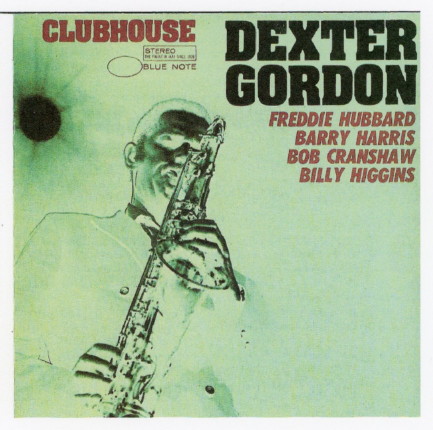
Recorded in 1965, but not released until 1979 following a discovery of this material by producer Michael Cuscuna, Clubhouse [LT-989/CDP 7 84445 2] is the second of three Blue Note recordings belately issued following Dexter Gordon’s 1961-1965 association with the label.


There’s more of trumpeter Freddie Hubbard on hand along with Dexter’s old running mate from California, Billy Higgins on drums, and first time pairings with pianist Barry Harris and bassist Bob Cranshaw.


Fortunately, Ira Gitler, who provided annotations when Dexter’s first Blue Note recordings were issued in 1962, was also available to write the insert notes for the tracks on Clubhouse which help place them in the larger context of Dexter’s recording career.


“When Dexter Gordon came to New York from Copenhagen in 1976 for appearances at Storyville (now Storytowne) and the Vanguard, he was given a hero's welcome. In 1965 his visit to Manhattan was not as widely celebrated. He had taken up residence in Europe in 1962, finally settling in Copenhagen where he became a fixture at the Club Montmartre and one of Denmark's favorite adopted sons. The series of albums he had commenced recording for Blue Note in 1961 - beginning with Doin' Alright (Blue Note 84077) - had put him back into the jazz listeners' consciousness but club owners weren't waiting in line to book him nor were customers standing patiently outside dubs in order to be able to catch his next show. Those who came, however, usually filled the club and left fulfilled, for to be present at one of Dexter Gordon's performances is to be in the presence of a preacher who disseminates messages of warm, love feelings and robust, witty celebrations of life (not expressions of undisciplined emotion). One usually leaves Rev. Gordon's temple in a state of exaltation.


Dex's physical appearance — tall, tan and handsome — has always been imposing. When his musical talent caught up to the edifice in which it was contained, a powerful combination was established.


I didn't hear him when he was with Lionel Hampton. His only solo outing in that band was as part of a tenor battle with Illinois Jacquet on a never recorded number called "Po'k Chops." I did see him in his Billy Eckstine and 52nd Street days at the Sunday afternoon jam sessions standard at the time. His charisma was as evident as the wide-brim hats he used to sport and his magnetism came through on those first Savoy recordings.


I didn't know him in those days but when he came from California to record Doin' Alright and Dexter Calling I did a feature on him for down beat. It was like a reunion with an old friend rather than meeting with someone for the first time. This wasn't completely unique for wherever Dex plays, old friends came up to greet him. Some actually know him; others are connected to him by his music. They are the people who grew up on the Savoy and Dial 78s. Now they are also the younger generation who have heard those sides on the LP reissues of the '70s.


Doin' Alright and Dexter Calling were followed by a string of excellent albums taped in the U.S. (Go! and A Swingin' Affair) and Paris (Our Man in Paris and One Flight Up). His 1964-65 trip to America produced Gettin’ Around with vibist Bobby Hutcherson. Little did we know that on the day before the Gettin’ Around date Dex, with Freddie Hubbard and the same rhythm section (Barry Harris, Bob Cranshaw and Billy Higgins), had done another session. Finding a Dexter Gordon album is like finding gold, even at a time when he is more than well represented on record. Whether it contains material done elsewhere (there are two such here) is not the point. It is the interpretation of that moment — what Dex was into at that particular time — that is important. Hubbard, one of the significant trumpeters to follow in the wake of Clifford Brown, wasn't always a star but he always could play. Some purists didn't care for his CTI period; others, more justifiably, have turned up their noses at his Columbia fusions. Whatever his current persuasion he remains a giant trumpeter. This unearthed outing should accommodate all his fans.


Harris, bearer, protector and enhancer of the bebop gonfalon, has persevered, enduring much job insecurity during the lean rock years, and triumphed as a recording leader in his own right. True to his musical ideals, he now occupies a position as a young elder statesman whose wise words and knowing notes are listened to by young as well as veterans.


Cranshaw has continued to be one of the most sought after bassists in the highly competitive New York arena. Sharp eyes can pick him out in the band on NBC-TV's "Saturday Night Live" but he's usually busy Sunday to Friday, too, in a variety of musical situations.


Higgins had already collaborated with Gordon several successful times before this recording. Hig is spirited as he is precise; as sensitive as he is swinging When the groove is really happening you can look to the back of the bandstand and see the big smile on Billy's face. His uplifting beat helps to make everyone else happy too.


Gordon's "Hanky Panky' could be subtitled "Chunky Funky" for its solid, bluesy, marching beat. Dex comes out stating a basic idea and then proceeds to elaborate and expand on it so he builds his solo, chorus by chorus. Hubbard also shapes his solo thoughtfully, alternating upward bursts with simpler phrases. There’s an implicit link to Louis Armstrong in his brassy brilliance. Then a relaxed Harris, sitting just behind the beat, seems to contemplate the scenery, commenting on it as it goes past his window at a comfortable pace.


Someone once wrote that Coleman Hawkins turned the saxophone into the "sexophone," and we've often heard Ben Webster's tone described as a "boudoir sound." Dex displays his romance/ sexuality on "I'm A Fool to Want You". Macho tenor yes, but for all to share in. Freddie with a hint of Nature Boy plays a tender, yearning solo before Dexter returns. Dig his friendly growl like a big tiger purring.


A winsome introduction by Harris leads into Gordon's "Clubhouse" a lithe, skipping Dameronian theme. The way it lays is arranged perfectly for commentary by Higgins and this is fully realized at the piece's conclusion. "Clubhouse's" harmonic structure allows for the most elegant, sophisticated bebop invention. Dex is at his suavest; Freddie fiddles fleetly; and Barry distills the Bud-Monk essence to its inevitable, logical beauty. Sometimes there are "perfect" solos and Harris' is just that. After Cranshaw picks one, Higgins gets a chance to swing into full play.


"Devilette", by bassist Ben Tucker, is a mixture of a "soul" feeling with a modal mood. It first reached record through Gordon in The Montmartre Collection for Black Lion in 1967 but this one was done two years earlier. Cranshaw and Higgins do not solo but they are a strong force throughout as they expertly underpin the principal soloists.


At this writing we don't know the composer of "Lady Iris B." [Rudy Stephenson] but it is a saucy blues with a Silver (Horace, that is) twist at its tail. Dex tips his cap to Pres along the way and Freddie is bluessential, as is Barry with Billy "sticking" it to everyone.


Dexter's beautiful ballad "Jodi" was first recorded by him in 1960 on The Resurgence of Dexter Gordon album for Jazzland and dedicated to his then wife. Dex has help from Hubbard and Harris (flashing a Monkish run) but he occupies center stage for the most part in this lovely portrait.


The Resurgence, produced by Cannonball Adderley, marked Dex's first recording in five years. Since that time he has surged and resurged, growing in grandeur with each successive tidal wave.


Like the others, this 1965 breaker is just right for ear-surfing.” 

— IRA GITLER (Jazz; Radio Free Jazz; Swing Journal)


Dan Morgenstern Sessions Notes from the Boxed Set Booklet -


(J) MAY 27,1965


“Back in New York (or rather, New Jersey, site of Rudy Van Gelder's marvelous studio), for a reunion with Freddie Hubbard and Billy Higgins and a first encounter with some other gentlemen of jazz. Pianist Barry Harris, born in


Detroit in 1929, got to play with practically everybody while in the house band at the famous Blue-bird Club, from 1951 on. He came to New York in 1956— the year of the "Detroit wave"—and worked with Max Roach, Art Blakey, Cannonball Adderley and Coleman Hawkins, also leading his own trios and a quintet with Lonnie Hilyer and Charles McPherson. Bassist Bob Cranshaw, born in Evanston near Chicago in 1932, started piano at 5 and bass in high school, worked in Chicago with pianist Eddie Higgins and his own MJT + 3, came to New York in 1960 with Carmen McRae and began a long association with Sonny Rollins in 1961. Like Harris, he'd been on Lee Morgan's "Sidewinder" session for Blue Note. Ben Tucker, who sits in on one number (his own), was born in Nashville in 1930, spent time in Los Angeles with Warne Marsh, Art Pepper and Chico Hamilton, and worked in New York with Billy Taylor and Herbie Mann; he wrote the hit "Comin' Home Baby," and later became involved in broadcasting.


HANKY PANKY, by Dexter, is a blues march that moves from minor to major and back. The tenor solo opens with a quote from the theme and becomes quite intense—Dexter even growls, a rare event. Hubbard, with strong chops, varies his phrases nicely, and Harris displays his clean, crisp touch, well backed by springy bass and drums.


Ben Tucker's DEVILETTE has its composer sitting in on bass. Dexter sails through his opening solo. Hubbard starts with a held note; his big, burnished trumpet sound is a pleasure to hear. Higgins works out behind him, taking risks but getting away with panache. Harris takes solo honors here with a spare, elegant, Powell-inspired turn, and then the theme, with its distinctive bass pattern, returns, the horns echoing each other. Typical hard-bop-cum-gospel 1960s fare.


Dexter's CLUBHOUSE bears the stamp of Tadd Dameron. Horns in unison, three fine choruses by Dexter, a slightly delayed entry but a good outing that ends as if he'd have liked to continue; two good ones from Harris, who thrives on this harmonic climate; a neat melodic-rhythmic turn by Cranshaw, and a tattoo by Higgins, who trades with the ensemble and adds fills in the ending.


JODI, a lovely Gordon ballad first heard in his 1960 "Resurgence" LP, is mostly tenor, but Hubbard takes the first bridge and Harris the second. Dexter is at his most poetic—languid yet buoyant. The cadenza is topped by a marvelous note.


I'M A FOOL TO WANT YOU, by Joel Herron and Jack Wolf, was written for and introduced by Frank Sinatra (who also contributed to the lyric.) It's a somewhat doleful lament, and Dexter captures that mood. He milks the bridge for all it's worth, tipping his cap to Coltrane. Hubbard's great here, as he picks up where Dexter leaves off, contrasting long notes and rapid flurries. When Dexter returns, he gives us one of his rare growls.


LADY IRIS B, by guitarist-arranger Rudy Stevenson, is one of those "Preacher-ish" pieces of the day. Dexter leads off the solos for three, followed by an equal number from Hubbard, who works well with Higgins here. Harris contributes a Horace Silver-flavored statement (he was briefly a Messenger,) and Cranshaw takes one before the theme recap. This was another session that remained on the shelf until the early '80s. It has its moments, but that special spark seems to be missing.”


Saturday, July 16, 2022

Dexter Gordon - "Gettin' Around" - The Blue Note Years Part 8

 © Copyright ® Steven Cerra, copyright protected; all rights reserved.


“Dexter Gordon is. ol course, the man who first created an authentic bebop style on the tenor saxophone He is also the man who profoundly influenced young John Coltrane (the roots of what became Coltrane's characteristic modality are plainly evident in Dexter's unusual and very personal harmonic accents) and, to a lesser but still significant degree, Sonny Rollins But above and beyond such historical credits. Dexter Gordon is one of the great players in Jazz, a man who makes music that is vital, direct and emotionally satisfying.”

- Dan Morgenstern


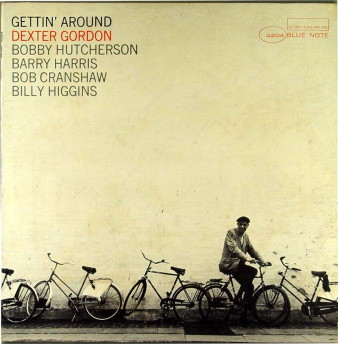
Although Dexter Gordon stopped recording for Blue Note after 1965, his relationship with the label didn’t end there as unissued tracks from his 1961 - 1965 contract period found their way into three new Blue Note recordings: 1967, Gettin’ Around [BST-84204]; 1979, Clubhouse [LT 989]; 1980 Landslide [LT-1051]. All three of the latter have been reissued on CD, both domestically and as Japanese imports. Perhaps one can conjecture that the latter two Blue Note albums were released to coincide with his triumphant return to the USA following a 14-year residency in Denmark.


The first of these - Gettin’ Around [CDP 7 46681 2] - was made up of tracks that were recorded in New York on May 28/29, 1965 and feature of group of [then] rising young stars: Bobby Hutcherson [vibes], Barry Harris [piano], Bob Cranshaw [bass] and Billy Higgins [drums].


Hutcherson’s appearance on these dates was particularly noteworthy as can be discerned in the following review by Richard Cook and Brian Morton in their The Penguin Guide to Jazz on CD, 6th Ed.


“One of the most engaging of Gordon's Blue Note recordings, Gettin' Around is also a showcase for the burgeoning talent of Bobby Hutcherson. Though the charts are relatively scant and unchallenging, the standard of performance is very high; Bobby's starburst patterns, executed round Harris's quiet and definite comping, are full of detail and excitement. The material is fairly basic and familiar, with just three Gordon compositions - not much more than blowing themes - tucked away at the end of the album. 'Manha deCarnaval' gets the record off to a breezy start, and the ensembles here are worthy of study; clean-lined, joyous and absolutely exact, yet with the spontaneity of a first take. Frank Foster's 'Shiny Stockings' was a favourite of the time with tenor players, and Dexter milks it enthusiastically.”


Ira Gitler is back to do the liner note honors for Gettin' Around and he offers the following information and insights:


“SINCE 1962 Dexter Gordon has been living in Europe. He has played all over the Continent but his European home has been Copenhagen, and that city's Club Montmartre his main base of operations. We in the United States have not lost contact with him, however, for several reasons. There have been Blue Note albums like Our Man In Paris (BN LP 4146) and One Flight Up ( BN LP 4176), recorded overseas but released internationally. 


Then each year at Christmas, Dexter sends his friends unique, personal holiday greetings. Last year's read, "Santa says, 'Make Glad The Heart'"; the 1965 message was "Santa says; 'Spreading joy in the neighborhood is easy to do and it feels so good!' Somehow you get the idea that Santa in this case is really Dex himself. The feeling that his playing imparts certainly is substantiating evidence.


At the end of 1964 Gordon visited the United States, played engagements on both coasts and in Chicago, and before returning to Europe in June 1965, left us with an LP that makes "glad the heart" and helps to "spread joy in the neighborhood!' He is supported by vibist Bobby Hutcherson, pianist Barry Harris, bassist Bob Cranshaw and drummer Billy Higgings. Support is quite the right word for although Hutcherson and Harris contribute solos, Gordon is the main man here. The others' solos are the condiments for Dex’s longer, meatier statements.


Side 1 is made up of two fairly recent popular songs and one tune that goes back quite a bit farther. Gordon's version of Luis Bonfa's Manha de Carnaval (Morning of the Carnival) from Black Orpheus is a bit slower than this bossa nova is usually played. Dex's sensual, expansive sound and languorous delivery immediately create a cloud to sink into and float on.Talk about being relaxed.


Gordon caresses Anthony Newley's Who Can I Turn To (not to be confused with Alec Wilder's song of the same title) as if he is holding a beautiful woman in his arms. His interplay with Hutcherson after Bobby picks up the melody statement is particularly moving.


On the old hit thatTed Weems mode famous, Heartaches, Dexter demonstrates how a great professional can insinuate a whole feeling just in the way he states the melody. He prepares you in definite but subtle ways for the harder swinging that is to come. The tempo is not that fast but Gordon can generate power at any speed. Hutcherson, showing his earlier Milt Jackson influence, and Harris have short but sweet solos before Dex returns with a clever quasi-quote from Deep In The Heart Of Texas - he has wit to match his heart - and brings everything to a climax with a dancing, delayed ending. Where Elmo Tanner whistled with Weems, Gordon wails with urbane heat.


Side 2 opens with an original by another fine contemporary tenor saxophonist, Frank Foster, While he was a member of the Count Basie orchestra Foster wrote Shiny Stockings and it has become a favorite of many modern musicians. (Pianist Jaki Byard uses it as his theme song.) The groove is an easy-swinging one here with Gordon, Hutcherson and Harris taking a chorus apiece. Dexter doing a reprise, and then out. There is absolutely no strain either in the playing or the listening.


Everybody's Somebody's Fool is a "blues ballad popularized by the first name band that Gordon ever worked with - Lionel Hampton - although it was first recorded in 1949, several years after he had left Hamp. Gordon strikes a wistful, late-hour mood, again bringing his beautiful tone into full play. Harris contributes an appropriately dreamy interlude. When he returns, Dexter makes a reference to Don't Explain - perhaps by design, or by accident.


Dexter's only written contribution to the session is a light, bouncy line called Le Coiffeur* (The Hairdresser). I wonder if he had someone specific in mind when he wrote this, To open his improvisation Gordon makes obvious but effective use of the written line and proceeds to employ rhythmic figures that echo the piece's structure.This adds a sense of unity to the whole track and Hutcherson and Harris stay with the character that has been established.


I think it is evident that the supporting cast was with Dexter all the way in this album. He set the tone and they fell right in with him. Since he is an expatriate it is not often that the New York-based musicians receive a chance to play in his company. Gordon's charm and musical inspiration make his company both delightful and stimulating. With albums such as this Santa Dex is able to disseminate his Christmas messages all year long.”

IRA GITLER


*Very Saxily Yours [ a phrase Dexter uses to close his letters] and Flick of a Trick are two other originals brought to the date and these are included on the CD reissue and the boxed set.


Dan Morgenstern Sessions Notes from the Boxed Set Booklet -


(K) MAY 28,1965


Just a day later, with the same rhythm team, but vibist Bobby Hutcherson taking Hubbard's place. Born in Los Angeles in 1941, Hutcherson became interested in jazz at 15 when he heard Milt Jackson on "Bemsha Swing." He bought a set of vibes, got some musical instruction from pianist Terry Trotter, and vibes pointers from Dave Pike. Work with Charles Lloyd and Curtis Amy preceded his 1 962 arrival in New York with the Billy Mitchell-Al Grey group; In 1963, he joined Jackie McLean's quintet with Grachan Moncur and Tony Williams, recording "One Step Beyond" for Blue Note. He became an important regular at the label, recording with everyone from John Patton to Joe Henderson to Eric Dolphy and Andrew Hill. A master musician, he recorded on his own for the label for more than 20 years.


LE COIFFEUR is a relaxed, playful Dexter original with a French flavor. The tenor-vibes unison works well on the theme statement. Dexter's solo starts with a break that quotes from the theme; he's in a laid-back mood. Hutcherson offers a melodic chorus, and Harris makes a lot happen in his 32 bars.


MANHA DE CARNAVAL was one of the first bossa nova hits, via the film "Black Orpheus." Dexter takes Luis Bonfa's catchy theme slightly slower than the customary—a very deliberate tempo. Tenor and vibes unison again works well. After Dexter's two plaintive choruses, an interlude sets up Hutcherson, who seems very much at home with the tune, and the interlude is repeated to launch Harris. He starts with a single-note line in the bass, adds harmony, and ends with a vamp—a lucid statement.


FLICK OF A TRICK, another Ben Tucker blues, this time at a slower tempo, is highlighted by Dexter's long sermon —he can preach a while! Barry also is deep into the blues, and Hutcherson, his approach to the blues not surprisingly touched by Bags', does some special tremolo things. A straightforward Cranshaw solo precedes the fade out of the theme. This remained in the can until the 1988 CD release of the album.


EVERYBODY'S SOMEBODY'S FOOL was introduced by Little Jimmy Scott on a Lionel Hampton record in 1950 and remained in the singer's


(L) MAY 29,1965

The same cast was reassembled for Dexter's third consecutive day of recording. There would have been no reason to change it since everything was going down muy simpatico.


Onzy Matthews' VERY SAXILY YOURS had been attempted the day before but comes off well here, though it wasn't issued at the time. Dexter starts his solo with a Yankee Doodle break; he's inventive and rocks in rhythm. Bobby and Barry split one, and Dexter takes over the final bridge.


SHINY STOCKINGS, Frank Foster's classic, is taken a hair slower than Count Basie's chosen tempo. Dexter again launches himself with a break, sure footedly. There are pleasant contributions from vibes and piano, and then Dexter takes another helping, enjoying the changes. The opening eight of this piece fit the standard "I Wish I Knew," but the rest is all original.


WHO CAN I TURN TO, the big hit from Anthony Newley's score to ”The Roar Of The Greasepaint—The Smell of the Crowd," was less than a year old when Dexter tackled it. A nice opening—Dexter, rubato, with just Barry, then the others joining in tempo. That tempo is s-l-o-w, but Dex keeps it out by himself, fashioning a fine finale.


HEARTACHES, a 1931 chestnut by Al Hoffman, introduced by Guy Lombardo and resurrected and turned into a hit by Ted Weems (with Elmo Tanner's whistling) in 1947 (he'd also waxed it in 1933,) may seem a surprising choice for Dexter, but he may have encountered the 1961 hit version by the Marcels, or simply liked the non-AABA structure and easy melody, characteristics that lend themselves to the bossa nova treatment he gives it. He comes in swinging after the vamp intro — debonaire, and again breaks into his solo, and again uses the break device for his second chorus. By the third, you can tell he enjoys the melodic-harmonic and rhythmic motion. Hutcherson's turn is underscored by Higgins' punctuations, and for Harris, Hig comes up with rimshots on the afterbeat. Dexter's re-entry is humorous, and then he tags it a la Stitt, getting his kicks and giving us ours, like he always did.”


-DAN MORGENSTERN June 1996