Showing posts with label Bud Shank. Show all posts

Wednesday, February 2, 2022

The Flute in Jazz and Buddy Collette's Swinging Shepherds

 © Copyright ® Steven Cerra, copyright protected; all rights reserved.


“All in all, the Davis [Birth of the Cool] Nonet was much like a band of apostles, gathered together for a brief time before scattering in their several separate directions, each inspired to proselytize others in turn ….


Although the [West Coast Jazz] movement was never as monolithic as the term suggested, a certain convergence of aesthetic values could be seen in many of the West Coast recordings. The music was often highly structured, rebelling against the simple head charts of East Coast modern jazz and reflecting a formalism that contrasted sharply with the spontaneity of bebop. Counterpoint and other devices of formal composition figured prominently in the music. Larger ensembles — octets, nonets, tentettes — continued to thrive in West Coast jazz circles, long after they had become an endangered species elsewhere. Unusual instruments were also embraced with enthusiasm, and many of them — such as flute and flugelhorn — eventually came to be widely used in the jazz world. Relaxed tempos and unhurried improvisations were frequently the norm, and the music often luxuriated in a warm romanticism and melodic sweetness that was far afield from the bop paradigm.”

- Ted Gioia, The History of Jazz


This feature is an extension and an elaboration of Ted’s comment in the above quotation regarding the role of the flute in Jazz and how the eclecticism and experimentation that was a keynote of Jazz on the West Coast helped to establish the instrument in Jazz in general. 


Christopher Washburne offers the following synopsis of the flute in Jazz in the following excerpt from his essay Miscellaneous Instruments in Jazz in Bill Kirchner, ed., The Oxford Companion to Jazz [2000]:  


Musicians create jazz in innumerable ways, and at times have defied orthodoxy by developing their voices on instruments that have not attained a prominent role in jazz. 


The flute was used only sporadically in early jazz styles; its popularity, however, has steadily grown throughout this century. Way-man Carver, who performed with Benny Carter and Chick Webb, is known as the first jazz flutist. In 1953 he recorded one of the earliest flute solos on Carter's "Devil's Holiday" (Columbia). Webb's 1937 recording of "I Got Rhythm" (Decca) is particularly representative of Carver's work. It was not until the 1950s that the flute's use became widespread, due in part to the interest of several saxophonists—-known as "doublers," for their ability to play a variety of woodwind instruments-—to play jazz on the instrument. 


The doublers active in the 1950s who became noted as accomplished flutists include Frank Wess, James Moody, Yusef Lateef, Buddy Collette, and Bud Shank. Wess, a saxophonist with the Count Basie orchestra (1955—64), was one of the first popularizers of the instrument. His warm, breathy, rich sound and virtuosic ability are heard on the 1955 Basie recording "Midgets" (Verve). James Moody's approach to flute soloing favored a beautiful clear tone and cleanly executed virtuosic melodic lines. One of his most remarkable solos is heard on his recording of "Cherokee" (Milestone). Lateef explored more unconventional approaches to playing the instrument and popularized the multiphonic technique of simultaneously singing and playing. A good example is heard on Lateef's 1957 recording of "Take the 'A' Train" on The Sounds of Yusef Lateef (Prestige), where he alternates between playing a conventional bop solo and multiphonics. In 1958 Buddy Collette was the first to record all the instruments of the modern flute family (piccolo, flute, alto, and bass), on Buddy Collette's Swinging Shepherds (EmArcy). Bud Shank was an important figure in West Coast jazz of the 1950s, playing with Howard Rumsey's Lighthouse All-Stars. His 1954 recording with Laurindo Almeida, Brazilliance (World Pacific), captures his soloing style.


Other notable doublers include Eric Dolphy, Rahsaan Roland Kirk, Joe Farrell, and Lew Tabackin. Dolphy played flute in modern and free jazz settings. His work with Chico Hamilton on the 1958 recording Gongs East (Warner Bros.) showcases his expressive soloing style. Roland Kirk explored more unconventional playing styles utilizing multiphonics and circular breathing extensively. In addition to playing the modern flute, Kirk performed on a variety of wooden and ethnic flutes. His 1964 all-flute album I Talk With the Spirits (Limelight/Verve) showcases his abilities. Joe Farrell was a member of Chick Corea's Return to Forever, a group that fused Brazilian and Latin musics with contemporary jazz. Their 1972 recording Return to Forever (ECM) includes several extended flute solos, capturing Farell's light, clear, and vibratoless tone. Lew Tabackin has been a featured soloist with the Toshiko Akiyoshi Big Band and his own groups since the 1970s.

Musicians who are known primarily as flutists include Sam Most, Herbie Mann, Hubert Laws, Jeremy Steig, and James Newton. Most's first recording as a bandleader (1955), The Sam Most Sextet (Prestige), firmly established him as the first bop flutist. 


Herbie Mann was the first jazz musician to establish his career performing only on flute. Although versatile in many jazz styles, it was with his jazz-rock playing and his explorations into Latin music styles in the 1960s and 1970s, well represented on his 1968 recording Memphis Underground (Atlantic), that he attained his greatest popularity. Hubert Laws also plays flute exclusively and is accomplished in both the jazz and classical styles. His 1964 recording The Laws of Jazz (Atlantic) demonstrates his large and refined tone and impeccable intonation. Jeremy Steig was active in jazz-rock and other modern jazz settings. He favored an approach to soloing that often included the use of vocalizations; his work on Bill Evans's 1969 recording What's New (Verve) is illustrative of this. James Newton, inspired by Eric Dolphy, has been active in avant-garde and other settings since the late 1970s; his 1981 album Axum (ECM) is a good introduction to his work.”


Thanks to a disc jockey friend of the family who hosted a very successful popular music AM radio show, whenever our families got together, I was able to choose from “anything along the living room wall” a stash which usually consisted of preview Jazz LPs that would never get airplay on his radio show.


To my good fortune, one of these hauls contained an album with four flutists dressed as monks on the cover, three of whom [Buddy Collette, Bud Shank and Paul Horn] I had heard play the instrument in other settings while one [Harry Klee] was new to me.


The recording just clicked with me [I think today’s phrase is “to resonate with”] and I’ve been a fan of the instrument in a Jazz setting ever since.


And it would appear that I’m not the only one with whom the album resonated.


Buddy Collette's Swinging Shepherds 1958 LP must have been somewhat of a success as there was a sequel issued the following year entitled Buddy Collette and His Swinging Shepherds al the Cinema.


Both of these recordings have been combined on one CD in the Jazz City Series on Fresh Sound Records FSR 2258 and you can locate order information by going here.


Nat Hentoff’s Original Liner notes from the 12" album

Buddy Collette's Swinging Shepherds (Mercury SR 80005 stereo/ME 36133 mono)


“During the short but fervent recent struggle of jazz flutists to be admitted into the legitimate company of jazz instruments, the usual charge leveled against the flutists (who finally won) was that the instrument had so slight a tradition in jazz history.


Had the flutists, however, wanted to throw historical weight around, they might have pointed out that if tradition is the criterion, there have been funky flutes on the earth for many more centuries than such neophytes as the tenor saxophone or the vibes. Or, as Grove's Dictionary of Music and Musicians puts the case, "a visit to any representative ethnographical collection will show that the flute in some form or another is known and loved by primitive tribes all over the world." It's hard to get any more basic than that.


Actually, within jazz itself, the flute is not without some history. Wayman Carver was playing solos on flute with Chick Webb at least as early as 1937, and his work, as I had occasion to rehear during the past few months, was far from "novelty" playing. His solos swung and had a good jazz conception.


Another of the earlier jazz shepherds was Harry Klee of this present assemblage, who recorded Caravan with Ray Linn in the early '40s, was with Boyd Raeburn in the mid '40s on alto saxophone and flute, and was heard on flute in a Mary Ann McCall set in the early'50s.


The fully-committed march of the flutes into jazz, however, did not begin to shape up until about 1954. Herbie Mann and Frank Wess in the east and Bud Shank on the west coast began to demonstrate marked affection for the instrument and a degree of idiomatic jazz facility with the horn. More and more recruits were added until in the 1957 Down Beat Readers Poll—in which a separate flute category made its second annual appearance—there were 13 candidates who received enough votes to be listed.


Buddy Collette, the leader of this four-way flute album (possibly the largest single assemblage of flutists yet gathered on one jazz date), has had a considerable share in accelerating the acceptance of the flute in jazz by his work when he was with Chico Hamilton and by his recordings.


Among his converts, for example, is Edgar Jackson of the stately British Gramophone, who wrote recently of Buddy; "If my personal preference is for his flute playing it is probably because I find his tone more attractive than that of any other jazz flutist." "Versatility has been the downfall of many jazzmen, but Collette seems able to make the switch from one instrument to another with the utmost ease and without the tone of any one suffering. Always graceful, he has a flair for melody,"


William Marcell (Buddy) Collette was born in Los Angeles, August 6, 1921. He began on piano at 10, added the alto at 12, and headed his first band that year with sidemen Charles Mingus and Britt Woodman. He accumulated the clarinet at 14, went to Jordan high school, and during his last year there (he was leader of the school dance band) he began studying theory with Floyd Reese. A classmate at Jordan, by the way, was Joe Comfort, the bassist on this session.


After some professional experience in and around Los Angeles, Buddy served in the navy for 3 and half years, eventually becoming leader of military and dance units therein. He formed an all-star band in 1946 that included Mingus, Woodman, and Lucky Thompson; and later worked with, among others, Edgar Hayes, Louis Jordan, Benny Carter, and Gerald Wilson.


Starting with Jerry Fielding on the Groucho Marx Show in 1950, Collette has been in ubiquitous demand in west coast radio, TV, and recording studios. He also played for a time on tour with the Chico Hamilton quintet.


Buddy had started studying at the Los Angeles Conservatory after his 1946 band broke up, and it was there he began on the flute. He later did advanced work with Martin Ruderman and Henry Woempner while continuing his study of the other reed instruments and theory.


In addition to Harry Klee, long established in Hollywood studios, Buddy's flute associates in this session include Bud Shank, the Kenton alumnus, who is also known on alto and in recent months, has begun considerable concentration on tenor. Paul Horn is also multiple-skilled (alto, clarinet, piccolo, flute, alto flute) and became generally known in the jazz field when he replaced Collette with Chico Hamilton in September, 1956, after a previous term with the Sauter-Finegan orchestra. He has since left Chico to settle in Los Angeles,


As for the program, Buddy wrote the melodically animable Flute Diet with Bud Shank on alto flute and the rest on C flutes. Short Story is also Buddy's, with Horn and Shank on alto flutes, Klee on bass flute, and Buddy on C flute. It's a reflective story and illustrates again Buddy's skill at constructing quickly ingratiating melodies. Pete Rugolo wrote the tribute to Machito in which the opening alto flute solo is by Harry Klee. There is doubling to piccolos by members of the confraternity later in the number.


The pastoral Improvisation with conga drum opens with overtones of Ravel and involves Buddy on C flute, Horn on piccolo, Shank on alto flute, and Klee on bass flute. It was "done right on the spot," notes Buddy, "with one take." Pony Tale is by Paul Horn (all the composers, incidentally, arranged their own works) and utilizes three C flutes and one alto flute.


The Funky Shepherds (perhaps a redundancy) is by Bud Shank with two C flutes, an alto flute and one bass flute. Tasty Dish is Collette's with all the front line this time playing C flutes. The second Improvisation is without rhythm section and indicates the viability of the flute even in such multiple consanguinity. The closing The Four Winds Blow is by Paul Horn, and for the second-time in the album, all four are C flutes.


Thus endeth the flute seminar, a presentation in four-fold force of the thesis that the flute, like any other instrument, has the capacity to be part of the jazz species. It's not the instrument, after all, that determines eligibility; it's the player.”

—Nat Hentoff


John Tynan’s original liner notes from the 12" album sequel - Buddy Collette and His Swinging Shepherds al the Cinema (Mercury SR 60132 stereo / MG 20447 mono]


“In this set of songs and themes from 11 Hollywood Flickers, Buddy Collette's "Swinging Shepherds" (Bud Shank, Paul Horn and Harry Klee) combine with the leader to produce by pen and assorted flutes one of the freshest albums of movie tunes to come along in a month of cliché-ridden Sundays.


Until the release of Buddy Collette's Swinging Shepherds (Mercury MG 36133), the flute in jazz had generally been utilized in solo context. Then came the Shepherds with their unique arrangements for a quartet of flutes, blowing free and off-the-chart modern jazz as the mood dictated.


Little need be added to Nat Hentoff's comprehensive summation of the action and the personnel on the first album except to note that Collette, Horn, Shank and Klee (and, of course, the worthies in the rhythm section Bill Miller, piano, Joe Comfort, bass, and Bill Richmond, drums and conga) continue to reign supreme on their instruments in the west coast jazz sphere. All remain top studio musicians on many of the most popular television programs, motion pictures and records.


In this album, where the instrumentation is of such complexity and variability, it would appear worthwhile to list the different flute voicings and order of solos. Bassist Red Mitchell is present on all the tracks; piano and drum chores were split between Bill Miller and John T. Williams (on piano) and between Shelly Manne and Earl Palmer (on drums). Jim Hall is on guitar.

So far as the flutes are concerned, suffice to say that confusion may seem the order of the day to the casual listener. But, for the assiduous fan, here is the track-by-track breakdown:


Colonel Bogey, a light, sprightly treatment of the Bridge on the River Kwai theme (composed as a military march by K.J. Aldford and adapted for the film by Malcolm Arnold), was arranged by Bud Shank. It's very tongue-in-cheek and cheerful and is scored for Horn and Shank on E flat flutes before a switch which casts Shank on the solo C (or "regular") instrument with Collette, Horn and Klee manning an alto flute apiece behind him. Collette has a brief statement on alto flute, and the piano soloist on this track is Bill Miller. Earl Palmer is on drums.


Laura spotlights the bass flute work of Harry Klee and Pete Rugolo's richly colorful arrangement of this David Raksin composition for the Gene Tierney-Dana Andrews picture. Note the startling key change as the bass flute enters to state the theme after the C flute introduction. There is a sinuous Latin beat behind the two-part writing for the C and E flat flutes of Shank and Horn, respectively. If you listen carefully it is easily discerned that Shank is quite close to the mike here. Soloist is Collette.


Smile, the poignant theme in Charlie Chaplin's Modern Times is here given a medium-up, swinging treatment by Collette, who arranged it for two C flutes (himself and Klee) and two altos (Shank and Horn). Collette has the lead in the ensemble section before guitarist Jim Hall's fine solo, then returns to take the first flute solo. Horn plays the second flute solo, followed by Bill Miller on piano. Note on the final chorus the big, fat ensemble sound achieved by Collette in his section writing for the four flutes. Shelly Manne is on drums.


The Bad and the Beautiful, one of the most haunting movie themes of all time, is another David Raksin composition for the film of the same name starring Lana Turner and Kirk Douglas. In the picture, it may be recalled, the first full soundtrack statement of the theme was played by trombonist Si Zentner as a "mood catcher'" for actress Turner. Here the blue legato feeling is sustained in Paul Horn's sensitive arrangement for his own C flute, the altos of Shank and Collette and Klee's bass flute. Note Jim Hall's effective downward guitar slur which ends the introduction, effectively preparing the listener for the mood to follow.


The Shrike, composed originally by Pete Rugolo for this film, is the only number here arranged by the original composer. It is appropriately eerie, but swings in medium tempo to Shelly Manne's drums. A high spot of this arrangement is Horn's piccolo performance, on which instrument he doubles with the alto flute; Collette is on C flute. Shank on E flat and Klee on bass. Rugolo's reputation for "far out" writing certainly is not belied here. Note in particular the manner in which he achieves unusual tonal color by manipulating instrumental voicings; e.g., the flutes, piccolo and piano toward the close manage to suggest an almost "Moonlight Sonata" feeling. Williams is on piano.


I Can't Believe That You're in Love with Me, by Clarence Gaskill and Jimmy McHugh, has been featured in a number of films, most recently in The Caine Mutiny. Always a good tune for jazz blowing, here it skips happily under Bud Shank's pen through 16-bar exchanges between the four flutists. First comes Shank, then Collette, then, finally Klee. Red Mitchell's brief but excellent string bass solo precedes a riding ensemble exercise on the final chorus.


The Trolley Song summons sentimental memories of a young, fresh Judy Garland in the picture Meet Me In St. Louis. Buddy Collette's interpretation of the Hugh Martin-Ralph Blane tune features the C flutes of himself and Klee and the altos of Shank and Horn. After motorman Earl Palmer clangs into up tempo, Klee takes the lead, then drops an octave on the first bridge. Note Bill Miller's economical and intelligent piano solo here.


Intermezzo inevitably recalls to the imagination a very young, refreshing Ingrid Bergman and the late Leslie Howard. The romantic theme is sentimentally handled by arranger Pete Rugolo who wrote for two C flutes (Collette and Shank), alto (Horn) and bass (Klee). Horn opens, followed by Collette, and Klee's is the final voice.


Ruby arranged here by Buddy Collette, was composed as a theme for the film of the same name by Mitchell Parrish and Heinz Roemheld. Guitarist Hall opens with a statement of the melody line backed by The C flutes of Collette and Horn and the altos of Shank and Klee. Following Bill Miller's piano solo, Mitchell enters for a 12-bar bass statement before the flutists command for a series of 8-bar breaks: Horn is first (note his flutter), then Klee; Collette follows and, finally, Shank. Drummer Palmer sends the ensemble riding home to the coda.


Invitation is another movie title tune — this time composed by Bronislau Kaper — was arranged by Paul Horn for his own alto flute lead, the C flutes of Collette and Shank, and Klee's bass. With drummer Palmer playing stick against tom-tom shell and guitarist Hall plinking a bongo effect at the bridge of his instrument, an exotic rhythmic pattern is achieved behind the flutes. Bill Miller is heard in a brief and tasteful piano interlude, and the piece closes with a high C flute note by Shank.


Would You Like to Swing on a Star will be remembered as the musical query posed by Bing Crosby in Goin' My Way. Composed for the film by Johnny Burke and Jimmy Van Heusen, this version was arranged by Paul Horn for three C flutes and Klee's alto. Solos by all four are on the C instrument and the order is Horn, Collette, Shank and Klee. There's a wild flurry of flutes before Red Mitchell steps in for a short solo, inviting the Shepherds to pipe the album back to the fold after an uncommonly happy gambol.”


Friday, May 10, 2019

Bud Shank: Part 2 - by Gordon Jack

© -Steven Cerra, copyright protected; all rights reserved.


“The Jazz improviser …  is in a very pure sense, a creator of melodies. In common with any composer, he is constantly making decisions which will determine not only the outcome of a given line but its overall effect on the sensibilities of his listeners.

… the improviser’s decisions are extempore, made on the spot. There is little opportunity to try out a given pattern in a given situation, giving it a dry run, then rejecting it and moving on to another if it fails to please ear and sensibilities.

The possibilities are all but limitless, as are the chances of a misstep, a choice which, though harmonically and technically sound, will break the spell, snap the thread, brings things irremediably to earth.”
-Richard Sudhalter

“[Although] he has appeared on numberless sessions, Shank’s playing has remained sharp, piercingly thoughtful and swinging in a lean, persuasive way.”
- Richard Cook and Brian Morton, Penguin Guide to Jazz on CD – 6th Ed.:

© -Steven Cerra, copyright protected; all rights reserved.                                                 

Gordon Jack is a frequent contributor to the Jazz Journal and a very generous friend in allowing JazzProfiles to re-publish many of his descriptive and discerning writings on these pages.

Gordon is the author of Fifties Jazz Talk An Oral Retrospective and he also developed the Gerry Mulligan discography in Raymond Horricks’ book Gerry Mulligan’s Ark.

The following article was first published in Jazz Journal on May 1998.

For more information and subscriptions please visit www.jazzjournal.co.uk
                                                              
© -Jazz Journal - Gordon Jack, copyright protected; all rights reserved; used with the author’s permission.  


“Clifford "Bud" Shank was born in Dayton, Ohio, on May 27, 1926, and his primary instrument is the alto saxophone, although for many years he doubled very successfully on the flute. During the fifties he made several fine recordings on the baritone, and none better than a 1954 Chet Baker L.P, where he fashioned a lyrical solo of quite exquisite beauty on "I'm Glad There Is You. "  We met in July 1995, when he was appearing at London's Pizza Express, and I began by asking him why he no longer played the baritone.

That was such a short period in my life because it was never an instrument that fascinated me. I was always attracted to the alto saxophone, and any explorations on the tenor, baritone, or even the flute were just sidetracks. The alto was always my main thing. The reason why my recordings on the baritone came off so well was because I really didn't care; I just picked up the horn and played it without getting too involved. It was the same thing about ten years ago when I stopped playing the flute. I woke up one day and asked myself what I wanted, and I realized that all I ever wanted to be was an alto saxophone player, so I put the flute in the case and it hasn't been out since, which doesn't please Linda, my wife. All my flutes are in a safe deposit box, and I will probably start selling them soon. There's a lot of money invested in them, so why not? Bill Perkins has my Conn tenor and Conn baritone, which he borrowed for a recording date.

To start more or less at the beginning, I auditioned for Stan Kenton at the Capitol Records studio in L.A. in 1949, thanks to a recommendation from Buddy Childers. Stan had a whole sax section set up, with parts that included woodwinds, and it was actually my flute playing that got me the job. He had already hired Bob Cooper, Art Pepper, and Bob Gioga, so the only open spots were lead alto doubling flute and second tenor doubling bassoon. He kept alternating both chairs with several players until he settled on Bart Caldarell and myself, and that was the only time I auditioned for anything in my life.

On the road, Art played all the alto solos because that was his job and mine was to lead the section. As you know, it was a very loud band, not just because of the ten brass but also because of the way it was written, and when I first joined during the "Innovations in Modern Music" period, there were two French horns and a tuba in addition to all that other lovely noise. It was thrilling, though, to hear that mass of sound behind you, although I don't know if anybody actually heard the saxes when the brass were playing. I was on the second recorded version of Bob Graettinger's "City of Glass," which I thought was marvelous, and still do -and even today, people don't realize how great that piece really was.

Bob's girlfriend was Gail Madden, and she was also Gerry Mulligan's girlfriend too. There were some others that used to hang out with them, and they were all a bunch of free-thinkers, especially Graettinger, Gail, and Gerry. They didn't think or act like anybody else. But Gerry, being Gerry, was able to survive in the everyday world, whereas a lot of that group just kept right on going! Graettinger died in 1957, and those of us who knew him felt that it was from a broken heart, although he had physical problems as well. He never found anyone to really understand him, and although Gail used to minister to him, she was just as out of it as he was. They weren't married, but she took her name from a tenor player called Dave Madden, who was also pretty strange.

She and Graettinger lived together, and Gerry and Dave were involved: just one, big, happy, funny family! I don't know all the inside details. and I probably wouldn't relate them if I did, because they must have been pretty odd. As far as Gerry was concerned, he cleaned up his act and very soon got a handle on reality, and even after all these years, he is still playing marvelously. Getting back to Kenton, I think the best album he ever did was Contemporary Concepts, with the Bill Holman and Gerry Mulligan arrangements. The peak was reached with that band and that writing.3

After I left Kenton in 1952, I worked in a group fronted by a drummer called George Redman. We played rhythm 'n' blues six nights a week for about a year around a circuit of L.A. clubs, and it was just me on alto and tenor with a rhythm section. Occasionally, Maynard Ferguson and Bob Gordon would play with us, and if I couldn't make it, Bill Perkins used to sub for me. Bob Gordon was my closest personal friend. He was a great person and a superb player, and it was a terrible loss to the music when he was killed in 1955. I also used to dep for Herb Geller and Joe Maini at a burlesque club called Duffy's Gaiety, where Lenny Bruce was the M.C. I was a fan of Lenny's because he was hilarious, but I didn't hang out with him like Herb and Joe, who had a free seat every night.

While I was with George Redman, I also made some rhythm 'n' blues records with "Boots Brown" and his Buddies. Not everyone knows this but "Boots Brown" was actually Shorty Rogers, who was recording that material for a laugh. It was just a put-on, and I'm probably letting some tales out of the closet here, but there were some very good players on those dates, like Zoot, Gerry, Marty Paich, Milt Bernhart, and Jimmy Giuffre - good musicians playing pretty raunchy music, but doing it well. It all started with a piece that Jimmy wrote for the Lighthouse All Stars called "Big Boy," which was a takeoff of the sort of thing the Lionel Hampton band used to do. Jack Lewis, the record producer, asked Shorty to write some more material in that style, and we got to make quite a few records with "Boots Brown."'

During 1953 when Gerry and Chet were at the Haig, I played there on Mondays, which were the off-nights, with Laurindo Almeida, Harry Babasin, and Roy Harte. The Haig was where that group with Laurindo was born, and it was Harry's idea for us to get together. We used to rehearse in Roy's drum shop, and after about six Monday nights, we made that first record for Pacific Jazz.' I also played on Mulligan's tentet album in '53, which is when I recorded my first alto solo, on "Flash."' Chet was on the date, and he could certainly read music, though not as fast as everyone else. During the fifties I worked a lot with Claude Williamson at the Lighthouse, and when I left there, Claude came with me. We toured Europe and South Africa and stayed together until about 1958. Later on in the sixties, he did a lot of television work as a rehearsal pianist on shows like Sonny and Cher. Both Claude and his brother Stu, who was a marvelous trumpeter, had personal problems, but Claude is beginning to resurface as a jazz player and is recording again. Unfortunately, Stu gave up playing, and before he died a few years ago, I believe he was driving a truck. I knew them both very well and was very close to them in the fifties.

In 1958, along with Art Farmer, Gerry Mulligan, Frank Rosolino, Pete Jolly, Red Mitchell, and Shelly Manne, I played on Johnny Mandel's first film score for the Susan Hayward movie I Want to Live.  I recently taped it off the T.V., but I couldn't watch it all because it's so depressing. The group played in some nightclub scenes, and our set was next to the gas chamber set where the Susan Hayward character was executed at the end of the film. It was right there while we were playing, just made out of plywood, but it looked awful! I also did the writing for a couple of films myself: Slippery When Wet in 1959, which was a surfing film, and Robert Redford's first movie, War Hunt, in 1961.

In the fifties there was a long stretch when I was very close to Frank Rosolino  - and what a player he was, just fabulous. When he was doing all that fast playing, the slide didn't seem to be moving; somehow it was all done with his lip and tongue. I remember, at the Lighthouse, he always sang at least one number every night where he would be yodeling and doing all those crazy things, and the crowd loved it, as did the band, because he was a very funny guy. I didn't see him very much towards the end, before his suicide in 1978, because he never made it much as a studio player like the other jazz musicians. It's horrible, dumb music, and he would have found that kind of work very difficult, especially as you spend a lot of time just sitting there, doing nothing.

None of that would have impressed Frank, who was so active and always bubbling around. He was probably not playing that much jazz in the seventies, which might have been part of the problem. He'd also been through a couple of wives, but shooting his kids and then killing himself was a dreadful shock. The whole thing was scary, because he was torn up inside, despite the front he presented of all humor and fun. He was a proverbial clown, like Pagliacci; a very sad clown, but nobody knew it. One of his children survived in a terrible state and is supported by an organization called "Musicians' Wives Inc.," which my former wife was instrumental in starting.

From about 1960 to 1963, I often played at the Drift Inn in Malibu, usually, with Carmell Jones, Dennis Budimir, and Gary Peacock. Dennis and Gary were very adventurous, especially in their conception of time, and being the early sixties it was a little early for that, so I used to hire some very straight ahead drummers to keep it all together. I didn't want to tell them to cool it. because I wanted them to have their freedom. So the drummers tended to vary, but more often than not, we had Frank Butler with us. Lee Marvin used to come to the club all the time, as did a lot of movie people, because many of them lived in Malibu. We recorded for Richard Bock in 1961, and although  I only played alto with the group at the club, Dick wanted me to play baritone on a couple of numbers, because I had just come second in the baritone section of the Playboy Readers' Poll. We used Mel Lewis on the album because. on the morning of the date, Dick Bock telephoned to say that our drummer had just been busted, so I said, "Get Mel, real quick!" That was the last jazz record I made for a long time, because right after that our music seemed to disappear; it was the end of that era.

In January 1966 Duke Ellington came out to Hollywood to record the music he'd written for a Sinatra film called Assault on a Queen. I was playing in L.A. with Stan Kenton's Neophonic Orchestra at the time, and we were doing monthly concerts of new material which actually featured me quite a lot.  Duke came to one of the concerts and asked me to join his orchestra on lead alto. Of course I was very flattered, but I wasn't in a position to leave L.A. at the time, and with the difficulties jazz was having, it wasn't a good time to be on the road with any band, even Duke's. I also had some family problems that would have made it difficult for me to be away, and I was just getting established in the studios, doing the better work. For the film score he had a nucleus of his own sidemen, like Cat Anderson, Cootie Williams, Jimmy Hamilton, Johnny Hodges, Paul Gonsalves, and Harry Carney, supplemented local studio players, Conte Candoli, Al Porcino, Milt Bernhart, Buddy Collette, and myself."

During the sixties a lot of young people, who were the potential new audience for jazz, were attracted to groups like the Rolling Stones and the Beatles, and the older listeners had become put off by some of the experimentation that was going on then. Eventually John Coltrane reached a level that wasn't accessible to the public, or even to other musicians, because the world wasn't ready for it, which is why we haven't had a Messiah since. Everything now has gone backwards with all this "return to the fifties" stuff, because with Coltrane we had gone as far as we could. The jazz-buying public wanted to go back and pick up the pieces, so guys like myself have been given a second chance. Historically we had gone from Louis Armstrong to Lester Young and Charlie Parker to John Coltrane in fairly quick jumps, but we've been in this retrospective phase now for about thirty years, which has never happened before. In the mid seventies, when we put the L.A. Four together, it was like putting your toe in the water, since Shelly Manne, Ray Brown, and I hadn't worked as jazz players for about ten years. We were a chamber jazz group rather than a straight-ahead jazz group, but it turned out that there was still an audience out there. That was when I phased myself out of the studio scene, because the more I was out of town, the less the phone rang. Soon they didn't bother to call at all, which was fine with me, since I didn't want to do it anymore.

One of my CDs that has recently been released, although we recorded it back in 1993, is New Gold, and it has Conte Candoli, Bill Perkins, and Jack Nimitz in the front line, who are old friends. We had a piano-less rhythm section, with John Clayton on bass and Sherman Ferguson on drums, and playing without the piano gives you a lot of freedom. It's easier to get into the altered notes of a chord, because you don't conflict with the pianist, but you must pay attention. Before we made the CD, we worked a few jobs at the Catalina Bar and Grill, and the guys were really concerned at not having a piano, but by the second night they all loved it. Bill's playing has changed over the years, and on this new recording, he's really out there, but a lot of his friends are forever giving him sermons about going back to playing the way he used to. Dick Bank in L.A. arranged for him to make a CD featuring some Lester Young transcriptions and doing them in a Prez style." Dick called me recently and played some of it over the phone, and it's marvelous. Lester used to play a Conn, and Bill asked if he could borrow mine, but in the event he used one of his old Selmer’s. He sounds just gorgeous, because he can change mouthpieces and go right back to the old Perkins, and I love him - he's wild! He plays a lot of baritone these days, and he is also amazing on soprano, because he finds it easy to play anything, but the real Bill Perkins is a tenor player.

Somewhere along the way there's going to be something new in jazz, but it won't come from the avant-garde guys, who seem to be saying: "I'm it, man. I'm the new Messiah. Follow me!" They make a lot of noise and forget about playing their instruments, and that really bothers me, because these people are leading us into another blind alley. It's going to take someone who masters his horn, because ego alone isn't going to make it.

The three people right now who are doing the most important writing are Manny Albam, Bob Brookmeyer, and Bill Holman." They've been around a long time, but there is more adventure and advanced thought with those three as writers than with any horn player I know, and maybe that's going to be the next phase-the writing only.”


Thursday, May 9, 2019

Bud Shank: Part 1 – by Doug Ramsey

-  © Steven A. Cerra, copyright protected; all rights reserved.


“Bud Shank is too much. I told him I had his contract ready but I can’t get him to leave California. He was the greatest part of the Kenton Neophonic concert the other night, and he was even greater with us the last two days [recording the film score for Assault on a Queen]. He even shook up Johnny Hodges. Bud Shank is something else.”
Duke Ellington, 1966

Much of the music from Bud’s early career has been collected and released as CDs in the Mosaic Records set entitled: The Pacific Jazz Bud Shank Studio Sessions [MD5-180].


What comes to mind when I listen to Bud play is his honesty.  Anyone who has ever attempted to play Jazz knows that you ultimately express who you are through your horn. With Bud, I always have the feeling of an unending search as he tries to arrive at an honest expression of his feelings through the music.

Another result of Bud’s constant quest is that his style is constantly changing, sometimes, dramatically.  Ted Gioia also notes this tendency:

“Shank’s musical evolution … [in] the decade of the 1950s found … [him] undergoing a gradual shift from a cool player to a hot one, a change that reached its culmination in the 1980s. … Unlike the stylistic continuity that marked the work of Chet Baker, Shorty Rogers, or Paul Desmond, Shank’s playing has continued to evolve….”
[West Coast Jazz: Modern Jazz in California, 1945-1960, p. 216].

Listening to Bud play also reminds me of the anecdote that Chuck Israels tells about alto saxophonist Phil Woods while attending a rehearsal of the Quincy Jones band.

“I listened to a number of pieces in which there were solos played by various members of the band. It would be unfair to say that those solos were perfunctory, but later, when Phil Woods stood up from the lead alto chair to play his solo feature, the atmosphere changed. Phil played as if there were no tomorrow. [emphasis mine]

The contrast was striking and I have always remembered the impression it left. If you practice rehearsing, then when it comes time to perform, you are ready to rehearse. Phil practiced performing.”


I can’t think of a more apt way to describe a Bud Shank solo than to say that he, too, brings it all every time. He doesn’t short-change anyone, least of all himself.

Not surprisingly, these qualities of honesty and integrity carry over from music into Bud’s verbal expressions as well.  If you ask him for an opinion, you’d better be prepared for an answer – his!

For example, as the Jazz scene began to wane in Los Angeles in the mid-1960s, Shank was asked by a critic in a 1987 interview if, upon reflection, he thought his move into the studios was a cop out. Bud responded:

“You have to eat. You have to survive. When I became a full-time studio musician, I had been unemployed for a long time since jazz music left us in 1962-63 or whenever. At that time, I don’t think a lot of us realized what was going on, but some American jazz musicians ended up here in Europe, some gave up playing all together, some went off into never-never land by whatever chemical they could find, and there were some who went into another business. That’s what I did. I went into another business using the tools that I had, which was playing the flute and the saxophone. Consider that a cop out? I don’t.”

[Roger Cotterrell, “Bud Shank: A New Image,” Jazz Forum, March, 1987, p. 25 as quoted in Ted Gioia’s West Coast Jazz: Modern Jazz in California, 1945-1960, p. 218].

Fortunately for the Jazz world, Bud made the decision to leave the studios and return to playing Jazz. As part of his re-involvement with the music, he also began making a number of appearances beginning in the 1990s and continuing up to the current year at the 4-day weekend events put on each year in May and October under the auspices of the Los Angeles Jazz Institute [LAJI].

In keeping with the mission of the LAJI, many of the themes for these events have to do specifically with Stan Kenton and more generally with Jazz on the West Coast Jazz from about 1945 – 1965.

It’s was a cornucopia of riches to hear him at these events in small group, big band and even in panel discussion settings and he is still speaking his mind [and his heart] very directly in all of them. Bud died in 2009.

Frequent visitors to the Jazz Profiles site are by now familiar with the custom of its editorial staff to try, whenever possible, to represent not only Jazz music and its makers, but also to bring forward great writing on the subject of Jazz.

In keeping with these efforts, Michael Cuscuna of Mosaic Records and Doug Ramsey, writer par excellence on all things Jazz, have graciously consented to allow Jazz Profiles to reprint the 1998 interview that Doug conducted with Bud for the insert notes to the Mosaic Bud Shank anthology [the album covers and photographs are our choices].

It doesn’t get any better than Doug Ramsey and Bud Shank talking about Jazz, except, of course, listening to Bud play it.

© Doug Ramsey [Michael Cuscuna/Mosaic Records] copyright protected; all rights reserved; used with the author’s permission.

“When I spent a couple of days with Shank and his wife Linda at their house in the woods near Port Townsend, Washington, he hadn't listened to this music since the original LP, THE BUD SHANK QUARTET, was released 42 years earlier. If the child is father of the man, then the thin, crew cut, diffident, inward-looking Bud Shank begat his opposite number. His substantial figure comfortable on a couch in a music room above a spacious lawn surrounded by tall pines, Shank agreed to do something he detests, look backward in music. With a mane of grey hair and a beard that squares off a solid jaw, he has the look of a Victorian sea captain. His appearance is appropriate to the history of the seafaring town he lives in, but one floor below is a garage containing his collection of Porsches and an Infiniti Q45. Shank's laugh comes often and usually accompanies strong opinions. It has resonance and a certain wryness. I persuaded him to listen to BAG OF BLUES, Bob Cooper's unusual composition.

(A) January 25, 1956


When it was over, he said, laughing, "I was very young at the time. Formative period. Still learning. Still searching.


I could see evidence of some of those influences we talked about. Spots of Zoot Sims, spots of Lee Konitz, spots of Charlie Parker."

I told him, "When you were listening to yourself play a double-time passage, you said, 'Show-off."'

"Well, yeah, but I really wasn't into showing off in those days. It came from some musical reason, but it didn't fit the flow of what I was doing before or after. I guess that's why it disturbed me. Again, that's the mish-mosh of different influences that were in me in those days. I didn't have it together yet."

I asked him about the rhythm section.


"Claude was all Bud Powell, and Chuck was all Philly Joe Jones. Don Prell was still back in the '30s somewhere - four on the floor, boom-boom - with all due respect to Don, who's a very close friend of mine. It was just a matter of the concept. Don's playing that way held us all together, in fact. He was one of the first people I met when I got to L.A. in 1946. We just sort of started a friendship off and on. I had a tremendous respect for his musicianship. He later ended up with the San Francisco Symphony for years. He retired from the orchestra two or three years ago. Every time I go to San Francisco, we see each other."

Flores, five days into his 22nd year, had just left the edition of Woody Herman's herd known as the Road Band. With Herman, he attracted widespread admiration for his ability to kick a big band into a state of sustained, heated swing.


"Actually," Shank said, "when he started with us, he was still playing the same way. In The Haig, that didn't work too well. Little bit too much, but that fixed itself after a while. I was really surprised the way he was playing here. Sounded great. I loved those bombs he was dropping."

NATURE BOY and NOCTURNE FOR FLUTE are in the mood of LOTUS BUD, a Shorty Rogers ballad that Shank recorded in 1954 on a Nocturne session later issued on Pacific Jazz. Audiences seemed to demand the flute. Shank complied, not happily.

"At The Haig, I would be playing things with the saxophone and I would notice that I was losing the audience. Quickly, I'd pick up the flute, using it as a crutch. I did this for years, saying, 'well, there must be something wrong with my saxophone playing.' This is analysis, looking back; I didn't know what the hell was going on when I was doing it."

How little was wrong with his saxophone playing is made clear in WALKIN', ALL THIS AND HEAVEN TOO, DO NOTHING TILL YOU HEAR FROM ME, JUBILATION and CARIOCA. His treatment of Vincent Youmans' classic Latin knock-off begins with the sensibility of his collaborations with Laurindo Almeida and quickly transmutes into pure hop. With the exception of those caught in the war between beboppers and moldy figs that was manufactured by know-nothing critics in the 1940s, no musicians have been more unfairly typecast than the young jazz players of Los Angeles in the 1950s.

"Neither Claude nor Chuck nor I was playing what was known as 'west coast jazz' music at that time," Shank said. "That happened a few years before then, and we were all breaking away from that."

"Meaning what?" I asked. "What were you breaking away from?"

"The very delicate way that we all played in earlier years...," he stopped in mid-sentence. "I don't even know what the hell west coast Jazz is," he said, with exasperation and no wry laugh. "It was something different from what they were doing in New York, so the critics called it west coast jazz. That Miles Davis BIRTH OF THE COOL album, out of New York, probably started west coast jazz. It was also very organized, predetermined, written. It was a little bit more intellectual, shall I say, than had happened before. Jimmy Giuffre, Buddy Childers, Shorty, Shelly Marine, Marty Paich, Coop, almost everybody involved; we all came from somewhere else, New York, Texas, Chicago, Ohio. The fact that we were in L.A. around the orange trees had nothing to do with it. I really think that everybody played the way they would have played no matter where they were. New York writers, they're the ones who invented west coast jazz.,,

"Those bastards," I said.

"Those bastards," he said, laughing uproariously.


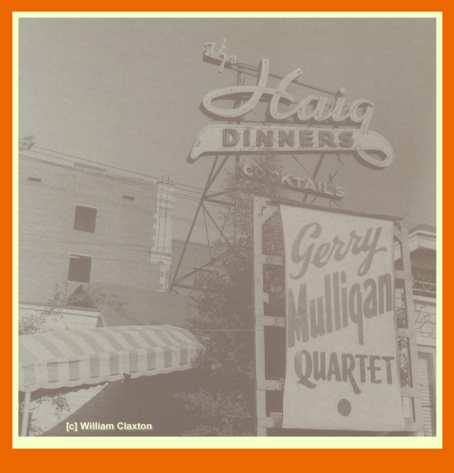
Between 1951 and 1956, The Haig was a jazz delivery room. In the little house on Wilshire Boulevard across from the Ambassador Hotel, a block from The Brown Derby, were born the quartets of Gerry Mulligan, Chet Baker, Laurindo Almeida, Shorty Rogers and Bud Shank. The club was tiny. The owner, John Bennett, ran it on a shoestring so short that although by law the club had to serve food, there was no kitchen. When a customer ordered a sandwich, the waiter stalled him while someone ran down the street to The Brown Derby for takeout. If someone ordered a brand of liquor not in stock, he had to wait until the band took a break and one of the musicians was dispatched to the nearest jar shop. In Shank's quartet, that was usually Chuck Flores's job; he was the youngest.

"It was a marvelous place to work in," Shank said. "It was so intimate, no sound system was necessary. It held maybe 50 people. Business was always good. We did very well while we were in there, from January until July. It was a great period. The place lasted until a year or so after that. Then somebody bought the property and bulldozed the whole thing."

I asked Shank how much he was paid at The Haig. A meticulous keeper of records, he went to an anteroom and retrieved a ledger listing 50 years of gigs.

"One-hundred forty-two bucks a week," he said. "Cleared $112. Everyone was paid individually."

In the summer of 1956, Shank and his band hit the road. From the ledger, here's the itinerary: The Newport Jazz Festival; a week at the Blue Note in Philadelphia; a concert in Shanks hometown, Dayton; the Rouge Lounge in Detroit; the Cotton Club in Cleveland; The Continental in Hartford; Olivia's Patio Lounge in Washington, D.C.; the New York jazz Festival; Olivia's again; The Modern Jazz Room in Chicago; Basin Street in New York; the Colonial Tavern in Toronto; a concert in Buffalo; the Storyville club in Boston; Chicago and the Blue Note again; a return to Detroit and the Rouge Lounge; back to L.A. in November for a series of dates at Jazz City in Hollywood; and into The Haig in December.

(B) NOVEMBER 7 & 8,1956


It was a tight, seasoned quartet Shank took into the studio after nearly half a year on the road. The confidence and increased mastery in his playing are obvious throughout; in the Lester Young drive and relaxation of his solo on JIVE AT FIVE; in the appropriateness and naturalness of the Charlie Parker quote in SOFTLY AS IN A MORNING SUNRISE; in his energy and effortless changes of pace in Williamson's suite, TERTIA. Even his flute work, particularly in A NIGHT IN TUNISIA, has a harder edge, a toughness.

Gazing into the trees, Shank says, "I can hear myself become more and more a stronger player through this period."

Always in demand by fellow musicians for recording dates, Shank's jazz studio activity intensified in 1957. He recorded as a sideman with Pete Rugolo, Mel Torme, June Christy, Russ Freeman, Bill Perkins, Peggy Lee, The Modernaires, Georgie Auld, his close friend Bob Cooper and dozens of others. As motion picture and television studios began slowly to accept the idea that jazz players might be real musicians, Shank's versatility and dependable musicianship put him onto a new path. That path would lead to financial comfort and artistic frustration. Years later, Shank would jump off it, with dramatic results. For now, he was doing well in both worlds. His next recording was an anomaly, a surprise, a re-emphasis of his jazz roots.

(C) NOVEMBER 29, 1957


Shank had played tenor as a sideman on a few record dates, but for the most part his old 10M Conn stayed in the closet after his rhythm and blues days with George Redmond. Having learned that Chuck Flores was about to be drafted, he told Dick Bock of Pacific Jazz that he wanted to make a record before Flores left. Bock asked him what kind of record. Shank - he doesn't remember why - said he would record some standards on tenor.

"After that heavy discussion," he told me, "we went in and did the record. There was no preparation. There were no arrangements. We just did it. HAVE BLUES, WILL TRAVEL was done for one of Dick's anthologies, not the original tenor album."

Like the tenor players he admires most - Stan Getz, Zoot Sims and Al Cohn - Shank was clearly under the spell of Lester Young, but only the most superficial listener would mistake him for any of those tenor men. What did he think, hearing himself on tenor after all these years?

"I'm pleasantly surprised. I like it. I wouldn't have known who the hell it was," he said with a laugh. "I think I would have recognized myself on some of the tracks here. The one we were listening to, ALL THE THINGS YOU ARE, I would probably not have been able to guess that it was me. I started as a tenor player. It's still in me. But I never developed any particular 'style' of playing, an identifiable style. It takes time to do that, but I was very pleased with what I heard."

(D) APRIL 23, 1958

Shank and Cooper had made a quick tour of Europe in 1957. In early 1958, they returned for a package tour with their quintet and Cooper’s wife, the singer June Christy. Drummer Jimmy Pratt substituted for Flores, who didn't want to go back on the road. The six-month expedition included a side trip for a series of concerts in South Africa, sponsored by Natal University. While they were there, Shank was urged by fans to record. He called Bock in Los Angeles to see whether Pacific Jazz wanted to pay for an album. Pacific Jazz did not. The South African enthusiasts raised the money, and one day Shank, Williamson, Prell and Pratt found themselves in what was described as a studio.


"It was just a room," Shank told me, "not much bigger than this one, and it had a solid wood floor and cement sides. It was full of people. We got rid of them. Then we played a tune. It just boomed. Every note would reverberate, 'buduhdoot.' I can't imagine what they ever recorded in there. I said, 'bring blankets, blankets, blankets.' So, they went out and got blankets from somewhere and started putting them around the room to deaden the sound a little bit. Well, it didn't do enough, but we decided to go ahead."

Then came the pennywhistle challenge. The record company people learned that admirers had given Shank one of the ubiquitous instruments beloved of children and amateurs and heard on street corners everywhere in South Africa. He had experimented with it in his hotel room. He had no thought of recording on it. The producers (to conjure up a job title for them) insisted that the quartet do something to honor African music. They produced a thumb piano for Williamson, gave Pratt a native drum and Prell a Nigerian bamboo harp. The result was A TRIBUTE TO THE AFRICAN PENNYWHISTLERS.

"I just made up something," Shank said. "It was a blues. The stupid pennywhistle ended up, as I remember, in the key of A-flat, by accident, because nobody down there ever played a pennywhistle with anything other than just a rhythm section, not another keyed instrument. I learned how to play the damn thing while I was making this record. When I first start playing it, I'm squeaking and very tentative and as it goes along, after about 20 choruses, I begin to figure it out."

Goofy as the assignment may have been, the performance has a good deal of charm and Shank seems to take modified pride in having subdued and adapted an instrument not remotely suitable for jazz improvisation. The band returned to their customary instruments for the other six tunes, which include three impressive Shank compositions, CHARITY RAG, MISTY EYES and WALTZIN' THE BLUES AWAY. After a shadowy life on obscure European labels, some of them pirates, this is the AFRICA album's first release in the United States.

(E) JUNE 30, 1958

The second version of MISTY EYES is not an alternate take from the South Africa album but a studio recording made later in Los Angeles and issued on a Playboy anthology. If any more material was recorded with this group, it no longer exists.

(F) APRIL 18, 1959

Bruce Brown was a Southern California surfer who wanted to make a documentary film about his sport. Shank thinks that they first met when he was playing at the Drift Inn in Malibu. Brown's plan was to do live in-person narration when he showed the movie. He approached Shank about providing music to accompany the picture, and Bud wrote themes that fit assigned sequences of the film SLIPPERY WHEN WET. Later he expanded them for a quartet recording. By this time, early 1959, his band had changed. Flores was back, but Williamson and Prell were replaced by guitarist Billy Bean and bassist Gary Peacock.


Bean was an experienced Philadelphia guitarist who worked with Charlie Ventura for a year and a half before he moved to Los Angeles in 1958. He played with Buddy De Franco, Calvin Jackson and Paul Horn, among others, before joining Shank at the Drift Inn. "A facile and impressively inventive guitarist," Leonard Feather called him in the 1960 edition of The Encyclopedia of Jazz.

"Good player," Shank says. "Very, very quiet. Liked to get up about 6 pm, have something to eat, go to work, stay up all night and go to bed at 7 am. Never saw the daylight. Around 1960, he just up one day and says 'I'm going home.' He went back to Philadelphia, and I've never heard of him since. I don't know what happened to him."

He knows what happened to Peacock. Anyone who follows jazz does. He began playing bass when he was in the Army in Germany in late 1955. By 1957, he was good enough to play with Shank and Cooper on their first European tour. Peacock was advanced technically and harmonically far beyond the norm for the period. He worked with pianist Bill Evans for a time in the 1960s, and later with Paul Bley, Miles Davis, Jimmy Giuffre, George Russell, Keith Jarrett and avant-gardes like Albert Ayler and Don Cherry. He is one of the giants of the instrument.

"His development," Shank says, "was phenomenal. He turned into one of the most creative bass players that ever happened."


I asked Peacock about his experience with Shank.

"Because of his own presence and his own interest, it created a space for me to be very, very flexible. That was a strong component of our connection during that time. There was a much greater sensitivity to sound quality than there is now, and when we recorded, we were all in the same room. We didn't get stuck in little cells or boxes. We played like we were playing a gig. I think that made an enormous difference in terms of the quality of the music. And Bud was – well everyone knows – the guy’s a master with the instrument. It takes someone like him to work in a framework like that. It was wonderful working with him.”

(G) May 1961

Peacock stayed with Shank well into 1961. With Bean back in Philadelphia, Shank hired Dennis Budimir, as adventurous on guitar as Peacock was on bass. The three of them generated sparks of creativity. Shank’s music moved onto a new plateau.


"Dennis was another intellectual, like Gary. He was his own man. He was very young when we made this record, 22 or 23. He never wanted to travel. He was by nature an improvising jazz player, a very good one. Very creative. But, he chose to forego that so he could stay home, stay in L.A. He became an extremely successful studio guitarist, still is to this day, probably the first-call guy even now. Very successful, and deserved to be. Of the jazz recordings he has made, this is one of the few. He did a solo or duo thing, in somebody's living room for Bill Hardy's little label called Revelation. This is the band, with the exception of Mel Lewis, that was working at the Drift Inn in Malibu at the time we recorded this."


For this session, issued as NEW GROOVE, Shank called Lewis in after drummer Frank Butler, on the morning of the record date, found himself in a bit of legal unpleasantness. One of the great big-band drummers, Lewis was also one of the great small-band drummers, and he proves it here.

When he moved from Kansas City to Los Angeles in 1960, trumpeter Carmell Jones called his friend John William Hardy (the Revelation man) to ask if he knew of work possibilities. Hardy recommended Jones to Shank, who said, "Sure," and hired him for the Drift Inn gig. A superb player in the Clifford Brown mold, Jones made a significant splash in jazz during his California years. He made several Pacific Jazz albums of his own, before joining Horace Silver in 1964 in time to appear on the SONG FOR MY FATHER album. His star, but not his ability, faded when he spent 15 years doing staff orchestra work in Germany before he returned to Kansas City in 1980. He died there in 1996.

Shank is on baritone as well as alto for this date, at the direction of Dick Bock. Bock had noticed that Shank ranked on baritone in a music magazine poll and thought there might be record sales impetus in the big horn.

"Funny how those things happen," Shank told me. "I was becoming more confident and more aggressive, but when somebody like Dick Bock said do something, I did it. Shortly after, if that would have happened, I'd have said, 'Later.' If I'd had to play another saxophone, I would much rather have played tenor."

The robustness of his baritone work is welcome on Duke Ellington and Tyree Glenn's SULTRY SERENADE and the others, but it is the intensity, even ferocity, of his alto on WHITE LIGHTNIN' and WELL, YOU NEEDN'T that signals a change in Bud Shank.

After we listened to NEW GROOVE, I asked him, "You said, ,same horn, same mouthpiece, but different.' How is it different?"

"I hear different things in my playing. It's aggressive, different harmonically, by all means. Different notes, different parts of the chord changes that I'm playing in. And I think that working with Gary Peacock and Dennis Budimir probably got me thinking along those lines. I was becoming more adventurous. I was becoming a better musician, a better saxophone player. More confident. Getting away from the way I was playing eight years before. There's a hell of an advancement between 27 and 35. I really broke through musically. I'm starting to get it together."

(H) NOVEMBER 1961

Bruce Brown, the surfing filmmaker, did well with SLIPPERY WHEN WET. His career in motion pictures was well under way and although he would soon join the '60s trend for rock and roll on sound tracks, he wanted Shank to provide the music for his next moist epic BAREFOOT ADVENTURE. The band was Shank, Peacock, Budimir, Shank's frequent alter ego Bob Cooper on tenor sax, and the busiest (for good reason) drummer in Los Angeles, Shelly Manne. As he did for SLIPPERY WHEN WET, Shank wrote the entire score. The music, tied to the lighthearted subject matter, has less specific gravity than NEW GROOVE, but the players get in plenty of heavy licks.

The film turned out to be extremely popular, and when Brown toured with it, he sold the sound track albums, lots of them. BAREFOOT ADVENTURE became the closest thing Shank had ever had to a hit. That created for Pacific Jazz a fiscal crisis.

"This record sold a whole bunch," Shank said, "like about 10,000 copies, which for that time was a lot of records. Dick Bock had to get the accountants, and they figured out, all of a sudden, that he owed me money. And he had never owed anybody money before. He didn't have any money to pay royalties. So he went down to Hollywood Electronics and bought me a very, very, very good sound system. I've still got the speakers, AR3s. My nephew has the Dynakit tube amp. This was my first hit, my first royalties. A big deal. I never got any royalties after it, either, for anything."


With BAREFOOT ADVENTURE under his belt, Shank had evolved into a mature artist, secure in his abilities, enjoying his work more than ever, on the threshold of great possibilities, and about to be absolutely stymied. By now, he was increasingly dependent on his income from studio work because jazz was beginning to dry up. With the success of Henry Mancini's music for the "Peter Gunn" television series, the traditional Hollywood studio music system finally collapsed in both TV and motion pictures. The executives discovered that jazzmen could fill their needs. Freelancers were in. Big staff orchestras on permanent payrolls were out. As that happened, popular music changed, and so did jazz. Shank thinks the serious damage started in 1962 or 1963.

"The real thing was The Rolling Stones and The Beatles. Then John came along, Coltrane. Things started to get so complex that it was difficult for the audience. And we were starting to get complex. I was. Nowhere near where John was, but in a club Gary Peacock was all over the place, way ahead of where Scott LaFaro was. And Dennis was also. We kept things under control on the record, but we were all getting more adventurous. I think we'd got to the point where as Coltrane became more well-known and going the direction he wanted to go, it became so complex that we not only lost the audience, but we lost the musicians because even they weren't able to understand where it was going. That's what drove the consumer, the audience, to the simpler music of The Beatles and The Rolling Stones and those things. They didn't have to think."

By 1965, Shank, Manne, Cooper and dozens of other stars of the Southern California music scene were rolling in studio work. They hated it, but the money was great. Jazz gigs were a low-paying luxury. Between 1965 and 1975, Shank says, he worked two or three times at Shelly's Manne Hole and two or three times at Donte's.


"The whole jazz business went in the toilet, and I didn't have a chance to make any more records, really, except the commercial albums with Michel LeGrand and all that junk that I did in the mid-60s. I didn't have a chance to make any more records until the mid-70s, and I had to start all over again. The bizarre thing is that I started all over again with The L.A. Four, with Laurindo Almeida. NEW GROOVE and BAREFOOT ADVENTURE are where it lay dormant for 15 or more years. It all just laid there and started to re-emerge when I re-emerged, 14 years later."

Shank fell in love with Port Townsend on a festival tour in 1979. He bought a house there in 1981. In 1985, he finally cut his connection to the studios, got rid of the flute, moved to Port Townsend, founded the Bud Shank Workshop, became the artistic director of the Centrum Jazz Festival and declared himself, then and forever, a bebop alto player.

Doug Ramsey, April 1998 @Doug Ramsey 1998 Doug Ramsey is the author of Jazz Matters: Reflections on the Music and Some of Its Makers (University of Arkansas Press). A regular contributor to Jazz Times, he is the winner of an ASCAP Deems Taylor Award for writing about music. [Of course, Doug is also the author of Take Five: The Public and Private Lives of Paul Desmond, Parkside Publications and you can visit him directly at his website -  http://www.artsjournal.com/rifftides/ .]