© Copyright ® Steven Cerra, copyright protected; all rights reserved.

"What a wonderful group this would be to have in a nightclub! Polished and polite and still musicianly, it would offer a superb background for talking and drinking and eating and then, for those of us who just like to listen, there would be soloists like trumpeter Don Fagerquist, whose rich understatement is the highlight of every track here, and tenorman Pell, Ronnie Lang on alto and bari and pianist Donn Trenner and trombonist Ray Sims and guitarist Tony Rizzi. And all night, there could be tunes like these Rodgers and Hart masterpieces, the like of which one rarely hears all at once, either on records or on a stage or in a room."
- George Simon Commenting on the Dave Pell Octet, Metronome
“Mine is not the approach of a jazz musician who goes into the recording studio to play 40 minutes of completely improvised jazz. Our projects are carefully planned. I feel that our music should be well designed, interesting yet easy to follow. We find it best to state the melody first, then come the spots for the blowing. But even behind a jazz chorus I want backgrounds going at the same time to give an overall big band sound. The restatement of the melody, in one form or another, in the closing completes the pattern."
- Dave Pell
When it comes to Jazz recordings from the halcyon days of the early “modern era” [for sake of discussion, 1945-1965], with a particular emphasis on the music recorded outside of New York city, Fresh Sound Records under the guidance of Jordi Pujol continues to be one of the “go to” labels.
In any transaction, availability and affordability are key elements and, broadly speaking, both of these aspects are relevant to Jordi’s efforts at Fresh Sound as he continually makes available handsomely packaged music from the West Coast Jazz era at very reasonable prices.
A case in point is the recently released Fresh sound double CD Dave Pell - The Complete Trend and Kapp Recordings 1953-1956 [FSR 936]. Just as a point-in-passing, if you are a fan of trumpeter Don Fagerquist, who many feel made too few recordings under his own name, you’ll love this two-fers as Don is featured throughout.
Dave Pell’s [1925-2017] earliest claim to fame was as a tenor saxophonist with Les Brown’s Band of Renown from 1949-1955, but he also worked as a recording engineer, an Artist & Repertoire producer for a number of record labels and as a photographer. Many of his snaps were used as album covers and on the back jackets of Jazz LPs.
In addition to his long stint with Les Brown, Dave’s public face was best served as the leader of the Dave Pell Octet which was originally a-small-band-within-a-big-band comparable to Tommy Dorsey’s Clambake Seven, Benny Goodman’s Sextet or Artie Shaw’s Gramercy Five.
Such small groups gave the brass players in the big band a chance to rest their chops [lips and lungs], while also offering a change of pace to the audience and a chance for some of the band’s Jazz soloists to stretch out a bit.
Les Brown was so successful as a result of his close working association with comedian Bob Hope and his orchestra in residence status at the Hollywood Palladium Ballroom that he rarely worked the small group opportunities that came his way in the form of invitations to perform at college campus parties and proms.
With some of the best musicians from the Brown band in tow, Dave formed his own octet and took over these “casual” gigs for which he and a host of arrangers put together a collection of melodious arrangements that were marked by a bouncy swinging beat that students really enjoyed dancing to.
Many of the musicians ultimately left the Brown band and were joined by others exiting the Kenton, Herman and Charlie Barnet bands for the lucrative and regular work in the Hollywood recordings studios. Over time, these big band expatriates would also see their fair share of work making television commercials and radio jingles.
Many talented musicians got off the band bus, married and raised families working as on-call studios musicians.
Affordable single family housing developments sprang up north and south of Los Angeles proper. With their two bedroom, one bath, den, dining and living room floor plan [and let’s not forget the all-important two car garage [attached, of course] - these residential developments were sold out before construction on them was completed.
Due to its easy access to the studios by car via the Hollywood Freeway - what else? - the San Fernando Valley northwest of downtown Los Angeles was a favorite of Jazz musicians and many of the guys in Dave’s Octet over the years, including Dave himself, would buy homes there and settle down to raise a family.
Because of the inversion layer that formed during the hot summer months, “The Valley,” as it came to be known, could become very hot and uncomfortable during the day. But this development became easy to deal with by taking out a second mortgage on the already-existing house mortgage and financing a swimming pool with it!!
Is it any wonder that after a time, Dave Pell began to describe his frequent Octet gigs as “pay-the-mortgage-music?”
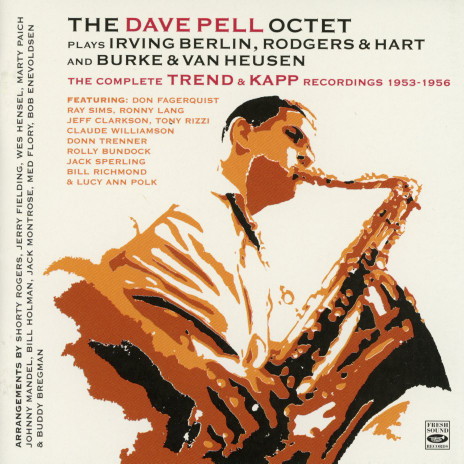
Here are Jordi Pujol’s notes to Dave Pell - The Complete Trend and Kapp Recordings 1953-1956 [FSR 936] which provide more information about Dave and the music and musicians on these wonderful recordings.
You can visit the Fresh Sound website via this link. You’ll be amazed at what is available in its large catalogue of interesting titles, all for very affordable prices.
“Dave Pell began playing clarinet early—his first musical recognition was by the Brooklyn Public School, where he won two musical awards leading the school dance band. At thirteen, his interest in jazz prompted him and his cousin, drummer Roy Harte, to organize a small jazz group called "Took Top Honors", modelled on John Kirby's sextet. As a clarinetist, Dave was influenced by the academic style of Buster Bailey (then a member of John Kirby's "Biggest Little Band in the World"). He was first clarinet with New York's "All City Star High School Band". Dave would later, however, lay this instrument aside for all but the odd occasion in favor of the tenor sax.
He made his professional debut in 1941, when he was signed by Bob Astor for a tour with Astor's orchestra. "Shelly Manne and Neal Hefti were just two of the famous guys in that band," Dave recalled. Later on he played with the band of Bobby Sherwood; then a stint with the Tony Pastor aggregation brought him to the West Coast. "I liked it so much in California that I decided to stay," said Dave. "I started my own little trio." But work wasn't too plentiful for the Pell trio so, in 1945 he joined Bob Crosby's orchestra, working for two years on the Ford radio show After that, he organized a quintet which performed in the Los Angeles area and made its first 78 rpm recordings in 1947 for the United Artists label. Later that same year, Les Brown called Dave to join his orchestra. "Les offered me such a nice situation that I couldn't turn it down. Les had the steady gig on the Bob Hope radio and TV shows. We were in town, at home, for 10 months of the year. The only time we went on the road was just for a couple of months in the summer." As a result of this, he stayed with the orchestra for the next eight years. His distinctive "cool" sound and melodic ideas, which reflect the influences of Bud Freeman and Lester Young, were always highly personal and made him one of the star soloists with the Brown band, being placed high in both the Down Beat and Metronome magazine polls.
At the beginning of 1953 he founded "The Dave Pell Octet", made up exclusively of musicians drawn from Les Brown's band. "We originally formed the Octet by taking the Les Brown rhythm section and adding each one of the top Brown soloists," Dave explained. The members of the first octet were trumpeter Don Fagerquist, trombonist and singer Ray Sims (Zoot's brother), flutist, alto and baritone sax Ronny Lang, pianist Geoffrey Clarkson, guitarist Tony Rizzi, bassist Roily Bundock, and drummer Jack Sperling.
The Octet's library had the ingeniously voiced arrangements of trumpeter and bandleader Shorty Rogers, one of the leading figures of the West Coast jazz school, and Les Brown's trumpeter Wes Hensel, whose stimulating scores gave the small group the feel of a big band. Dave said about this, "we used the guitar as a voice in unison with trumpet and so the Octet sound had a successful formula which allowed us to play a tempo that was danceable and yet still had a jazz feel." From then on, Dave's Octet began doing a few local dates during the days Les Brown's band wasn't working.
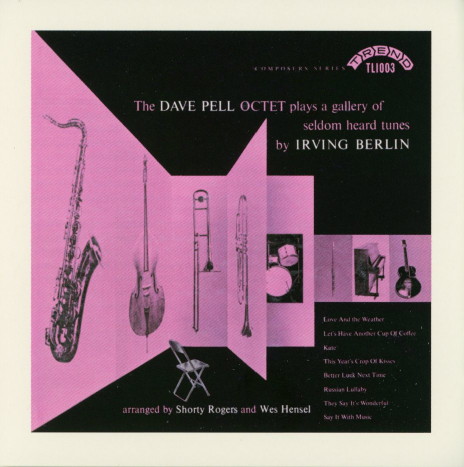
In March 1953 producer Albert Marx, formerly head of Musicraft and Discovery Records, signed The Dave Pell Octet for Trend, his new record label. Marx was associated with Paul W Trousdale, a wealthy construction and oil man. The label already had signed bandleaders Jerry Fielding and Claude Thornhill, as well as pianist Joe Burton, and in spring the Octet recorded a 10" record dedicated to the compositions of Irving Berlin. The album came out in October and became an immediate success for the company. George Simon in his Metronome review wrote: "All present songs by Irving Berlin, as played by an exceptionally musical, modern group of musicians out of Les Brown's band. Shorty Rogers arranged the first four, Wes Hensel the last four. The difference is noticeable, with Shorty's stuff more stylized and better integrated; Hensel's perhaps a bit more adventuresome in that he tries for more effects. But whatever either writes is magnificently played by this octet, which gets a better blend, a better tonal quality, and which plays more precisely than practically any group you've ever heard. This is potent proof that well trained musicians can play superior jazz, providing, of course, they have a feel for it." The Octet was listed as the best new combo of the year in polls conducted by the Daily News and the Mirror.

In the fall of 1953, Dave hired Brown's vocalist Lucy Ann Polk—formerly with Les Brown's band—as a featured singer with the Octet. She had already gained considerable reputation with some of the biggest name bands in the country, and with Les Brown's band in particular when she was twice winner in Down Beat's poll (1951-1952) of the No. 1 Girl Singer with Band award. She had decided to leave Brown (winner in the dance band division) following his summer tour of 1953 in order to settle down at her Los Angeles home. "I want to stay home and rest this summer. We've had a busy year, with all of Les' one-niters slipped in between radio, television, and recording dates, and I just didn't feel I could do my best on this long tour he has comping up"—the band would have to play more than two months of almost solid one-niters.
Dave explained that "Lucy was a pro throughout her career and when I asked her to record some sides with my octet... out of the Les Brown band... she jumped at the chance." And, he pointed out, "she had such a great easy sound that was kind of Jo Stafford but still very much her own." For her, this was a turning point that also marked the beginning of an association with Dave Pell that endured for years.
Soon after she was also signed by Albert Marx, and in December 1953, Lucy Ann, co-featured with the Octet, recorded a 10" album with eight songs composed by Johnny Burke and Jimmy Van Heusen. The scores were again supplied by Wes Hensel, and Shorty Rogers, who would be deservedly named by the Metronome magazine: "Arranger of the Year."
The ending of 1953 brought good news for the members of the Octet too, when they were all included in Downbeat magazine's poll of the top jazzmen in the country. There was good news for Lucy Ann, too, when she won her third award. Pell made the best showing, placing fourth in the list of tenormen. He was preceded by Stan Getz, Flip Phillips and Lester Young.
The Octet, by doing a combination of concert-show dates at coast colleges, became very popular among teenagers. On Tuesday March 30th, 1954, the group, with Lucy Ann Polk and Les Brown's vocalist Butch Stone, appeared in concert at the Auditorium of the Los Angeles City College. Daily News jazz columnist Bill Brown placed the concert in headlines in his column Jazz Beat of March 25th, calling the show "the most significant jazz event of the week," and he pointed "Pell and his group have flipped fans everywhere they've appeared and their Trend LP of Berlin is a heavy seller." The concert received the support of several local disc jockeys—including the popular Gene Norman. Tickets for students were sold for $1, and $1.50 for others.
The Lucy Ann Polk album came out late in spring, and Albert Marx proudly wrote in the notes: "the happiness Lucy Ann portrays throughout these first eight sides is evident that she has found the freedom of singing with a small group, the proper combination for some tasty and swinging sides." Lucy Ann was described by Les Brown's trumpeter and arranger Wes Hensel as "one of the grooviest people who ever walked this earth."
Her debut album as a single was well received both by the public and jazz critics. Down Beat's Nat Hentoff gave the record a four-star review: "Backgrounds and solos are tasty, everybody's relaxed and swinging, and the result is a happy, unpretentious collection. Lucy has good diction, a fine beat and though her vocal quality and phrasing don't always gas me, she knows what she's doing musically all the time and fits into this easeful setting very well. This is a good set to relax to."
With Lucy Ann Polk handling the vocals, the Octet appearances throughout South California were a smash success. "We're successful, I believe, because of the simple fact of showmanship," Dave admitted. "I don't mean that the guys in the octet stand on their heads, or wear funny hats while they play, or anything like that. The showmanship lies in the arrangements and in the overall presentation of the group." The whole appeal of his octet lay in the considerable time and attention given to the arrangements. Pell, on top of Shorty Rogers and Wes Hensel, continued building up his book with the works of such skilled arrangers and leading exponents in the modern sounds of jazz, such as Marty Paich, Bill Holman, Johnny Mandel, Jack Montrose and Jerry Fielding. The keynote of the group was "good taste." There's Just enough clever improvisation without completely ignoring the melody. This was the reason that Dave's music appealed even to those who were unfamiliar with jazz.
Still in 1954, Albert Marx recorded the Octet again in June, this time for a 12" album dedicated, as he wrote in the liner notes, "to present a folio of Rodgers and Hart's lesser known works by a jazz group." George Simon's Metronome review said: "What a wonderful group this would be to have in a nightclub! Polished and polite and still musicianly, it would offer a superb background for talking and drinking and eating and then, for those of us who just like to listen, there would be soloists like trumpeter Don Fagerquist, whose rich understatement is the highlight of every track here, and tenorman Pell, Ronnie Lang on alto and bari and pianist Donn Trenner and trombonist Ray Sims and guitarist Tony Rizzi. And all night, there could be tunes like these Rodgers and Hart masterpieces, the like of which one rarely hears all at once, either on records or on a stage or in a room."
In summer 1954, Dave left Les Brown after the Bob Hope radio show was dropped and Les was forced to go back on tour for good. "I decided then that I'd built up enough to break away from Les." Even though he wouldn't tour with the band that summer, he still continued to play and record with Brown until 1956.
For a couple of years The Octet, with Lucy Ann Polk as the main attraction, did many dance concerts, the majority in High Schools and colleges. "I guess I worked with Dave about once a week on all kinds of gigs—colleges, concerts, dances, every imaginable location. And, y'know, I dug it so much, both for the guys and the music," the vocalist recalled. All this boosted Lucy Ann's popularity, and helped her get another Downbeat award in 1954, as best Girl Singer with Band, despite the fact that, by 1954 she was with the orchestra much more sporadically. Dave also repeated the fourth place on the tenor division.
Despite having some good titles, Trend's catalog wasn't selling as many records as his major investor Paul W Trousdale expected, and so in spring 1955 he decided to sell the company. Former president Albert Marx entered the personal management business by signing singer Johnny Holiday as his first client, but his new career didn't last long. As for Pell, he signed a new exclusive deal with Atlantic Records in April 1955.
In February 1956 Dave Kapp, president of the Kapp Records label, purchased the Trend catalog for a figure running well into five figures. Both Capitol and Columbia Records had liens on the masters prior to the sale, Capitol for an estimated $19,000 and Columbia for approximately $6,000. Albert Marx had started working as a free-lance repertoire scout for Kapp Records. This time, his job lasted only a year, but during his time with Kapp he reissued the Dave Pell Octet and Lucy Ann Polk masters on three 12" albums, with different covers. The original 10" Irving Berlin album was filled with four new recordings by the Octet also with Jeff Clarkson, recorded at Radio Recorders in May 14,1956; four vocal tracks were removed from the original Burke & Van Heusen album, and eight new instrumentals tunes—this time with pianist Claude Williamson—were added from two sessions recorded at the same studio on May 7 and 21; whereas the Rodgers & Hart album kept the same tunes from the original Trend release.
His success was not always well received by some critics and jazz purists, who sometimes accused him of focusing too much on the commercial appeal of his music. In truth, his music was well received even to those unfamiliar with jazz. Pell was the first to admit to this, but as he envisioned it: "The direction and meaning of our brand of music is a little different. Mine is not the approach of a jazz musician who goes into the recording studio to play 40 minutes of completely improvised jazz. Our projects are carefully planned. I feel that our music should be well designed, interesting yet easy to follow. We find it best to state the melody first, then come the spots for the blowing. But even behind a jazz chorus I want backgrounds going at the same time to give an overall big band sound. The restatement of the melody, in one form or another, in the closing completes the pattern."
This 2 CD-set compiles all recordings made by the Dave Pell Octet for the Trend label during 1953 and 1954, and the Kapp sessions from 1956. They are the epitome of smooth sophistication; with their tightly scored ensembles, the deft styling concealed some excellent musicianship, and they all contain highly individualistic contributions from Fagerquist, Sims, Lang plus the airy, swinging tenor of Dave Pell, who proudly pointed: "We play jazz for dancing. That's our forte."
From 1955, Dave Pell's Octet played more dance dates than any other contemporary club in the country—schools, colleges and top night clubs such as Hollywood's Crescendo and the Cloister. They had numerous, and at times prolonged contracts with night clubs which forced the group to make personnel changes when some of the members had work in the studios. Up until 1961 Pell himself participated in many recordings by other jazzmen, alternating his sessions with the Octet (for Atlantic, Kapp, RCA, Capitol, and Coral) with other activities. As a photographer he won a well-deserved reputation (it has been estimated that more than 200 LP covers have been illustrated with his photographs) and as a writer he contributed a regular column to Down Beat titled "Pell Mell". This was the name that Frank Comstock had given to one of his compositions, dedicated to Dave Pell in 1949, when both of them were in Les Brown's orchestra, Dave then being featured on bass clarinet. From 1957 he had also been head of the a. & r. production department of Precision Radiation Instruments (Tops Records), and starting in the early 60s he worked as an independent producer, signing in 1963 with Liberty Records.
After retiring from the jazz stage, he continued playing as a session musician, manager, producer and music coordinator for movie scores. He gradually went back to making regular appearances in the nightclubs of Los Angeles in the 70s. In 1978 he founded the group Prez Conference, with the idea to take some of the great solos by Lester Young and harmonize them for a four-piece saxophone section. The group also comprised a rhythm section with guitar and usually included a trumpet. Prez Conference would record two albums for GNP/Crescendo, and their warm reception would take the group on a tour of Japan.
Dave started a new phase in his career when he reorganized his legendary octet the summer of 1984. After almost twenty five years since their last session, the Octet recorded an album for Fresh Sound Records titled The Dave Pell Octet Plays Again (FSR 5009). From then on Dave played regularly around Los Angeles, where the octet was one of the local staples. Their popularity never dwindled. By the year 2000 Dave was still living and playing with the same optimistic and sincere enthusiasm as always, leading his octet with great success every Friday night at the Paradise Cafe at the Beverly Garland Holiday Inn in Studio City, and other venues in Los Angeles. For several years he joined in as a featured soloist every Tuesday morning with Johnny Vana's Big Band Alumni at the Mexican restaurant Las Hadas in the San Fernando Valley. The Big Band Alumni group is aptly named, by the way. Virtually every member of the seventeen piece ensemble has credits reaching from Jimmy Dorsey and Glenn Miller to Stan Kenton, Count Basie and beyond. Despite their silver hair, however, they played such jazz staples as One O'clock Jump and String of Pearls with an irrepressible blend of easygoing familiarity and high spirited youthfulness.
The Octet's last long engagement was a series of concerts at Pete Carlson's in Palm Desert. Bruce Fessier wrote in November 9, 2015 for the Desert Sun: "The median age of this band was over 80. Pell will be 91 in February. Trumpeter Carl Saunders, a youngster at 73, became a grumpy old man after all of the missing or falling sheet music held up the show. Capp, 83, just laughed. "There's nothing like a well-prepared band," he said. "And this is nothing like a well-prepared band." When the show was still going strong after 90 minutes, Capp asked Pell, 'What are we going to do, play 'til there's a death in the band?'
"There's something about those old guys that reminds me of the Preservation Hall Jazz Band I saw in my 20s," he said. They have a feel you can't teach in college. Pell's band read their difficult charts intently, but, at some point, they were like, 'I got this,' and their personalities started seeping into the music, making it swing."
Dave passed away at 92 years old, on May 8,2017.” —Jordi Pujol


