© - Steven A. Cerra, copyright protected; all rights reserved.
"Zeitlin's main activity as a musician has been to give concerts as a soloist or with small ensembles; these display his thorough grasp of Jazz theory and mastery of free improvisation"
- Bob Doerschuk, in Barry Kernfeld, ed., The New Grove Dictionary of Jazz
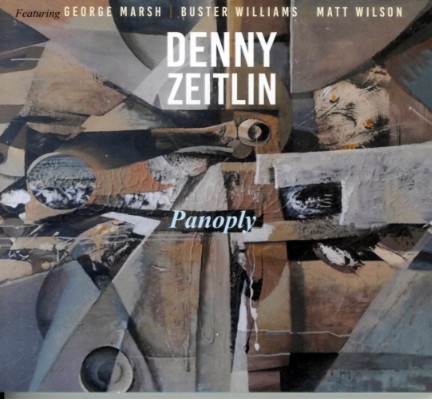
With the recent arrival of Wishing On The Moon, pianist Denny Zeitlin's latest CD on Sunnyside Records [SSC 1514], the editorial staff at JazzProfiles thought it might be fun to use our comments about his most recent recording as a lead-in to our previous postings about Denny to form a career retrospective of sorts.
So what you will find as you read through this piece are four previous postings about Denny from my perspective, as well as, from the pen of the esteemed Jazz author, critic, and educator Grover Sales and the interview mike of Jazz musician and historian, Ben Sidran.
I have also included below the press release about the new recording that Bret Sjerven kindly sent along with my preview copy and Denny's comments about each track in the insert notes to give you more information about Denny, his trio with bassist Buster Williams and drummer Matt Wilson and the music on the recording.
But what I want to do at this point as a sort of prologue is to share some of my general observations about Denny and his approach to Jazz.
In The Penguin Guide to Jazz On Record, 6th Ed., Richard Cook and Brian Morton offer a parallel between Denny's music and John Coltrane's "sheets of sounds" approach when they state that Denny has "... the ability to put seemingly inimical materials side by side and harmonize them in great rushes of sound."
Messrs Morton and Cook also state that: "... Zeitlin has the ability to marry free improvisation with a strong sense of musical structure ... and that some of his performances "... suggest a two-part classical structure which pushes towards what Zeitlin likes to describe as a 'merger state' where piano, music, player, audience and performing space are almost indistinguishable from one another."
There's a lot to consider in that, last paragraph, but if you reflect on it long enough, especially while listening to Denny's latest CD, I think you'll find that these dualities are not mutually exclusive, but that they are in fact mutually inclusive.
To my ears, if the level of intensity does not change, the music can become monotonous and Denny is constantly on the alert for compositionally and improvisoral devices to do just that - change the level of intensity.
The inclusion of the earlier articles in this feature about Wishing On The Moon are also meant to show how he has used changes in his trio, duo and solo piano formats to project various aspects of intensity into his music to keep it alive and growing for the past 60 years.
In a way, the music on Wishing On The Moon is a return to Denny's piano, bass and drums roots, but with the addition of the many new elements from his musical adventures that he has garnered along the way.
In a 1984 interview with Dominic Milano which appeared in Keyboard Magazine, Denny, who is also a practicing psychiatrist, gave his views on the relationship between improvisation, creativity and consciousness.
The timing of this interview was such that Denny gave it from a vantage point of his exploration of electronic keyboards. In this regard, he is a member of a very select group of Jazz artists who established themselves on acoustic piano and moved on to electronic keyboards and synthesizers: Herbie Hancock, Chick Corea, Joe Zawinul and Clare Fischer come to mind, here.
But in the same year as the interview for Keyboard Magazine, Denny released Tidal Wave with guitarist John Abercrombie, bassist Charlie Haden and drummer Peter Donald which reflected his continuing commitment to Jazz in more standard group structures.
Subsequent to this 1984 quartet LP, there followed Homecoming, a 1986 solo piano recording; Trio a 1986 album with bassist Joel DiBartolo and drummer Peter Donald; In The Moment a 1989 trio project with bassists DiBartolo and David Friesen and Peter Donald once again on drums; 1995 saw the release of Denny Zeitlin and David Friesen on Concord with the same label putting forth Denny Zeitlin and David Friesen Live at The Jazz Bakery in 1999; Slick Rock appeared in 2004 and marked the first recorded appearance of Denny's trio with Buster Williams and Matt Wilson; Precipice a solo piano effort was released by Sunnyside in 2010 followed by Solo Live on the same label the following year; 2013 marked the issuance on Sunnyside of Both/And - Solo Electro-Acoustic Adventures. These are just some of the highlights of Denny's recording career during this period.
Continuous and constant "conversations of the improvisor's art," a phrase that's borrow from the subtitle of Andy Hamilton's book on Lee Konitz, characterize the performing and recording career of Denny Zeitlin.
Denny's musical life has been a constant process of what the social psychologist Arthur Koestler termed - "Act of Creation." There's more on Denny's art and its relationship and Koestler's concept of 'bisociative' thinking - the creative leap made by the mind that gives rise to new and startling perceptions and glimpses of reality - later in this feature.
Denny has had a presence in recorded Jazz for over half-a-century and this documentation allows us to enrich our own lives through the gift of his music in much the same way that the works of art of a painter, literary books of a writer, pictures of a photographer can serve as a source for both inspiration and entertainment.
Denny has made 37 recordings since his 1963 appearance as co-leader with Jeremy Steig on Flute Fever and Wishing on the Moon continues his search for honest artistic expression at the very highest level. It's been a pleasure to be able to accompany him on this journey.
Order and contact information about Wishing on the Moon can be found at:
www.sunnysiderecords.com
www.sunnysidezone.com
sunnyside@sunnsiderecords.com

Sunnyside Media Release:
"Denny Zeitlin is known as a musician of great taste and vast breadth of interests. It should come as no surprise that most of the great pianist's collaborators have been equally eclectic and brilliant in their musical pursuits. In the long list of tremendous accomplices, bassist Buster Williams and drummer Matt Wilson have cemented themselves as two of Zeitlin's most dynamic and moving.
The trio has entered their 18th year as a working combo and, though they are all busy in many endeavors, their unique chemistry makes every performance a not to be missed event. Their new recording, Wishing On The Moon, was recorded live at Dizzy's Club Coca Cola in New York City on March 10, 2009.
Zeitlin had always admired Buster Williams' s playing, and loved the warmth and immediacy along with his elastic and propulsive groove he displayed in their first encounter—Denny's trio recording, As Long As There's Music (Venus). Shortly thereafter Zeitlin and Williams needed a drummer for a performance at the San Francisco Jazz Festival. Matt Wilson was recommended, and after Zeitlin delightedly checked him out on the Internet, and was hired for the gig. Though there were quick rehearsals with bassist and drummer separately, the first time this trio hit together was at the concert. Mart's connection with Denny and Buster was immediate and telepathic. Everything fit like a hand in glove.
The trio's connection is deeply collaborative: each member has an equal voice in contouring the music. The mutual trust has allowed for the continued evolution of the group sound and dynamic and to create what Zeitlin calls true "trio music."
The recording presented is an exemplary instance of the trio's cohesiveness, a fantastic snapshot of the band at that point of their union. Dizzy's Club Coca Cola was a wonderful venue for playing and recording. The Steinway on hand was impeccably maintained and the recording engineer, Jeff "The Jedi Master" Jones, an expert.
The recorded program is made up of compositions the ensemble was familiar with and which provided them perfect launching platforms for improvisation. Upon deep listening, layers of subtlety are revealed, expressing high levels of confidence, surprise, empathy, nuance and commitment to the creation of ensemble music.
The program begins with one of the ensemble's favorite pieces, Cole Porter's "All Of You" (with some extensive reharmonization from the leader), which they frequently use as a leadoff piece at performances. Zeitlin's searchingly tender "Wishing On The Moon" follows as a slow, yet challenging bossa nova. Originally introduced to the song by George Shearing's rendition, Zeitlin has found a new life for jule Styne's "As Long As There's Music" as a waltz. The leader's "Slickrock" was inspired by Zeitlin's interest in mountain biking and his rides in Moab, Utah. The piece evokes a day's adventures of a group of bikers navigating the treacherous terrain, allowing for some musical gymnastics, including some brilliant free playing. It plays continuously on the CD, but is divided into 4 sections to allow it to be experienced as a suite, and to encourage air play.
A staple of Zeitlin's book, the lullaby "Put Your Little Foot Right Out" follows as a divine, relaxed, gentle waltz. Zeitlin's shifty "There and Back" takes its inspiration from Tolkien's "The Hobbit," and balances between funk and jazz time. Williams' bass mastery is on full display before the trio launch into David Friesen's bluesy "Signs and Wonders," a longtime favorite and propulsive, driving piece perfect to conclude the program.
Hearing a mature and highly intuitive band is always worth celebrating. Denny Zeitlin's trio featuring Buster Williams and Matt Wilson has once again opened the curtain to reveal truly brilliant music making on their Wishing On The Moon."
Denny's Insert Notes:
"BY 2009, BUSTER WILLIAMS, MATT WILSON, AND I HAD BEEN PERFORMING AS A TRIO FOR 8 YEARS, AND THIS RECORDING OF A NIGHT AT DIZZY'S CLUB COCA-COLA CAPTURES SOME OF OUR BEST MUSIC—FULL OF SURPRISE, EXPLORATION, CONFIDENCE, EXCITEMENT, NUANCE, AND EMPATHY THE PROGRAM HAS SOME OF MY FAVORITE ORIGINALS AND STANDARDS. I HAD RECORDED ALL OF THEM PREVIOUSLY;THEY HAVE ALWAYS PROVIDED A SPECIAL SPRINGBOARD INTO IMPROVISATION.
SOME COMMENTS ON THE COMPOSITIONS:
1) All Of You: This Cole Porter tune is one of my all-time favorite standards. The extensive reharmonization adds considerable spice.
2) Wishing On The Moon: This original composition, a slow Boss Nova, poses subtle harmonic challenges for improvisation, and conveys a sense of yearning. 3) As Long As There's Music: I first heard George Shearing doing this tune as a fox trot with his quintet back in the fifties. I've enjoyed doing it as a waltz.
4-7) Slickrock: My wife Josephine, and I were avid mountain-bikers for over
20 years, and made several trips to Moab, Utah, a mecca for the sport This original composition tries to evoke the feeling of an adventurous day on "Slickrock" a type of sandstone that actually provides tremendous traction for harrowing ascents and descents. The challenges can be gnarly and dangerous, and crashes all too frequent. Performed as one piece, it plays continuously on the CD, but is divided into 4 sections to allow it to be experienced as a suite, and to encourage air play.
8) Put Your Little Foot Right Out: I reharmonized this childhood nursery rhyme to bring in some new colors.
9) There and Back: Inspired by Tolkien's The Hobbit, this original composition shifts back and forth between walking jazz time and funk.
10) Bass Prelude to Signs and Wonders: Buster Williams performs an unaccompanied introduction.
11) Signs and Wonders: David Friesen wrote this unusual bluesy composition
that has great drive and excitement."
© - Steven A. Cerra, copyright protected; all rights reserved.[7.24.2015]

I’m never certain as to why I get into a listening mode that focuses on the music of one musician, but I often do and lately the center of my undivided attention has been the music of pianist Denny Zeitlin.
What I like best about Denny’s approach to Jazz is that I know he’s always going to give me an honest rendering; his compositions and improvisations are unmistakably his own. Cue Magazine [circa 1965] even went so far as to say that “Denny Zeitlin was the most inventive pianist in at least two decades.”
Art Tatum, Fats Waller, Earl Fatha Hines, Teddy Wilson, Bud Powell, Nat King Cole, George Shearing Lennie Tristano, Oscar Peterson, as well as, Denny’s contemporaries including Bill Evans, McCoy Tyner, Herbie Hancock Keith Jarrett and Chick Corea, all have an instantly recognizable “voice” on an instrument that’s not known for its individuality of expression.
And yet, it doesn’t take long before Denny’s unique style to manifest itself. He’s such an honest player who rarely falls back on licks and tricks and hardly ever repeats himself.
I’ve been listening to Denny’s music for a long time, having first become familiar with his work through three recordings that he recorded for Columbia in the mid-1960s under John Hammond’s supervision: Cathexis, Carnival, and Zeitgeist. Another of my favorite recordings by Denny on Columbia from the same period is Shining Hour: Denny Zeitlin Live at The Trident [a Jazz club that was based in Sausalito, CA just across the Golden Gate Bridge from San Francisco]. It was recorded in performance at the club in 1965.
Bassist Charlie Haden and drummer Jerry Granelli join Denny on most of these recordings with bassist Cecil McBee and drummer Freddie Waits accompanying him on Cathexis.
While researching a lengthier profile on Denny that encompasses his 50+ year career in the music, I came across the following piece by the eminent Jazz scholar and author Grover Sales which appeared in the May 1986 edition of Gene Lees Jazzletter.
While I continue my research into the ever-evolving music of Denny Zeitlin so as to do it justice from a career perspective, I think you’ll be in good hands with Grover in the meantime.
"The good thing about being famous," quipped the late Howard Gossage [an advertising innovator and iconoclast during the ‘Mad Men’ era who was also sometimes referred to as ‘The Socrates of San Francisco’], "is that you don't have to explain yourself." Though famous in two divergent arenas, jazz pianist-composer and psychiatrist Dr. Denny Zeitlin has been forced to "explain himself since he first pursued his dual career.
"Some musicians I work with," he says, "feel threatened that I'm trying to psych them out; some are envious that I'm making a comfortable living as a psychiatrist while they're scuffling. Some doctors wonder, “What is he doing with this Jazz? — still a dirty word to some people. Some in both music and medicine doubt I can be good at something I'm not doing full time, and even get angry about it. But there are many who can see that the dual career enriches both my medicine and my music — which I know to be true — mainly in Europe where the pursuit of a double career does not seem as bizarre as in America. And it's always been a problem in American that you should be having fun with your work.
"On both sides there's been a tendency to suppose that I do psychiatry primarily for the money and music mainly for the fun. Actually, I get equal pleasure and fulfillment from each, and couldn't imagine not dividing my time this way. Also, music and psychiatry are not as afield as some assume. One of their many similarities is perpetual newness. I know a lot of doctors who become bored and burned out with their three-hundredth appendectomy, and many musicians drugged with recording repetitive jingles and schlock movie scores. Even though many psychological themes are common to many people, each individual's mode of experiencing and expressing is unique; and in music, I’ve been lucky enough to be able to pick and choose projects that are challenging and exciting."
Tall, athletic, bearded, and with a rabbinical cast, Zeitlin combines the seeming incompatibles of seething intensity and relaxed grace. Reflecting his diverse trades, his professorial speech is laced with staples of the jazz argot. A radio announcer's voice resonates with untempered enthusiasm for his multiple interests. This associate clinical professor of psychiatry has played the Newport and Monterey jazz festivals and has recorded nearly a dozen albums of his own works, as well as standards, all raptly acclaimed by jazz critics. In the recent Jazzletter poll of forty-two pianists, Zeitlin garnered as many votes as Count Basie, McCoy Tyner and Jimmy Rowles.
Zeitlin came by both music and psychiatry honestly. He was born in Chicago in 1938 to a radiologist father who could play any popular tune on the family Steinway by ear and a speech pathologist mother who was a classically trained pianist. "At two and three I started doodling at the piano, climbing on mother's or father's lap and putting my hands on theirs while they were playing. I started studying music at six, but was always more interested in composing and improvising than playing. A comment on my parents' remarkable sensitivity is that when I was nine, they rejected my teacher's advice that I start grooming for a concert career to the exclusion of all other interests. They knew that, as much as I loved Bach and Chopin, my object was not to include them in a concert repertoire but to learn how their music was constructed, and use this knowledge in my own compositions.
"I first heard jazz in the eighth grade when a wonderful piano teacher brought me an early George Shearing album that just knocked me out! Here was a pianist with all the technical chops, playing this marvelous new music. And that rhythm! Then she brought me Art Tatum records, and I was totally blown away by his technique, but even more by his incredible ability to reharmonize pop tunes. In high school I played with Dixieland bands that were popular at that time, but my heart wasn't in it; this music never spoke to me emotionally like Debussy or Ravel. Then I got into Stravinsky, Bartok, Schoenberg and Berg, who knocked me out, man! Galvanized me! And when I first heard Bud Powell and Lennie Tristano I immediately moved over to that. Because I was tall and looked lots older, I started going to jazz clubs in Chicago in the mid-1950s, digging major players, and again, my folks were so sympathetic and so trusting because here I was at fifteen, and often the only white cat in these clubs, sitting in, coming home at five in the morning, and my folks never batted an eye, even though they knew nothing of jazz.

"My medical career also started early, in the fourth and fifth grade. I became a spontaneous playground psychotherapist, interested in the kids, their problems, and they'd ask me, 'Why do the other kids pick on me?' or, 'Why can't I get along with my father?' 'Why does the teacher have it in for me?' And a leader would talk to me about how he felt lonely at the top. From my mother, who was a marvelous listener for me, I seemed to get this intuitive radar about people. I was a member of a peer group, not the neighborhood four-eyes, which I could have been if my folks had let that piano teacher suppress every urge in me but a concert career. My uncle was a psychiatrist and I felt in the playground that I would become one, as well as a musician.
"At the University of Illinois I took four years of pre-med with a major in philosophy, mainly existentialism, and again lucked out running into top jazz players like Wes Montgomery and Joe Farrell, who was a classmate of mine, and played gigs with them. The same thing happened at Johns Hopkins med school from 1960 to 1964 when I ran into the great reedman Gary Bartz, whose dad owned a jazz club in Baltimore.
'Then I got a fellowship in psychiatry at Columbia, a period that shifted my whole life. Paul Winter dragged me kicking and screaming to John Hammond. I grew up believing that to record was to put yourself at the mercy of some soulless megastructure, prostitute your music and give away artistic control. I heard all the horror stories from other musicians, so why should I bother with this? But Hammond was such a marvelous, exuberant, open guy, and so genuinely excited about my music. He said, ‘I’d love to record with you! What do you want to do? Play whatever you want! How would you like to record with Jeremy Steig?' And he played me tapes of Steig's wonderful, wild flute things, and I said, 'Sure!' So 1963 saw my first album with Steig, Ben Riley and Ben Tucker, just a blowing date — we'd never played together before — and in the studio everything clicked. Six months later, with Hammond at Columbia Records, I cut Cathexis, my first record date as a leader, and then Zeitgeist - - they had to come up with something cute for a title, but it was nothing as horrendous as Group Therapy, which is what they were going to call the album until I threw a fit.
"I moved to San Francisco in 1964, having fallen in love with the place, and never applied for an internship anywhere else. I was at S.F. General on a tough one-year rotating internship. One night, I had a woman on the verge of delivery and her baby conveniently came an hour before I was due to play at the Trident in Sausalito. The Trident experience was fortunate because I was part of the woodwork there every Monday night for two and a half years, an incredibly long time for a steady gig, with a chance to develop. And manager Lou Canapoler was such a warm, utterly sympathetic boss. At the Trident I was playing what I call 'acoustic modern jazz piano trio music,' but augmented with unusual time signatures and more extended compositions, which hadn't been done much at that time.
This continued until the mid-'60s when I began to get restless and feel limited. Synthesizers were then at their primitive, unwieldy state, so I dropped out of public performance for several years to do research and development in synthesized and electronic keyboards, integrating jazz, electronic and avant garde classical with some things in rock that many in jazz were too contemptuous of — a lot of rhythm 'n blues, Muddy Waters and Chicago, a dynamite group. I loved Frank Zappa, the Band from Big Pink, and the Stones, which had a fantastic rhythm section, and of course I adored the Beatles. But when I started to expand into this new territory, the record companies said, 'How can we sell it? What is it? We have no established conduits to market this kind of music.' So I put out the record on my own mail-order label, Double Helix records. It sold well enough and got good reviews, so a small, classy label in Berkeley, 1750 Arts, took it over. I did two more albums for them, one of the few labels that truly care about music, but sadly, it looks like they're disbanding.

"Then in 1978 my career took a shift when Philip Kaufman did a remake of Invasion of the Body Snatchers and hired me to write the film score because he dug my records; he wanted a contemporary symphonic acoustic-electric mix, big stuff, and I had never written for a symphony orchestra before. I had to sell producer Bob Solo, and frankly, if I had been him, I never would have hired someone with as few credentials. I only got the gig because Phil Kaufman twisted his arm. I closed my medical office for five weeks to undertake the most exciting and exhaustive experience of my life. The thrill of hearing my music performed by the very best of L.A. musicians was a gas! Overwhelming, man! During a break, the first violinist said, 'I love your music, but of course, you have done many scores.’ When I told him no, this was my first, his eyes widened and he said, 'But you should be doing this all the time!' After Body Snatchers I got a lot of movie offers, but shied away now that the mystery was gone. There are too many extra-musical considerations in sculpting music to fit a producer's and a director's concept of what the film is about, and if you can do this and still please yourself, that's rare. Film composers have told me that I could do a thousand films before lucking into a unique situation where, thanks to Phil. I could hire the best conductor, the best musicians, the best studio, the best sound engineer absolutely unheard of!
"After the tremendous musical congestion of Body Snatchers I had the urge to return to the simplicity of the acoustic piano. and recorded Soundings for 1750 arts, and then a duet with bassist Charlie Haden, Time Remembered One Time Once, live at Keystone Korner for the German label ECM. followed by Tidal Wave for Palo Alto Records, mostly my own compositions. Herb Wong then included me in a potpourri 'twofer/ Bill Evans — A Tribute in the exalted company of John Lewis, Teddy Wilson, George Shearing and Dave McKenna. Almost anyone playing acoustic piano today owes a debt to Bill Evans, but I started early enough so that my first influences were before Bill's time, which I'm glad about because his influence on younger pianists is so formidable that it's hard to get from under. But I'm grateful for the exposure to his early work on Riverside, which I feel is Bill's best, and thankful that I had him for a friend. He was rare in that he was so comfortable with his talent that he never felt the need to be competitive, and took great delight in encouraging other players, like me.
"To get back to medicine, I did a psychiatric residency at Langley Porter [a hospital in San Francisco] from 1965 to 1968 when the human potential movement was burgeoning and studied a broad range of psychiatric disciplines, including many Esalen workshops with Fritz Perls. Later my training and orientation became more psychoanalytic. My feelings about groups like est are mixed; est is a blunt instrument that has proved its unquestionable value for some people, providing them with a genuine breakthrough experience; for others it was a form of adult recreation. But serious studies have found that among est, and most encounter groups of this kind, a disturbing rate of casualty exits, in some cases as high as ten percent.
"During the '60s I worked with the drug study unit at Langley Porter, the first unit to deal with the ravages of the 'flower children.' Drugs have never been part of my life. Apart from the legalities, I don't condemn it for others who seem to function better on judicious amounts of drugs, but I do condemn it when it gets out of control like cocaine, which is the major problem today among middle- and high-income people. Cocaine is totally destructive, far more than LSD, and is incredibly addictive, psychologically; it's worked its murderous way into every sector of society.
"In more recent years I've become increasingly interested in the creative process. Many of my patients are involved in creative pursuits, and not necessarily people labeled by society as 'artists,' but entrepreneurs, business people who are feeling blocks to the flow of their creativity. I conduct workshops and lecture-demonstrations on 'unlocking the creative impulse: the psychology of improvisation.' All creative pursuits share a common task of entering an ecstatic or merger state where the artist can tap into the wellspring of his emotional and unconscious life, while simultaneously, in some subliminal way. bringing to bear everything learned, felt and believed about his or her art. There's a parallel between playing Jazz and doing psychiatry because the deepest kind of creativity and communication is involved in both fields. Ideally. when I'm playing with a group, a state of subconscious merger exists between me and my fellow musicians, just as it ideally exists between me and my patients; a complete immersion and a state of genuine trust allows something special, musically or psychologically, to emerge. When that state is reached, whether in music or in therapy. I give up all sense of my physical body, or the positional sense of self.
"One of the reasons drug use is often prevalent among Jazz musicians is so they can achieve this state despite the distractions of noisy audiences and bad amplifying systems, and also deal with the internal noise which is potentially much more insidious and disruptive. Like. I’m playing a concert in Edmonton. and am going to Japan the next day. and in the middle of a phrase, suddenly I think. "Where did I put my plane tickets?'and get pulled out of the music. Being a professional. I'm still moving my fingers and maybe haven't made an actual mistake, but I'm no longer centered in the music. Another common kind of internal noise is self-doubt, and self-flagellation for making a mistake. My fascination with Bjorn Borg's tennis experience - I'm a wild tennis nut and an avid player - is that Borg is able to get into a state of total concentration, playing at the moment, that no other player has been able to achieve in quite this way. This is what I try to do at the piano and my medical practice; I try to merge with my patients, their dream and fantasy life, leaving a part of myself free to observe and comment and help the patient understand what they are experiencing. I try to merge in this same way with the other cats on the stand.
"One of my patients, an extremely gifted Jazz musician, had this tremendous block about performing in front of people, so severe that he began to withdraw from playing entirely. What he was consciously aware of was a fear of failure, of humiliation, and on the surface he chronically undervalued his own playing. But alter we worked for a while, what at first seemed a fear of failure slowly emerged as a tremendous guilt over success, which is what he was really afraid of, that he would get up on the stand and blow the other cats away, show them up, knowing himself to be supremely gifted. For him, the act of performing was the recapitulation of an important childhood conflict, wherein he felt he had always outdistanced his younger brother, crippling him, and his brother never had as good a life. And as he became more consciously aware of this dynamic, and could re-live early experiences, he began to feel less guilty, more free to perform, and went on to become extremely successful. Without giving any clues as to his identity, let's just say he was able to actualize his talent. This took many months, there was no sudden Hollywood breakthrough. Certainly there are ‘Ah-Hah' experiences in psychotherapy, but the bulk of change occurs as a result of slowly working these things through."
One night at the Trident in 1967. in mid-performance, Zeitlin experienced "an external distraction of the most delicious kind" when his future (and second) wife, Josephine Shady, entered the room: "The hell with the merger experience … who is this woman? I couldn't wait for the set to be over. We've been together ever since, and she's the hub of everything in my life. Josephine's one of the most creative people I know, as a professional landscape and garden designer, as a photographer and as a gourmet chef. She can look at a recipe and instinctively sense how much to add and what to leave out. just as she can see a client's disaster-area backyard and get an immediate physical impression of what can be there. When we went on a restaurant safari in France, very few of these three-star outfits came up to her level."
As a guest at the Zeitlin table. I can attest that Denny's enthusiasm goes well beyond routine husbandly pride: Josephine Zeitlin is indeed one of the world's great cooks. Since 1973 the Zeitlins have occupied a captivating house in wooded Kentfield with a rare Egyptian Pharaoh dog and three exotic cats. A gleaming grand piano dominates the living room, but the household centers around the kitchen. Spacious gardens and orchards provide "live" fare for sublime lunches and dinner. Downstairs is Zeitlin's suburban office; he has another across from Langley Porter in the city. Adjoining the home-office is a studio crammed with an array of electronic keyboards, plus a cavernous temperature-controlled wine cellar. Zeitlin approaches wine and food with the same breathless rapture that marks his passion for music, medicine and tennis: "I got interested in wine in high school, not drinking it, but reading about it. Then as an intern I got started collecting great French vintages in those days you could buy Chateau Lafitte for three, four dollars a bottle! Fantastic!
"All of my activities seem organically related, I can't say exactly why. When I run on Mount Tamalpais [Mill Valley, CA], I get the same sense of merger with the mountain that I do with my music and my patients, I find a deep, sensual and aesthetic pleasure in all of these activities, all of which make me appreciate the wonder of humans, what they feel, what they think about."”
© -Steven Cerra, copyright protected; all rights reserved. [3.13.2016]
“Jazz musicians are their music. Absent that, they're just people making a living, eating meals, paying bills — no different from cops or politicos. But that's just the point: the music can't be subtracted: it's the defining essence, which sets musicians apart, makes them special and ultimately a little mysterious. Makes their various complexes and misbehaviors interesting to writers, chroniclers, fans.
Would British writer Geoff Dyer, for example, have found Bud Powell, Charles Mingus, Art Pepper, and the other walking pathologies celebrated in his BUT BEAUTIFUL (Farrar, Straus, 1996) so fascinating had it not been for the music they made? Subtract the music and you have just another chronicle of aberrant thought and behavior. In a review of his book, I wondered whether Dyer would have been similarly drawn to musicians such as Henry “Red” Allen, Dizzy Gillespie, and Red Norvo, no less brilliant, who seem to have led balanced, eminently non-neurotic lives.”
- Richard Sudhalter, Jazz cornetist, author and critic
I very much enjoy what the late, distinguished publicist, writer and educator Grover Sales refers to as Denny Zeitlin’s “two track mind.”
For not only is Denny a dynamite keyboard artist, he is also an M.D. Psychiatrist at the renown University of California at San Francisco and in private practice.
Denny is able to participate in what Arthur Koestler refers to as “The Act of Creation” and he is also able to articulate what is involved in the psychological dynamics of that “act” or process in a studied and pellucid manner.
One of the best examples of the latter is contained in a lengthy conversation that Denny had with Ben Sidran on his National Public Radio series “Sidran on the Radio,” which has been published as part of Ben’s Talking Jazz: An Oral History - 43 Conversations.
The conversation took place in 1988 which is approximately the midway point in Denny’s career which began professionally in the early 1960’s.
I hope Ben won’t think that we are stealing-his-thunder; we just want to share a little of it with you in the form of the following excerpts.
As regards Denny’s musical “track,” he has a new CD out entitled Riding the Moment with percussionist George Marsh, with whom he has had a long-standing working relationship. It’s available from Sunnyside Records [SSC 1408], online retailers including Amazon and CD Baby and on Denny’s website - www.dennyzeitlin.com.
“Ben: You said something that I think might be a key to your parallel careers in psychiatry and music. And that is, classical music interested you to the extent that you could understand how it fit together. You know, your interest in knowing how it fits together and how the process works, I think, might be parallel in both cases.
Denny: Boy that's a good point. I think that's really very much at the heart of it for me. I also have memories of age six or seven, on the playground at school, of having kids come up and talk to me, spontaneously, about themselves, about their lives, about problems. And I was fascinated in just the way you describe. What makes life work? What makes people act and feel the way they do? Why would somebody do something with another kid that seems so patently self-destructive? I mean, that intrigued me even then. So this hunger to understand process, and to understand how things are organized, is very central to my character. I think it's really a good point...
Ben: And I think also that we can see jazz as being a parallel experience, not simply for you, but for all of us, in a way, to help understand the world. It has many of the human elements in it, but in a symbol system that can be manipulated almost safely, huh?
Denny: Yes. And it's a continuous unfolding, as is doing psychotherapy with somebody. It's not, it's not a finished product. I guess in some ways, playing Ravel's "Gaspard de la nuit," as much as I love to hear somebody play it, would have too much of a concretized, finished aspect for me. I wanna have this open-ended process in front of me, and jazz has always meant that to me.
Ben: You know, it's marvelous, because when one listens to a Denny Zeitlin performance, the thing that one comes away with is this sense of unfolding. For me, your playing keeps opening, and that's the experience of it, as opposed to other styles, which are also great but may be more linear or more driving toward a particular point. The point of your playing seems to me to be this "opening."
Denny: I'm glad you hear it that way. That's very much my intent. Maybe an unconscious intent much of the time, but that really speaks to me when I hear you describe it that way.
Ben: Well, let's talk a bit about the music. First of all, before we get too far ahead, the happenstance that occurred through the interjection of John Hammond, when you recorded with Jeremy Steig, a young flute player from New York who had clearly been influenced by Roland Kirk and other people who were starting to vocalize through the instrument. Somebody, we should say, who had suffered a facial injury in a car accident not long before he recorded, and learned a special technique that allowed him to still play.
Denny: Yeah, he had a special device, like a prosthetic device he would shove in his mouth to keep air from escaping from the flaccid side of his face. And he just played his tail off. Man, this cat could really play.
Ben: Your first record date, then, was with Ben Riley on drums and Ben Tucker on bass.
Denny: It was neat. You know, it was literally a blowing date. We just got together, never having played before, and played. It was just, I think, done in a day. But I think there was some nice natural spark that happened that day.
Ben: And you can imagine in 1963 what those of us who heard this record thought, when we heard Denny Zeitlin. Your playing suggested, a little bit, the playing of Lennie Tristano, but not really. George Russell, but not really. Bill Evans, but not really. A lot of parallels were drawn at that time.
Denny: Well, you know, those are all people that were certainly a big part of my musical influences as I was growing up. Bud Powell, I would certainly have to add to the pianistic influences. Billy Taylor was an early and important influence, and by then Coltrane was a big influence on me. And Miles had been a tremendous influence. And then a lot of the modern twentieth-century classical composers were equally important as any of these jazz people I mentioned.
Ben: But you obviously didn't divert your career by being a member of the Jeremy Steig group. It seemed, instead, that you settled into your medical career. You took up your residence in San Francisco rather than go on tour.
Denny: Yes, I was a junior in medical school at Johns Hopkins when that was recorded, and then I did another album for Columbia next, which was my first trio album. Well, I guess the first of four albums I did for Columbia in the mid and late '60s. And during that time I did my internship at San Francisco General Hospital and started and completed my residency in psychiatry, University of California in San Francisco, and then set up a private practice and have been teaching at UC ever since.
Ben: So you were there in San Francisco as it transitions from a kind of quiet, sleepy Italian neighborhood into the Haight-Ashbury. You were there in the midst of that madness, as a musician.
Denny: And as a psychiatrist too. You know, that's a wonderful time to learn. I mean, besides, it's sobering but exciting from a scientific angle, in terms of drug abuse and what was happening with psychedelic drugs. Our hospital was literally three blocks from the center of the Haight-Ashbury, and for several years I was consulting and working on a youth drug abuse study unit, where we had an opportunity to really work in depth with people who were literally blowing their minds. And it was very, very sobering to see what was happening. But it was very exciting, as a learning experience.
Ben: Let's talk briefly about why you think jazz musicians have used and abused drugs, since the beginning it appears, but certainly since the '40s. What are your thoughts on that? Why heroin? Why drugs? Why jazz?
Denny: Complex question. I think though that probably one central aspect of it is that everybody who tries to create has to deal with the issue of noise. External noise is the more obvious sort that we think of, and certainly a musician who has to stand up on a bandstand in a nightclub and fight the Waring blender, the tinkling of glasses, the patrons screaming "Play Melancholy Baby," and everything else that happens in the external world, those distractions are tremendously potentially destructive to any ongoing flow of the music. But I think even more insidious is the kind of internal noise that most of us as creative people have to deal with at one time or another.
In a sense, I think it's an ongoing issue to deal with that internal noise. And that can take a number of forms. Sometimes it can be, for example, somebody who gets up to play, or is about to be involved in a creative activity, who has an internal feeling of, "I have no business being here," or "I haven't really prepared," or "What happens if I play and I flub a few notes," or "There's a tremendously important pianist out there in the audience. What's he gonna think of this voicing," or ... All these kinds of internal things that can start to percolate, that have to do often with fears of public humiliation, of failure, sometimes of loss of control. At other times it's a more interesting theme of fear or guilt about being successful. Which is interesting.
In my private practice over the years, where I've often had a larger percentage of people involved in creative pursuits perhaps than other psychiatrists, that theme comes up again and again. Where people unconsciously have a tremendous inhibition about allowing themselves to be successful.
And then often, historically, what it turns out is that it involves some early familial experiences, whereby they learned or came to believe that their success would be at the expense of somebody else in the family. For example, a very talented saxophone player, and I'll disguise the elements here so that there's no way the person could be identified. Let's call him a saxophone player, comes to my office with the stated complaint that he was tremendously [in] fear of, had a tremendous fear of failure on the bandstand. He thought he was an imposter, he thought he was no good. And he was so almost phobic about performing that his career had ground to a halt.
We began doing intensive psychotherapy. And after a number of months it turned out that that fear of failure theme was really a cover story for a more pervasive underlying guilt over being successful. He was the older of two brothers, and he always felt that he had been favored in the family, and that his younger brother had suffered, and had been somehow shoved off in the corner. Never had a chance to shine.
So when he was up on the stand, potentially being able to really play, and he knew on some level that he was more talented than everybody else in the band that he was playing with, and that he could literally blow them away. And when he would talk about that imagery, you could feel the potential destructiveness that had in his fantasy life. That his playing well would blow other people away. Annihilate them. That's what he felt on a symbolic level he was doing to his brother by excelling. And after being able to be able to work this through, in psychotherapy, his career began to really take off, and he went on to make some really major contributions.
Ben: Two things come to mind. One, the idea of internal noise. You know, Charlie Parker once was quoted as saying, "You don't play better on heroin, but you do hear better." Because a lot of the noise drops away. And what you hear is the music.
Denny: Yeah. I think that one of the major reasons why people would take drugs is to quell noise. And to have more access to the purity of the merger state, which to me is a prerequisite for true creativity. Where I think there's a severe backlash for most players, and I'm not talking about legal issues, or ethical issues here, but, I don't wanna say that there might not be people who, literally, given their make-up and their background, would play better on drugs. And there probably are some that do.
But I think for most people, the price one pays esthetically for the drug, for getting to that place where you don't have the noise, is a huge price, in that the sense of form typically goes out the window. In that, where there may be a subjective feeling that you're really burning, "It's really happening, man," you know, and it feels wonderful, if one goes back often and listens critically to the tapes of such experiences, you find out that there's a lot of heat but not much light. That often it can end up being what sounds like a form of musical masturbation. That whatever organizing principle a person internally has about the shape of an improvisation, or the compositional inevitability that one often hopes is going to emerge from playing, that doesn't seem to happen as frequently.
Ben: Well that's interesting also. The inevitability of music is really an illusion, isn't it? We do this music. This music is not literally done through us. We do it. A lot of musicians, John Coltrane included, expressed the sentiment that they're merely the vessel and the music passes through them. And to some extent it's true, but...
Denny: It's a useful state of mind to have, I think, and I think getting into the merger state helps promote that, that feeling of being one of the people in the audience, almost, listening to the music. And I think that allows us as musicians often to less consciously manipulate the music, which I think gives it a more natural and spontaneous feel. But there's no question: "There ain't nobody else at the keyboard."
Ben: Someone's doin' it. It's so easy sitting here with you, Denny, to get far afield. But of course, the main reason we're here today is because you're a player. You're a player first and foremost to most people. I'm sure your patients would argue otherwise, but to the rest of us, we think of you when we hear your music, as being an original voice. For somebody who is such a gifted acoustic piano player, with such an original voice, I think it was a surprise to many that you became very involved in electronics. Talk about that a bit. ….”
© -Steven Cerra, copyright protected; all rights reserved. [8.1.2016]
In many respects Jazz is one of the more difficult art forms to teach and to learn. The most effective method to learn about the music has been to listen to it. The rich history of Jazz thus becomes a stream of consciousness that is imparted from one generation to the next as a continuum as opposed to disconnected and analyzed fragments.
The same can be said of this process of transference from one musician to another: listening to how one musician plays Jazz can inform and inspire another musician’s efforts to play the music.
The most obvious example of this dynamic is when a strong player such as a Louis Armstrong or a Lester Young or an Oscar Peterson influences the style and approach of other trumpet players, tenor sax players or piano players, respectively.
But influences do not always follow a straight line in terms of the same instrument: brass players can influence reed players; reed players can influence keyboard players, and percussion instruments can shape the rhythmic approach of all instruments.
And an even less obvious and less common relationship is formed when a Jazz musician uses the compositions of another player as a platform of expression.
Such is the case with pianist Denny Zeitlin’s new CD Early Wayne [Sunnyside Records SSC 1456] on which the compositions of iconic tenor saxophonist Wayne Shorter form the basis for Denny’s “explorations.”
Jazz is not about expressing information; it has more to do with what pianist Keith Jarrett has described as an "internal burning. Jazz started with someone needing to express himself... .You can't want to mean it. You have to need it. Is there something in you that absolutely needs to get out?”
Sometimes the vehicle for this inner expression [“something that needs to get out”] is facilitated by the compositions that you feel comfortable improvising on.
This context becomes one way to listen to Denny’s solo piano explorations on Early Wayne for as he explains in the insert notes:
“I was in college in 1959 when Wayne Shorter made his recording debut as a leader and I was captivated by the originality of his sound and concept, both as a performer and as a composer. He has continued to inspire me over the ensuing decades and I’ve recorded his compositions on a number of occasions.”
In another excerpt from the insert notes to his Complete Blue Note Recordings [ECM 1575-80], pianist Keith Jarrett remarks that: “A master Jazz musician goes onto the stage hoping to have a rendezvous with music. He/she knows the music is there (it always is), but this meeting depends not only on knowledge but openness …. It is like an attempt over and over again to reveal the heart of things.”
In line with this “rendezvous” we have Denny explaining that “the idea of an entire concert of Wayne’s tunes as launching pads into improvisation occurred to me as I was preparing for an annual performance at the Piedmont Piano Company in Oakland, CA. The venue is perfect - a stable of marvelous pianos; an intimate concert space that attracts an attentive and adventurous audience; flawless acoustics; a staff that really cares about music. I believe that Wayne is Jazz’s greatest living composer and improviser, and for this concert I focused on his timeless early compositions.”
The ten tracks that comprise Early Wayne were recorded in performance on December 5, 2014 and each is a magnificent example of an artist displaying the ability to create Jazz at the highest level of personal expression.
Denny’s achievements with the music are a testimony to his love of what he is doing, his honesty, and of his artistic devotion to master the discipline necessary to perform what the author Ted Gioia has referred to as “The Imperfect Art.”
As the novelist Willa Cather once wrote: “Artistic growth is more than anything a refining of a sense of truthfulness. Only the stupid believe that to be truthful is easy; only the artist knows how difficult it is.”
I’ve been listening to Denny’s music in performance and on recordings for over 50 years and I view each new opportunity to do as another episode to hear his quest for truth.
In this regard, you won’t want to miss his latest efforts as reflected in the ten stunning improvisations that make up Early Wayne: Explorations of Classic Wayne Shorter Compositions.
For order information, please visit Sunnyside Records via this link.
© -Steven Cerra, copyright protected; all rights reserved. [8.18.2017]
“Our goal has been to approach the music without a score or any preconception; to be as fully present as possible, "riding the moment," and allowing the music to go where it wants — without any constraint of genre, or fixed harmonic, rhythmic, or melodic structure. We hope that what emerges are spontaneous compositions that have freshness, beauty, excitement, internal logic, new sounds, and a sense of journey — an "expedition."”
- Denny Zeitlin
This piece gets it title from the recently released Sunnyside CD Expedition [SSC 1487] that features keyboard artist Denny Zeitlin and percussionist George Marsh, which is a follow-up, or perhaps a better way to phrase it would be a follow-on to their critically acclaimed Riding the Moment which was issued by Sunnyside in 2015.
The common element in both of these recordings is spontaneous improvisation [or what Denny refers to as “spontaneous compositions”] by Denny and George in a quest for new sounds, what Stan Kenton termed “neophonic” music some years ago. Of course, the entire history of Jazz could be considered the ultimate neophonic musical progression as the sound of the music was constantly in flux due to the changing styles in which it is played.
The same holds true today and alterations in Jazz are even more dramatic now that it has assumed international proportions.
But while Kenton’s neophonic Jazz was predicated on arranged and written out compositions that select soloists used as a point of departure for their improvisation, Denny and George have opted for a more immediately responsive, almost reactive, basis for their improvisation by essentially interacting with one another while playing their instruments over a span of time or what Denny refers to as “real time.”
There are compositions on Expedition, thirteen of them, in fact, but I suspect that their real purpose is to basically set the mood for what is referred to as the duo electro-acoustic improvisations.
This is mind-centered music, which is not as redundant or obvious a description as it might seem, in that all musical performance requires a mental preparedness to execute along with trained muscle memory and breathing techniques depending on what instrument is being played.
Heard in the mind or intellectual music seems to be the central orientation of the music on Expedition which makes it no less interesting than that which is generated from the heart or the emotions.
This emphasis on the mental process of what author -journalist Arthur Koestler termed “the Act of Creation” is not coincidental because paralleling Denny Zeitlin’s career as a Jazz musician has been his professional life as a former Clinical Professor of Psychiatry at University of California at San Francisco and currently as clinical psychiatrist in private practice.
The Process of Creation is one that Denny has taken part in personally and professionally so he is on intimate terms with Koestler’s axiom that
creative activity can be described as a type of learning process where teacher and pupil are located in the same individual.
He and percussionist par excellence George Marsh continue to explore the dynamics of creation at an exciting level of interaction on Expedition. And what’s more, while doing so, they heed bassist Bill Crow’s admonition about the purpose of Jazz - they have fun. You can sense the thrill of adventure in the music they are making as the music is alive; boundless; unpredictable - just they way it should be at this stage of their long careers in music.
You know they know the rules, the conventions, the patterns associated with making Jazz, and the follow them to some extent to keep their bearings in the musical journey that they are undertaking together. But what you don’t know is where the music is going because you’ve never heard music that sounds like this before.
The luxury of being able to create unfettered music in this manner is as it should be at this point in their respective careers: these men have paid their dues; they have become accomplished musicians; the least we can do is accord them the privilege of listening to their not inconsiderable, yet unconventional, musical musings.
Interestingly, I found that of the thirteen tracks on the CD, I could listen to them as self contained units or as a suite in 13 parts; in other words, individually or as a continuum. These are not melodically memorable pieces but they do evoke moods some of which are almost introspective and meditative.
Track sequencing is a matter of taste so while I deferred to the manner in which the music is arranged on the CD during my first listening, I subsequently tried listening to it using the Random feature on my disc changer and this revealed further surprises in the music.
While listening to the music on Expedition, I became aware of the level of technical mastery that Denny and George have on keyboards and percussion which allows them to maintain an inner core of discipline in order to keep such freely created music from becoming a train wreck.
There is a constant balancing going on in the music - a tension and release - that requires Denny and George to come together at times, pull apart at other times and also parallel one another at other times as the music evolves through spontaneous improvisation.
Denny offers more insights into the “how and why” the music on Expedition came together in the following insert notes to the recording.
A Note From Denny Zeitlin... In the two years since Sunnyside's 2015 release of Riding The Moment, George and I have continued our expedition into new territories of spontaneous composition, and this CD chronicles what has been an exciting and enriching evolution. For listeners having a first contact with our duo, I'll repeat my remarks from our first album, since the set and setting remain the same.
This album, like Riding The Moment, has roots going back to the late sixties, when I began a decade of exploring the electro-acoustic integration of jazz, classical, funk, rock, and free-form music. My trio included Mel Graves or Ratso Harris on bass, and throughout, the incredible drummer/percussionist George Marsh. We recorded and toured the West Coast, concluding this period with my electro-acoustic-symphonic score for the 1978 remake of Invasion of the Body Snatchers.
I then returned to a focus on acoustic solo, duo, and trio music for a couple of decades, and George went on to numerous other projects. With the passage of the millennium, synthesizer and recording technological advances lured me back into a major and ongoing studio upgrade.
Both/And(Sunnyside 2013) was devoted to the electro-acoustic domain as a soloist. And since 2013, George and I have musically re-united, and have been exploring the potential of duo electro-acoustic free improvisations — the co-creation of what we often refer to as "sound paintings."
Our goal has been to approach the music without a score or any preconception; to be as fully present as possible, "riding the moment," and allowing the music to go where it wants — without any constraint of genre, or fixed harmonic, rhythmic, or melodic structure. We hope that what emerges are spontaneous compositions that have freshness, beauty, excitement, internal logic, new sounds, and a sense of journey — an "expedition."
Over 95% of this music was recorded in "real time" with one pass. On those occasions where I didn't have enough hands to play what I was hearing, I over-dubbed some orchestration or a solo voice. And in those instances, I typically went with the first take, to preserve the spontaneity of the project.
I believe you will hear in our interaction that George is a full partner in the co-creation of this album. To preserve acoustic separation during recording we were unable to see each other; we were carried by our shared musical vision, trust, and a rapport that seems telepathic. We often feel like we are some kind of galactic orchestra.”
And Bret Sjerven at Sunnyside sent along the following media release about Denny, George and Expedition:
“For longtime collaborators Denny Zeitlin and George Marsh much of their enthusiasm for music lies in exploration of new terrain. Their recording Expedition finds them continuing their journey into the worlds of sound and spontaneous composition.
Pianist Denny Zeitlin has long been in the vanguard of musical innovation. His 1960s acoustic trio was one of the first to advance beyond the concepts of Bill Evans, and his genre defying electro-acoustic experiments were some of the most intriguing from a jazz musician.
Zeitlin always wanted to develop his ability to be more expansive with his sound. As a child, the pianist dreamed of being able to control an orchestra with a single device. Zeitlin was obviously ready for the advances in synthesized sounds that developed, especially during the 1960s and 1970s, which put an orchestra at his fingertips. He quickly adopted synthesizers and sound design into his musical language, creating classic records like Expansion and the soundtrack to Invasion of the Body Snatchers.
Innovative percussionist George Marsh was there through all of these electro-acoustic professional musical excursions, offering a sympathetic and advanced sense of what percussion could add in these widely varying situations. His egoless approach makes him a perfect partner for Zeitlin, as everything they do together serves the music.
During the past four years, Zeitlin and Marsh's collaboration has been reenergized. Meeting regularly at Zeitlin's home studio, the two have explored new topographies in collaborative music making. They both see their meetings as a privilege, as there are no pressures of time, finance or extraneous purpose to impede their enthusiastic music making.
Zeitlin's studio, with its array of keyboards, synthesizers, grand piano, pedals, outboard gear, computers, and monitors, evokes images of Mission Control at NASA.
Setting up to preserve track separation while recording, Zeitlin and Marsh are unable to see each other, and depend upon a rapport that seems telepathic. They have focused on free improvisation — spontaneous compositions that arise with no preconception. With their shared vision, the music is allowed to bloom on its own accord; there is a fluidity within the sound as harmonic and rhythmic textures weave themselves in and out. Times signatures often do not apply, as many of the pieces find the collaborators switching and blending continually.
The initial presentation of some of the fruits of their labor was the critically acclaimed Riding The Moment (Sunnyside, 2015.)
Two years later, their follow-up recording. Expedition, shows just how profound their relationship has become. The music demonstrates the very feeling of delight that the musicians take in the freedom they have in conjuring their music.
The music presented is inspired and stylistically varied. There are atmospheric pieces, like "Geysers" and the quietly surging "The Hunt," and ballad-like ruminations, like the ambient "Thorns of Life" and "Spiral Nebula." The pulsating uptempo tracks are rhythmically fascinating, like the skittery percussion highlight "Shooting The Rapids" and the driving "Sentinel." The triumphant "Expedition" is a perfect example of the duo's goal of creating a succinct composition with direction and arc, all spontaneously in the moment.
Zeitlin and Marsh's forward-thinking collaboration spans 50 years. Their connection has only gotten stronger as they have invested themselves in expanding their vocabularies in electric-acoustic and improvised music. Expedition brilliantly displays what two highly attuned and flexible musicians can create on the fly.” www.sunnyside.com
You can locate order information about Expedition and sample the music on it by visiting Denny at www.dennyzeitlin.com.