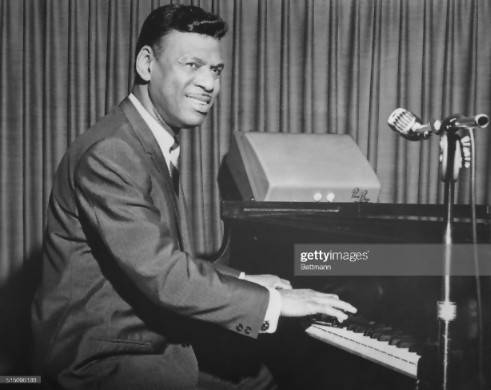
© Copyright ® Steven Cerra, copyright protected; all rights reserved.

“The meat of Hines's methodology was already set in place: sometimes called a 'trumpet style', primarily because of the sharply delineated melody lines, and tremolo effects which were used much as a horn player uses vibrato. His most dramatic departure from what other pianists were then playing was his approach to the underlying pulse: he would charge against the metre of the piece being played, accent offbeats, introduce sudden stops and brief silences. In other hands this might sound clumsy or all over the place, but Hines could keep his bearings with uncanny resilience.”
- Richard Cook’s Jazz Encyclopedia
“Actually, too much has been made of the impact of Louis on Earl. It is likely that the trumpeter's manner of phrasing encouraged Hines to develop his hornlike treble lines more convincingly, but there is little evidence of wholesale borrowing of musical concepts. Armstrong was a master builder, one who constructed a solo from the ground up; Hines tended, at this time, to think in four-bar or eight-bar fragments, each a unit unto itself. Louis moved with the rhythm section, often relaxing just behind the pulse; Hines pushed the beat, creating the illusion of accelerating while keeping perfect time. Most importantly, Armstrong thought in essentially vocal terms; Hines improvised primarily in abstract instrumental fashion.”
- Richard Hadlock, Jazz Masters of the 1920’s
Richard Hadlock [1927-2022] didn’t witness the birth of jazz in the early years of the 20th century. But he interviewed and befriended, studied and performed with some of the emerging idiom’s foundational artists, and it’s no exaggeration to say that he worked with pioneering New Orleans musicians who consorted with legendary trumpeter Buddy Bolden.
The longtime Berkeley resident has contributed to the jazz scene over the decades as a saxophonist, publisher, historian, educator and disc jockey who brings uncommon depth and free-ranging curiosity to all his undertakings, especially his long-running Sunday night KCSM show Annals of Jazz. An essential presence on the Bay Area airwaves since 1959, Hadlock was named on May 21, 2020 by the Jazz Journalists Association as recipient of the McPartland-Conover Award for Lifetime Achievement in Broadcasting.” [KCSM webpage]
Richard Hadlock has written jazz criticism for Downbeat, The Jazz Review, Jazz Quarterly, Metronome, as well as The New York Times and San Francisco Examiner. He hosts one of the longest running jazz radio shows, "The Annals of Jazz," on Station KCSM in San Mateo, California. He lives in Berkeley where he is an active musician.
First published in 1965, Jazz Masters of the 1920’s contains one of the most comprehensive essays about the work of pianist and bandleader Earl Hines [1903 -1983], another of the pioneers of Early Jazz that we are celebrating on JazzProfiles during the 100 anniversary of Jazz in the 1920s.
This feature is a continuation from Part 1.
“Earl's solo recordings in 1928 present a curious contradiction: though even more impressive in strictly pianistic terms than his Armstrong work, they occasionally suggest a man to whom music is a kind of advanced game of wits and perhaps little more. "Music is like baseball," Hines has said. "The reason we didn't go for back-room musicians much was that it didn't take anything to figure it out. If it's not a challenge, there's no fun in it."
Many jazzmen would agree, but perhaps not so many would want the kind of compliment that a Hines sideman once offered, quite sincerely: "Earl is just like a machine — but a machine that swings!"
There were moments of tenderness, real or posed, for the "machine that swings," though. His Blues in Thirds is a charming mood piece, if not a true blues in its depth of emotional expression. It was recorded first in Chicago as Caution Blues, but Earl's QRS version, made in New York a couple of weeks later, is the more sensitive rendition.
When QRS, ordinarily a piano-roll company, asked Hines to make phonograph records in December, he went immediately to New York for the date. Entering the studio without music or even very much idea of what he would do, Earl sat down and played eight tunes: Blues in Thirds, Panther Rag (obviously Tiger Rag, already recorded in part as 57 Varieties), Monday Date, two other blues, and three originals titled Chicago High Life, Stowaway, and Just Too Soon. Beneath the elaborate superstructures, these last three compositions are made up largely of stock progressions borrowed from songs like Sister Kate, Big Butter and Egg Man, and other good jam-session favorites.
That Earl hoped to make an impression in his New York recording debut may be deduced from these recordings in two ways: his tempos are exhibitionistically fast; and in several instances (Monday Date is one), he paraded his command of the Harlem "stride" style, perhaps added for the benefit of critical local pianists like Johnson and Waller.
The QRS solos (and those recorded in Chicago as well) are unique virtuoso performances. Though the Armstrong stamp still appears on some of Earl's ideas, this group of records marks his break with the trumpeter as a co-musician and as a continuing influence. From here on, each man went his own way.
Actually, too much has been made of the impact of Louis on Earl. It is likely that the trumpeter's manner of phrasing encouraged Hines to develop his hornlike treble lines more convincingly, but there is little evidence of wholesale borrowing of musical concepts. Armstrong was a master builder, one who constructed a solo from the ground up; Hines tended, at this time, to think in four-bar or eight-bar fragments, each a unit unto itself. Louis moved with the rhythm section, often relaxing just behind the pulse; Hines pushed the beat, creating the illusion of accelerating while keeping perfect time. Most importantly, Armstrong thought in essentially vocal terms; Hines improvised primarily in abstract instrumental fashion.
It was while he was in New York that Earl heard from Lucky Millinder, a sort of middleman between the Chicago underworld and the local music business, who was looking for a known musician to head up a band at the Grand Terrace Ballroom. Hines thought of his rehearsal group, assured Millinder that he was ready to go, and took the next train for home.
It was a good choice by Millinder, for Earl's knowledge of showmanship, staging, and musical directing put the fast-moving Grand Terrace show on a par with the revues at the Sunset and the Savoy. The band was a good one, if a little rough at first, and included top men like trumpeters George Mitchell and Shirley Clay, a Miff Mole-inspired trombonist named William Franklin, ex-Dickerson saxophonist Cecil Irwin, and Lester Boone, a good jazz tenor saxophone player. For a couple of months, trumpeter Jabbo Smith also worked with this band. Franklin, Alvis, and Irwin contributed original arrangements to the band's book, which was already expanding rapidly. By early 1929, the Hines band offered a respectable sound of its own that seemed to lie somewhere between the loose swing of Bennie Moten's Kansas City band and the advanced ensemble precision of William McKinney's Cotton Pickers. There were, too, overtones of smaller stomp bands in arrangements like Beau Koo Jack and of the strutting Harlem style in numbers like Everybody Loves My Baby. These and several other titles were recorded for Victor in February, 1929, barely two months after the band opened at the Grand Terrace.
During these early band years, Earl expanded his harmonic scope, partly through the influence of Cecil Irwin, whose arrangements for the band reflected the saxophonist's formal studies of harmony and increased interest in "modern" voicing. Ninths, elevenths, sixths, and minor sevenths began to appear more frequently in Hines's piano improvisations, adding new dimensions to his already complex style. An intriguing example of this new turn is contained in a February, 1929, solo recording of Glad Rag Doll. Two separate versions, takes from the same recording session, have been issued that offer some clues to Earl's transitional position at that time. Take 1 is a straightforward compound of Morton, Johnson, Waller, and Hines, full of strutting Harlem devices, that concludes on a major chord with the sixth added for interest. The second take is slower and more thoughtful, ending with a tense flatted fifth — a modern touch, indeed, for 1929. Throughout, Hines's affection for [Fats] Waller's frothy stride manner is evident. Earl's bass lines, alternating chromatic tenths with harmonically sophisticated oom-pah figures, are a mixture of Waller and his own ideas as originally developed from Jim Fellman in Pittsburgh.
As he continued to work with a large band, Hines began to rely more upon his supporting musicians, causing the full semi-orchestral sound of his piano to undergo subtle changes. The rhythm section took over many of the functions of the pianist's left hand, leaving Earl free to experiment further with running-bass countermelodies. Right-hand octaves were still useful in many instances, but more and more single-note improvisations were appearing in the pianist's solos. (By now, the widespread use of electric microphones had encouraged pianists everywhere to play with a faster, lighter touch.) Finally, Earl no longer had to prove his ability to other jazzmen, for he was acclaimed by musicians throughout the country and, as a bandleader, could send his music in any direction he wished without having to force the issue from the keyboard. This, too, had its effect upon his playing, now becoming less frantic and more contemplative — but no less venturesome — with each passing month.
By 1932, Earl had enlarged his band to twelve men. Cecil Irwin, Darnell Howard, and Omer Simeon made up the sax section; trumpeter Walter Fuller, who also arranged for and sang with the band, was a major asset; guitarist Lawrence Dixon, trumpeter-saxophonist George Dixon, bassist Quinn Wilson, trombonist Louis Taylor, and saxophonist Irwin all contributed original tunes and arrangements. British composer and arranger Reginald Foresythe formed a close friendship with Hines at this time and wrote a theme song, Deep Forest, for him. Foresythe's advanced harmonic concepts again affected the pianist's personal musical outlook. The Grand Terrace landed a network radio wire about that time, and regular broadcasts of the band from Chicago began to be heard across the nation. It was a happy period for Earl, despite the raging Depression that was crippling most of the American economy at the time. There was security, little travel, musical satisfaction, personal celebrity, and the excitement of planning musical shows around performers such as Ethel Waters and Bill Robinson. Young players like Teddy Wilson were coming around to learn from him, and visiting jazzmen from out of town frequently asked to sit in. For a green bandleader of 27, Earl Hines was doing rather well.
At this time, Earl turned out a pair of recorded solos, Love Me Tonight and Down Among the Sheltering Palms. The second is an especially notable performance, for it reveals a new level of maturity in its orderly progression from simple melodic statement to conservative embellishments to an agitated climax of broken rhythms and fugue-like cross-melodies. The solo, in short, is built to stand as a single spiral of variations on a theme, and it represents an advance from Hines's earlier montage methods.
The band took on a more positive identity in 1933, when arranger-saxophonist Jimmy Mundy joined up. With Mundy arrangements like Cavernism and Madhouse, the reputation of the band soared, and musicians began comparing the Hines band with Fletcher Henderson's superb organization. In this setting, Earl's playing took on a new warmth that had only occasionally been revealed before.
Hines continued to strengthen his band from 1933 to 1935. Trummy Young, a modern trombonist and an entertaining singer, joined the brass section. Singer Herb Jeffries became a prime attraction with recordings like Blue. The best addition of all, however, was tenor saxophonist Budd Johnson, replacing Cecil Irvvin, who was killed in a car accident. Johnson was a first-class soloist and a highly skilled, forward-looking arranger. He was also a good organizer and eventually took over many of Earl's personnel problems.
In 1934, the band started recording for Decca, a new company that took over many of the old Brunswick label's established artists, including Hines. Someone at Decca had the singular notion that the band ought to turn out a string of modernized Dixieland tunes, so Earl recorded Sweet Georgia Brown, That's a Plenty, Angry, Maple Leaf Rag, Copenhagen, and Wolverine Blues. The balance of the Decca output of 1934 and 1935 was made up of new versions of old hits: Cavernism, Rosetta (Hines's best-known composition), Blue, Bubbling Over, and Julia. The material was not really suited to a band as good as this one was, but Earl tossed off a number of impressive solos, particularly those on Copenhagen and Wolverine Blues.
The best of the Grand Terrace era was over by 1936. From the time the Hines band commenced broadcasting some five years before, more and more months of each year had been devoted to traveling. Now the band was away from home more often than not. In 1936, Benny Goodman lured arranger Jimmy Mundy away from Hines, and Fletcher Henderson became the darling of the Grand Terrace operators. Earl was, in fact, lucky to get even six weeks at the ballroom between Henderson runs. And there was no arguing with the Capone-trained backers of the Terrace — it wouldn't have been good for the "health," as contemporary movie villains were wont to say. The Decca contract lapsed, and no one bothered to record the band at all that year. Hines stayed on the road.
Most of the trouble, of course, came from Earl himself. He was not a good businessman and always seemed to make the right move at the wrong time. He also was, it must be added, neither popular among musicians nor skilled in public relations.
Though its fortunes rose and fell on the waves of mismanagement, the Hines band was still a musically rewarding outfit to hear. In 1937 and 1938, a few more records were released. By now, Earl had updated his playing again, featuring light, airy solos over buoyant swing-band arrangements. The crisp, almost metallic, and very authoritative keyboard touch was still there, as were the broken rhythms and double-time figures, but a fresh, graceful quality that hadn't been noticeable before appeared in some of his work now. The melodic lines were longer and smoother, with fewer stops and starts, and seemed to ride easily over the band rather than welling up from within it. The [Jelly Roll] Morton- [J.P.] Johnson dicta, which held that a good pianist must imitate a full orchestra, were almost completely put aside. The new piano hero of the period was Teddy Wilson, and it is quite possible that Earl borrowed an idea or two from the fleet and precise Wilson, just as Teddy had once learned much from him. It is likely, too, that Hines's deep regard for the clarinet style of Benny Goodman caused some modification of his old Armstrong-like "trumpet" lines. Much of the pianist's work from this time on was closer to clarinet-saxophone conception than to trumpet ideas. Good examples of this new phase of Earl's development are Pianology, Rhythm Sundae, and Flany Doodle Swing. Honeysuckle Rose, a concurrent quartet performance featuring clarinetist Simeon and tenor saxophonist Johnson, was a happy affair in which Hines and Johnson explored some outside harmonies while remaining inside the familiar Fats Waller composition.
From 1938 to 1940, Earl's band continued its downward slide. Though still bound by a one-sided contract with Ed Fox of the Grand Terrace, most of Hines's time was spent on tour. Budd Johnson returned to the group after a year or so with Gus Arnheim, but at one point about half the band, including Walter Fuller, quit altogether. Earl switched booking offices, but it didn't seem to help. In an era of successful big bands and unprecedented public enthusiasm for jazz, the Hines unit, though offering good music, might as well not have existed. Metronome magazine's 1938 annual readers' poll, in which swing fans voted for the "Best of All Bands," listed Earl Hines and company in seventy-ninth place. There wasn't much cause for rejoicing, either, when the magazine's 1939 poll pulled the band up to the sixty-first spot.
Walter Fuller's departure in 1940 was another blow. (The popular singer-trumpeter took his own band into the Grand Terrace but was pulled out by the union some months later when manager Fox failed to meet the payroll.) Budd Johnson was in and out for a while, but he finally returned to help Earl shape a totally new kind of band. The old contract with Fox had been judged worthless by the musicians' union, and Hines decided to give the band business a fresh try. He already had a new record contract with Bluebird, a hit record shaping up in Boogie Woogie on the St. Louis Blues (a commercial and uncharacteristic piano specialty), another new booking agency, a fresh band put together by Johnson, and he was soon to have a new singer named Billy Eckstine. When Billy recorded Jelly Jelly for Earl in December, 1940, the upward swing had already begun, but it was Eckstine who finally brought Hines the success he had been unable to find alone.
Just as he was beginning his term with Bluebird, Earl recorded two long solos for the very young Blue Note label, The Father's Getaway ("Father," often pronounced "fatha," being a nickname Hines had acquired from a radio announcer in the Grand Terrace days) and Reminiscing at Blue Note. They were his first recorded unaccompanied solos in seven years. The first is an explosive burst of energy and ideas into which Earl seems to be trying to cram everything he had ever learned. There is a segment of pure James P. Johnson, a sustained tremolo suggesting his Boogie Woogie on the St. Louis Blues routine, a series of wild rhythmic gyrations and some melodic broken-field running that seem on the verge of getting out of hand but never do, and an incredible tangle of block chords, suspensions, and breaks within breaks. The result is a kind of amalgam of new and old Hines in a display of virtuosity that no pianist of 1939, save one, could have matched. (The one, of course, would be Art Tatum, who himself began as a Hines-Waller disciple.) Reminiscing at Blue Note is a curious hodgepodge, full of references to boogie-woogie, pseudo modern harmonies of the twenties, Harlem piano, and smatterings of Hines favorites like You Can Depend on Me.
Three solos for Bluebird recorded in 1939 and early 1940 deserve mention. One is the inevitable Rosetta, which begins conservatively enough but eventually winds up as a tightly compressed knot of ideas, concluding, it seems, just before the snapping point. Body and Soul reminds the listener that Earl was still, though a more modern musician than before, a little too much the hard-boiled pianist to lose himself completely in a sensitive ballad performance. Child of a Disordered Brain is essentially a solo in the style of Fats Waller, upon which is superimposed a dizzying succession of out-of-time breaks and other familiar Hines devices.
The development of the Hines band from 1941 to 1943 is an important early chapter in the story of modem jazz and is better told elsewhere. Suffice it to point out that Budd Johnson gathered the best modem players he could find, helped to build a distinctive library of advanced arrangements, and acted as a valuable liaison between Hines and his men; that during this period the band included outstanding performers like Dizzy Gillespie, Charlie Parker, Sarah Vaughan, Scoops Carry, Freddy Webster, and Benny Green; and that Eckstine's departure to form his own band in 1943 sent Earl's rating down to the bottom of the polls again.
During this period of intimate contact with modern jazz, Earl's own style moved ahead somewhat on his band recordings but appeared to stand still on solo records. On the Sunny Side of the Street and Melancholy Baby, for example, are 1941 solos that actually seem to go back to the stomping and romping of Morton and Waller, although Hines' flourishes are present, too. Yet Earl's short solo on his 1941 band recording of You Don't Know What Love Is is built on a hard, firm line that was thoroughly modern for its time. The exploratory urge and the fondness for musical puzzles that distinguished the musical character of the budding jazzmen in the early forties were exactly the drives that propelled Hines. It is unfortunate that the sound of Earl's greatest band (1943) was never preserved, owing to a recording ban called during that year by the musicians' union.
Earl's next venture grew out of an anomalous ambition he had nurtured for a long time: to front a huge stage orchestra built along Paul Whiteman lines, complete with a string section. (Strings with dance bands were in vogue again by the early forties.) He added a covey of draft proof female violinists and some French horns to his new seventeen-piece band and featured concert arrangements of selections from Showboat and other old war-horses. The experiment lasted a few troubled months, after which the strings and horns suddenly vanished. By mid-1944, Earl was back to seventeen men, including reedman Scoops Carry, trumpeter Willie Cook, and tenor saxophonist Wardell Gray.
The recording ban was over in 1944, and Earl recorded some twelve-inch sides for Keynote, featured with groups led by Cozy Cole and Charlie Shavers. Amazingly, they were the first records Earl had made since 1928 with a group of jazzmen who were not only reasonably modern in outlook but also near Hines's own musical level in ability. The Cole releases are especially satisfying, for Hines was matched with Coleman Hawkins, and both men seemed to enjoy the experience enormously. Each had passed through much the same learning processes in the preceding two decades, and each stood on the threshold of modern jazz in 1944. Earl was uncommonly relaxed for the date, employing a light but authoritative touch and even trying his hand at some uncharacteristic bits of understatement. The four excellent performances are Blue Moon, Just One More Chance, Father Cooperates, and a reworked Honeysuckle Rose called Through for the Night. With trumpeter Shavers, Earl recorded another Rosetta, an uncommonly slow version of Star Dust, and two other on-the-spot compositions. Again one man on the date matched Earl's skill and artistry — drummer Jo Jones. With Jones assisting, Earl's background chording for front-line soloists is decidedly modern, totally unlike his work behind Armstrong in 1928.
A session for Apollo during this period found Earl once more in the company of his peers, in this instance altoist Johnny Hodges, bassist Oscar Pettiford, and drummer Sidney Catlett. Of six titles, Life with Father is the best example of Hine's 1944 style.
A set of four 1944 recordings with a trio that again included bassist Pettiford points up even more clearly what was happening to Earl at this time. Many of the arresting left-hand figures had fallen away in favor of light chromatic accents and occasional harmonic punctuations. The advent of bold, modern string-bass lines had made this move by Earl not only possible but musically desirable. In addition, Earl had long been hinting at a more soft and gentle approach, although his own best work never seemed to lean very much in that direction, and the modern rhythm section encouraged him to bring out that side of his musical personality.
"In the twenties," Earl recalls, "much of the music was loud, two-beat gutbucket stuff. It was like shouting all the time. I preferred musicians who played soft and beautiful things — men like cornetist Joe Smith, who used to stop the crowds cold using a coconut shell for a mute. Trombonist Tyree Glenn has some of that quality today."
Earl once selected Tommy Dorsey as his favorite trombonist, because Dorsey had "technique, good taste, experience, and a real knack for organization and selecting song material." These, it seems, were the qualities Hines now tried to stress in his own work. It was a more feasible proposition from 1944 on, when the prerequisites for jazzmen that prevailed in the twenties and early thirties — volume, powerful attack, heavy rhythmic emphasis, and a "down home" blues feeling — had been superseded by a new set of values — harmonic research, long melodic lines, rapid-fire articulation, and rhythmic experimentation. The only drawback was that Hines at 39 was not in a position to build an entirely new style on the principles of bop, and his middle-of-the-road approach, while perfectly sound musically, led nowhere commercially. Not wishing to play Dixieland or early forms of swing, but unable to participate fully in the modem movement of the mid-forties, Earl relied instead upon his new, softer, less aggressive mode of expression and entered what might be called his "bland" period. He has never entirely emerged from it since.
In 1945, the Hines band was still a rocking one, with jazzmen like Wardell Gray, Benny Green, and tenor saxophonist Kermit Scott featured, but Earl kept his own solos to a bare minimum. When the piano was spotlighted, the result too often amounted to an undistinguished porridge of pseudo-boogie-woogie and melodic cliches. This strange phase is documented by a handful of recordings — including still another Rosetta — on the ARA label. Earl's last sustained fling at big-band jazz was in 1947. He had just recovered from a serious automobile accident, his second in ten years, that had left him temporarily without sight. The economic picture grew darker, and he finally gave up, after nineteen stormy years as a leader, and accepted Louis Armstrong's offer to join his new All-Star sextet. It was not a good musical solution to Earl's dilemma, but the pay was good and the headaches were few. He stayed nearly four years.
Two decades had brought many changes, and the Hines-Armstrong team was no longer the formidable musical Gestalt it had been in 1928. Louis had, if anything, retreated from his once-modern position and arrived at a kind of theatrical New Orleans style, while Earl had moved on from his early modern approach to a musical posture consistent with later developments in the forties. Furthermore, Hines had long since grown accustomed to the limelight and could not be content as a sideman — even an All-Star sideman.
Not surprisingly, Earl's best recordings during these Armstrong years were made with others. A number of dates in 1948 and 1949, some with trumpeter Buck Clayton and clarinetist Barney Bigard (also an All-Star), found Earl in good form and occasionally up to his old creative level. One called Keyboard Kapers is first-rate Hines from beginning to end. Another mixed batch recorded without Armstrong while on tour in Paris is less impressive, but Earl repeatedly breaks through the prevailing air of indifference to offer some bracing ideas.
A set of solos for Columbia in 1950 features mainly the bland side of Hines's contradictory musical personality, but there are absorbing moments when Earl reveals what he could still do when the mood struck him. In his new Rosetta, for example, he constructs, over simple bass patterns, a long, single-note melodic line that could easily be the work of a modern horn player. Hines was still, when the spirit moved him, a unique and impressive talent.
The inevitable departure from Armstrong in late 1951 triggered some uncharacteristically hostile remarks from the trumpeter (reported in Down Beat at the time): "Hines and his ego, ego, egol If he wanted to go, the hell with him. He's good, sure, but we don't need him. . . . Earl Hines and his big ideas. Well, we can get along without Mr. Hines."
Earl lost no time in putting an excellent semi modern band together, but he soon found himself a victim of his own poor business methods again. Leonard Feather, reviewing the group in Down Beat, sensed the problem: "It's not surprising that Fatha Hines has one of the brightest little bands in the country. The only surprise is that he's been working so sporadically and that so few people seem to know about the group. (One possible reason: D'Oro Records keeps his releases top secret.)"
Featuring versatile jazzmen like trumpeter Jonah Jones, former sideman Benny Green, bassist Tommy Potter, drummer Art Blakey (later replaced by Osie Johnson), and reedman Aaron Sachs, this little band represented Earl's last bid for a place in the contemporary music scene. When it failed, the pianist seemed ready to try anything to earn his living. He worked for a while with a small unit featuring Dickie Wells, but that petered out as well. In September, 1955, Earl turned up at the Hangover Club in San Francisco with a pickup Dixieland band that included his old Chicago colleague Darnell Howard and New York trombonist Jimmy Archey. He learned an appropriate list of traditional tunes, discovered how to hold back improper "modern" chords to an even greater extent than had been necessary in Armstrong's All-Stars, and settled down to a long, if musically unrewarding, sojourn at the Western saloon.
For several years, the pianist covered up his Dixieland activities by recording and traveling with more modern trios and quartets, but in 1960 he finally went on the road with his traditional band and immediately found wide acceptance in Eastern nightclubs. Weary of resisting the unavoidable, Earl began rehearsing his little traditional band so that at least some part of each performance would reflect his penchant for organization and showmanship. Hines remained, as he must, very much the leader of his own band.
Shortly after settling in the West, Earl recorded two albums for Fantasy, one devoted to Fats Waller specialties and another containing twelve unaccompanied solos. The second set suggests that Hines's powers were undiminished; he soars effortlessly through a superb version of Piano Man, a blues named for the late Art Tatum, some new thoughts on Monday Date, and others. However, the records did not sell well, favorable reviews notwithstanding.
Along with a couple of uneventful sessions, including one conducted during a 1957 Paris visit, Earl recorded at least one outstanding performance during the next couple of years. This was Brussels' Hustle, a blues put together by Hines and some San Francisco musician friends for a Felsted recording. It is a hearty and imaginative affair, not at all like his playing in a Dixieland context. Brussels' Hustle reassured those who cared that Earl was still vitally concerned with music — and rather modern music at that — when he wanted to be.
A 1958 Benny Carter-Hines collaboration, with bassist Leroy Vinnegar and Shelly Manne added, should have provided the ideal showcase for Earl's finest work, and indeed there are many good moments in the twelve performances they recorded, but Carter's unbending alto and Hines's cool piano failed to inspire each other. It was, however, a noble experiment (by Contemporary Records) and a rare instance of intelligent handling of the enormous Hines talent.
Earl's next trip to the studios occurred a year later, when MGM tried once more to sell the natural and timeless Hines style rooted in the music of the mid-forties. An engagingly handsome quartet treatment of Willow Weep for Me and a happy Stealin’ Apples place this date among Earl's best later efforts, but it was followed by a long silence — a silence broken only in 1961 by a new recorded collection of Earl's Dixieland band numbers: from his 1927 recordings with Johnny Dodds, Earl had traveled nearly full circle.
In early 1963, Hines dismissed his traditional group and for a while tried operating his own nightclub in Oakland, California. From time to time, he toyed with a big band, worked with a semi-commercial swing sextet, and even experimented with a trio consisting of piano, organ, and tenor saxophone. Though reluctant to leave his well-appointed middle-class home and family in Oakland, he found his greatest success on trips to the East. A long overdue jazz piano recital at New York's Little Theater in 1964 enthralled critics and led to new record dates, as well as to an engagement at Birdland, a club generally reserved for modem musicians. In strapping health and still a persuasive improviser, Hines appears ready to carry on his search for musical and financial fulfillment for many more years.
Hines's influence over other pianists has been so extensive that it is difficult to assess it clearly. Broken-bass rhythms, treble octaves, frequent use of tenths in both hands, and even trumpet-like melodic ideas were not new or original with Hines; it was how he combined them into a refreshing new style that made such a deep impression on other pianists. Unlike most of the barrelhouse keyboard men before him, Earl captured the spirit and substance of jazz without sacrificing classical finesse. He used, for example, all the foot pedals for shading, tone control, and heightening the dramatic value of certain passages. His arched fingers, long enough to cover a tenth but seldom more than that, struck the keys in the crisp, forceful manner of a concert pianist. Earl's tremolos were never the sloppy affairs that one heard from blues and boogie-woogie specialists; each note sounded strong, clear, and evenly spaced. And there were no phony diatonic runs or other shortcuts to flashiness; Earl conceived and played every note.
Hines's solos differed from those of, say, Jelly Roll Morton in one fundamental way: Morton and other early pianists attempted to emulate the sound of an orchestra; Earl wanted to achieve the sound of a horn soloist over supporting rhythmic and harmonic figures. The older view followed logically from ragtime and New Orleans preferences for ensemble playing. (King Oliver once scolded pianist Lil Hardin for making fancy runs by reminding her that "we have a clarinetist in the band.") Earl's attitude made perfect sense in the light of new trends toward solo exposition ushered in largely by Louis Armstrong.
It was the Hines theory that appealed to young pianists in the late twenties and early thirties. Jess Stacy rejected the violent broken-bass figures, but he made extensive use of Earl's hornlike treble phrasing in octaves. Joe Sullivan elaborated on the powerful on-the-beat attack that marked much of Earl's work and borrowed some of his jagged-bass-line concepts as well. Teddy Wilson arrived at his own influential style by way of Hines's octave work in the right hand, his handling of chromatic tenths in the bass, and his advanced harmonic inversions and alterations. Art Tatum picked up and extended some of Earl's most spectacular tricks — overlapping counter rhythms, breathtaking suspensions, fiery double-time figures, and startling changes of pace and direction. Hundreds of others learned from Hines, many of whom tried to copy his style outright.
Though Earl's playing was agitated and "hot" (in the best sense), it was seldom earthy. Stacy and Sullivan avoided this trap by combining the blues message with their Hines-derived styles; Wilson and Tatum, like Hines, evinced little interest in the blues and remained "cool," though highly effective, jazzmen. Through these two channels, Earl affected virtually every jazz pianist who came after him — until the arrival of Bud Powell and Thelonious Monk in the forties.
Because Hines is still an outstanding pianist and a robust, restless man, those who admire his music are hopeful that he will yet achieve rightful recognition for just what he is—an unclassifiable improviser, a primary contributor to the art of jazz piano playing, and a performer still capable of sustaining intensity and excitement as few jazzmen can. Only in Europe, especially in England (where Earl appeared with Jack Teagarden in 1957), has Hines found widespread enthusiasm for his work. It is a pity the country that planted the flower will not permit it to reach full bloom in its own soil.”