© Copyright ® Steven Cerra, copyright protected; all rights reserved.
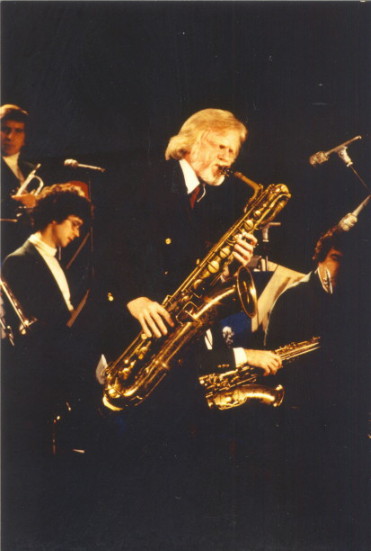
Central to the importance of this article by Richard Cook which appeared in the November 25, 1986 issue of The Wire is the statement that closes it: “the 1986 Gerry Mulligan displays more talents, in a far more appropriate context, than the youngster who exploded on the West Coast scene more than three decades ago.”
For someone who was a constant figure in the national Jazz press for the first 25 years of his career, Jeru was an infrequent reference in it during the last 25 years of his career until his death in 1996.
Some of the reasons for this absence are explained in Mr. Cook’s article. [Of course, what’s not mentioned is the fact that the music itself lost its presence in the national Jazz press.]
What is important is that Mulligan continued to grow as an artist and to represent this development in the new and different venues that were available to him in the 1980s as described in Mr. Cook’s article.
“GERRY MULLIGAN'S NAME CONJURES up a bright yet somehow fuzzy image as a jazz-household word. The reason will be clear to anyone who has followed his greatly acclaimed but convoluted career.
He has been a leader and a sideman; a composer and arranger; has headed groups of every size and shape, and has voluntarily been semi-inactive for extended periods. Nevertheless, he has enjoyed what may be an unequalled series of consecutive poll victories, as the No. 1 baritone saxophonist, starting in 1953. For many years Duke Ellington's Harry Carney had a near-monopoly on this full-toned horn. Mulligan and Carney (who died in 1974) were mutual admirers and once recorded together with the Ellington orchestra.
Today, very belatedly, Mulligan has devised a setting that enables him to display his multiple talents. He is leading, more or less on a full-time basis, a 15-piece orchestra that devotes itself primarily to his compositions and arrangements. In recent years he has taken to doubling on soprano saxophone, an instrument that has been violated by so many squeaking, out-of-tune dilettantes that the purity Mulligan brings to it is a rare joy indeed.
Because the band has never played in California, it was good news to me that Jeru (this is the nickname given him many years ago by Miles Davis) had been booked to play the last two of four consecutive week-long cruises out of Miami aboard the Norway — the world's longest jazz festival, produced by Hank O'Neal and Shelley Shier. I was on board for the second and third weeks. More than 100 musicians were involved in this unique venture; Mulligan thus was able not only to present his own ensemble but also to join impromptu forces with various small groups involving a few old friends and several promising youngsters.
Al Cohn, who played on the Norway last year teamed with the late Zoot Sims, was particularly pleased to be reunited with Mulligan during one of the late-night jams. "Gerry and I go back a long way," he reminded me. "I played with him and Zoot Sims on his Mulligan Song Book album in 1958, and I wrote some of the arrangements for the album he did with Judy Holliday." (Holliday With Mulligan, in which the actress sang four songs she had written with Mulligan, is the most tangible legacy of their long romance in the 1960s and early 70s. After her death, Mulligan continued to make the gossip columns during a romance with another actress, Sandy Dennis, that also lasted several years. He is presently married to an Italian, Franca, and has a home in Milan.)
Probably the most surprising ad hoc grouping during the cruise was his alliance with Art Hodes, the Chicago-based pianist who was 81 last November. After playing briefly with a rhythm section that included an old Mulligan teammate, Bobby Rosengarden, on drums, Hodes paired with Mulligan for a slow, pensive blues for which the two men were alone on the bandstand.
Hodes has always taught Basic Blues Piano 101 in his simple performances. Time was when I found his style limited, once writing impetuously (and quite inaccurately) that I could cut him at any session. Hearing him in a more mature light four decades later, I was impressed, not only by the taste Hodes showed within his technical compass, but also by the sensitivity with which Mulligan adjusted his style to a situation that was, for him, quite unusual.
"I enjoyed playing with Art," he said afterwards. "In fact, it's been a kick having so many people around whom I don't normally get a chance to play with."
For some of the less experienced artists present, the opportunity to play alongside such giants as Mulligan, Joe Williams, Dizzy Gillespie and others was a rare learning experience. Cyrus Chestnut, a 22-year-old pianist and composer, was technically on hand as a member of a group of students from the Berklee College of Music in Boston, under the direction of the trombonist Phil Wilson, of Berklee's faculty. It is safe to assume that within a few years Chestnut will be well known in jazz circles for more than his uncommon name.
During the same set Mulligan summoned to the bandstand an onlooker who was not an official member of the festival; Eliane Elias, a gifted pianist from Brazil, had joined the party as the wife of Randy Brecker, the New York studio trumpeter.
For all his pleasure in these unplanned collaborations, Mulligan clearly was proudest of the moments when he presented his full orchestra in concert. Essentially, this is an updated extension of the slightly smaller band, 13-strong, with which he toured internationally in the early 1960s; but the present band's repertoire was almost a cross-section of his variegated 33-year life as a leader.
"Bweebida Bobbida", for instance, with which he opened one recital, brought to mind for me his very first session with a band of his own, in 1951, for which he composed it. Though the original record, by a nine-piece group, sounds a little dated, he has brought to the present version the textures and orchestral diversity one expects from him as both a classicist and a vivid melodist.
"Line for Lyons", named for the Monterey Jazz Festival's Jimmy Lyons, was a product of the 1952 Quartet with Chet Baker; though he has recorded it several times, the 1985 treatment brings it up to date, retaining the simple essence of the song but interpolating solo, sectional and ensemble work that reflects his progress both as writer and soloist.
Outstanding in the band’s library are several compositions from his album Walk On The Water, which won him a Best Big Band Grammy Award in 1981. "Song For An Unfinished Woman" accentuated the band's sedulous attention to subtle dynamic contrasts. On "42nd And Broadway", a delightfully captivating melody, Mulligan switched to soprano saxophone. For Duke Ellington's "Across The Tracks Blues", he virtually duplicated the master's original version, with a splendid reed section passage, clarinet taking the lead, Gerry's baritone supplying the solid foundation. Even the piano introduction by Bill Mays was a note-for-note restatement of Ellington's own.
Mays was one of several inspired soloists. "I moved to New York two years ago because I was tired of doing studio work," he told me. "Now I'm getting all the jazz gigs I want. Playing with this band is a dream." In the rhythm section with him are the drummer Richie de Rosa and an exceptionally supple bassist, Dean Johnson.
In the sax section was Seldon Powell, a tenor veteran with name band credits from Erskine Hawkins and Louie Bellson to Benny Goodman and Clark Terry, "I’m not a regular member of the band," he said, "but Gerry's tenor player gets seasick, so he opted out. I told Gerry I don't get seasick, so I got the job." Also subbing in the reed team was the alto saxophonist Jerry Dodgion, who toured the USSR with both Benny Goodman and the Thad Jones/Mel Lewis band.
Mulligan's talents do not end with his writing and playing. "When I Was A Young Man" presented him as a cheerful, quaintly charming vocalist and writer of lyrics to his own song.
True, the tall, crew-cut, clean-shaven, redheaded youth of the old Quartet days has yielded to a tall, gaunt, white-bearded figure, but the effervescent personality seems to improve with age along with his music. In short, the 1986 Gerry Mulligan displays more talents, in a far more appropriate context, than the youngster who exploded on the West Coast scene more than three decades ago.”