Showing posts with label Herbie Hancock. Show all posts

Sunday, November 12, 2023

So Much Heart: HERBIE HANCOCK on Wes Montgomery


© Copyright ® Steven Cerra, copyright protected; all rights reserved.


“The first time I heard about Wes Montgomery, I was anxious to see what this guy sounded like; this guy everybody was raving about. Those people who were raving about him were right. He was amazing. I had a lot of experiences with him — I made some records with him; I heard him on the radio back then on the jazz stations, and I watched him play the magic that he played and that everybody borrowed from him from that point on. He changed the face of jazz electric guitar.


He had a beautiful way of playing in different settings, whether it was a small group setting of a quartet or a quintet or large-scale things with orchestral accompaniment. He made several records with large ensembles and he was able to bridge the gap between two views of what could be considered jazz. One was more related to the pop side of jazz and the other related to the more hardcore jazz. He just knew exactly what to do depending on the setting. And here's a guy who never studied guitar. He was self-taught. He didn't read music, but he sure had amazing ears, amazing fingers and an amazing heart.


Wes was known for his ability to play his improvisations and/or his melodies in octaves. He created this way of being able to do that and move around quickly on the guitar. As far as I knew, before Wes, nobody knew how to do that. Many guitar players tried to copy what he did. but most of them gave up. George Benson was able to get some of that. I mean, I'm sure he would say that Wes was a mentor for him and his basic style. And as a matter of fact, when George Benson first came on the jazz scene he was playing with Jack McDuff, the organ player, everybody was saying, "Oh. this young kid." which he was then, "This young kid is the next Wes Montgomery." To my ears, it sounded like he followed in the footsteps of Wes Montgomery, but I think the other guitar players quickly gave up the idea of being able to play that octave style the way Wes did it. It just seemed impossible to them. 


Maybe they tried it. I'm sure they all tried it. but they gave up.


I didn't spend very much personal time with Wes. When I saw him at clubs, it was usually because he was performing and it was only actually during the recordings that I made with him at Rudy Van Gelder's studio that I got to have some personal time with him. It wasn't very much because we

were concentrating more on the music that we had to do that day, but Wes was a very personable human, a person full of the kind of heart that you would expect from someone who plays with so much heart. Some musicians can be problems or their egos get in the way. Many times, it's actually an ego problem. But Wes wasn't that kind of person. He had a great humility and a great respect for all the other musicians. I never saw him get into anything like an argument or any kind of confrontation with anybody.


This is another reason the musicians respected him so much. It wasn't just because he was a musician and the talent that he had as an amazing guitar player, but as a human being. He had great humility and never tried to overshadow any other musicians. He just played himself and it was always amazing.


When Creed Taylor started making records with Wes, it marked a change in Wes's style, at least on record. On Creed's records, very often there was an orchestral background. This was not something that was heard prior to that on jazz recordings. There might have been some, but they were few and far between, but the orchestrations on Creed's records were modern for that time — the sixties and seventies.


There was a connection to popular music in that approach. Now this is not rock and roll, but more like the popular music that had evolved from the Great American Songbook and some of those songs were actually from the Great American Songbook, the style from the twenties and the thirties and the early forties. They were so beautiful, although there was a little controversy among musicians about Creed's approach. Many jazz musicians were very protective of the style of playing that evolved from Charlie Parker and Dizzy Gillespie. that very speedy and very amazing music from a technical standpoint. It was amazing music in itself, but it was also advanced from a technical standpoint, whereas those records that Creed made with Wes were considered by many jazz musicians to be easy listening music.


But whatever negative first impressions the jazz public or jazz musicians had, they quickly changed because they had to. It was just so beautiful that nobody could stay on the other side of the tracks of that. Many musicians not only began to admire it. but they also wanted to make records like that themselves.


When we recorded the records I did with Wes for Creed, it always began with the rhythm section with Wes playing live in the studio; the orchestra was overdubbed later. They were always done that way. Back then. Creed would usually hire what was considered the kind of Blue Note, go-to rhythm section. Ron Carter was often the bass player with Grady Tate on drums. I was not the first pianist in the beginning, but I did play on all or part of around five of Wes's records he did with Creed.


When he played in clubs and concerts, Wes seemed to go back to what he was playing at the beginning, which was more straight-ahead jazz, as you can hear on these recordings. Wynton Kelly was the perfect partner for Wes for that. Wes and Wynton sure could both play the blues and in that jazz style of blues playing. It was funky, yet it balanced the technical side of jazz playing and sophisticated harmonization.


Wes made some records with Wynton Kelly. They sure sounded tight, very much in the same pocket, in the same bag. Wynton and Wes were older than I am. Not much older, but older. Wynton was from the era before I came on the scene. My own harmonic approach to jazz was a little further advanced than Wynton's style, more like something that was influenced by Bill Evans, and so on the records Wes made with Creed Taylor, the style that I played was a style that was probably more closely related to the orchestrations that Don Sebesky demonstrated with what he wrote for the Wes albums — I mean closer than what Wynton did. But we had two styles. They were not opposed to each other, but they were certainly different styles we were playing. And whereas mine leaned kind of between a funkiness that came from my background being born in a Black neighborhood in Chicago, which is a blues town really, along with harmonies that grew out of composers like Maurice Ravel, whom I listened to a lot. as well as other composers like Stravinsky and many other more modern composers. That wasn't Wynton's bent. His was in a way kind of closer to the bone and maybe my style had some other ornaments that I put on the bones.


When Wes came on the scene, everybody was talking about him and they continued to talk about him for years because his playing continued to evolve into different settings as the harmonic structure and the focus of jazz recordings began to expand into the pop area, while still maintaining jazz roots, which was a new thing at that time. And those records he made in that way pioneered that direction and the jazz musicians loved it. It gave them kind of a doorway to being able to sell more records to a wider audience. And not just the selling of the records, but expressing themselves to a wider audience.


The musicians were more about the music than they were about the money. If you were worried about the money, you wouldn't be a jazz musician. That wasn't what we cared about. We cared about the music and that's what we wanted to share. I mean, it's always that. That's the heart of jazz and Wes Montgomery is an integral part of that heart.”


Excerpted from an interview conducted by Zev Feldman on May 26. 2023.


Monday, January 17, 2022

A 60-Second Harmony Lesson from Herbie Hancock - by Benny Green

 © Copyright ® Steven Cerra, copyright protected; all rights reserved.


The anecdote that pianist Benny Green relates below about his encounter with Herbie Hancock in Japan while both were touring the country with a select number of other Jazz pianists has taken place countless times both formally and informally in a variety of settings since time immemorial.


In a way, it’s another example of the adage: “Jazz can’t be taught but it can be learned.”


And, in my experience, the best way to learn Jazz is to learn it from those who have already demonstrated what you want to “say” on your instrument when you play Jazz.


How did they get to where you want to be in terms of technical proficiency and expressiveness? 


In the final analysis, it’s rarely about what gear you use, or what practice techniques you employ or how you conceptualize the music - all of which, of course, are important - but it’s usually about something simple and direct that breaks down barriers to entry. Accumulate enough of these lessons through studying with or listening to the masters and the results can be transformative in terms of the quality of your playing.


To wit -


“On too many occasions, I’ve reached out into an abyss of the unknown, hoping something "different” and beautiful will manifest, while lacking substantial grounding of any real semblance of sure footing from which to proceed.


Whether though divine intervention or merely law of averages, sometimes a happy accident might occur when one doesn’t really know what they’re doing, but as bassist Ray Brown cautioned when he felt that I tended to leave too much to kismet or chance - “If Oscar, Phineas, Ahmad, Hank Jones and Tommy Flanagan come out to hear you, and there they are sitting in the front row - you'll want to have something prepared”.


During an afterparty for musicians who’d played the Mt. Fuji Jazz Festival in 1988, in a small corridor adjoining the ballroom of our hotel and relatively out of view and earshot of other attendees, one of the pianists noticed a small upright piano.


Billy Childs, Mulgrew Miller, Renee Rosnes, me, and possibly Gonzalo Rubalcaba, (who was on the festival program that year although I’m not positive whether he made this particular hang), gathered around the piano with Herbie Hancock - all seeking an impromptu lesson, be it collectively or individually.


What wound up happening was that each individual in turn played a little for Herbie, who then provided each of us with some candid personal feedback.

What I recall of Mulgrew and Herbie’s exchange, was that Herbie encouraged Mulgrew to employ more “close fingering” and less of a raised-finger position in articulating his single-note right hand lines. Mulgrew expressed great appreciation and value for what Herbie had suggested, and I remember him later intimating that this exchange marked (paraphrasing) - a significant kind of turning and growth point for him.


I stood hovered over the other pianists’ shoulders as they played, halfway more caught-up in taking in the incredible good fortune and rarity of such a once-in-a-lifetime moment, than fully absorbing the informational gold that Herbie was imparting.


When it came my turn, I hadn’t given any real significant forethought to what I’d play. As embarrassed as I was about to become, the spontaneity of the situation, and the reality of the lack of preparation on my part, exposed my musical immaturity in no small way. I’ve since learned that a student’s musical shortcomings being fully exposed, is an ideal place from which a teacher can access and address the truth of a young musician’s stage of development. If one seeks to learn, they need not pretend that they know more than they do, that’s just a defensive stall from allowing the teacher to help.


Although my teacher and New York Father, Walter Bishop, Jr., was completely in my corner and believed in my potential all the way, the first time he heard me play outside of our lessons, comping for horns in a jam session when I was 19, he called me out of the club and onto the sidewalk. “What the hell were you doing up there? You sound like a striped tie on a plaid shirt - too busy. I see we’re going to need to work on your comping”. That’s some real love - Bish cared so much and was so invested in helping me, that he’d said “We”.


I began attempting to play “Someone To Watch Over Me” for Herbie. I guess I was trying to play what I’d hoped, on a wing and a prayer, would somehow turn out to be some sort of dramatic harmony.


Herbie stopped me after about 11 or 12 bars, and motioned for me to get up from the piano.


“If you want to play this song - or any song - you first need to learn how to do this -“


And with that, he proceeded to play the song in a way markedly unlike how I’d characterized Herbie Hancock’s playing to myself prior to that moment. He played what sounded like a very plain and authentic piano sheet music arrangement, with perfect counterpoint and voice distribution and of course, a gorgeous touch that made the upright piano sound like a grand. It was nothing fancy, no bells or whistles, it was just correct. He played “ Someone To Watch Over Me” - really straight, and good. To illustrate what I lacked, he served the melody rather than using the song as a vehicle to show off his wares.


This was undoubtedly an invaluable schooling in building one’s own house - whatever shapes and forms it may ultimately become, from solid foundations.”


Saturday, February 20, 2021

Herbie Hancock: Into His Own Thing by Brooks Johnson

 © Copyright ® Steven Cerra, copyright protected; all rights reserved.


It’s hard to believe that this interview was published half-a-century ago in the Jan. 21, 1971 edition of Downbeat.


Herbie was just finishing his first decade on the Jazz scene.


But then, as now, Herbie’s ability to articulate what’s happening in the Jazz World in general and in his music in particular is straightforward and full of insights.


“Herbie Hancock had been doing SRO business all week at the Cellar Door in Washington, D.C., and it seemed inconceivable that things could get any better. The crowds were receptive and the group—consisting of Eddie Henderson, trumpet, fluegelhorn; Julian Priester, trombone; Benny Maupin, tenor sax, flute; Hancock, keyboards; Buster Williams, bass; Billy Hart, drums— really swung. It was Saturday night and the Cellar Door was as jammed as I had ever seen it, but there were two people present in the audience who probably helped to inspire the group to even greater heights than usual: Dizzy Gillespie, seated in a chair on the aisle, and Bill Cosby, seated on the front stairs. It was just that crowded.


As expected, the group really let it all hang out on "Fat Albert Rotunda." There are magic moments in a jazz listener's life when a certain combination of factors produces a truly memorable experience. It was after this performance, the last set of an exceptionally fine week, that I interviewed Herbie Hancock. I had been particularly impressed with the way in which the rhythm section seemed to work, and the thought struck me that they played so well together and got so much out of three pieces that there did not appear to be that much need for anything else. I was curious why Herbie wanted the sextet sound and feeling; thus my first question to him and the start of a rather revealing interview.


Brooks Johnson: One of the first questions that comes to mind, particularly when I heard the trio work, and the way it was swinging, is what are your basic motivations for performing with a group consisting of six pieces?


Herbie Hancock: Well, when I did the sextet album, I liked the sound of that particular combination of instruments. So right then and there, I decided that if I got a group together, it would have to be that. In using this instrumentation, I've got the same flexibility a small group has and yet I have a vehicle for getting orchestral colors the way a large group might. I've got three horns—that's almost like a lower limit for making what we call harmony. You can do it with two instruments, but three is the least comfortable number of instruments for getting harmonic colors. Let me explain that just a little bit: The three instruments being trombone, fluegelhorn and alto flute for the ensemble, I can use, I get a chance to experiment with woodwind color, which a saxophone will not give you. And then the fluegelhorn has enough of a trumpet quality, yet enough of a more blending quality because of its mellowness so I can use it with the alto flute. It sort of overlaps in sound, and then the trombone gives it a little brassiness. This way, I get a chance to really use different kinds of colors, not just because of the harmony I can use, but because of the instruments that I have.


B.J.: Now, assuming that you had a concept in mind, or a type of sound you wanted, I'd like to know when you started to choose your personnel, and let's review them individually, by what criteria; what were you looking for, what did you hear? Let's start with Billy Hart—what attracted you to him?


H.H.: Well, actually, I'd heard him with Wes Montgomery and Jimmy Smith. That alone didn't convince me that he would be the right drummer for my band. It was just that I had to have a substitute drummer one day, and Buster Williams told me to call Billy Hart—he said he's out of sight. I said OK. I really didn't know he was going to work out.


When he swings, when we're doing a thing that's supposed to swing, he swings hard. And when we're doing things that are... well, I guess I can break it down by saying the scope of the band is very broad. We do things from finger popping, swinging things through things that are more like rock or rhythm and blues, on through impressionistic-type things, and then on up to very far out things. So we cover a very wide area, and I want to have somebody who can do all of that—just play music for the sound of the music, not a guy that can play a bossa nova, and he can play a rock beat, and he can play this or that, not that, but a guy who has a style that encompasses everything. Now that applies to all the guys in my band.


B.J.: What particular quality do you hear and feel most from Buster Williams?


H.H.:  His walking style.  When he walks on the bass, he places the note - in exactly the right place in the beat so that he really swings. His musical conception is what really knocks me out.


B.J.: How about Julian Priester—he's a recent addition to the group, right?


H.H.: Right. Julian is probably more steeped in tradition, I think, than the other guys in the group. He worked with Max Roach quite a few years ago, and with Lionel Hampton and Duke Ellington. But he knows the trombone. He just brought up, a couple of days ago, his bass trombone, and he's going to bring an alto trombone in addition to a tenor trombone, so he's going to play all of those on the gig. It was funny, the first few days he worked with us, I didn't know whether he was going to give me what I needed.


B.J.: And Eddie Henderson?


H.H.: Well, there's a certain lyrical quality about Eddie's playing that is the kind of thing I was looking for. He doesn't just play the changes and run chords off the changes. He constructs melodies that stand alone without the changes, and builds them a lot on composition.


B.J.: We talked earlier about the particular use of the fluegelhorn. Do you want to elaborate on that and how it brings in the certain tone quality and texture that you're looking for?


H.H.: The fluegelhorn has a sound that to me is somewhat between a trumpet and possibly a French horn. It's sort of a mellow trumpet because of the construction of the horn itself. It blends better with the alto flute and the trombone — better than the trumpet does. We use the trumpet when we need a lot of pure power. But on the other things, we use the fluegelhorn because it blends better with the other instruments.


B.J.: The saxophone player is Benny Maupin. What is it that particularly recommends him, or his playing, to you?


H.H.: Well, Benny plays pure sound. He gets inside of the music that's going around and grabs out the core. You know, he uses the chord changes only as a point of reference in most cases, and I mean a point. You hit that point and he goes off someplace else and comes back and hits that point and goes off someplace else. In addition to that, his style—all the guys' styles broaden the scope of the band.


B.J.: OK, now you have five talented musicians and yourself, which makes six. Now you've had it both ways — as a side-man, part of a rhythm section, you had a studio thing, and now you have your own group. Can you point out the things that you dig that are special and peculiar about having a group?


H.H.: I get a chance to play my music and, as a group, we get a chance to evolve the music. You can't do that at a recording session that is a one-time thing — you have to play tunes over and over in different settings on different occasions. Subsequently, the tune will change shape depending on the individual feelings of the musicians who are playing it.


B.J.: What are some of the problems about being a leader?


H.H.: Well, I'm responsible for paying the guys and making sure that they work so l can keep a hand. That's one rough thing, because I have to worry not only about my family, I have to worry about six families— I have to be aware they're there, and if I'm going to keep a band, I have to make sure that we're working so that they can feed their families as well as I feed mine. Secondly, I guess the leader, depending on the I guys in the group, can run into problems with personality, and I guess it's up to the leader to really keep the situation open enough so that personality conflicts don't erupt, keep some kind of harmony in the band.  It's kind of rough.


Also — well, this isn't much of a problem with this band — a bandleader could run into the problem of not allowing enough of the personality of the individual players to be present in the music. They have to all feel that they are responsible for doing the best they can. If they don't feel the responsibility, if they don't feel that they're really contributing, then they may feel that they're sort of dead weight in the band—just holding an instrument and not serving a real function. So their personality has to be present in the music.


B.J.: What about the experience or the influence that your stay with Miles Davis might have had? For example, what things about Miles, as a sort of group leader, do you yourself think were worthwhile salvaging in terms of bringing together your own group?


H.H.: One thing I just mentioned — the openness of the music. With Miles' band we were all allowed to play what we wanted to play and shaped the music according to the group effort and not the dictates of Miles, because he really never dictated what he wanted. I try to do the same thing with my group. I think it serves this function that I just mentioned-—that everybody feels that they're part of the product, you know, and not just contributing something to somebody else's music. They may be my tunes, but the music belongs to the guys in the band. They make the music — it's not just my thing — that's one thing.


Miles showed me some other things, even the construction of the music. I used to bring tunes to Miles and he would take things out and put different bass notes on certain chords and extend certain phrases, and put spaces in there that I hadn't even conceived of. It's kind of hard for me to describe exactly what he does, but he uses certain devices in order to make the tune more meaningful and make it — actually, make it slicker. Miles really knows how to make a tune slick, and I learned a lot about that from watching how he goes about making a tune. He doesn't put too much in it or too little, you know, and none of his stuff is commonplace.


B.J.: There seems to be a trend in music, probably exemplified by your band, toward playing music that a lot of people can relate to. It's not so far removed that the listener can't get into it. Would you care to address some remarks to that — what do you think the trend is and the feeling is in terms of, say, just as a music, and in terms of the audience returning to the clubs?


H.H.: Well, let's start with my group. I personally have always been involved with a variety of music from things that I did with Miles to the things I did with Wes Montgomery to the things that Mongo Santamaria got involved with, and so I've had a chance to experience firsthand a broad scope of things. One thing I wanted the group to be involved with is the whole, total picture of music. I think everybody in the group enjoys that as well as I do. This keeps the group interesting to its members and keeps the music interesting to the audience. Now that's just part of the picture.

Another part is that when we play, we're not playing for ourselves, purely. We are conscious of the fact that there are people out there. It has nothing to do with the people who are paying to hear us or whatever it is. It's just the fact that the people are there and they are part of the surroundings that produce the music. We're just a vehicle that the music comes through, so the audience plays a definite part — we don't try to shut them out of the musical situation.


B.J.: They're part of the whole catalytic process then, and the creation on any given night to some degree reflects whatever is coming from the audience itself?


H.H.: Right. To get into the other more general question you were asking about the direction of jazz today. There was a time when you could say that there was a direction in jazz, and the people who didn't follow that direction usually stood alone, you know. But there was a general direction that everybody went in. Not so much today. I think there are many directions happening in jazz, and you can't pin it down to one. There is what's called the avant-garde; there's what's called the jazz-rock idiom; there's what's called I guess you'd have to say a post-bebop flavor to music. Then there are some groups that are involved with total theater — involving not just music but some visual things too. Right now, I'm thinking of the AACM in Chicago, the Association for the Advancement of Creative Musicians, and it's really hard to pin it down.


There are certain people like, for example, Miles Davis, Tony Williams, Cannonball Adderley and myself who have gotten into using electronic instruments— you know, electric bass, electric piano and exciting instruments like the bass clarinet in my band, and in Miles' band, he's got Airto Moreira. he's a Brazilian, playing all kinds of Brazilian instruments. And in Cannonball's band, he's got the electric bass and sometimes they even play guitar. The bass player, Walter Booker, plays guitar sometimes, and Joe Zawinul plays the electric piano.


But these groups are influenced by things that are happening in rock, and we've found ways to use some of the things we've heard in more commercial aspects of black music that can be employed to expand our horizons. But that's not the only direction that the groups that I've mentioned are going in. Miles is still as far out as he's ever been—farther out, if anything. The same thing with my band, and Cannonball's too. In addition to that, there are also the more lyrical-type things that we also do that may be linked with impressionistic flavor, if anything.


B.J.: My feeling is that the thrust or partial thrust of some of the music is going to bring a lot of the people back in—people like myself, who are used to hearing changes and things like that. Do you think this is going to continue to be the case?


H.H.: Well, we don't play changes the way we used to anymore. But we are, in most cases, aware of the changes. In most cases, we're not just playing a melody and then just going off and playing whatever we feel at the moment. There usually is a chordal basis that underlies whatever direction that we go in.


B J.: There is a common denominator that has some substance and some form that runs through all music, and I think the audience eventually picks it up. There's got to be a certain common denominator of familiarity. But too often the avant-garde went beyond the range of familiarity for listeners and even in some instances, musicians as well.


H.H.: Could be. On the other hand, I think that since our involvement in the avant-garde, the music in that particular direction is really beginning to take shape. It's not amorphous anymore, I mean, the sound is not totally unfamiliar to the musician anymore, so that certain things have been established, even in the avant-garde. There are certain things that are part of it. One thing seems to me to be the energy that comes out of the rhythm section. You take a guy like McCoy Tyner, and Elvin Jones or Freddie Waits or whoever he uses on drums. Even though they may start out with a song, and after the song is played, they leave the changes and just play what you might call a through-composed piece — it just goes straight ahead — the energy level sustains the interest of the audience. There are ways of using dynamics in playing your melodies no matter how jagged or how weird they'll be that can stimulate some inner feelings within yourself as a listener that, even though you may not he able to relate to the notes or the chords or the sounds that are being played in a way that you're used to relating to them, you still react because that emotional element is there. It can be quite a shock to walk into a club and hear some music that you’ve never heard before, but you are totally stimulated by.


B.J.: So the person should listen for and feel for, not the familiarity of the changes, but look to the energy, the dynamics as a source of familiarity as opposed to looking for the progressions and things like that?


H.H.: Actually, the person shouldn't listen for anything. The person should just go in there and listen to whatever is going on and then make his decision. He should try not to walk in with criteria in his arms, but just walk in empty-handed and listen to whatever's going on. If it feels good, he digs it  —doesn't deny it — but if it doesn't feel good, familiar or unfamiliar, nobody should object if he is not able to accept it. But so much of what's happening today in the most modern aspects of jazz does feel good — I think even more so than in the past.


B. J.: Let me ask you this, then, in some note of closure. What — either primary or secondary, defined or undefined — goals or objectives do you envision for your group? What is it you want to accomplish?


H.H.: Well, I'd like to bring more people into listening to my music, so that whatever direction we might take in the future, they might have an easier time following that direction. I think that the material we're using now should help that situation. In other words, part of what I want lo do is find that part of my musical being that relates to the most people because I'm a "people,” too, you know, so part of me is part of them, and there must be some part of me that they understand just as there is a part of them that understands. You know, we're all really the same, and I'm searching for that part of my musical experience that relates to them. If they can grasp that, then as the group takes further musical steps, that can be a reference point. As has happened in the past with any performer, Miles started out playing a certain way and he evolved, but he gathered his audience in the beginning, and as he evolved, the reference point was the first point. It's just like arithmetic: you learn the first lesson, then you learn the second one, then the third. You might have a hard time jumping in there on the ninth lesson to begin with, without knowing the first lesson. That's not always the case, but once you can grab onto the moving train, you're on the train.


B.J.: Is there anything you want to say in closing? Anything you want to make sure we get in?


H.H.: Well, I guess the main thing is that jazz is not dead. The music has continued to evolve. I think it's better now than it's ever been—I really do.”

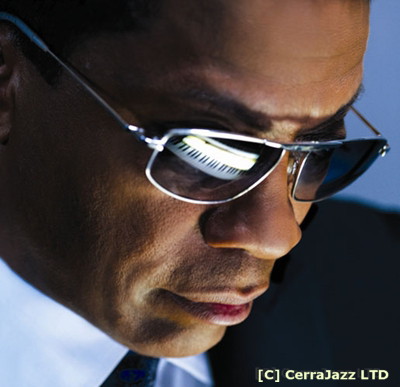
Thursday, May 2, 2019

Herbie Hancock – A Jump Ahead

© Introduction. Copyright ® Steven Cerra, copyright protected; all rights reserved.


Before he became a sizzling Jazz-Rock Fusion superstar for Warner Bros. and Columbia Records during the 1970s [and beyond], pianist-composer Herbie Hancock made seven LPs under his own name for Blue Note Records in the 1960s.

A few of these albums were hugely successful, especially for someone like Herbie, who during the 1960s was still primarily a Jazz musician and who was largely unknown to the greater public.

That lack of recognition would begin to change almost immediately with Herbie’s first LP for Blue Note – Takin’ Off - which contained the commercial hit tune – Watermelon Man. [conguero/band leader Mongo Santamaria also recorded a very successful version of the song]. 

The year was 1962, which was also a seminal year for Herbie as he joined the Miles Davis quintet along with Wayne Shorter on tenor saxophone, Ron Carter on bassist and drummer Tony Williams. This was to be Miles’ last “classic” Jazz quintet before he moved on to add more Rock ‘n Roll elements to his music along with a host of electronic instruments as these made their appearance in the late 1960s.

Herbie’s additional Blue Note LP’s were to all have at least one horn fronting a rhythm section, with one exception, an album he recorded in August 1963 that almost went unnoticed. 

Entitled Inventions and Dimensions, it is a piano-bass-drums trio album although Osvaldo “Chihuahua” Martinez plays Latin percussion on all but one track.

The album marked the first time that Herbie had ever worked with bassist Paul Chambers and, for many of us, it was the first chance to hear Willie Bobo play a Jazz drum kit. Throughout most of his career, Willie was primarily known as a timbales player and Latin percussionist

As Nat Hentoff explains in his liner notes to the original LP, Inventions and Dimensions gets it title 

“… [from the fact that it] reflects Hancock's increasing preoccupation with releasing himself from what he terms the customary jazz ‘assumptions.’ Usually, he explains, ‘you assume there'll be chords on which to base your improvisations and you assume most of the time that the playing will be in 4/4 and that the bass will automatically walk. On this date, I told the musicians not to assume anything except for a few rules I set for each piece, and every time those rules were different. As it happened, Paul Chambers did often play a walking or a recurring rhythm, but that was because he wanted to play that way. I didn't suggest it, and he could have done whatever he wanted. There were no specific chord change on any of the tunes except Mimosa, nor did any of the tunes have a melody to begin with.’”

The musical departure inherent in this last sentence is what caught my ear when I first heard the album.

But the music on this recording is no exercise in what came to be known as Free Jazz in the sense of doing away with all musical rules and conventions.


According to Bob Belden in his insert notes Herbie Hancock: The Complete Blue Note Sixties Sessions

“On August 30, 1963, Herbie went to Englewood Cliffs to record another Blue Note album. Instead of the typical Blue Note dates he was creating, Herbie sought to do something different, something that reflected what he felt about his playing at the time. Since he had been on the road steadily since May, he may not have had enough time to write complex new material. His associations with more open musicians may have planted the seed of adventure, but the confidence of being Miles Davis's pianist had a lot to do with Herbie's next album.”

To my ears, what is so compelling about this recording is best exemplified in the track entitled A Jump Ahead, which we have used as the soundtrack to the video tribute to Herbie’s Blue Note years located at the end of this piece.

As Herbie denotes above in the Nat Hentoff quotation, A Jump Ahead does not have a conventional melody or theme. 

Instead, the tune gets its structure from a four-bar ostinato played by bassist Paul Chambers.

An ostinato is a short melody pattern that is constantly repeated in the same part at the same pitch.

Nat Hentoff’s notes contain this further elaboration:

“The rule which Hancock set for A Jump Ahead was for Paul Chambers to select an introductory four-bar pedal tone. ‘Then there come sixteen bars of time,’ Hancock points out, ‘in which what I improvise is based on the pedal tone Paul played during the first four bars. Another four-bar break follows, for which Paul selects another note. I never knew what Paul would play, and that's how this one got titled. He was always a jump ahead. Incidentally, since any one note can be related to all twelve tones on the keyboard, I had complete freedom to utilize Paul's pedal notes any way I wanted to. Those notes acted as a note in a chord, but I formed the chords in my own way. Again, there was no preconceived melody, and the harmony came from the notes Paul chose.’”

Structurally, A Jump Ahead is what may be referred to as tonal music.

And in tonal music, a pedal tone is a sustained tone, played typically in the bass. Sometimes called a pedal point, a pedal tone is a non-chord tone. 

The term “pedal tone” comes from the organ’s ability to sustain a note indefinitely using the pedal keyboard which is played by the feet; as such, the organist can hold down a pedal point for lengthy periods while both hands perform higher-register music on the manual keyboards.


In effect, Chambers acts like the organ pedal keyboard while Herbie plays over it using both hands on the piano keyboard. 

One other point that may be of interest is Willie Bobo’s use of very thick/heavy drumsticks that really serve to crackle & pop the snare drum and crash the cymbals. Such large sticks take great control and using them masterfully, Willie generates tremendous swing on this six-and-a-half minute cut.

Paul’s four-bar ostinato can be heard at the outset of the track, again at 18 seconds, and again at 35 and 53 seconds and so on.

Each time it is followed by a 16-bar improvisation that Herbie conceives based on the pedal tone that Paul selects.

In effect, A Jump Ahead is the Jazz equivalent of the geometric head-start in which one never catches-up.

To my ears, Herbie’s solo really hits its stride on A Jump Ahead at around the 2:42 mark [which Willie conveniently underscores with a cymbal crash!] and just soars thereafter.

See what you think.