Showing posts with label J.J. and Kay. Show all posts

Wednesday, January 6, 2021

J.J. JOHNSON AND KAI WINDING QUINTET: The Early Years by Gordon Jack

 © Copyright ® Steven Cerra, copyright protected; all rights reserved.
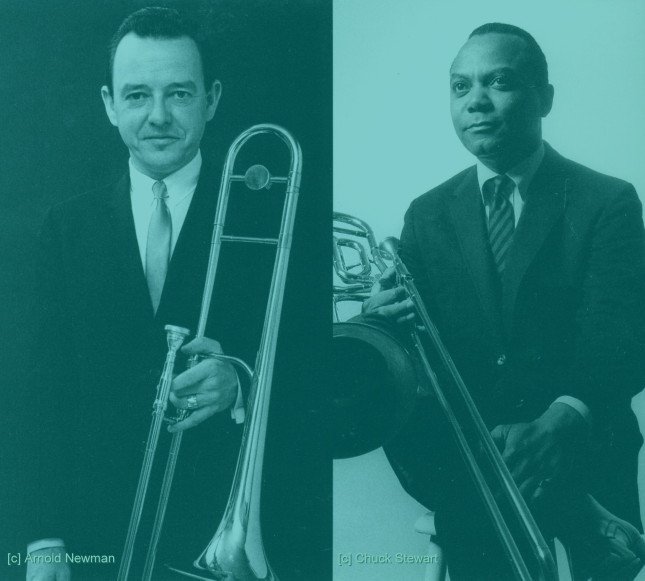


Gordon Jack is a frequent contributor to the Jazz Journal and a very generous friend in allowing JazzProfiles to re-publish his insightful and discerning writings on various topics about Jazz and its makers.


Gordon is the author of Fifties Jazz Talk An Oral Retrospective and he also developed the Gerry Mulligan discography in Raymond Horricks’ book Gerry Mulligan’s Ark.


The following article was published in the December 15 & 20, 2020 edition of Jazz Journal. 


For more information and subscriptions please visit www.jazzjournal.co.uk


© -Gordon Jack/JazzJournal, copyright protected; all rights reserved; used with the author’s permission.


“With the advent of bebop the trombone might have suffered the same relative decline as the clarinet but for two virtuosos - J.J. Johnson and Kai Winding. Their early recordings showed how well they overcame the difficulties of adapting the unwieldy trombone with its seven slide positions to the demands of the new music. 


J.J. Johnson was born in Indianapolis on 22 January 1924 and took up the trombone at the age of 14. Fred Beckett was an important early influence with his 1940 solos on Harlan Leonard’s My Gal Sal, Skee and A La Bridges (Classics 670 CD)  – “He was the first trombonist I ever heard play in a manner other than the usual sliding, slurring, lip trilling or ‘gut-bucket ’style. He made a lasting impression on me.”  He toured briefly with the Clarence Love and Isaac Russell bands before joining Benny Carter’s orchestra in 1942 until 1945. Talking about Carter J.J. said, “It was a continuous education in music”. His first recorded solo took place with the band in 1943 on Love For Sale (Definitive DRCSD 1129) and the following year he was invited to appear at the first JATP concert in Los Angeles before an excited audience of more than 2000. His extrovert contributions to Lester Leaps In, Body And Soul, Tea For Two and Blues with Illinois Jacquet, Jack McVea, Nat King Cole and Les Paul would probably fool many on a blindfold test (Properbox (E) 82CD). He left Carter for Count Basie and is heard on three 1946 solos with the band – The King, Stay Cool (both on Classics (F) 934CD) and Rambo (Neatwork RP2062CD). He wrote and arranged Rambo and Jon Hendricks added lyrics to it for Manhattan Transfer’s 1985 Vocalese album. 


In 1946  he received the New Star award from the critics of Esquire magazine and his swiftly articulated solo with the all-star band on Indiana Winter (based on How High The Moon) caused many to speculate wrongly that he was playing a valve-trombone (Definitive DRCD 11293). On one occasion his amazing facility prompted a Philadelphia club owner to post a sign outside advertising, “The Fastest Trombone Player Alive”. That was the year he settled in New York and started sitting-in at the clubs on 52nd. Street. For a time he had a quartet at the Spotlite with Bud Powell and later he worked there with Allen Eager. He also played at the Three Deuces in a sextet with Fats Navarro and Stan Getz. His first date as a leader took place in June 1946 with Cecil Payne, Bud Powell, Leonard Gaskin and Max Roach when Coppin’ The Bop, Jay Jay, Jay-Bird and Mad Bebop were recorded for Savoy (SVO 151CD).


In late 1947 after his hit with Robbins Nest Illinois Jacquet formed a new band with J.J., Leo Parker, Sir Charles Thompson, Fats Navarro and Joe Newman providing a high octane mix of jazz with rhythm’n’blues overtones which proved to be hugely popular.  John Lewis replaced Thompson for a while and he said, “We had to play Flying Home about three times a night (but) I’ve never seen so much money”. Johnson solos on Riffin’ With Jacquet, Destination Moon, For Truly, King Jacquet, Embryo and Mutton Leg (Mosaic MR6-165). When he wasn’t on the road with Jacquet he became the trombonist-of-choice on many bop recordings in the late forties with Charlie Parker, Tadd Dameron, Dizzy Gillespie, Howard McGhee, Babs Gonzales, Leo Parker and Coleman Hawkins.


He performed on eight of the twelve titles recorded by the Miles Davis nonet in 1949/50 and solos on Deception. Kai Winding was on the other four and was featured on Godchild (Capitol 7243 5 30117 2 7). There were two other trombonists involved in the project because Eddie Bert rehearsed with the group at Nola’s studios on several occasions and Mike Zwerin played on their live performances at the Royal Roost. Peter Pullman’s book (Wail - The Life Of Bud Powell) mentions that on one occasion Powell performed with the nonet at Birdland. The last number of the set was Move and Bud received a standing ovation. He was a little bemused by the audience reaction so Gerry Mulligan very gently led him off the bandstand with the applause still ringing in his ears. An early portent of  Johnson’s later highly successful collaboration with Kai Winding took place on a Chubby Jackson date in 1950 when they were featured together on Tiny Kahn’s Flying The Coop (Original Jazz Classics CD 711-2). He was briefly with Woody Herman at this time and Conte Candoli said, “He was really good on the lead book”.


In early 1951 he occasionally worked at Birdland in a small Dizzy Gillespie group with Milt Jackson and Budd Johnson or John Coltrane and in April that year he was on the 78 rpm disc that introduced Dizzy’s The Champ (Savoy SV-0170CD). Between May and August 1952 he was part of a Symphony Sid package that included Miles Davis, Jackie McLean, Zoot Sims, Milt Jackson, Max Roach, Percy Heath and John Lewis that toured New Haven, Montreal, Toronto, Chicago, Detroit, Pittsburgh and Atlantic City before concluding at Harlem’s Apollo Theatre. They did not record unfortunately but there is a fine series of photographs in Ken Vail’s book Miles’ Diary from the Apollo booking. Ira Gitler in his Jazz Masters of the 40s says, “When this group broke up, the trombonist became discouraged with the music business”. He briefly withdrew from the jazz scene because of the lack of regular work. He also had the problem of having to renew his cabaret card every six months because of an earlier misdemeanour in 1946. His permanent cabaret card was not reinstated until 1959.


He began working in the defence industry as a blueprint inspector out at Long Island but he kept practicing and making occasional recording dates. One of which took place in 1953 in Brooklyn at a Charles Mingus Jazz Workshop session with three other trombonists – Bennie Green, Willie Dennis and Kai Winding (Properbox  (E) 77CD). In April 1954 he was one of the Miles Davis All Stars along with Lucky Thompson and Horace Silver who created the classic Walkin’ and Blue’n’ Boogie for Prestige (PRCD 7076-2). It’s worth pointing out again that Walkin’ started out as Gravy on a Gene Ammons 1950 date. It was written by Jimmy Mundy until it was appropriated by the infamous Richard Carpenter who got a composer credit on the Davis date.


His temporary retirement ended four months later when Ozzie Cadena wanted to team him with Eddie Bert in a two-trombone album for Savoy. Eddie was unavailable as he was contracted to Discovery. Bennie Green would have been selected but he was busy thanks to his 1953 Blow Your Horn hit which had become something of a juke-box favourite. Producer Teddy Reig suggested Kai Winding which led to a happy two year partnership that was successful both commercially and musically and was marketed under the title Jay and Kai.   


Kai Winding was born in Aarhus, Denmark on 18 May 1922 and emigrated with his family to the U.S.A in 1934. He was largely self-taught and began his professional career with the Sonny Dunham and Alvino Rey bands before spending three years with the US Coast Guard from 1942. His debut as a leader took place in December 1945 with Shorty Rogers, Stan Getz and Shelly Manne when they recorded four titles for Savoy under the title Kai’s Cats (Masters Of Jazz MJCD117). One of the tracks – Loaded – was by an obscure Washington D.C. pianist called Bernie Miller (1919-1945). A year earlier Boyd Raeburn’s orchestra had recorded another of his originals – Bobby Socks - which became better known as Bernie’s Tune


In February 1946 he joined Stan Kenton’s orchestra who had been selected as the Band of the Year by Look magazine and were breaking records everywhere they played. His first solos four months later were on Rika Jika Jack (a forgettable June Christy feature) and Artistry In Boogie (Mosaic MQ10-163). Even though he was only with Kenton for about a year his influence was immense. He created a distinctive section sound by persuading his colleagues to produce a lip instead of a slide vibrato. Milt Bernhart said, “Kai Winding was the lead trombone and without question the most important player in the band at that time”. Kenton agreed - “Kai changed the whole God-damn conception of the band and my whole way of thinking”.  He brings something special to his features with the band on Capitol Punishment, Artistry In Bolero, Yesterdays, Ecuador, I’d Be Lost Without You, Collaboration and Machito (Mosaic MQ10-163). When they were appearing at the Paramount in NYC he heard J.J. Johnson for the first time at the Famous Door with Charlie Parker. He told Milt Bernhart that J.J. left him “Speechless”.


Leaving Kenton he worked with Charlie Ventura for a while in 1947 and they were recorded at the Hotel Sherman, Chicago with singer Buddy Stewart. The popular East Of Suez was introduced on the booking and Winding thrives in what was a forerunner to Ventura’s Bop For The People ensemble (Properbox 41CD). In the late forties he had a group that included Brew Moore, Gerry Mulligan and George Wallington that often worked at the Royal Roost and Bop City. They recorded 14 titles on obscure labels which are difficult to obtain now but would make a very welcome reissue from Fresh Sound perhaps. In the early fifties he combined radio and television studio work with occasional bookings at Birdland with Red Rodney, Zoot Sims, Brew Moore and Bill Harris. He was also briefly with Woody Herman in 1953 and he can be heard on the memorable Four Others by Jimmy Giuffre, a feature for the trombone section which included Urbie Green, Frank Rehak and Vern Friley (Discovery DSCD 944).


Joining J.J.Johnson in 1954 was a chance to escape the routine of studio work and return to full-time jazz. Together they created stimulating small-group performances with tightly arranged ensembles usually voiced in unison or thirds. A variety of mutes sometimes came into play for extra colour on It’s Alright With Me, I Concentrate On You, Just For A Thrill and especially The Whiffenpoof Song. Producer George Avakian was particularly impressed with their studio performance on Whiffenpoof, “It’s a wild sight to see them each keeping pace with the lightning routine of mute up, mute in, blow, mute out, mute down, new mute up, mute in, blow and so on. Never once did they fluff a phrase” (Lonehill Jazz LHJ 10179). After two years together they felt that all the possibilities of a two trombone line-up had been exhausted so they decided to call it a day in 1956 but not before one of their last albums where six other trombones were added to the mix with particularly notable performances on Night In Tunisia, The Surrey With The Fringe On Top and The Peanut Vendor. (Columbia COLCD 480990).


Years later J.J. had this to say, “I have a very fond recall of the Jay and Kai cycle. Kai was a super jazz trombonist who always performed with wit, killer chops, quasi reckless abandon yet with intelligent sophistication. He was a complete musician and total artist plus a fun, fun dude to be with or to work with”.


1956 of course was the year Leonard Feather invited 100 leading musicians from Louis Armstrong to Lester Young to nominate their favourite instrumentalists. J.J.Johnson came top in the trombone section followed by Bill Harris, Jack Teagarden, Bob Brookmeyer, Tommy Dorsey, Lawrence Brown, Jack Jenney, Vic Dickenson, Kai Winding, Trummy Young, Jimmy Harrison, Frank Rosolino and Earl Swope.”


Wednesday, September 23, 2020

Jay and Kai – When Two Trombones Are Better Than One


© -  Steven A. Cerra, copyright protected; all rights reserved.


“'You can't play all night in a club with just two trombones and rhythm!’ a friend told Kai Winding when he announced that he and J. J. Johnson were going to do just that.
He was wrong, but awfully right at the same time. The answer is that you can do it, but not with ‘just two trombones.’ You have to have the best—Kai Winding and J.J. Johnson.

Their ability as trombonists is only part of the story. The entire "book" for the group has also been written by them, and it is their imagination as arrangers which has carried off this tour de force even more than their extraordinary talent as soloists.

Jay and Kai have done it the musicianly way, with no gimmicks—just solid musicianship. Working without a guitar, which would have given them variety in the col­oring of the solos as well as another voice in the ensem­bles, makes their job that much harder. But in order to get engagements in clubs, they had to confine the group to five men, and the added challenge has only spurred them to greater creative height.

Each has had a wealth of big band and small combo experience. During the hop era, Jay was in the rare posi­tion of establishing a school of trombone playing which consisted of himself alone; no one else was remotely in his class. Kai came up through the big band field, achiev­ing prominence as a soloist with Stan Kenton in 1946. In recent years, both men have gigged extensively with small groups, and Kai still keeps his hand in as a studio sideman between the quintet's bookings.

The arranging of the book has been divided equally between them, and each man has contributed several fine originals. Their choice of repertoire is discriminating; they seem to have a knack of choosing half-forgotten but exceptional show tunes and songs which are fine vehicles for "class" singers. (Perhaps the lyric quality of their trom­bone playing is responsible for this taste.) Both play with a technical ease which is the envy of lesser slide men. Although they play quite unlike each other most of the time, there are many occasions on which it is impossible for even their closest followers to tell them apart.”
- George Avakian, insert notes to CD re-issue of Trombones for Two

The idea for this piece came from revisiting the J.J. Johnson and Kai Winding Columbia recording made at the 1956 Newport Jazz Festival [the LP is shared with the Dave Brubeck Quartet]. Along with bassist Bill Crow and drummer Rudy Collins, the two trombonists’ quintet featured Dick Katz on piano. Dick was to be the pianist with Jay and Kai’s group throughout its existence from 1954-56.

Listening to this recording reminded me of what an excellent pianist Dick Katz was, he died in 2009 at the age of 86, but it also brought back thoughts about Dick Katz the record producer [he founded Milestone Records with Orrin Keepnews], Dick Katz the Jazz educator [he taught at the New School and the Manhattan School of Music], but most especially about Dick Katz, the gifted Jazz author [Bill Kirchner tapped him to write The History of Jazz Piano essay in his The Oxford Companion to Jazz].


I never got to attend any of Dick’s Jazz courses, but I always learned so much about the music from his writings.

Sure enough, when I went digging around my collection of Jazz recordings, there was Dick writing his usual, clever and insightful insert notes to the 1960 reunion album by Jay and Kai’s quintet on Impulse! Records [The Great Kai and J.J.! IMPD-225].


A sample Dick’s expository skills, flowing style of writing and considerable knowledge on the subject of Jazz and its makers can be found in the following excerpts from the J.J. Johnson and Kai Winding Impulse! notes:

“‘I don't know anything about music, but I know what I like.’

This bon mot is usually attributed to the celebrated Common Man, and while the sophisticate might wince upon hearing such a bromide, an element of truth is pre­sent. The sentence often indicates that knowing how music is made does not necessarily assure one's enjoyment, or even enlightenment. The intellectual, armed with the tools of musical analysis, will not experience music any more intensely than someone not blessed with musical scholar­ship — if the conditions for being "moved," or emotionally stimulated, do not occur in the music. Indeed, knowing too much can actually interfere with hearing the music.

You see, music has to do with feelings, and the knowledge of what makes it tick should be a bonus that adds to or enhances the listener's understanding. It should never be a substitute for emotional involvement.

Now, the "conditions" referred to above are what concern us here. Good jazz does not come out of the air like magic. True, a genius sometimes creates this illusion, but in the main, it is the result of an artistic balance between the planned and the unplanned. Even the great improviser is very selective, and constantly edits himself.

Throughout the relatively short history of jazz, many of the great performances have been ensemble performances where the improvised solo was just a part of the whole. This tradition of group playing, as exemplified by Hender­son, Basie, Ellington, Lunceford, John Kirby, Benny Good­man's small groups, the great mid western and southwest­ern bands, big and small (Kansas City, et. al.)» almost came to a rather abrupt halt with The Revolution. And that is exactly the effect Charlie Parker, Dizzy Gillespie and their colleagues (J. J. Johnson among them) had on jazz music. Their extreme improvising virtuosity seemed to take the focus off the need to play as a group. But herein lies the irony — the precision with which they played their com­plex tours de force was due in large measure to the exten­sive ensemble experience they gleaned as members of dis­ciplined bands like Hines, Eckstine, etc.

It was their tal­ented, and not-so-talented, followers who often missed the point. Musically stranded without the opportunity to get the type of experience their idols had (due to many factors, economic and otherwise), they resorted to all they knew how to do — wait their turn to play their solos. This type of waiting-in-line-to-play kind of jazz has nearly domi­nated the scene for many years. Although it has produced an abundance of first-rate jazzmen, many excellent performances, and has advanced some aspects of jazz, the lack of organization has often strained the poor listener to the point where he doesn't "know what he likes."

So, in 1954, when J.J. Johnson and Kai Winding formed their now celebrated partnership, one of their prime con­siderations was to help remedy this chaotic state of affairs. Both men, in addition to being the best modern jazz trom­bone stylists around, were fortunate enough to have had considerable big and small band experience. They astutely realized that a return to time-tested principles was in order. Variety, contrast, dynamics, structure (integrating the improvised solos with the written parts) — these ele­ments and others which give a musical performance com­pleteness — were accepted by Kai and J.J. as both a chal­lenge and an obligation to the listener.


This awareness, combined with their individual composing and arranging talents, plus an uncanny affinity for each other's playing, made their success almost a certainty. That success is now a happy fact. From their Birdland debut in 1954 to their climactic performance at the 1956 Jazz Festival at New­port, they built up an enviable following. Also, they have created an impressive collection of impeccable perfor­mances on records. That they overcame the skeptical reaction to the idea of two trombones is now a near-legend. One only need listen to any of these performances to demonstrate once again the old adage — ‘It ain't what you do, but the way that...’

The respective accomplishments of J. J. and Kai have been lauded in print many times before. Their poll victories, fes­tival and jazz-club successes are well known. Not so obvi­ous, however, is the beneficial effect they have had on jazz presentation. Their approach to their audience, the variety of their library (a good balance between original composi­tions and imaginative arrangements of jazz standards and show tunes), together with their marvelous teamwork, helped to wake up both musicians and public alike to the fruits of organized presentation. With the jazz of the future, organization will be an artistic necessity; the future of jazz will be partially dependent on it, as is every mature art form.

Hearing this album, one could easily be led to believe that J. J. and Kai have been working together all along. The precision with which they perform is usually found only in groups that have worked together for a long time. Actu­ally, they have played together very little in the last few years, both having been occupied with their respective groups — J.J. with his quintet, and Kai with his four-trom­bone and rhythm combination. However, it is quite evident from these performances that both have continued to grow musically and bring an even greater finesse and seasoning to their work. This is a welcome reunion.

What can't be verbalized are the feelings expressed in the music. That's where you, the listener, are on your own.”


Wednesday, May 8, 2019

Jay and Kai - J.J. Johnson and Kai Winding - Tonal Trombone Textures

© -Steven Cerra, copyright protected; all rights reserved.


“Jay Jay Johnson and Kai Winding have formed a group. Why didn't such a natural combination band together before? It's almost like asking why jaii musicians don't work more often. The important fact is that they are together and Jan will benefit.

Their association is not necessarily a new one [on a permanent basis that is) and although it may not have been the dream of each to have a combo jointly, it very likely might have been a subconscious desire because there has always been a respect for and enjoyment of each others' playing.
They started from opposite directions, Kai from hit birthplace in Aachui Denmark and Jay Jay from his in Indianapolis. Kai came to the United States with his parents in 1934. Both served their apprenticeship with various jmall-name bands. After this came the name bands. Kai played with Benny Goodman and Stan Kenton. At the same time Jay Jay was with Benny Carter and Count Basie. And then came New York. Who that knew them, will ever forget the halcyon days of the Forties when the music that they tagged "bop” flowered on both 52nd St. and Broadway. I remember nearly falling off my chair at the Spotlite Club in 1946 when I first heard Jay Jay sit in with Dizzy Gillespie and rip off intricate ensemble and solo passages with fluency equal to that of Diz.

There were other nights at the same club, and Jay Jay fronting a quartet with an old grey felt beanie hanging on the bell of his horn to give a singularly delightful tonal effect. Then there was the Roost in 1948 with Kai coming into his own in a group with Charlie Parker, Miles Davis and Allen Eager and blowing mightily every night from under the artificial tree.
Their careers have crossed and run parallel at different times. When the great Miles Davis band recorded for Capitol, Kai was in on the first sessions and Jay Jay replaced him on the later ones. The Chubby Jackson All Star Band (Prestige 105) had both as its trombone section and their "conversation" choruses on "Flying The Coop" were actually the forerunners of their present group.

Don't get the idea that I'm going overboard into the sea of nostalgia. i in just standing by the rail on the ship of reality looking back over the ror-izon. Jay Jay and Kai played great in those days but they are playing greater today. They have combined as mature and polished musicians who still have the love of jazz and the fire to play it.”
- Ira Gitler, insert notes to Kai and Jay Bennie Green and Strings [Prestige OJCCD -1727-2/Prestige 7070]

Somewhat ironically, my first exposure to the quintet co-led by trombonists J.J. Johnson and Kai Winding was on a Columbia LP that they shared with the Dave Brubeck Quartet.

It was recorded in performance at the 1956 Newport Jazz Festival and emcee Willis Conover says at the beginning of their set that their appearance at the NSJ constituted a sort of farewell appearance as a unit! Nothing like coming in at the end.

As George Avakian, the producer of the LP further explains in the liner notes to the album: “Their amicable parting was based purely on a desire each one has to pursue again a separate career after having brought off a daring experiment. J. J. has since formed a quintet of his own and Kai has a septet featuring four trombones. Both groups will shortly be heard on Columbia Records.”

Although I came in at the end, so to speak,  had great fun, then [during the analog era] and now [during the digital era] amassing a collection of the group’s recorded output and listening to the very enjoyable music created by these giants of modern Jazz trombone.

Here’s more information about the background of both trombonists, the formation of their group and a description of some of the music on their recordings. If you haven’t heard the music made by the singular quintet, you might want to check it out for all the reasons detailed below.

“The dominant bebop trombonist, J.J. Johnson's saxophone-influenced sound has been criticized as unidiomatic and insufficiently 'brassy' - whatever that means - but there is no mistaking his preeminence in the recent history of jazz. Born in Indianapolis [1924-2001], Johnson emerged in Benny Carter's orchestra and as part of Jazz at the Philharmonic, but he left an indelible mark as half of Jay and Kai with fellow-trombonist Winding. ...

Johnson is one of the most important figures in modern jazz. Once voguish, the trombone, like the clarinet, largely fell from favour with younger players with the faster articulations of bebop, Johnson's unworthily low standing nowadays (his partnership with Kai Winding, as 'Jay and Kai', was once resonantly popular) is largely due to a perceived absence of trombone players with whom to compare him. In fact, Johnson turned an occasionally unwieldy instrument into an agile and pure-toned bop voice; so good was his articulation that single-note runs in the higher register often sounded like trumpet. He frequently hung an old beret over the bell of his horn to soften his (one and bring it into line with the sound of the saxophones around him.

Kai Winding [1922-83] was born in Denmark and came to America in his early teens. He was around to see the birth of bebop and helped to devise a fast, clear-toned delivery for the trombone, a development which also had an impact on how the horn sections of big bands could sound. His long partnership with J.J. Johnson is definitive of the modern history of the instrument.


The success of Jay and Kai was, in the end, not altogether equitably shared. J.J. Johnson's unchallenged dominance on the trombone as a bop voice was always questionable, Whereas J.J. brought a saxophone-like articulation to the instrument, it was Winding who showed how it could follow the woodwind players fast vibrato and percussive attack and still retain its distinctive character. While with the Kenton hand, Winding worked on ways of producing a very tight vibrato with the lip rather than using the slide, and this had a marked impact on a younger generation of players. … There remains, to be sure, something a little cold about Winding's work. Certainly, compared to J.J., he couldn't give a ballad more than a gruff expressiveness, but that was not his forte. What he did, he did well, and he deserves more credit for it.”

[Richard Cook and Brian Morton, The Penguin Guide to Jazz on CD, 6th Ed.]

Johnson is the most important postwar jazz trombonist and a major Influence on all players of the instrument. His earliest recorded solos up to 1945 reveal a thick tone, aggressive manner, and impressive mobility. They are not yet far removed, though, from the solos of his early influences - Lester Young, Roy Eldridge, and the trombonist Fred Beckett, who emphasized the linear qualities of the instrument rather than the effects of the slide.

During the 1940s Johnson developed such an astounding technical facility that some record reviewers insisted, erroneously, that he played a valve trombone; the speed of his playing and the clarity and accuracy he achieves at fast tempos have never been surpassed. In 1947 he began to play with a lighter tone (occasionally enhanced by a felt mute) and reserved vibrato for special effects. The result was a rather dry but attractive sound resembling that of a french horn. Johnson also worked diligently at this period to adapt bop patterns to the trombone, and his solos suffer from an emphasis on speed and an overreliance on memorized formulas incorporating such bop trademarks as the flatted 5lh. His performances on both versions of Crazeology with Charlie Parker (1947) begin with the same phrase and contain other whole phrases in common. The same is true of the two renditions of Johnson's celebrated solo on Blue Mode (1949), despite their very different tempos.

During the late 1950s Johnson's playing matured: he relied less on formulas and speed, and more on a scalar approach and motivic development. Recordings of live performances dating from this time provide examples of brilliant developmental sequences that were delivered with powerful emotion.”

- Lewis Porter

“Winding was one of the first bop trombonists and one of the most important. The distinct sound he brought to Kenton's trombone section was achieved partly by his persuading the players to produce a vibrato with the lip rather then with the slide (van Engelen). His solo work was characterized initially by a rough, exuberant, biting tone, recalling earlier trombone styles (a fine example may be heard on Kenton's recording of Lover, 1947), though a more restrained manner is evident in the brief solos he contributed to the first of Miles Davis's sessions that resulted in the Birth of the Cool (1949). On forming the group Jay and Kai, Winding began to produce a delicate sound; he improvised in a manner so close to that of Johnson that it is sometimes difficult to distinguish between the two musicians.”

- Les Jeske

[ The Porter/Jeske annotations are in Barry Kernfeld, Ed., The New Grove Dictionary of Jazz.]

“Another remarkable trombone section, totally different from Ellington's was that of Stan Kenton's orchestra. Beginning in the mid-1940s, its style initiated and set by Kai Winding, it revolutionized trombone playing stylistically, especially in terms of sound (brassier, more prominent in the ensemble) and type of vibrato (slower, and mostly lack thereof), as well as by adding the "new sound" of a bass trombone (Bart Varsalona, later George Roberts). The Kenton trombone section's influence was enormous and pervasive, and continues to this day. Although the section's personnel changed often over the decades, it retained an astonishing stylistic consistency, not only because such stalwarts as Milt Bernhart and Bob Fitzpatrick held long tenures in the orchestra, but because incoming players, such as Hob Burgess and Frank Rosolino and a host of others, were expected to fit into the by-then-famous Kenton brass sound. …

But the biggest breakthrough on the trombone toward full membership in the bop fraternity was accomplished by J. J. Johnson, who essentially proved convincingly that anything Gillespie could do on the trumpet could now also be matched on the trombone. Johnson is regarded as the true founder of the modern school of jazz trombone, developing astounding (for the time) speed and agility on the instrument, and thus becoming a charter member of the bop evolution/revolution. These outstanding qualities, as well as his solid, full, rich, centered tone, can be happily savored on "The Champ" (DeeGee, with Dizzy Gillespie) and "Jay and Kai" (Columbia, 1955).

Johnson spawned a host of followers, foremost among them Jimmy Cleveland, whose speed and dexterity on the trombone were even more dazzling than J. J.'s (which led to him being called "the Snake"), the Danish-born player Kai Winding (with whom J. J. teamed up in a highly successful two-trombone duo) in the 1950s, the Swedish trombonist Ake Persson, and young turks like Frank Rosolino, Frank Rehak, Urbie Green, and Jimmy Knepper. All were spectacular technicians, easily expanding the range of the trombone to the trumpet's (!) upper register (high B flat and C), and with their new-won technical wizardry capable of playing things that a few years earlier could have only been played on a trumpet, or a flute or violin.”

- Gunther Schuller from his essay The Trombone in Jazz, in Bill Kirchner, Ed., The Oxford Companion to Jazz

When J.J. and Kai first formed their unit in the mid-1950s, it was quite common for the LP producer to also write the liner notes [referred to today as insert or sleeve notes].

George Avakian produced a number of the Jay and Kai recordings for Columbia and we can learn quite a lot about the background of how their group came to be and their approach to arranging the music for it from the following excerpts from his liner/sleeve notes.

“'You can’t play all night in a club with just two trombones and rhythm!’ a friend told Kai Winding when he announced that he and J. J. Johnson were going to do just that.

He was wrong, but awfully right at the same time. The answer is that you can do it. But not with 'just two trombones." You have to have the best — Kai Winding and J.J.Johnson.

Their ability as trombonists is only part of the story. The entire "book" for the group has also been written by them, and it is their imagination as arrangers which has carried off this tour de force even more than their extraordinary talent as soloists.

Jay and Kai have done it the musicianly way, with no gimmicks — just solid musicianship. Working without a guitar, which would have given them variety in the coloring of the solos as well as another voice in the ensembles, makes their job that much harder. But in order to get engagements in clubs, they had to confine the group to five men and the added challenge has only spurred them to greater creative height.

Each has had a wealth of big band and small combo experience. During the bop era, Jay was in the rare position of establishing a school of trombone playing which consisted of himself alone; no one else was remotely in his class. Kai came up through the big band field, achieving prominence as a soloist with Stan Kenton in 1946. In recent years, both men have gigged extensively with small groups, and Kai still keeps his hand in as a studio sideman between the guintet's bookings.

The arranging of the book has been divided equally between them, and each man has contributed several fine originals. Their choice of repertoire is discriminating; they seem to have a knack of choosing half-forgotten but exceptional show tunes and songs which are fine vehicles for "class" singers. (Perhaps the lyric quality of their trombone playing is responsible for this taste.) Both play with a technical ease which is the envy of lesser slide men. Although they play quite unlike each other most ol the time, there are many occasions on which it is impossible for even their closest followers to tell them apart.

Watching them at work is almost as much fun as listening. When they trade off alternating muted phrases on a fast tune, as in Let's Get Away From It All and The Whiffenpoof Song, it's a wild sight to see them each keep pace with the lightning routine of mute up, mute in, blow, mute out, mute down, new mute up, mute in, blow, and so on. Never once during these sessions did either ever flub a phrase or even blow a bad one. Nor were there any easy cliches. Even under pressure, each listened carefully to what the other was playing and kept a logical line flowing.”

From his insert notes to Trombone for Two J.J. Johnson - Kai Winding [Columbia LP CL 742 in 1955; Collectibles CD 6674; Sony A-50662]]

George Avakian also shared more of his thoughts about the special qualities of Jay and Kai as performances and the distinctive qualities of their trombone Jazz in these excerpts Jai & Kai + 6: The Jay and Kai Trombone Octet; [Columbia CL 892 in 1956; Collectibles CD-5677; Sony A-26542].

“It is not true (not yet, anyway) that trombonists throughout the world have been raising funds to erect a monument to Kai Winding and J.J. Johnson in recognition of their unique contributions to the elevation of the estate of trombone playing.

This is about the only honor left for their fellow practitioners to bestow upon this extraordinary pair of musicians. The public has shown its appreciation of their work as co-leaders of one of the most unusual quintets in the jazz field (two trombones and a rhythm section), and there are even true-blue jazz fans who have given their ultimate recognition in the form of declaring that Jay and Kai are so popular that they must be out of bounds--although the day of the starving but uncompromising jazzman is being rendered a little passe' by the public's ever-growing interest in jazz [would that this would continue to prove true, sadly, it didn’t].

Jay and Kai, who are apparently fearless, have set themselves another difficult goal in this album, but the results literally speak for themselves. Their self-imposed challenge was to make an entire album with eight trombones (six orthodox-type horns and two bass trombones) and their usual rhythm section of piano, bass, and drums. On some of the tunes, they themselves play tromboniums, which are upright valve instruments of similar range and nearly the same tone, developed to replace the more cumbersome slide trombones in marching bands. (Slide trombones have to be placed up front so they can be played freely, which isn't the best set-up for tonal balance.) ….

The arrangements for this eight-trombone idea were executed by Jay and Kai themselves. Juist how they managed to do this - and do it so well-during their busy personal appearance tours is something I haven't figured out yet, and I'm sure neither Jay nor Kai are as yet in condition to explain coherently, either. Suffice to say that they made it despite some mighty close deadlines. Coffee - very strong and black - was one of the principal ingredients that made it possible.

Getting the right men to play these difficult arrangements was a problem, too, but fortunately the sessions came at a time when six of the best trombonists in New York were available for all the sessions. They are Urbie Green, Bob Alexander, Eddie Bert, and Jimmy Cleveland, with bass trombonists Bart Varsalone and Tom Mitchell. Their rhythm section consists of Hank Jones (piano), Milt Hinton (bass), and Osie Johnson (drums), except on Night in Tunisia, All At Once You Love Her, The Peanut Vendor, Four Plus Four, and The Continental, in which Hinton was replaced by Ray Brown. Candido Camera is added on conga drum and bongos as noted in the analyses of the individual arrangements, given below.

An extraordinary variety of sounds were created by this unique ensemble. The final results are a tribute to the Columbia engineering department, as well as the arranging skill ol Jay and Kai and the extraordinary performances of these two fine trombonists, and their six cohorts. There are times when the brass choir sounds as though it is divided into middle-register trumpets blended with trombones, and occasionally there is even some of the quality of an unusually rich saxophone section blended with trombones. No tricky effects were used to get these sounds; they are all in the scoring. What you get is the full artistry of two gifted arrangers and eight spectacularly fine trombonists. …”

And Dick Katz, who played piano with the quintet for a number of years, wrote the notes for The Great Kai and J.J./ J.J. Johnson & Kai Winding [Impulse 225] which was recorded as a sort of reunion LP in 1960 and from which the following excerpts are taken.

“"I don't know anything about music, but I know what I like."

This bon mot is usually attributed to the celebrated Common Man, and while the sophisticate might wince upon hearing such a bromide, an element of truth is present. The sentence often indicates that knowing how music is made does not necessarily assure one's enjoyment, or even enlightenment.

The intellectual, armed with the tools of musical analysis, will not experience music any more intensely than someone not blessed with musical scholarship — if the conditions for being "moved," or emotionally stimulated, do not occur in the music. Indeed, knowing too much can actually interfere with hearing the music. You see, music has to do with feelings, and the knowledge of what makes it tick should be a bonus that adds to or enhances the listener's understanding. It should never be a substitute for emotional involvement.

Now, the "conditions" referred to above are what concern us here. Good jazz does not come out of the air like magic. True, a genius sometimes creates this illusion, but in the main, it is the result of an artistic balance between the planned and the unplanned. Even the great improviser is very selective, and constantly edits himself.

Throughout the relatively short history of jazz, many of the great performances have been ensemble performances where the improvised solo was just a part of the whole. This tradition of group playing, as exemplified by Henderson, Basie, Ellington, Lunceford, John Kirby, Benny Goodman's small groups, the great midwestern and southwestern bands, big and small (Kansas City, et. al.), almost came to a rather abrupt halt with The Revolution.

And that is exactly the effect Charlie Parker, Dizzy Gillespie and their colleagues (J. J. Johnson among them) had on jazz music. Their extreme improvising virtuosity seemed to take the focus off the need to play as a group. But herein lies the irony — the precision with which they played their complex tours de force was due in large measure to the extensive ensemble experience they gleaned as members of disciplined bands like Hines, Eckstine, etc. It was their talented, and not-so-talented, followers who often missed the point. Musically stranded without the opportunity to get the type of experience their idols had (due to many factors, economic and otherwise), they resorted to all they knew how to do — wait their turn to play their solos. This type of waiting-in-line-to-play kind of jazz has nearly dominated the scene for many years. Although it has produced an abundance of first-rate jazzmen, many excellent performances, and has advanced some aspects of jazz, the lack of organization has often strained the poor listener to the point where he doesn't "know what he likes."

So, in 1954, when J.J. Johnson and Kai Winding formed their now celebrated partnership, one of their prime considerations was to help remedy this chaotic state of affairs. Both men, in addition to being the best modern jazz trombone stylists around, were fortunate enough to have had considerable big and small band experience. They astutely realized that a return to time-tested principles was in order. Variety, contrast, dynamics, structure (integrating the improvised solos with the written parts) — these elements and others which give a musical performance completeness — were accepted by Kai and J.J. as both a challenge and an obligation to the listener. This awareness, combined with their individual composing and arranging talents, plus an uncanny affinity for each other's playing, made their success almost a certainty.

That success is now a happy fact. From their Birdland debut in 1954 to their climactic performance at the 1956 Jazz Festival at Newport, they built up an enviable following. Also, they have created an impressive collection of impeccable performances on records. That they overcame the skeptical
reaction to the idea of two trombones is now a near-legend. One only need listen to any of these performances to demonstrate once again the old adage — "It ain't what you do, but the way that..."

The respective accomplishments of J.J. and Kai have been lauded in print many times before. Their poll victories, festival and jazz-club successes are well known. Not so obvious, however, is the beneficial effect they have had on jazz presentation. Their approach to their audience, the variety of their library (a good balance between original compositions and imaginative arrangements of jazz standards and show tunes), together with their marvelous teamwork, helped to wake up both musicians and public alike to the fruits of organized presentation. With the jazz of the future, organization will be an artistic necessity; the future of jazz will be partially dependent on it, as is every mature art form.”