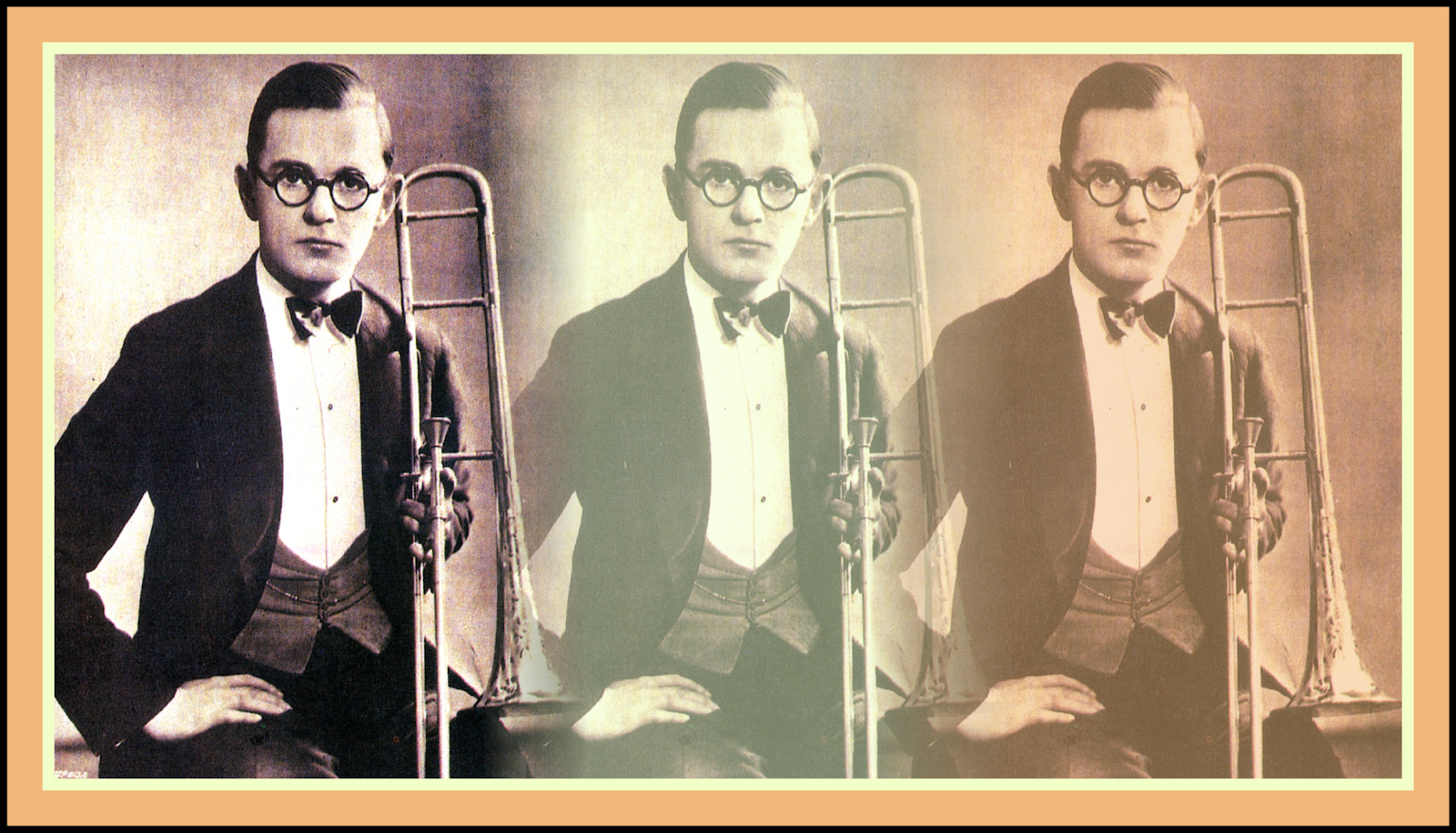
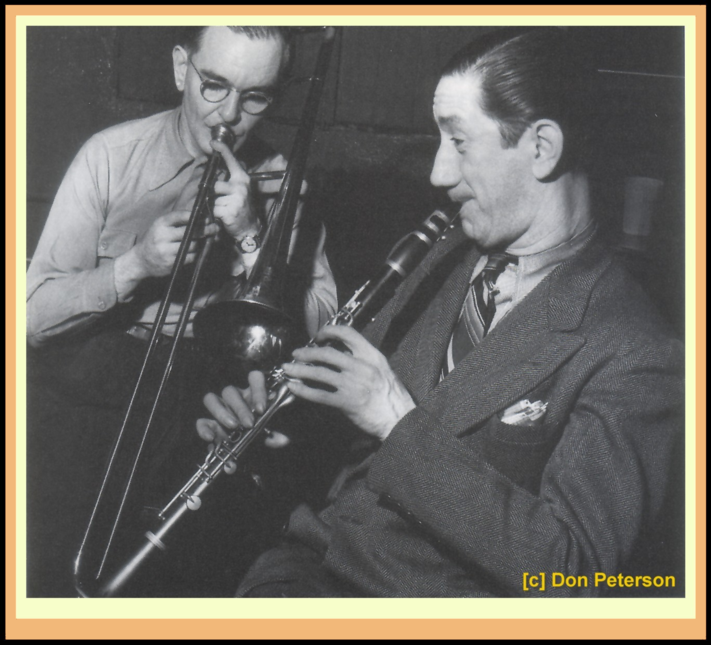
"The slide trombone is a primitive-looking instrument which, next to a trumpet, seems like a cycle to an auto. If your arms are short, don't even attempt to play it, for while you hold it to your lips with your left hand, you must move the slide back and forth in front of you through seven positions with your right, meanwhile manipulating your embouchure within a large mouthpiece in order to achieve the instrument's usual two and a half octave range. It’s no wonder that the trumpet is so vastly preferred as a Jazz instrument., far apart from its carrying power within a higher range, its streamlined size and valves permit easy mobility where acrobatic coordination is required of the trombonist. Thus it's traditional in big bands for the trombone section to be rather simpler than those of the other winds, and indeed, in early jazz, the trombonist's role was to chuff away at rhythmic and harmonic support for the more mobile instruments.
Yet until the advent of jazz, the deep communicative power of the trombone had not been realized: its big sound, rich textures, and classic expressive techniques were the most distinctive of early jazz sonorities. Soloists emerged in the '20s as the big bands grew in versatility and the New Orleans ensemble style began to disappear, and while the liberating influence of trumpeter Louis Armstrong was a major factor in evolving trombone styles (transmitted most influentially by the young New York big band soloist Jimmy Harrison, who died in 1931 the grand manner of early masters such as Kid Ory retained its attraction, too. Surely the Swing Era was the jazz trombone's time of glory, for a diverse group if individualists flourished while, for example, trumpet and tenor sax players seemed to depend on the resources of Louis Armstrong and Coleman Hawkins. There were the majestic arrogance of J.C. Higginbotham, the powerful and subtle mastery of Dicky Wells, the suave melodism and blues interpretations of Jack Teagarden, and the elegance of Lawrence Brown to provide standards of excellence; Tricky Sam Nanton, with the Ellington band, was another world of expression entirely; outstanding players such as Trummy Young and the eclectic Vic Dickenson proved important influences themselves.
The end of the trombone's greatest significance was forecast when Lester Young introduced a wholly new sensibility to Jazz, when small combos with their emphasis on treble clef horns gained important as sources of jazz innovation, and finally when the fresh winds of Charlie Parker and Dizzy Gillespie renewed the whole atmosphere of the music. Bebop was a music wherein small note values and the clarity of the melodic line, almost the exclusive source of aesthetic values, could not in the least be obscured. The Swing trombone's nobility of sound and dramatic capacities had no place in such a completely lyrical idiom, for if even a trumpeter as accomplished as Gillespie had to sacrifice sonoric richness in order to achieve mobility of execution, how much more did the player of the ungainly slide trombone abandon. A teen-aged Indianapolis J.J. Johnson [born 1924] listened to the graceful, ornate Fred Beckett, with the bands of Harlan Leonard and then Lionel Hampton, "the very first trombonist I ever heard play in a manner other than the usual sliding, slurring gutbucket style. He had tremendous facilities for linear improvisation." Johnson's sense of musical values is important, for he is the leading modern trombonist, almost the exclusive source of '50s and '60s style — yet he maintained that tenor saxist Lester Young and trumpeter Roy Eldridge were more important to his developing art than his trombone peers; later came the impact of Parker and Gillespie on his work.
What Johnson's playing particularly offered — with Parker, Gillespie, and the other major bop figures; with the two-trombone Jay and Kai (Winding) quintets and then his own small touring groups, before he abandoned playing for a Hollywood composing career in the '60s — was fast, highly active lines played with a vibratoless tone so light that it abandoned expressive capability. These qualities made Johnson the dominating figure on his instrument, as two generations of players based their art on his perceptions; without his ideas, the trombone may not have survived in the bop hothouse. "There was a time in my life in the mid-1940s, when my aim was to play as fast as physically possible," he told Ira Gitler in an important interview (Jazz Masters Of The Forties, Macmillan, 1966). "In Philly a ridiculous club owner had a sign outside which read, 'Fastest Trombone Alive.” Inevitably, Jazz and tempos became more civilized . . ." The Johnson style made virtuoso demands on the player's stamina, dexterity, and intellect — thus Johnson was aware of the pitfalls of bop intensity, despite his natural attraction to a Romantic musical outlook."
- John Litweiler insert notes to The Trombone Album [Savoy SV-0276]
From the vantage point of when this article was written in January, 1962, many of the trombonists that Martin Williams writes about were still active in the music.
My one quibble with the piece is that it doesn’t take into consideration some excellent trombonists that were resident on the West Coast during the same period. Players like Frank Rosolino, Carl Fontana and Lou Blackburn probably escaped Martin’s attention due to the fact that his geographical vantage point was the East Coast.
But as it stands, Martin’s essay is a wonderful retrospective of the history of the Jazz trombone and the important Jazz trombone stylists.
One would be hard-pressed to find a better survey, especially one that treats as many of the more obscure early pioneers on the instrument.
“It is usually said that J.J. Johnson was the first trombonist to develop a modern Jazz style on the instrument.
There is more to it than that. It might be more nearly accurate to say that Johnson developed an individual style, which he plays on a trombone. There is not very much about that style that is peculiar to the instrument he uses, not much about it that uses the particular resources of the trombone.
Jimmy Knepper, on the other hand, is the first trombonist in quite a while to find his style specifically in the possibilities of the instrument itself.
To say it another way, and exaggerate it a bit, you could play Johnson style on any horn, but you could play Knepper style only on trombone.
Cannonball Adderley spoke of the distinction and his opinion of it in a review of an LP featuring Knepper a couple of years atzo:
"Knepper is a very good trombonist. But J. J. has spoiled me with regard to a trombone sounding like a trombone. I mean that Knepper, though he's very good, is too tied to the instrument. J. J., on the other hand, is a good soloist who happens to use the trombone. Therefore, if you call Knepper an 'original' trombonist, you may be right. If you mean an 'original' soloist, in the same sense in which I'd use the term for J. J., that's something else.
"Similarly, I think Jimmy Cleveland is an original trombonist but not the original jazz soloist J. J. is. J. J. has a style, and it's the kind of style that allows men on other instruments beside the trombone to emulate it, and they wind up sounding in part like J. J.
"I'd say Knepper is like a modern Jack Teagarden. A man like Curtis Fuller emulates J. J. from a trombone point of view, and a player like Kai Winding was originally a J. J. emulator (not in content but from the viewpoint of the trombone). Knepper's influences, however, sound more traditional — Teagarden, Urbie Green. Even his sound sounds similar to Teagarden's in some spots."
Nowadays, then, jazz trombone has a dual role. It always has had, although the distinction that is now made between an almost abstract style, like Johnson's and a more "trombone-istic" style, like Knepper's, has not always been the distinction that applied.
It is obvious enough and well established enough that jazz first began at least partly as an instrumental imitation of vocal music.
It happens that the characteristics of the trombone are very close to those of the human voice, perhaps closer than those of any other instrument. Therefore, the temptation among early jazz trombonists to imitate human sounds must have been enormous. A surviving practitioner of the early style is, of course, Kid Ory. There are trombonists who probably play the "tailgate" New Orleans ensemble style with more technique than Ory uses (Georg Brunis does), but surely that are few who can play with more expressiveness. And even when Ory is playing the simplest parade smear, he is obviously a man singing on a trombone.
There were some marvelously guttural (and gutter-al) trombone comments recorded in the 1920s by a man named Ike Rodgers.
It has been said that Rodgers could play only two notes but that when he played the blues, they seemed to be the only two notes anybody ought to need. There are examples of Rodgers' work on an available LP, playing with blues pianists Roosevelt Sykes and Henry Brown and commenting on the woes of singers Edith Johnson and Alice Moore (Riverside 150). Rodgers had a trick of his own, of stuffing the end of his horn with window screening. He got a sound that words fail to describe—he still seemed to be talking away on his horn but with a different voice.
Charlie (Big) Green, who graces many an early Fletcher Henderson and Bessie Smith record, carried this vocal tradition further along.
But it reached another kind of development in the work of Duke Ellington's plunger man, Joe (Tricky Sam) Nanton. There are Nanton solos from the late 1930s and early '40s that are so uncannily like projections of the male human voice that they are nearly unbelievable.
Sidewalks of New York was a particularly striking example, because there Nanton was playing a well-known melody, and he seemed almost to be singing it wordlessly. It might be said with only slight exaggeration that Nanton had but one solo, which he put together in various ways. But Ellington used that solo, and the impact of its sound and emotion, so resourcefully and with such variety of settings that to this day there must be a capable Nanton imitator in the Ellington trombone section. He not only must play the old pieces, but he must re-create some of the old effects even on many of the new tunes.
Before Nanton, jazz trombone had already taken another step that gave it its first duality.
There were trombonists in the early 1920s who were playing the horn as a brass instrument, not just using its slide in limited and obvious ways and not using its resources only to re-create human sounds. The first such men to be celebrated in jazz history, were, of course, Jack Teagarden and Jimmy Harrison, and independently they worked out rather similar approaches. (Actually, Miff Mole did the same sort of thing concurrently, if not slightly before them, and Mole was a fine instrumentalist if not quite so good an improviser.)
Coleman Hawkins, who was in the Henderson band with both Big Green and Harrison has put the story this way:
"Jimmy, he was quite a trombone player. . . . I'll never forget it. You know I used to kid Jimmy a lot. I'll never forget the first time we ever heard Jack Teagarden. It was in Roseland. This other band played the first set. I'd heard about this Teagarden ... so I went up to hear him, you know. I went downstairs to get Jimmy and the fellows, to start kidding about it. So I said, 'Umm, man, there's a boy upstairs that's playing an awful lot of trombone.'
'Yeah, who's that, Hawk?'
I said, 'what do they call him . . . Jack Teagarden?'
I said, 'Jimmy, you know him?'
" 'No, I'm not gonna know him. I don't know anything about him. What's he play? Trombone player, ain't he? Plays like the rest of the trombones, don't he? I don't see no trombones. Trombone is a brass instrument. It should have that sound, just like a trumpet. I don't want to hear trombones that sound like trombones. I can't see it.'
"So I said, 'But, Jimmy, he doesn't sound like those trombones. He plays up high, and he sounds a whole lot like trumpets to me.'
"I'll never forget it. Jimmy and Jack got to be the tightest of friends."
So they did, and played together nightly. Sometimes they played all night long in Hawkins' apartment. They did it out of mutual respect, of course, but Hawkins adds slyly that they also did it because each was trying to find out what techniques and ideas the other had that he hadn't learned yet.
It has not been possible during the last few years to hear Harrison on currently available LPs, but Columbia's recent four-record set, The Fletcher Henderson Story (C4L 19; also available as a CD boxed set), presents a great deal of Harrison, and also of Big Green. It is also possible on that set to hear Harrison, J. C. Higginbotham, and Dickie Wells all taking solos on various versions of King Porter Stomp during the evolution of that important Henderson arrangement.
Teagarden remains a superb instrumentalist, and he can be a first-rate improviser. Bill Russo said of him in a recent tribute, "... it was not until a few years ago that I realized that Jack Teagarden is the best jazz trombonist. He has an unequaled mastery of his instrument, which is evident in the simple perfection of his performance, not in sensational displays; the content of his playing illustrates a deep understanding of compositional principles. ..."
A favorite, representative Teagarden solo is the variation he played on Pennies from Heaven during a Town Hall concert with Louis Armstrong (on RCA Victor 1443). It is a free invention within the harmonic framework of the piece that makes little reference to melody itself.
Once Harrison and Teagarden had shown the way, a number of trombonists followed. One of the best was Dickie Wells. Another was J. C. Higginbotham, whose style humorously carried both the vocal tradition and the trombone-instrumental tradition as one. One of Higginbotham's later heirs decidedly is Bill Harris.
Wells has been most highly praised by French critic Andre Hodeir as one of
those who need only "blow into their instruments to achieve something personal and move the listener. Dickie Wells gets this expressive quintessence out of the most thankless instrument of all. When played without majesty, the trombone easily becomes wishy-washy and unbearable. Dickie Wells is majesty personified, in style and particularly in tone."
Wells is also praised for his sense of balance and for the fact that he also knows how to use contrast within a solo. Among the solos Hodeir cites are those on Fletcher Henderson's 1933 version of King Porter Stomp and on Count Basie's Texas Shuffle (Brunswick 54012), Panassie Stomp (Decca 8049), Taxi War Dance (Epic LN 6031-2), and his accompaniments to Jimmy Rushing on Nobody Knows and Harvard Blues (Columbia 901).
And then there is Benny Morton. A compliment once was extended to Morton on the originality and compositional balance of his solos. It was a half-humorous remark: "I don't see why you throw them away by just playing them. You really ought to publish them, they are so lovely and complete." His modest reply was, "Well, I don't have an awful lot of flashy technique so I figured the best thing for me to do was to work on making melodies in my playing."
One of Morton's other contributions was inadvertent and came about because one of his solos happened to get orchestrated.
Even into the late '30s, the written parts and section effects for trombones, although sometimes highly effective, were likely to be rudimentary. In fact, the trombone style that still was used in many swing arrangements can be heard in scores from the mid-1920s by King Oliver's and Jelly Roll Morton's groups.
However, there is included in The Fletcher Henderson Story a remarkable pair of pieces, originally sold back to back on a 78-rpm single, called Hot and Anxious and Comin' and Goin'. Bits of those two orchestrations were lifted by swing arrangers to make "originals" (including In the Mood). The most notable "borrowing" was the Count Basie arrangement Swinging the Blues, which comes directly from these Henderson pieces, and during the course of which Morton's trombone solo on Comin' and Goin' is orchestrated for the entire Basie section.
So far no mention has been made of a singular trombonist in American popular music, Tommy Dorsey. There is hardly a man on the instrument who does not look up to Dorsey as a player, and Dickie Wells recently dedicated a piece to him with a tribute-title: Bones for the King.
On the other hand, it is quite possible to maintain that Dorsey was not a very good jazzman, perhaps not a jazzman at all, although he was in several respects a dedicated musician, and there was never anything phony or patronizing about his use of jazz or of jazz musicians. About Dorsey as a jazzman, one remembers the story of the Metronome all-star date on which both he and Teagarden appeared. Dorsey would not agree to solo with an improviser like Teagarden in the studio, but he did agree to ad lib an accompaniment, using his lovely sound, when Teagarden played The Blues. The result is now available on Camden 426.
Another trombonist who was celebrated in the late '30s and early '40s among musicians was Jack Jenney, who had a lovely tone and ballad style and some fine variations on Stardust. He recorded them with his own band in 1939, and repeated them with Artie Shaw in 1940 (the latter reissued on Victor LPM 1244).
As was indicated, J. J. Johnson gave the trombone an almost abstract style that depended neither on the fact that a trombone can be made quite readily to imitate the human voice nor on the specific resources of the instrument.
As Johnson himself has indicated, he was inspired by one predecessor in this, Fred Beckett.
The more vocal style of trombone continues in J. C. Higginbotham, in the Ellington trombone section, in Al Grey's plunger style, in Bill Harris, and in Bob Brookmeyer, who punctuates his fluent improvising with allusions to the sighs, laughs, grunts, and other yeahl-sayings of the vocal-trombone tradition.
Brookmeyer has spoken with deep respect of Vic Dickenson. To Brookmeyer, Dickenson's horn has gone beyond being an instrument and is an extension of himself, not only of his voice but also of his whole being, so that it is hard to know which is Dickenson and which is trombone. And Dickenson also combines the instrumental tradition and the vocal tradition in a very personal way.
The trombone-instrumental style— or as it may somewhat awkwardly be called, the trombone-istic style—that reappeared in Urbie Green's and Jimmy Knepper's work may find its following again.
This discussion has not been an exhaustive treatment of the history of jazz trombone, or of all its major players in any sense, but it was intended to indicate that there long have been at least two jazz trombone traditions and that now there are three. A young player whose ears are really open to the past has a varied tradition to draw on.”
“In 1927, Miff Mole’s playing was far in advance of any white recording trombonist. His command of the instrument was so supple as to make others sound fumbling. Hitherto, the trombone in Jazz had been employed chiefly for smears, swoops and chord bases. Few ,if any, Jazz trombonists ventured to explore the instrument’s possibilities for melodic improvisation. Mole proved once and for all that the trombone and flexibility were not irreconcilable.”
- Jay D. Smith and Len Guttridge, Jack Teagarden: The Story of a Jazz Maverick, p. 55.
“[Miff Mole]… sounded like a guy who started out as a legit player and came to Jazz from there. A lot of trombone players at that time had different little tricks, ways they found of getting around things. Miff went at it straight, head on: that slide was always in motion, all those maneuvers of the positions. Sometimes, watching him, I thought the slide was going to come right off the trombone.”
- Jack Lesburg, Jazz bassist
“His solos on records of this time show how far his basic concept had evolved. Their balance and trumpet-like accuracy of attack prompted some trombonists of the period to suggest that Miff must actually be playing valve trombone; no slide work, they insisted, could be that clean.”
- Richard Sudhalter, Lost Chords: White Musicians and Their Contributions to Jazz, 1915-1945, p. 123.
What follows is one of the saddest Jazz stories I’ve ever read.
“It's hard now to remember who spotted him first. Just an old-looking guy in an old-looking overcoat, standing there beside his big, old-looking trombone case. No mistaking him, though: wire-rimmed glasses just a little askew on a leathery, seamed face. The look — still, so many years later — of a slightly quizzical owl.
Miff Mole. Mister perfection himself. He of a thousand hot-lick surprises, leaping off countless old records with a "Gee, ain't this easy?" insouciance.
He'd been invited, this hero from the past, to appear at the 1960 Newport Jazz Festival. If you knew enough to care, the very idea that Miff Mole, the genuine item, was going to be playing there was an event in itself.
In Newport Festival annals, 1960 is remembered as the year the roof fell in. The year things got so unruly that the City Fathers finally decided they'd had enough, didn't really need to have their old-money purlieu overrun every Fourth of July by gangs of beer-swilling college kids.
"They came to drink, raise hell, and release their inhibitions," said Festival historian Burt Goldblatt. "It was a substitute for panty raids and had replaced the Ft. Lauderdale beach scene in spring.” [Newport Jazz Festival: An Illustrated History, New York: Dial Press, 1977]
He was sixty- two and hadn't played regularly in ten years. Repeated operations on an infected hip had undercut his health and depleted what savings he had. The jazz world of the time, embroiled in its usual intramural squabbling, neither knew of him nor gave a damn. Yet some important people, John Hammond among them, had remembered enough to find him and get him practicing again.
There was also internal strife. Festival founder-organizer George Wein had angered some musicians by engaging pop, folk, and rhythm-and-blues performers. Bassist Charles Mingus and drummer Max Roach seceded altogether, announcing their own concert series at nearby Cliff Walk Manor.
The Festival began Thursday evening at Freebody Park, while revelers by the carload streamed into town. By Saturday their numbers had swollen to an estimated twelve thousand; that night order broke down entirely, as hordes of them stormed the park's perimeter fence.
From there it was only a step to full-scale riot, with state police, tear gas, cries of "Kill the cops! Get the bastards!" all but drowning out musicians' attempts to play. At two a.m. the National Guard arrived. Heads were broken, arrests made.
He was to appear on Sunday, the final evening. It would be recorded, with radio and TV attendance. It looked for all the world like comeback time at last for the man Tommy Dorsey had once called "the Babe Ruth of the trombone."
At 9:20 Sunday morning, the Newport City Council met in emergency session. After hours of shouting and accusation, they put it to a vote: the Jazz Festival was finished.
Workers at Freebody began dismantling stage, tent, lights, chairs, sound system. Journalists, standing around the press tent, wondered why, for jazz, it was always a matter of one step forward, two steps back.
And into the middle of all this, steadying himself with a cane as he lugged the big trombone case, shuffled the gray, stooped figure of Miff Mole.
"It was like seeing an apparition," said Dan Morgenstern, in those days a twenty-nine-year-old freelance jazz writer. "He hadn't been listening to the radio. Didn't know about any of it. He'd just gone to Port Authority Station [New York] and taken the bus up to Newport." [conversation with Richard Sudhalter, December 4, 1992]
Photographer-archivist Jack Bradley spotted him right off. "He sat down on one of those folding chairs, just sat," said Bradley. "People kept walking by. Nobody even stopped to talk to him. He seemed utterly lost."[conversation with Richard Sudhalter, December 6, 1992]
He asked for a cigarette. Asked to speak to Hammond. "I've been practicing for weeks for this thing," he said to no one in particular. "My lip is in good shape—whatever that means."
Morgenstern remembered it with terrible clarity. "What went through my head was 'My God, he doesn't know. He doesn't know what's happened here.' But he seemed so old: he was only sixty-two—I'm sixty-three now—but here he was, on this windy, kind of chilly July day, dressed like an older person, several layers of clothing. And clearly exhausted." …
His disappointment at the way things worked out that Newport Sunday, said Dan Morgenstern, was a thing so vivid, so palpable, you could almost touch it. He tried to find John Hammond, for explanation, for reassurance. Anything. But Hammond was off fighting for the life of the festival; he never even knew, until afterwards, of the small drama going on in the press tent. In the end they got Miff back to the bus station, and he returned to New York.
Some time later—days? weeks?—trombonist Eddie Bert, who had taken lessons from Miff back in 1941, reported seeing him somewhere on upper Broadway, selling apples in the street. The story has circulated in several forms: some accounts place him near the 59th Street Bridge, selling pretzels. In another version it's peanuts. Another, pencils.
Fans, colleagues, admirers rallied in support. Record Research magazine published a special Miff Mole issue, its centerpiece an exhaustively researched, intelligent, and sympathetically written biographical article by Richard DuPage on which this chapter has drawn. Jack Crystal, who ran regular jam sessions at the Central Plaza, scheduled a "Miff Mole Night" benefit concert for late February 1961, the proceeds to help Miff move to Arizona, where he might find a new life, another chance, teaching in a healthier environment.
Crystal (father of the comedian Billy Crystal) asked Benny Goodman to take part, and the clarinetist readily agreed. When out-of-town engagements intervened, Crystal rescheduled the date for March, then for April, and finally for May 22.
It never happened. On April 29, 1961, Miff Mole suffered a cerebral hemorrhage at his 250 West 88th Street apartment. He was dead by the time medical help arrived.”
The above account is drawn from the beginning and ending pages of Richard Sudhalter’s chapter entitled Miff Mole and the Original Memphis Five in his seminal work, Lost Chords: White Musicians and Their Contributions to Jazz, 1915-1945 [New York: Oxford University Press, 1999].
The remainder of Dick’s thirty-page essay is devoted to a musical analysis of Miff Mole’s significance to Jazz trombone, his style of playing, and the overall importance of the Early Jazz musicians with whom Miff [which is short for “Milfred”] worked.
Sudhalter pays particular attention to Miff’s tenure with the Original Memphis Five, a group whose contributions to the development of Traditional Jazz ranks right up there with the Original Jazz Band and the New Orleans Rhythm Kings.
In his treatment of Miff who, “… before Jack Teagarden arrived in New York at the end of the 1920s, was the envy of just about every hot trombonist around,” Sudhalter, as he notes, makes particularly use of Richard DuPage’s Miff Mole, First Trailblazer of Modern Jazz Trombone,” Record Research, No. 34, April, 1961.
Fortunately for Jazz fans everywhere, DuPage and Sudhalter have preserved a treasure trove of information about “New York and Its Hot Chamber Music” in the 1920s, a period about which “with its principals long dead and little early documentation, it is hard to pinpoint dates and places with certainty.” [Sudhalter, note #15, p.766].
In this regard, we are also fortunate that Max Harrison employed his considerable writing skills to produce a comprehensive review of Miff Mole’s Okeh Records in his A Jazz Retrospect [London: David & Charles, 1977].
“Time passes so quickly that the so-called New York school of the late 1920s has now been out of fashion for several decades. The received unfavorable opinion on their considerable body of work has repeatedly been confirmed by application of inappropriate criteria, derived from other jazz which had different aims. Yet non-conformists who compare Gunther Schuller's dismissal of supposedly ''commercial performances geared to a thriving mass market requiring a consumers' product" (Early Jazz, NY:1956) with Red Nichols's comment that "the principal aim was to turn out something which met the approval of your fellow musicians right there in the recording studio" (Jazz Review, December, 1958) may wonder if the truth is not more complex. In fact, this was music for music's sake, and, to an extent then uncommon in jazz, was unequivocally intended for listening.
The best recordings of Nichols, Mole, Eddie Lang and their companions show us musicians working hard at sophistication, as some jazzmen always have, ever since the days of the ragtime composers. Essentially this meant the absorption from other traditions of techniques fresh to jazz, and was important for two reasons. First, jazz, with a relatively short continuous tradition behind it, needed further resources to enable growth—at least until the 19608, when Ornette Coleman led an attempted rejection of this music's steadily accumulated European borrowings. Second, as the world effectively gets smaller its musics may fuse. As is remarked on an earlier page, that would entail many losses as well as gains, yet, while conservative refinement of existing materials can produce beguilingly polished results, more disturbing astringent and asymmetrical elements cannot be ignored, and in a shrinking world assimilation of the exotic may not only be unavoidable but actually a rule of life. Some of the transformations of acquired materials and methods which have taken place in jazz might to that extent be prophetic.
Not surprisingly, the New York musicians, like the West Coast group of about thirty years later, sometimes got their pieces overcrowded with incident, as items such as Nichols's That's no bargain or Washboard blues (1926) show. And this was a perfectly honorable weakness, scarcely to be avoided in the development of a new style, as is confirmed by several early Duke Ellington records such as Georgia grind (1926). Such attempts at sophistication were further confused by the fact that all these musicians were still shaking off the notably tenacious influence of ragtime. This can be heard not only in the New Yorkers' recordings but on such diverse items as Charlie Creath's Market Street stomp (1925), Bennie Moten's Kansas City breakdown (1928) or in Ellington's piano work in Deacon jazz (1924). The increasing rhythmic flexibility of Mole's trombone parts throughout his 1927-30 sessions for the Okeh company (Reissued on British Parlophone PMC 7120 and 7126), though clearly forecast by his earlier playing with Ladd's Black Aces—e.g. Muscle shoals blues (1922)—further illustrates this, and points to a third factor, that leading performers were amplifying their instruments' jazz capabilities.
Mole was one of several trombonists who, in Burnett James's words, freed that instrument from its earlier "moronic and fatuous antics" (Burnett James, Essays on Jazz, London: 1961), although the detailed fluency of, say, his Honolulu blues solo was approached by few of them during the 19205. A further example of his striking mobility is the Shimme-ska-wabble he recorded with Frank Teschemacher, although his dates yield many other surprises, like the balanced three-part counterpoint between Nichols, Jimmy Dorsey (on clarinet) and himself in Davenport blues, which is not the sort of thing at which the New Yorkers were supposed to be any good. Although this music no doubt was organised according to Mole's ideas, he never dominates unduly, and other voices were allowed their say, often appearing in a better light than elsewhere. On Davenport blues, for instance, Dorsey's alto saxophone solo, making thoughtful use of the main thematic phrase, is preferable to the my-next-trick-is-impossible jugglery in which his virtuosity often tempts him to indulge on other sessions, and this feeling is confirmed by his shapely improvisation on, of all things, A hot time in the old town tonight. Mole's recordings benefited from the explorations in which he participated under Nichols's leadership, but his own dates were more relaxed, less insistently probing.
It is hard to decide how justified Nichols was in saying (Ibid) that rather than copying Bix Beiderbecke, they both derived inspiration from the same sources, for this is not explicit enough. There are obvious links between Beiderbecke and the New Yorkers, such as the bass saxophone breaks in Mole's Feeling no pain, which recall the Bix and his Gang recordings, or the touch of klangfarbenmelodie in this piece's thematic recapitulation, duly echoed at the beginning of Beiderbecke's later Wa-da-da (and at the end of Louis Armstrong's Two deuces).
Far more significant, in terms of the growth of jazz as a musical language, is the advanced harmony common to both groups of players, not only in written ensembles but in the soloists' tendency to use the upper intervals of chords—ninths,-elevenths, even thirteenths—with a fair amount of chromatic alteration. Twenty years later people who had never attended properly to Beiderbecke, the New Yorkers, or to the more adventurous jazzmen of the swing period imagined this to be an innovation of bop. Relevant listening here includes Mole's Feeling no pain, Imagination plus Beiderbecke's Humpty Dumpty and Krazy kat, which, along with the carefully ordered rising intensity of Clarinet marmalade, give a fuller idea of his aims, of his search for overall formal coherence, than the admittedly intense poetic beauty of his I'm coming, Virginia or Riverboat shuffle solos.
Nimble and angular, Feeling no pain is most appealing, and this, like Humpty Dumpty and Imagination, was composed and scored by Fud Livingston, a musician whose striking contributions to 19205'jazz have never been properly studied. In the last-named piece, recurring thematic phrases and contrasting improvisations cohere in a pattern that is satisfying yet significantly new. Indeed, the New Yorkers' links with Beiderbecke must not be exaggerated, for the ensembles of Imagination or Feeling no pain are considerably more original than those of the earlier Bix and his Gang titles. Beiderbecke may have felt that his sometimes rather conservative choice of repertoire offered the most secure basis for daring advances in other directions, but his version of, say, At the jazz band ball (1927) is still modeled on the Original Dixieland Jazz Band's recordings (1917-19), however much more imagination it displays.
Mole's treatment of such material was different, as his rather sardonic reading of Original Dixieland one-step shows. This is made to sound light and airy, emphasis being achieved by understatement, although, as on Hurricane, there is a taut sequence of solos, each so concentrated as to appear complete in itself yet leading irresistibly into the next. Pee Wee Russell and Mole are outstanding in Original Dixieland one-step, but it is the maligned Nichols, his trumpet solos dancing yet oblique, who fares best on Honolulu blues and My gal Sal. The influence of Jimmy Noone on Dorsey's clarinet playing is apparent in After you've gone and particularly Moaning low, notable also is the freedom of Phil Napoleon's thrusting trumpet accents on Navy blues, clearly taking advantage of Armstrong's contemporary innovations. Pleasing, too, is the dialogue between Lang's guitar and the ensemble in Some sweet day, and his combination of sensitivity and robustness on Hurricane. Mole's Crazy blues solo is an especially well-rounded statement, also, and there is an impressive degree of light and shade in his solo on I've got a feeling I'm falling, one of Fats Waller's best songs, which, like the one on Moaning low, is full of unexpected linear inflections. Further evidence of his extension of the trombone's powers in this music are the sober gaiety he achieves in Davenport blues and his pointed intricacy on Navy blues. Other fine sequences include Russell's clarinet solo in Feeling no pain, Leo McConville's sweeping trumpet contributions to That's a-plenty, and the telling use of Livingston's clarinet against the brass on You took advantage of me.
Inevitably these are paid for with less successful passages, such as the later ensemble intensifications of Moaning low, which are not so original as the opening clarinet and trombone solos. And it is true that when faced with something like A hot time in the old town tonight the Molers—to mention at last the preposterous name the trombonist gave his recording bands—occasionally resorted to caricature. Note here, for example, the heavily sedate ensemble, blandly contrasting with the inane opening verbal dialogue, or the tuba's grotesque melody statement, recalling all too vividly a similar moment in King Oliver's Frankie and Johnny. Smith Ballew's epicene singing on Navy blues and Lucky little devil is a reminder that unisex was no invention of the ig6os, but the jaunty treatment accorded You made me love you, in direct contravention of the lyric's doleful reproaches, is less discouraging. In any case the lapses ought not to worry us unduly. Rather than a fully developed ensemble style, Mole offered a group of brilliant improvisers whose best music is quite undimmed by several decades' neglect.
Jazz Monthly, January 1973”
Here’s a video tribute to Miff and The Molers. In addition to Miff on trombone, the performance of Original Dixieland One-Step features Red Nichols on trumpet, Fud Livingston on clarinet, Adrian Rollini on bass sax, Eddie Lang on guitar, Arthur Schutt on piano and Vic Berton on drums.