Showing posts with label Joan Benavent. Show all posts

Tuesday, April 13, 2021

Joan Benavent - SUNRISE

 © Copyright ® Steven Cerra, copyright protected; all rights reserved.
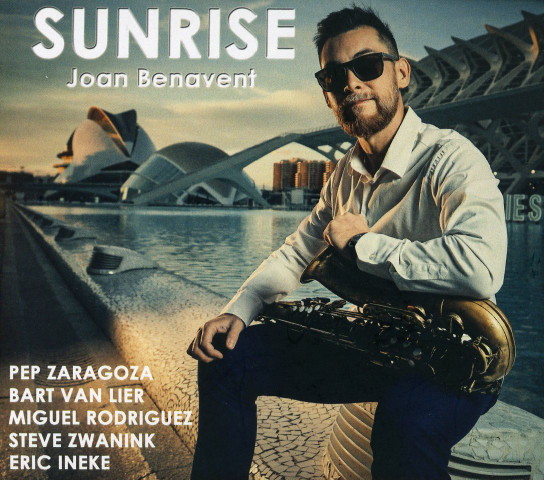

Not to demean other approaches to the music, but I have a preference for straight ahead Jazz: Jazz that you can pop your fingers to; tap your foot to; nod your head to. Its metronomic pulse - what some refer to as “swing” - creates a feeling of elation in me as I get carried away listening to the music.


And in this context, solo, duo, trio, and horn plus rhythm section are all enjoyable formats for this form of Jazz,  although, I have a particular fondness for what I refer to as “ensemble Jazz;” Jazz as played by quintets, sextets and octets.


Multi-horn front lines allow for more use of harmonies which in turn produce more textures or sonorities in the music. To my ear, the music sounds richer and fuller


In the modern idiom, the most common form of ensembles are quintets headed-up by trumpet and saxophone combinations. But I was particularly intrigued by groups led by Art Blakey, Benny Golson and Art Farmer and Gerry Mulligan formed sextets that included the trombone as the latter provided a bass clef extension or vehicle for the harmonies used in their arrangements. More recently the Marsalis brothers sported such a group.


The traditional, straight tenor trombone is written in the key of C, and it is in "Concert Pitch." This means that trombone, unlike many other wind instruments, will have the same notes and note names as a piano.


This sets up a host of possibilities for the arranger in terms of creating “colors” when the trombone is combined with a trumpet and a tenor saxophone.


When powered by a hard-driving and swinging piano, bass and drums rhythm section, and in the hands of a composer-arranger who can take full advantage of the possibilities, such a sextet becomes a Jazz Juggernaut. 
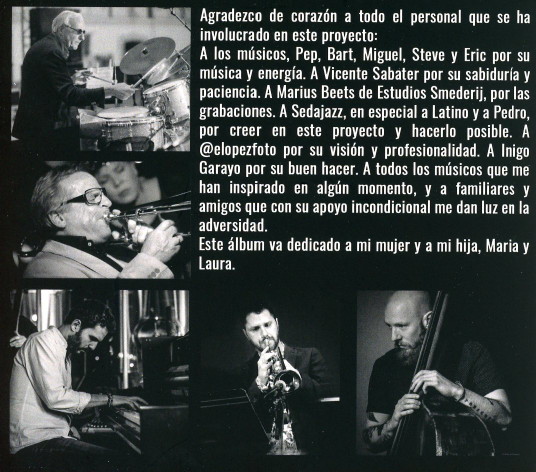


Enter tenor saxophonist Joan Benavent’s latest CD - Sunrise [SedaJazz Records V448-2020] - which pairs him with Pep Zaragoza, trumpet and Bart van Lier, trombone on the front line and a rhythm section made up of pianist Miguel Rodriquez, bassist Steve Zwanink and drummer Eric Ineke.


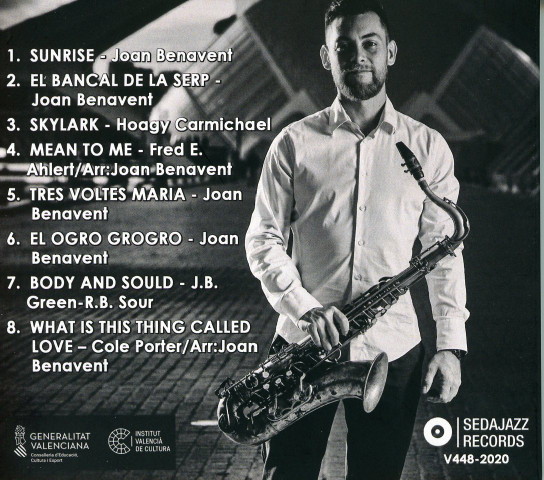
The album is made up of four originals by Joan and four standards from what is now commonly referred to as The Great American Songbook: Skylark, Mean to Me, Body and Soul and What Is This Thing Called Love.


In listening to the recording, I started at the end, so to speak, with What Is This Thing Called Love - an old standby which closes the album because its familiar melody gave me a chance to “set my ears” to Joan’s arranging style, and also because, I knew it would most likely by played as and up tempo tune in a straight ahead manner.


I wasn’t disappointed. Using Pep’s trumpet as the lead voice for the melody and the tenor to play the bridge, Joan beautifully integrates the sonorities of the instruments to explore the song as well as develop countermelodies and riffs off the main theme.


It’s a prime example of the way that the music boldly bursts forward on this recording as Joan takes advantage of the range of possibilities presented by this instrumentation.


The interplay of the textures afforded by the trumpet, trombone, tenor sax and piano is particularly evident on the recordings four originals, all penned by Joan: Sunrise, El Banca de La Serp, Tres Voltes Maria, and El Ogro Grogro [which is based on Benny Golson’s Jazz standard, Stablemates].


Joan takes great care in his treatments of the ballads on the recording. For example, Body and Soul has a rubato Intro by Joan with Miguel, Steve and Eric coming in at the bridge in tempo; Miguel plays the first solo with Joan coming in on the bridge to solo after which Miguel, Steve and Eric return to take it out. Miguel offers a brief introduction on Skylark, Joan states the melody with the rhythm section and the tune then becomes a vehicle for sensitive solos by Bart van Lier on trombone and Joan.


Skylark highlights Joan's ability to play a simple melody and get some feeling into it - a rare thing these days of overplaying and overblowing to the point that even familiar tunes lose all recognition.


Mean to Me is given a surprising twist when it’s played at an up tempo ¾ time and serves as a solo vehicle for Joan, Bart and Miguel.


Joan’s tone comes from Sonny Rollins with some harmonic helpings of Michael Brecker and Walt Weiskopf and he blends well with Pep, who has a brilliant solo with overtones of Freddie Hubbard and Jim Rotondi on the opener, Sunrise, and Bart, whose trombone style, while being very much his own, reminds me in places of Willie Dennis and Jimmy Knepper. Miguel’s solos are always informed, both rhythmically and harmonically, and bring to mind a young Herbie Hancock. 


Chuck Israels the renown bassist, composer-arranger and music educator once stated that when he works with a drummer he expects to hear “wedding bells” -  an obvious metaphor for the bassist and drummer locking in to drive the time feel. Well, Chuck would certainly be happy with the union that bassist Steve Zwanink and drummer Eric Ineke established throughout Sunrise as this fusion forms a “heartbeat” that keeps each of the tracks on the album alive, fresh and swinging.


The use of modes, odd time signatures, and tempo changes keep things interesting throughout and, with so much going on in the music, Miguel, Steve and Eric keep it moving straight-ahead by laying down the beat and staying out of the way. 


Whenever possible, in the few reviews that I do bring up on these pages, I attempt to have the musician talk about the music on their recordings to bring you their perspective.


In this instance, I elicited some commentary by asking Joan the following questions which he was kind enough to answer via email.


I do have two questions for you - why did you decide to arrange the music for a sextet?


Also, why did you choose these particular musicians for your group?


“I decided to arrange for sextet because it's the largest small ensemble, and it gives the opportunity to have harmonic density in the melodies and arranged parts like solis or counterpointistic melodies without having the inconvenience of putting together a large band. That can be an inconvenience for the reason of matching agendas, because some of us were flying from Spain to record in Holland, so we had quite a short time for making the whole thing happen.


I've chosen these musicians because Eric and I were looking for a project that combined both jazz scenes, the Spanish and Dutch. So we have invited some of our favourite musicians and great friends that, at the same time, were representative from each of the scenes.


Miguel Rodriguez is an Spanish piano player that has been living in Holland since he moved there to graduate, nearly 20 years ago. Since then he became one of the most essential pianists in NL, playing with the top of the scene. The same happens with Steve Zwanink, a Canadian-Dutch bass player that moved to NL to follow jazz studies. Since he is around he has shared the stage with the most important local jazz musicians and with others from abroad that called them as a local sideman. Bart van Lier is probably the father of the Dutch jazz trombone, he is still active and kicking, as you can hear him. The same with Eric, sharing stage as a side man for some of the most important jazz cats in history when they came to Europe, and still burning. Pep Zaragoza is one of the top trumpeters from the young wave in Spain, awarded and claimed several times.


In my case, I also moved to NL to study jazz, then I met Miguel and Steve (as classmates) and Eric as a teacher first and my mentor afterwards. After seven years living there I moved back to Spain and since then I'm living happily making music in my place and coming back to NL every once in a while to play with these cats.”


Sunrise by Joan Benavent and his colleagues is another example of Jazz as a music without boundaries or as “the gift” that Dizzy Gillespie once described as - “If you can hear it, you can have it.” Thanks to Joan, Pep, Bart, Miguel, Steve and Eric, Jazz is well-heard in both Spain and The Netherlands.


Saturday, March 31, 2018

Benavent, Baker and Ineke Create an "Opening"

© -  Steven A. Cerra, copyright protected; all rights reserved.

When I first received my copy of Openng, the instrumentation - tenor sax, bass and drums - brought me back to my first listening of Sonny Rollins’ A Night at the Village Vanguard which has been reissued and remastered as a double CD as part of the Rudy van Gelder [RVD] collection.


Sonny worked the gig when the club had a Sunday afternoon - dinner break - Sunday evening format using either Wilbur Ware and Elvin Jones or Donald Bailey and Pete LaRoca on bass and drums respectively.


At the time of its release in 1957, I had reached a certain proficiency as a Jazz drummer, but I had played the music primarily in larger groups such as big bands and octets.


Sonny’s Vanguard album made me aware of a lot of things, not the least of which is how important it is for each musician in a trio to listen to one another because that format strips things down to the barest of essentials: melody, harmony and rhythm


Another aspect of the music that it brought home to me was that such a “naked environment” really allowed for a more natural flow of the music in terms of the interaction of the instruments since there are no other horns or comping instruments to play off of.


That trio format is not for the faint of heart; there’s nowhere to hide. The tendency might be to hold back but you gotta be brave and venture forth otherwise to music becomes boring, full of cliches and other musical “safe harbors.”


It’s exciting and a bit scary at the same time because the music almost directs itself, assuming of course, that the musician’s who are making it have something to say.


Enter tenor saxophonist Joan Benavent, bassist Matt Baker and drummer Eric Ineke, each a master player in their own right, whose individual talents and skills blend beautifully to produce the music on the seven tracks that make up Opening [SedaJazz records DL V1230-2017].


It’s almost as though Joan, Matt and Eric  as the O3 Trio have channeled that spirit of Sonny and his Vanguard cohorts, brought it forward, and added their own sonority and ideas to make tenor sax-bass-drums Jazz with a texture that reflects their personalities and tastes.


Of course, it’s unfair to attempt to compare Joan to the incomparable Sonny Rollins, but there are some similarities.


One in particular that struck me as I listened to the music on Opening and that is that Joan shares Sonny’s big sound on the big horn; his tone is full, robust, and rich. His sonority engulfs the listener. Much like Sonny, Joan plays the tenor saxophone with brio, fuego and caliente - enthusiasm, fire and heat. And much like Sonny, although he is aware of the harmonic references and substitutions, his solos tended to be melodically and thematically configured.


Because of the bare-boned configuration, bassist Matt Baker’s virtuosic technique actually gets to be heard as a distinctive voice instead of just being felt as a pulse within a rhythm section. His arco [bow] work on bass is exceptionally and rarely heard in a Jazz setting.”


Drummer Eric Ineke has the wisdom and experience to not “push” the music in a particular direction; he doesn’t overplay and thus doesn’t overpower. Instead with his steady time-keeping and “colorist” approach to the rhythm he enables the previously mentioned natural flow between the three instruments.


What also struck me about Eric’s performance on this CD was how beautiful his drums sounded. Clean, crisp with just the right amount of overtone on the cymbals and timbre on the drums coming through. The recording engineer really got his drums “right”


And just when you think the trio groove can’t get much better during the course of the first five tracks, a sextet materializes on the closing two tunes of the CD when Voro Garcia, trumpet, Toni Belenguer, trombone and Santi Navalon on piano join in on Speak Low and Grew’s Tune, respectively. The arrangement on the late pianist’s Mulgrew Miller’s tune that closes the CD rekindled memories of Art Blakey’s Jazz Messengers when Freddie Hubbard, Curtis Fuller and Wayne Shorter formed the “front line.”


While doing some research on the web about about the musicians, I came across a full review of Opening [SedaJazz records DL V1230-2017] by François van de Linde at www.flophousemagazine.com


I wrote to François and requested his permission to use his review in this blog posting and he kindly granted it. You can read the review on his site which is located at www.flophousemagazine.com


© -  François van de Linde, copyright protected; all rights reserved; used with permission.


“The first thing that comes to mind listening to 03 Jazz Trio’s Opening is that it must be the work of a tight-knit outfit that has been playing together nightly for months.


That’s not the case. Although the protagonists have been crossing each other’s paths. The Spanish tenor saxophonist Joan Benavent and American bassist Matt Baker both live in Valencia. Dutch master drummer Eric Ineke, also an enthusiastic teacher at music schools and conservatories all around Europe, met Benavent at the Conservatory of The Hague. Subsequently, Benavent invited over Ineke to Valencia’s Seda Jazz school. There, Benavent coupled the drummer with the versatile Matt Baker to form a recording unit for Benavent’s ideas to come to fruition. The men participated in an avant-leaning session (and live performance) that turned out remarkably well.


By his own account inspired by John Coltrane, Ornette Coleman, hard bop and classical music, there is nothing that suggests Benavent is overreaching. An immaculate and extravert stylist – Benavent searches the extremes of his horn but is neither wild nor aggressive – the big and clear-sounding saxophonist tackles such diverse compositions as Debussy’s Danses De Delphes, Weill/Nash’ Speak Low and Benavent’s post-boppish Opening. This particular ‘opening’ of the program, definitely marked by the ‘Impulse label’ vibe, is something else. The grand, bowed bass opening, loose drum polyrhythm and Benavent’s lyrical yet charged theme immediately works on the emotions, pulling you in the promising universe of the album. Bang! It further develops through the solo of Benavent, whose ‘singing’ tone effectively ices his cake of sheets of sound and staccato playing, via fluent switches of tempo by the trio, subtle interaction of snare drum with sax and bass and a melodic drum intermezzo to the humorous, concise coda in march rhythm. Held together by Benavent’s thematic variation throughout. A royal cake indeed.


Sira i Xesca is a playful and hefty dip into mambo land. Añoranza, a composition by E. Granados, presents a happy marriage between high drama and the smoky tenor atmosphere so typical for classic jazz. The fact that the album’s two mainstream jazz tunes – thoroughly swinging sextet treatments of Speak Low and Mulgrew Miller’s Grews Tune – are snowed under a bit by the album’s front-running setting, speaks volumes about the trio’s skills and passion.


Surely we will see a growth on (relatively) young Benavent’s part in the department of storytelling, perhaps the least imposing aspect of the album, a carefully prepared session that undoubtedly revolves around the controlled fury of Benavent and the trio’s alert interaction. Ineke, elder statesman of hard bop who nonetheless has done his part of ‘far out’ playing during his long career, feels like a fish in the water. Matt Baker, a jack-of-all-hi-level-trades working in the fields of jazz, world, folk and classical music, contributes a forceful tone, melodic, versatile phrasing and exceptional use of the bow.


The tart, touching first part of Debussy’s Danseuses De Delphes is followed up by a meaty drums/tenor battle, the song ending with a blast not unlike one of those surprising thunderous twists in a Mingus performance. The curious but effective mix of vamp and modality of Coffee At The Almost Dead People Place is enticing. Moreover, it’s gutsy and fresh. The whole sum of Opening is just that, made all the more exciting by the sonorous and punchy sound production.”


Personnel

Joan Benavent (tenor saxophone), Matt Baker (bass), Eric Ineke (drums) Voro Garzia (trumpet 6-7), Toni Belenguer (trombone 6-7), Santi Navalon (piano 6-7)

Recorded

in 2016 in Valencia

Released

as SedaJazz Records DL.V1230 in 2017

Track listing

Opening
Sira I Xesca
Danseuses de Delphes
Añoranza
Coffe At The Almost Dead People Place
Speak Low
Grews Tune


Check out Joan Benavent’s website here.