Showing posts with label Joe Henderson. Show all posts

Thursday, February 29, 2024

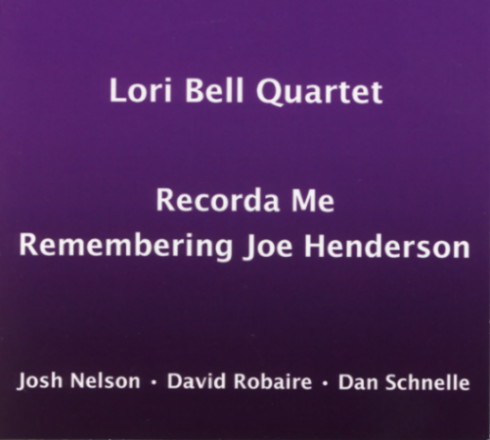
Lori Bell - Recorda Me Remembering Joe Henderson

 © Copyright ® Steven Cerra, copyright protected; all rights reserved


For nearly thirty years, Henderson has possessed his own sound and has developed his own angles on swing, melody, timbre and harmony, while constantly expanding his own skill at playing in uncommon meters and rhythms. In his playing you hear an imposing variety of harmonic, rhythmic and melodic choices; you also hear his personal appropriation of the technical victories for his instrument achieved by men such as Sonny Stitt, Stan Getz, Sonny Rollins, Warne Marsh, Paul Gonsalves, Johnny Griffin and John Coltrane.


His, then, is a style informed by enormous sophistication, not limited by insufficient study or dependence on eccentric clichés brought into action for the purpose of masking the lack of detailed authority. In this tenor playing there's a relaxation in face of options that stretch from Coleman Hawkins, Lester Young and Charlie Parker to all of the substantial innovations since. So the music of Joe Henderson contains all of the components that make jazz so unique and so influential woven together with the sort of feeling, imagination, soul and technical authority that do the art proud.

- Stanley Crouch, Jazz author and critic


"Joe Henderson is the essence of jazz ….He embodies musically all the different elements that came together in his generation: hard-bop masterfulness plus the avant-garde. He's a great bopper like Hank Mobley or Sonny Stitt, but he also plays out. He can take it far harmonically, but still with roots. He's a great blues player, a great ballads player. He has one of the most beautiful tones and can set as pretty as Pres or Stan Getz. He's got unbeliev­able time. He can float, but he can also dig in. He can put the music wherever he wants it. He's got his own vocabu­lary, his own phrases he plays all dif­ferent ways, like all the great jazz players. He plays songs in his improv­isations. He'll play a blues shout like something that would come from Joe Turner, next to some of the fastest, outest, most angular, atonal music you've ever heard. Who's playing bet­ter on any instrument, more interest­ingly, more cutting edge yet complete­ly with roots than Joe Henderson? He's my role model in jazz."

- John Scofield, guitarist


"Joe Henderson and Wayne Shorter emerged at the same time with their own sounds and rhythms and tunes. They inspired me as a young player …. He's always had his own voice. He's developed his own concepts with the inspirations of the people he dug but without copying them. I hear Joe in other tenor players. I hear not only phrases copped from Joe, but lately I hear younger cats trying to cop his sound. That's who you are as a player: your sound. It's one thing to learn from someone, but to copy his sound is strange. Joe's solo development live is a real journey — and you can't cop that! He's on an adventure whenever he plays."  

- Joe Lovano, tenor saxophonist


"Joe Henderson is one of the most influential saxophone players of the 20th century …. I learned all the solos on Mode for Joe and the records he did with McCoy Tyner, a lot of the stuff he's on, like The Prison­er. He was one of the few saxophone players who could really play what I call the modern music, that really came from the bebop tradition but extended the harmonic tradition fur­ther. There's a small group of guys in that pantheon: Coltrane, Wayne Shorter, Warne Marsh, Lucky Thompson, Sonny and Ornette, and Joe Hen. He's an amazing musician. I'm really jaded. I don't really go to the clubs anymore. There's not really anything I want to hear — except when Joe's in town. And when Joe's in town, I'm there every night!"

 – Branford Marsalis, soprano and tenor saxophonist


I got to know Joe Henderson a bit when I lived in San Francisco in the 1990s. He had just finished the Lush Life [Verve/Polygram 314 511 779-2] tribute to Billy Strayhorn and was working on the charts that would appear a few years later on the Joe Henderson Big Band CD [Verve/Polygram 314 533 451-2].


He and I lived on either side of Divisadero Street in central San Francisco. Divisadero is a north-south traffic throughway that cuts through several neighborhoods, including Lower Haight, Alamo Square, Pacific Heights, the Marina and the Western Addition. The street offers a kaleidoscopic mix of dining, grocery, and merchant fronts that serve each neighborhood.


The first time we met, Joe was sitting in a barbecue ribs place on Divisadero called The Brothers and while I waited for my take-out order I spotted him sitting quietly in a window seat reading some music scoring sheets.


For years, Joe wore a straw-hat version of Lester Young’s pork-pie hat and big suspenders that adorned shirts with thick, colorful stripes. This garb along with his salt and pepper beard was a dead give-away so I sauntered up to him and said: “You’re Kenny Dorham aren’t you?"  [Joe was close friends with trumpeter and composer Dorham and made his recording debut on Kenny’s Una Mas Blue Note LP.]


He looked up from his scores with a momentary, puzzled look that quickly turned into a smile once he saw that I was wearing one, too.


Motioning me to sit down at the table next to him he asked: “And what would you know about Kenny Dorham?”


That conversation in various forms took on a life of its own for a number of years in a variety of Divisadero locations ranging from coffee shops to pizzerias.


On one occasion, Joe invited me to his house and when I got there, I was surprised to hear him playing the flute. When I asked him why he didn’t play it more often in public he explained that the instrument required a “whole new orientation” than playing his tenor sax “and I’m not there yet with doing too much on it in public.”


I noted, too, that he hadn’t played it on either the Lush Life or his Big Band albums.


During this period, Joe often talked about his big band disc which was issued on Verve in 1996 [314 533 451-2]. I didn’t see him very much after the Joe Henderson Big Band CD was released as by then I had moved to the West Portal area of the city.


Joe died in 2001 at the much-too-young-age of sixty-four [64].


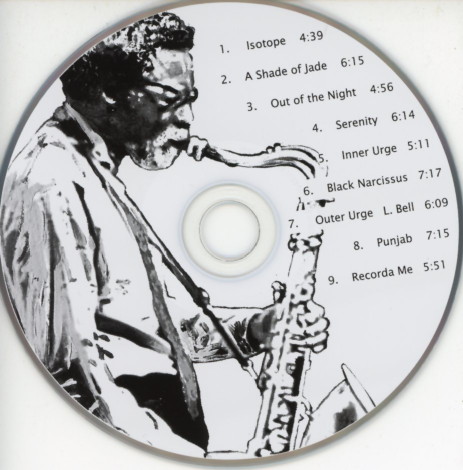
Imagine my surprise then when flutist Lori Bell, who is based near San Diego, CA, recently sent me a copy of her homage to Joe entitled Recorda Me: Remembering Joe Henderson which is due to drop on April 19th.


Rob Evanoff at 1888media.com, who is handling the promotional support for the new recording, sent me this press release which offers detailed information about Lori and the new recording which received four stars in Downbeat, Jazz Journal, the Los Angeles Times and the Jazz Times.


"Bell's playing is lithe and energetic, her lines unspooling with ease. But she's also an improvisational shapeshifter."

- Downbeat 'Editors Pick'


"Bell flaunts prodigious chops on both C flute and alto flute though her pen might be mightier than her sword. Her originals all reveal a wide harmonic palette, a sophisticated rhythmic sensibility and a refined sense of dynamics, along with an urge to swing." 

- Downbeat


“Bell’s playing on C and alto flute is gorgeous, filled with light and air on the ballads, briskly inventive on her bop-tinged improvisations."

- Los Angeles Times


"One of the finest virtuoso flutists of our time.'

- Latin Jazz Network


Virtuoso LORI BELL Pays Homage to Musical Titan JOE HENDERSON


Releasing April 19, 'Recorda Me' Reimagines 8 Henderson Classics Including 60s Era Groundbreakers "Isotope," "Serenity," "Inner Urge," "Punjab," and "A Shade of Jade"


Features Josh Nelson (Piano), David Robaire (Bass), Dan Schnelle (Drums) 


“San Diego, CA: Accomplished arranger, virtuoso musician and esteemed educator, Lori Bell returns April 19th with Recorda Me: Remembering Joe Henderson, an extraordinary new collection paying homage to one of the all-time greats, hard bop, jazz icon, Joe Henderson.


Portuguese for "Remember Me," the 9-song, Recorda Me: Remembering Joe Henderson showcases Bell at her enchanting best, one that the LA Times has dubbed "briskly inventive...gorgeous playing" while Downbeat describes her as "an improvisational shapeshifter."


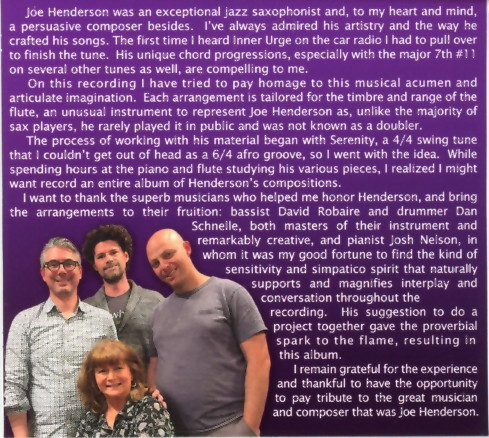
"Joe was an exceptional jazz saxophonist and to my heart and mind, a persuasive composer besides. I've always admired his artistry and the way he crafted his songs. His unique chord progressions, and use of the major 7th #11 on several tunes are compelling to me," offered Bell.


Of the eight compositions Bell chose to honor, all but one are from Henderson's mid 60s output, including the title track and "Out of the Night," both from Henderson's debut album, Page One (1963). Also included are two songs from Henderson's bewitching third album In 'n Out ("Punjab," "Serenity"), a pair of spellbinders from his 1966 Inner Urge opus ("Inner Urge," "Isotope"), "A Shade of Jade," the beguiling lead cut from his universally acclaimed release, Mode for Joe and "Black Narcissus," from the 1977 album of the same name.


"On this recording I have tried to pay homage to his musical acumen and articulate imagination. Each arrangement is tailored for the timbre and range of the flute, an unusual instrument to represent Joe Henderson as, unlike the majority of sax players, he rarely played it in public and was not known as a doubter," said Bell.


Transposing saxophone to flute provided a welcome challenge while allowing Bell to imbue the arrangements with her own sense of artistry. "The process of working with his material began with Serenity, a 4/4 swing time that I couldn't get out of head as a 6/4 afro groove, so I went with the idea. While spending hours at the piano and flute studying his various pieces, I realized I might want to record an entire album of Henderson compositions."


The lone original on Recorda Me is Bell's "Outer Urge," a knowing nod and apt complement to Henderson's 12-minute astral projection on "Inner Urge." On "Outer Urge," Bell flavors the excursion with her love of Latin modalities. It's an exhilarating journey and one she's explored before with her Music of Djavan on the Resonance Records label.


With a father that was a big band lead trumpeter in NYC for 30 years and a mother that played accordion with a great ear for both jazz and classical music, the Brooklyn native was exposed to the alchemy of improvisation by pillars of the golden era of jazz at places throughout Greenwich Village and lower Manhattan. Over the past several decades, she's carried the torch forward, establishing herself as an in-demand, world-class performer regularly touring the Western U.S. while also leading seminars and Masterclasses in NYC and beyond.


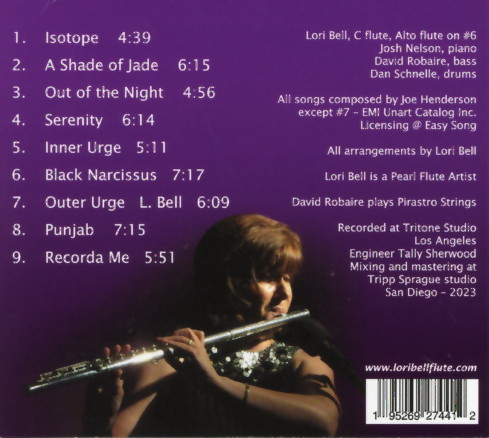
Accompanying her on her musical journey navigating the majesty of Henderson are pianist Josh Nelson, known for his work with John Pizzarelli, Peter Erskine and Natalie Cole, bassist David Robaire (Larry Goldings, Billy Childs, Jane Monheit), and drummer Dan Schnelle (David Benoit, Karrin Allyson, Billy Childs).


Bell will honor Joe's lasting legacy throughout the spring with shows throughout California including four hometown shows in San Diego, February 8th - June 28, an April 25th date at Sam First in Los Angeles and a very special concert at The Joe Henderson Lab at SF Jazz in San Francisco on Saturday, April 20. The 4/20 show is a part of the annual Joe Henderson Festival to celebrate Henderson's April 24th date of birth and his love of the city where he resided after leaving NYC in the early 70s, even teaching at the San Francisco Conservatory of Music for a stretch.


About the songs:


Isotope - Deconstructed blues. Very conversational between the flute and the piano, full of interplay.


A Shade of Jade - Originally composed as a swing tune reimagined as a samba/swing idea.


Out of the Night - Minor blues which features an arranged piano intro with a featured bass solo.


Serenity - Originally a swing tune reimagined as an afro-groove in 6/4.


Inner Urge - Beings with flute and drums with a knowing nod to hip hop.


Black Narcissus - Original intro for piano and features the alto flute.

Outer Urge (L. Bell) - Unique 4/4, 7/4, then in 5. Solo section in 5/4, Latin flavoring.


Punjab - Freestyle introduction adding reharmonizing using major 7#5 chords.


Recorda Me - Re-harmonized concept using original bass line. Features a moving chord progression with the solos featuring Joe's original chord changes.


Here’s an itinerary of Lori’s upcoming gigs promoting the new CD and you can locate the list of musicians accompanying her by going to her website.


3/15 – San Diego, CA – Golden Island

4/20 – San Francisco, CA – The Joe Henderson Lab (SF Jazz) [LP Release]

4/25 – Los Angeles, CA – Sam First

4/28 – San Diego, CA – Tio Leo’s

5/23 – Temecula, CA – The Merc

6/28 – La Jolla, CA – La Jolla Community Center (Fourth Friday Jazz Series)

7/06 – Paso Robles, CA – Libretto


Recordings which exhibit this level of musicianship don’t come along very often so you might want to do yourself a favor and snap up a copy and if you are in the neighborhood for any of the above concerts, go out and support Jazz in performance and share with Lori how much you enjoyed listening to it.

Wednesday, May 26, 2021

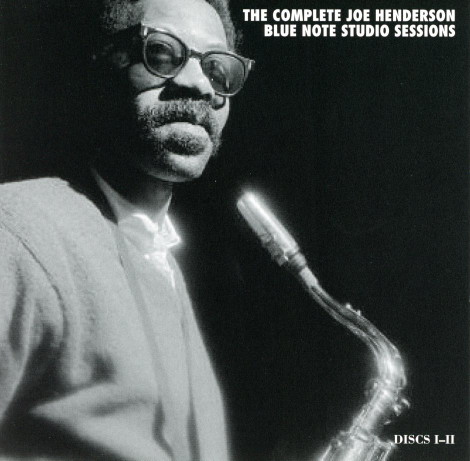
Joe Henderson: The Complete Blue Note Studio Sessions

 © Copyright ® Steven Cerra, copyright protected; all rights reserved.


In Down Beat, the guitarist John Scofield was quoted explaining what's so special: "Joe Henderson is the essence of jazz..... He embodies musically all the different elements that come together in his generation...He has one of the most beautiful tones and can get as pretty as Pres or Stan Getz... He can float but he can also dig in... He's got his own vocabulary, his own phrases, he plays all different ways, like all the great jazz players... Who's playing better on any instrument, more interestingly, more cutting edge yet completely with roots than Joe Henderson? He's my role model in jazz."


“Dignity is the word for him - intelligent, swinging, hip, modest and worthy are others.

He had no complaints. He made a good living, he owned a house, took care of his medical bills, and his family. He was respected for doing what he enjoys. Not too many people can say that.”

- Mike Zwerin, Culturekiosque Jazznet


“Mr. Henderson was unmistakably modern. ''Joe had one foot in the present, the other in the future, and he was just a step away from immortality,'' said the saxophonist Benny Golson. His tenor saxophone sound was shaded, insinuating, full of layers, with quicksilver lines amid careful ballad phrases and short trills. He had a clean, expressive upper register and a talent for improvising in semi-abstract harmony, and when the far-out years for jazz arrived in the mid-60's, led by musicians like John Coltrane and Miles Davis, he was well positioned to take part. He made a series of records for Milestone that used studio echo, Alice Coltrane's harp, violins, wood flutes and other exotic accouterments.


But Mr. Henderson's greatest strengths were more traditional: the ballad, the uptempo tune, the standard. And by the early 1990's, when he was a respected elder, he made some of his greatest statements on a series of well-produced, nearly theatrical albums for Verve Records.”

- Ben Ratliff, Obituary, New York Times


“Joe Henderson became one of the surviving jazz icons in the 1990s, and as a consequence his back pages - long neglected by-reissues - were extensively released on CD. He's a thematic musician, working his way round the structure of a composition with methodical intensity, but he's also a masterful licks player, with a seemingly limitless stock of phrases that he can turn to the advantage of any post-bop setting; this gives his best improvisations a balance of surprise, immediacy and coherence few other saxophonists can match. His lovely tone, which combines softness and a harsh plangency in a similar way, is another pleasing aspect of his music”

- Richard Cook and Brian Morton, The Penguin Guide to Jazz on CD 6th Ed.


“If in the 1990's there is a consensus on anything in jazz, it is that Joe Henderson is one of the music's premier living soloists. From the time of his first recordings (1963) until now, Henderson has been a totally distinctive improviser by any and all criteria: melodic inventiveness, harmonic sophistication, rhythmic sureness, a totally personal sound, and arresting powers of communication. He is also a composer of substance who has added a sizeable number of pieces to the jazz repertoire.”

- Bill Kirchner, insert notes to The Joe Henderson Big Band [Verve 314 533 451-2].


Over the years, Blue Note Records, Michael Cuscuna at Mosaic Records and Bob Blumenthal have become an unbeatable team when it comes to licensing, reissuing and annotating the iconic Jazz that Alfred Lion and Frances Wolff produced in the 1950s and 1960s.


The finished products are beautifully packaged sets marked by enhanced audio quality, superbly researched and written booklet notes and distinctive black and white photographs of the musicians performing at the original recording dates.


It’s important to keep in mind that these are limited edition sets so when they are gone, they are gone. You can find out more about Mosaic and related order information for the Henderson 5 CD set [MD 271] by going here.


We wrote to Michael and Bob to ask their permission to feature the initial pages of the booklet notes to give you a taste of what’s on offer here and they kindly consented to allowing us to share the following excerpts with you.


© -Bob Blumenthal/Mosaic Records, copyright protected; all rights reserved; used with the author’s permission.


“From the moment he emerged in 1963 until his death in 2001, Joe Henderson was one of the most distinctive and consistently inspired voices in jazz. His bold yet wizened sound coupled with an effortless attack and flawless flow of ideas across the harmonic and rhythmic spectrum, plus a rare knack to naturally command the widest variety of musical contexts, made Henderson a musician whose every appearance was significant. This was true of his early recording career at the center of Blue Note's early '60s successes, and extended to the more irregular middle period of his career as well as the ultimate commercial success he finally achieved in the 1990s.


Henderson was an elusive and somewhat mysterious figure. Associates were known to refer to him as The Phantom, an individual hard to get to know and often hard to find. His efforts to maintain a working band were fitful at best, and while releasing some exceptional albums of his own in 1971 he chose to spend an anonymous year in the ranks of Blood, Sweat and Tears. I had two telephone conversations with Henderson at his later, popular peak, one in 1993 as a columnist for the Boston Globe and a second five years later for liner notes to ULTIMATE STAN GETZ, a Verve anthology that Henderson had selected. In both instances he could not be found at the appointed hour, finally responded to numerous messages at the very edge of my deadlines, and then proved friendly, forthcoming and willing to extend the conversation well beyond my expectations.


While generally upbeat and willing to express appreciation of musicians from diverse generations, Henderson was not above expressing his displeasure with younger players who showed up uninvited at his recording sessions or displayed a commitment to improvisation that, in his view, implied an indifference to the underlying material. ""It hit me at a recent concert," he said while discussing Getz, "that young guys who took this approach were playing on the same bandstands where Stan, Ben Webster, Bill Evans, Miles Davis and other giants played. Did they deserve to lie there? And should I be lending my support by being there with them?"' In our earlier discussion, he indicated that the popularity of his compositions also raised problems with players young and old. "Inevitably, new ideas come to you after you've recorded a piece. A year or two pass, and the tune becomes what it should have been on the record. Meanwhile, other people have learned the tunes off the record, or transcribed them, and what they play isn't the tune as I've come to know it."


Henderson was far more generous, to me and to early authors of liner notes, in recollections of his formative years. He was born in Lima, Ohio on April 24, 1937, one of 15 children in a family that encouraged the study of music. (His brother Leon, also a tenor saxophonist, was heard on Blue Note as part of the Kenny Cox group.) He began to take the saxophone seriously around the age of 13, "I had had a saxophone for three years, and was supposed to be studying technique in books," he told me, "but I was more interested in obtaining a familiarity with the instrument so that I could play things that didn't just leap out of the book." He credited Herbert Murphy, his teacher, for familiarizing him with the instrument; pianists Richard Patterson and Don Hurless for providing a working knowledge of the piano; and drummer John Jarette for suggesting which records to take seriously in an older brother's substantial collection.


Henderson's early idols might surprise some of his fans. “In the beginning, Stan [Getz] was the guy I wanted to be when I grew up," he confessed. "He captured the lion's share of my attention for three or four years...when I was just zapping up ideas like an ink blotter. I started doing things Stan's way just to see what it felt like; and it didn't take me too long to change a note here, a note there. Pretty soon this thing was uniquely my own." In later years, when both saxophonists lived on the West Coast, Henderson and Getz became what the former described as "part of a mutual admiration society." Henderson also began to take composing and arranging seriously in high school, as he explained to Leonard Feather, because "I was originally under the influence of the Stan Kenton band — the one with Lee Konitz in it." Konitz is another early favorite who would return Henderson's appreciation, as documented on the classic 1967 LEE KONITZ DUETS.


After graduating from high school in 1955, Henderson attended Kentucky State College for a year before transferring to Wayne State University in Detroit. He described his immersion in that jazz haven to Nat Hentoff as "the real awakening for me." Among other things, it marked his reconsideration of Charlie Parker. "Just before I moved to Detroit I got back to Bird," he told me in our second interview. "At that point, I had the knowledge to appreciate him for being the god that he really was...Then I spent about eight years trying to play Bird tunes with total accuracy, which is like playing etudes." It no doubt helped that, like many other young Detroit musicians, he began studying with Larry Teal and playing with the professorial Barry Harris.


Henderson served in the Army between 1960 and 1962, winning honors in a talent show and participating in a tour of three continents with a military band for which he wrote arrangements and played occasional bass as well as tenor. He received his discharge in August 1962 after a final period of service in Baltimore, and quickly headed to New York. Kenny Dorham described Henderson's arrival in the liner notes to PAGE ONE as follows: "[His] first stop was at a party at a friend's place (saxophonist Junior Cook) where I was introduced to this bearded, goateed astronaut of the tenor sax. Later I suggested that we go down to see Dexter Gordon, who was headlining at the Birdland Monday night 'Jazz Jamboree'... 'Long Tall Dexter' 'asked the young man if he'd like to play some. Minutes afterward...the saxophonist was off and soaring his lyrical way to new heights on a Charlie Parker blues line. At the end of the chorus (and I do mean 15 or 20) there was a warm and exhilarating applause tor Joe, and as for Dex, sitting on the side, he looked "gassed."'


Dorham became a mentor to Henderson, guiding him through the intimidating New York scene and employing him as the second horn on gigs. Henderson, already a longtime fan of the trumpeter's, told Nat Hentoff "We have some kind of vibration going. Even when we play unison lines, it seems we breathe at the same time." It was Dorham who brought the young unknown to the attention of Blue Note, where Henderson made all of his albums as a leader and most of his appearances as a sideman in the years that would become the first chapter of his recorded history. This collection contains all of Henderson's own Blue Note albums and the pair he made with Dorham, plus a sampling of the original compositions he contributed while recording with others.”


Tuesday, December 1, 2020

Joe Henderson's Adventures in Barber College


© -Steven Cerra, copyright protected; all rights reserved.


“PARIS, 1 April 1998 - Miles Davis reinvented himself many times, in many shapes. His alumni include just about every influential jazz musician from his own generation on down. Davis helped deliver Bebop with Charlie Parker, gave Birth to The Cool, explored modality, was the father of jazz-rock and funk-jazz and is the principle inspiration for the young generation now marrying jazz and rap.

The poetic sound of the name "MILES", the way he looked, his lifestyle, his trademark rasp and his marriage of quality and commerciality have entered the folklore. His combination of musical, visual, sexual, and financial chops is unequaled. The ghost of MILES hovers.”
- Mike Zwerin


Very few of my business trips to Europe turned out as planned; there was always an inconsistency to them.

But whether it was tea and scones in London, cafe au lait and a croissant in Paris, or an espresso and biscotti in Rome, one person that I could always count on joining me for breakfast and consistently bringing pleasure to my day was Mike Zwerin.

This was because Mike, who was based in Paris until his death in 2010, wrote a regular Jazz column for the International Herald Tribune, the English language newspaper that is available on a daily basis in most of the major cities of Europe.

And, Man, could Mike ever write.

For those not familiar with his work, Mike was an expatriate for quite a while having left for Europe in 1969.

Mike was a fine trombonist who became known when he was a member of the Maynard Ferguson band. A strange thing happened on the way to the job. His father died and Mike suddenly found himself the president of Dome Steel. I found it very hard to imagine Mike as the head of a steel company; so did he, and in fact he would stash his horn in his office in New York so that he could slip away to play gigs. Eventually he gave the position up, returned to playing full time, and became jazz critic of the Village Voice [1964-1969] and then its London correspondent [1969-71]. He moved to Paris and wrote regularly for the International Herald-Tribune for 21 years while also freelancing for various European magazines and continues playing.

Here’s another in Mike Zwerin’s fine series Sons of Miles which he posted to Culturekiosque Jazznet between 1996-1998.

“When Joe Henderson's wise and gentle smile appeared on the cover of Down Beat magazine, the accompanying story was presented like the latest news rather than a feature about a well-known and beloved master.

"They all love Joe," the headline read.

Surprise! Look who's still kicking. Bird Lives. Glenn Miller playing "In The Mood" in that great Roseland Ballroom in the sky all these years. Elvis still singing "Jailhouse Rock" in Vegas. Where has Joe been all these years?

The man thought to be decaying in the saxophone wilderness has been discovered alive and well and living in San Francisco. Actually, he has been the tenor player of the year for years. And anyway he doesn't really care, one way or the other.

His good sense of balance questions not past absence but current presence: "I hear people saying, ‘He's been doing it for 30 years, he should have been on that cover 20 years ago.' But I'm asking myself, ‘you mean somebody's paying attention to what I've been doing all this time?'" He's happy to be on the cover, late or not.

"I'm just not curious about why I haven't been on the Down Beat cover previously," he says. "Or why I haven't been on any sort of magazine cover. It doesn't make any difference to me in terms of what I'm trying to do out here. I've been doing it for a long time, and I hope to continue to do it with or without recognition."

The most obvious and immediate physical change recognition made in his life on the road, which was most of his life, involved a qualitative as well as quantitative improvement. His hotel rooms quickly became big enough so that he could walk around the bed without tripping on his suitcase. He's not naive, he knows this is not the least in life and that he's earned it.

It did not seem like false modesty when he continued: "I'm the last one to have an opinion of what I deserve or don't deserve. You can't please everyone. We only have to try to convince the suits that perhaps we are a bit more valuable than they consider us. And above all, we try to get from sunup to sundown with as much dignity as possible."

Dignity is the word for him - intelligent, swinging, hip, modest and worthy are others.

He had no complaints. He made a good living, he owned a house, took care of his medical bills, his family. He was respected for doing what he enjoys. Not too many people can say that.

He'd been having "the strangest time" trying to convince the journalists who were suddenly pursuing him that he hasn't exactly been obscure. The people who have been in and out of his home and seen the dignity with which he has lived for the past 20 years are surprised that he hasn't broken through to this degree of respect ages ago: "I've been living in the trenches. I'm on the front line, on the point. The first shot gets fired, I get hit." The point man is expendable. Except that Joe Henderson is a terminator.

There is a joke in the critics' community, when one of them gets lazy and decides not to go out on a rainy night to hear the latest teenage whiz: "Why hear somebody who sounds like Joe Henderson when you can hear Joe Henderson?"

In Down Beat, the guitarist John Scofield was quoted explaining what's so special: "Joe Henderson is the essence of jazz..... He embodies musically all the different elements that come together in his generation...He has one of the most beautiful tones and can get as pretty as Pres or Stan Getz... He can float but he can also dig in... He's got his own vocabulary, his own phrases, he plays all different ways, like all the great jazz players... Who's playing better on any instrument, more interestingly, more cutting edge yet completely with roots than Joe Henderson? He's my role model in jazz."

Since graduating from Wayne State University in Detroit, he has accompanied Yusef Lateef, Donald Byrd, Bud Powell, Kenny Clarke, Horace Silver, Kenny Dorham, Herbie Hancock, McCoy Tyner, Miles Davis, Wynton Marsalis, Lee Morgan (on the classic "The Sidewinder") and... Well, you get the idea. Why so long without a recording of his own music? "Lush Life" was the first in 11 years: "I didn't want to just go into a studio and make another record. Do the same things I'd done before. I didn't think I had anything new to say. It took 11 years to get some new ideas buzzing around in my brain and go out and make them available to my fans." He's very demanding on himself about what constitutes a real "idea."

He talks about "fans" not possessively but as people to whom he owes something. He repeats the word periodically, always with an unspoken "faithful" modifying it: "My fans know what I'm about. I respect them for that. I love my fans."

He sees all this current adulation as just basically being in the right place at the right time. The healthy dimensions of this man's ego are hard to believe.

And then comes the smile that looks you in the eye and you think of a preacher being thankful for God's will. Can you imagine? He saw a life-size poster of his own face the other day. What's the big deal? He takes the stance - you're supposed to play well, play your butt off, that's what it's all about. Why are they praising him for it?

He once called himself a "60-year-old-novice" when it came to handling publicity; learning how to be an "interesting" interview. He should have learned it long ago. Young-blood Branford Marsalis doesn't have any trouble finding and dealing with journalistic interest and praise. It's not Henderson's fault that his time and place came 30 years late.

It should be easy. When you're asked a question just try and say what you really think. Trouble is the questions are always the same and he finds himself trying to "guide these people to ask the right intelligent questions" so that "I can find new ways to express myself. I'd like interviews to be more fun." In his innocence, God bless him, he's asking a lot. He wants intelligence where there are merely noses for news.

Words have always been important to him, he improvises music with punctuation like commas, colons and paragraphs. He admires writers who can manage long complex sentences. And now that he was being interviewed a lot, he was reading more, trying to get his "verbal juices flowing again" and so find ways to come up with new twists to be able to enjoy all the talk.

Trouble is journalists tend to line up one after another like in a barber shop and whether it be Time or Newsweek or Down Beat, they all have the same haircut.”

Joe Henderson passed away in 2001, about five years after Mike’s article about him was posted in the Sons of Miles Series.

Ben Ratliff brilliantly explained Joe’s significance to the Jazz World and what made his playing so distinctively brilliant in the following obituary which appeared in the July 2, 2001  edition of The New York Times.

Joe Henderson, one of the great jazz saxophonists and a composer who wrote a handful of tunes known by almost every jazz student, died on Saturday in San Francisco. He was 64 and lived in San Francisco.

The cause was heart failure after a long struggle with emphysema, The Associated Press reported.

Mr. Henderson was unmistakably modern. ''Joe had one foot in the present, the other in the future, and he was just a step away from immortality,'' said the saxophonist Benny Golson. His tenor saxophone sound was shaded, insinuating, full of layers, with quicksilver lines amid careful ballad phrases and short trills. He had a clean, expressive upper register and a talent for improvising in semi-abstract harmony, and when the far-out years for jazz arrived in the mid-60's, led by musicians like John Coltrane and Miles Davis, he was well positioned to take part. He made a series of records for Milestone that used studio echo, Alice Coltrane's harp, violins, wood flutes and other exotic accouterments.

But Mr. Henderson's greatest strengths were more traditional: the ballad, the uptempo tune, the standard. And by the early 1990's, when he was a respected elder, he made some of his greatest statements on a series of well-produced, nearly theatrical albums for Verve Records.

Born in Lima, Ohio, he was one of 15 siblings. His parents and his brother James encouraged him to study music because of the talents he displayed as a saxophonist in his high school band. He attended Kentucky State College for a year, then transferred to Wayne State University in Detroit, where he was among fellow students like Yusef Lateef, Curtis Fuller and Hugh Lawson. In Detroit he worked with the saxophonist Sonny Stitt, and eventually formed his own group before joining the Army in 1960. He played in the Army band at Fort Benning, Ga., and toured military bases in the Far East and Europe with a revue called the Rolling Along Show.

In 1962 Mr. Henderson, who soon became a distinctive presence with his rail-thin body, thick black glasses and bushy mustache, was discharged and headed for New York. He quickly joined the young musicians recording for Blue Note records, especially the trumpeter Kenny Dorham, who was acting as a talent scout for the label. He made his recording debut in 1963 on Dorham's ''Una Mas,'' one of the classic Blue Note records of the early 60's.

Mr. Henderson was entering jazz at a fertile moment, when a few ambitious, challenging albums, like John Coltrane's ''My Favorite Things'' and Miles Davis's ''Kind of Blue,'' had broken through to a wide audience. A new self-possessed intellectualism was widespread in black music, and the experimental and traditional factions hadn't yet hardened their positions. Within the same four-month stretch as a Blue Note session regular, Mr. Henderson found himself playing solos on Lee Morgan's ''Sidewinder,'' an album full of bluesy, hard-bop tunes, and Andrew Hill's album ''Point of Departure,'' with its opaque, knotted harmonies and rhythmic convolutions.
He played more roadhouse riffs on Morgan's record, more abstract thematic improvisations on Mr. Hill's, and sounded perfectly natural in both contexts.

After making five albums with Dorham, Mr. Henderson replaced Junior Cook in Horace Silver's band from 1964 to 1966. Again he was on hand for a milestone album, ''Song for My Father.'' He was also a member of Herbie Hancock's band from 1969 to 1970.

During the 60's he made several first-rate albums under his own name, including ''Page One'' and ''Inner Urge,'' and wrote tunes -- among them the blues pieces ''Isotope'' and ''A Shade of Jade,'' the waltz ''Black Narcissus,'' the bossa nova ''Recordame'' and the harmonically complex ''Inner Urge'' -- that earned lasting underground reputations as premium modern-jazz improvisational vehicles.

Mr. Henderson briefly joined the jazz-rock band Blood, Sweat and Tears in 1971, and his albums for Milestone, where he recorded until 1976, started to change from mystical Coltrane-inspired sessions to grooves and near jazz-rock. By the end of the 70's, he was working with the pianist Chick Corea. Then, after a five-year silence, he came back with the two volumes of ''The State of the Tenor.'' The first of his moves to redefine his career, these excellent mainstream jazz sets were recorded live at the Village Vanguard.

In the early 1990's he signed a new contract with Verve, which led to three Grammys. ''Lush Life,'' from 1991, used Billy Strayhorn tunes. With its first-rate playing and narrative arc - it began with a duet, expanded to a quintet and ended with a saxophone solo - it has sold nearly 90,000 copies, reports Soundscan, a company that tracks album sales.

Other songbook albums, only slightly less successful, included ''So Near, So Far (Musings for Miles),'' a treatment of pieces associated with Miles Davis; ''Double Rainbow,'' an album of Antonio Carlos Jobim's music; and Gershwin's ''Porgy and Bess,'' recorded with an all-star jazz lineup as well as the pop singers Sting and Chaka Khan. His 90's discography also included ''Joe Henderson Big Band,'' a lavish rendering of his compositions.”
.