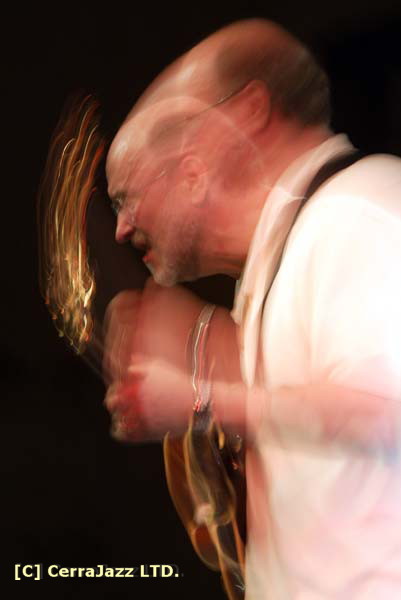
© - Steven A. Cerra, copyright protected; all rights reserved.
“John Scofield. "Filibuster" (from Electric Outlet, Gramavision). Scofield, guitars, DMX bass; Steve Jordan, drums; David Sanborn, alto saxophone.
That's John Scofield, right? It's his tone, and the way he's been writing lately with Miles. Like the layman's ear, I tend to get lost when people start playing too much noodle-roni, or too much improvisation without theme. But his playing lately has gotten infinitely more thematic and more melodic, and to me it's great because it keeps my attention much more closely. It's that old saying, "It's more fun to improvise than it is to listen to it," and that's a fact, unless you're close to that other galaxy of Charlie Parker and Trane and people like that. But I think the song is really positive, and it's a really good groove. Four stars. That's David Sanborn, right?
- Carlos Santana, guitarist and bandleader, Downbeat “Blindfold Test” - August 1985
“Scofield, John (b Dayton, OH, 26 Dec 1951). Electric guitarist. He became attracted to rhythm-and-blues, urban blues, and rock-and-roll at an early age, particularly the playing of the guitarists B. B. King, Albert King, and Chuck Berry…. his display his blend of blues and country styles with the harmonic sophistication of bop.”
- Bill Milkowski, in Barry Kernfeld [ed.]The New Grove Dictionary of Jazz
“Seen by many as the quintessential, most widely read and flexible contemporary Jazz guitarist. … His playing is an intriguing mix of a classic, open-toned bop style and a blues-rock affiliation. … His six Gramavision albums are a coherent and highly enjoyable body of work on which his playing assumes a new authority; tones are richer, the hint of fuzz and sustain is perfectly integrated and his solos are unflaggingly inventine. … Scofield’s transfer to Blue Note moved his career and his music substantially forward where he released a number of strong and thoroughly realized recordings that featured his consistent strength as a writer: variations on the blues, slow modal ballads, riffs worked into melodies. … The guitarist is always finding new ways to walk over old paths.”
- Richard Cook and Brian Morton, The Penguin Guide to Jazz on CD, 6th Ed.
“John Scofield's rugged, rawboned sound fits his trademark blend of hard bop, fusion, electric blues, and the rock music he grew up on in the 1960s; but his gift for intrepid, sharply chiseled improvisations has made him a favorite of jazz purists as well as fusioneers through such albums as Meant to Be and Hand Jive (his collaboration with Eddie Harris), both on Blue Note.”
- Neil Tesser, The Electric Guitar and the Vibraphone in Jazz, in Bill Kirchner [ed.], The Oxford Companion to Jazz
“John Scofield, a young guitarist with romantic leanings and an inclination toward relaxed, understated swing in his melodic lines ... is one of the few younger guitarists who seems to be exploring the style of Jim Hall, possibly because he is one of the few temperamentally and technically equipped to do so.”
- Doug Ramsey, Jazz Matters: Reflections on the Music and Some of its Makers
Every time I listen to the music of John Scofield, I wonder why I don’t spend more time with it?
John’s innovative pairing of instruments in forming his groups and his imaginative approach to Jazz guitar nearly always moves my ears in new directions while generating a satisfying listening experience.
Above all, John is a storyteller, with a good sense of pace and timing, relishes a tight, in-the-pocket groove and even displays occasional splashes of humor to keep things interesting.
Our most recent visit with with Sco’s music was prompted by a preview copy of John’s latest CD and was prompted by a preview copy of his latest Impulse! CD - Past Present.
Max Horowitz at Crossover Media was kind enough to send along the following press release and, since I couldn’t improve upon it, I thought I’d share it with you “as is.” Remember, you can always go on www.crossovermedia.net and click on the artist search in the upper right hand corner for more information about the artists they are working with and to listen to samples of music from their latest recordings.

“On Past and Present, John Scofield updates his early-’90s quartet with drummer Bill Stewart and saxophonist Joe Lovano by recruiting bassist Larry Grenadier for his fetching, appropriately titled impulse! debut, Past Present. Between 1990 and 1992, the celebrated guitarist released three well-received discs – Meant to Be, Time on My Hands and What We Do – for the Blue Note label as the John Scofield Quartet. On those records, either Marc Johnson or Dennis Irwin played bass. Nevertheless, Grenadier also has history playing with Scofield; he toured with Scofield in support of the 1996 disc, Quiet.
The nine exciting tunes Scofield penned on Past Present also reflects his philosophy on playing jazz music. He stresses the importance of being knowledgeable of the music’s deep, complex roots while simultaneously being spontaneous and in the moment while performing it. For an artist with such a multifaceted discography as Scofield’s, getting to the root of jazz means channeling the blues, as demonstrated on the disc’s closing, titled-track.
Buoyed by Grenadier’s ebullient, recurring bass line and Stewart’s delicate swing, Scofield describes “Past Present” as “futuristic blues,” on which he and Lovano craft unison melodies before the two separate then intertwine invigorating improvisations. In Scofield’s estimation, “Past Present” sums up the whole disc.
In addition to Scofield’s meditation on a William Faulkner quote: “the past is never dead. It’s not even past,” – from the 1951 book Requiem for a Nun – the disc’s title gains even more poignancy and thematic heft from Scofield’s enduring love for his son, Evan, who passed away in 2013 after a battle with cancer. “There are people in the past who are really still alive for us – like my son, Evan,” Scofield says. “He’s in the past but he’s still with me right now.”
Scofield emphasizes that point on three tunes that touch upon Evan’s legacy. Two songs – “Get Proud” and “Enjoy the Future!” – are titled after some of Evan’s catchphrases. The former is a strutting, bluesy number, steered by Stewart’s implied boogaloo shuffle, on which Scofield’s rough-hewn guitar lines and comping mesh with Lovano’s brawny tenor saxophone passages. Like the title suggests, the latter tune evokes a bright optimism as Scofield and Lovano develop billowing melodic lines that swirl around each other while the rhythm section powers them with a snazzy, pneumatic swing.
Evan’s spirit also informs the introspective, mid-tempo ballad, “Mr. Puffy,” which was a nickname Scofield gave him to help lift his spirits when he was undergoing chemotherapy. The quartet hints at the physical transformative effects the chemotherapy had on Evan by John Scofield Press Release and Bio having the song’s breezy A section progress into a more bristling B section.
Scofield’s love for R&B and blues tends to inform all of his discs regarding of idiomatic styling. After all, his first guitar hero was the legendary B.B. King, who strummed very vocal-like single-note melodies. Singable melodies and infectious rhythms shine on the soul-jazz opener, “Slinky,” on which the guitar tickles an instantly catchy riff before Stewart underscores it with a supple 5/4 groove that suggests New Orleans’ second-line rhythm. Grenadier propels the momentum with a loping blues bass line while Scofield and Lovano trade soulful licks and tasty solos.
Past Present also highlights Scofield’s love for country music on the whimsical “Chap Dance,” which evokes both the wide-eyed Americana compositions of Aaron Copeland and the hoedown sophistication of Ornette Coleman’s harmolodics. Scofield says that the song’s exuberant opening melody and spry rhythmic pulse remind him of Richard Rodgers and Oscar Hammerstein’s 1943 Broadway musical, Oklahoma!, particularly the scenes with the cowboys dancing in chaps and vests.
In spite of its suggestive title, “Hangover” is lyrical waltz on which Scofield and Lovano weave comely melodies atop of the rhythm section’s gentle thrust. Originally written with lyrics penned by Scofield’s wife, Susan, the song’s theme actually deals with romance rather substance abuse.
Scofield originally penned the sanguine melody of “Museum” for promotional use by a hometown museum where Scofield curated a successful music series for seven years. The guitarist liked the melody so much that he developed it into an intricate jazz excursion that contains a tricky in-between rhythm that Scofield argues could not have been well realized by any other rhythm section.
The intriguing “Season Creep” is yet another blues – this time dedicated to climate change. Scofield composed the slow, shuffling ditty in February 2013 when he noticed warm, spring-like temperatures were slowing creeping into a month, commonly noted for being freezing.
As Scofield continues to solidify his reputation as one of modern jazz’s most dynamic guitarists, history will reveal Past Present as an integral chapter in his expansive discography – one that reflects him being more reverential than referential to his personal and professional past while remaining fresh and ever-present.
It’s been 40 years of professional recording underneath his belt, John Scofield is one of the most distinctive and versatile modern jazz guitarists; his capacity to play in fusion, funk, blues, bebop, country, drum-n-bass, avant-garde and pop settings while retaining his distinctive voice is peerless. In addition to leading numerous ensembles and recording more than three dozen albums as a leader, Scofield has played with a “who’s who” of jazz greats that include Charles Mingus, Miles Davis, Chet Baker, George Duke, Joe Henderson, Billy Cobham and Herbie Hancock, among others. In 1998, the Montreal International Jazz Festival gave Scofield its prestigious “Miles Davis Award.” John Scofield was also awarded Officier de l'Ordre des Arts et des Lettres in France.
Track Listing
Slinky 7:09
Chap Dance 5:18
Hangover 6:33
Museum 5:02
Season Creep 4:34
Get Proud 5:18
Enjoy The Future! 5:21
Mr. Puffy 5:00
Past Present 6:01
Bonus Tracks Available On Request
1. Weird Hands 5:30
2. Pedals Out 5:16
All songs written by John Scofield
John Scofield (guitar); Joe Lovano (tenor saxophone); Larry Grenadier (double bass); Bill Stewart (drums). Recorded on March 16 and 17, 2015 at The Carriage House Studios, Stamford, Connecticut.