© Copyright ® Steven Cerra, copyright protected; all rights reserved.
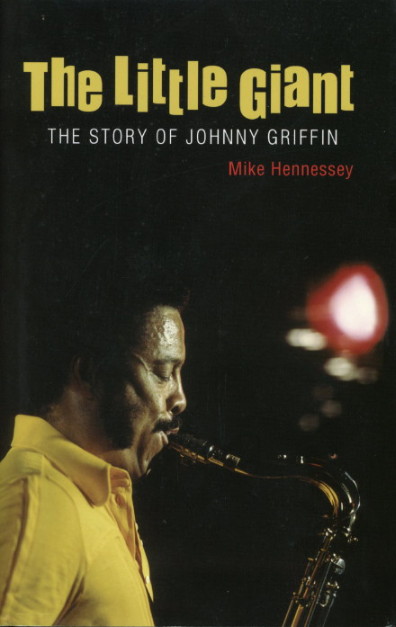
“Griffin, one of the fastest saxophonists in jazz, would hurtle through solos like a snooker player intent on clearing the table in one break, scattering his improvisations with wry quotes, skimming runs and raucous hoots and honks. He would regularly accelerate the most tender of ballads to a sprint, and deliver a blues with an earthy relish that drew on the raw rhythm and blues traditions of his native Chicago.
Griffin was also one of the few saxophone players who could negotiate the harmonic mantraps set by performing alongside Thelonious Monk - John Coltrane and Sonny Rollins were also among this select group - and, although he never acquired the iconic status of artists such as Rollins, he was unfailingly good-humoured, professional, and wore his virtuosity lightly.
Griffin did not change jazz, but he delivered its established practices with devastating aplomb, played with some of its most creative stars, and perfected a full-on, sweepingly virtuosic bop-based style that for many defined exactly what straight ahead swinging sax-playing should sound like. He became more restrained as the years passed, and more inclined to play with a handful of favourite cards - including the bumpy descent to a bone-shaking low note, an interrogatory mid-register warble reminiscent of Dexter Gordon, and a softly billowing vibrato on romantic ballads - but he was reliably inventive well into his 70s. He remained a popular performer and personality on the international circuit.
Griffin always sounded as if he thought jazz should be an uncomplicated, straight-from-the-shoulder business - but his methods of achieving that involved leaping some of the most daunting technical hurdles in sax-playing, and making it seem like something anyone should be able to do. That open-handed, unambiguous and vastly entertaining devotion to spontaneous music-making lasted until his death.”
- John Fordham, Obituary in The Guardian July 25, 2008
“London-born jazz writer, critic, producer, broadcaster and pianist Mike Hennessey [1928-2017] moved to Germany's Schwarzwald in the autumn of 1989. He was the author of a well-received biography of drummer Kenny Clarke, Klook, a book about the British music business, Tin Pan Alley, and Some of My Best Friends Are Blues, a history of Ronnie Scott's Club. As well as covering the international music scene for Billboard magazine for 27 years, he has written more than 500 album notes and hundreds of articles, reviews and biographical features for jazz magazines in North America and Europe.
For 25 years Hennessey was a member of the British jazz group, the Chastet, becoming its leader in 1986. He has played sessions with numerous well-known European and American musicians.
In addition to his work as a journalist and musician, Hennessey produced concerts, television programmes, and albums by many artists and bands including the Paris Reunion Band and Roots - both of which he created. His compositions include Gaby and the lyrics to the Johnny Griffin composition When We Were One.
In 2008, he published The Little Giant: The Story of Johnny Griffin [Northway].
Originally from the South Side of Chicago, Johnny Griffin was recognized internationally as a major jazz star with a readily identifiable style, an immense improvisational flair and an unfailing capacity to swing. As jazz writer Brian Priestley has observed: 'Griffin is one of the fastest and most accurate ever on his instrument.'
As well as expressing himself with great verve and vitality through his tenor saxophone, Griffin is an articulate, witty and entertaining conversationalist with an unending flow of anecdotal reminiscences about his days with Lionel Hampton, Art Blakey, Thelonious Monk, Eddie 'Lockjaw' Davis, the Clarke-Boland Big Band and the variety of small groups he has fronted during his 53-year career.
He is an uncompromising believer in straight-ahead, hard-swinging jazz. He says: 'As long as guys swing, jazz will not die.' He is also a perceptive observer of the world at large and an avid reader who takes a keen interest in international affairs. He is a man who lives life to the full and who has been a good friend to the distillers over the years.
Griffin has described his move to Europe 42 years ago as a matter of survival. If I had stayed in America I would be dead by now. I was a stoned zombie when I left.' When asked at the Jazzland club in Paris: 'How can you play so brilliantly when you are stoned?', he replied: 'You see baby, I was stoned when I learned to play!'
The Little Giant is a light-hearted, irreverent and uninhibited look back at the life of one of the most consummate musicians in jazz and one of its most colourful and entertaining characters.
Orrin Keepnews [1923-2015], the famed recorded producer, who was a close friend of Johnny’s wrote the following Foreword for Mike’s Griffin bio.
“I have been involved in producing jazz albums for what seems to be an unbelievably long time - I began in 1954, so at this time of writing it has been going for more than a half-century. Some of the most important personal friendships in my life have developed from the working relations involved in planning and recording that music. Certainly one of the oldest and strongest of these is the bond between Johnny Griffin and myself. It has survived not only the passage of time and countless working hours in a great many recording studios under a wide variety of circumstances, but also a vast amount of geography, as I relocated from New York to San Francisco and he far outdid me by moving from New York and Chicago to the south of France.
The first time I ever heard of Johnny Griffin probably should have indicated that I was likely to keep on hearing about him for quite some time although I certainly could be forgiven for not realizing at the time that I would continue knowing and working with him just about forever. Because the man who first mentioned Griffin to me was, at the time, certainly the most distinguished jazz musician I knew. Even now, more than two decades after his death, Thelonious Monk remains the most important artist I have ever had the pleasure of working with.
But, at that time, he had not yet succeeded in fighting his way through to broad recognition. Also, having run up against some of the arbitrary regulations that governed New York nightlife at the time, he was not licensed to work with any regularity in that city and, on this occasion, he had accepted an engagement to travel to Chicago by himself and appear with some local musicians he did not know. But the situation developed much better than it might have. The bassist on the job was Wilbur Ware, who would soon move to New York and work frequently with Monk over the next few years. And the group also included a young local tenor saxophone player named Johnny Griffin.
Monk, at the time, had begun what was to be an almost six-year association with Riverside Records, a very young independent jazz record label of which I was co-founder, co-owner and sole record producer. Like several of my colleagues in the jazz business, I really did not know what I was doing. I did, however, know enough to appreciate what it meant when Monk, recounting his adventures in Chicago, paid Griffin the considerable compliment of quietly declaring: 'He can play.'
But, as I soon discovered, this knowledge did me very little immediate good. Alfred Lion, founder of Blue Note Records, (who had been the first to record Monk), had already become aware of Griff and had signed him up to an exclusive contract. So I had to start by judiciously using Johnny as a sideman on other people's dates. I clearly recall the very first such occasion: it was our first album featuring the great Ellington trumpet player, Clark Terry - whom I had also met through Monk. I began to use the tenor player as often as possible on other people's dates and, sooner than I expected, he became fully available.
Perhaps because he continued to live in Chicago, possibly because (like a great many of the players whose importance has eventually become a recognized part of jazz history) his own records didn't particularly sell when they were new, and at least in part because he had made it clear to Blue Note that he would rather be with us, they made no real effort to extend his contract, and, in late February of 1958, he came to New York for what was to be the first of a great number of occasions we would work together in a recording studio. And, because transporting a musician from the Midwest was no small burden for our little label, I planned to make double use of Johnny's few days in New York - both as part of a Monk sextet date and leading a quartet on his own Riverside debut as a leader.
As it turned out, however, our scheduled first studio evening turned into a major confusion of missed signals and lack of communication, so that the two key cast members of the Monk project never did appear and I was forced to do a lot of improvising and last-minute phone-calling and finished the week with no Monk LP, but two by Johnny
I originally planned to have Johnny Griffin appear on a Monk album while he was in New York to make his own first Riverside recording. The Monk session, as agreed with Thelonious, was to be a sextet date also involving Sonny Rollins, Donald Byrd, Art Blakey and Wilbur Ware. We arbitrarily divided responsibility for notifying these four men of time and place - I called Byrd and Ware, Thelonious was to contact Sonny and Blakey. (Remember that, at that time, no-rehearsal dates, completely constructed after the personnel were assembled in the studio, were not all that unusual.) Rollins and Blakey did not appear and could not be reached for some time.
Eventually both men claimed, quite believably, that Monk had never contacted them about the session. So we sought replacements. But after rehearsing and doing one or two takes on a new Monk composition, he decided that, since this wasn't the band he had intended to record with, he didn't want to continue - and he left. I then decided not to stop, since I was going to have to pay the musicians anyway. I reached Kenny Drew at his home - he was scheduled to be the pianist on Johnny's quartet album -and we did record most of a Griffin sextet LP that night.
Quite importantly Monk at this time was in the midst of accomplishing a major breakthrough. Having been legally cleared for regular work in New York clubs by mid-1957, he quickly began his long and legendary stand at the Five Spot with a group that included John Coltrane. And when Trane, rapidly developing into a star in his own right, left after six months, Thelonious soon took advantage of the opportunity to back up his frequently expressed enthusiasm for Griffin by bringing Johnny into that quartet.
It must be admitted that, at this point, Griffin took a bit of a beating - primarily from the critics (fellow musicians and even club-owners who knew better) - simply because he was himself and sounded like himself and not like his predecessor. But Monk knew how to draw the greatest benefits from working with Johnny. Thelonious may have been second only to Duke Ellington in his ability to adapt his band's repertoire and arrangements to fit the strengths and special abilities of valuable sidemen - and quite concrete evidence of that exists on two very exciting Riverside albums that were recorded in performance at the Five Spot one night in August 1958.
I very much enjoyed working with Griff on a variety of projects. He was one of the first jazz musicians from whom I learned that what you hear in their music can be not just art, but real emotion. The warmth, the wit, the joy or sadness that certain players project is a direct expression of the man himself. (Griffin has always been such a direct communicator; Wes Montgomery was another, so that the night on which they were recorded together at a Berkeley, California club for Wes's Full House album on Riverside was a most memorable example of that particular form of soulfulness.) One of our goals was to overcome the stereotype of the slogan that some writers had pinned on Johnny as 'The fastest gun in the west'.
As one step in that direction, I approved the unrealistic expense of a 1959 with-strings and almost-all-ballads LP called White Gardenia, which was undoubtedly one of the first Billie Holiday memorials. The excitement generated by the distinctive two-tenor team of Johnny and Eddie 'Lockjaw' Davis impressed a lot of people, but it wasn't exactly an all-out commercial success. (I clearly remember Griffin's exasperation when a booking agent proudly announced the price he had been able to get the quintet for a week's work - it was exactly what Johnny had received for his own quartet the preceding year!)
Eventually, for that and other personal reasons, Griffin began paying attention to the success that comparable (or lesser) jazz musicians were enjoying in Europe - and, eventually, he was gone.
I did not see Johnny again for about a decade and a half, but when he made his first return visit to the United States, to appear at the 1978 Monterey Jazz Festival, I drove him back to San Francisco and, a day later, he was in a studio at Fantasy Records, where I was then running the jazz programme, as a featured guest on a Nat Adderley album that happened to duplicate the 1958 circumstances of Nat's first Riverside album - a quintet date with Griff as the other horn.
Over the years, that sort of thing has continued - every now and then we make a record together. Whenever we are in the same part of the world, we make a real effort to hang out together, to eat or drink or listen to music. My wife died in late 1989; one of my fondest mementos remains a picture of the two of us at a table in a Bay Area jazz club. Our friend Johnny is there with us, though not visible in the photo, and we are both laughing heartily at some now unremembered punchline he has just delivered.
Johnny Griffin is both a talented musician and a valuable human being. Mike Hennessey, who has known him for a long time, has done an admirable job of setting down for his readers both sets of qualities.”
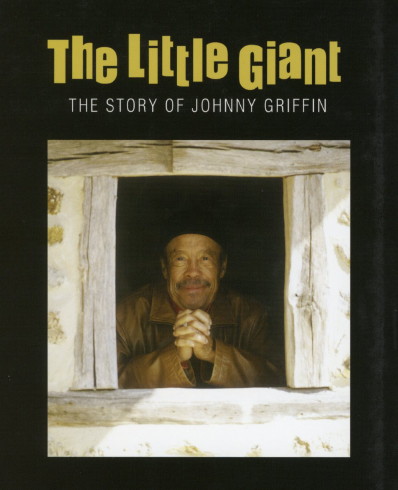
Mike wrote the following Preface to his Griff bio.
“Not least among the achievements of Johnny Griffin, the Little Giant from the South Side of Chicago, is that he has remained at the top of his game despite having spent the last thirty-five years of his sixty-two-year playing career as a resident of Europe.
It has happened all too often in jazz that when an American star takes up residence in Europe, he gradually becomes absorbed into the European scene and his star status slowly but surely ebbs away. Not so with Griffin. He is still recognised internationally as a legendary jazz icon with a readily identifiable style, unblemished integrity, an immense improvisational flair and an unfailing capacity to swing. As British writer Brian Priestley has observed in his Jazz: The Rough Guide:
‘Although Griffin is fully conversant with the tenor tradition of Hawkins, Byas, Webster and Young, it has often been remarked how close in spirit Griffin's playing is to that of Charlie Parker. The headlong rush of ideas and the rhythmic variety and freedom that go with them, all point in this direction. In addition, his tone combines a vocalised sound with a slightly hysterical edge that, at his best, can evoke almost uncontrollable exhilaration - except, perhaps, for other tenor players, since Griffin is one of the fastest and most accurate ever on his instrument.'
Reviewing a Johnny Griffin performance in Down Beat in 1958, Ralph J. Gleason wrote: 'Unquestionably, Johnny Griffin can play the tenor saxophone faster, literally, than anyone else alive. At least, he can claim this until it's demonstrated otherwise. And in the course of playing with this incredible speed, he also manages to blow longer without refuelling than you would ordinarily consider possible. With this equipment, he is able to play almost all there could possibly be played in any given chorus.'
Commenting on Gleason's statement in his note for the March 1967 Black Lion album, The Man I Love, Alun Morgan observed:
As far as it goes, Gleason's words are probably correct, (In the absence of a jazz section to the Guinness Book of Records, we must assume Griffin's leading position in the field of runners in the Semi-Quaver Race.) But it would be wrong to assume that John Arnold Griffin III was nothing more than a note-producing machine. He is an amazingly consistent soloist, a man who is never off form by all accounts; undeniably he likes fast tempos but is a complete, rounded jazz musician, capable of tackling any material. Since he came to Europe in 1962, at the age of thirty-four, he has been giving free lessons on the gentle arts of relaxation, saxophone technique, deep-seated emotional intensity and a host of other important elements to thousands of listeners in Paris, London, Copenhagen and any other centers where jazz is appreciated.'
Johnny Griffin is not particularly disturbed by being called, 'the fastest gun in the west'. He says, 'I like to play fast. I get excited, and I have to sort of control myself, restrain myself. But when the rhythm section gets cooking, I want to explode.' He told Israeli journalist Ben Shalev in December 2005: 'I don't care at all if they describe me like that. It's definitely not insulting, and if it's good publicity, why not? After all, it's just a label. It's like there was a period when they called me 'the little giant'. There's no need to take those descriptions too seriously. As far as I'm concerned, they can call me 'the big midget'.'
Whatever fanciful appellation is used to describe him, there is absolutely no doubt that Johnny Griffin is one of the supreme masters of the tenor saxophone - an uncompromising swinger whose energy and creative vitality are unsurpassed.
One of the salient characteristics of Griffin's improvisational style is his predilection for decorating his solos with phrases borrowed from well-known, and predominantly unlikely, compositions. On a live recording made with Sal Nistico and Roman Schwaller m Munich in 1985 (Three Generations of Tenor Saxophone, JHM Records), the Little Giant managed to include in his solos extracts from 'The Yellow Rose of Texas', a Chopin 'Polonaise', Charlie Parker's 'Cool Blues', 'The Surrey with the Fringe on Top', Mendelssohn's 'Wedding March', 'The Foggy, Foggy Dew', 'The Kerry Dancers', Thelonious Monk's 'Rhythm-a-ning', 'Mairzy Doats', 'Turkey in the Straw' and 'Rhapsody in Blue' !
Johnny is celebrated for his sterling work with Art Blakey and Thelonious Monk, for his 'blow-torch' duets with Eddie 'Lockjaw' Davis, for his inspired and electrifying work with the Clarke-Boland Big Band in the late 1960s and early 1970s, and for a diverse flock of admirable albums recorded for an assortment of labels with small groups, which he has always favoured. He says he prefers to work with a quartet because it gives him the maximum possible freedom: 'I can change heads when I feel like it - but with another horn in the group there has to be a little more control, and so less space for creativity With just a rhythm section, I can do what I want. The musicians I idolised as a youth were Lester Young and Ben Webster - they worked with just rhythm sections - and that's the format that I like.'
When he's on the stand, holding forth at high speed with a sensitive and supportive rhythm section, Johnny Griffin is in his element. An uncompromising believer in straight-ahead, hard-swinging jazz, he says: ‘As long as guys swing, jazz will not die.’ Jazz music is Griffin's religion. And he has some very firm opinions about some of the musicians who operate on the free side of the jazz spectrum.
As he said to me in a 1979 interview for Jazz Journal International:
'You get all this talk about avant-garde music, but who plays it apart from guys in a few lofts in New York and one or two guys in Europe? I can't imagine them going into Harlem and playing that stuff. They'd get lynched.
'I have given this a great deal of thought ever since I heard Archie Shepp for the first time, every night for a month at Le Chat Qui Peche in Paris. That band sounded as sad at the end of the month as it did at the beginning - but I understood even less.
And how can people take Ornette Coleman's trumpet and violin playing seriously? Come on, that's just ridiculous.'
Griffin is one of the most articulate of musicians - both verbally and instrumentally. Whether he is having a conversation or holding forth on the tenor saxophone, he tells it like it is. Johnny Griffin speaks his mind. He is a genial cynic and a down-to-earth realist with a quick-fire wit and a great sense of humour. He says of himself: 'I'm a Taurus - like Duke Ellington and Joe Henderson - we eat too much, drink too much and love too much. Very stubborn.'
Johnny has long been a popular favourite at major festivals around the globe. He still commands a substantial and enthusiastic international following and is in constant demand for festival, concert and club dates. He has an immutable musical philosophy, which he outlines as follows: ‘I’m happy with what I do because I feel good doing it - and that's the most important thing. I'm not following anybody - I'm just playing the music I want to play If people dig it, that makes me doubly happy'
Johnny Griffin's move to Europe forty-four years ago was a matter of survival. He often said, unequivocally, that had he not moved to Europe for good in 1963, he would not have survived for more than a year or so. As he put it, in a mid-1960s interview: 'If I had stayed in America I would be dead by now I was a stoned zombie when I left.'
As well as expressing himself with great verve and vitality through his tenor saxophone, Johnny Griffin is a witty and entertaining conversationalist with an unending flow of anecdotal reminiscences about his days with Lionel Hampton, Art Blakey, Thelonious Monk, Eddie 'Lockjaw' Davis, the Clarke-Boland Big Band and the variety of small groups he has fronted over the years. He is a natural optimist and, at the same time, a thoroughgoing realist, with a healthy skepticism when it comes to promoters, politicians and jazz pundits.
He is a compassionate man, completely lacking in arrogance, and is also a perceptive observer of the world at large and an avid reader who takes a keen interest in international affairs. He is a man who Jives life to the full and who has been a good friend to the distillers over the years.
He once told me, back in September 1965:
'You know, I was drinking a bottle of gin a day at one time. Now I've got it down to five double whiskies a night -but it is still too much. Alcohol gives you a lift, deadens the nerves, gets rid of inhibitions. Whisky can make a poor man feel like a millionaire. That's why they sell so much of the stuff!'
Apropos the lubricating oil, an encounter I had with Johnny at the Jazz Land club in Paris in September 1965 produced a characteristic Griffinism, which should not go unrecorded:
'How,' I asked, 'can you play so ridiculously well when you are stoned?'
'You see, baby Johnny replied, 'I was stoned when I learnt to play!'
And in a June 2005 interview, when I asked him what he considered to be the real high points of his career, he replied, 'I think it would be all the bars I was introduced to over the years. I lost count ... or perhaps I should say I lost consciousness.'
We got onto the subject of playing, and Johnny said that he tries to play what he feels rather than what he thinks. 'I'm always doing things I've never heard of or played before. Of course, there are always times when you are not creating, when the clichés come out. Sometimes I can see myself going into a familiar phrase, but it starts so fast I can't stop it - so I'll try to vary it a little. But I don't like getting too 'mental' about this because it makes the music too contrived. When it gets good is when something takes over my mind. Sometimes it feels as though my mind leaves my body and I seem to have nothing to do with the music that's coming out. It's as though somebody else has taken over.'
Johnny Walker?' I asked. And he roared.
'Or Glen Grant [single malt scotch]. But if I'm really hot, I can play just about everything I feel. I just like to let the music flow out.'
The story of Johnny Griffin is a light-hearted, irreverent and uninhibited look back at the jazz life of one of the music's most consummate musicians and one of its most colourful and entertaining characters. And it is the story of a man who is totally committed to his craft.”
Mike Hennessey
Durchhausen, Germany,
January, 2008


