Showing posts with label Larry Kart. Show all posts

Saturday, November 26, 2022

Philly Joe Jones (1980) by Larry Kart

 © Copyright ® Steven Cerra, copyright protected; all rights reserved.
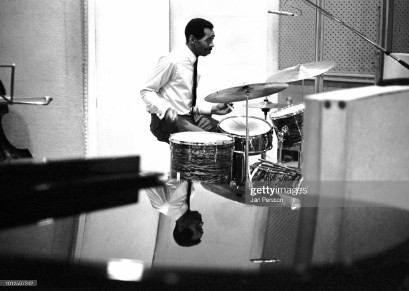


“Philly Joe Jones, a leading modern-jazz drummer, died of a heart attack Friday, August 30, 1985 at his home in Philadelphia. He was 62 years old.

Mr. Jones was a hard-hitting drummer who gave a spacious sense of swing to his ensembles. His combination of deep-toned tom-tom and bass drums with subtle swirls of cross-rhythm on cymbals was widely imitated. He was a member of the trumpeter Miles Davis's influential mid-1950's quintet, with the bassist Paul Chambers, the pianist Red Garland and the saxophonist John Coltrane.


Joseph Rudolph Jones adopted the name Philly Joe to distinguish him from the pioneering jazz drummer Jo Jones.” 

Jon Pareles, 9.3. 1985  NY Times Obit


“Born Joseph Rudolph Jones, Philly Joe Jones was an exciting, explosive drummer and his influence on modern jazz is legendary.


Considered a superb timekeeper, Philly Joe Jones’ techniques are studied by jazz students throughout the world. Whether his influence was through subtle technique or hard-driving aggression, Philly Joe was versatile, often playing on a minimal drum kit, and adapting his drumming style to create many moods and sounds. His contribution to some of the most important jazz recordings in history elevated the role of drumming in modern jazz and changed the course of jazz music forever.”

- Philadelphia Music Alliance, Walk-of-Fame


W. A. Brower: [“Following a demonstration on the drum set} - That last segment of the drum solo you just played - after the cymbal potion - seemed to flow out of the creative use of rudiments [there are 26 major drum exercises that fall under this classification]. Is this something you got out of studying with Cozy Cole, that real strong rudiments foundation that allows you to branch off like that.


Philly J.J.: “Yeah, that’s Cole’s idea of how you should be a rudimental drummer - they help you in developing your hands. It’ll help you develop your mind, too - as long as you know all the rudiments. Like I said earlier, it’s like a bag of tricks that you can reach into when you need them.” So if it’s something I want to say, I can use the rudiments to say it. Most drummers who don’t know anything about rudiments have a hard time saying what they want to say. It’s just a conversation. Most of the great drummers are rudimental drummers, you know. All the great ones I know went through the rudiments. That don’t mean you have to sound like a boy scout when you play them. And you can make them sound - I can make them do anything I want to.”

- W. A. Brower, June 10, 1985 interview with Philly Joe Jones, Howard University Oral History Project; transcript of audio track of a video tape recorded in the studios of WHMM-TV on the campus of Howard University 


“This thesis explores the life of drummer “Philly” Joseph Rudolf Jones, one of jazz’s most renowned, unknown figures. As the drummer for the Miles Davis Quintet/Sextet and a later incarnation of the Bill Evans Trio, Joe achieved worldwide fame and success. Yet, his life story has always been told in the footnotes of the towering figures he performed with: John Coltrane, Bud Powell, Charlie Parker, Thelonious Monk, etc. Jazz history books recognize Joe’s contributions and nearly all provide a space, albeit a small one, to recognize his accomplishments.” 

- Dustin E. Mallory, Jonesin’: The Life and Music of Phily Joe Jones, Rutgers University Graduate School, May 2013, Thesis Director, Dr. Lewis Porter. Here’s a link to the entire thesis.


By way of introduction, Philly Joe Jones was one of the greatest of the hard boppers. His contributions to the art of jazz drumming are immeasurable. He was a virtuoso with a pair of brushes, and a genius at turning the rudiments into fluent musical ideas. 


More than any of his peers, it was Philly Joe’s time feel that defined the idea of swing in the 1950s. In retrospect, he would prove to be the strongest link in the chain between Max Roach, Art Blakey, and Roy Haynes, and the Elvin Jones/Tony Williams school that was soon to emerge.


The editorial staff at JazzProfiles has previously written extensively about Philly in some of the earliest feature for the blog dating back to 2008 and you can find them via these links: The Wonder of Philly Joe Jones, Part 1 and The Wonder of Philly Joe Jones, Part 2.


In the coming weeks, we plan to bring up additional feature about Philly Joe Jones on these pages to build the archive links so as to create a centralized point of  information about this outstanding musician.


In this regard, the following  essay on Philly JJ  can be found in Larry’s Jazz in Search of Itself [New Haven: Yale University Press, 2004]. We asked Larry for his consent to post it to the blog and he very kindly said “Yes.”


At its conclusion you’ll find some YouTubes with audio tracks that exemplify Philly Joe Jones’ unique style of Jazz drumming.


© -  Larry Kart: copyright protected; all rights reserved; used with the author’s permission.


“THERE are drummers who have had a greater influence on the course of modern jazz — Max Roach, Elvin Jones, and Tony Williams come to mind. And there are others who have more successfully parlayed their skills into commercial gain. But, from the first moment I heard him, back in 1955 with Miles Davis, no drummer has given me greater pleasure than Philly Joe Jones.


For one thing, Jones has the rare distinction of having invented a new concept of swing — one that may seem to have been superseded by later developments but one that is, in fact, as timelessly beautiful as the concept of time laid down by jazz's first great percussionist. Baby Dodds. Until Jones came along, jazz rhythm had become increasingly fluid, achieving in the cymbal-oriented work of Roach and Kenny Clarke a remarkable gliding ease. But Jones disrupted that evolution by switching the emphasis back to his snare drum, which chattered away like a machine gun, creating a stiff-legged, irresistibly compulsive drive that, as Miles Davis once said, "could make a dead man walk."


A fairly high volume level usually went along with that style, which obscured one of Jones's key virtues — the remarkable delicacy and precision of his playing. Listening to him is like watching someone weave lace out of barbed wire, as every accent, no matter how angular or explosive, becomes part of an exquisitely balanced design. In that sense Jones resembles a great dancer more than he does other drummers, and the ways in which he introduces the maximum amount of rhythmic obliqueness while still retaining his cool make him one of the most intriguingly graceful jazz percussionists. His left hand — the one controlling the stick that attacks the snare drum — is a study in itself, as it opens and closes, loosens and tightens with the rapidity of a snake's tongue. And often that always functional litheness will

ripple through his entire body, leaving him frozen for an instant in a pose Fred Astaire would have admired.


But of course it is the sounds Jones produces that matter most, and here he is unique, too. The tonal range he gets out of his kit is unusually compact when compared, for example, to Roach's tympanilike spectrum of timbres, and he seems to be constantly striving for a "back-to-basics" effect. It's a dry, all-rhythm approach to drumming that could support a jazz soloist of any era, and it certainly suits the band (tenorman Charles Bowen, pianist Sid Simmons, and bassist Andy McGee) that Jones is leading now. And even though neither Bowen nor Simmons is in the same class as the men Jones once played behind (John Coltrane, Sonny Rollins, and Bud Powell, to name a few), their relative ordinariness is not disturbing because it allows one to concentrate that much more on the masterly patterns of a masterly drummer.


Philly Joe Jones died in 1985.”


Wednesday, October 17, 2018

Hank Mobley - Poppin' - by Larry Kart

© -  Steven A. Cerra, copyright protected; all rights reserved.


“Ah yes, The Hankenstein. He was s-o-o-o-o hip.” That was the response of Dexter Gordon when the late Hank Mobley’s name came up in conversation a while ago. “Hankenstein” - as in identifying Mobley as a genuine “monster” in the best sense of the term, while the slow motion relish of “he was s-o-o-o-o hip” seemed to have both musical and extramusical connotations.

But then, like so many who came to know Mobley’s music, Gordon decided to qualify his phrase echoing critic Leonard Feather’s assessment that Mobley was “the middleweight champion of the tenor saxophone,” whose approach to the instrument (according to Feather) lacked the “magniloquence” that Gordon, Sonny Rollins, and others had brought to it.

But that is not the only way to estimate Mobley’s achievement. The middleweight champ, yes, if magniloquence and size of tone are what is involved, but never merely a middleweight - for Mobley, who died last May [1986] at age fifty-five, blazed his own trail and left behind a body of work that never ceases to fascinate. Indeed when one examines the core of Mobley’s music (the twenty-four albums recorded under his own name for Blue Note from 1955-1970), it seems clear that his poignantly intense lyricism could have flourished only if magniloquence was thrust aside.”
- Larry Kart, Jazz author, critic and book editor

"Don't get backed too much into a reality that has fashioned your senses with too many realistic claims. When art promises you this sort of reliability, drop it. It is good to know how not to know how much one is knowing."
- Stefan Wolpe, composer

My ongoing Mobley Quest takes a slightly different spin at this point with the emphasis being placed on just one of Hank’s many recordings as a leader for Blue Note [There were 24 in all.].

I plan to do this for more of Hank’s individual Blue Note recordings especially when the accompanying insert notes warrant highlighting because of the significant light they shine on understanding Hank and his music, both of which have been ignored for far too long, hence my quest to bring more attention to them.

Larry Kart’s notes to Poppin’ one of Hank’s earliest Blue Note LPs that was very late to CD issuance certainly fall into this category as they are a masterful revelation of what makes Hank’s approach to Jazz singular and unique. One of the tunes on this date is Gettin’ Into Something and Larry certainly does that and more with his analysis of, not only of what makes Mobley tick, but also of what are the defining qualities of the styles of the other musicians on the album.

Both the following essay and the later, 1987 piece on Hank can be found in Larry’s Jazz in Search of Itself [New Haven: Yale University Press, 2004]. Here’s a link to Larry’s “Hank Mobley - A Posthumous Appreciation” which was posted earlier on these pages.

© -  Larry Kart: copyright protected; all rights reserved; used with the author’s permission. [Paragraphing modified in places.]

HANK  MOBLEY
The first of these two pieces was the liner notes for a reissue of Hank Mobley's 1957 album Poppin'. (The reference there to Nietzsche supposedly commenting on Mobley's style was a would-be serious joke. Nietzsche did write those words, in his essay "Contra-Wagner," but he was referring to the music of Georges Bizet.) The second piece was a posthumous appreciation.

[1982]

“In the mid-1950s the Blue Note label yielded momentarily to super-salesmanship, releasing such albums as The Amazing Bud Powell, The Magnificent Thad Jones,  and The Incredible Jimmy Smith. That trend was dormant by the time Hank Mobley became a Blue Note regular and unfortunately so — a record titled The Enigmatic Hank Mobley would have been a natural. "To speak darkly, hence in riddles" is the root meaning of the Greek word from which "enigma" derives; and no player, with the possible exception of pianist Elmo Hope, has created a more melancholically quizzical musical universe than Mobley, one in which tab A is calmly inserted in slot D.

Though he was influenced by Charlie Parker, Sonny Stitt, and, perhaps. Lucky Thompson, Mobley has proceeded down his own path with a rare single mindedness, relatively untouched by the stylistic upheavals that marked the work of his major contemporaries. Sonny Rollins and John Coltrane. In the words of Friedrich Nietzsche, not previously known for his interest in jazz, Mobley's music is "without grimaces, without counterfeit, without the lie of the great style. It treats the listener as intelligent, as if he himself were a musician. I actually bury my ears under this music to hear its causes." And that is the enigma of Mobley's art: In order to hear its causes, the listener must bury his ears under it. In a typical Mobley solo there is no drama external to the developing line and very little sense of "profile"— the quality that enables one to read a musical discourse as it unfolds. Not that high-profile players — Rollins and Dexter Gordon, for example — are necessarily unsubtle ones. But to understand Mobley the listener does have to come to terms with complexities that seem designed to resist resolution.

First there is his tone. Always a bit lighter than that of most tenormen who worked in hard bop contexts, it was, when this album was made, a sound of feline obliqueness — as soft, at times, as Stan Getz's but blue-gray, like a perpetually impending rain cloud. Or to put it another way, Mobley, in his choice of timbres, resembles a visual artist who makes use of chalk or watercolor to create designs that cry out for an etching tool. Harmonically and rhythmically, he could also seem at odds with himself. For proof that Mobley has a superb ear, one need listen only to his solo here on "Tune Up."

Mobley glides through the changes with ease, creating a line that breathes when he wants it to, one that that is full of graceful yet asymmetrical shapes. And yet no matter how novel his harmonic choices were — at this time he surely was as adventurous as Coltrane — Mobley's music lacks the experimental fervor that would lead Coltrane into modality and beyond. Mobley's decisions were always ad hoc, and from solo to solo, or even within a chorus, he could shift from the daring to the sober. What will serve at the moment is the hallmark of his style; and thus, though he is always himself, he has in the normal sense hardly any style at all.

Even more paradoxical is Mobley's sense of rhythm. His melodies float across bar lines with a freedom that recalls Lester Young and Charlie Parker, and he accents on weak beats so often (creating the effect known in verse as the "feminine ending") that his solos seem at first to have been devised so as to baffle even their maker. That's not the case, of course, but even though he has all the skills of a great improviser, Mobley simply refuses to perform the final act of integration; he will not sum up his harmonic, rhythmic, and timbral virtues and allow any one element to dominate for long. In that sense he is literally a pioneer, a man whose innate restlessness never permits him to plant a flag and say, "Here I stand." Thus, to speak of a mature or immature Hank Mobley would be inappropriate. Once certain technical problems were worked out — say, by 1955 — he was capable of producing striking music on any given day. New depths were discovered in the 1960s and the triumphs came more frequently; but in late 1957, when Poppin' was recorded, he was as likely as ever to be on form.

Much depended on his surroundings, and the band he works with here has some special virtues. The rhythm section is one of the great hard bop trios, possessing secrets of swing that now seem beyond recall. Philly Joe Jones and Paul Chambers, partners, of course, in the Miles Davis Quintet, shared a unique conception of where "one" is — just a hair behind the beat but rigidly so, with the result that the time has a stiff-legged, compulsive quality. The beat doesn't flow but jerks forward in a series of spasmodic leaps, creating a climate of nervous intensity that was peculiar to the era. Either the soloist jumps or he is fried to a crisp on the spot. As a leavening element there was Sonny Clark — equally intense but more generous and forgiving in his patterns of accompaniment. Clark leads the soloists with a grace that recalls Count Basie, and his own lines, with their heartbreakingly pure lyricism, make him the hard bop equivalent of Duke Jordan.

The ensemble sound of the band, a relatively uncommon collection of timbres heard elsewhere on Coltrane's and Johnny Griffin's first dates under their own names, gives the album a distinctive, ominous flavor; but this is essentially a blowing date. Art Farmer, for my taste, never played as well as he did during this period, perhaps because the hard bop style was at war with his pervasive sense of neatness. Possessing a musical mind of dandiacal suavity, Farmer at times sounded too nice to be true. But this rhythm section puts an edge on his style (as it did a few months later on Clark's Cool Struttin'), and I know of no more satisfying Farmer solo than the one preserved here on "Getting Into Something," where he teases motifs with a wit that almost turns nasty.

Adams's problem has always been how to give his lines some sense of overall design, and too often the weight of his huge tone hurtles him forward faster than he can think. But when the changes and the tempo lie right for him, Adams can put it all together; and here he does so twice, finding a stomping groove on "Getting Into Something" and bringing off an exhilarating doubletime passage on "East of Brooklyn."

As for the leader, rather than describing each of his solos, it might be useful to focus first on a small unit and then on a larger one. On the title track, Mobley's second eight-bar exchange with Jones is one of the tenorman's perfect microcosms, an example of how prodigal his inventiveness could be. A remarkable series of ideas, mostly rhythmic ones, are produced (one might almost say squandered) in approximately nine seconds. Both the relation of his accented notes to the beat and the overall pattern they form are dazzlingly oblique, and the final, whiplike descent is typically paradoxical, the tone becoming softer and more dusty as the rhythmic content increases in urgency. In effect we are hearing a soloist and a rhythm player exchange roles, as Mobley turns his tenor saxophone into a drum.

On "East of Brooklyn" Mobley gives us one of his macrocosms, a masterpiece of lyrical construction that stands alongside the solo he played on "Nica's Dream" with the Jazz Messengers in 1956. "East of Brooklyn" is a Latin-tinged variant on "Softly as in a Morning Sunrise," supported by Clark's "Night in Tunisia" vamp. Mobley's solo is a single, sweeping gesture, with each chorus linked surely to the next as though, with his final goal in view, he can proceed toward it in large, steady strides. And yet even here, as Mobley moves into a realm of freedom any musician would envy, one can feel the pressure of fate at his heels, the pathos of solved problems, and the force that compels him to abandon this newly cleared ground.

In other words, to "appreciate" Hank Mobley, to look at him from a fixed position, may be an impossible task. He makes sense only when one is prepared to move with him, when one learns to share his restlessness and feel its necessity. Or, as composer Stefan Wolpe once said, "Don't get backed too much into a reality that has fashioned your senses with too many realistic claims. When art promises you this sort of reliability, drop it. It is good to know how not to know how much one is knowing."

Thursday, September 20, 2018

"Hank Mobley - A Posthumous Appreciation" by Larry Kart

© -  Steven A. Cerra, copyright protected; all rights reserved.


From every standard of judgement - improvisational brilliance centered on memorable melodic lines, intonation and facility on the instrument, astute knowledge of harmony, precise rhythmic phrasing - Hank Mobley, was a giant - a tenor saxophonist more than worthy of comparison with his contemporaries who have long been considered as such - Dexter Gordon, Sonny Rollins and John Coltrane.


To say that during his time on the scene that Mobley was done a disservice by the Jazz press would be to underscore one of the great understatements in the history of modern Jazz.


What were they listening to?
- The Editorial Staff at JazzProfiles


“By dint of hard perseverance over the years Mobley has finally reached a stage in his career where recognition of the kind accorded Rollins and Coltrane must surely be well within his grasp. When I contributed an article on the former's earlier work to this magazine in October, 1959, I went out of my way to assert there was no point in setting one such musician up against another: instead the listener should do his utmost to penetrate to the heart of the music, to see where each man's true achievement lies. Not unnaturally, I believe this holds good for Mobley as well.


He has had to contend with many sneers in his time and with the type of criticism that metes out summary justice by mechanically bracketing this or that performer with his associates, irrespective of the ways in which his style differs from theirs. Today the time is past when Mobley can be written off so easily. The host of excellent records he has made for Blue Note during the last two years stand as irrefutable evidence of his stature.


In this essay my intention has been to point out the distinctive qualities of his music, to show how they relate to each other, and to suggest the various shades of feeling they imply. Having attempted as much, perhaps I may be allowed lo close on a more general note, and insist that if intelligence, inventiveness and emotional power rank as the most desirable attributes of the artist, then Hank Mobley, at the comparatively young age of thirty-one, has already done enough to deserve that appellation.”
- Michael James, December, 1961 edition of Jazz Monthly.


Sadly, Michael’s assertions about Hank Mobley’s deserved place in the pantheon of great Jazz tenor saxophonists were not meant to be - then or now.


But credit is due to Michael for having heard and written about Hank’s special qualities both as a player and as a composer of great talent and distinctiveness at such an early date in Hank’s career.


Written in 1987, Larry Kart, in the following, second of two essays on Hank Mobley published in his brilliantly conceived and artfully written Jazz in Search of Itself [New Haven, CT: Yale University Press, 2004], also acknowledges Michael James’ place in the scheme of things as an early admirer of Hank Mobley’s masterly abilities.


Michael James also published a later essay on Hank in the August, 1962 edition of Jazz Monthly and we will subsequently link Larry Kart’s first piece to it as the Mobelian themes in each compliment one another.


© -  Larry Kart: copyright protected; all rights reserved; used with the author’s permission. [Paragraphing modified in places.]


“Ah yes, The Hankenstein. He was s-o-o-o-o hip.” That was the response of Dexter Gordon when the late Hank Mobley’s name came up in conversation a while ago. “Hankenstein” - as in identifying Mobley as a genuine “monster” in the best sense of the term, while the slow motion relish of “he was s-o-o-o-o hip” seemed to have both musical and extramusical connotations.


But then, like so many who came to know Mobley’s music, Gordon decided to qualify his phrase echoing critic Leonard Feather’s assessment that Mobley was “the middleweight champion of the tenor saxophone,” whose approach to the instrument (according to Feather) lacked the “magniloquence” that Gordon, Sonny Rollins, and others had brought to it.


But that is not the only way to estimate Mobley’s achievement. The middleweight champ, yes, if magniloquence and size of tone are what is involved, but never merely a middleweight - for Mobley, who died last May [1986] at age fifty-five, blazed his own trail and left behind a body of work that never ceases to fascinate. Indeed when one examines the core of Mobley’s music (the twenty-four albums recorded under his own name for Blue Note from 1955-1970), it seems clear that his poignantly intense lyricism could have flourished only if magniloquence was thrust aside.
Mobley’s career as a recording artist falls into three rather distinctive stages.


The first ran from 1955-1958, when he made eight of his Blue Note Albums, while working with the Jazz Messengers and groups led by Horace Silver and Max Roach. The second produced the magnificent Soul Station, Roll Call, Workout, and Another Workout albums in 1960 and 1961, when he was a member of the Miles Davis Quintet. And the third ran from No Room for Squares [1963] to Thinking of Home [1970].


Influenced initially by Sonny Stitt, but incorporating far more of Charlie Parker’s asymmetrical rhythmic thinking than Stitt chose to do, Mobley was also more attuned to the lyrical sensibilities that Tadd Dameron brough to bop - an unlikely and perilous blend that gives Mobley’s stage-one solos their special flavor.


Perhaps the first critic to pay any close attention to him was an Englishman, Michael James, in the December, 1962 issue of Jazz Monthly, and James’ account, and James’ account of the tenor saxophonist’s solo on News from the 1957 album Hank Mobley (Blue Note) is particularly apt.


“His phrases grow more and more complex in shape,” James writes, “until … it seems as though he is about to lose all sense of structural compactness. But he rescues the situation … and his last 12 bars less prolix and tied more closely to the beat, imbue the whole improvisation with a unity of purpose that is paradoxically the more striking for its having tottered for a while, as it were, on the brink of incoherence.”


Solos of that kind and quality can be found as early as 1955 when Mobley recorded his first album, Hank Mobley Quartet (Blue Note). And, as James suggests, his best work of the period is so spontaneously ordered and so bristling with oblique rhythmic and harmonic details that its sheer adventuresomeness seems inseparable from the listener’s - and perhaps the soloist’s - burgeoning sense of doubt. That is, to make sense of lines [improvisations], one must experience every note - for there are so many potential paths of development, each of which can inspire in Mobley an immediate response, that ambiguities of choice become an integral part of the musical/emotional discourse.


And that leads to the genius of stage two, for as Mobley gained in rhythmic and timbral control, his music became at once more forceful and uncannily transparent - as though each move he made had its counterpart in a wider world that might not exist if Mobley were compelled to explore it. Two fine examples of that urgently questing approach are I Should Care and Gettin’ and Jettin’, both from Another Workout (Blue Note). Rather than being a direct romantic statement, I Should Care becomes a song about the possible contexts of romance - not so much a tale of love but a search for a place where that function can be expressed. (Mobley does this by building his solos around balladized” bop phrases whose angular tensions, here made more languid, serve to test the romantic dreaminess, which in turn tries to subdue those “realistic” intrusions.)


Mobley’s sensitivity to context is present in a different way on Gettin’ and Jettin’ as he pares down his lines toward the end of his brilliant solo in order to invite the active participation of drummer Philly Joe Jones. (Mobley’s interaction with drummers is a story in itself - his exceptional taste for contrapuntal rhythmic context bringing out the best that he and such masters as Jones, Art Blakey and Billy Higgins had to offer.)


Stage three of Mobley’s career had its virtues too, and if such recordings as A Caddy for Daddy (Blue Note), Dippin’ (Blue Note) and the first side of the recently issued Straight No Filter (Blue Note) were all we had, Mobley would still be a major figure. But as John Litweiler has pointed out [1973 Downbeat interview], Mobley “Consciously abandoned some degree of high detail in favor of concentrating his rhythmic energies” which gave his music a bolder profile but left less room for the jaw-dropping ambiguities of his stage one and stage two work. Above all though - and to a degree that is matched by few soloists - Mobley invites the listener to think and feel along with him. Indeed, his commitment is such that a commitment of the same sort is what Mobley’s music demands.”