Showing posts with label Louie Prima. Show all posts

Saturday, February 6, 2021

Remembering Louie Prima [1910-1978] and Wingy Manone [1900-1982]

 © Copyright ® Steven Cerra, copyright protected; all rights reserved.


“Though Louis Prima recorded widely and well throughout the '30s, achieving great popularity and visibility, his name is often conspicuous by its absence from standard jazz histories. Dealing with him seriously means confronting one aspect of New Orleans jazz which chroniclers, almost as a point of honor, seem to find distasteful.


That, of course, is the matter of showmanship. The flamboyance of Prima's latter career, in which his identity as a trumpeter became almost totally subordinate to his role as a high-energy showman, seems to offend those who would represent Jazz as an art music of solemnity and unstinting high purpose. The Las Vegas image, the raucous sound of Sam Butera and the Witnesses, the risque badinage with singer Keely Smith—such make it all too easy to mistake this showbiz aspect of Prima for the creative substance, ignoring his past achievements and core musicianship.


Far from being exclusive to such as Prima, the idea of hot music as an arm of highly commercialized show business runs throughout the early years. It's present in the singing, dancing, and impromptu comedy skits of the dance bands, including those that prided themselves on their dedication to jazz. Its absence is a root cause of the failure of the great Jean Goldkette orchestra, an ensemble which either stubbornly resisted advice to "put on a show" or acquiesced in a manner landing somewhere between perfunctory and downright hostile.


For New Orleans musicians, especially, showmanship was—and remains—a fact of life. Was it not Louis Armstrong, above all, who understood the relationship between music and entertainment, and never wavered in his application of it, even in the face of critical hostility? "You'll always get critics of showmanship," he told British critic Max Jones. "Critics in England say I was a clown, but a clown—-that's hard. If you can make people chuckle a little; it's happiness to me to see people happy, and most of the people who criticize don't know one note from another.""


Prima, in common with his two hometown friends Wingy Manone and Sharkey Bonano, accepted—as had Nick LaRocca before them—that they were, above all, entertainers; they might now and then get together for their own enjoyment, and even (as in the case of the 1928 Monk Hazel titles) make music to suit themselves. But where the public was concerned, the paying customers always came first. By his own lights, and by the laws of the box office, Prima was doing what he properly should be doing, and with resounding success. It is only regrettable that the nature of his fame in later years has drawn attention away from his skills as one of the most accomplished, often thrilling, of New Orleans trumpet men. ...


Between September 27, 1934, and July 17, 1937, Louis Prima recorded some fifty-four titles, mostly backed by small jam groups. What strikes the listener now is the overall excellence of the bands (Pee Wee is the clarinetist on some, with Arodin, Weinberg, and Eddie Miller on others), the ease with which Prima handles a wide variety of material—and the incendiary brilliance of his trumpet work. Again and again, he fires off compelling, technically assured solos, fluent throughout the entire range of the horn.


The records (and those of Manone) tend to follow a pattern: more or less straightforward melody chorus, Prima vocal in what one musician called "that hoarse, horny voice of his," solos by a sideman or two, then the leader's trumpet back for the big finale. Within that, there are consistent peaks, including tough and exhilarating Russell solos on "Chasing Shadows," "The Lady in Red," and "Cross Patch."


Prima, for all his gaudy ways, stands up well. There's no denying the pervasive Armstrong flavor, but what's refreshing here is how freely he's able to work within that vocabulary. There are moments, particularly when he descends into his low register, when his figure shapes and sense of drama recall those of Bunny Berigan.


Manone, too, often surprises. His work on dozens of 1930s titles—while displaying nothing comparable to Prima's technical command—is crisp and assured. On "Swing, Brother, Swing" (1935) he easily paces hard-driving solos by Miller (on tenor) and clarinetist Matty Matlock. He opens "Jazz Me Blues," from a September 12, 1934, date with Arodin and Brunies, with a quite Armstrong-like cadenza.


Both men made the jump to radio and movies, and their subsequent careers have been well documented. Their travels, taking them far afield in both a geographical and musical sense, continue the Auswanderung of the earliest jazz days, the arrival-and-departure cycle woven into the fabric of New Orleans life.”

- Richard Sudhalter, Lost Chords: Whiye Musicians and Their Contributions to Jazz, 1915-1945. [1999]


© -  Mosaic Records and Lloyd Rauch, copyright protected; all rights reserved, used with the author’s permission.


“Scuffling,” in the sense of getting by on a low income or struggling financially is not a term used very much these days in Jazz circles, although given the deleterious effects of the current pandemic on musicians’ incomes, it could very well be.


But it certainly was applicable to these lives of many of those attempting to make their way in Jazz during the formative years of the music’s existence in the 1920s and 1930s.


Some struggled for a while before becoming successful while others struggled for a good long while before some measure of economic success came their way. 


Trumpeter Louie Prima falls into the former category while his fellow trumpeter Wingy Manone is relegated to the latter.


Reviewing the trials and tribulations they encountered, sometimes one gets the sense that their passionate love of the music was the only thing that kept them alive during their early years of trying to make it in the music.


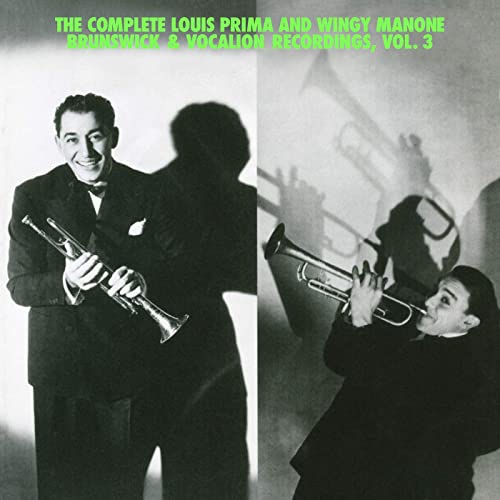
Lloyd Rauch is a jazz historian, disc jockey and collector of vintage jazz material. He has written numerous liner notes and articles on jazz and was a personal assistant to Benny Goodman in 1986. He put together a succinct overview of Louie’s and Wingy’s careers for the Mosaic set  MD6-217 THE COMPLETE BRUNSWICK AND VOCALION RECORDINGS OF LOUIS PRIMA AND WINGY MANONE (1924-1937). 


Reading them will definitely give you a realistic understanding of the scuffling that Prima and Manone went through to carve out their careers in Jazz.


LOUIS PRIMA - 1910-1978


New Orleans natives Louis Prima and Wingy Manone both lived the American dream and they used jazz as their vehicle; an opportunity afforded few over the past hundred years. And if one wanted inspiration, growing up in New Orleans was the place to be, especially in the first twenty years of the last century, the period when ragtime turned into jazz.


Louis opened the Famous Door on March 1, 1935. The new club was operated by Jack Colt, who raised money from prominent New York musicians so they could have a place to go after work, enjoy some good spirits and a little jazz. Though Manone was older by six years, their mutual fame and fortune blossomed during the early months of 1935 on the same New York City street - 52nd Street.


Louis Leo Prima was twenty-four years old in 1935 and had performed largely in New Orleans.  He was born on December 7, 1910 and started his early training on violin at age seven, providing him with a solid musical foundation.  His mother Angelina encouraged all her children to play an instrument, resulting in the formation of a little family band.  Angelina was a bit of a flamboyant blues shouter herself, performing in church shows and at family gatherings.  Little Louis hated the violin and longed to blow a trumpet or cornet (the smaller, sweeter version of the trumpet) which Leon, his older brother by three years, was then playing.  


Leon played jazz in New Orleans' French Quarter clubs throughout the early Twenties. By 1924 he had made enough to afford a new $75.00 trumpet and accept a gig in Texas. He had left his old beat-up cornet home and the temptation was just too much for young Louis, now only thirteen years old. His mother was with Leon in Texas, so when no one was at home, Louis would pick up that old horn and teach himself to play over the next few months.  Despite his mother's disapproval, he continued with the cornet, trying to emulate the great horn players in New Orleans that fascinated him.  


Leon Prima: "I switched to trumpet and then went on the road, I left an old trumpet (cornet) at home.  I stayed out about a year or so and when I came home, Louie was blowing the trumpet...real good." (1)


Years later, Louis Prima sighted Buddy Petit, Louis Dumaine, Punch Miller and Louis Armstrong as inspirations, though ultimately it was Armstrong who wielded the most influence on Prima.  Prima also would peek into the Black churches to enjoy and absorb the music of his brothers. At that time, Italians and Blacks frequently interacted on the job and socially. Both black and white bands would play at the New Orleans clubs, many owned by Italians, though local law forbade mixed groups from performing on the same stage at the same time. When a mixed session did take place, it was informal and not advertised.


  By 1928, Louis was good enough to join the musicians union. There were lean times and periods of triumph for the next six years. Prima recorded a few numbers with Dave Rose for Bluebird Records in 1933 but they made little noise and he returned to New Orleans. Upon a visit to New Orleans in 1934, Guy Lombardo, who's band almost never played jazz, heard Prima in a nightclub at two o'clock in the morning. He couldn't believe his ears and ran over to the hotel to wake his brothers Carmen, Victor, and Lebert (all members of the Lombardo orchestra) and ask them if they too felt that this was a great talent. They did and Guy suggested Prima move to New York and try his luck in the city that was the capital of radio, recording and nightclub entertainment.


Guy arranged a recording contract for Prima with Brunswick records and attempted to line up a gig at Leon and Eddie's on 52nd Street. The owners thought Louis was black due to his kinky hair and olive complexion and refused to hire him. This policy did not apply to all clubs on 52nd Street as the Onyx, one of the few that offered jazz, featured the Spirits of Rhythm (a black group) for years. Within a year or two both black and white bands were common on "The Street'' as well as  in Greenwich Village downtown and although mixed bands were rare, black bands would alternate with white at the same clubs. These were the days on 52nd Street where one could listen to such stars as Billie Holiday, Teddy Wilson, Bunny Berigan, Stuff Smith, Ed Farley and Mike Riley.


Another great locale was The Famous Door found at 35 West 52nd Street (right next to Leon and Eddie's), the same spot as the original Onyx, which was now at 72 West 52nd. At first, the opening night "crowd" consisted of proprietor Jack Colt, the waiters and the band on stage.  There was no business despite the fact that a fire at the Onyx, only the previous night, forced that club to shut its doors for a number of months. Colt took a walk around the block contemplating the firing of Prima and the closing of his new club. When he returned, he noticed a real crowd waiting to get in the Famous Door. The late night clientele, for which the club was intended, did finally show up to hear Prima and to see the new club.


Newspapermen such as Ed Sullivan, Robert Sylverster, and Walter Winchell wrote glowingly of Prima's stage persona and fine little band.  Eventually the folks from Park Avenue began frequenting the place and other clubs on 52nd Street started booking small jazz or jam bands into their venues. It should be remembered that at the time, personality was as important as music and Prima was the spark that ignited interest in that fabled block between Fifth and Sixth Avenues, soon to be known as Swing Street.


Prima became such a success that he left New York before the end of 1935 and opened his own Famous Door club in California. His reputation grew via national radio broadcasts and motion pictures. By 1936 he was experimenting with a big band but the reception did not equal the great response to the small group so he returned to the original format for the next three years.


In 1940, he organized another big band, which lasted until about 1950. This was a fruitful venture, which resulted in dozens of hit recordings. Robin Hood, My Dreams Are Getting Better All the Time, and many Italian novelties removed Prima from his jazz roots but made him a rich man. Though he continued to play trumpet until 1975, his peak years were 1934-39.


In 1954, after a few years of scuffling, he and his new vocalist Keely Smith (by this time his wife) joined together with saxophonist Sam Butera to form an act that set Las Vegas on fire. Prima did for Vegas what he had done almost twenty years earlier for 52nd Street; opening the door to a whole new era of entertainment. Every hotel in Vegas began to book big name acts for their casino lounges in the wake of Prima and Smith's success.


Following their divorce in the early Sixties, Prima continued to perform but never achieved the notoriety that he had with Keely. In addition, he could not produce another hit record. The advent of the Beatles and changing musical tastes added to Prima's decline in popularity. However, his participation in the Walt Disney animated film, The Jungle Book, in which Prima provided the voice for "King Louie", leader of the jungle apes, brought him to a new audience for a brief time in the late Sixties.


Though he was still performing in 1975, he elected to have a benign tumor removed from the stem of his brain due to severe headaches.  The operation left him unable to speak or move for the next three years.   He died on August 24, 1978 in his hometown of New Orleans at age sixty-seven. Surely he was one of the most memorable entertainers of his time and his best jazz work is included here in this set.


WINGY MANONE - 1900-1982


Wingy Manone was one of the real characters of jazz, always full of jive talk and the spirit of life. He was born Joseph Manone on February 13, 1904 just outside of the French Quarter in New Orleans (not far from where Prima was born and raised). At the age of eight or nine he began trumpet lessons and studied seriously for almost a year.  Eventually, he tired of the regimented music he was expected to play, so one day he invited his teacher to come over to the other side of the levee and hear the music of the black bands. After listening for a while, his teacher declared that they were faking and there was no way she could teach him that kind of music, so he quit taking formal lessons.


Not long after, at age ten, his right arm was crushed in a streetcar accident and the doctors were forced to amputate. Not only had he lost his arm, he lost the dominant extremity that he depended upon for fingering the trumpet. For almost a year he shied away from his friends and quietly taught himself to play with his left hand. He refused to perform in public until he was ready and when he finally did, he used a gloved hand attached to a prosthetic arm to hold the trumpet in place while he fingered the valves with his left hand. Eventually, he quit school and organized a band with his young friends, joining in the second line in a New Orleans parade or simply playing on the street corner. He was no longer Joe Manone, but Wingy.


His early influences were King Oliver and Buddy Petit, the same Petit that had inspired Prima. He was well known in New Orleans and briefly toured California with Jelly Roll Morton. Though he never recorded, Petit is fondly remembered by many of the musicians who lived in New Orleans during the early days of jazz. Later on, Louis Armstrong, who Wingy knew as a boy, would be a significant inspiration.


Wingy and his band struggled for a few years and finally landed a job at the Ringside Café, which lasted for six months. Ultimately they quit to take a gig at the Eldorado Club, but the place folded after two weeks. Wingy suggested that the band, at that time playing under the name Steamboat Six, try their luck in Chicago, where so many New Orleans musicians had found work. Without sufficient train fare, the boys would have to travel with the hobos.


Wingy: "We climbed up in a boxcar and the train pulled out - a jazz band heading up north to show how real jam music should be played.  Wow! We kept in the eating department by playing on the streets and passing the hat in all the towns where we had train waits. We had to keep changing trains, riding in lumber cars, gondolas, flat cars and on the rods." 


When the band reached Kankakee, Illinois they got off the train and encountered a gentleman who demanded that they leave his property. Believing that he was the landowner, they pleaded with him for some food, explaining that they were musicians looking for work in Chicago. The man invited them up to the big house on the hill so they may have a bite to eat.


Wingy: "No sooner did we get up to the house then out came some guards and we found out that the place was an insane asylum and the fellow (who they mistook for the landowner) was one of those harmless "bugs" (patients) that they let walk around like a trusty every afternoon. When we found out where we were, we started to run, but the guards grabbed us and took us inside to the head doctors. They listened to our story and ordered food for us. We were so hungry, we ate like pigs and afterward we played for some of the inmates who were about to be released. As we were leaving, the doctors gave us two bucks for cigarettes, then we heard the slow freight. The crew saw us running like hell toward the train but they thought we were breakin' out of the bughouse. I shouted to them that we were the boys that was riding on the train before. I had to open up my trumpet case to convince them. They were relieved and said: 'Okay, bums, find your spots and keep out of sight till we get out of town.'  We never forgot that bughouse though. Those inmates thought that we was nuts, playin' those musical instruments." 


The next stop was Chicago. By 1921, the sweeter dance bands were becoming more popular and the public's fascination with New Orleans jazz was waning. Manone could barely read music so many jobs were closed to him. In order to eat, he would play Italian and Jewish weddings in Chicago on the weekends and fill in the other days with whatever he could find. The members of his band were on their own. Eventually, he found steady work in St. Louis, where he recorded his first session.


For the next ten years, he traveled from Chicago to New York or wherever there were gigs. He managed to get a few record dates with the likes of Benny Goodman and Red Nichols, but these were rare. In Chicago, he performed regularly with Bud Freeman, Frank Teschemacher and Art Hodes and for a short period of time he even worked with Bix Beiderbecke whose influence can be heard on Wingy's 1927 recordings.


He jobbed in vaudeville with Blossom Seely and Benny Fields (major stars in their day) and even worked for a while in a Native American Indian jazz band led by trombonist Chief Blue Cloud. The Chief and his wife Ida Blue Cloud were the only real Indians in the band so the other members would have to dress in costume. Wingy was required to don full-feathered headgear, wear moccasins and not speak any English. They played in all the big vaudeville houses and Wingy had a great time until his friends in New York found out that he was "passing" as Indian. Big Charlie Green, trombonist with Fletcher Henderson, saw one of the shows and told everyone about Wingy's gig. The boys at Plunkett's bar gave him such a ribbing that he had to quit the Chief and look for something else.


  By May of 1934, Wingy had more than ten years of scuffling behind him and was determined to make it in New York. After about six months he landed a job at the Grill Room of the Knickerbocker Hotel with his own group. The gig was a smashing success with capacity crowds every night, but the club closed after only five days. It seems that the jam sessions lasted until eight the next morning and liquor would continue to be sold, a crime after hours in New York City, so the club was shut down. One of the next stops was the De Luxe Club on 52nd Street, where he helped to establish free wheeling jazz on "The Street". On February 20, 1935 he was booked into The Piccadilly Hotel on West 45th Street just off Broadway, where music started at 9:30 and continued, as Wingy says, "to four in the early brightness". The sign outside the club declared that the music was, "the hottest this side of Harlem". After a few months, Adrian Rollini, master of the bass sax and an early pioneer of the vibes, offered Wingy the opportunity to join his band at the Hotel President where he ran his own club called Adrian's Tap Room. The club was jumping every night with Wingy, Rollini, Carmen Mastren on guitar and Putney Dandridge at the piano. Everyone from Fats Waller to Martha Raye used to sit in with the band and then enjoy a lamb chop or two. The band even cut six sides for Victor records on June 20, 1936.  


By this time Manone was recording and his records were selling briskly. But it wasn't until Wingy's huge hit recording of Isle of Capri that he found more work on 52nd Street at clubs such as the Hickory House and the Famous Door. He continued to play jobs in New York, Florida and the northeast region until the early forties when Bing Crosby invited him out to California for a guest spot on his radio show. Wingy was hired for only two weeks but lasted for five years. Manone would do comedy dialog with Bing and play jazz with a small group from John Scott Trotter's studio orchestra. Bing also included Wingy in his Hollywood picture, Rhythm on the River (1940) which paved the way for many more movie roles as both musician and actor.           


Wingy Manone continued to record for Bluebird, Decca, Capitol and many other labels until the 1970's. He worked in California and later in Las Vegas until shortly before his death on July 9, 1982.    


For his whole life, Wingy Manone played what he called, "the righteous music"; free wheeling dixieland and swing with a solid New Orleans beat. He didn't care whether he performed in a small club with an unknown group of local musicians or on the stage at Carnegie Hall, as long as he could play in the uninhibited manner that defined who he was. 


Wingy ended his 1948 autobiography Trumpet on the Wing with these reflective words: "I ain't never been sorry that I went up over the levee and listened to the only kind of music that's really solid and caught it, and kept on playin' it all my life. I intend to keep on playin' it until they really put wings on that trumpet...." 

- Lloyd Rauch 


Wednesday, May 27, 2020

Louis Prima – Show Time!

© -Steven Cerra, copyright protected; all rights reserved.


“In 1954, after a few years of scuffling, he and his new vocalist Keely Smith (by this time his wife) joined together with saxophonist Sam Butera to form an act that set Las Vegas on fire. Prima did for Vegas what he had done almost 20 years earlier for 52nd Street [at the Famous Door] — opened the door to a whole new era of entertainment. Every hotel in Vegas began to book big name acts for their casino lounges in the wake of Prima and Smith's success.”
- Lloyd Rausch

“Though Louis Prima recorded widely and well throughout the '30s, achieving great popularity and visibility, his name is often conspicuous by its absence from standard jazz histories. Dealing with him seriously means confronting one aspect of New Orleans jazz which chroniclers, almost as a point of honor, seem to find distasteful.

That, of course, is the matter of showmanship. The flamboyance of Prima's latter career, in which his identity as a trumpeter became almost totally subor­dinate to his role as a high-energy showman, seems to offend those who would represent jazz as an art music of solemnity and unstinting high purpose. The Las Vegas image, the raucous sound of Sam Butera and the Witnesses, the risque badinage with singer Keely Smith—such make it all too easy to mistake this showbiz aspect of Prima for the creative substance, ignoring his past achievements and core musicianship.

Far from being exclusive to such as Prima, the idea of hot music as an arm of highly commercialized show business runs throughout the early years. It's present in the singing, dancing, and impromptu comedy skits of the dance bands, including those that prided themselves on their dedication to jazz. Its absence is a root cause of the failure of the great Jean Goldkette orchestra, an ensemble which either stubbornly resisted advice to "put on a show" or acquiesced in a manner landing somewhere between perfunctory and downright hostile.

For New Orleans musicians, especially, showmanship was—and remains—a fact of life. Was it not Louis Armstrong, above all, who understood the relation­ship between music and entertainment, and never wavered in his application of it, even in the face of critical hostility? "You'll always get critics of showman­ship," he told British critic Max Jones. ‘Critics in England say I was a clown, but a clown—that's hard. If you can make people chuckle a little; it's happiness to me to see people happy, and most of the people who criticize don't know one note from another.’


Prima, in common with his two hometown friends Wingy Manone and Sharkey Bonano, accepted—as had Nick LaRocca before them—that they were, above all, entertainers; they might now and then get together for their own enjoyment, and even (as in the case of the 1928 Monk Hazel titles) make music to suit themselves. But where the public was concerned, the paying customers always came first. By his own lights, and by the laws of the box office, Prima was doing what he properly should be doing, and with resounding success. It is only re­grettable that the nature of his fame in later years has drawn attention away from his skills as one of the most accomplished, often thrilling, of New Orleans trumpet men.”

- Richard Sudhalter, Lost Chords:White Musicians and Their Contributions to Jazz, 1915-1945 [p. 80, emphasis mine]
           
A-zoom, a-zoom, a-zoom, a-zooma or some such onomatopoeia.

Shuffle beats; rim shots; plenty of triplets and cymbal crashes.

Boogie woogie piano rumblings; bar-walking tenor saxophone licks; trumpet, trombone and sax unison, “shout choruses” to close out the tunes.

False song endings; surprise endings; stop-and-start endings.

Hand-clapping, finger-poppin’ and foot-stompin;” sometimes even sing-a-longs if the melody was a familiar one [most were].

Laughter, smiles-all around and much joy and happiness in listening to the music all served up in an atmosphere of watered-down cocktails, stale smoke with not a clock in sight - anywhere.

A good time was had by all despite the fact that the “3 Shows Nightly” generally took place at 11:00 PM, 2:00 AM and 4:00 AM, respectively.

Pack away the cymbals, put a cover over the drums and join the other members of the band for a breakfast of steak and eggs before going “home” to sleep all day, which was just as well given the torrid, daytime heat of the desert sun.

This is a brief description of what it was like to play in one of the Show Bands that were everywhere apparent on the Las Vegas strip before the town gave itself over to the bigness and big business wrought by corporate America and “live” music virtually disappeared as one casualty of profitability.

The Sands, the Flamingo, the Tropicana, the Sahara, the Desert Inn, Harrah’s, The Barbary Coast and a host of other casinos featured show bands in one or more of their lounges as free entertainment for those punters who wanted a break in the action. Some came by with a date or to have one-more-for-the-road.

The entertainment in these lounges was generally free and it was often of the highest quality.

The King of the Show Band leaders was Louis Prima who re-made his career in music at The Casbar Lounge of the Sahara beginning in 1954.  Along with vocalist Keely Smith and tenor saxophonist Sam Butera and The Witnesses, Louis Prima’s act was the act that all of the other acts caught when they performed in Las Vegas.

On any given evening [morning?], one could find Frank Sinatra, Dean Martin, Sammy Davis, Jr., Peggy Lee, Dinah Shore, and many of the major comedians who played Las Vegas taking in one of Louis, Kelly and Sam’s sets.

For the next ten years or so, Louis’ lounge act was the talk of Las Vegas and was responsible for spawning a generation of show bands that employed a similar style in supper clubs, night clubs and restaurants all over the country.

Twenty-six tracks from the heyday of Louis’ time in the Las Vegas lounges have been issued as a Louis Prima Collectors Series Capitol Records CD [CDP 794072 2] and they are a treat.

Scott Shea’s insert notes offer a nice recap of the details of Louis’ career as well as a broad overview of the music on the CD.

© -Scott Shea/Capitol Records, copyright protected; all rights reserved.

"To think that these notes could possibly cover the musical career (let alone life) of Louis Prima would be to believe the impossible. There could never be enough space, enough pages, to do either of those topics full justice with anything less than a fairly large sized book. When that book gets written it will be a terrific read, for Louis Prima was truly one or a kind: trumpeter. singer, composer, humorist; band leader, husband (several times), father (ditto), sportsman, son of Italy, and entertainer par excel­lence, besides many other things, which separately could never describe him, but togeth­er come close.

His musical career spanned from the 1920s to the 1970s. His time at Capitol Records came at the height of his glory in the mid 1950s to early 1960s, when he, along with singer and then-wife Keely Smith and Sam Butera and the Witnesses, was the hottest lounge entertainer in Las Vegas. That heady plateau came in a later incarnation of Prima's career; the road he traveled to get there was a long one.


Louis Leo Prima was born on December 7, 1910 on St. Peter Street, at the edge of New Orleans' notorious Storyville dis­trict. His parents, Anthony and Angelina, were second-genera­tion Sicilians who encouraged Louis and his older brother Leon to learn music. Louis and Leon started with violin and piano respectively, but soon Leon switched to trumpet, the better to emulate the new sound being formed by the local musicians (among them Joe "King" Oliver and Louis Armstrong), later to be known as Dixieland Jazz.

Leon took to the road for touring gigs and left Louis a trumpet: by the time Leon returned Louis had switched instruments and was fronting his own band. He dropped out of high school to become a musician full-time.

An early stint with the house band of a Jefferson Parish gam­bling club ended when the band leader, piqued with Prima's bur­geoning trumpet style, fired him. Louis soon had another job play­ing in the pit band at New Orleans' Saenger Theater. Band leader Lou Forbes recognized Prima's talent and ambition, and drafted arrangements to feature Prima's playing as well as his singing. Always restless, Prima formed his own jazz combo to play New Orleans clubs and speakeasies,

In 1934 (following a stint in Red Nichols' Orchestra), Guy Lombardo caught Louis' performance, and encouraged him to venture to New York City. He auditioned at a 52nd Street club. Leon and Eddie's, which turned him down. Undaunted, he soon found work at another club on 52nd Street with his newly formed group, The New Orleans Gang.

He scored a huge hit at the open­ing of New York's Famous Door club in 1935. and took his Gang to Hollywood the following year to open the west coast version of the club. While there, he per­formed with Martha Raye and appeared in several shorts and musicals, among them Rhythm On the Range, with Bing Crosby, and Rose of Washington Square, with Tyrone Power and Alice Faye.

During this period Prima had sev­eral hits on the Brunswick label, including "The Lady In Red" and "In a Little Gypsy Tearoom". His biggest success in the thirties came when Benny Goodman recorded his composition "Sing, Sing, Sing", giving Goodman a hit and turning the song (and Goodman version of it) into a classic.

In 1939 Prima followed the trend, broke up his Gang, and formed a big band, which he kept into the late 1940s. By now Prima's repertoire had turned away from jazz, and moved towards pop and dance numbers, with a decidedly Neopolitan tilt: "Angelina (which he wrote for his mother), Felicia No Capicia", and "Bacciagaloop (Makes Love On the Stoop)". Needless to write, Prima had no problem with humor.

Louis kept the band going in World War II, but had some difficulties replacing musicians who enlisted. In this period he scored modest hits with "Robin Hood" "Civilization", and "I'll Walk Alone", and composed the hit "A Sunday Kind of Love" for Jo Stafford and Fran Warren. Major success, however, contin­ued to elude him.

In August, 1948. Prima replaced his singer, Lily Ann Carol, with a 16-year old from Norfolk, Vir­ginia, (Dorothy) Keely Smith. Her smooth phrasing and clear tones could not have contrasted more with Louis' heavy, bellowing delivery.

They developed a rou­tine in which Louis would attempt to break down Keely's deadpan stage persona with ad libs, jokes and distractions. When they sang together, improb­ably, they blended.

Louis and Keely remained as a performing duo after Prima ended his big band in 1949. In 1952, Keely became Prima's fourth wife. The couple called attention to the large disparity in their ages for comedic effect on stage. They continued to perform on the club circuit until the fall of 1954, when the gigs started to dry up.


In desperation, Prima phoned Bill Miller, an old friend, who was then running the Sahara Hotel in Las Vegas. Prima plead­ed with Miller for a booking, and Miller gave them a two-week engagement in the hotel's lounge, starting on November 24, 1954.

Before heading for Vegas. Louis and Keely had shared the bill at Perez's Oasis Club in Metairie, Louisiana with tenor saxophonist Sam Butera and his band, The Night Trainers. Butera, a skilled jazz player and arranger, had been packing in crowds in New Orleans area clubs, and had had some local hit records.

Prima told Butera of his Vegas plans, and promised Sam that if anything happened in Vegas, he would get back in touch. "About three months later I was working at the Monteleone Hotel, and he called me and said. 'You better come out here, ana bring three guys (musicians)'," says Butera. ‘He wanted me to join him on Christmas Day, but I told him I'd join him the day after Christ­mas.’

The group that took the stage with Prima at the Sahara on December 26, 1954 had not even had a chance to be introduced to him. When it came time in the show to introduce the sidemen, Louis asked Sam who they were. Sam hollered, "The Witnesses!" Thus are legends born.

The combination of Louis Prima with Keely Smith, and Sam Butera and the Witnesses, was a smash hit in Las Vegas. They became a fixture in the Sahara's Casbar Lounge, performing five shows a night. They would be soaking in sweat when they final­ly left the stage at dawn.


For its era, the Prima-Smith-Butera show was considered risqué (Time called it "doggedly vulgar"). The banter between Louis and Keely was not without its share of innuendo and off-color references (Sonny and Cher later borrowed much of it to re­establish their career on televi­sion in the 1970s).

Surrounding the jokes and gags, and keeping everything jumping, were Butera and the Witnesses, supplying a wild, relentless, driving beat that punched through the lounge's smoke and chatter and left crowds in awe. There was noth­ing like it, which was why it ' became known as "The Wildest Show in Vegas".

"Everything sounded sponta­neous," says Butera. "but we were well rehearsed, with Louis' laughter and Keely's presence and great singing, the group always looked like we were hav­ing fun, and we were, really."

It was at this point that Prima signed with Capitol in 1956. Pro­ducer Voyle Gilmore's intent from the start was to capture as much as possible the live feel of Prima's group. The liner notes for Prima's first Capitol album, The Wildest, claim that Prima remarked, "That's us, man! That's us!" upon hearing the tapes (Capitol recorded Prima live on many subsequent occasions, as is evidenced by some of the selec­tions on this disc). Much of the material had been performed by Louis and Keely for years previ­ous, but Butera re-arranged all the selections to make them swing, and they do.
The selections on this disc abound with Prima trademarks: sudden tempo shifts into and out of Prima's patented "shuffle beat"; tarantellas interwoven with Dixieland jazz; medleys of re-worked standards; altered lyrics befitting Prima's dialect, and numerous passages of Louis own inimitable scat talk.


Keely shows she can hold her own with Louis in the jive talk department on "The Lip,” and displays her skills as a fine ballad singer (or tries to) on "Embraceable You"/"I Got It Bad".

Sam takes the lead vocal on one of the group's classic numbers. "There'll Be No Next Time": "I heard it on a 45, and brought it to Louis... he listened to it and said we had to change some lyrics and make it longer so we could do it on stage. Louis wrote about 80 percent of the lyrics we used on that."

Louis also re-wrote other lyrics when certain numbers were recorded because he thought the live versions were too suggestive. For example, the recorded ver­sion of "The Sheik of Araby" sub­stitutes the words "turban" and "jumpin’" for "pants" and "naked" in the live version. A switch of two words gives the song an entirely different meaning!

This disc also features re-record­ings of earlier Prima hits ("Oh Marie", "Buona Sera", "Angelina"/"Zooma Zooma"), songs from movie appearances ("Hey Boy, Hey Girl* "Banana Split For My Baby", "Twist All Night"), and Louis and Keely's two most mem­orable hits, “That Old Black Magic", and "I've Got You Under My Skin".

Probably the oddest selection on this disc is "Beep! Beep!", from a 1957 single which Louis recorded in recognition of the Sputnik launch earlier in the year. It is the only selection on this disc to contain an overdub, made neces­sary for the sound effect.

By 1961 Louis and Keely had moved from the Sahara's lounge to the main showroom at the Desert Inn. Prima also moved from Capitol to Dot Records, for an extremely lucrative recording deal. Later that year problems in the marriage caused Keely to file for divorce, thus also ending her professional affiliation with Prima. Louis later replaced her with his fifth wife and singing partner, Gia Maione.

Prima enjoyed his last hit at Dot with a version of "Wonderland By Night", then moved back to Capi­tol in 1962 for one further album, The Wildest Comes Home. Louis and Sam's no-holds-barred ver­sion of "St. Louis Blues", taken from that album, rounds out this collection.

After his final departure from Capitol Prima continued per­forming in Vegas and elsewhere (but always on the mainland; a strong fear of flying precluded overseas performances), and recording. In 1967 he made an acclaimed cameo in Walt Dis­ney's animated film, The Jungle Book, providing the voice of King Louie the Orangutan, and a duet with Phil Harris on "I Wanna Walk Like You".


In the early 1970s Prima, along with Butera, moved the band to residency at the Royal Sonesta Hotel in New Orleans' French Quarter. In November 1975, Prima underwent surgery to remove a brain tumor. He never regained consciousness after the operation, and remained in a coma until his death on August 24. 1978 at New Orleans' Touro Infirmary.

Keely Smith also returned to Capitol to record several albums (perhaps Capitol will release a Keely Smith Collector's Edition CD: she certainly deserves it), and continues performing to date.

Sam Butera regularly performs worldwide and records with his band, The Wildest ‘’’’ Though he has drifted more to jazz in recent years, he still performs some Prima favorites in his sets.

Says Sam of Prima: "He was one of the greatest entertainers who ever lived - he was an entertain­er's entertainer." Anyone who lis­tens to this CD will have to agree.

Liner notes by Scott Shea”


Sunday, March 18, 2018

Louie Prima - 1910-1978: A Tribute

© -Steven Cerra, copyright protected; all rights reserved.


“The three greatest early jazz musicians to have recorded extensively, Louis Armstrong, Sidney Bechet, and Jelly Roll Morton, have all testified to the influence of opera and, in Morton's case at least, other forms of concert music in the formation of their styles.

As Joshua Berrett has shown (Musical Quarterly, Summer 1992), it was from opera singers that Armstrong learned the high-flown bravura style that set him apart from the simpler and more straightforward New Orleans cornetists trained solely in the brass band tradition. Moreover, he interpolated in many of his recorded solos passages from favorite operatic arias and ensembles. Among the first records he acquired, as a teenager, were ones by Caruso, Tetrazzini, and Galli-Curci.

Such slightly younger New Orleans cornetists as Sharkey Bonano, Wingy Manone, and Louis Prima have often been singled out as disciples of Armstrong — which they surely were. But it has been suggested that some of the similarities between their playing and his may be due to the fact that their Italian heritage gave them easy access to the same operatic music that influenced him, as well as to Neapolitan songs and salon music.”
- William H. Youngren, The European Roots of Jazz in The Oxford Companion to Jazz, Bill Kirchner, ed.

“The Famous Door had swung open the previous February. The first band to work there was led by the trumpet player Louis Prima, who had recently arrived from New Orleans. Prima was, in those days, a very good jazz musician, but he was also an extremely entertaining performer, peppering his sets with a lot of amusing jive vocals and good-humored patter. (In his later years he became king of the Las Vegas lounge acts.) To the consternation of the musicians and jazz purists in the audience, Prima's effusive showmanship soon began drawing crowds of big spenders who were less interested in his improvising than in his comedy. But they turned the Famous Door into the hottest club in town.”
- Ross Firestone, Swing,Swing,Swing: The Life and Times of Benny Goodman

“For New Orleans musicians, especially, showmanship was—and remains—a fact of life. Was it not Louis Armstrong, above all, who understood the relationship between music and entertainment, and never wavered in his application of it, even in the face of critical hostility.”
- Richard Sudhalter, Lost Chords: White Musicians and Their Contribution to Jazz, 1915-1945.

Trumpeter, bandleader and showman/entertainer Louis Prima was the original “Louie Louie” before the character by the same name was enshrined in the famous rock ‘n roll song.

He was born Louie Loui in New Orleans, LA into a family of Italian immigrants on December 7, 1911

He taught himself trumpet (1925) and began performing in various bands based in New Orleans.

“Though Louis Prima recorded widely and well throughout the '30s, achieving great popularity and visibility, his name is often conspicuous by its absence from standard jazz histories. Dealing with him seriously means confronting one aspect of New Orleans jazz which chroniclers, almost as a point of honor, seem to find distasteful.

That, of course, is the matter of showmanship. The flamboyance of Prima's latter career, in which his identity as a trumpeter became almost totally subordinate to his role as a high-energy showman, seems to offend those who would represent jazz as an art music of solemnity and unstinting high purpose. The Las Vegas image, the raucous sound of Sam Butera and the Witnesses, the risque badinage with singer Keely Smith — such make it all too easy to mistake this showbiz aspect of Prima for the creative substance, ignoring his past achievements and core musicianship.

Far from being exclusive to such as Prima, the idea of hot music as an arm of highly commercialized show business runs throughout the early years. It's present in the singing, dancing, and impromptu comedy skits of the dance bands, including those that prided themselves on their dedication to jazz. Its absence is a root cause of the failure of the great Jean Goldkette orchestra, an ensemble which either stubbornly resisted advice to "put on a show" or acquiesced in a manner landing somewhere between perfunctory and downright hostile.

For New Orleans musicians, especially, showmanship was—and remains—a fact of life. Was it not Louis Armstrong, above all, who understood the relationship between music and entertainment, and never wavered in his application of it, even in the face of critical hostility.

"You'll always get critics of showmanship," he told British critic Max Jones. "Critics in England say I was a clown, but a clown — that's hard. If you can make people chuckle a little; it's happiness to me to see people happy, and most of the people who criticize don't know one note from another."

Prima, in common with his two hometown friends Wingy Manone and Sharkey Bonano, accepted — as had Nick LaRocca before them — that they were, above all, entertainers; they might now and then get together for their own enjoyment, and even (as in the case of the 1928 Monk Hazel titles) make music to suit themselves.

But where the public was concerned, the paying customers always came first. By his own lights, and by the laws of the box office, Prima was doing what he properly should be doing, and with resounding success. It is only regrettable that the nature of his fame in later years has drawn attention away from his skills as one of the most accomplished, often thrilling, of New Orleans trumpet men.

He arrived in New York in 1934 and right away landed a job at the Famous Door, a 52nd Street club popular with—and owned by—musicians. At first Sidney Arodin was his clarinetist, but when Arodin left to work with Wingy elsewhere in town, his replacement was Pee Wee Russell, who'd played with Louis's elder brother Leon (also an excellent trumpet player) in a Texas band headed by pianist Peck Kelley.

Things started happening. Broadway columnist Walter Winchell took note. The little band was featured on a coast-to-coast CBS radio hookup. Society folk, ever on the lookout for novelty, ''discovered" Prima. He fit the role admirably, dispensing an early form of the high-voltage fare which was still sending the customers into orbit twenty years later at Vegas and Tahoe.

Critics, predictably, couldn't resist sniping: the formidable John Hammond, while praising Russell, complained that Prima "persists in playing identical solos night after night"— this from a man who never complained when Billie Holiday sang the same predictable embellishments for three decades. Another commentator found Prima performances to be "all on one level."

Whether or not that was so, audiences hardly seemed to mind. The Famous Door did turn-away business—and provided inspiration for a cluster of other tiny places that began opening along "Swing Street." Executives of the American Record Co., clearly viewing both Prima and Manone as potential competitors for Louis Armstrong, signed them both, the former on Brunswick, the latter for the thirty-five-cent Vocalion label alongside fellow — Crescent City trumpeter Henry "Red" Allen.

Between September 27, 1934, and July 17, 1937, Louis Prima recorded some fifty-four titles, mostly backed by small jam groups. What strikes the listener now is the overall excellence of the bands (Pee Wee is the clarinetist on some, with Arodin, Weinberg, and Eddie Miller on others), the ease with which Prima handles a wide variety of material — and the incendiary brilliance of his trumpet work. Again and again, he fires off compelling, technically assured solos, fluent throughout the entire range of the horn.

The records (and those of Manone) tend to follow a pattern: more or less straightforward melody chorus, Prima vocal in what one musician called "that hoarse, horny voice of his," solos by a sideman or two, then the leader's trumpet back for the big finale. Within that, there are consistent peaks, including tough and exhilarating Russell solos on "Chasing Shadows," "The Lady in Red," and "Cross Patch."

Prima, for all his gaudy ways, stands up well. There's no denying the pervasive Armstrong flavor, but what's refreshing here is how freely he's able to work within that vocabulary. There are moments, particularly when he descends into his low register, when his figure shapes and sense of drama recall those of Bunny Berigan.”

Source: Richard Sudhalter, Lost Chords: White Musicians and Their Contribution to Jazz, 1915-1945.

Louie has long been one of my favorites Jazz musicians from the heyday of Jazz in New Orleans and its early development in New York City.