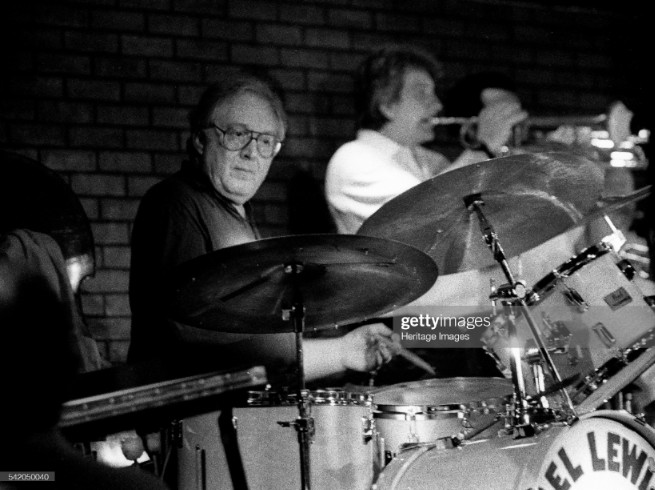
© -Steven Cerra, copyright protected; all rights reserved.

“Mel showed me at that time, what a drummer is capable of doing as far as being integrated as an inescapable component of the arrangement as a whole. Not just something stuck in there at the last minute. You don't replace Mel Lewis, you just hope to get somebody who's like him — maybe.”
- Don Sebesky, trombonist, composer-arranger
“Well, it boils down to the fact that Mel played music on the drums. He absorbed what everyone in the band was doing and found things to play that complimented it. His time was so relaxed that sometimes he got in trouble for it. I remember one time; while we were playing with Terry Gibbs, hearing Al Porcino pounding his heel on the floor and saying, "Let's go Mel!" Because Mel was so easy that sometimes he would drag a little bit. But, to me it was a perfect solution to big band drumming.”
- Bill Holman, tenor saxophonist, big band leader, composer, arranger
“Mel never stopped speaking up for what he believed in and he always stayed true to his belief that jazz music should be swinging and innovative. Due in part to his unapologetic honesty his career wasn't filled with the fame and fortune that other drummers achieved. Yet Mel stayed true to himself and developed artistically throughout his entire life, in turn leaving the world with a recorded legacy that is priceless.” [p. 105]
- Chris Smith, professional drummer, educator author of Mel Lewis: The View from the Back of the Band
"My whole approach to playing is reaction. I don't listen to myself play. I'm too busy listening to everything going on around me. All my body is doing is reacting to that. I augment, compliment, round out. I can make anybody sound good. I have my own style, but I play uniquely with everyone that I play with ... Sometimes I'm forcing things, making things happen another way, but I'm still reacting to everything I hear. The composition I'm creating as I play in a big band is also because of what I'm hearing ... Everything depends on your ears. If I'm busy listening to me, then I'm not hearing the rest of the band. When the band is playing as an ensemble, I'm part of that ensemble."
— Mel Lewis, clinic in Hilversum, Netherlands 1985
Early in his career, some Jazz critics dismissed Mel Lewis as a drummer with “no chops” [little technique] who played behind the beat. But as Chris Smith points out in his masterfully comprehensive biography of Mel is that - “What makes the critics' under-appreciation of Mel so incorrect is what most every musician and many listeners know: that while a band can play poorly with a great drummer, no band can be great without one.”
When you finish reading Chris’ Mel Lewis: The View from the Back of the Band - The Life and Music of Mel Lewis [Denton, TX: University of North Texas Press, 2014], there will be no doubt in your mind - nor should there be - that Mel Lewis was one of the greatest Jazz drummers who ever lived [1929-1990].
He ranks right up there with Baby Dodds, Zutty Singleton, Gene Krupa, Chick Webb, Buddy Rich, Davy Tough, Sid Catlett, Kenny Clarke, Max Roach, Shelly Manne, Louie Bellson, Joe Morello, Philly Joe Jones, Elvin Jones, Tony Williams, Jack DeJohnette and any other “signature drummer” in the history of the music. [“Signature drummer” was Buddy Rich’s term for a drummer whose style was instantly recognizable and distinctive from other drummers].
As Gerry Mulligan once put it: “There’s still not a drummer who achieved what Mel Lewis did. And I’m not sure how to describe it.”
Maybe one answer is in the following remark that Mel made to Burt Korall the author of Drummin’ Men: The Heartbeat of Jazz - The Bebop Years:
“I found that to really make money you had to give up music. So I gave up money.”
For forty years, Mel Lewis made music in a widely diverse range of settings that included trios, small groups and big bands.
And what a collection of big bands: Tex Beneke, Boyd Raeburn, Alvino Ray, Ray Anthony, Stan Kenton, the Terry Gibbs Dream Band, Gerald Wilson, Gerry Mulligan’s Concert Jazz Band, the Thad Jones Mel Lewis Big Band and Mel Lewis and The Jazz Orchestra plus the many performances with various iterations of the WDR big band in Germany during the 1980s.
But Gerry’s point is well-taken, Mel’s footprint on Jazz is so huge - how do you describe it?
Until Chris Smith biography of Mel came along, Mel’s career was almost impossible to recount let alone describe. After reading it one is tempted to ask: Is there anyone that Mel didn’t play during a career that spanned four decades from approximately 1950 to 1990?
Each time I started to prepare and outline for how I wanted to approach reviewing Chris Smith’s engaging biography of Mel Lewis, I’d read a little further in my notes to each chapter which then prompted me to rethink and rewrite the whole feature!
Chris’ book is much more than a mere biography of Mel, it imparts a great deal of knowledge and information about the broader Jazz World in the second half of the 20th century and Mel’s role in creating of lot of it that it could easily have been entitled Drum Wisdom and Jazz Revelations: The Life and Times of Mel Lewis [1929 - 1990].
Perhaps the easiest way to begin is with Mel Lewis’ own description of who he is and what he does: “Hi, my name is Mel Lewis and I play drums and cymbals.”
Or as it it specifically stated in Chris’ biography:
“You can say I am an old man, the kids can say "Oh what does he know he is from the old school." Man, I am not from the old school! I am a musician, and I play drums and cymbals. I use cymbals that are real cymbals. It’s like driving a good car as opposed to a piece of junk, you know. But man, once you really know how to play a drum, meaning you can play it, you know what it sounds like, and you can sit and create music on that drum, then you’ve achieved something. I don't mean play songs where you sit there playing backbeats and play a fill here and you do this there. I mean where you can actually make music on an instrument, then you'll know exactly what I am talking about.” [p. 105]
The significance of this remark is that while many drummers are apologists because of the bad rap they get for not being like other musicians [not being melody and harmony “sensitive”], Mel was proud of his instrument and the way he played it.
Never one to downplay his own abilities, Mel took things a step further when he remarked:
"I am a unique drummer. I have a style that nobody else has. I make music happen. I make bands do things that no other band can do. Any time I've played, any band I've played in, that band has become mine. Now, I didn't do it on purpose... it just happened.” [p. 74]
What becomes apparent as you read through the 23 chapters of Chris’ biography is that Mel Lewis put a lot of thought into his approach to drumming, something you might not assume, because Mel was not a flashy or “technique drummer.
Here are some quotations that reflect how deeply Mel thought about his drumming:
- "My whole approach to playing is reaction. I don't listen to myself play. I'm too busy listening to everything going on around me. All my body is doing is reacting to that. I augment, compliment, round out. I can make anybody sound good. I have my own style, but I play uniquely with everyone that I play with. Sometimes I'm forcing things, making things happen another way, but I'm still reacting to everything I hear. The composition I'm creating as I play in a big band is also because of what I'm hearing ... Everything depends on your ears. If I'm busy listening to me, then I'm not hearing the rest of the band. When the band is playing as an ensemble, I'm part of that ensemble." —Mel Lewis, clinic in Hilversum, Netherlands 1985
- Strangely, in print interviews Mel often downplayed the influence Tiny had on his drumming. However, in an interview with Will Moyle, Mel clearly stated, "Tiny played so musically, he was a big influence on my playing. That great sound out of his bass drum and his constant motion. He used what we call 'Rub-a-Dub' feel, which I use too. That is what really makes a band move ahead and play inspired, it's that 'Rub-a-Dub'."
- [Mel was often credited with bringing a small group style of drumming into a big band setting]. “Now I am with a dance band again [Alvino Ray], but the funny bit is that bebop had completely taken me over by this time; I was really a bop drummer. And the small group thing was really coming into my head now, this way of playing. But I wasn't thinking about it that way, I didn't even realize what I was doing. I wasn't saying, "oh, I'm gonna play small group drums in a big band."
- “Good drummers were a rarity and that's all there was to it. There's no ego problem involved, it's just there weren't many good drummers. There still aren't.”
- “[During] his time with Kenton, Mel's softer dynamics and bebop-influenced style of big band drumming were a major influence on the band's sound. … After only a handful of times playing the [Kenton band’s] complex arrangements, he was beyond reading the chart and had already interpreted the music in his own style. Even at the young age of twenty-six, Mel had the ability to quickly memorize music and play in a way that uniquely suited each arrangement … .Mel’s light touch, bebop comping, and ability to support the ensemble without overplaying, began setting a new standard of big band drumming.” [Chris Smith]
- “It is worth noting that the sound of Mel's drums and cymbals on Art Pepper + Eleven: Modern Jazz Classics [arrangements by Marty Paich] is an excellent representation of his "typical sound" at the time. Mel's "sound" was a combination of many aspects, two of which were his use of calfskin drumheads and tuning his drums medium-low in pitch, even when playing in a small group. His drum sound on Modern Jazz Classics is a prime example of the warm tone he pulled out of the calfskin heads and how the sound of his drums blended into the ensemble, yet were tuned high enough to cut through when needed. Another important aspect of Mel's "sound" heard on the album is his use of low-pitched cymbals and the master touch in which he played them. … Mel was physically relaxed when he played, creating so much intensity while making the whole process look effortless.” [Chris Smith]
- “Buddy [Rich] knew the melody so well he would play the melodies along with the band. That is where I disagreed with him. He forced the music to be played like a drummer, where my bit is I play it like the band is playing. That's where him and I are opposites in big band playing. But behind it, we have the same talent for hearing. This is what he liked about me and what I liked about him. In other words, what we liked about each other was the things neither one of us could do, the respect for each other’s signature.”
- “His cymbal colors and textures created a continually shifting sonic backdrop, and in typical Mel fashion, when it was time to swing his cymbal beat wrapped a comforting blanket of sound around the whole band. His bass drum and toms were used as both melodic voices and low register textures. Most importantly his drumming demonstrated that orchestration and patience were as powerful musical tools as chops and speed. … Mel often pushed intensity to new heights by moving from his main ride cymbal to his Chinese cymbal. At the point where other drummers may have added volume or overplayed, Mel elevated the music by changing his cymbal sound and intensifying the texture.” [Chris Smith]
- "Playing from hand to hand and constantly moving the cymbal pattern, gets the feeling of straight ahead motion without getting into a rigid situation. The only thing that really has to keep going and stay rigid is the hi-hat. But you never think about your hi-hat, it just goes. But you keep moving your hands with different patterns while listening to the soloist and reacting to what they play." —Mel Lewis, clinic in Hilversum, Netherlands, 1985
- "I think drummers should create their own fills based on what they are hearing instead of the old standard fill before a dotted quarter... Drummers can create their own fills based on the music itself, based on what will follow or what proceeded.” —Mel Lewis, Modern Drummer, February 1985-
- "When playing figures with the ensemble, duplicate its effects: loud or soft, long or short. For short sound, strike the center of the snare drum; snap the hi-hats shut tightly) press the stick into the head of a torn) make a cross-stick shot. For a long sound, strike a cymbal; hit the bass drum) instantly snapping the beater back) snap the hi-hats in an open position and let them ring. Strike a tone and let the note sustain. Strike the off-center area of the snare drum (a semi-long sound). Never, unless it is called for, play a figure with just one sound (every note sounding alike). Each note has a different texture and requires varying treatment... Always sing the figure, either aloud or to yourself. This applies when studying the figure (before playing it) and at the moment of execution. And sing with the feeling and articulation of the horn. Then duplicate this feeling on the drum set. In this way you will get a better blend between the drums and the horns." —Mel Lewis, International Musician, 1961
What also becomes apparent through a close reading of Chris Smith’s Mel Lewis: The View from the Back of the Band is how much other musicians appreciated Mel’s approach to drumming.
- “The thing that was so amazing about Mel was that he heard everything that was going on in the band. Mel would give it up for the band. In other words, he felt that he was not only a part of the rhythm section, but that he was a part of each section of the band. And depending on which section had the lead, whether it was a sax soli, a trombone soli, or the trumpets were leading the ensemble through the out chorus, Mel knew every part. Inside of what he did, as far as the overall sound of the drums, he would also accentuate things that other drummers would never hear. He would do it so subtly that you felt it more than you heard it. He was just so unique in his ability to be a total part of the orchestration. He never got in the way, and Mel never made the drums a prominent instrument in the band. His sound was always something that the band sat on top of, and he was the most supportive drummer that I have ever heard. For me, I have never heard anyone be so giving musically, as part of a big band. I don’t think he ever thought of himself as a drummer, I think he probably thought of himself as just a band member. But as it ended up, he was the band!” - Marvin Stamm, trumpet player
- “The Concert Jazz Band was my first chance to really get to know Mel and get to play music with him on a steady basis. I thought it was a hot rhythm section! I liked the sounds that he got out of his cymbals and I liked the general steam that he was able to turn on. You know it s funny, one time he told me, ‘I don't like to play what the brass section is playing, they got enough accent in their playing and they can do that on their own. If I play everything that they play they get lazy. We need to get them more up on the time. I like to play what the saxophone players are playing.’ And I thought that was a very interesting insight into his conception of playing.” - Bill Crow, bassist
- “When Mel Lewis was with the Terry Gibbs band, he did some of the best drumming I ever heard with that band. I'm not that free with compliments, but the band was so hot. It was the most perfect way of playing drums with that band. Mel's a marvelous drummer and totally individualistic. He doesn't sound like anybody else. That's the best thing you can say about anybody, and I said it.” - Buddy Rich, drummer and band leader
- “Through the years I played various gigs with Mel, everything from big band, to piano trio at Jazz clubs, to wedding gigs. He was always so relaxed when he played it looked like he was up there reading the paper! Mel's absolute first priority, no matter what, was the feel of the music. He knew that if it didn't feel good, neither the band nor the audience would like it. It didn't matter what you wanted to do harmonically, melodically, formally or any of that—if the music didn't start from a place of good feel, forget it! Trust your body, trust your instincts and let the music flow—it will be ok.” Peter Malinverni, pianist
- “Mel really knew how to hear what was right for the music. Like most good musicians, he had the ability to adapt to a situation and play what was appropriate in a very natural way. He really knew how to orchestrate. What I also loved so much about Mel was his ability to "shade" the time of the music. He knew when to get up on it, and he knew when to get back on it, depending on what was happening with the band. He knew how to "dig in the stirrups," or "pull back the reins," you know. He had an amazing ability to know how and when to do that. A real gift — Adam Nussbaum, drummer
- ”Mel was capable of contributing many things to an album, and he did it in ways that only he could do. His musical approach to drumming never forced people to play a certain way. He allowed people to play the way they play, and then he made his musical contribution while that was happening. —Jerry Dodgion, alto saxophonist
- “He really embodied the idea of being a team player, rather than drawing attention to himself. He tried to keep the small group feeling in the big band, and I think that he proved that great music could be made without making bold technical statements. I also think that he showed that it's really possible to play a wide range of music well over the course of a career. Even though he may have been "pigeon holed" as a certain type of player, he found a way to bring life to all kinds of musical situations.” —John Riley, drummer
- “Mel's wasn't an incredibly technical drummer, he kind of rumbled back there, but he could just explode with energy when the music called for it. He was the only drummer that I have ever played with that told me he had a specific cymbal for my sound. That really blew me away! He said, "Yeah I have a cymbal for George, I had a cymbal for Richard, and I have a cymbal for you."
- Mel and I once recorded these play-along albums for Ramon Ricker. After recording the whole day it was suggested that since everyone had settled in we go back and rerecord the very first song. The recording engineer said, "Should I playback the tempo of the first take?" And Mel said, "No I got it."
- So we recorded the song again and when we finished we listened back. The new version ended up being one second different than the original take! The song was six or seven minutes in length and the two recordings were done at least six hours apart. Everybody that was in the control booth kind of fell silent and looked at each other and said, "Wow that’s incredible!" Mel had a very unique internal clock; that was one of his gifts.” — Rufus Reid, bassist
- “Mel played to make everybody else in the band sound as good as possible. He did this by thinking of their phrasing and thinking like a horn player. He was totally unselfish; he always played what the band needed.” — Jeff Hamilton, drummer
- “Mel played very musical. All the drummers that have played with my band, after Mel left and the records came out, they sort of played the same licks that Mel played because it was almost like someone had written them out, they fit the music perfect! He was so musical.” - Terry Gibbs, vibraphonist and band leader
- “When Mel died, it was one of the biggest losses the music ever had. People all over the world suffered. And they'll never recover. We were sitting in Cologne, a key producer and I. We said, "Mel," and were silent for five minutes because there's no replacement. All of the bands, big and small, amateur and professional, that he made sound good have to feel a terrible, terrible loss. There will never be another like him. Mel was one of the greatest drummers of all. I'd stake my life on that.” - Bob Brookmeyer, valve trombonist, band leader, composer-arranger.
There are two other main themes that Chris Smith stresses over the course of the 23 chapters that make up Mel Lewis: The View from the Back of the Band are Mel’s development as a band leader which dated back to his time on Stan Kenton’s band when he observed: “‘Stan Kenton treated his musicians like gentlemen; and he knew how to draw the best out of you. He never told anybody how to play. And I thought that was very important,’ recalled Mel. The lessons Mel learned from Kenton deeply influenced the way he treated fellow musicians when he became a bandleader.”
The other primary theme that Chris Smith underscores in his biography was Mel’s efforts to help young drummers: “Much like the love he showed for the members of his band, Mel also extended his friendship, advice, and equipment to the young jazz drummers whom he thought showed promise. Drummer Adam Nussbaum recalled his relationship with Mel:
“I really got to know Mel when I was playing with John Scofield and Michael Moore at a club "Paissons" on West 72nd street in New York City; that was not too far from where Mel lived. He showed up to the gig and saw me playing with these cats. He kind of knew about me because I was playing with some of the guys in his band like Dennis Irwin, Dick Oatts, Joe Lovano, Jim McNeely, we were all buddies. At the time I had a set of walnut finish Gretsch drums, was using old K's, and had calfskin heads on my snare and bass drum. I guess he may have seen me as a younger version of himself; I also had red hair and was Jewish. After we said hello to each other, I said, "Hey Mel why don’t you come up and play a little bit." So Mel sat in and played a couple tunes with Scofield.
After the gig was done Mel said to me, "What are you doing tomorrow? I want you to come to my house tomorrow around noon, you free?" So I went over the next day, I ring the bell, and Mel said, "Wait for me in the lobby." So I waited for him in the lobby, and then we went down to the basement, to his storage place. When we got down there he took out a snare drum and floor torn. He said, "Here man, I want you to have these." I said, "What?" He goes, "Yeah man, these match your Gretsch drums | perfectly, they stole the rest from me and I am using Slingerland now, so you should have them." Just real matter of fact, it was just so sweet of him.
Mel didn't have a son, so I think he saw a bunch of us guys in New York—of the younger generation (Kenny Washington, Danny Gottlieb, Joey Baron, Peter Erskine, and others) whom he felt had some talent—kind of like his family. He was very supportive and encouraging to us, like a father. I would have to say that he is one of my musical fathers. We'd go out to eat, we'd go to his apartment and he would sit in his big chair and play recordings that he played on. I'd bring up things that I played on. We'd listen and we'd talk. We spent time just hanging out; not necessarily talking about drums per say just talking about music and life. He watched out for the guys that he cared about. If Mel cared about you and liked you, he really took to you.”
The book concludes with over 50 pages of drum transcriptions and annotated listening guides for examples of Mel on records, a timeline of the drum equipment that Mel played on over the course of his career and a selected discography.
One couldn’t ask for a better retrospective of Mel’s career and assessment of its significance in the history of Jazz than the one that Chris Smith has researched, compiled and written for Mel Lewis: The View from the Back of the Band -The Life and Music of Mel Lewis.
Mel was so deserving of the respect that Chris’ biography puts forth in his definitive study and we are fortunate to have Chris’ outstanding treatment of this singular musician. Along with Helene LaFaro Fernandez’s biography of her brother Scott LaFaro and Michael Sparke’s biography of Stan Kenton, it assumes its honored place in the University of North Texas Lives of Musicians series.
You can locate order information about the book via this link.