Showing posts with label Michael Brecker. Show all posts

Monday, December 13, 2021

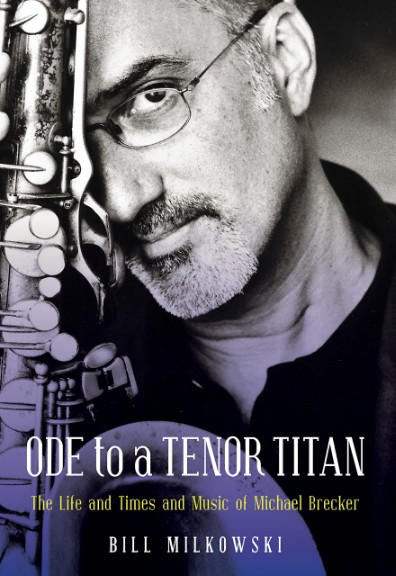
Ode to a Tenor Titan: The Life and Times and Music of Michael Brecker by Bill Milkowski - An Appreciation

 © Copyright ® Steven Cerra, copyright protected; all rights reserved.

For Jazz fans of a certain age [mine], the focus on the music has been the styles that developed from approximately 1945-65.


The elements of free Jazz, Jazz-Rock fusion and the use of electronic instruments that really took hold in Jazz in the late 1960s and early 1970s generally left this generation cold [not me].


As the music progressed into the 1970s to form a synthesis of these new elements, this 1945-65 generation regressed almost to the point of developing a reverie for the older forms of Jazz while shunning these new directions.


Enter Michael Brecker and the Jazz musicians of his generation who, rather than reject this synthesis, flat out embraced it and made these new forms their own while establishing a place for them in the history of the music.


If you are interested in the details of this transition, look no further than Bill Milkowski’s Ode to a Tenor Titan: The Life and Times of Michael Brecker [Backbeat Books 2021].


Bill’s Brecker Bio offers a variety of illuminating perspectives on Michael’s career while at the same time documenting the development of the trends in Jazz that came to characterize the music in the last quarter of the 20th century.


In chronicling Michael’s career from his arrival on the New York scene in 1970 until his death in 2007, Bill’s Brecker Bio also treats us to a look at many of the other major artists who shaped the Jazz Rock fusion of this era because Michael played with just about everyone and anyone of importance.


Ode to a Tenor Titan follows Michael's story from growing up in Philadelphia, finding his tenor sax voice during his brief stint at Indiana University, making his move to New York City in 1969, and taking the Big Apple by storm through the sheer power of his monstrous chops. A commanding voice in jazz for four decades, Brecker possessed peerless technique and an uncanny ability to fit into every musical situation, whether it was as a ubiquitous studio musician (more than nine hundred sessions) for such pop stars as Paul Simon, James Taylor, Bruce Springsteen, Todd Rundgren, Chaka Khan, and Steely Dan; playing with seminal fusion bands like Dreams, Billy Cobham, and The Brecker Brothers; or collaborating with the likes of Frank Zappa, Charles Mingus, Pat Metheny, and Herbie Hancock. But his biggest triumphs came as a bandleader during the last twenty years of his career, when he produced some of the most challenging, inspired, and visionary modern jazz recordings of his time.”


Since “everyone comes from someone” in Jazz, it was certainly obvious to anyone with a listening knowledge of Jazz that Michael “came from” tenor saxophonist John Coltrane for as he explains in Chapter 1: Becoming Michael Brecker:


“[As he recalled in a 2004 interview at the Newport Jazz Festival,] The first Coltrane album that I bought was Live at Birdland, which was a pretty bizarre record for a fledgling listener because the music was so intense and absolutely riveting. A lot of it was modal music with long solos. And I'd never heard drums play with that kind of intensity and crashing. And Coltrane was playing in a style and with a sound that I was not accustomed to. I didn't like the record at first, but I began listening to it every day until finally after listening to it over a period of probably months, I began to understand what was going on. From there, I started buying other Coltrane records and became really interested in his music, to the degree that it became an enormous influence in the direction that I chose for a life's endeavor. Coltrane's music was both spiritual and certainly intellectual, technically highly developed, emotional and immensely creative and courageous. Put all those things together, plus the phenomenon quartet, which was one of those groups where the sum is greater than the whole, and the power of that group literally kind of propelled me into choosing music as a livelihood."


But it would be a mistake to assume that Michael was little more than a John Coltrane clone for as Ravi Coltrane, the son of Michael’s biggest role model and inspiration and himself a fine tenor saxophonist delineates:


“I think Michael came about at a very unique time in music and was able to really utilize everything coming out of the late '60s and early '70s in the jazz and funk-rock scenes. He absorbed so much at a prime time and just got ahead of the game really quickly because he was a focused musician and very diligent about how he practiced. And clearly, he worked out a ton of shit on the saxophone and was able to kind of take it to another place. He also had a very distinguishable sound. And there was a point in the '80s where that sound became THE sound among aspiring saxophone players. There were so many younger players trying to play like Michael then. We used to call them the Breckerheads. But I always thought Michael's thing always sounded most genuine — because it was his shit! And, obviously, his influences were not only John Coltrane but Joe Henderson as well. But he put a lot of shit together and worked it out, all over the horn, and was able to play in a variety of styles of music with a kind of proficiency that made him one of the best of the best. And I think it was his curiosity and passion and the profoundly deep connection he had to the music that really set him apart from other great saxophone players on a similar technical level.” [Emphasis mine]


In an era which has as one of its socio-cultural keynotes the concept of “cultural appropriation,” one has to be careful about making assertions, but although the comes-from-influences of Coltrane and Henderson are certainly apparent in the early Brecker style [as are Stanley Turrentine, Junior Walker and King Curtis], they were soon superseded by “ a kind of proficiency that made him the best of the best.”


Tenor saxophonist Joe Lovano expressed Michael’s genuineness this way in the following excerpt from an interview he gave Bill Milkowski:


“Mike was a true virtuoso on his horn. I remember being down in his basement studio in Hastings [New York] just trying out these wooden mouthpieces that Francois Louis, the Belgian mouthpiece maker, had made for him. This was probably around 2004. I drove Francois up to Mike's pad, and we went down to his basement studio, and you should have heard him try these mouthpieces, man. He was like Heifetz or something the way he played the harmonics and the overtone series on the horn from the lowest register to the highest register. And that's how he would practice. He would play from the bottom of the horn to the upper extensions and really feel all the overtones and undertones within that. Mike lived in that world. He was constantly searching, constantly evolving, and he had a deep passion and a lot of love in his playing.”


Aside from his innate talents and abilities, it was Michael’s practice regiment that set him apart and helped him become a true virtuoso; a practice regiment that Anders Ericsson and Robert Pool describe as “deliberate practice, … the gold standard, the ideal to which anyone learning a skill should aspire” in their book “Peak: Secrets from the New Science of Expertise” [Eamon Dolan, 2016].


Not to distract from the focus on Bill’s Brecker Bio but briefly, deliberate practice “ draws a clear distinction between purposeful practice — in which a person tries very hard to push himself or herself to improve — and practice that is both purposeful and informed. In particular, deliberate practice is informed and guided by the best performers' accomplishments and by an understanding of what these expert performers do to excel. Deliberate practice is purposeful practice that knows where it is going and how to get there.


Deliberate practice is characterized by many traits - “Deliberate practice develops skills that other people have already figured out how to do and for which effective training techniques have been established. The practice regimen should be designed and overseen by a teacher or coach who is familiar with the abilities of expert performers and with how those abilities can best be developed.”


Michael was lucky to have two marvelous teachers in Vince Trombetta and Phil Woods who early on instilled another of Peak traits: “Deliberate practice takes place outside one's comfort zone and requires a student to constantly try things that are just beyond his or her current abilities. Thus it demands near-maximal effort, which is generally not enjoyable.”


Fortunately for Mike, he arrived in New York during the 1970s, a time in which lofts with plentiful space were available for inexpensive rates which allowed him to “deliberate practice” incessantly both alone and with many other musicians who would later become bandmates and/or stars in their own right in the burgeoning Jazz-Rock Fusion scene including Billy Cobham, John Abercrombie, Don Grolnick, Peter Erskine, Steve Khan, Mike Manieri, Bob Mintzer, Hal Galper, David Sanborn, Jan Hammer, Alex Blake, Barry Rodgers, Jack Wilkins, Lenny White, Dave Holland, et al.


“In their freewheeling loft jams, the saxophonists tended to hone in on latter day Coltrane. "That was the period of Trane that we were most affected by and were emulating," said Liebman. "And us being young guys, as is always the case, you want to emulate what you hear around your environment. And Ascension is the record that stands out as 'Let's do that!' Meaning, play group improv with as many horns as possible at the same time, even with a couple drummers ... no basic heads, no melodies, no chords, just completely free association and a lot of energy, which, of course, is a big component of it. And Michael was very much a part of that."


Liebman added, "If you were a young musician in New York at that time, you had to deal with Trane; you couldn't avoid it. Why would you? You had to deal with Coltrane's oeuvre, his work and his language. So, we were all enamored by that and really affected by it. Trane was everywhere, and the immensity of what he did was on everybody's mind. And when you hear tapes of some of our jams from back then, you really hear the personalities coming out between me and Michael and Steve Grossman and Bob Berg. It was the beginnings of what would become our way of being stylistic; playing a vernacular that's known and putting it together in your own way." …


According to Bill, Randy Brecker confirmed that the sessions at Liebman's and other lofts around New York at that time were, indeed, happening around the clock. "There were sometimes three sessions going on at once in that building on 19th Street on each floor, as well as other lofts around town where cats would go to play at any hour. Liebman's loft became a main focal point mostly for free jazz jams. The bebop and Miles-infused fusion jams were over at Gene Perla's loft, who shared a space with Jan Hammer and Don Alias in Lower Manhattan on Jefferson Street near the Fulton Street Fish Market just off the East River. I had gone to Berklee with Gene one summer and met Jan at the Vienna Jazz Competition in 1966, so I was over there jamming quite a bit, too, along with a lot of people who were under the electric Miles wing.


"And then you had the big band rehearsal spaces like Lynn Oliver's uptown on 89th and Broadway and downtown at Tom DiPietro's place Upsurge on 19th between Fifth and Sixth Avenues, where the Chuck Israels [Jazz] Orchestra and Joe Henderson Big Band used to rehearse. I went to those places as well. There were so many places to play then."


"It was a special time to be in New York," Michael told [Lorne Frohman in a 2004 Distinguished Artists interview] "That's when the so-called boundaries between what was then pop music and jazz were becoming very blurry. And those of us who experimented with combining R&B rhythms with jazz harmony began to develop a music that was a fusion, if you'll excuse the word, of various elements. The music was fresh, exciting, powerful, and exhilarating. We really had no word for it; at the time it was loosely referred to as jazz-jock."


Bill’s description of Michael’s work in the 1970s includes his time with Horace Silver’s and Billy Cobham’s Bands, the Chicago and Blood Sweat & Tears inspired Dreams with a front line of Randy and Michael along with brass instrumentalist Barry Rodgers, the music of Michael’s best friend pianist Don Grolnick, and early iterations of the Brecker Brother Band, among many other musical associations during this period. But what is patently obvious was the lack of a recording under Michael’s own name.


This “preternaturally gifted player whose facility seemed super human, who was modest to a fault and universally beloved by fellow musicians” asserted that he just wasn’t ready to issue an album under his own name.! This was not to happen until 1987!!


In the meantime, we are treated to Bill’s annotations and discussions about a whole host of recordings that Michael made with other musicians and groups among them The Brecker Brothers, Steps and Steps Ahead, Billy Cobham, Hal Galper, Don Grolnick, Claus Ogerman, Jaco Pastorious, among many others.


As a point in passing, I along with some others friends, used the annotated discography provided in Bill’s Brecker Bio as a read-along, play-along platform to better familiarize ourselves with the points about Michael’s style and music that Bill makes in his book, to fill-in-the-gaps of Michael’s music that was new to us, as well as, to reconnect with Brecker recordings already in our my collections.


Of particular poignancy, largely because I was unaware of this fact, is Bill’s description of the dark side of Michael’s heroin addiction in the 1970s and how he “turned his life around and became a beacon for countless others to lead clean and sober lives.”


Also unknown to me:


“By the end of 1977, Mike and Randy took out a ten-year lease on a downtown space that would become a popular haven for them and other like-minded musicians to put together new projects and experiment with impunity. Seventh Avenue South, as it was christened, would also become a notorious den of iniquity for those people who were interested in doing the wrong thing right. Coke fiends and fusion fans rubbed elbows at the downstairs bar and in the upstairs performance area, and the lines flowed like champagne. After all, it was the '70s.”


By the 1970s, Jazz had pretty much been abandoned by the national press. There was Downbeat and a few other specialty magazines and some newspapers offered the occasional column about Jazz, but the music had lost much of its following to Rock and this was reflected in the lack of coverage in news outlets.


Bill’s Brecker Bio offsets some of this obscurity with his accounts of Michael’s activities in New York, Japan and the international Jazz festivals such as Montreux in Switzerland during the 1970s and beyond.


On a more personal level, if you love “Love Stories,” Michael’s marriage to Susan Neustadt will tug at your heartstrings and Mike’s association with Darryl Pitt will make you wish that every prominent artist could have such a caring and competent manager. The scientifically curious side of Michael as manifested in his adoption of the EWI [the electronic wind instrument] reveals another side of the Brecker Genius. Others have played the EWI; no one has ever played it like Michael and Bill goes into a graphic, yet very readable, description as to why this is so. 


Thankfully, by 1987, we have Michael creating and issuing recordings under his own name and all nine of these are fully annotated by Bill.


The book contains a full discography of Michael’s recordings and concludes with an Appendix of “Testimonials to a Tenor Titan” by David Sanborn, Dave Liebman, Joshua Redman, Chris Potter, Joe Lovano, Bill Evans, Ravi Coltrane, Branford Marsalis, John McLaughlin, Tim Ries, Steve Slagle, Bob Mintzer, Adam Rogers, Chris Minh Doky, Ben Wendel, Chris Rogers, David Demsey, Rick Margitza, Michael Zilber, Bob Reynolds and Franco Ambrosetti.


Of course, throughout the book, Bill includes comments by many of the musicians who worked closely with Michael over the years, not the least of which were brother Randy, Pat Metheny, Herbie Hancock, John Patitucci, Jack DeJohnette, McCoy Tyner, Mike Stern, Peter Erskine, Jeff “Tain” Watts, Mike Mainieri and Antonio Sanchez among many, many others.


The word “tragic” is all-too-often associated with the word “genius” and, unfortunately, this turns out to be the case with Michael whose death from multiple myeloma in 2007 deprived the Jazz World of a singular voice and a very special human being. 


“Michael Brecker was a player of tremendous heart and conviction, and a person of rare humility and kindness. His story is one for the ages.”


In the dedication he entered in the review copy he so graciously sent me Bill wrote:


“Steven - Hope you enjoy reading this sad and beautiful tale of the great Michael Brecker. He was a friend and a hero to me. I put my heart and soul into this one. All the best! Bill Milkowski.”


With the reading of each page in this definitive work, it shows Bill; it shows.


Taking on the responsibility of writing the biography of someone with the astounding abilities and legacy of Michael Brecker is no easy task. Bill Milkowski’s biography is fittingly the equal of the man and his music that it chronicles.


The book is available through all retail and online booksellers.


Saturday, February 8, 2020

Michael Brecker - The Koninklijk Conservatorium [Den Haag] Interview 3.21.2004


© -Steven A. Cerra, copyright protected; all rights reserved.


“His work as a session-man has polished his style into something superbly confident and muscular, a Coltrane without the questing inner turmoil.”
- Richard Cook and Brian Morton,
The Penguin Guide to Jazz on CD
6th Edition

“Mike Brecker was, by the 1980s, the most influential saxophonist since John Coltrane; any aspiring saxophonist was forced to take account of his tone, technique, energy and his harmonic methodology.”
- Stuart Nicholson
Jazz: The 1980’s Resurgence

“Michael Brecker developed into perhaps the most comprehensive saxophone talent of … [the last 30 years] with a burnished, incisive sound and a fluency and drive which are unsurpassed.”
- Ian Carr
Jazz: The Rough Guide

I miss Michael Brecker.

His impassioned, Coltranesque wails on the tenor saxophone never failed to move me and his knuckle-busting, chromatic runs never failed to astound me. I loved the sound that he got on the tenor saxophone and I loved the improvisations he made using that sound as a constant and unyielding focal point.

Michael’s passing on January 13, 2007 at the age of 58 meant the end of his incessant explorations in a variety of musical contexts, both acoustical and electronic. He grew up as a part of the generation of Jazz musicians who saw rock music not as the enemy but as a viable musical option. His all-embracing musical curiosity encompassed everything from electronic wind instruments to African music.


Over the course of his career, this “quiet, gentle musician who was widely regarded as the most influential tenor saxophone player since John Coltrane,” won 15 Grammy Awards and played with some of the most influential Jazz and rock ‘n roll groups of the second half of the 20th century including:

- Horace Silver
- Herbie Hancock
- Quincy Jones
- Chick Corea
- George Benson
- Billy Cobham
- James Taylor
- Paul Simon
- Joni Mitchell
- Eric Clapton
- Frank Zappa
- Bruce Springsteen
- Steely Dan
- Claus Ogerman
- Jaco Pastorius
- Pat Metheny

He led his own groups, usually quartets and frequently in the company of either keyboardists Don Grolnick or Joey Calderazzo, and co-led the groups Steps Ahead with vibraphonist Mike Mainieri and The Brecker Brothers with his brother, trumpeter Randy Brecker.


In looking for a way of saluting this singular and seminal artist, the editorial staff at JazzProfiles uncovered the following audio interview that Michael gave presumably to Wouter Turkenburg, head of the Jazz department at the Koninklijk Conservatorium in The Hague, Holland as part of a March 21, 2004 performance and clinic with the students studying Jazz at the conservatory.


The generosity of spirit and modesty that always seemed to inform Michael's personality, despite his huge success as a performing artist, shines through during the 38 minute interview with this self-effacing and fascinating man.

To the best of our knowledge, it is being presented here as a written transcription for the first time.

Some of the stop-and-start language that typically plays a part in conversations has been streamlined to create more of a flow between the interviewer’s questions and Michael’s answers. Other than these simple adjustments, nothing has been altered from the original interview, although I have added annotations and/or examples to help complete or elaborate on some of the expressed thoughts that make up the interview.

Koninklijk Conservatorium Interviewer [KCI]:  The idea of this session is that the students have written out the questions that I will ask Michael to give answers to.

Michael Brecker has also been to school [i.e.: a music conservatory] at Indiana University, but only for a short period.  Why that school; what was happening there?

Michael Brecker [MB]: I went to Indiana University in 1968 [from Philadelphia, PA where he was born and raised] to pursue a career in music and I enrolled there because the music school was famous. Also, my brother Randy [trumpet player] had gone there.


I went there but I changed my major away from music. I had a kind of rebellion. I grew up in a very musical family. My father was an attorney and a Jazz pianist. So we were all very highly influenced by his approach to music. He loved Jazz and he loved music so we were all kind of subtly urged to pursue careers in music. For whatever reasons, I rebelled at the last minute and decided that I wanted to be a doctor.

It was kind of a reverse rebellion. I ended up in the Liberal Arts School for a little over a year. Then I switched again to the Fine Arts. I was painting and then I decided to leave the university altogether in 1969 and moved to New York, because I had decided to pursue music.

My art teacher at the university became a good friend of mine and he suggested that I become a musician.

I think that it was an unwise decision in retrospect. If there is one thing that I could change – I don’t really have any regrets about anything – but if I were to do one thing again it would have been to complete school.

KCI: The Medicine School or the Fine Arts School?

MB: The Music School.

KCI: A few years ago, you were interested in African Music.  How did it happen, I mean you have good timing …

MB: [To which Michael interrupts and says] “Thank You” [with laughter following from the students in attendance for the interview].

KCI: From you interest in African music, did your timing become better or more profound?

MB: It’s very simple as to the attraction, I just liked the sound of African music.

[One of the pieces that Michael performed during the concert portion of his March 24th 2004 visit to the Koninklijk Conservatorium was his original composition African Skies which can be found on the GRP disc The Brecker Brothers: Out of the Loop GRD-9784].


I don’t know if I really know what “African Music” means, it’s so broad a term. There are so many different kinds of music coming from the continent of Africa. I was intrigued by the rhythmic aspect of the music, and harmonic aspect.

And I’d always loved the tension and release created in Jazz rhythm and I was intrigue how Jazz may have grown out of African music [in this regard].

While I’m intrigued by it, I really don’t know that much about. I haven’t really been to Africa other than to South Africa and Botswana.

From that standpoint, it is kind of ludicrous, but I enjoy listening to the music. Although I have a great collection [of African music] at home, I still have a lot to learn.

KCI: Are there any specific, African rhythms that appeal to you; maybe from Senegal?

MB: It’s hard for me to comment, specifically. I had a chance to get a little closer to it during the tour I did with Paul Simon in 1991 when we traveled with a lot of good musicians from South Africa. So I asked a lot of questions, I mean I asked really dumb questions, and they were gracious enough to let me tag along.


KCI: What kind of questions? Why were they “dumb?”

MB: My main question was where is “1” [i.e., the first beat of a bar or measure of, in this case, African music]. [Laughter from the students because of the very basic nature of the question]. And the South African musician would always say: “Don’t count.”

They played some very highly developed music for me [the implication being that Michael would never be able to follow this music if he tried to count it out in standard Western or European forms].

One of the South Africa musicians used to tap me on the shoulder on “1” when we would listen to recorded versions of this music when we would travel on buses and planes. I didn’t even have to ask after a while. [more laughter, this time from both the interviewer and the students].


KCI: Did it affect your way of playing; give you ideas?

MB: It gave me writing [compositional] ideas, but it hasn’t necessarily affected my playing, per se. It did give me new avenues and opened other doors rhythmically.
I’ve done some recording reflecting these influences, but I would still like to make a whole record of this music.

KCI: Coming from different societies, do you think that it’s possible to understand that music and make a representative recording of it?

MB: I wouldn’t try to do that; I see it more as cross-pollination. The idea wouldn’t be to pick an African flower and take it home, but to plant things around the flower and let them cross pollinate like taking some subtle rhythmic ideas and writing around them. That’s what I’ve done in the past in an attempt to make it something of my own.


KCI: You were talking about composing, how do you compose? Do you take a walk along the Hudson [River] and then melodies come to you like some classical composer of romantic melodies?

MB: [With his tongue apparently in his cheek, Michael replied:] “I dream them and when I wake up they are written! [howling laughter from the students]. I actually have friends who have done this. I have dreamt some music, but I always forget it when I wake-up.


KCI: Do you think it is possible to dream in music?

MB: Yes. A lot of Life’s conflicts are resolved in our dreams and since dreams are pure creativity, there’s a lot that happens in them.  Occasionally, I do dream something [about music] which I think in the dream is really great, unfortunately I forget it when I wake up. But I do remember the experience  of having dreamt it, but the notes are gone.

I don’t know where the [writing/compositional] ideas come from.  I used to say that writing [composing] was difficult for me, bit for some reason it has now become not difficult and a lot of fun for me.

Maybe it was difficult at first because it wasn’t natural for me; I didn’t have any kind of natural leaning toward being a writer.


When my brother [Randy] and I formed the Brecker Brothers, we made our first record in 1975 and it really was a Randy Brecker album, and that’s what it was meant to be. It turned out that the record company wanted to, at the last minute, call it Brecker Brothers [Arista 4037 LP; 31449 CD]

But my brother had written the whole album and it was brilliant music in a way that was totally identifiable as “Randy Brecker.” He had both a harmonic and rhythmic approach that was very unique.

The record was successful which was kind of the good news and the bad news. The good news was that we had a group that could tour and record, and all of that was great, but the difficult part of it for me was that I had to begin to write to hold my own.  Otherwise I felt like I was just not contributing anything.


And I was forced to try and write in my brother’s way to make it sound like the Brecker Brothers because we had a sound now, and it was hard because it didn’t really come naturally for me and took a number of to be able to get away from that and to find my own identity.

Once that began to happen, then it began to get easier to write.

I write at the piano, I write on the saxophone and use any tools I can.  The computer is tremendously helpful to me as well.

But as you said, occasionally I will hear a melody or a rhythm while driving the car or in the shower, or in places that are away from music and I try and remember and write it down quickly or get to a piano quickly.

The best way for me to write is to create time everyday in what I visualize as a writing mode and be able to sit down at the keyboard and write.


KCI: So you force yourself to write. Do you think it is a good thing for the students to do?

MB: Yes.

KCI: Why?

MB: Because if you are at the piano and have some ideas happening, you’ll be able to bring them to fruition. I have days when there is nothing happening. There are other days when it is just incredible. But I don’t know where it comes from when it comes. I have no control over that state of mind, but I do have control over the environment that I am in. If I’m next to a piano or near my saxophone, at least I can carry out the ideas [when they come].


KCI: But students should write/compose?

MB: Well, yes, but keep in mind that not everyone is a writer, and I don’t know if everyone needs to write. How can I explain this [express myself more clearly]? For much of the 1920s, 30s, 40s &, 50s, writers were separated from performers. The great writers wrote and the singers and musicians performed. George Gershwin, Irving Berlin, Cole Porter …, they were writers and bands and singers performed their material. There was a pretty sharp distinction [between the two] with the exception of maybe Duke Ellington and one or two others.

Gradually, beginning in the 1950s and 1960s, musicians began to write their own material and perform it, for better or worse.

I just like to write, I don’t even know if I’m that good at it, but I enjoy doing it. One important thing for me is if I start writing something, I have to finish it. Even if you don’t like the whole tune, at least bring it to some point of resolution. Finishing a tune [whether I like it or not], at least enables me to move on and to start something else.

KCI: You’ve just finished a project with strings that I don’t think anyone has [as yet] heard about. Could you talk about it?

MB: Yes, I actually finished the project with a large ensemble just last night in New York. I had the brilliant idea about 3 days ago of calling it the “New Yorkestra.” But I went on the Internet and found that it already taken. And the person who has the band with this name is a saxophone player. Just my luck. This is an album for three [3] woodwinds – bass clarinet, flute & oboe, three [3] brass – trumpet, trombone & French horn, four [4] strings, and a rhythm section of guitar, bass and drums – no piano. [Michael would ultimately label this group his “Quindectet.”]


I wrote all the tunes, except one [Evening Faces] by [the late] Don Grolnick that was never recorded that I had at home and always wanted to record. I did all the arrangements and then gave them to Gil Goldstein to further arrange into sections and to orchestrate it. I had them somewhat orchestrated, but he really fixed them up.  It was a writing project that I had a lot of fun with.

KCI: How does it sound?

MB: It sounds terrible [loud laughter from the students]. I think it sounds like me, for better or worse. It certainly doesn’t sound like anything else. There are certain things that I wish I could have done differently, but it is a fairly through-written album that I am happy with and I’m curious to see the reaction to it.

The next thing we need to do is arrange the order of the tracks, but I haven’t had time to think about that yet.


KCI: Are these mostly long pieces?

MB: They are an average of eight [8] minutes, but there is a lot of improvisation, mostly coming from me. They are saxophone vehicles and the project was aimed at writing things for the horn.

The mixes were very difficult [from the standpoint of] being able to hear what everyone is doing in each arrangement. I have the mixes with me, but I wanted to be able to create a little space before I heard them again.

KCI: Are you influenced by certain writers, Classical or Jazz?

MB: Definitely. You can’t but be influenced by everything; everything I’ve heard. The strongest influence is Herbie Hancock, who influences all of us. He is one of the great writers of the last few decades. Other influences are Thelonious Monk, my brother, Randy, Horace Silver, McCoy Tyner and John Coltrane, too, was a great influence writing-wise.  Even though I grew up playing all the standards with my [Jazz piano playing] father, they never felt as though they were mine.

KCI: Do you have an interest in other instruments?

MB: I took flute for a number of years in New York. I have, at times, tried the soprano sax, in vain. I took some lessons on it and probably will continue to. But the tenor has always been the natural and main voice for me. I spent a lot of years playing the EWI [electronic wind instrument] and I’m trying to come up with ways to use its power book as a sound source and nothing else. I write at the piano and used to play a lot of drums [at home], but the tenor saxophone has always been my main voice.


I have to admit that a friend came over to the house the other day with his alto, he let me play it and it felt pretty good. It made me want to get an alto and start messing around with it again.

Even just in terms of my size, the tenor always fits me perfectly. The range of it fulfilled most of my needs.

KCI: How do you work with your writing influences and how do you achieve your unique sound on the saxophone?

MB: By taking what I need and leaving the rest. I also take mental notes when I record. Horace Silver used to tell me that when he soloed on a record, if he played something that he really liked, that he felt was his, that he would always make a mental note of it. And I learned to do that as well; trying to hold on to things that I thought were mine – for lack of a better word, “mine” – because none of us own any of this stuff.

In terms of “sound,” sound is wrapped up in the “feel” as well. The feel itself is connected to the airflow and the rhythm. In terms of sound, often what’s determined is what I don’t want to sound like; and what overtones I don’t want to hear in my sound. Although this is not pleasing to me, I just let it be what it is. I just let my sound be what it is; I can’t capture that or visualize it.


KCI: Can you relate it to colors in a painting; there are some people who say I have a “brown sound.”

MB: I can’t do that, but I can definitely say that it is feminine [mild laughter from students]. I know that sounds really strange, but that’s important to me.

KCI: I’m sure that some people would like you to explain what you mean by having a “feminine sound.”

MB: [KCI suggests these adjectives]  “Soft warm, round, [more laughter] beautiful” … beautiful, yes, it’s not a dense, muscular sound, although I’ve certainly heard it described that way. There’s a certain transparency and there’s no ceiling on the sound. I try and have no roof on it. I want the top of it to be open. It’s very hard to articulate this. So this leads me toward equipment that will produce that and ways of playing that form this sound.

The sound that we get from our instruments is partially, but automatically created by our own individual shape: we have different throats, jaws and teeth and mouths and these are all automatically connected to the sound that 
is created.


The saxophone, as well, is a tremendously, broadly creative instrument that allows for no, two people to generally sound the same as someone else. Saxophone creates a very complicated, complex wave form if you see it graphed on a computer. It’s ridiculous and make it hard to sample. The physical  characteristics combined with pre-conceived sound ideas can create a very individual sound.

For me in the 30s, 40s, 50s, and 60s, I could tell any saxophonist by just hearing one or two notes. Obviously, Stan Getz – one note! Sonny Rollins – one note! Wayne Shorter – one note! Maybe two!! Coltrane – one note! Charlie Parker, sometimes is a little more difficult, because of the recording quality; Cannonball – one note! Paul Desmond, c’mon; half a note!

All of my favorite guys had such unique sounds. Coleman Hawkins, Lester Young – boom, one note!

More difficult in the 80s and 90s. Is that Dave Sanborn or is that someone copying Dave Sanborn?

For people who try to sound like me, generally it is very flatering and I like that; it makes me feel good. On the other hand, I tell them to go back and listen to everybody because I am just a culmination of all the people that I’ve listened to.


Definitely go back and listen to ‘Trane, listen to Sonny, listen to Joe Henderson [he’s another one with one note]. Checkout all these guys; don’t just check me out.

Playing a lot with other people is very important as is recording a lot.  I would go crazy just sitting around doing exercises; I wouldn’t even know what to practice.

I know that you can do things like long tones to create a consistent sound, but to actually make a sound that’s yours, at least for me, was something that happened naturally.

I didn’t sit around and say: OK, now I’m going to practice that sound. It was developed more over years of playing and recording and finding things that worked for me and things that didn’t. 

And it is very difficult for me to change [but sometimes I have to].   

For example, on this trip I brought a different horn. I haven’t been playing for two weeks; didn’t touch the horn. That’s very rare for me, but I’ve been doing a lot of writing, mixing and editing.

The horn that I have been using for the last 25 years has finally decided that it has had enough.  It’s becoming very hard to play. I had it overhauled, but it’s still not working well, so I brought this thing and I hope that it going to … [do the job]. But its already got a different sound.

I love the feeling of performing live in front of an audience with other musicians that are able to really create in the present time.

And I think that this is what really distinguishes Jazz as an art form.

I love to improvise with other musicians, or alone, and the ability to be able to do that in real time and let other people share it in an intimate way is very special and I consider myself very lucky to be able to be in a position to do it.

KCI: Let’s play something from your time with Horace Silver and maybe you can tell us something about it.


KCI: [Plays Michael’s solo on Liberated Brother from Horace’s Silver’s CD In Pursuit of the 27th Man [Blue Note 35758] and asks: “Is this painful or does it bring back good memories?”

MB: Oh, it’s not painful and it does bring back lot’s of good memories. This was in 1973 [actually more like 1970-71]. I think I was 22 or 23 years old. I had auditioned for the band with five [5] other saxophone players in the same room, which I hated. We all had to stand there and play with Horace.

We’d all play the head [tune’s arrangement] together and then each of us took solos with Horace [on piano] and the rest of the rhythm section and that was nerve-wracking.

But I was very fortunate to get the gig and my brother was already playing trumpet with Horace so we obviously had a chemistry.

I remember that I was using an old Otto Link mouthpiece that I had dug out.  It was before I had problems with my throat and I was trying to play that equipment in sort of a funky way which was very difficult to do.

I could tell that Horace was probably “telling” me not to play any sixteenth [16th] notes which he used to do and I didn’t listen to him. [laughter]

For any of the funky stuff, he didn’t want to hear any of the sixteenth [16th] notes, strangely enough.

And I also noticed that I was trying to find common tones in some of the moving changes which is often what I hear guitar players doing. I heard myself doing a couple of guitaristic licks in there.


There was tune on this record that I really liked, it was called Gregory is Here. That was one that I wouldn’t mind hearing. Horace is obviously one of the really great composers and bandleaders. He was really good to me. I remember the first gig that we ever did, we were playing A Song for My Father, which was a big hit for him as well as the big tenor saxophone showcase every night.

My first night with him, I started wailin’ on it and he turned to me and yelled “Gone.” Which was bebop lingo for “Stop.” He wanted me to stop playing. He felt that I had played long enough. 


But on thought he said: “Go on.” [loud laughter from the audience].

I thought he was liking what I was doing, so I started really bearing down and continued to play.

A couple of minutes later he was really irritated and he yelled “Gone,” again.

I thought, Gee, he must really love this [hilarious laughter from the audience].

He explained to me later that “Gone” meant “Stop.”

That was one of my first lessons on stage with Horace. He helped me to edit myself, to be able to say what I had to say in a short period of time.

At that time, I was coming out of the Coltrane-play-really-long-solos-school and he didn’t want that. It didn’t fit his musical sensibility.

A lot of Horace’s on-stage persona was about The Presentation. He took this very seriously and it was the first time that I had ever been in a real Jazz group and we were touring around the US and Europe and it was the first time that I ever had to think about that.

KCI: What do consider to be your best recording?

MB: The next one; the one that’s about to come out [laughter from the audience].

KCI: [Wouter then surprises Michael by playing the title track from their 1978 JVC Japan album Don’t Stop the Music - JVC Japan 37572].


MB: [Audience laughs at the disco vocals] Michael laughs and then says: But there’s some great music on that album, please play track 4. Wouter complies with Michael’s request and plays Randy Brecker’s Squids.

MB: Don't Stop the Music and Finger Licking Good are pure disco, with pushy rhythms and ingratiating backing vocals. They are both a little silly, but they have some great horn riffs. Beyond those danceable tunes, Don't Stop the Music there’s great writing by my brother; some of his most challenging work like the funky and quirky Squids and his Funky Sea, Funky Dew which he wrote as a tenor feature for me.


Some of it sounds dated in terms of recorded sound, but these are very hip compositions and very characteristic of my brother, Randy’s writing.

This record was our third [3rd] record and it was done in 1977.  My most lasting memory of it was that we had done two successful recordings with ARISTA, a brand new label at the time under Clive Davis, and the record company was really pushing us to record a commercial record and they hired a producer for us.

Half of it had our normal wacky stuff on it, and half of it had this inspire, awful tunes.

The first was called Finger Licking Good which, believe it or not, my Mother wrote the lyrics to [audience laughter and Wouter asks Is that true? To which Michael responds, she really did].


We disliked the record so much that we put together a recording entitled Heavy Metal BeBop that was a live record that I liked a lot.  It was pretty adventurous for its time. At that point, we had gone to battle with the record company.

And the one that followed it was called Détente because we had reached a sort of a state of uncomfortable peace with them. Problems with publishing and with our contract. I haven’t heard this [Don’t Stop the Music] in a long time.


KCI: But did it become a disco hit?

MB: Yes it was disco, but no it didn’t become a hit. I had to learn this lesson a number of times during this period, but if you try to do something commercial and it doesn’t do well, then you are forced to live with the darn thing.

We didn’t believe in it in the first place. Generally, if you are recording something that you don’t believe in, you don’t stand a chance.

Ever since then, I have tried to avoid ever letting that happen again. And I think that Randy did as well."

The interview concluded at this point for an intermission to be followed by a performance by Michael with students from the conservatorium.