Showing posts with label Michael James. Show all posts

Thursday, January 13, 2022

Miles Davis - Kings of Jazz Series - by Michael James - Part 4

 © Copyright ® Steven Cerra, copyright protected; all rights reserved.
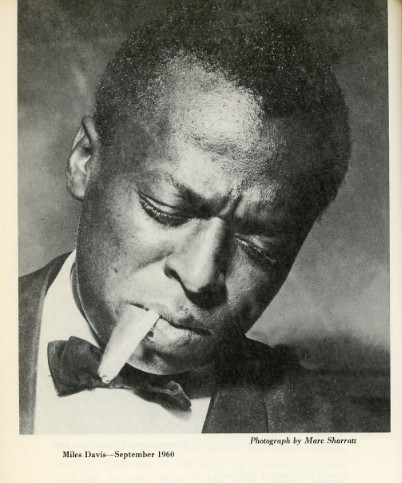

By way of background: “This new PERPETUA series, Kings of Jazz, provides authoritative introductions to the individual masters of traditional and modern jazz who have become legends in the field. The series has been designed for the jazz lover, and each volume has been written by an expert on his subject. These books include notes on the musician's life, early career, and influence, as well as a selected discography and a number of photographs. Bob Dawbarn wrote in The Melody Maker-. "This admirable new series fills a great need in the ever-increasing library of jazz literature. At last we are to have intelligent and authoritative jazz books at a price within the reach of every student of the music." Other titles in the Kings of Jazz series include: Duke Ellington, Bessie Smith, Dizzy Gillespie, Bix Beiderbecke, Louis Armstrong, Fats Waller, Charlie Parker, King Oliver, and Johnny Dodds.”


The back cover annotation goes on to say: “Miles Davis, the subject of this volume, is presently in the mid-stream of a controversial trumpet-playing career that has developed with a single-mindedness untouched by fashion or the lure of monetary gain. While the promise of his future is abundant, his talents have already had an enduring effect on jazz development as a whole. Attracted long before his twentieth birthday by the new form of jazz then being pioneered by his seniors, he matured within the bop idiom to develop a style of improvisation that was clearly his own. He has become an acknowledged leader of contemporary jazz thought, with a body of recorded work to his credit that corroborates the justice of this general view.”


Here’s the Part 4 conclusion of Michael extended essay on Miles’ career up to 1961:


“The recording dates which produced the first of the albums on which Miles Davis and Gil Evans worked together in the late nineteen-fifties were held during May 1957. The record was eventually issued under the title of Miles Ahead. It consists of ten different pieces by various writers, including Ahmad Jamal, Dave Brubeck, and Johnny Carisi, assembled as a whole, with connecting notes or chords between one track and the next; although Evans himself contributed but a single composition—Blues for Pablo —he was responsible for all the arrangements, and his individual touch ensures that the collection offers an impressive degree of unity. The very nature of Evans's approach to the problems of arranging means that these pieces lack the rhythmic richness and vitality which abound in the Davis quintet's music, but in compensation they offer considerable harmonic appeal. The warmly lyrical tone Davis achieves on flugelhorn fits in perfectly with the orchestral textures; it is obvious on first hearing that it was a very wise decision which led him to forsake his usual instrument for this occasion, since the abrasive quality of his high-register trumpet work would probably have clashed uncomfortably with the voicings Evans devises. It is true that in the course of a second collaboration of this kind when the material used comprised themes from George Gershwin's Porgy and Bess, Davis did indeed play trumpet on several tracks. However, the latter album often presents him as a soloist over and against a scored backdrop, rather than as a closely integrated voice in the general musical scheme, as is definitely the case with the Miles Ahead record. Comparison between My Ship and Summertime, each to some extent typical of its companion pieces, clarifies the difference between the two collections.


Since our immediate concern is with Davis's part in these undertakings, there is no point in going into their subtleties at any length, for it is Evans who must take the lion's share of the credit for the finished effect, in so far as he wrote all the arrangements and presided over the sessions at which the recordings were made. Nevertheless, if we are to judge by Davis's public pronouncements, he was very enthusiastic about cooperating with Evans in their production, and they show a facet of his musical personality which any comprehensive appraisal of his work must take into account. More convincing than most of his small-group ballad renditions, though cast in a similar emotional mould, they more often than not find him dealing in a wistful tenderness which has its own peculiar charm. 


The irony which creeps in with It Ain't Necessarily So is far from characteristic, and it is very noticeable that the sour and aggressive overtones of his medium and rapid tempo quintet or sextet performances are altogether absent. Here, it seems to me, is the reason why Miles Ahead and Porgy and Bess were accepted by the public at large, as distinct from the hard core of enthusiasts who had for some years previously bought most of the records issued under the trumpeter's name. It is no particularly original observation that the casual listener prefers not to be reminded of the dilemmas which face the artist in our society, and if the albums under discussion convey, first and foremost, an atmosphere of serenity and elegance, then this, we may he sure, is something of an asset from the commercial standpoint.


I trust nobody will infer from the above remarks that I wish to equate high sales figures with artistic poverty, for about such matters there can be no hard and fast rules, even under the present conditions of mass entertainment. Evans's collaborations with Davis, as I have already remarked, possess indisputable merits: his manipulation of the various instruments at his disposal bears witness not only to true originality on his part, but also to a remarkable flair for establishing a mood by sheer quality of sound alone. Here, I feel, we touch upon the essence of his achievement. 


The best of his records represent the phenomenon which in recent years has come to be known as 'mood music’ at its highest level. He can present interesting individual textures of sound in a formal framework of some strength; but rarely can he evoke, even with a soloist of Davis's powers at his disposal, that exhilarating sense of emotional release which characterizes the trumpeter's finest small-group performances. Working in what is more or less a jazz context, using techniques that at times recall Duke Ellington, he has at his command only the faintest echo of Ellington's rhythmic understanding. Intent on harmonic and textural invention, he pays little attention to the cardinal quality of swing. It is no exaggeration, in fact, to say that he willingly sacrifices it at the altar of his first loves, a point that is borne out by the reticence of such excellent drummers as Art Taylor and Philly Joe Jones on the records made under his direction. With the issue of Sketches of Spain, which contains the results of these two men's most recent collaborations in the studio, it has become quite clear that Evans's strength is also his weakness, and that the same gift which allows him to express with such persuasive accuracy the allied feelings of sadness and nostalgia debars him from transcending these moods to arrive at a bold artistic statement. In these records we can discover the virtues of sensitivity and grace, but with one or two exceptions, the necessary backbone seems to be missing. Beautiful invertebrates, Evans's creations seldom lift their heads far above the ground.


Miles Davis had been something of a fixture at the Cafe Bohemia Club in Greenwich Village during 1957, except for a brief period when he underwent throat surgery; but at the close of the year he made a short trip to Paris in order to record the soundtrack for Louis Malle's Ascenseur Pour L'Echafaud. Inspired, it seems, by the simultaneous projection of the film on a screen in the recording studio, Davis provided an unfailingly apt commentary on the vicissitudes of the action. The collection is certainly superior to the album he made for Blue Note shortly after his return to New York. Though issued under Cannonball Adderley's name, this record is clearly dominated by his current employer, whose incisive choruses on Somethin' Else, the title piece, and One For Daddy-o make the altoist sound a discursive soloist in comparison.


In January 1958, John Coltrane rejoined Davis's group, having played with Thelonious Monk during the preceding summer. Adderley remained, so that Davis was now leading a sextet, and it was this band which recorded for Columbia some three months later [Milestones]. The atmosphere of cohesion that had been so striking an aspect of the group's work when Coltrane had previously partnered Davis is by no manner of means so striking, but some excellent solos are to be heard, and the rhythmic support is perfection itself. The trumpeter takes his best sequence of choruses in Sid's Ahead, a blues he had recorded in 1954 under the title of Weirdo, and a near relation to Walkin’. He performs with masterly precision, making every note tell, and generally using runs only to lead up to a sustained note. Adderley's task in having to follow a statement of such raw intensity is unenviable, and he fares no better than on the Blue Note session.


If no other evidence were at hand, this astonishing solo would be proof enough that Davis had learnt how to refine his style without weakening its substance; but with the departure of Red Garland, the band's character altered to some degree, with more emphasis being placed on a subdued mode of expression. “Especially when he started to use Bill Evans, Miles changed his style from very hard to a softer approach. Bill was brilliant in other areas, but he couldn't make the real hard things come off,” Cannonball Adderley has said. [Jazz Review, May 1960]. Evans spent eight months with Davis in 1958. His residence in the band coincided with two other important changes. The first has to do with a shift in the leader's musical sensibilities. During 1958 he seems to have been strongly attracted by the idea of basing his improvisations on a scale rather than a harmonic sequence. His phrasing grew sparer, the rests in his melodic line more prolonged. The second was Philly Joe Jones leaving the group, and his eventual replacement by Jimmy Cobb, a steady drummer possessed of a crisp swing but lacking the immense verve, imagination and technical resources of his predecessor. All three of these factors  —  the advent of Evans and Cobb, together with the evolution in Davis's views — were clearly interdependent, and their influence is keenly felt in the music which may he heard on Kind of Blue, a collection containing performances recorded at two sessions held in March and April of 1959.


This album, the only one to he issued of Davis's small-group work since Milestones, which was done about twelve months previously, represents a new departure in his musical thinking. One of the pieces it contains, Flamenco Sketches, is cast in 6/8 time, whilst other selections find the leader and his men constructing their improvisations with a scale, rather than a given chord sequence, in mind. All Blues, for example, is a calm, reflective performance in which each soloist wends his way expertly through five different scales in turn. It says much for the maturity and group feeling of the musicians that none loses his grip on the direction of his solo, despite the wide melodic choice with which he is faced. Bill Evans is especially good here, doubtless because the style of interpretation is eminently well suited to his capabilities. It is significant that on Freddie Freeloader, a more conventional mid-tempo blues, Davis saw fit to use Wynton Kelly at the keyboard. A less personal improviser, Kelly is a model accompanist for this type of number, and his presence explains in part why the track contains the leader's most cohesive solo of the album, a gripping, intense sequence which proves that Davis still finds ample inspiration in the more normal harmonic approach. 


Flamenco Sketches, All Blues and So What are interesting, often absorbing, but this performance, together with Blue in Green, a minute exploration of the inner recesses of melancholia, emerge as the highlights of the set. When one muses upon the very high standard the group attains both on this album and Milestones, it seems almost an impertinence on the part of those responsible that these two collations, supplemented by three rather less impressive renditions, should make up the entire catalogue of Davis's recordings with his regular group over the past three years. One hopes that other sessions have in fact been held in the Columbia studios and that in the fullness of time their fruits will be made available. Although the band has undergone one or two personnel changes over the past year or so, Adderley having left to form his own group in September 1959, and Coltrane having done likewise, with the same end in view, a few months later, the trumpeter has had no difficulty in maintaining a regular unit, thanks to a measure of popularity which must be unprecedented for a jazz musician over the past two decades. Currently he is leading a quintet which comprises Sonny Stitt on alto and tenor saxophones, and a rhythm section composed of Wynton Kelly, Paul Chambers and Jimmy Cobb. At the present writing the band is about to embark on a British tour. This event will give local enthusiasts a unique opportunity of evaluating Davis's present musical approach to their own satisfaction.


The same wave of acclaim that has brought economic security within Davis's grasp  —he is reported to command fees in the region of $2,500 for one night's work and to possess $545,000-worth of stocks and shares — has inevitably been accompanied by the type of vulgar publicity usually reserved for popular entertainers such as Frank Sinatra or Johnny Ray. What is very curious is that so much that has been written about him turns upon his supposed antipathy to the people who pay to hear him. Perhaps because of the equivocal relationship that must always exist in an unintegrated society between a coloured performer and a predominantly white audience, Davis has made a point of refusing to acknowledge applause. Furthermore, very rarely will he announce the titles of the tunes his group plays, nor does he remain on stage whilst another musician is soloing. 


As a result, the trade Press is forever receiving letters from indignant customers who regard themselves as insulted by his behaviour. More surprisingly, many of the reports devoted to his club appearances by these same journals are concerned first and foremost with his bearing on and off the stand, often passing over the music proper with a brief phrase or two. Strangely enough, none of this publicity has proved to be as adverse as might have been supposed, and the anecdotes that abound regarding his hostility to employers and enthusiasts alike seem indirectly to have swollen his bank balance rather than depleted it. 


Although Davis maintains that he conducts himself with the best possible intentions and is anything but disdainful of the audience, one might be forgiven for supposing that he finds it extremely lucrative to perpetuate this image of himself as an arrogant outsider. However, the situation is not quite so simple as that. Since he was arrested and beaten up by police outside Birdland in August 1959, a violation of his rights as a citizen which would appear to have absolutely no justification, he is rumoured to have grown more irritable and short-tempered than ever, and many reports have it that his attitude is governed by a kind of reverse racial prejudice, though this, once again, he vehemently denies.


The degree to which attention has been focused upon Davis's stage presentation, or lack of it, reveals just how closely jazz is bound up with the mechanics of the popular music industry. Anecdotes about jazz musicians are still eagerly seized upon by record collectors, not so much for the extra light they throw on the music itself as for their entertainment value as novelties, in much the same way as countless people live out a surrogate existence by way of the daily newspaper gossip columns. In such a context it is hardly surprising that comment on Davis's recent musical activities has been at a premium.


It is to my mind undeniable that since Davis has achieved the kind of popularity enjoyed by such diverse musicians as Dave Brubeck, John Lewis and Gerry Mulligan, only a certain proportion of his records have been marked by the emotional intensity which characterized the whole of his output from 1950 to 1955. His technique, agreed, has grown a good deal surer. Though he still makes mistakes, generally in the higher register, they are far less frequent than in the past. Powers of execution, however, are only incidental to the point I am intent on making; if accuracy were a prerequisite of the successful jazz performance, neither the Armstrong Hot Five nor the Parker Quintet records could be regarded as milestones in the idiom's development, though this is what they very obviously are. Armstrong's occasional fluffs and Parker's recurrent squeaks are minor matters in the final analysis. 


Similarly, if Davis's 1951 recording of My Old Flame is compared with the version of Stella By Starlight done seven years later, it will be evident that the latter contains far fewer technical errors, if indeed any at all; but from the standpoint of melodic interest, rhythmic diversity, and — most vital of all — emotive power, the earlier selection is very clearly the better one.


Fortunately enough, the deterioration has been only partial and it is hard to see how anyone could unreservedly agree with the anonymous drummer who declared that 'a certain vitality isn't there any more. He lives a pretty lush life and his music gets kind of lush'.[Playboy Magazine, August 1960]. Whilst he has latterly tended to deal in moods less aggressive than before, the best of his records in this vein, such as Blue in Green or Summertime are every bit as convincing in their own way as Airegin or Tune Up, hard-driving performances done with his 1956 band. Whilst it seems probable that the comfortable existence he is now able to lead, in common with the more strictly musical factors already mentioned, has affected his choice of style, only at times, to judge at least from the records he has made, does he fall short of the artistic standards he established prior to emerging as a popular performer.


Only the very rash would care to predict what road Davis will take in the future, for at the present writing it is plainly impossible to know whether he will press on to an even sparer style of phrasing, or whether the influence of Sonny Stitt, currently working in his quintet, will cause him to lay more stress on rhythmic drive and melodic complexity. Yet wherever his alert musical spirit leads him, there is no gainsaying the fact that his talents have already had an enduring effect on jazz development as a whole. 


Attracted long before his twentieth birthday by the new form of jazz then being pioneered by his seniors, he matured within the bop idiom to develop a style of improvisation that was clearly his own, though based on the doctrines introduced to jazz by those who had originally inspired him. Over the past ten years he has worked to extend the range of his talents. The body of music he has produced during that time is extremely diverse, not only in feeling, but also in its formal character, yet this diversity in no way impugns the individual character of his work. His creative impulse has induced him to seek out new modes of  expression whenever he felt they were needed, irrespective of prevailing fashions. It is most encouraging to reflect that his artistic growth may yet take unsuspected directions.” [“Unsuspected directions” is an understatement in terms of the subsequent development of Miles' career over the next 30 years until his death in 1991].


Tuesday, January 11, 2022

Miles Davis - Kings of Jazz Series - by Michael James - Part 3

 © Copyright ® Steven Cerra, copyright protected; all rights reserved.


By way of background: “This new PERPETUA series, Kings of Jazz, provides authoritative introductions to the individual masters of traditional and modern jazz who have become legends in the field. The series has been designed for the jazz lover, and each volume has been written by an expert on his subject. These books include notes on the musician's life, early career, and influence, as well as a selected discography and a number of photographs. Bob Dawbarn wrote in The Melody Maker-. "This admirable new series fills a great need in the ever-increasing library of jazz literature. At last we are to have intelligent and authoritative jazz books at a price within the reach of every student of the music." Other titles in the Kings of Jazz series include: Duke Ellington, Bessie Smith, Dizzy Gillespie, Bix Beiderbecke, Louis Armstrong, Fats Waller, Charlie Parker, King Oliver, and Johnny Dodds.”


The back cover annotation goes on to say: “Miles Davis, the subject of this volume, is presently in the mid-stream of a controversial trumpet-playing career that has developed with a single-mindedness untouched by fashion or the lure of monetary gain. While the promise of his future is abundant, his talents have already had an enduring effect on jazz development as a whole. Attracted long before his twentieth birthday by the new form of jazz then being pioneered by his seniors, he matured within the bop idiom to develop a style of improvisation that was clearly his own. He has become an acknowledged leader of contemporary jazz thought, with a body of recorded work to his credit that corroborates the justice of this general view.”


Here’s a Part 3 continuation of Michael extended essay on Miles’ career up to 1961:


“By the late spring of 1955 Davis had evidently formed a fairly good idea of the kind of group he wished to work with regularly, because the band which recorded under his name on 7 June differed in only two respects from the quintet he was to lead from the autumn of the same year until the spring of 1957: Oscar Pettiford played bass and there was no saxophonist to partner the leader in the front line. The rhythm section attains a high standard but Davis himself is not at his best, although there are some attractive trumpet passages on Green Haze, a slow blues, and A Gal in Calico. For much of the time he sounds dispirited. The familiar bugbear of faulty intonation partly explains this undesirable state of affairs, aggravated in one or two cases by a questionable choice of themes. Night in Tunisia will always be associated in the majority of enthusiasts' minds with the virtuoso displays of Dizzy Gillespie and Charlie Parker. This version is almost dull in comparison, and exposes Davis's relatively limited range; the break he improvises after the opening theme statement sounds especially unadventurous.


If the fruits of this session were, in the main, disappointing, they are nevertheless interesting for the ways in which they foreshadow his future development. The chief of these concerns the relationship between his phrasing and the basic metre. I have already remarked that throughout most of 1954 he appeared to have been playing just a trifle behind the beat; it would also be true to say that the time-lag, infinitesimal as it was, seemed altogether regular. Now, however, the link between phrases and beat has grown less strict, and there is greater rhythmic freedom in his improvising, but, inevitably, less swing. With a rhythm section as relaxed and as powerful as this one behind him, the last point is comparatively academic, for although Davis's playing, considered apart, can barely be said to swing at all, the listener is not aware of any such shortcoming in the work of the quartet as a whole. It might be mentioned in passing that the drive — or forward momentum — of his playing is  not being impugned. I am talking purely of swing, a sensation which is not susceptible to even the most cursory verbal definition, but which will be readily understood by anyone acquainted with the music of the great jazzmen of the past four decades.


It was not with his quintet, nor indeed with this embryonic version of it, that Davis made his mark at Freebody Park in July, but with a motley group which had been, thrown hastily together, as is so often the case on gala occasions. For the record, it comprised, in addition to Davis, Gerry Mulligan, Zoot Sims, Thelonious Monk, Percy Heath and Connie Kay. There seems little reason to believe that he excelled himself; it is far more likely that his unexpected acclamation by those present was merely yet another case of the jazz audience suddenly becoming aware of talent that had hitherto been concealed from it for lack of publicity.


Not until late October did Davis's new quintet make its first records, but in the interim he took part in two sessions, the first for Debut with a band which was obviously dominated by Charlie Mingus, although the trumpeter's name appears as leader on the label, and the second with a pick-up group for the Prestige company. The Debut album may be safely overlooked, for although Davis is his characteristic self from the tonal viewpoint, he sounds ill at ease and evinces little melodic inventiveness. It may be that he felt inhibited by the framework within which he was obliged to work, since the extended performances for Prestige [LP 7034] find him in far more confident form. McLean is disappointing, but Davis, Milt Jackson and Ray Bryant all play brilliantly, aided by Percy Heath and Art Taylor. Subdued yet swinging, the rhythm section complements Davis to perfection on Changes., where his muted solos, the very epitome of tenderness, overshadow even Jackson's fleet choruses.


If one were to take these two recording dates as a guide to Davis's reaction to an arranged setting, it would appear that pre-set routines were inimical to his style; but as the Capitol records of 1949 and 1950 and those made for Blue Note in 1952 and 1953 had previously shown, this was not the case when he himself was able to dictate the form these routines were to assume. 


This important distinction was now to be stressed yet again by his new quintet, which worked regularly for some eighteen months with an unchanged personnel, and was thus able to develop ensemble techniques that were out of the question with a group assembled for a single record session or a short run of a week or so in this or that jazz room. These techniques concern not so much the relationship between the two wind instruments,  though arranged passages, of course, there were, as the interplay between the solo horn and the various members of the rhythm section. 


I have already spoken of this subject in discussing Davis's records of the early nineteen-fifties, and have pointed out the important role played by the drummer, who was often responsible not only for implementing the beat but also for enriching the polyrhythmic content of the music as a whole. 


Continuous employment was now to give Davis the opportunity of amplifying this procedure in a number of intriguing ways, but before going on to examine actual instances, it will be instructive, I think, to consider the styles of the men he chose when assembling his band. A brief digression of this kind will help to explain the success of the major part of the quintet's recorded work and will also illuminate Davis's perceptiveness as a bandleader, an aspect of his talent which economics had hitherto obscured.


It was widely rumoured that he would have liked Sonny Rollins to join him, and there is little reason to doubt this, for he had frequently used him in the past when engagements had been forthcoming. Rollins, however, spent most of 1955 studying in Chicago, and presumably felt that the time was not ripe for him to accept Davis's offer; he eventually went with Max Roach instead, replacing Harold Land in the drummer's group. In his place the trumpeter chose John Coltrane, a Philadelphian who had been with Dizzy Gillespie's big band in the late nineteen-forties and had since appeared with Eddie Vinson and Johnny Hodges. 


Ever since his stay in the altoist's quintet Davis had preferred to work with saxophonists whose playing reflected Parker's ideas, perhaps because he felt that their multi noted flights made an interesting contrast with his own rather spare phrasing. Coltrane, who had also been influenced by Sonny Stitt and Dexter Gordon, fulfilled this condition in no uncertain way. At this time he was a relatively immature stylist, his harmonic researches leading him to employ a greater number of notes than he eventually found to be necessary, but whilst some of his solos with Davis in 1955 and 1956 were to sound rambling and incoherent, he made an exceptionally good foil for the leader, and his use of phrases of uneven length was in full accord with the asymmetrical nature of the group's music.


On bass Davis chose Paul Chambers, a young Detroit musician who had quickly made himself a reputation in New York jazz circles through his work with George Wallington, with whose quintet he appeared at the Café Bohemia in September. His harmonic sense was nothing short of exceptional; his tone was satisfyingly full, and — an important point where his work with Davis was concerned — he was able to create distinctive melodic lines; even when primarily concerned with stating the beat, the intervals he chose were always attractive to the ear. Philly Joe Jones, who was at the drums, had gained much of his experience in rhythm-and-blues bands. Possessed of enviable stamina and a driving swing, both doubtless acquired in this demanding field, he had also formulated by 1955 a style of accompaniment which was decidedly original, though deriving in part from Max Roach, with whom he had previously studied on an informal basis. Now that Davis's phrasing had grown freer of the beat, it was essential the qualities of drive and swing be abundantly present in his accompaniment, and it was because he recognized these so clearly in Jones's playing that his admiration for the drummer knew no bounds. 'Look,' he once said, ‘I wouldn't care if he came up on the bandstand in his B.V.D.s and with one arm, just so long as he was there. He's got the fire I want. There's nothing more terrible than playing with a dull rhythm section. Jazz has got to have that thing.'[Esquire Magazine, March 1959.] Just as vital in the context of this band was Jones's gift for elaborating the melodic line. He had at his command a rich variety of devices for doing this, and his exemplary volume control and uncanny anticipation enabled him to make the unexpected accent sound not only logical but inevitable. At times he would perform at a near contrapuntal level with the soloist, and in view of the prolix nature of his accompaniment it is clear that Davis made a wise selection in the Quintet's pianist. 


Instead of complementing trumpet tenor or bass choruses with the filigree melodies of an Al Haig, Red Garland restricted himself to spurring the soloist on with a series of hard, percussive chords. In this way he avoided obscuring the detail of the drummer's commentary yet still contrived to enrich the harmonic and rhythmic interest of any given performance. It seems likely that it was above all his skill in this sphere which recommended him to Davis, for his solo work, though showing great craftsmanship, is rarely so absorbing as one would wish. Immature and unfinished Coltrane's style certainly was at this time, but his contributions hold more interest than Garland's. On repeated hearings the piano solos tend to sound mechanical, partly because they are so often divided neatly into two halves, the first consisting of single-line improvisation over left-hand punctuations, the second made up of an unrelieved sequence of chordal patterns similar to those used by George Shearing or Erroll Garner. No one would contest his swing or sound musical knowledge, but a large proportion of his solos recorded with Davis lack the inventiveness of his playing, say, on Traneing In, which was recorded in August 1957.


During the year and a half or so of its existence, the quintet made records for both the Prestige and Columbia companies. Those issued by the former concern were done at three extended sessions held in November, May and October, the group playing a selection from its repertoire as though it were making a normal club appearance. A greater number of recording dates were held under the aegis of Columbia, but these brought forth fewer sides, which suggests that greater attention was paid to precise interpretation, the final choice for commercial release being made from several different versions of the same theme. Such methods very often entail a loss in spontaneity, and there is no doubt that the band sounds more subdued on its Columbia records. It would not do, however, to lay too heavy a stress on this difference, for it derives in part from the divergence in recording, the Prestige albums possessing far better definition than the others. Many Columbia issues from this period are similarly at fault; the rhythm sections are recorded most unsatisfactorily, as with the albums by Art Blakey's

Jazz Messengers. In practice, though, the principal split in the body of the quintet's recorded work was not between the records made for Prestige on the one hand and Columbia on the other, but between the ballad renditions and the medium or fast tempo pieces.


There Is No Greater Love, Bye Bye Blackbird and All of You typify a style of ballad playing which Davis has used widely in recent years, both with the band at present under discussion and its successors. The pattern is a fairly simple one: the melody is stated by trumpet in mute followed perhaps by a further passage of muted trumpet, Davis never straying far from the theme, before solos by Coltrane and Garland lead up to a final chorus, similar to the first. Performances of this kind made scant use of the group's artistic potential and when heard consecutively sound rather stylized, as though Davis and his band were going through a familiar routine. This is especially true of the leader's playing, for whilst he performs in a very individual way, utilizing his tonal resources to convey an emotional climate of acute melancholia, rarely does he appear to extend himself. In Bye Bye Blackbird, it is true, we find some interesting theme development, but for the most part he is content to stay very close to the melody as written, and one is led to wonder to what extent he was making concessions to the audience. In recent years Davis has frequently been accused of assuming a contemptuous attitude towards the customers of the jazz-rooms in which he works, and it is ironic in view of this that his music should be open to this charge. However that may be, comparison between My Funny Valentine and You're My Everything, ballad renditions which do not conform to the prevailing pattern, and the bulk of his recorded output in this vein lends support to the accusation.


There can be little doubt that the quintet's records at faster tempo were the more absorbing. At first its performances generally conformed to the normal modern small-group style, the soloists improvising freely over the rhythm section. Ah-leu-cha, How Am I to Know and Sposin’ are examples of this, with Davis contributing a splendid solo to the first. Two pieces from the group's initial session for Prestige, held in November 1955, more clearly illustrated its possibilities as a unit. Just Squeeze Me has Paul Chambers fashioning a second line beneath Davis's theme statement and also finds Red Garland tacit in places, but it is above all The Theme which features exhilarating interplay between the musicians. This performance begins with a fascinating duet between Chambers and Jones. Davis then enters, sustaining high notes to good effect, but the main melodic burden is carried by Garland who sets down some rollicking piano beneath the leader's austere line before the latter comes to the fore on the bridge. Solos follow from Davis, Coltrane and Garland, with Jones providing an exciting commentary on them all. Although the saxophonist is in poor voice, his phrases in double-time muddled and badly constructed, Chambers' strong musicianship holds this section together, and one is left with the agreeable impression that adventurous as the group's conception was, the understanding which existed between its members ensured that its music was always thoroughly integrated.


The unconventional character of The Theme foreshadowed the quintet's subsequent development. If records are any guide, it is safe to say that by late 1956 such renditions were an important part of its repertoire. Oleo, Airegin and Tune Up stand out as spectacular instances of the band's style and compare favourably with its more orthodox performances such as Blues by Five or When Lights Are Low. There is no profound schism between the one approach and the other, for all five of these records score with the listener by virtue of their poly-rhythmic content; but on the first three an adept distribution of duties between the quintet's members steps up the interest already implicit in each single musician's work. In his soloing Davis maintains a high standard, using his improved technical powers to good advantage. If I Were a Bell has a characteristically intense contribution by him, whilst on Airegin he plays in an extremely aggressive way, employing phrases that are as incisive as they are rhythmically free. Nor was he ready to forgo the felicities of inflexion: his improvisation on When Lights Are Low shows that he was continuing to use this most fecund device to strengthen the communicative power of his work. The confidence he exudes at fast and medium tempi suggests that he found ample inspiration in the polyrhythmic stylings of his group, and makes a strange contrast with his subdued contributions to the ballads, which, as I have already explained, are set in far simpler form, with the rhythm section restricting itself mainly to marking out the beat.


The strength of this band resided above all in the understanding which existed between its members, for at the time Coltrane was a relatively undeveloped soloist. In ''Round Midnight, done in September 1956, he fashions a moving chorus, but on most of the quintet's records he falls a long way short of the standards he was eventually to set with Traneing In and Good Bait. It is not surprising, then, that Davis tended to be at his best when his group was working up to its full capacities as a unit.


Although this quintet had worked on a regular basis there had been times when it was inactive for one reason or another, as for instance when Davis came to Europe in late 1956; and in the spring of the following year it disbanded altogether. In the summer Davis formed a new band. Rollins was on tenor saxophone in place of John Coltrane and Art Taylor at the drums instead of Jones. Garland and Chambers, as before, completed the group. The same musicians, with the exception that Tommy Flanagan and not Garland played piano, had recorded together about a year before, and on that occasion the results had been more than encouraging; but by 1957 Rollins had developed further, and reliable authorities have it that he was dissatisfied with his position and yearned for a band of his own. In view of this it was to be expected that the new formation would not long stay together, and such indeed proved to be the case. The autumn found Davis once again signing on new men. Bobby Jaspar took over from Rollins, Flanagan joined on piano, and Philly Joe Jones returned. Jaspar, featured on both flute and tenor, soon left, replaced in October by Julian Cannonball Adderley, who joined the group during the course of a concert tour. 


No records have been issued by any of these transitional groups, and indeed it is probable that none, in fact, were made, perhaps because of the frequent changes in personnel. Yet such hardly seems a satisfactory explanation when one considers that by 1957 Davis was a very popular figure with enthusiasts at large. His contract with a business corporation such as Columbia was now to consolidate his status with the jazz public, not only by way of small group recordings, but, more significantly, through a series of orchestral sessions held under the direction of Gil Evans, one of the arrangers who had been concerned in the mounting of the nine-piece group he had led at the Royal Roost in 1948.”


To be continued and concluded in Part 4.


Sunday, January 9, 2022

Miles Davis - Kings of Jazz Series - by Michael James - Part 2

 © Copyright ® Steven Cerra, copyright protected; all rights reserved.


By way of background: “This new PERPETUA series, Kings of Jazz, provides authoritative introductions to the individual masters of traditional and modern jazz who have become legends in the field. The series has been designed for the jazz lover, and each volume has been written by an expert on his subject. These books include notes on the musician's life, early career, and influence, as well as a selected discography and a number of photographs. Bob Dawbarn wrote in The Melody Maker-. "This admirable new series fills a great need in the ever-increasing library of jazz literature. At last we are to have intelligent and authoritative jazz books at a price within the reach of every student of the music." Other titles in the Kings of Jazz series include: Duke Ellington, Bessie Smith, Dizzy Gillespie, Bix Beiderbecke, Louis Armstrong, Fats Waller, Charlie Parker, King Oliver, and Johnny Dodds.”


The back cover annotation goes on to say: “Miles Davis, the subject of this volume, is presently in the mid-stream of a controversial trumpet-playing career that has developed with a single-mindedness untouched by fashion or the lure of monetary gain. While the promise of his future is abundant, his talents have already had an enduring effect on jazz development as a whole. Attracted long before his twentieth birthday by the new form of jazz then being pioneered by his seniors, he matured within the bop idiom to develop a style of improvisation that was clearly his own. He has become an acknowledged leader of contemporary jazz thought, with a body of recorded work to his credit that corroborates the justice of this general view.”


Here’s a Part 2 continuation of Michael extended essay on Miles’ career up to 1961:


“It is no coincidence that the most successful recordings Davis made in 1947 and 1948 were those in which the personal flavour was most marked. Agreed, there are indications that he admired Navarro sufficiently to adapt some of his mannerisms for his own use, but primarily he was concerned with moulding a highly original mode of expression which would not call for the same kind of technical command that had hitherto been obligatory for the trumpet soloist in the new school. Other players, such as Kenny Dorham, Red Rodney and Doug Mettome, by patterning their style more or less on the established leaders, rapidly acquired fluency in the new idiom. Davis preferred to create his own language and his progress was in consequence a good deal slower. If plagiarism was repugnant to him, he had to pay the price for his aversion to it; hence the split notes, faulty intonation and scrambled phrases that mar much of his work in the first five years  of his recorded career.


Because of the very nature of the brass instrument, it will often happen that a trumpeter plays badly on one recording session only to perform at a much higher level, say, a week or two later. Forthwith, it must be pointed out that this was definitely not the case with Davis during his tenure with the Parker quintet. Two main factors seemed to govern the standard of his solos: the tempo and the thematic material. At the very fast pace of Bird Gets the Worm or Klaunstaunce he was able, by dint of rapid fingering, to make his runs conform to the underlying beat, but this mechanical approach meant that the musical interest of his work was almost negligible. His phrases had scant melodic appeal, his note separation was exceedingly poor, there is not a vestige of swing, and the overall impression one receives is of an ill-controlled succession of sounds. What a difference we find when the pace is less demanding! It was unfortunate for the trumpeter, at least from the short-term standpoint, that Parker was so partial to extremely fast tempi. Davis's passages on How Deep Is the Ocean, All the Things You Are., and indeed most of the ballads the group committed to record, are singularly attractive. In such leisurely conditions he obviously found it much easier to think clearly. The line he creates is full of inventive twists and turns and his tone has a beauty that is all its own, admirably suited to the clear-cut phrases. When these records were first released many people were quick to brand Davis an interesting but cold and detached player, lacking the communicative power of other jazz trumpeters. The fiction was to last for almost a decade, but today even his detractors, if pressed, will most of them agree that the emotional aura of these solos is a convincing and memorable one, though it may not appeal to them personally.


Not only the tempo affected his work on these records. Its quality also depended on the type of tune being interpreted. In fact it would not be a gross inaccuracy to say that the only performances to which he contributed praiseworthy solos apart from the ballads were the medium-paced blues. There are, agreed, the inevitable exceptions to this rule; on Steeplechase, for instance, he plays a nicely ordered chorus and also makes apt use of inflexion. For the most part, though, the twelve-bar form would seem to have been the only context in which he was really at his ease when the tempo was faster than thirty bars to the minute. Air Conditioning [Drifting on a Reed], Bongo Bop and the various takes of Barbados and Perhaps all have effective passages by him. It would be foolish to imply that these solos are faultless, but his conception is not distorted to the point of anonymity by the technical weaknesses, as is the case with his work on many of the other tunes recorded by the quintet. One is reminded of a drawing where the lines are imperfectly controlled, becoming almost indistinct in one or two places, but where the artist's vision comes over convincingly in spite of the flaws.


It is clear, then, that whilst a great many of his solos on the Parker quintet records of 1947 and 1948 are mediocre in the extreme, the experience he gained with the group was most valuable to him. He had begun to refine the texture of his work, at the same time intensifying its effect. In short, he was establishing his identity as a jazz soloist. He still had much to learn, of course, both in matters of construction and technique; but it is typical of his adventurous thinking that in the immediate future he was to turn his attention to other matters, concerning himself not only with the problems of improvisation, but more especially with those of composition and arrangement.


In the summer of 1948 Davis left the Parker quintet. Earlier the same year promoters Monte Kay and Ralph Watkins, in company with disc jockey

Symphony Sid Torin, had opened a new club called the Royal Roost on Broadway. In June Dizzy Gillespie played there with his orchestra, sharing the stand with Thelonious Monk, and amongst the groups which followed them were those of Charlie Ventura, Tadd Dameron — and two units led by Miles Davis, the second of which was destined to have a far-reaching effect on small group writing. 


Appearing at the club for only two weeks, in September 1948, Davis's band comprised the unorthodox instrumentation of trumpet, trombone, French horn, tuba, alto and baritone saxophones, piano, bass and drums. The greater part of the book consisted of original tunes from the pens of George Wallington, Gerry Mulligan, John Lewis and the leader himself, whilst the arranging was handled primarily by Mulligan and Gil Evans. The band's booking lasted only a fortnight owing to lack of support, and according to Mulligan it played only one date in public, which took place at the Clique Club a year or so later. A recording ban was in force throughout 1948, but Davis subsequently managed to secure three recording sessions at which the group was recreated. Two of these were held in 1949, in January and April, and the third in March of the following year. The resulting records are of interest from a variety of standpoints, and in view of the praise which has been accorded them and the extent to which they have been identified with Davis's ideas by so many commentators, it is worth pausing for a moment to consider the events which led up to their creation.


It is beyond dispute that the Claude Thornhill Orchestra was the seed without which Davis's group would almost certainly never have come into being. Thornhill’s was first and foremost a 'society' band, and except for the war years, when its leader was in the United States Navy, had been in existence since 1939. By 1947 its personnel included young musicians such as Red Rodney, Konitz and Mulligan. Gil Evans, who had been associated with Thornhill since the nineteen-thirties when both were writing for a bandleader called Skinnay Ennis in Stockton, California, was its principal arranger, whilst Mulligan, John Carisi and Gene Roland also contributed to the library. Because of his interest in the rhythmic and harmonic aspects of bop, Evans became friendly with Charlie Parker, sharing a room with him for some time, and it was probably through the altoist that Davis made his acquaintance. There is every reason for believing that Davis found the light textures of the Thornhill band's scores to his taste, for they echoed in an orchestral context the sound for which he himself was evidently striving; and their congeniality was doubtless enhanced in the case of Anthropology, Donna Lee and Yardbird Suite, three of Parker's tunes that Evans had arranged for the band. It should be remembered, however, that such pieces were not characteristic of the Thornhill repertoire, a fact that is borne out by Evans leaving the band in 1948 in protest at its leader's preoccupation with sheer sound as against linear and harmonic activity.


According to Gerry Mulligan, the idea of assembling a group which would make use of Gil Evans's arranging skill in a setting more akin to jazz than was the case in Thornhill's orchestra, did not stem from Miles Davis. Not until rehearsals were in progress did Davis assume the leading role; for some months beforehand Evans, Mulligan, John Lewis and John Carisi had been discussing the formation of the group, mapping out instrumentations and so on. It is clear, too, that the actual question of who was to play in the band was not settled by Davis alone. His original intention was that Sonny Stitt should play alto and John Simmons or Al McKibbon bass. He did not expect that Mulligan would take part other than as a writer. Once agreement was reached on the personnel, however, and the group started to rehearse, it was Davis who dictated the style of interpretation.


On the records the group made at the three sessions I have already mentioned, Davis gets more solo space than any other musician and his tone lends the scored passages a distinctive quality; but these two points cannot obscure the fact that these are essentially ensemble performances. Almost every one has some extraordinary feature. Israel contains contrapuntal passages; Jeru has an unconventional structure and makes use of different time signatures; Moon Dreams is a fascinating textural study. Most jazz writing dates rapidly; it is pleasant, therefore, to be able to say that at ten years' remove these performances remain as absorbing an experience as ever for the listener. The impression of serenity and restraint which marks them all is as convincing today as it was when the records were first issued.


Something of the same atmosphere is evident in the trumpet solos. The sense of emotional stress apparent in Davis's playing on many of the Parker quintet records has not vanished altogether, but for the most part it is hidden beneath a cloak of restraint. Godchild, which contains an excellent solo by the leader, serves to illustrate the principal changes. He ignores the eight-bar divisions, it is true, and in this way reveals his bop training; we have already seen that he had made considerable  progress along these lines by the close of 1947. His tone, however, is considerably smoother, and he intersperses complex runs with sustained notes that are executed with a bare minimum of vibrato and attack. 


To judge from his playing on transcriptions made of the Dameron group's programme at the Paris Jazz Fair which was held in May 1949, it seems likely that his style was in a state of flux in these years, for on the Dameron recordings he performs in a very different way, using a much broader tone and more aggressive phrasing. In the circumstances it is natural that his style would depend on the immediate musical surrounds, taking its colour from them. I do not wish the reader to infer from these remarks that his work on the Capitol sides is altogether devoid of character. On the contrary, it is noticeable that it has a warmer glow about it than have the ensemble passages or even the other solos; introspective his creations may be, but they have a communicative power that is largely absent from the contributions of Lee Konitz or Gerry Mulligan. 


Apart from the chorus on Godchild, Davis is also heard to especially good advantage on Jeru, Move, Venus de Milo and Rouge, whilst on several of the other sides, such as Rocker, where his solo is interpolated in the ensemble, his playing is of interest. These sides certainly contain solos more elegantly formed than he had contrived at previous recording dates, but in some respects it was a pity that critics subsequently tended to use them as a yardstick to judge all his work, for from the standpoint of content they are by no means fully representative.


Although many musicians were enthusiastic about the original nine-piece group Davis led at the Royal Roost, public interest was not widespread enough to enable it to continue there and the trumpeter reverted to the orthodox small-group format. The recording ban ended on 15 December 1948, but its results were to plague the jazz world for many months to come. Very little instrumental music had been recorded during the time it was in force, for only the small independent labels, with the connivance of a handful of jazz musicians, had ventured to defy it. Singers, on the other hand, had made innumerable records, generally with the backing of musicians not subject to the union's decrees. As a result the public had lost any taste it may once have had for instrumental. This was no catastrophe for the studio musicians, who were naturally very soon in demand again to accompany the vocalists, but on jazz, no matter of what kind, it had a disastrous effect. Many orchestras, such as Dizzy Gillespie's, were forced to disband by early 1950, and others were severely reduced in size. Jazz musicians who would make no concessions to the public at large found it harder than ever to obtain work, and of these Miles Davis was a typical example. January 1949 found him working at the Audubon, a small New York jazz-room, with Art Blakey and Sonny Rollins; and during the spring he played in a rehearsal band that Tadd Dameron had assembled, prior to travelling to Europe with the pianist, to appear, as previously stated, at the Paris Jazz Fair. He also spent two weeks in Chicago, but apart from these engagements, some record dates and the occasional gig, he was unemployed throughout the year.”


To be continued in Part 3.