Showing posts with label Michael Owen. Show all posts

Friday, January 24, 2025

"Ira Gershwin A Life in Words" by Michael Owen: A JazzProfiles Feature

 © Copyright ® Steven Cerra, copyright protected; all rights reserved.
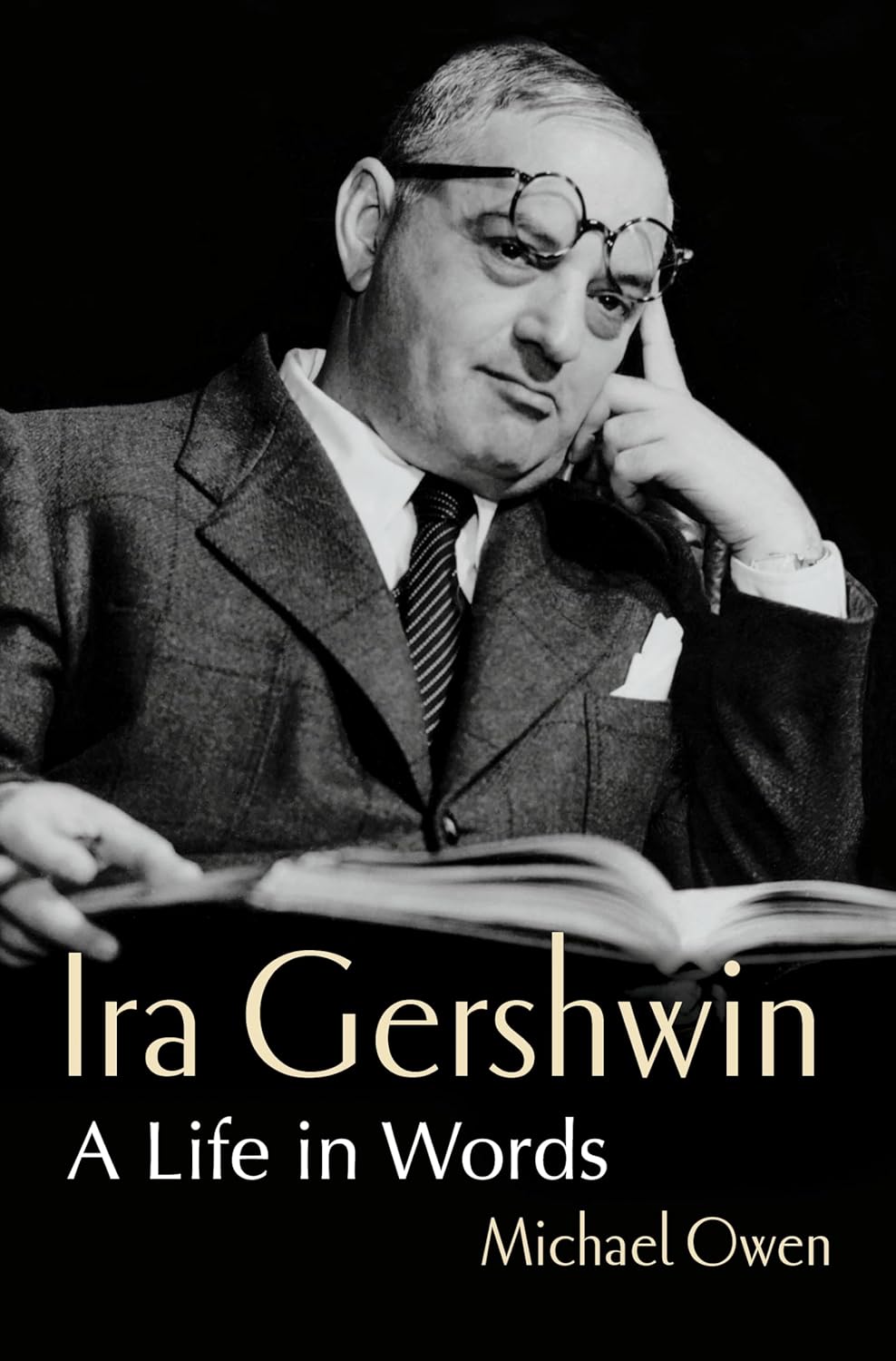


"This book is a marvel and a model of how to write resonantly and engagingly about a charming subject who was unintentionally elusive. Having personally known and adored Ira for years, I am overwhelmed by the information and detail Owen captures. I love the way he spins the tale of a greatly talented lyricist who, thanks to this book, might permanently find his proper place in the pantheon of great songwriters."

—MICHAEL FEINSTEIN, singer, pianist, founder of the Great American Songbook Foundation, and author of The Gershwins and Me: A Personal History in Twelve Songs


This is a story about a world gone by.


About a time when rhapsodic musical melodies were graced with poetic lyrics.


A time when songs were artistically composed and the words that made them memorable were created by writers with a sensitivity to language who used it to help create an enjoyable musical experience.


Not all of these songs were serious: some were whimsical; some expressed light-hearted sentiment; some were downright comedic.


But the music and the lyrics were crafted in such a way that they created feelings that reached a variety of emotions: love, happiness, longing, grief and many more.


How did these lyricized songs happen? Who did it and why?


Ira Gershwin A Life in Words by Michael Owen tells the story of one of these magical wordsmiths, a story too often overshadowed by a more renowned brother - George Gershwin.


In many ways the story that Michael tells here is one of death and resurrection.


Following George Gershwin’s death at the age of 38, Ira Gershwin is forced to begin anew. The composer is no more but the lyricist is challenged by circumstances to carry on.


The six chapters of Michael’s biography are essentially structured around the death of George in 1937: the first three with George and the last three in which Ira draws out from under the shadow of his more famous brother and becomes his own man.


By way of background, Michael Owen is a historian, researcher and served for many years as the manager of Ira’s archive. He is also the author of one of my favorite books about Jazz and popular singing - Go Slow: The Life of Julie London [2017]. He also served as the editor for The Gershwins Abroad [2024].


Obviously, with that background, who better to write Ira’s biography?


The significance of Michael’s work and its contribution to the genre of what is now generally referred to as the literature of The Great American Songbook is ably summed up in this assessment by —ANNA HARWELL CELENZA, author of Jazz Italian Style and general editor of The Cambridge Companion to George Gershwin:


"In Ira Gershwin: A Life in Words” Michael Owen offers an insightful exploration of his subject's lifelong quest for an artistic voice. Using a rich variety of archival resources — personal letters, diaries, production notes, and business correspondence — Owen documents Gershwin's tireless commitment to song-writing, from the linguistic play of his teenage years and his prizewinning successes (and failures) as an adult, to his commitment to preserving the Great American Songbook and the Gershwin family legacy in his final years. The book is indispensable for fans and scholars alike. It shines a revelatory light on the complex life of the great lyricist who lived forever in the shadow of his younger brother George."


The “artistic voice” that Ms. Celenza references comes to life with examples, description and analyses on what made Ira so special - his lyrics.


These are portrayed throughout the book in the context in which they were created. Thus we read:


Shall We Dance [1937 Astaire/Rogers film] proved that George and Ira could still write hit songs, and the score contained at least three that rank among the greatest of their storied careers.


The idea for the lyric of "They All Laughed" came from the 19205 boom in the business of self-improvement, with an extremely popular correspondence school advertisement for the US School of Music: "They laughed when I sat down to play the piano but when I started to play!" One of the lines—"They laughed at Fulton and his steamboat"—may have been borrowed from Ira's friend Groucho Marx, who reportedly made that quip to George S. Kaufman.


They all laughed at Christopher Columbus

When he said the world was round;

They all laughed when Edison recorded sound.


They all laughed at Wilbur and his brother When they said that man could fly; They told Marconi Wireless was a phony—-It's the same old cry!


They laughed at me wanting you,

Said I was reaching for the moon; But oh, you came through—

Now they'll have to change their tune.


They all said we never could be happy, They laughed at us—and how!

But ho, ho, ho— Who's got the last laugh now?


One of the cleverer ideas in "Let's Call the Whole Thing Off" was inspired by Lee Gershwin's youthful — and retained in adulthood — pronunciation:


You say eether and I say eyether, You say neether and I say nyther; Eether, eyether, neether, nyther— Let's call the whole thing off!


You like potato and I like po-tah-to, You like tomato and I like to-mah-to; Potato, po-tah-to, tomato, to-mah-to— Let's call the whole thing off!


For Ira, the key ingredient in "They Can't Take That Away from Me" was the lovely, raised note that his brother gave him to accompany the buildup to the emotion of the word "life" at the end of the song:


The way you wear your hat, The way you sip your tea, The mem'ry of all that— No, no! They can't take that away from me!

The way your smile just beams,


The way you sing off key, The way you haunt my dreams— No, no! They can't take that away from me!


We may never, never meet again

On the bumpy road to love, Still I'll always, always keep

The mem'ry of—


The way you hold your knife, The way we danced till three,

The way you've changed my life-No, no! They can't take that away from me! No! They can't take that away from me!”


Rarely are masterfully wrought lyrics such as these read. They are usually heard while listening to the song in which they are placed. In offering them to us in this manner, Michael helps us appreciate them even more.


Or as the esteemed essayist, writer and novelist Joseph Epstein explains in his Wall Street Journal review: 


“Lyricology,” as Michael Owen notes in his biography, is not an established subject, which is to say that not all that much is known about the lyricist and his work. Many popular composers — Irving Berlin, Cole Porter, Stephen Sondheim — were able to do without lyricists, writing both music and lyrics themselves. Others — Jerome Kern, Richard Rodgers, George Gershwin — found lyricists indispensable. The construction of lyrics is fraught with complications. Some composers could not write their music until they had the lyrics before them; others—George Gershwin again—wrote the music and let lyricists find words to fit the music. 


The lyrics of the songs of what came to be known as musical comedy — featuring romance, colloquial speech, street slang—may indeed be the true American poetry. They were written by, among others, Yip Harburg, P.G. Wodehouse, Cole Porter, Irving Berlin and Ira Gershwin. As for the job of lyricist, it is perhaps best described by Ira Gershwin himself: “Given a fondness for music, a feeling for rhyme, a sense of whimsy and humor, an eye for the balanced sentence, an ear for the current phrase and the ability to imagine oneself as a performer trying to put over the number in progress — given all this, I would still say it takes four or five years collaborating with knowledgeable composers to become a well-rounded lyricist.” 


On the precariousness of the lyricist’s job, Ira wrote that it requires “a certain dexterity with words and a feeling for music. . . the infinite patience of the gemsetter, compatibility with the composer and an understanding of the various personalities in a cast.” Difficulties invariably arise. Songs one loves are canceled from shows, some performers insist on alterations in what one has written, others perform them poorly, the whims of producers are weighed, disputes over royalties emerge, entire shows are closed down for want of public taste.” 


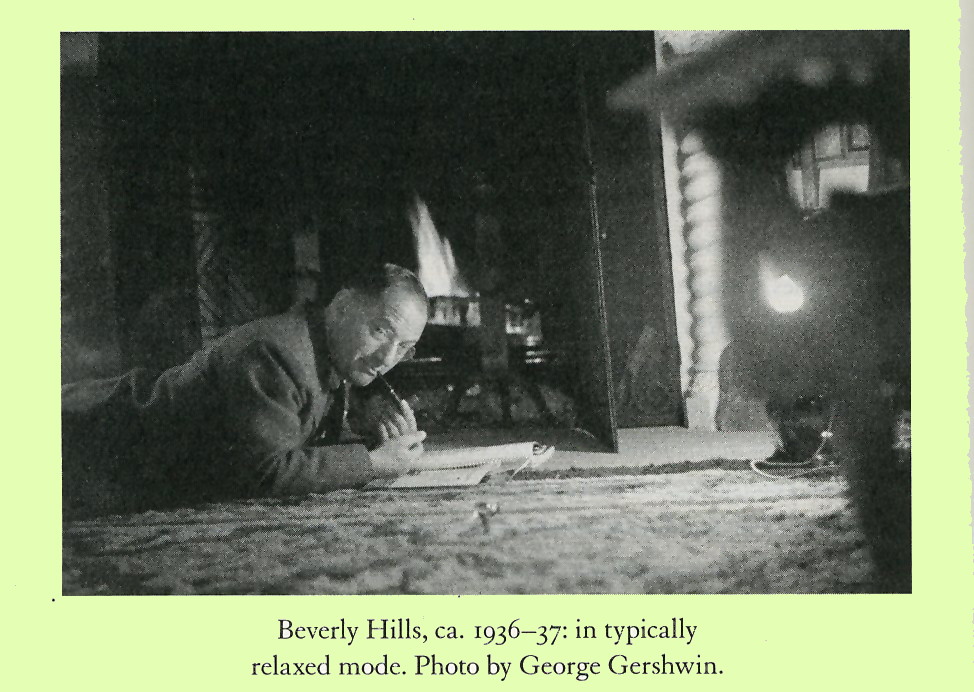
The slow and deliberate process of lyricology is reflected in this photograph of Ira laying before a fire in his Beverly Hills home, pipe in mouth, pen in hand and, assumedly, blank notebook before him.


As you read through Michael's richly detailed biography replete with anecdotes, jokes, and example lyrics, the reader comes to understand what Alexandra Jacobs meant when she wrote the following in her New York Times review of his work:


"Owen gives this perpetual supporting player an infusion of main-character energy. He succeeds. Ira Gershwin: A Life in Words is dignified but not starchy, efficient but not shallow, and honest about grief's unrelenting toll. . . . Owen captures elegantly his survivor guilt, flying home for the grand funeral of his brother . . . . George Gershwin's presence in this book is not only spectral; it's almost holy . . . .


Life's plodders can be as interesting and amusing, in their way, as the sprinters. . . . You feel deeply for the oldest Gershwin brother, who tended George's legacy like a faithful gardener."


Returning to Joseph Epstein who beautifully summarizes the reading experience of Michael’s Ira Gershwin biography:


"The reader comes away from Mr. Owen's Ira Gershwin: A Life in Words with a strong appreciation for all that the craft of the lyricist entails. . . .More important, at the close of Mr. Owen's biography one feels that one knows Ira Gershwin — knows him and likes him. In these pages we learn what the world thought of Ira Gershwin, what his co-workers and family thought of him, and, through Mr. Owen's careful mining of his subject's letters and diaries and pronouncements, what he thought of himself."


This concluding statement is drawn from the publisher WW Norton’s press release:


“The Pulitzer Prize-winning American lyricist Ira Gershwin (1896-1983) has been hailed as one of the masters of the Great American Songbook—songs written largely for Broadway and Hollywood from the 1920s to the 1950s. Now, in the first full-length biography devoted to his life, Ira Gershwin steps out at last from the long shadow cast by his younger and more famous brother George.


It's a life with a sharp dividing line; we witness Ira's transformation by George's death at thirty-eight. From carefree dreamer and successful lyricist, he becomes guardian of his brother's legacy and manager of complex family dynamics, even while continuing to practice his craft with composers like Harold Arlen and Jerome Kern.


Drawing on extensive archival sources and often using Ira's own words, Michael Owen offers a rich portrait of the modest man who penned the words to many of America's best-loved songs.” For order information, go here.


Sunday, October 20, 2024

Go Slow - The Life of Julie London by Michael Owen

© -Steven Cerra, copyright protected; all rights reserved.


"Beautifully crafted and stunningly researched, this entertaining biography of Julie London reminds us of why she matters, now and for always. It is a great read!"
— Michael Feinstein, singer and entertainer


"Go Slow offers us a long-awaited, highly detailed look at a neglected jazz and
pop singer who has always been worthy of greater recognition and attention.
The author provides lots of new information and historical context, while, to
his credit, resisting the temptation to make outrageous claims for his subject.
I learned a lot that I didn't know and it made me want to hear more."
-Will Friedwald, author of Stardust Melodies and Sinatra! The Song Is You


"Michael Owen tells the unique story of a singular talent and reluctant
celebrity with dispassionate appreciation, weaving personal life and
professional history into the tale of a woman who was steadfast in her
personal passions and career path without the ego and ambition that drives
so many other singers and actors. Neither sycophant nor assassin, Owen
deftly chronicles Julie London's life with both empathy and objectivity."
— Michael Cuscuna record producer, writer, and discographer


"Go Slow is a sensitive, informative biography, inviting the reader to
discover Julie London's unique and solitary contribution to the history
of American music. With an ear for tone and an eye for story, Michael
Owen leads us seamlessly through a life fashioned for style, revealing
an instinctive range where just enough sound can occupy a space,
exploiting every lyrical nuance along the way.


"As Go Slow discloses, through years of struggle and turmoil, an irony
was born that would further distill some of Julie's finest work as an interpreter of popular song. Esteemed jazz vocalists and musicians loved
and respected her. A generous spirit to her family and friends,Julie
London was one grand dame and there will never be anyone like her.


Thanks to Michael Owen, we begin to understand why."
— Kevin Tighe, actor, Emergency!


In his essay for the July 31, 2017 edition of The Wall Street Journal entitled The Versatile Robert Mitchum, Peter Tonguette shares that:


“Filmmaker Peter Bogdanovich once asserted that movie stars were not far removed from the gods and goddesses of Greek mythology. “They were no longer actors playing parts,” Bogdanovich wrote in his 2004 book Who the Hell’s in It, because all their roles merged into one definitive character, one special folk hero, similar to but not necessarily identical with the original mortal.”


Stars usually displayed a finite series of easily identifiable attributes — not unlike Greek deities who stood for particular virtues or vices. Think of Cary Grant’s breezy poise or Jimmy Stewart’s sputtering sincerity, qualities that neither performer deviated from too often.”


If we expand Bogdanovich’s analogy to include the late actress and song stylist, Julie London, then perhaps the best mythological comparisons would be with the Greek Goddesses Aphrodite [Venus] and Erato.


Aphrodite (/æfrəˈdaɪti/ af-rə-DY-tee; Greek: Ἀφροδίτη Aphrodite) is the Greek goddess of love, beauty, pleasure, and procreation. She is identified with the planet Venus; her Roman equivalent is the goddess Venus. Erato was one of the nine Mousai (Muses), the goddesses of music, song and dance.and love and erotic poetry [later adopted by the Romans as part of their Pantheon of Gods].


But such comparisons would perpetuate the unfortunate fact that, all too often in her career, Julie London was perceived as an object of eroticism and as a chanteuse, a songstress often referred to as a “torch singer,” to the point that when she wasn’t being cast in movies and television roles that capitalized on her beautiful face, shapely figure and sultry voice she was posing provocatively on LP covers for albums filled with songs for young lovers to do what young lovers long to do.


But that was the image.


The reality of who Julie London was is much deeper than these facile and superficial portrayals.


Now, thanks to Michael Owen’s well-researched and explorative biography, we begin to see what a skilled, multi-talented entertainer Julie London was and to understand that the key to Julie’s legacy was her versatility.


One of the central facts that Michael’s book brings home is how hard Julie worked to make a career in show business. From his detailed descriptions, the reader gains an appreciation of the long hours spent in rehearsals, travels, waiting on movie sets from sunup to sundown, studying scripts, learning dance steps, practicing lyrics, dealing with agents, brokers and a host of other “intermediaries,” all of this, particularly in Julie’s case, while trying to maintain some semblance of a normal family and home life.


Michael’s sensitive and insightful biography of Julie certainly takes the glamor off an ostensibly glamorous life.


Throughout her career, Julie struggled to overcome issues of confidence, anxiety, low self-esteem, insecurity, chronic shyness and a dread of performing in public.


But despite these severe emotional and psychological “demons,” Julie got there: she realized her professional and personal goals by not giving up on herself and by benefitting immensely from the love and adoration of her soulmate, pianist and songwriter, Bobby Troup.


Through Michael’s skillful storytelling, readers are treated to an intimate look at what went into developing the creative life that was Julie London, the entertainer, while also being allow access to the family and home life that completed her as a human being.


Sadly, all too often, show business people during this era led personal lives that were ongoing disasters that ended badly.


But this was not the case with Julie and Michael’s description about her qualities of character help us see and appreciate the heartwarming story of how Julie and Bobby were able to make show business a means-to-an-end toward balancing creative expression with the satisfaction of a happy home life.


So if you want to read a biography about a centered, mid-level celebrity who loved show business and left it, so to speak, for the satisfaction of deep personal and familial love and a life in tune with her inner needs, then you’ll find Michael Owen’s Go Slow: The Life of Julie London to be a deeply gratifying book.


Michael closes the book with this all-encompassing perspective on Julie and her career:


“Julie London could have been a star for the ages, one who was remembered as that rare thing: a performer who successfully crossed and recrossed the barriers between acting and singing. That sort of success did not come. Her innate reluctance to exert herself as an actress—to stretch beyond her limitations—and, some would say, her lack of ability, meant that she remained a middle-level star. Clearly, she wanted to work as little as possible and therefore was largely content to leave her career up to the whims of chance. By her own definition, Julie London was happy to be known as a wife, a mother, or a friend rather than as a singer, an actress, or a celebrity.


But did she ever look back and wonder how she had been able to find her place in the sun? Did she ever think about what her life would have been like had she made even a few different decisions? Probably. Yet there is little doubt that Julie London would surely have dismissed any extended praise of her work as a singer or actress with a deep shrug of the shoulders, a long drag on her cigarette, a sip of her vodka and orange juice, and a well-placed expletive.


For all her success as an interpreter of lyrics, in the end a snatch of dialogue from her 1956 movie The Girl Can't Help It may shine a light onto the woman behind the facade and help us understand why she was not reluctant to slip away from fame into a self-imposed obscurity. "If a girl's gonna make it big in show business," talent agent Tom Miller says as he recalls his reluctant star, "she's got to be vitally interested in it." A teenaged Gayle Peck may have vowed to become a star one day, yet it was the older and wiser Julie London who had the final words on her career. "You gotta have the ego for it. And I never really did."”


The Chicago Review Press’ Caitlin Eck, Publicity Manager, and Ashley Alfirevic, Publicity Associate, sent along the following media release which contains more details about the book and you can find order information about the book’s various formats by going here.


Following the Chicago Review Press media release you’ll find a video montage set to Julie performing Free and Easy on a the Stars of Jazz TV program that Bobby Troup hosted.  Free and Easy might have served as an alternate title for Michael’s book about Julie.


Dazzling new biography—Go Slow: The Life of Julie London—explores a storied and sultry career in music, film
and television


“CHICAGO—Julie London was a pop-jazz singer and actress during the height of glamour in Hollywood. Her smoky voice, cool sexuality and self-confident demeanor captivated audiences around the world. The mysterious bombshell persona often concealed a shy and rather introverted manner that remained at her core no matter how many performances she gave. Ironically, it was this lifelong fear of singing to anyone but herself that helped to create the iconic breathy sound for which she became known.


Go Slow: The Life of Julie London (Chicago Review Press; July 1, 2017) by Michael Owen explores the struggles, heartache and overwhelming loss of identity that consumed Julie's youthful start, as well as the many leaps of faith she took in order find joy in the world of entertainment. The book follows Julie London's life and career through its many stages: her transformation from 1940s movie starlet to the coolly defiant singer of the classic torch ballad "Cry Me a River" of the 1950s, and her journey from Las Vegas hotel entertainer during the rock 'n' roll revolution of the 1960s to the no-nonsense nurse she portrayed in the 1970s hit television series Emergency!


A self-proclaimed wallflower, Julie London had little interest in fame. Hollywood scouts were taken by her stunning and curvaceous appearance and she signed a studio contract when she was 16. Her early career stumbled from roles in one unsuccessful movie after another, and over time, the allure of acting began to wane. Marriage to actor Jack Webb turned sour, and the stress of divorce, raising her children, and incessant gossip left Julie adrift. Struggling to find herself, her life was changed when she took the advice of her new sweetheart, songwriter Bobby Troup, to try singing. The unexpected #1 success of her first album—and its hit single, "Cry Me a River," which spent 20 weeks in the Billboard charts—reignited the interest of the movie studio executives who had previously consigned her to the shelves.


Through photos, film stills, thoughtfully collected interviews and exclusive archival materials, Go Slow: The Life of Julie London offers an intimate look at Julie London's memorable public career and the sharp contrasts of her private life.


Michael Owen is a writer, archivist, and researcher. A historian of popular music and culture, he is the Consulting Archivist to the estate of the songwriter Ira Gershwin, for which he is currently completing a scholarly, annotated book of Ira Gershwin's 1928 travel journal as part of the Gershwin Critical Edition project. He lives in the San Francisco Bay Area with his wife and their cat.


Go Slow: The Life of Julie London
By Michael Owen    Chicago Review Press    Distributed by IPG    Music/Biography ISBN: 9781613738573    336 pages    6x9   19 color photos, 36 b/w photos   Cloth    $29.99 ($39.99)”


Tuesday, July 19, 2016

Julie London and "Cry Me a River" - An Essay by Michael Owen

© -Steven Cerra, copyright protected; all rights reserved.


I recently received the following correspondence from Michael Owen concerning the status of his Julie London book project and I thought it might be fun to share it with you as a blog feature of sorts.

“Dear Steve,
Good news! The final manuscript of my book - currently entitled Go Slow: The Life of Julie London - is due to Chicago Review Press next Friday. The title's taken from a song she recorded in 1957 that she said summed up her style. Are you familiar with it?
Thanks for being in touch with me early on the process. I really appreciate how willing people were to provide me with contacts and information. It all went into the mix - successfully, I hope.
Although it's not set in stone, the book's scheduled for spring/summer 2017 release. As a preview, I've attached an essay I was asked to write on Julie's 1955 recording of Cry Me a River, which was added to the Library of Congress’ Recording Registry earlier this year. The essay was recently posted online.
Feel free to pass this along to anyone you think might be interested in the subject. The more the merrier!
I hope you're doing well.
All the best,
Michael”
By way of background, “Michael Owen is an archivist, writer, researcher, and librarian. A Consulting Archivist to the Ira and Leonore Gershwin Trusts, he is also the webmaster at www.gershwin.com, and the Managing Editor of Words Without Music, a publication of the Trusts. He is a member of the Editorial Board of the George and Ira Gershwin Critical Edition. A historian of popular music and culture, he is currently completing a biography of Julie London. He lives in the San Francisco Bay Area with his wife and their cat.”

Cry Me a River – Julie London (1955)

Added to the National Registry: 2015 Essay by Michael Owen (guest post)*

Julie London

An unknown song...an unknown singer...an unknown label. Not an ideal combination for a hit record.

Julie London was born Nancy Gayle Peck in Santa Rosa, California, in 1926. As a child, London was surrounded by music. Her parents were singers who often performed on the radio and at nightclubs in San Bernardino, California, and she soaked up songs and a relaxed vocal style that matured into a uniquely throaty purr as she reached adulthood.

At the age of sixteen, London was discovered by an agent who spotted her running an elevator at an upscale men’s clothing store on Hollywood Boulevard. She appeared in 11 movies during the 1940s and 1950s--among them supporting roles opposite Edward G. Robinson and Gary Cooper --but with little success, and retired at the age of 25 to raise a family with her husband, actor Jack Webb (“Dragnet”).

After the couple’s divorce two years later, London intended to resume her acting career, when fate arrived in the person of songwriter Bobby Troup (“Route 66”).
Troup encouraged London to sing professionally from the moment they met. The natural, unaffected qualities in her voice set her apart from other female vocalists of the day, he reasoned, and would help her regain a footing in show business.
While London often sang around the house--she described herself as a “living room singer”--with friends who gathered around her piano at the end of the evening, she had no interest in singing for her supper. Undeterred by her fierce reluctance, Troup’s contacts in the music business soon brought London a booking-- without an audition--at a small Hollywood nightclub in the summer of 1955. Accompanied solely by the influential jazz guitarist Barney Kessel and double-bassist Ray Leatherwood, who succeeded Ralph Peña midway through the engagement, London’s intimate performances of standards from the Great American Songbook were immediately successful among the Hollywood cognoscenti.

Two weeks of shows became ten. One night, Troup sent Si Waronker, the owner of a new Los Angeles-based independent record label, to see London perform. Impressed by the uniquely- individual sound London made with just guitar and bass, and the visceral effect her physical presence had on audiences, Waronker signed her as one of the first artists on Liberty Records.

“Cry Me a River,” the song that cemented London’s reputation, came out of the blue and was a last-minute addition to her first recording sessions. Arthur Hamilton, a high school boyfriend of London’s, had been working as a songwriter for the production company of her ex-husband, Jack Webb. (She had helped Hamilton land the job.) In 1955, Webb was making “Pete Kelly’s Blues,” a movie set in the 1920s with appearances by singers Peggy Lee and Ella Fitzgerald. The lyrics for one of Hamilton’s songs intended for Fitzgerald included the word “plebeian,” which Webb told the songwriter no one would believe her singing. Hamilton was unwilling to change the word. Webb dropped the number from the picture.

A few nights later, Hamilton played the song for London at her house. She immediately fell in love with its haunting melody and coolly defiant lyrics, hearing echoes of her troubled relationship with Webb. Hamilton said “yes” when London asked if she could record it. As with all of the arrangements for London’s early performances, “Cry Me a River” was very quickly sketched out in a head arrangement by the singer and her accompanists. Guitarist Barney Kessel and bass player Ray Leatherwood had never heard or seen the music to “Cry Me a River” when London suggested it in the last few minutes of a recording session at Western Recorders. It would be the one new song added to the collection of standards taken from her nightclub act that had already been laid down. Captured in just a few takes, Kessel’s chords and Leatherwood’s descending bass introduction set the stage for London’s coolly-detached performance that kept the slow pace of Hamilton’s original and allowed his lyrics to come through with the precision they required.

Test pressings of the album were sent to disc jockeys around the country, and they found “Cry Me a River” as intriguing and unique as its singer did. The whispered, murmured sound of “Cry Me a River” was unlike anything they’d heard in recent years. London’s soft-sell approach, and the understated quality of the record, was a sharp contrast to contemporary hits such as “Love Is a Many-Splendored Thing” and “I Hear You Knockin’.”

Liberty Records released the song as a single in Fall of 1955. Aided by television appearances on Perry Como’s popular variety program and Steve Allen’s “Tonight” show, “Cry Me a River” began an unlikely five month run on the pop singles chart. It was Liberty’s first hit and the company had difficulty fulfilling the demand for orders from record distributors. The release of London’s first album, “Julie Is Her Name,” which topped industry charts, soon followed.

London had rejected the idea of recording her first record in front of a live audience, rightly judging that her “thimbleful of voice” would be drowned out by the clattering of dishes and conversation. Audio engineer John Neal recognized that London lacked the ability to project her voice, and asked her to move in as closely as she could to the sensitive Telefunken microphone, which accurately captured the intimate sound of London’s breathing on the recording tape. The addition of a subtle echo gave a near three-dimensional presence to her voice that encouraged listeners to come ever closer to their speakers.

Shocked by her unexpected success, London’s New York nightclub debut in January 1956 was another major milestone, and her appearance in the hit movie musical “The Girl Can’t Help It,” in which she sang “Cry Me a River” as an ethereal presence haunting actor Tom Ewell, helped cement her relationship to the song. London remade the song, complete with strings and a tinkling cocktail piano, for a 1959 single. For the remainder of a career that took her around the world, from nightclubs in Rio de Janeiro to Tokyo, to a long series of engagements at the Tropicana Hotel in Las Vegas, London sang to audiences that could never get enough of her first hit. “Cry Me a River” is now a standard and has been covered by many artists in a wealth of diverse styles. Barbra Streisand included the song on her 1963 debut album, while Ray Charles and Joe Cocker delivered soulful renditions in 1964 and 1970, respectively. In 1993, it was released as the first single by the lounge revival act Combustible Edison, and was returned to its roots by Canadian jazz/pop vocalist Diana Krall eight years later.

But there can only be one first recording, one chance to make something of nothing. Although Julie London released more than 350 recordings during her career as a singer (1955-1981), “Cry Me a River”–-with its subtle, and uniquely-suitable, guitar and bass accompaniment--remains her most popular, a signature tune that set a standard few have ever equaled.”

*The views expressed in this essay are those of the author and do not necessarily represent the views of the Library of Congress.