HIGH HOPES FOR BROADWAY
“In 1959, while Brubeck's manager was obsessively planning a tour to Australia and New Zealand, Dave and Iola Brubeck were intently focused on their dream of producing a musical on Broadway. This never came to pass, although music from The Real Ambassadors was recorded in 1961 and subsequently released as an album (Columbia CL 5850), and a concert version (with Iola as narrator) was performed at the Monterey Jazz Festival in September 1962.
Dave and Iola Brubeck conceived the idea in 1956 of writing a musical together." During the first couple of years, they shared their plans with only a select group of close associates. For instance, toward the end of 1957 Dave sent to George Avakian (the executive who had signed him to Columbia a few years earlier) "the story outline, the first act of the book, lyrics, and a list of the tunes," and asked for his advice "about where we
go from here." At that time, the show's working title was World Take a Holiday. He told Avakian, "It is still in the beginning stages, and will be rewritten and revised probably many times before we get a version we think ready for production."
During most of the next several months, the Quartet was on tour in Europe, Asia, and the Middle East. Shortly after their return, Dave mentioned to his brother Howard their plan to discuss it with the president of Columbia, Goddard Lieberson, and their hope "that he will show some interest in" their show. He also confessed his weariness from "this constant touring," and said he intended to concentrate on composition as his plan of escape from the itinerant lifestyle. The linchpin was the new musical: "If we can just see this first show in production, I will be encouraged to develop this field of writing."
Central to the Brubecks' vision for their project was a starring role for Louis Armstrong. By their own testimony, they designed the show around him. One week before Thanksgiving in 1958, Dave told his booking agent, Joe Glaser, who represented Armstrong as well, that he and Iola "have been working night and day on [the show] and have rewritten it." He dreamed of "owning a nightclub jointly" with Armstrong, "while the play is running on Broadway, with me performing the early part of the evening at the club and Louis coming in for one set after the show." After the Christmas holidays, Brubeck met with Armstrong in Chicago and evidently reported back to Glaser that Armstrong was interested in the show. One week after New Year's, however, Brubeck requested Glaser's "frank appraisal" and said he wanted "Louis to do the show only if he believes in it." The idea was for it to be produced on Broadway during the 1959-1960 season. Brubecks manager, Mort Lewis, was so optimistic about its prospects that he included an exit clause in the agreement for the November 1959 "Jazz for Moderns'' tour, in the event that Brubeck "cannot possibly make the tour this year because of the Broadway show."
As the year wore on, the Brubecks did their level best to get the show on Broadway. They reached out beyond their inner circle, initiated innumerable new contacts, and followed up every lead. In late March, their spirits were still high. Lewis told his colleague in Australia that the
Brubecks' show was "at present being submitted to a few Broadway producers," and "from the looks of things, it will be produced sometime soon." He confided, moreover, that "this very success may. .. mean the end of the Quartet as we know it." The same day, Iola informed her close friend, "This summer we will go to New York (all of us), and Dave and I will concentrate on trying to snag a producer to do our 'bang up' musical." With a light touch, she added, "We are proud of it, if we did write it ourselves."
Three months later, Dave went so far as to approach Jerome Robbins, the famous choreographer, whose work with Arthur Laurents, Stephen Sondheim, and Leonard Bernstein on West Side Story was all the rage around that time. In the draft of this remarkable letter, written in Oakland on June 20, Brubeck makes reference to his own use of "odd rhythm patterns," just days before the first Time Out recording sessions in New York:
To come directly to the point of this letter, I would like very much to talk to you and play for you some of the music I have written for a Broadway production starring Louis Armstrong and Carmen McRae. I have the assurance of Mr. Joe Glaser, Armstrong's manager, that Louis will be available to me for a Broadway production, as both he
and Louis have heard and approved of the score___I think you will be
interested in the manner I have treated the chorus and the dance. For example, I have superimposed rhythms in the crowd scenes to create a feeling of mass movement, and of tensions, of mass forces pulling against each other. In an "Around the World" ballet sequence I have employed odd rhythmic patterns based on the folk music of various countries of Europe, the Middle East, India and Africa.... The time is now ripe for a jazz show on Broadway, and I think mine is ready.... I plan to make some positive moves toward production this summer.
The second recording day for Time Out was July 1, less than two weeks after Brubeck penned this letter. In addition to the artist job sheet for that session (2:30-7:00 p.m.), there are two more pages with the same job number, for a three-hour session on July 2 (1:30-4:30 p.m.), marked "experimental takes." Eleven of the sixteen tunes listed are from The Real Ambassadors.™ This evidence suggests that the show was actually more important to the Brubecks in 1959 than was Time Out, At all events, they were deeply involved with its creation and promotion at exactly the same time as Brubeck's most famous album was taking shape. Paradoxically, although it never really got off the ground, The Real Ambassadors was the endeavor that occupied first place in Brubeck's affections and to which he devoted the greatest amount of time and effort — instead of the project that ultimately became one of the best-selling albums in jazz history.”
- Stephen A. Crist, Dave Brubeck’s Time Out [2019]
In addition to our Italian-American heritage, Ricky Riccardi and I share two other passions in common: [1] our general love of all things Jazz and [2] our respect and unending affection for the music of Louis Armstrong.
As the Director of Research Collections for the Louis Armstrong House Museum and the author of What a Wonderful World: The Magic of Louis Armstrong's Later Years and Heart Full of Rhythm: 'The Big Band Years of Louis Armstrong, Ricky has obviously taken his adoration of Pops a few steps further.
[The Louis Armstrong House Museum is based in Queens, New York which also places him closer to terrific Italian food than those of us who live on the Left Coast can generally access, but I won’t hold that against him.]
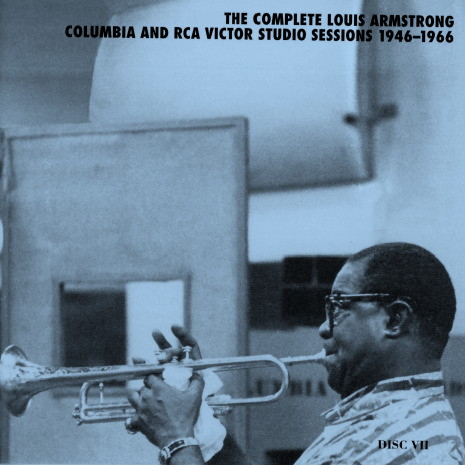
Among his recent services to the memory of Pops and his music are Ricky’s comprehensive and readable booklet notes to the recently released Mosaic Records set The Complete Louis Armstrong Columbia and RCA Victor Studio Sessions, 1946-1966 [MD7-270]. For order information on the set, please go here.
Included in Ricky’s narrative, are many original observations about the background to the development and recording of the music and lyrics to Dave and Iola Brubeck’s The Real Ambassadors which featured Pops along with Carmen McRae, Lambert Hendricks and Ross and the musicians from Dave Quartet and Louis’ All-Stars.
As frequent visitors to the blog will attest, The Real Ambassadors is a subject that is near-and-dear to the heart of the Editorial Staff at JazzProfiles and therefore any additional information is always welcome [scroll down to “Labels” in the blog sidebar to locate previous postings on the subject].
So we wrote to Ricky and to Michael Cuscuna at Mosaic and asked if we could include Ricky’s narrative on “the opera the Brubecks wrote for Pops” [a play on Louis’ reference] and both kindly gave their permission.
Having listened and re-listened to the music in this boxed set, enjoyed the booklet photographs and learned so much about the music of Louis Armstrong during these recordings from the later years of Pops’ career thanks to Ricky’s annotations, if you are a fan of Louis Armstrong, this set belongs in your collection. [I paid full price for my set.]
© -Ricky Riccardi/Michael Cuscuna/Mosaic Records, copyright protected; all rights reserved; used with the author’s permission.
THE REAL AMBASSADORS
SEPTEMBER 12, 13, 19 AND 20, 1961
"[George] Avakian's work with Armstrong brought him to new heights of popularity, but with that came an almost pathological scorn from many critics and even some musicians who now publicly stated their disappointment over Armstrong's musical choices, his smile, his showmanship and stage persona, his sense of humor, his trumpet playing, his commercial appeal, his lack of political activism and more. Much of these criticisms emanated in the United States, as Armstrong remained a God-like figure — and "ambassador of goodwill" -— overseas.
Finally, in September 1957, Armstrong could not keep quiet any longer and put his career on the line to speak out against President Dwight Eisenhower and Arkansas Governor Orval Faubus for the way they handled the Little Rock Central High School integration crisis. His comments drew severe criticism from many public figures, both black and white, and an astonishing silence from the jazz community — except for Dave Brubeck and his wife Iola, who were supremely inspired by Armstrong's stand. At a time when many young jazz musicians viewed the elder trumpeter as an out-of-date "Uncle Tom" figure, Brubeck — a Civil Rights advocate who performed with an integrated combo — saw something else: an American genius who broke down barriers for his race and who was America's greatest Ambassador of Goodwill. "I think that's what we really tried to overcome when we wrote THE REAL AMBASSADORS because before we got into this project we didn't really know Louis that well," Iola Brubeck recalled, "but we sensed in him a depth and an unstated feeling we thought we could tap into without being patronizing."
Soon after Little Rock, Dave and lola sat down and wrote a script and the score for what they envisioned to be a full-blown Broadway musical to be titled, World, Take a Holiday, a phrase that crops up in the song KING FOR A DAY.
Unfortunately, both Armstrong and Brubeck were too busy to tackle the project in 1957 or 1958 but both ended up in Chicago in late December 1958. Brubeck saw an opportunity, but found it difficult to get to Armstrong.
"...Louis' road manager wouldn't give me access when I wanted to discuss the project with him in Chicago, so I found out the number of Louis' hotel room, sat in the lobby until room service came and hollered, 'Hi, Louis' when the door opened. Louis invited me in, ordered me a steak and thought the idea was interesting. I gave him copies of the tunes to listen to on the road; and at the session, he was the first one in the studio and last guy to leave." Brubeck even managed to show him the song LONESOME, with Armstrong reciting the lyrics with great emotion.
Less than a week later, on January 2, 1959, the Brubecks watched Armstrong's appearance on the ABC television program You Asked For It. When host Jack Smith referred to him being called an "Ambassador of Goodwill," Armstrong responded with the following monologue:
"Say, Jack, I think you're wrong about ME being the ambassador. I think JAZZ is the ambassador. One might be the courier that takes the message over there, but it's jazz that does the talking. That's the good thing about our kind of music: it speaks in every language and it's understood by everyone that wants to listen. My horn and me have traveled from Sweden to Spain and when I played Berlin, a lot of them cats jumped down first to hear of Satchmo! Which proves that music is stronger than the nation. I don't know much about politics, but I know these people in foreign countries hear all kinds of things about America, some good, some bad. I'm pretty sure what comes out of this horn makes them feel better about us. One thing's sure: they know a trumpet ain't no canon! This horn is my real boss. It's my living and my life. I've got a lot of high notes in me that haven't been blown yet. Yeeaaah."
The Brubecks could not believe what they were hearing since many of those same themes were in World, Take a Holiday. They immediately turned on their tape recorder and began recording a series of "audio letters" to Armstrong, explaining why they wrote the musical with Armstrong in mind and offering demo performances of the original score. (These priceless recordings survive today at the Louis Armstrong House Museum in Corona, Queens and as part of the Brubeck Collection at the Wilton Library in Connecticut). Armstrong was thrilled, but they had a problem: "All of the producers I took it, thought it was great, but they'd give me all these excuses," Dave Brubeck recalled. "You weren't supposed to have a message. I forget the word they used, but it meant you weren't entertaining. We couldn't lecture the American public on the subject of race."
The Brubecks figured it might be easier to convince people of the merits of the play if they recorded the score first. Carmen McRae and Lambert, Hendricks and Ross agreed to participate, but Armstrong's punishing schedule didn't have any free time and Joe Glaser proved to be a tough negotiator. Two years went by before Glaser and Armstrong finally signed, Columbia Records agreeing to support the project after Brubeck's incredibly successful TIME OUT album and the popularity of the single TAKE FIVE, which reached number 25 on Billboard's "Top 100" in May 1961.
In the intervening years, Armstrong's real-life adventures once again almost eerily paralleled the Brubeck's late 1950s script, which seemed to predict Armstrong's future. In October 1960, the State Department sent Armstrong on a tour of Africa, the only State Department—sponsored tour of his career. In the Congo, Armstrong's mere appearance inspired a temporary halt to a civil war in Leopoldville as the trumpeter was carried into the stadium on a throne like a king. "Having been around the world numerous times, and as a representative of the State Department, this man with his trumpet is able to overcome barriers between peoples in a way beyond the capacity of polished diplomats," read a syndicated editorial published in November 1960. The Brubecks, who based their plot on Armstrong visiting Africa, being mistaken for an Ambassador and eventually declared "King for a Day," must have been shocked to see their fictional story play out as reality.
Brubeck was finally able to set up a series of sessions in September 1961. Armstrong recorded his numbers with Lambert, Hendricks and Ross on September 12 and his duets with Carmen McRae on September 13, in addition to a first pass at SUMMER SONG. He brought the All Stars with him for two separate sessions on the 19th and concluded with just Brubeck's rhythm section on the 20th, completing quite possibly the most challenging album of his career.
Due to time constraints, the finished album didn't include all the material Dave and Iola Brubeck wrote for the production. A finished copy of the complete World, Take a Holiday script survives, as does a scaled-down version prepared by Iola Brubeck for the only live performance of the work at the Monterey Jazz Festival. Taking a page from her book, the following section will not only discuss the making of the music but will also include plot summaries to provide better context for how the songs were sequenced.
The album's dynamic opener was EVERYBODY'S COMIN', a reworking of EVERYBODY'S JUMPIN' from TIME OUT. With lyrics by Iola, the song now served as an overture featuring Lambert, Hendricks and Ross alerting listeners to what they were about to hear and who they were about to hear from, with Armstrong joyously punctuating the message with various utterances of "Yes, yes!" On the previously unissued take 2, we even get to hear Armstrong respond with his horn, an always welcome sound that was eliminated as the takes went on.
At this point in the stage production, Iola wrote a touching description of Armstrong's character, "Pops": "The music which poured from his horn became his identity — his passport to the world — the key to locked doors. Through his horn he had spoken to millions of the world's people. Through it he had opened doors to presidents and kings. He had lifted up his horn, as our hero would say, and just played to folks on an even soul-to-soul basis. He had no political message, no slogan, no plan to sell or save the world. Yet he, and other traveling musicians like him inadvertently served a national purpose, which officials recognized and eventually sanctioned with a program called cultural exchange."
Indeed, the song CULTURAL EXCHANGE brings us directly into the politically charged environment of the "Jazz Ambassadors." In November 1955, the New York Times picked up on Armstrong's importance overseas, with Felix Belair writing, "America's secret weapon is a blue note in a minor key," adding, "its most effective ambassador is Louis 'Satchmo' Armstrong." The State Department paid attention and with prodding from Adam Clayton Powell, Jr., began sending jazz musicians overseas on official state department tours, beginning with Dizzy Gillespie's trip to Southern Europe, the Middle East and South Asia in March 1956 (the track references 1957; Iola apologized for the error in the liner notes). In Greece, students had recently stoned the U. S. Information Service office, but they cheered the arrival of Gillespie. All of that is described in the lightning fast intro to CULTURAL EXCHANGE by Lambert, Hendricks and Ross, originally named DIZZY DITTY. The previously unissued take 3 gives us a tantalizing glimpse at these three geniuses in action, discussing how to properly word "restored" and later, the titular "cultural," almost nailing it in this early attempt.
Eventually Armstrong ambles up to the mike (his part was recorded at a different session) to sing the pointed lyrics about how "The State Department has discovered Jazz / It reaches folks like nothing ever has." The Brubecks also got in a few comedic lines, such as "And when our neighbors call us vermin / We send out Woody Herman!" The lyrics also feature verbal responses from Trummy Young, who contributes some excellent moments throughout the album as a foil of sorts to the character of "Pops." Armstrong takes a full chorus of trumpet, playing the melody up an octave in jaw-dropping fashion. To illustrate the difficult nature of the material, we have included the previously unissued take 2, the first full take to be completed. Armstrong humorously messes up the lyrics twice and he sounds like he's still warming up on the trumpet, but he proved to be a fast learner, completing much of what's heard on the master on his very next attempt.
At this point in the script, Pops and his band were booked on an official State Department-sponsored tour, much to his unease. This was an especially autobiographical turn as Armstrong originally didn't want to do anything for the State Department, venting to a friend in 1959 that he was a musician, not a politician and didn't want to be pestered with questions on issues such as race. "I said, 'Well, what do you want me to tell these people when I go over there? It's all right? Bullshit!" Armstrong said. He knew there'd be questions about Russia and politics and that was something he did not want to discuss. "You see, I told them, you want to go through that kind of shit, have [United States Secretary of State John Foster Dulles] do the talking, we do the blowing, that's all. I ain't going to make no speech for shit." All of these quotes come from the middle of a six-month tour of Europe from 1959, Armstrong stating, "And then they ask me, 'Did the State Department send you?' And I say, 'You know no state department sent me over here. It's the fans.'"
Iola Brubeck took these private statements and accurately summed them up in her script: "For in addition to his undeniable musical gifts, he possessed a gift equally as rare — the ability to keep opinions to himself and observe in silence. He had taken great pains to create a dazzle-toothed, shimmering public image, which could possibly become tarnished if he were to speak what was on his mind." The only half-truth in the script was the line, "After all, through the years he had gained the admiration of not only the public, but the critics," since critics had been hammering Armstrong for decades.
But the line was mainly intended to cue GOOD REVIEWS, a cute number that serves as our introduction to Carmen McRae, humorously dissecting the role critics play on an artist's psyche. The session tapes reveal that at the September 13 session, Armstrong took the trumpet solo by himself but perhaps finding it to be a bit empty, Brubeck and producer Teo Macero had the entire All Stars band take the instrumental interlude on September 19, splicing it in as best they could to the earlier attempt. We've included take 7 from the first session, as well as an unissued insert with the All Stars doing their best to keep up the momentum of the playback. The session tapes also contain two hilarious, though unused tags that are being issued for the first time.
REMEMBER WHO YOU ARE gets us back into the ambassadors realm as it's based on a briefing Brubeck received before his 80-city, 14-country State Department tour of 1958, the government's not-so-subtle reminder to the musicians that they were representing the United States and shouldn't go off spouting any political opinions — even though many of the African American "ambassadors" still received inhumane treatment at home (both Armstrong and Brubeck dealt with resistance as the leaders of integrated combos, as well). The lyrics sung by Trummy Young more than hint at what Armstrong had to go through on a daily basis, giving nearly constant interviews to the press while overseas: "Never face a problem, always circumvent / Stay away from problems, be discreet / When controversy enters, you retreat." This one took 15 takes to complete, most of them breakdowns, but the complete takes did offer different trumpet breaks by Armstrong, including the excellent one heard on the previously unissued take 6.
With MY ONE BAD HABIT, the shift of the production pivots, something that could be a little jarring when listening to the original LP. In Dave and Iola Brubeck's script, though, this was the formal introduction of McRae as Pops' new singer, "Rhonda." Perhaps realizing that satirical and pointed messages about politics and race weren't commercial enough, the Brubecks threw in a love story subplot, with Iola writing in the script, "From the moment the new vocalist joined the band, her predatory eyes had not wavered from their principal target: our hero." Dave Brubeck actually got the idea for the song from a backstage conversation with Ella Fitzgerald. Asked how she was doing, Fitzgerald responded, "Well, Dave, my one bad habit is falling in love." That's all Brubeck needed to hear, writing the song and giving Fitzgerald co-composer credit. McRae is at her sassiest here, an excellent showcase for her considerable talents, while Brubeck's quartet is suitably funky.
In the envisioned show — and on the album— McRae's sexy showcase would be followed by SUMMER SONG, Armstrong's tender reflection on falling in love in the August, if not quite September, of his years (and also a way of acknowledging that he was 21 years older than McRae). Even without any connection to the plot, the song inspired one of Armstrong's greatest vocals, as he brings the perfect blend of wisdom and warmth and even pathos that would infuse later works like WHEN YOU WISH UPON A STAR and WHAT A WONDERFUL WORLD. Dan Morgenstern was present when Brubeck first went over SUMMER SONG with Armstrong and remembered, "Brubeck was totally overwhelmed. As a matter of fact, tears came to his eyes when he heard Louis do this thing and the record of it is marvelous." Armstrong's friend Jack Bradley, who photographed the sessions, described it as "a lovefest, especially between Dave Brubeck and Louie. Dave would run up and hug and kiss Louie after every take. It was a wonderful session and it went well considering they didn't have time to rehearse."
Rumor always had it that Armstrong accomplished SUMMER SONG in one take, but the session tapes tell another story. With time remaining during the September 13 session devoted to Armstrong's duets with McRae, Brubeck called SUMMER SONG. Armstrong was somewhat unfamiliar with the melody and had to work some phrases out on his first attempt, but by the previously unissued take 2, he was able to turn in a beautiful rendition of the challenging song. Brubeck called an insert to iron out the ending, but still must have thought he could do better. On the final day of recording, Brubeck and Macero called for a SUMMER SONG remake in a higher key, now with the addition of Billy Kyle on second piano. We have included a complete sequence where Armstrong sings the hell out of it, but it breaks down twice, the first time due to a barely suppressed belch! Still, they carried on with insert takes, making it to the finish line, though Brubeck's comping is a little too busy at times. We have combined both of these previously unissued attempts into one track to create a super-sized document befitting this especially epic entry in the Armstrong canon.
One further attempt resulted in much of what became the master, as they made it through it in one shot, Brubeck simmered down a bit and nobody belched. As Chip Stern wrote of the issued take, "On his poignant performance of SUMMER SONG, you can hear the elder Armstrong accepting the inevitability of death and looking ahead towards his final peace, even as he casts a parting glance at all of his remarkable achievements." A prized possession in the Brubeck household was a copy of the score to SUMMER SONG, on which Armstrong wrote, "To Mrs. Brubeck, Am very happy. Satchmo Louis Armstrong." As Iola wrote in the original liner notes, "So are we."
After such a moving performance, the plot of the show dropped the love story and went back to the ambassadorial theme, with "Pops" triumphantly conquering his State Department tour, but, starting to "feel the power that was in his horn," he began spending his time on the plane daydreaming about what he would do if he was KING FOR A DAY. The result was one of Armstrong and Young's finest duets, thanks to the clever lyrics, the swampy New Orleans beat, and the hamming-it-up by the two pals (especially during the section about jazz royalty Duke Ellington, Count Basie, King Oliver and Earl Hines). Once again, Armstrong had to work hard, remarking after one take, "That was a real tongue twister." Brubeck asked, "Pops, what do you want to do next?" A game Armstrong replied, "I don't care, you call 'em." Brubeck said, "I was thinking of your lip." Armstrong answered, "It ain't the lip, it's the lyrics. You don't have to worry 'bout my chops." In the studio, Armstrong played a full chorus of melody up front, which was edited down to just 12 bars on the record. The musicians only made it all the way to the end through take 5, which is heard on the album, but we have included take 4 because of the extra trumpet playing at the start and the hilarious way it breaks down during the royalty section.”
To be continued in Part 2.