© Copyright ® Steven Cerra, copyright protected; all rights reserved.
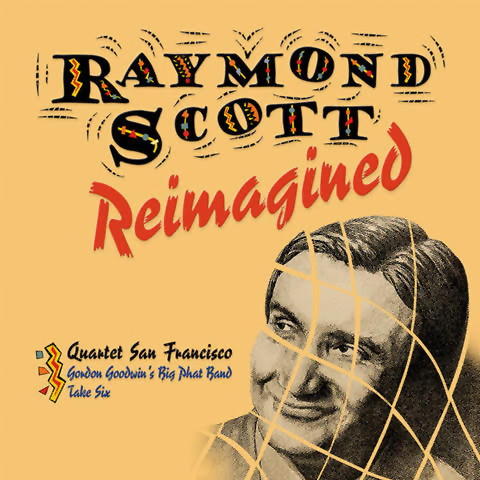
"Composer, inventor, visionary pianist, engineer, electronic music producer, control freak"
—Irwin Chusid (Scott archivist, catalog administrator, and historian)
Raymond Scott was born Harry Warnow on September 10, 1908, in Brooklyn. At age 16 he played his first job as a professional pianist. At 23, he was hired as staff pianist for the CBS Radio orchestra, and soon assumed the name Raymond Scott (which he allegedly picked out of a Manhattan phone book). In 1938 he signed with 20th Century Fox and moved to Hollywood with his group, the Raymond Scott Quintette, which performed and appeared in major motion pictures. In 1943 Warner Brothers began adapting his compositions in Bugs Bunny and Daffy Duck soundtracks, although Scott never specifically composed a note for a cartoon. He was a pioneer in the world of electronic instruments, advancing the technology during the 1950s. He invented, built and recorded with his own instruments.
“The phrase ‘jazz repertory’ has many definitions and dimensions. Perhaps the most basic is: the study, preservation and performance of the many diverse musical styles in jazz. In recent years, the phrase most often applies to big bands and jazz ensembles performing classic and new music written for reeds, brass, and rhythm section in various sizes and combinations.”
- Jeffrey Sultanoff, Bill Kirchner, ed., The Oxford Companion to Jazz [p.512]
Regular visitors to JazzProfiles are no doubt familiar with the concept of Jazz Repertory as I used it as a context in which to place two previous blog features about the unique composer-arranger, Raymond Scott: [1] The Raymond Scott Chesterfield Arrangements commissioned and performed by the Paul Whiteman Orchestra in 1937-38 and subsequently recorded by The Metropole Orchestra with The Beau Hunks Saxtette and [2] The Beau Hunks Saxophone Soctette involving their two beautifully recorded BASTA CDs. Both of these musical aggregations are based in Holland.
In line with the best aspects of Jazz Repertory, today marks the release of new interpretations of Raymond Scott’s music as described in the following notice from 1888 Media.
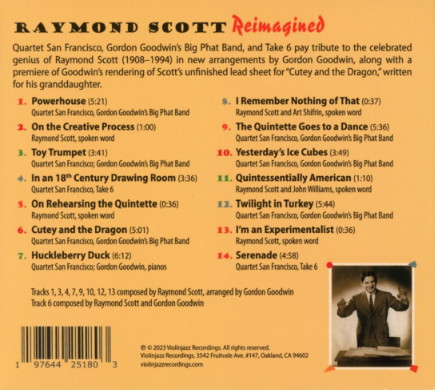
'RAYMOND SCOTT REIMAGINED'. An Unprecedented Musical Journey Arrives July 21, 2023 via Violinjazz Recordings
The Project Is A Collaboration Between Quartet San Francisco, Gordon Goodwin, Take 6 and The Raymond Scott Archives
San Francisco, CA:
Violinjazz Recordings, the label of acclaimed Grammy-nominated musician Jeremy Cohen, principal violinist and founder of Classical Crossover specialists Quartet San Francisco, has announced the release of 'Raymond Scott Reimagined,' an unprecedented new collaboration teaming Quartet San Francisco with accomplished Grammy/Emmy Award-winning composer/producer/arranger Gordon Goodwin and revered Grammy-winning a cappella group Take 6.
The thrilling 14-track collection, which includes Goodwin's fresh arrangements of eight Scott classics, including mainstays "Powerhouse," "Twilight in Turkey," "Huckleberry Duck," "The Quintette Goes to a Dance" and "In an 18th Century Drawing Room," also introduces an entirely brand new composition, "Cutey and the Dragon," which was crafted from an unfinished sketch Scott made in 1982 with Goodwin completing the composition in a manner that honors the great composer's style and verve.
The album, available for order at Vioiiniazz Recordings, also contains several interstitials of Raymond Scott's voice, along with spoken word from audio historian Art Shifrin and Grammy-winning composer/conductor John Williams, excerpted from the documentary film, 'Deconstructing Dad (directed by Raymond's son, Stan Warnow), has been two years in the making but, in actuality, is a journey of nearly 50 years.
Jeremy Cohen, the project's Executive Producer, explains, "I grew up during an era when a simple turn of the television dial could bring one's world from Leonard Bernstein to animation and cartoons. Escape, creativity, and whimsy fueled my imagination where animation offered a humorous view of the world. As a kid studying classical violin, I was fascinated by Carl Stalling's incorporation of iconic classical music into the Warner Brothers cartoon soundtracks."
"Raymond Scott, who never actually wrote music expressly for animation, was widely quoted in Merrie Melodies cartoons featuring Bugs Bunny, Daffy and pals. Scott's music sat right alongside the world's most recognizable classical music and became part of the soundtrack of my imagination. Scott's 'Powerhouse' brings musical shape to emotions."
"In the 1990s, I was introduced to Raymond Scott with the album The Music of Raymond Scott: Reckless Nights and Turkish Twilights' (Columbia, 1992, Irwin Chusid, producer) and let's just say that at that moment, the lantern was lit for a longstanding quest. Scott's music found its way into arrangements for my group, Quartet San Francisco. We found boundless passion and energy for bringing this music to our audiences."
While the basis of the album would be an alliance between Quartet San Francisco and Gordon Goodwin's Big Phat Band, Jeremy and Gordon decided to engage a variety of ensembles to partner with the string quartet. These include pairing the string quartet with the big band on "Powerhouse," "The Quintette Goes to a Dance," "Twilight in Turkey," and "Cutey and the Dragon," incorporating a smaller ensemble of three horns on "Toy Trumpet" and a saxophone quintet on "Yesterday's Ice Cubes." Two pianos enhanced "Huckleberry Duck" with the gorgeous vocals of Claude V. McKnight III, Mark Kibble, Joel Kibble, Dave Thomas, Alvin Chea and Khristian Dentley (of the group Take 6) joining on "In an 18th Century Drawing Room" and "Serenade." The results are spellbinding.
Gordon Goodwin, co-producer, composer, arranger, and bandleader of The Big Phat Band, recalls his introduction to the iconic composer and approach to the project, "I took a deep dive into the music of Raymond Scott when I was working as a composer for Warner Brothers Animation. His music made quite an impact on me, so when Jeremy approached me about collaborating on a project featuring Scott's music, the answer was an immediate and enthusiastic yes!"
"There is a long list of great Raymond Scott songs from which to pick, but we knew that were some tunes we had to include, such as 'Powerhouse' and ‘Toy Trumpet,' but we were excited when the Raymond Scott Archives presented us with an unfinished lead sheet to a song called 'Cutey and the Dragon' that Scott was working on with, and for, his granddaughter Kathy. They asked if I wanted to arrange it, but as I examined the lead sheet, I realized that it really wasn't a finished composition, but rather a work in progress. So the Scott family gave me the honor of finishing the composition. This allows us to present something rare—a previously unheard composition by Raymond Scott."
"Another highlight was "Twilight in Turkey," which features Don Williams on timpani, along with Wade Culbreth on mallet percussion. This is special because Don's father Johnny Williams was the drummer for the Raymond Scott Quintette. He is also the father of film composer John Williams. Don was able to allow us the use of his father's cowbell and torn toms, so this track has a direct and unique connection to this music's creator."
"When we considered the vocal component for this music, there was really only one consideration. Take 6 has set the bar for a cappella singing over the past three decades, and I knew that their sound and versatility would make for a distinctive contribution."
A distinctive collaboration is quite the understatement. Between the three main collaborators, QSF, Goodwin and Take 6, they've earned 60 Grammy nominations, scoring 12 wins. And that's just the tip of the iceberg of the size and scope of Reimagined as two dozen best-in-class musicians amplify the sound and vision including Wayne Bergeron (trumpet), Ray Brinker (drums), Joey De Leon (percussion, congas, bongos), Justin Smith (guitar), Andy Waddell (guitar), Kevin Axt (bass), Sal Lozano (alto sax), Brett McDonald (alto sax, piccolo, clarinet), Brian Scanlon (tenor sax), Thomas Luer (tenor sax), Jay Mason (baritone sax), Daniel Fornero (trumpet), Aaron Janik (trumpet), Dan Savant (trumpet), Andrew Martin (trombone), Charlie Morillas (trombone), Francisco Torres (trombone), Craig Gosnell (bass trombone), Wade Culbreath (marimba, vibes, xylophone, cowbell), Meredith Clark (harp) and Don Williams (timpani, tom-toms) with Goodwin on piano and tenor sax and esteemed accompaniment by the other three virtuosos in Quartet San Francisco, Joseph Christiansen (violin), Chad Kaltinger (viola) and Andres Vera (cello).
Also in the mix is 7-time Grammy-winning engineer Leslie Ann Jones, who's recognized for her work with Kronos Quartet, Chanticleer and Rosemary Clooney and whom Cohen's worked with on previous projects including Pacific Premieres: New Works by California Composers. For Raymond Scott Reimagined, Jones recorded the joint sessions at Lucasfilm's Skywalker Sound, the famed studio on George Lucas's Skywalker Ranch in Nicasio, California. Additional recording took place at Dragonfly Creek Recording in Malibu and Lake Balboa Sound in Los Angeles….
Buckle up 'cause the dectet is going to a dance. It's gonna be a mighty dynamic powerhouse in a 21st century listening room.”
The excitement and enthusiasm that Jeremy, Gordon and company have for this project literally explodes through this repertorial revisiting with Raymond Scott’s magnificent music, no less so because of the brilliant audio quality of the recording.
The musicianship on display here is first rate, both individually and collectively. And the idea of inserting actual spoken word excerpts by Raymond Scott is as instructive as it is brilliant.
“The artistry of Raymond Scott wove itself into the fabric of American culture. This celebration of Scott's music in a collaboration of 32 musicians brought together by Jeremy Cohen and Gordon Goodwin presents Quartet San Francisco, Gordon Goodwin's Big Phat Band, and Take 6. These new arrangements by Goodwin of Scott's compositions, and the premiere of Goodwin's rendering of Scott's unfinished lead sheet, written with and for his granddaughter Kathy, pay tribute to the celebrated genius of Raymond Scott.”


 Another Musical Crusade for THE BEAU HUNKS SAXOPHONE SOCTETTE
 The Beau Hunks play the Original Little Rascals Music, Vols. 1& 2 [Koch Screen 8702, 89021].

 The most ambitious project to date materialized in 1997 when the band was expanded to a 35-piece outfit for the purpose of performing Ferde Grofe’s symphonic Suites as composed for the Paul Whiteman band in the 1920s. This was the first project where we could actually use the composer's original scores and parts which were retrieved in the collections of Williams College and the Library of Congress by the Hunks' leader, Gert-Jan Blom. The results of this project are available as The Modern American Music of Ferde Grofe [Basta 30-9083-21].
 The present album introduces the Beau Hunks in yet another setting. For this project the brass, strings and piano were omitted, while the woodwind and saxophone sections were dramatically expanded. The aim of this project was to pay tribute to the various saxophone bands from the first four decades of this century, when the saxophone was still a 'new' instrument.
 The extremely virtuoso arrangements for this Soc-tette were made by Nathan Van Cleave for a lineup of nine saxes doubling on clarinets, accompanied by two guitars, bass and drums. Four of these Soc-tette recordings were released on 78rpm discs: "Blue Skies"/"What'll I Do?" [Decca 2698] and "I Kiss Your Hand, Madame"/"After You've Gone" [Decca 2467, both recorded 4/7/39]. Van Cleave also arranged Irving Berlin's "Tell Me, Little Gypsy" and "Crinoline Days" [Decca 2694] for the Woodwind Ensemble with a lineup of clarinets, bass clarinets, flutes, oboe, bassoon and rhythm section.
 On the original Soc-tette recordings one can hear some outstanding soloists. We dedicate this CD to all of them - but especially to the Soc-tette's first alto and clarinet virtuoso, Alfred Gallodoro.
 Over the past three years, Al Gallodoro has become a dear friend, Our saxophone players had worshipped Al's impressive recordings for many years and were surprised to find out that he was still alive. At the initiative of Robert Veen, Al Gallodoro, performed with the Beau Hunks at the 1996 Breda Jazz Festival before a flabbergasted audience. Mr. Gallodoro - who had to obtain a passport for his first trip ever outside the U.S. - moved several audience members to tears with his playing and impressed the musicians with his incredibly accurate memory and wonderful stories about his career and the people he had worked with, including Whiteman, Scott, Grofe, Shield, Toscanini and many others. Al is a living encyclopedia of American music history.
 The following year, by public demand, Al returned to Holland for a series of concerts, TV & radio appearances and several Master-classes at music colleges. A funny thing occurred when Beau Hunks' sax players Ronald Jansen Heijtmajer and Robert Veen drove Al to the Hilversum Conservatory where he was to give a Master-class. Robert played the new Beau Hunks recording of the original Nathan Van Cleave arrangement of "Blue Skies" over the car stereo. Hearing the introduction and the first chorus, and believing he was listening to the Whiteman original, Gallodoro remarked, "Yeah, we were great in those days..." As the music continued, he "recognized" Artie Reyerson [guitar], Sal Franzella [clarinet], Art Drelfinger [tenor sax], and even his own virtuoso cadenza in the coda! Having played a couple of our recordings, Robert stopped the car and told Al that what they were hearing was not the original Soc-tette but the Beau Hunks' renditions of the same arrangements. Al couldn’t believe it and was raving about it for the remainder of the trip, thus giving us the best compliment we could have dreamed of.
 Along with Nathan Van Cleave’s Soc-tette and Woodwind arrangements from the late ‘30’s you’ll find some pre-thirties material to illustrate the history and evolution of saxophone bands.
 We hope that these recordings will contribute to a better understanding and appreciation of the pioneers of saxophone playing and arranging.-Robert Veen, September, 1998
 As one would imagine, in the interests of authenticity, special provisions were made in the making of these retrospective recordings and they are described in the insert notes as follows:
 In 2003, Contrasts was issued by the Beau Hunks on BASTA CD [30-9128-2] and this sequel carried the following introductory explanation.
 During roughly four decades, the saxophone evolved from a rather cumbersome marching band instrument into a hugely popular and versatile Jack of all Trades. In its early years, vaudeville groups, circus bands, novelty acts and early dance bands incorporated the relatively new instrument into their programs. Some of these ensembles, like The Six Brown Brothers, were offered recording contracts, which helped spread the growing popularity of the instrument even further.
 In collaboration with the Frank Holton Co. from Elkhart, Indiana, he modified the saxophone to facilitate higher action and smoother projection of the lower notes in order to accommodate his virtuoso style. Thanks to the pioneering contributions of Wiedoeft, the saxophone finally gained the respect of professional musicians as its voice became more mature. By the late 1920s a veritable “saxophone craze” was underway and there was an increasing demand for saxophones of all shapes and sizes, which were eagerly supplied by a rapidly growing industry.
 Our previous album [BASTA 30-9089-2] includes all of Van Cleave’s original arrangements for the Paul Whiteman Sax Soc-tette and Woodwind Ensemble. This new album is a further exploration of the history and development of saxophone music in a wide variety of musical dialects and formats. You’ll hear the entire range of the saxophone family, from bass sax to sopranino, including the extremely rare Swanee-sax!”
 In closing this Jazz repertory retrospective of early saxophone music by the Beau Hunks, Jeff Sultanof offers these further thoughts about the relevance and importance of such efforts [paragraphing modified].


