© Copyright ® Steven Cerra, copyright protected; all rights reserved.
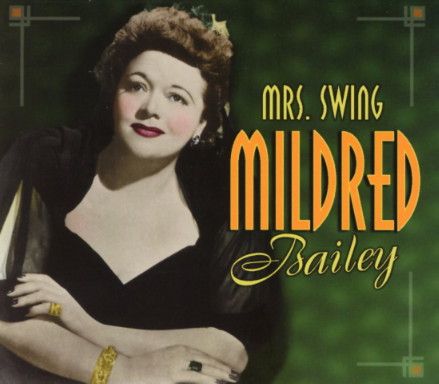
“The emergence ol three girl singers at virtually the same time: heralded the beginning of the age of the female jazz and band singers at the beginning of the 1930's. Decca's Jack Kapp recorded Mildred Bailey with the Casa Loma band in September 1931, that same year Lee Wiley recorded two sides with Leo Reisman's popular society band for Victor and Connee Boswell, the dominant voice of the Boswell Sisters vocal trio, recorded a number of solo sides with musicians of the calibre of Tommy and Jimmy Dorsey and Eddie Lang.”
- Will Friedwald, Jazz Singing [paraphrase]
“She made her first record in 1929, with Eddie Lang, and became an instant favorite of the jazz elite—the one white woman (she preceded Lee Wiley and Connie Boswell by a couple of years) with an identifiable style who could hold her own in a field dominated by black singers. She had been one of the first to assimilate the styles of Bessie Smith (whose blues she sang in an audition for Hammond), Ethel Waters (whose lighter voice was closer to home), and Louis Armstrong (whose time and invention liberated everyone). She would emerge as a transitional figure between them and the band singers that followed, including Billie Holiday and Ella Fitzgerald, though Bailey had a style all her own. Her high, light voice inclined to a whirring in the top notes while packing plenty of power; her time and enunciation were exemplary. After a couple of years as a side woman, indulging in excessive vibrato, she rid herself of affect and ornamentation. She focused on the language of a song, the meaning, the special story it had to tell. She was funny, cool, smooth, and always in a groove.”
- Gary Giddins, Weather Bird
“The best thing that ever happened to Mildred Bailey was Red Norvo, her third and last husband and her most important collaborator. They met in Whiteman's ranks (he played vibes behind her on "Rockin" Chair") and were married in 1933—the same year Kapp stupidly prevented Norvo from putting his advanced ideas on wax—and organized a touring band together in 1936, appropriately christened "Mr. and Mrs. Swing." Together with the young arranger Eddie Sauter, they created three years' worth of the most beautiful vocal records ever produced, each a perfect blend of written ensemble passages, vocal refrains, and instrumental improvisations and each a minor classic of shading and dynamics that would have a profound influence on many singers, including Frank Sinatra, and even more arrangers.”
- Will Friedwald, Jazz Singing
Blessed with a light, clear, bell-like voice and a musician’s ear, coupled with excellent diction, Mildred Bailey [1909-1951] could sing a song with such conviction and warmth, the she could make you, the listener, believe in it, no matter how superficial the actual message. She was the number one white singer of The Swing Era. She was truly - Mrs. Swing.
The following is from The Great American Singers by Henry Pleasants. Himself a trained musician and esteemed literary critic, the piece is a succinct yet comprehensive explanation of the qualities that made Mildred Bailey one of the most significant vocalists in the early history of Jazz.
The feature also represents the continuing efforts of the editorial staff at JazzProfiles to commemorate important developments as part of the 100th anniversary in the history of Jazz and its makers.
“Mildred Bailey, more than any other of the great American popular singers, was a jazz musician's singer, a jazz musician's delight. This was the secret of her unique success. But it also had a lot to do with the commercial limitations of that success.
Jazz singing, until the late 1920s [wrote Leonard Feather in The Book of Jazz] was largely confined to the Negro artists, and, despite occasional exceptions, such as Armstrong and Waters, was limited in substance to the form of the blues. The break on both levels may have been completed with the advent of Mildred Bailey. Where earlier white singers with pretensions to a jazz identification had captured only the surface qualities of the Negro styles, Mildred contrived to invest her thin, high-pitched voice with a vibrato, an easy sense of jazz phrasing that might almost have been Bessie Smith's overtones.
She sang popular music. Indeed, she sang every kind of popular music, from blues and pseudo-blues, gospel and pseudo-gospel, through Tin Pan Alley and show tunes to Charles Wakefield Cadman's "From the Land of the Sky-Blue Water." And she sang it all idiomatically — with the possible exception of the Cadman piece, which had once figured in the programs of Lillian Nordica. Her career in radio, her numerous records, her association with the Paul Whiteman, Red Norvo and Benny Goodman bands and her work as a single in prestigious nightclubs earned her a considerable portion of fame and money. Yet she never quite made it, as show-biz terminology has it, really big.
Mildred blamed it on her personal appearance. She was fat. For a variety of reasons, probably representing a fatal combination of biological and psychological factors, she was never able to keep her weight down. She loved to eat. She ate too much. She ate compulsively. Even in the later stages of the diabetes that killed her—on December 12, 1951, at the age of forty-four—she used to say: "Now, I've ate the diet, so bring on the food."
Obesity may have had something to do with it. She was no beauty. Dainty feet and trim ankles could not divert the onlooker's eye from the hulk they supported. She had, moreover, plenty of prettier contemporaries, some of whom made it bigger than she without being in her class as a singer or musician. But there were, I suspect, other, more musical reasons.
She was, to begin with, ahead of her time. As a featured vocalist with Paul Whiteman, beginning in 1929, she became the first girl singer to front a jazz band, or, in the jargon of the period, a jazz orchestra. More significantly, she and Connee Boswell were the first white singers, male or female, to absorb and master the blues, or rather the early jazz idiom of the black singers of the 1920s. Mildred Bailey was singing bluesy jazz, and swinging, when the rest of white America had hardly got beyond the Charleston.
Her place in American musical history is with those white musicians who as youngsters in the 1920s were listening to Sidney Bechet and Louis Armstrong, to Bessie Smith and Ethel Waters, at a time when middle-class America's idea of jazz was Ben Bernie, Vincent Lopez, Fred Waring and Paul Whiteman — or Gene Austin, Al Jolson, Harry Richman, Sophie Tucker and Rudy Vallee.
Many of those youngsters went on to great careers —Jimmy and Tommy Dorsey, Benny Goodman, Woody Herman, Harry James and Glenn Miller. Others — Bix Beiderbecke, Bunny Berigan and Dave Tough, for example — achieved only posthumous recognition. For all of them, however, the transition years from the Jazz Age to the Swing Era were difficult and precarious. The musicians knew what they had heard in the black nightclubs and theaters of Chicago and New York, and on race records. They had learned to play it. But the general public was not ready for it, or for anything very much like it.
What these young musicians heard, and what they wanted to play, was, in ethno-musical terms, something closer to a black original than was being offered by the white theater and dance bands of the 1920s. Benny Goodman made the breakthrough in 1935-36. Swing, if not yet the blues, was in. The musicians had been swinging, privately and on records, for years. One of the most exciting, and also one of the most instructive, ways of hearing what they were up to, individually and collectively, is to listen to them playing behind Mildred in more or less ad hoc groups on the records she made in 1933-34-35.
The personnel on these dates reads like a Who's Who of early swing: Bunny Berigan, Chu Berry, Jimmy and Tommy Dorsey, Benny Goodman, Coleman Hawkins, Johnny Hodges, Gene Krupa, Red Norvo, Teddy Wilson and many more. The presence of black musicians is significant. This was before Benny Goodman and Artie Shaw had broken the color line in public performance, Benny with Wilson and Lionel Hampton, Artie with Billie Holiday. But behind the scenes, and in the recording studios, jazz was one world. Benny Goodman's famous trio was hatched, it is pertinent to recall, when he met Teddy Wilson at Mildred Bailey's home on Long Island.
Mildred, on these records, appears with bands variously designated. There are the Dorsey Brothers' Orchestra, Benny Goodman and His Orchestra, and Red Norvo and His Orchestra, all subsequently famous. There are more ephemeral titles: Mildred Bailey and Her Orchestra, Mildred Bailey and Her Alley Cats, and Mildred Bailey and Her Oxford Greys, the personnel sprinkled with names now hallowed. Listening to those records, and noting how Mildred always emerges not just as a singer fronting a band but as the lead voice in any band she worked with, one is tempted to forget the names of the bands and think of them simply as Mildred Bailey and Her Friends.
They were her friends. Red Norvo was her second husband. This was her music. So it had been since she was a young girl. Bing Crosby remembers her singing in Charlie Dale's Cabaret in Spokane (she was born in Tekoa, Washington, in 1907) during his college days, when he and Mildred's brother, Al Rinker, had a six-piece band called the Musicaladers. Mildred, he recalled in a prose portrait for
CBS's Her Greatest Performances album, "used to get some great records from the east from time to time, and Alton and I and our band would copy them. Believe me, with such a library in those days in Spokane, we were pretty avant. This was in 1925."
Mildred married and went on to Los Angeles. Bing and Al Rinker, then on their way to becoming the Rhythm Boys, found her there a year later, working in a club called The Swede's.
“I'll never forget my first visit there [Bing recalls] how my eyes bugged when I saw Gene Pallette, eminent actor of the period, lay a Benjy [a hundred-dollar bill, so called because it bears a portrait of Benjamin Franklin] on her for two choruses of "Oh, Daddy!" "Ace in the Hole" was good for a brace of Benjys. And "Sweet Mama, Where Did You Stay Last Night" might get pretty near anything.
There it was that she introduced us to Marco, at that time a very big theatrical producer, and we were on our way — with a lot of her material, I might add. Ah! She was mucha mujer. A genuine artist, with a heart as big as the Yankee Stadium, and a gal who really loved to laugh it up. She had a beautiful sense of humor, and a way of talking that was unique. Even then, I can recall her describing a town that was nowhere as "Tiredsville."”
Obviously, Mildred was closer to jazz than were other white singers of the time. She was listening to race records, and not only singing, but also talking, in the jazz idiom, as she would continue to do for the rest of her life. "Oh, Daddy!" had been Ethel Waters' first record hit. Another of Mildred's favorites was "Down Hearted Blues," recorded by Ethel Waters in 1921 and by Bessie Smith at her first session for Columbia in 1923. Mildred's own recording of it, in 1935, is one of her finest. When Bessie Smith made her last public-appearance in New York, impromptu, in a jam session at the Famous Door on 52nd Street, Mildred was so moved that she declined to follow.
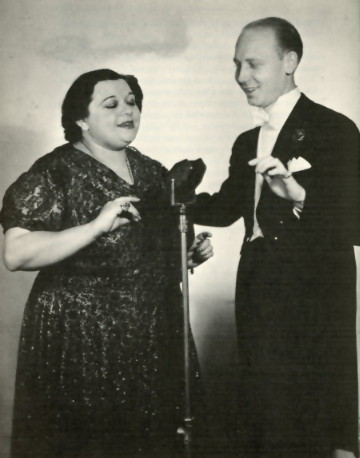
Red Norvo, reminiscing with Whitney Balliett for a New Yorker Profile, told how life was at their home on Pilgrim Circle in Forest Hills:
“Bessie Smith and her husband came to the house, too. Bessie was crazy about Mildred. She and Mildred used to laugh at each other and do this routine. They were both big women, and when they saw each other one of them would say: "Look, I've got this brand-new dress, but it's too big for me, so why don't you take it?" Fats Waller came out. And Jess Stacy and Hugues Panassie and Spike Hughes and Lee Wiley and Bunny Berigan and Alec Wilder. Red Nichols lived right across the street. . . .”
It may have been this sense of total identification with jazz, especially with jazz as it was emerging in the early 1930s, and with the young musicians, black and white, who were playing it, that inhibited Mildred's communication with a wider public. Where musicians are so obviously having a ball, so obviously playing for each other, admiring each other and liking each other, the lay public, excluding the "hot jazz" buffs of the time, may have felt excluded, The musicians were playing their own music and on their own terms.
Another problem for Mildred, probably, was the way in which her singing tended to suggest another instrument, or, as jazz musicians would put it, another horn. There was a paradox in this, for no other singer has rejoiced in a lovelier voice. But it was not the voice that suggested a horn. It was what she did with it. Her way with a phrase or a tune, particularly in the early days, tended to be an instrumentalist's way.
This has always been a way calculated to win the approval of jazz musicians, jazz critics and jazz fans. Their highest praise is to say of a singer that he uses his voice, or phrases, like a horn. It is essentially what they are talking about when they speak of a singer as being a "jazz singer." The praise has seduced and inhibited many a fine singer. It is nonsense.
Not in the sense that it can't be done, of course; but in the sense that it should be done. To encourage the singer to emulate the instrumentalist is to stand music on its head. It is to forget that the instrument is a vocal substitute, that the best instrumentalists are those who are the best singers on their instruments. What has confused and distorted our view of the singer-instrumentalist relationship in jazz has been the fact that the greatest jazz instrumentalists-Louis Armstrong and Sidney Bechet, for example—have "sung" so well on their instruments.
They learned from the singers. One notes the backing personnel on countless recordings of the 1920s by Bessie Smith, Ethel Waters, and their contemporaries. There they all are: Red Allen, Louis Armstrong, Buster Bailey, Sidney Bechet, Bunny Berigan, Henry Brashear, Jimmy and Tommy Dorsey, Benny Goodman, Charlie Green, Jimmy Harrison, Coleman Hawkins, Fletcher Henderson, James P. Johnson, Eddie Lang, Joe Smith, Jack Teagarden and so on. It is easy to miss the point when a Frank Sinatra says he learned all he knows about phrasing from listening to Tommy Dorsey play the trombone. He probably did. But Dorsey learned what he knew about phrasing from Henry Brashear, Charlie Green, Jimmy Harrison and Jack Teagarden. And they, in turn, learned from the black singers.
In Mildred Bailey's time, particularly in the early 1930s, an instrumental approach to singing was neither so hazardous nor so distinctive as it became later on, when jazz departed disastrously from its roots in song. The best instrumentalists were admirable models for a singer simply because they had modeled their own phrasing on such excellent singers, and "sang" so well. But for a singer of Mildred's extraordinary musicality, their virtuosity and invention were also a temptation. She could do with her voice what they did with their horns. Sometimes she would deliberately imitate an instrument — a trumpet, a trombone or a sax. She could do it marvelously. She enjoyed doing it.
It was not so much that she sang in an instrumental manner as that she thought instrumentally. Her enunciation was a model of clarity. The sound was vocal and feminine. But the effect was often as if a lead instrument had somehow acquired the capacity of articulating words. What one heard was admirable and delightful. The sheer virtuosity, however, sometimes overshadowed the articulation of a lyric and the probing of textual substance.
Any first-class jazz musician of the time could have taken a Mildred Bailey chorus and reproduced it on his instrument note for note, deviation for deviation, slur for slur, rubato for rubato, without the slightest suggestion of incongruity. She worked with a tune as the instrumentalists did, improvising from and around it, but never losing touch with it. This ability, and this predilection, help to explain why, on these early records, she comes through so strikingly as a member of the band.
The dangers, for a singer, of an instrumental style were compounded in Mildred Bailey's case and time, if she wished to reach a white audience, by the fact that the style itself was so blues-flavored.
All the white instrumentalists with whom she worked were also phrasing in the manner of their black contemporaries. For Mildred, as a singer, phrase was inseparable from language. So she adopted not only the black musician's way with a phrase, but also his way with a word and his vocal sound, including the pronounced nasal resonance—not nasality—which has characterized the great black female singers from Bessie Smith to Aretha Franklin.
For one born and raised in the state of Washington in the American Northwest, two or three thousand miles from the deep South and from Southern speech, Mildred's enunciation in any song requiring or even suggesting a blues inflection is astonishing. I have often played Mildred Bailey records of this type of song for unsuspecting visitors, both black and white, and asked them to describe the singer. The response, without exception, has been: "Well, to begin with, she's black." In more European material she doesn't sound black at all. I reckon it a sign of an acutely sensitive musicality that she reacted instinctively and profoundly to the indivisibility of music and language.
For all her concern with language, rendered the more conspicuous by the unfailing distinctness of her enunciation, the melody of language would seem to have been more important to her than its meaning. This has always been a problem for singers in whom musicality is combined with a beautiful voice. It has something to do with the fact that the greatest dramatic artists among the great singers in any category have rarely been those with the loveliest and most tractable voices. With the superbly endowed, the endowment takes precedence. Their singing tends to be more delightful than exciting. The fault may lie, to be sure, with the listener, so beguiled by the sound that he misses the substance.
Records Mildred made at the close of her career reveal a voice as fresh as that of records made fifteen years earlier. There is not a trace of blemish, no evidence of wear and tear, no falling of pitch. The explanation is apparent in the records themselves; there was never any wear or tear in her singing. One is tempted to put it all down to exemplary vocal production, as one can do, in good conscience, in accounting for Ella Fitzgerald's vocal longevity. What one hears in Mildred's singing is indeed exemplary. But it is only what Mildred would let you hear. It speaks more of artful resource, of taste and discretion, than, as with Ella, of technical mastery.
She would seem to have been a bit lazy as a singer, and possibly not just as a singer. It may be more than idle coincidence that the song most intimately associated with her is Hoagy Carmichael's "Rockin' Chair," and that she was known in her prime as "the rockin' chair lady." The best photograph ever taken of her shows her idly swatting a fly on her arm as she reposes in that rocking chair.
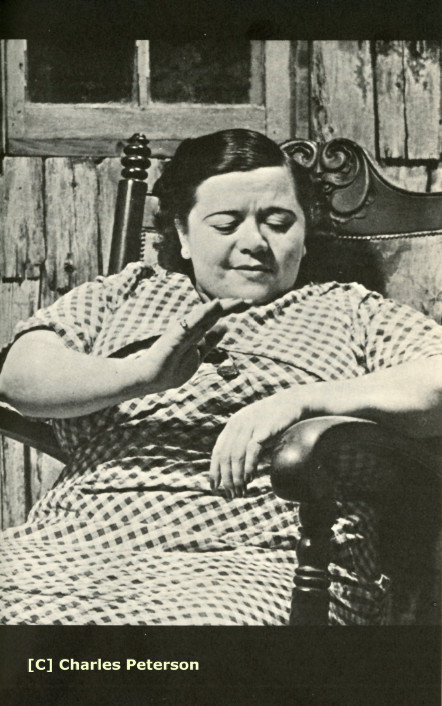
Not that her singing was ever slovenly. She was too fine a musician for that, too conscientious an artist, and sufficiently inventive to evade difficulties without betraying the evasion. A telling example is a recording of "Can't Help Lovin' Dat Man," where she repeatedly passes up a low E on "lovin'," reshaping the melody so artfully that only the purposefully attentive will note the discrepancy.
Those funked low Es are not the only remarkable or revealing feature of that performance. It is even more remarkable that the low Es are there to funk. She sings the Kern song in A flat, a fifth below the original E flat, in which she could easily have sung it without having to pass up any notes at all. This curious choice of key tells a lot about Mildred Bailey. It tells a lot, too, about the art and the vocation of other admirable singers working in the Afro-American idiom.
A term encountered over and over again in descriptions of Mildred's voice by those who knew her well and heard her often is "high-pitched." It was no such thing. She is frequently referred to as a soprano. She was not. The sound could seem high, even soprano-like, but the actual pitch was low. Her effective range was from a G below to an E above, or an octave and a sixth. She probably had more below. She certainly had more above, as may be heard on her 1939 recording of "St. Louis Blues," where she suddenly and easily comes up with a high G.
She had, then, a mezzo-soprano's normal two octaves from G to G. But she preferred to work in a narrower range. When a song, or the chosen key of a song, took her out of that range, she simply altered the notes to suit herself, as in "Can't Help Lovin' Dat Man." Even within her favored octave and a sixth, she took things comfortably, passing into head voice very early in the ascending scale.
This passing into head voice has been noted as a characteristic of both Bessie Smith and Ethel Waters. They had not the vocal technique to carry the full sound of the middle voice any farther. With both of them, the register break is conspicuous and sometimes disquieting. With Mildred it is not.
She, too, probably lacked the technical know-how. But she would seem to have been more aware of the break and its aesthetic consequences than either Bessie or Ethel were, and she got around it, as Bing Crosby was doing at about the same time, by easing into head voice well before it became the only alternative to vocal disaster. Instead of seeking, as opera singers do, to extend the quality of the middle voice upward, she extended the character of the light head voice downward, thus achieving a delightfully homogeneous quality throughout her range, if not without some sacrifice of fullness, power and amplitude in precisely those areas of the vocal compass where such attributes repose naturally.
She ascribed this evenness of scale to her experience as a child and young girl singing Indian music. Her mother was part Indian and, according to Barry Ulanov in his A History of Jazz in America, used to run through Indian songs with her. When the family moved to Spokane, her mother often took her over to the nearby Coeur d'Alene reservation. Ulanov quotes Mildred on what she learned there:
“I don't know whether this music compares with jazz or the classics, but I do know that it offers a young singer a remarkable background and training. It takes a squeaky soprano and straightens out the clinkers that make it squeak; it removes the bass boom from the contralto voice, this Indian music does, because you have to sing a lot of notes to get by, and you've got to cover an awful range.”
A matching of registers by easing off in the middle instead of stretching at the top has been common to many popular singers, who never learned it from the Indians, but may have learned it from Mildred Bailey. It has much to do with the failure or reluctance of European oriented vocal connoisseurs to appreciate them as vocalists and artists. The connoisseurs note the absence of the big sound while overlooking the subtleties made possible by its avoidance,
Mildred Bailey could have sung "Can't Help Lovin' Dat Man" in any one of several keys between E flat and A flat. She chose the lowest because it best served her communicative purpose. That the choice involved a melodic alteration betraying shortness of range at the bottom of the scale would not have troubled her for an instant, nor, probably, would it have troubled Jerome Kern.
It may have troubled less discerning listeners, not because they would have been aware of the distant transposition, but because they would have missed the vocal tension they were accustomed to in performances by other singers in higher keys. The opera singer Eleanor Steber, for example, transposed the same song upward to F and threw in a superfluous but vocally exciting high B flat, and a far too arty cadenza.
Mildred, as Red Norvo remembers her, "made you feel that she was not singing a song because she wanted you to hear how she could sing, but to make you hear and value that song." She may well have been to some extent a victim of her own good musical taste. She would have liked to be a commercial success. She made records with the strings and choir backings she thought would appeal to a wider public and thus offended her jazz-oriented admirers. As Bucklin Moon puts it, in his contribution to the CBS album:
“She chose to be neither the one thing nor the other, but a combination of all that was good in both. She was too deeply rooted in jazz to have a large popular following, and too commercial to be accepted by a jazz cult which, until recently, was unwilling even to admit that a musician who could read music could play jazz. . . . Songs that she introduced, records that she made, had an alarming habit of turning up as somebody else's hits. . . . She never lacked for a tight little following who loved and admired her, but somehow, just about the time you figured she had made it finally, it all started to come undone again.”
The result was a sense of frustration and resentment ill-housed in an ever volatile temperament. She was not always the laughing lady of Bing Crosby's portrait. Moon says that she was "salty as a fishwife," and he describes her rages as "monumental." John Hammond, producer of many of her CBS records, calls them "towering." Norvo, who knew her better than anyone else, passed on to Whitney Balliett an affectionate reminiscence of Mildred with her dander up. Norvo and Benny Goodman had gone fishing on Long Island. What with moving from one fishing hole to the next, they were gone two days instead of one.
“When I got home, I could tell that Mildred was hacked. Things were cool, but I didn't say anything, and a night or two after, when we were sitting in front of the fire — I was on a loveseat on one side and she was on one on the other side — Mildred suddenly got up and took this brand-new hat she had bought me at Cavanaugh's and threw it in the fire. So I got up and threw a white fox stole of hers in the fire, and she got a Burberry I'd got in Canada and threw that in. By this time she was screaming at me and I was yelling at her, so finally I picked up a cushion from one of the love seats, and in it went. The fire was really burning. In fact, it was licking right out the front and up the mantel, and that was the end of the fight because we had to call the Fire Department to come and put it out.”
Mildred's tragedy was not her weight, nor her diabetes nor her rages. These were problems, and they brought with them vicissitudes and bitterness. Her tragedy was that people could not hear her, during her short life, in the perspective we bring to her singing today. It is an old story. Ned Rorem, in his Music and People, has summed it up in a way which at once illuminates the inevitable frailty of contemporary evaluation and does tardy justice to Mildred Bailey:
“The open question of what will come is vain but tantalizing. Tantalizing, because it is the primal question of human nature. Vain, because historic events, even history itself, switch focus evew year as we funnel faster toward novel philosophies. Certainly we listen now to Mozart in a manner inconceivable to him: he was ignorant of Mascagni and Mildred Bailey, who came between to recondition us. . . .”
Similarly, we hear Mildred today with ears conditioned by our experience of Ella Fitzgerald, Billie Holiday and Frank Sinatra. Thanks to them, the vocal art that was uniquely hers in her youth is now widely appreciated. She was a great and lonely artist, born just a few years too soon. That was her tragedy, mitigated, one hopes, by the fact that she lived just long enough to see her genius and her insights perpetuated in the art of the great singers whom she inspired.”


