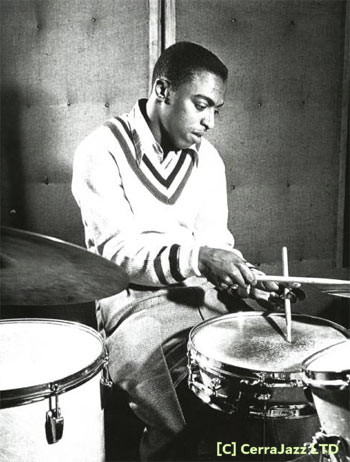
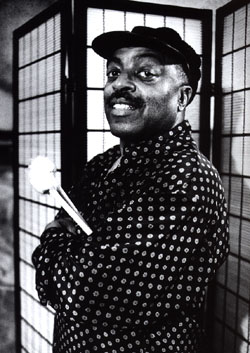
I’ll have more to say about Roy in an extensive future piece. Some of these observations on Roy’s style of drumming reflect the fact that he wasn’t what he referred to as a “rudimental drummer.”
Formal drum instruction is based around various exercises associated with the 26 standard drum rudiments which through practice help drummers develop coordination, independence and muscle memory.
Although the current term for it is “intuitive,” what this really means is that Roy was self-taught and his approach to the drums was not formalized by what Joe Morello refers to as “The Rules [aka The Rudiments].”
Over time, Roy developed his own style of drumming based on what he heard in his head, or as Shelly Manne once said: “I refuse to let my hands control my style.”
ALAN DAWSON: “Any Boston drummer couldn't help being influenced by Roy. I must have been eight or ten, something like that, when we first met. Roy always was a topic around the neighborhood. One thing that stands out in my mind about this guy. He always had great confidence in his ability. You never heard any tentativeness in his playing. My late brother said to me one day: ''Roy Haynes sounded the same years and years back. Even then he was a monster! He came to the music and drums ready and capable of dealing with both. Unlike most other musicians, he didn't have to go through a difficult learning phase."
Roy always has been adventurous—absolutely fearless. He plays whatever bethinks is right, regardless of the context. Only in recent years have people come to realize how important and talented he is. For a long time, only musicians, and a few writers close to the music, knew what he could do and how original he was.
Many felt Roy's playing was too far "out there"—beyond understanding— the same thing they used to say about Bird. Roy's breaks sometimes could puzzle listeners.
As you said, they don't always start on "1." And sometimes they might be short or go beyond "1," whether he was playing a four-bar break or a chorus. He does that purposely. He feels so secure in dealing with the beat and time that he never thinks: "Well, I really have to get this four bars just right." Roy finishes his idea, wherever it takes him. What he does works for him and for the music.”
PHIL BROWN: Roy was the first guy to come along and do something after Max. By 1948, Max had his approach to the instrument perfected. At about that time, Roy was introducing his way. It was totally different from what Max had established and, as far as I'm concerned, far more attractive, hipper, more stimulating.
He had his own language, techniques, and ideas. His breaks were completely different. He played all kinds of intricate things between the beats — ideas that other guys didn't play because their heads didn't work that way.
I heard him every chance I got—at the Savoy with Pres in '47, with Bird and other musicians. He completely gassed me. I bought a drum set just like his — with the three-by-thirteen snare. Roy was using Ludwig drums, so I had a set made up by Ludwig. Roy used a green sparkle. I had my set made up in blue sparkle.
A situation came up regarding the "tiny" snare drum when I went to work for Roy Eldridge. He said: "What are you doing with that? It sounds like a toy!" It didn't have enough guts for the music that the Eldridge band was playing. I had to get another drum. But it was right for Roy because he played all these inside, fast things. He got a lot out of the drum.
Later he began using tom-toms much more, and he was all over the set. He
has done so many interesting things: playing the ride rhythm differently by
stretching it out, approximating straight eighths; turning the beat around;
abstracting the time. What he does not only gives the music a fresh sense of
unity but forces everyone to pay attention.
Roy Haynes is a school of one. You've had countless Max, Blakey, and Kenny Clarke clones. But there's no one who can play like Roy. He's to the drums what Erroll Garner is to the piano. A school unto himself.”
STAN LEVEY: I loved Roy Haynes. He was different than Max, myself, and others. Roy was clean. He had these beautiful suits; he looked so sharp, man. He was a real good player—real good. He had nice time and technique and a beautiful drum set. We used to look at him and say: "How the hell did he do that?" We all knew. Simple. He wasn't a f**kup.
“Any Boston drummer couldn't help being influenced by Roy. I must hâve been eight or ten, something like that, when we first met. Roy always was a topic around thé neighborhood. One thing that stands out in my mind about this guy. He always had great confidence in his ability. You never heard any tentativeness in his playing. My late brother said to me one day: "Roy Haynes sounded the same years and years back. Even then he was a monster! He came to the music and drums ready and capable of dealing with both. Unlike most other musicians, he didn't have to go through a difficult learning phase."
Roy always has been adventurous—absolutely fearless. He plays whatever he thinks is right, regardless of the context. Only in recent years have people come to realize how important and talented he is. For a long time, only musicians, and a few writers close to the music, knew what he could do and how original he was.
Many felt Roy's playing was too far "out there"—beyond understanding— the same thing they used to say about Bird. Roy's breaks sometimes could puzzle listeners. As you said, they don't always start on "1." And sometimes they might be short or go beyond "1," whether he was playing a four-bar break or a chorus. He does that purposely. He feels so secure in dealing with the beat and time that he never thinks: "Well, I really have to get this four bars just right." Roy finishes his idea, wherever it takes him. What he does works for him and for the music.”
- Alan Dawson, Drummer and educator
“If you watch Roy and listen, you know that his early inspiration had to he Papa Jo Jones. The way Roy sits at the drums, the way he touches the cymbal. The whole thing comes out of his approaching the instrument as if it's fine china — and respecting it.”
- Dick Katz, Pianist and educator
“Roy and I worked together in Stan Getz's band. But I first heard him when I was in the Army at Fort Meade, near Baltimore. Pres and his group were appearing in a local club. Roy gave every indication he was a very talented young guy. I had never before experienced anyone who played quite that way. He was so light with sticks. His sound was bright but not loud. Roy had his own way of doing things. Even then, he could do pretty much what he wanted on the instrument.”
- Bill Crow, Bassist
“Roy was the first guy to come along and do something after Max. By 1948, Max had his approach to the instrument perfected. At about that time, Roy was introducing his way. It was totally different from what Max had established and, as far as I'm concerned, far more attractive, hipper, more stimulating.
He had his own language, techniques, and ideas. His breaks were completely different. He played all kinds of intricate things between the beats — ideas that other guys didn't play because their heads didn't work that way.
I heard him every chance I got — at the Savoy with Pres in '47, with Bird and other musicians. He completely gassed me. I bought a drum set just like his — with the three-by-thirteen snare. Roy was using Ludwig drums, so I had a set made up by Ludwig. Roy used green sparkle. I had my set made up in blue sparkle.
A situation came up regarding the "tiny" snare drum when I went to work for Roy Eldridge. He said: "What are you doing with that? It sounds like a toy!" It didn't have enough guts for the music that the Eldridge band was playing. I had to get another drum. But it was right for Roy because he played all these inside, fast things. He got a lot out of the drum.
Later he began using tom-toms much more, and he was all over the set. He has done so many interesting things: playing the ride rhythm differently by stretching it out, approximating straight eighths; turning the beat around; abstracting the time. What he does not only gives the music a fresh sense of unity but forces everyone to pay attention.
Roy Haynes is a school of one. You've had countless Max, Blakey, and Kenny Clarke clones. But there's no one who can play like Roy. He's to the drums what Erroll Garner is to the piano. A school unto himself.”
- Phil Brown, Drummer
“This guy was sitting in and playing the greatest "fours" that I had ever heard — incredible commentaries in four bars. It was Roy Haynes. His breaks, solos, the general feeling of his time all were unusual. His personality came through in what he played.”
- Ira Gitler, Jazz author, producer and critic
“I loved Roy Haynes. He was different than Max, myself, and others. Roy was clean. He had these beautiful suits; he looked so sharp, man. He was a real good player — real good. He had nice time and technique and a beautiful drum set. We used to look at him and say: "How the hell did he do that?" We all knew. Simple. He wasn't a f**kup.”
- Stan Levey, drummer
“Half of Bird's [Charlie Parker’s] band was kind of crazy. But Roy always was cool. Clean-living, healthy. We depended on him a great deal. He was like a Rock of Gibraltar. Roy didn't have a bad night in the almost three years we worked with Bird.”
- Red Rodney, trumpet player and bandleader
“He's the perfect guy for trying new stuff. He's a free soul with extraordinary instincts— much less tied to the traditional drummer's role than almost anyone. He's a great model for how we all should be. There's this tendency to go stale musically, to kind of get stuck at some point. And he never does.
We've been together since the 1960s in a variety of situations — with Stan Getz and in my bands. Roy takes chances if he's attracted by the possibilities of anything. When he first played in my band, with Larry Coryell [guitar] and Steve Swallow [bass], we were young guys with long hair and beads, involved in the jazz/rock thing. Roy dug what we were trying to do, though he must have been given grief by people of his own age. They must have said: "Man, what are you doing playing that weird music with those kids?" But it "happened," because Roy can play anything with anybody and make it right for everyone.”
- Gary Burton, vibraphonist and bandleader
“I feel instantly comfortable with Roy Haynes. He's so easy to play with, so fun, because everything is so perfectly subdivided and perfectly enunciated. He's so fluent rhythmically with every little thing he does that you can fit right inside it.
To play effectively with Roy, you have to be confident and secure as a
musician. You have to know where you are in the song and where you are in the bar — because his whole thing is displacement. The people who seem to enjoy playing with Roy the most are those who are pretty advanced rhythmically.”
His stuff is very complex, but at the same time, it sounds simple and inviting. The way he makes the subdivision between the hands and feet is the essence of his style.”
- Pat Metheny, guitarist and bandleader
“Roy plays like a man on a tightrope. Even when you think he's going to fall, he gets it together. The sound of the instrument and how he plays it is always in my ear. I'm fascinated by the way he handles time, the way he shuffles the beat around, the way he manipulates it—instead of playing "2" and "4" on the hi-hat, he might play "1" and "3."
He can bring you to the edge of your seat. You say: "Wait a minute!" But then he'll do something else and come out on "1" and you'll say: "Oh, okay." You can't typecast Roy Haynes, He does everything. Tony [Williams], Elvin [Jones], Clifford Jarvis—all those guys come from Roy. Within a few beats, in 4/4 time, he can take a listener around the world.”
- Kenny Washington, drummer
As all of the above accolades attest, Roy Haynes holds a special place in the history of Jazz drumming.
In his Une Histoire de la Batterie de Jazz [2000], George Paczynski calls him “Le père de la batterie contemporaine’ - the father of contemporary drums. He goes on to say that “Certains musiciens patientent de très nombreuses années avant d'être reconnus.” Some musicians wait many years before being recognized. Such is the case of Roy Haynes.
But it’s never been that complicated for Roy: “I am a natural drummer first and foremost. Some people are born with a gift from God, and whatever that gift is, it's natural. As far back as I can remember, I've always played rhythms."
If truth be told, many of the drummers associated with the advent of Bebop in the 1940s were largely self taught and had a natural gift for rhythm among them Stan Levey, Shelly Manne, Art Blakey, Philly Joe Jones; even some of those who came along later - Art Taylor, Jimmy Cobb and Albert “Tootie” Heath - all were largely “natural drummers.”
In a way, this lack of technical training is what helped give them their individual styles: one press roll and you knew it was Art Blakey; aggressive, rat-a-tat-tat assertive and active accompaniment was Philly Joe Jones’ trademark; melodically blending drums into any setting was a chief characteristic of Shelly Manne’s approach to the instrument [he used timpani mallets!].
While the unsurpassed, highly technical drumming of Buddy Rich, Louis Bellson and Joe Morello was something to be admired, it was not something these self-taught guys aspired to. Lengthy, complicated, and challenging drum solos impressed them as much as they did many Jazz fans, but they had little interest in playing them.
Haynes received his first major shot in the jazz press in the December 1, 1950, issue of Down Beat. Pat Harris, a discerning writer, profiled the drummer. Harris said: "Musicians, drummers included, agree that Haynes, a 25 year-old Boston boy, is one of the most rhythmically exact, musically meticulous men working over a snare and cymbal today."
That same year, Haynes began playing with tenor saxophonist Stan Getz, a subtle, lyrical player who recast the Lester Young style, emerging with a stimulating, identifiable, communicative manner of expression. A large listening public embraced Getz almost from the beginning of his career as a bandleader.
Getz had several excellent drummers in his band over the years. But the saxophonist had special feelings for Haynes because the drummer brought quiet intensity and an ongoing sense of creativity to the music.
Haynes's records with Getz tell a story of discretion, swing, and rhythmic surprise that, in sum, raised the level of everyone involved. His best recording with Getz, according to the drummer, is "I'm Late, I'm Late," which opens Getz's extraordinary 1961 Verve set Focus, composed and arranged by Eddie Sauter.
The work comprises seven sections. Getz improvised over, through, and around what was written. The nature of the music and the performances themselves made it impossible to splice takes. On the Haynes feature, the takes were so good and so different one from the other that recording director Creed Taylor decided to use both, tacking them together.
Haynes's spontaneity and ability as a brush player bring to the music an unusual, underlying spirit. He acts out what he feels, activating Getz and responding to him and the strings (ten violins, four violas, two cellos, a bass, and a harp). He brought to the session only a minimal set: snare and an open bass drum. The hi-hat is used essentially as a color source.
Haynes's buoyant patterns behind Getz and the strings draw you into the piece. Often he breaks into conversations with Getz and the supporting musicians or speaks for himself. It's a matter of pure instinct guiding Haynes's hands and feet. The piece moves swiftly. Veteran critic Dom Cerulli, the writer of the liner essay, noted: "The pace immediately calls to mind the rush hour or the flight of the ‘Mad Hatter to the Tea Party in Alice in Wonderland.’"
As Haynes played more and more in diverse contexts (did you know he played with Lennie Tristano and George Shearing?), he grew as an artist and had an increasing impact on other drummers. Though a major presence within the jazz community, for a number of years he was comparatively unknown to the public. Despite Haynes's declarations to the contrary, this implicit rejection hurt him — all the more so because he had a continuing effect on how the instrument was played in a jazz sense.
Haynes is not formally trained. He relies completely on what he feels and hears. Many of the things he articulates are technically breathtaking — some on several levels at once, suggesting a variety of feelings and more than one time signature. You hear the history and progression of jazz and elements from allied idioms, notably Latin, mixing and mingling. He takes full advantage of the sound and color possibilities of each drum in the kit.
Unlike those who have undergone years of training, he doesn't readily realize that what he plays is particularly difficult. Naturally talented drummers like Chick Webb, Shadow Wilson, Jo Jones, Buddy Rich, and Haynes hear the music and that's all they need to proceed. What comes out is often as surprising to them as it is to colleagues and listeners. It's a partially controlled happening, couched in their instantly identifiable language. These crafty, deeply gifted percussionists introduce new functions and concepts and puzzles for others to solve. Not always understood at the outset, these innovators and their work are ultimately vindicated.
For Roy Haynes, playing drums never has been just a matter of "ding-ding-a-ding"—straight time on the hi-hat or the top cymbal and symmetrical, supportive strokes on the snare and four beats to the bar on the bass drum. Even in the early days in Boston, Haynes had a tendency to break things up, making the rhythms more interesting to him and to those who worked with him.
Haynes performances, taken as a whole, are a major departure from what listeners expect, The techniques that bring reality to his thoughts - except in the very early days — are of his own making. His performances often take the form of a story: sharply honed sentences, melding into brisk paragraphs and chapters, building to conclusions. All of this is made possible by his talent for time and improvisation. Haynes makes fresh and provoking music on an instrument where music, as such, is uncommon,
Duke Ellington, whose range of interests always was admirable, had to replace Louie Bellson in 1953 when the virtuoso drummer wanted to form his own band and join wife Pearl Bailey on the road. Bellson suggested that Ellington call Roy Haynes. The Maestro called and offered him the job. The drummer was flattered and appreciative, but he felt many of the Ellington veterans might not feel as strongly about an "experimental drummer" as Ellington obviously did. Haynes politely turned the offer down. Though he subbed with the Maestro, and with Basie later on, he never worked with them on a full-time basis.
The diminutive, self-contained drummer was crucial to establishing what the late drummer-teacher-percussion historian Charlie Perry called "the new thing in jazz drumming." Haynes did this by coming up with so many things first. As an accompanist relating to other instruments and as a soloist, he paved the way for Elvin Jones, Tony Williams, Jack DeJohnette, and others who bear collective responsibility for moving the instrument into relatively unexplored regions — musical areas that generally tax your sense of comfort and understanding until an almost inevitable epiphany makes sensible and exciting and edifying what previously seemed without rhyme or reason.
Though Haynes actively has been a part of change in the Jazz idiom for most of his career, there is the existing reality of making a living. At some point, there's the pressing need for a steady job that pays well — hopefully, one that doesn't demean the musician's art and provides opportunities to be expressive.
Haynes was fortunate. He caught on with Ella Fitzgerald in the summer of 1952,. The following year, he joined singer Sarah Vaughan and remained with her until 1958. Listening to their records together on Mercury, I was reminded how gifted Vaughan was. Comparable to a great jazz horn player in her investigative treatment of songs, she offered performances that rarely, if ever, were pat, redundant, boring, or excessively show business oriented
Generally more restrained with Vaughan, the drummer served the concerns of the singer quietly, yet remained Roy Haynes, a distinct presence
As Haynes explained it: “I've learned so much more about life and music—met and played with so many people [since the years with Charlie Parker]. It's all there in what and how I play. Tell you one thing: I'm only happy when I'm moving forward. Some musicians play the same songs the same way every night. That's impossible for me. My fundamental style may not really be different. But there have been so many things added.
I'm always thinking about playing and what I want to do—and how to do it. I work things out in my mind when I'm traveling, sitting around the house, even while I'm eating. It's constant. I don't practice; it's not my thing. I didn't practice even when I was a kid. I just wanted to accompany someone. I wanted to be able to play with someone. I did it to the ultimate with ‘Trane. To the ultimate, man! When we were together, there was that very special freedom. We had an equal partnership. I could play all the things I dreamed of playing. You can't do that with too many people.”
Haynes felt the same connection to the playing and writing of Thelonious Monk. He was challenged to get inside the music, be a part of it, move beyond what he had done before. How the drummer responded to Monk is well illustrated on Thelonious in Action (Riverside), the 1958 live session at New York's Five Spot, co-featuring Johnny Griffin (tenor) and Ahmed Abdul-Malik (bass). On another set, The Thelonious Monk Quartet Featuring John Coltrane—Live at the Five Spot—Discovery! (Blue Note), he is strongly motivated to act creatively both by Monk and Coltrane. Haynes allows Monk's compounding of rhythm, melody, and harmony to guide him. He doesn't turn to preconceived modes of rhythmic behavior. Haynes frames and extends what the thematic material and soloists say, infiltrating the music with his personality, building to bursts of energy.
The time is always implicit, no matter where Haynes goes. The cymbal rings. The hi-hat breathes in tempo. His left hand chatters on the snare. The bass drum serves multiple functions in development of the rhythmic line.
Haynes is a discerning, controlling presence in the music, condensing, expanding, balancing what's being said. He places comments, asides, punctuations, and accents in places that enhance interest for the players and listeners. Basics of the Haynes language include flams, rolls, quarter-note and broken triplets, and ruffs of various lengths. How they're used adds to the potency of each performance.
Haynes takes an educational multilevel solo on Blue Monk (Thelonious in Action), moving into double time, slowing and speeding up for expressive effect, putting a variety of thoughts together with flair and concision. He is equally effective as a solo voice on Evidence — a little over a chorus based on a five-stroke idea that grows, varies, and keeps you nailed.
Throughout these recordings, the drummer's connective tissue — the ideas and techniques that tie things together — often is so imaginative and fitting that it makes you smile broadly. His associates on the Monk recordings have no problem because, no matter how chatty Haynes becomes, he seldom gets in the way of the other players' thoughts — particularly after they've become acclimated to his style.
His range of dynamics is incredible. He gives you the feeling of floating out in space. He is the perfect foil for Monk's relatively heavy-handed approach. They complement each other. A lesser artist would have sounded feeble.
Haynes's work with Coltrane is clearly a matter of great compatibility, passion, love, and understanding. You hear it throughout the Five Spot CD with Monk and on Coltrane Impulse CDs, particularly the one done live in Newport in 1963. The two take flight, brothers on intimate terms with the same muse. John Coltrane — Newport '63 has to be listened to. It provides a great lesson in mutual creation. They push each other to the edge; one boldly acts on the other. The performances — try Impressions — achieve an almost hysterical heat.
Listening to Haynes records, you can't help being impressed by the
drummer's extraordinary ability to play for the circumstances. With Eddie "Lockjaw" Davis's big band on Prestige, he lays down the time; the band
and soloists have an appropriate foundation on which to lean. With Bud
Powell and Fats Navarro (Blue Note), he's the personification of bebop,
bringing his own modifications of the style to the fore. With Eric Dolphy
(Prestige), he allows the experimental alto saxophonist freedom to do what
he will and, simultaneously, is accommodating, understanding, musically
encouraging. With pianist-composer Andrew Hill, on Black Fire (Blue Note), Haynes adeptly immerses himself in this very personal music. He
works compatibly with both the ensemble and the soloists. Every
instrument in Hill compositions has a role. The player is expected to serve
the music and be an individual. Haynes does exactly what is expected of
him—and more.
The well-recorded early 1960s set on Impulse Out of the Afternoon, with Haynes as leader and featuring Rahsaan Roland Kirk (reeds), Tommy Flanagan (piano), and Henry Grimes (bass), is another must-have recording. The reasons soon become apparent: Haynes's wonderful time; his sound and articulation over the entire instrument; typical Haynes rhythmic counterpoint, which feeds the flow of the other instruments; his ideas, expressed with an almost defiant buoyancy: his patient, colorful ballad performances— and the Haynes solos.
Pianist-composer Chick Corea has been a very important musician in the middle phases of the drummer's career. Haynes first worked with him in the Stan Getz band. One of the most influential Haynes records, Now He Sings, Now He Sobs, was made with Corea in 1968 on Blue Note. It presents Corea, who often mirrors his Latin background in his writing, the musically literate, firm yet free bassist Miroslav Vitous, and Haynes, enhancing the music and the work of his associates, very much in a give-and-take mode. He plays the role of the percussionist. He concentrates on communicating with colleagues, color, and his own view of time.
The three men engage in meaningful exchanges There are frequent suggestions of a Latin base in this music. Haynes—a longtime devotee of timbale drumming—more than suggests the Latin tinge, the underlying reference in the music. Freedom, time signature variety, and some abstraction are notable in the Corea pieces. But it's the physicality and swing of the performances and their thoughtfulness that catch hold of you. Try "Steps." What Haynes does is a matter of true improvisation. His work here tells you a lot about his techniques and how very potent they can be.
Two other continuing associations, with Gary Burton and Pat Metheny, also have been very meaningful to Haynes for a number of years. The music of both, like that of Corea, is adventurous yet never so far afield that it loses connection with the central rhythmic root feelings of music.
Roy Haynes has lost nothing with the passage of time—a rare situation indeed. The drummer's records of the 1990s (on Dreyfus, a French label) with his own band, featuring Dave Kikoski, a fine young pianist, document his continuing capacity to be better and better.
Now that the world has found Roy Haynes at last, it's making up for lost time and perhaps a sense of guilt. Awards and honors, large and small, frequently come his way. The press salutes his "startling" talent and his capacity to survive and grow. This is somewhat reassuring to all of those who have admired him for so long. That talent can ultimately lessen cynicism.
His palette is larger; his technique has grown. His talent is well cared for and lustrous. Always sage and sensitive in his management of drums and cymbals, he makes each experience pay its way. Every part of the kit — from the unknown corners of the snare to the tom-toms and cymbals to the rims of all the drums — plays a role in his classy offerings. Drums have revealed their special secrets to him.
Roy Haynes has the fancy cars, the great clothes, the bread, the fine ladies, the home, the comforts — all the trappings of success. Why not? You should get what you deserve.
[The editorial staff at JazzProfiles is indebted to the following source for information about Art: [1] the drummer world website, [2] Modern Drummer magazine, [3] Kenny Mathieson, Cookin’: Hard Bop and Soul Jazz, 1954-1965, [4] Burt Korall, Drummin’ Men: The Heartbeat of Jazz – The Bebop Years, [5] Georges Paczynski Une Histoire De La Batterie De Jazz Les Années Bebop, La Voie Royale et Les Chemins de Traverse and Downbeat magazine.
The late Paris-based jazz musician and International Herald Tribune writer Mike Zwerin posted a 41-week series entitled Sons of Miles toCulturekiosque Jazznet.In this series, Zwerin looks back at Miles Davis and the leading jazz musicians he influenced in a series of interviews and personal reminiscences. Here is the Roy Haynes piece in that series. It was published on October 29, 1998 so add 20+ years to any math in the article.
Roy Haynes: No Beats to Waste
"Stan Getz liked my beat, he loved to play with Roy Haynes," says Roy Haynes, who likes the sound of his Third Person.
Positive subjective judgments sound more objective from that perspective. In his case, the sound itself implies stature. Lester Young told him: "You should be called the Royal of Haynes." Roy Haynes is the only drummer to have played with (not all at the same time) Louis Armstrong, Lester Young, Charlie Parker and John Coltrane.
Others also tend to refer to him with both names, running them together, syncopated - Royhaynes, accent on the "Ro." It sounds like him. Dorothy Donegan says he's getting to look more like Count Basie drummer Jo Jones every day. Which means to say royal, clean, crispy.
His discreet, flexible tatoo controls the time and space and the dynamic of whatever formation he's part of. He's compact, energy-packed, confident. He chooses his shots. He's a warrior, the battle plan is his: "Remember Town Hall a few years ago? You were there. I put Michel Petrucciani in the pocket. I'm known for putting cats in the pocket. That's what I do." (The "pocket" is the place where the pool-ball of tempo should be shot.)
It started in 1944 at the age of 18 with Frankie Newton and Sabby Lewis in his hometown Boston. His style eventually became so pervasively subversive that, without being known as a leader, or even a "star," he is behind certain key elements common to an eclectic list of people including Art Pepper, Sarah Vaughan, Chick Corea, Thelonious Monk, Eric Dolphy and Gary Burton (Larry Coryell, Steve Swallow and Roy Haynes were the rhythm section for Burton's mid-'60s groundbreaking jazz-rock fusion efforts). From 1961 to 1965, he was Elvin Jones's principal substitute with the John Coltrane Quartet.
Trane described his time as "spreading, permeating." Leaving Charlie Parker to form his own band, Max Roach advised his boss: "Hire Roy Haynes."
The British critic Brian Priestly wrote: "Roy manages to be intelligently insistent and provocative in accompaniment without overpowering the soloist." Jazz Hot magazine put him on its cover when he arrived in Paris in 1954 with Sarah Vaughan. (Roy Haynes was impressed with a culture interested in the drummer, not the star.) "Roy Haynes should be immortalized," said Sonny Rollins. "I can dig his statue somewhere, like the one of Sydney Bechet in Antibes."
Although universally acknowledged as a prime mover by soloists, leaders, critics and other drummers, the general public has never truly appreciated his stature. When I asked him why he thought that was, he looked at me with astonishment: "You think I'm not appreciated? Man, you must be getting out of touch, living here in Paris.
"I was giving a lecture for a workshop in Massachusetts and when they announced 'Roy Haynes,' the kids shouted - kids are so hip these days - they shouted 'Yeah yeah yeah' and cheered and applauded. They just went crazy. I got a standing ovation for just standing there. I hadn't even played yet. It just happened. Boom!"
After hearing him in Chicago one night, a reporter from Down Beat magazine said he didn't know he could play like that. Haynes did not consider this a compliment: "You know, I'd been doing it for a long time. And he wanted to know where I'd learned it. Man, a lot of drummers copped my important stuff. I was there first."
He had the distinct impression that the reporter was surprised he could do an Elvin Jones impersonation so well. But Roy Haynes knew for a fact that Elvin had been listening to him play that way back in the '50s, before anybody else was doing whatever you call it - "spreading the rhythm," "suggesting the beat," "elastic," "melodic," "permeating."
This is the way the most advanced drummers like Jeff (Tain) Watts (with the Marsalis brothers) and Jack DeJohnette play now. Any credit withheld from him is not the drummers' fault, they all admit their debt to Roy Haynes. But it's been going on so long and it just got to him this time. He couldn't resist telling the reporter: "I think you should talk to Elvin about that."
"I'm an uncrowned king," he says, head held high. "I don't have to win any polls to know that." He does not win many. "I'm cool, I know. I've been to the mountaintop."
Along the way, he began to dress like royalty - custom-made suits, Italian shoes, sharp hats. Esquire magazine put him on their best-dressed list. Along with Miles Davis, one of only two African Americans, and only two jazzmen. The New York Times referred to him as "the dapper drummer." he started to suspect that he was better known for his clothes than his drumming. It got to be a "mixed blessing, still is. If I have a hole in my sock, some girl will say: 'Hey, I thought you were supposed to be well dressed.'
"I have a 10-speed bike, quite a few grand-children, and two Doberman pinschers. I have an original 1974 Malcolm Bricklin car. You know, he was De Lorean's buddy. I win prizes with it. I live in Freeport on the south shore of Long Island, not far from where Guy Lombardo used to live. I don't work a lot. I don't have to. I've made myself comfortable. It's good for the mind to play music, but now people are asking me to back up singers and do all-star tours with a whole bunch of horn players. That stuff is not good for the mind. I need time to think and dream. I'm a dreamer.
"Some agent called and asked me to lead a sort of Art Blakey ghost band, he even suggested I get some of the guys from the Jazz Messengers. His point is it would make a lot of money, and he does have a point. But why should I do that? It doesn't mean anything. This cat has got to be joking. Man, I played with Bird, with Trane, I played with Billie Holiday. Art Blakey used to admire me.
My career is catching up with me. I call my own shots. I only play on Roy Haynes dates. I'm the leader. I do what I want to do when I want to do it. When I play, it has to mean something. Let it float like a balloon. I'm talking about jazz. Other people did it, but Roy Haynes did it and did it and did it.
"I don't like to pin compliments on myself, but..." Yes he does: "...But I'm one of the last innovators from the '40s who's still out there saying something new. I couldn't really be myself with Trane or Getz because my job was to accompany them. They came first, that was my role. And it was cool. They didn't need a drummer juggling between his right and left feet and hands getting in their way. But my kids are grown up, my mortgage is paid and now I don't have to worry about making anybody sound good but myself.
"I have a good band now. Young guys, they play the way I like. Anybody else wants me to play with them, it has to be somebody I respect, somebody who wants to take risks like I do. Guys like Pat Metheny" on "Question And Answer," with Dave Holland, bass, Geffen Records. Dig it. This is my religion. It's what I believe in. I don't waste beats. Roy Haynes has no beats to waste."”
Since around 1960, Down Beat has been running an annual drum edition which is generally filled with profiles, interviews and reviews of select drummers and their music.
The late Roy Harte [1924-2003] who owned an operated Drum City on Santa Monica Blvd., Hollywood, CA for many years was fond of saying that: “ Drummers are like hockey goalies; you gotta know how to talk with them.”
Unlike brass, reed, woodwind, string and keyboard players with their common language in melody and harmony, Jazz drummers, for the most part, speak in rhythm. They are focused on the way the music MOVES.
In this regard, I’ve oftentimes thought that Jazz drummers have more in common with dancers than with melody and harmony instruments.
While poised precariously on the tip of a drum stool, all four of a drummer's limbs are in motion at the same time, each doing separate and distinct things on various drums and cymbals to generate the rhythmic flow and metronomic pulse that is a singular characteristic of Jazz.
Some of my happiest memories involve hanging out at Drum City on Santa Monica Blvd. or around the corner at the Professional Drum Shop on Vine Street in Hollywood and talking “shop” with other drummers.
You’ve never seen such animated conversations with everyone talking with their hands and feet while describing some aspect of drumming.
Who knew they were all Italian?
The following appeared in the November, 1998 Down Beat and was conducted by Ed Enright, the former and now retired director of the Institute of Jazz Studies at Rutgers University in New Brunswick, NJ.
“Louie Bellson, Roy Haynes, Elvin Jones and Max Roach are like four giant planets.
Fellow musicians gravitate like meteors, and hangers-on constantly orbit like satellites. Getting them together is like orchestrating the Harmonic Convergence — a once-in-a-lifetime celestial phenomenon.
Avedis Zildjian Co., the 375-year-old cymbal-maker, made it happen this September [1998] when they paid tribute to these four jazz drumming heavies, septuagenarians all. Billing it the American Drummers Achievement Awards, Zildjian called on a younger generation of drummers — Steve Gadd, Terri Lyne Carrington, Peter Erskine and Marvin "Smitty" Smith — to perform in honor of Bellson (74), Haynes (73), Jones (71) and Roach (74), respectively. Proceeds from the bash, held at Berklee College of Music in Boston went toward scholarships in each of the honored names.
The day before the big event, Down Beat held a roundtable discussion with the foursome in the privacy of the Friends Lounge, upstairs from the Berklee Performance Center. (We also heard from the honorees during a brief press conference the afternoon of the show; a few of those comments have been integrated into the following interview.)
After posing for a quick photo session, Bellson, Haynes, Jones and Roach drank a toast of red Italian wine, sat down and were ready to roll.
Ed Enright: Have the four of you ever been together before?
Roy Haynes: I know we've all been together separately, but not all four of us.
Elvin Jones: Not at the same moment. This is the first time for that.
Enright; What does it mean to receive this honor? How does it make you feel to be together for this?
Haynes: I'm glad to be here with these guys. Somebody said I was in good company to be with Max, Elvin and Louie. I'm looking forward to it. But I would like to hear these guys play! That would really knock me out. I'd sit back and just check 'em out! We've got some youngsters playing tomorrow, so it'll be cool.
Max Roach: It brings back a lot of memories. For example, I remember the time that Louie Bellson and Buddy Rich and Gene Krupa ganged up on me because I had won this DownBeat poll. I was the first black musician to win a poll for the magazine. So they went to California with Clark Terry and me, and here I was on the stage with these three killers. What a night that was! When I first heard Elvin, the band with Brownie [Clifford Brown] and them came to Detroit, and I got sick and I had to stay home a couple nights. Every night when the gig was over, I'd hear them coming down the hall happy. Laughing. This is Elvin, now, so I thought, I'd better get well and get myself back to work. Quick! Elvin Jones, he was a baby at that time. Roy Haynes, every time we came to Boston, Roy was the killer in Boston. When Roy finally got to New York City, Bird (Charlie Parker| hired him. I left and went on the road with Benny Carter, and Roy took my gig and kept it! [Laughs.]
Louie Bellson: It's a very special honor for me because I consider myself a student of these three teachers. I started with Big Sid Catlett, "Papa" Jo Jones, Max Roach, Roy Haynes and Elvin Jones. These are truly my teachers. Anything I do today is a reflection of what they showed me. Max, I recall in the '40s when we did two drum-set clinics in Brooklyn for Henry Ader. Saul Goodman was there for tympani and Burt Morales did the Latin thing. After I played, Max came to me and said, "Louie, you play so wonderful, can I add a comment?" I said, "Yeah, of course." He said, "Why don't you learn how to play melodically?" I said, "What do you mean?" He said, "For instance, if you're playing 'Cherokee,' build your solo around that tune of 'Cherokee.' I never forgot that. It put me on a new avenue. Of course, many times I've listened to this gentleman here, Roy, and also Elvin. I'm especially honored to be one of the four honorees. And I think it's marvelous that this is happening, because what we've done so far can be a reflection on some of the students coming up: to love your craft and do the best you can and add something to this wonderful history of drumming.
Roach: Let me just say something about Louie and what an inspiration you were to me. As a composer and an arranger, you stood out in the crowd. Louie Bellson was a craftsman, one of the few people whose music Duke Ellington played. Mercer [Ellington] always complained that his father never would play his music. When we did a record dedicated to Charlie Mingus, Duke invited us all to participate and asked us all to bring compositions, and we played your music as well. We got to the studio, and Duke was at the piano — Louie, you're probably familiar with this sight— he was already writing stuff, putting stuff down. When we finished the date, we didn't play anything of Mingus', we didn't play anything of mine! [Laughs.] But we recorded Louie's. Louie to me was as much a drummer as he was a composer and an arranger. I especially remember the tune "Skin Deep."
Bellson: That was actually written in 1947. Of course in those days, Tommy Dorsey or Benny [Goodman] had their own arrangers. I just wrote to keep my hand in composition. Then when Juan Tizol and Willie Smith and I joined Duke, Tizol said, "Bring those arrangements into Duke." I said, "Juan, are you crazy? Me bringing in arrangements to Duke Ellington and Billy Strayhorn? No way!" So finally, Duke came to me and said, "Bring the music in." So, reluctantly, I brought in "The Hawk Talks" and "Skin Deep." I was just flabbergasted that he wanted to hear some of my music. Even if he just heard it during rehearsal, that was good enough for me.
Roach: That was a great piece, "The Hawk Talks." I forgot about that one. But that was an inspiration to the few drummers who did do a lot of writing. It got me really on it. I was always trying to do something in that area. The drums are a hell of an instrument, and people don't always recognize that.
One of the things about Elvin that has always mesmerized and fascinated me was the way his mind worked on that instrument. He uses all four limbs, not just contrapuntally — not left, right and against each other — but as a composer. No matter how much you watched and listened, there was something else. And there were a few people like that: [To Bellson.] You mentioned "Papa'' Jo was one of the great masters, and of course Big Sid. The track Jones set is an innovation that came out of the United States, where you charge with all four limbs, you charge. And Roy Haynes was another one who came to New York with all that stuff. Stuff was happening from every other direction. Then when I learned that Elvin played guitar, that really fascinated me. It was very musical. I had no idea about Elvin until he came to New York. He just shattered the vernacular, as did Roy.
Jones: This is the first time a manufacturer has recognized their endorsees as contributors to the musical art form. I think it benefits not just the four of us, or the next four artists, whoever they may be; but it provides a kind of inspiration for the students. It gives them a motivation. This isn't something that just gets printed in the paper. It's something that recognizes what you have done, what you have accomplished with your life as a musician. I think that's what is most important about the whole event, I think, that in the future it will even be more significant because now a precedent has been established. And I think it will be followed up in greater numbers, with more manufacturers setting up Scholarships for other universities and music schools across the country.
Enright: The four of you share what seems to be an instant rapport. Would you say that's true of drummers in general, more so than other instrumentalists? Drummers of all styles seem to learn from each other and feed off each other.
Jones: You say "drummers" as if we're a different breed from anyone else. I don't think that's true. Drummers are certainly musicians, and they may even be more musical than other instrumentalists. But when you imply that drummers are more of a fraternity, I don't think that's true. It's just that when we're together, we know that we share something, something in common, something very essential in our life... which is a drum set. We use it for musical expression. But all musicians do that, I think: piano player, the woodwinds, the reeds. So I can't say it's anything exclusive in that way, but I think it may appear that way sometimes.
Haynes: I agree. Every time I go somewhere and we have a discussion with musicians, I always learn something. That's one of the things I've been doing with the music: I try to keep my ears open because I'm learning from what he's saying. But I've often heard people — even years ago — say that drummers were closer. I mean, I heard people say that in the '40s and the '50s, so there is something to it. First of all, the drummer is the heartbeat, I and there's something about drummers. I don't know what it is, but I've felt it in a lot of the older players. But I like what Elvin's saying about us all being musicians. There's a joke that I heard once, I think when I was with Ludwig. They were having a meeting, and they said all the musicians should be there at a certain time, and you drummers can come, too, if you want to!|Laughs.| That's an old one.
Roach: We had a little abuse that we had to deal with, we were discriminated against, and we had to band together, I guess, so we defend and protect each other.
Haynes: Max Roach, this guy, he was the first of the drummers, especially the black drummers, to get credit from where I was sitting, and I've been doing this since the '40s. I've watched him and Sid Catlett and Jo Jones—as great as he was, he didn't get enough credit from where I was sitting. Cozy Cole, to me, got a lot of credit. He played the drums with Cab Calloway. He did a movie, Stormy Weather or whatever movie it was, and he also had a drum school. But this guy [Roach") was the first person around my age to really get noted.
And this guy, Elvin... I was playing with Ella Fitzgerald in the '50s at Cafe Society, and Hank Jones was playing piano. This young guy comes in and Hank says, "This is my brother." That's when I first met him. That was in the '50s, before I went to Detroit.
Jones: I was just visiting! Haynes: That's the first time I met you. Hank said, "He plays drums," and I said, "OK!" So later on in the '50s, I think I heard him from playing with Mingus and Harry "Sweets" Edison. I used to go to Detroit a lot, and I would always go by the Bluebird, a club where Elvin was working. I would sit and hang out with this guy. That's how we met. There's something about each of these guys that I've connected with.
Roach: This is very special because Zildjian has opted to recognize the instrument itself. As Roy just told in that funny story about drummers—we're the outcasts. The drummer is not really considered a musician.
Haynes: You guys helped change that, though.
Roach: And when I think about composition, our instrument—and I know I'm being partial here—brings a special something to the world of composition. Maxine [Roach, Max's daughter], for example, who's a string player, did a piece off a drum solo which was mine. She made the bass drum the cello, the cymbals became violins, and so on. It was a magnificent piece. She took the drum solo and just orchestrated it for strings, it showed me something about that instrument. I told her, "Now, the next one you do, listen to Elvin and put something to what he did!" |Laughs.]
Haynes: I think it's really a strong bond that's here. We're all related in some way. I filled in with John Coltrane for Elvin several times. And I replaced Max Roach with Charlie Parker. And I think it was 1952 when Louie Bellson was leaving the band and Duke had called me up. Louie, you had just married Pearl Bailey, and you were going on a honeymoon. Duke did call me, but he just talked, he didn't say, "I'd like you to join," but that's what it was all about. I didn't go with the big band, because this new music was happening, so-called bebop. Max Roach, when he left Charlie Parker, he recommended me. He said I took his gig, but he offered me the gig, [laughs] and I went with the band and started on 52nd Street at the Three Deuces. And stayed there a long time. They always had two groups on 52nd Street; I think it was Erroll Garner and Charlie Parker. Then Bud Powell came with his trio, and Max Roach was going to be on drums, and I was still going to be there. And I didn't know if I was going to have to mess in my pants or what when I learned Max Roach was going to be playing opposite me with Bud Powell.
And I think one of those nights Charlie Parker played a tune that I had never played before, and I didn't know what the hell I was going to do. There was a little door on the side of the drums at Three Deuces, and Max came up to the door and told me everything I should do, if it's a break here or a solo or whatever, and he always helped me. I remember when I was playing in New York at the Royal Roost with Lester Young, and we were playing "Lover Come Back to Me," and Lester gave me the bridge. And at the end, Max said to me, "That was a hell of a 16 bars," and I said, "I wasn't countin' bars." I just played. I realized then, hmmm... 16 bars, this guy's pretty good. [Laughs.]
Jones: The first time I listened to Max was on a recording. I was in the Army at the time, and we were in the barracks practicing rudiments. And this fellow, Raymond Lancaster, I asked him, "What is |Max| playing?" And he immediately analyzed everything you were doing, put it into rhythmic context and said this is what YOU were doing. And it made me aware of how much further I needed to go to reach a point where I could feel even partially satisfied with what I was playing, the way I was getting myself educated. It was that distinct identity that Max Roach had in any context. The music would start, and everybody would say, "That's Max Roach playing the drums." I think Louie Bellson has the same kind of identity as a drummer. The first time I heard him was with Duke Ellington's band, also on record, and he played a solo, and the only other person I 'd ever heard at that time who could play a drum solo like that would have been Buddy Rich, but it wouldn't have been as distinctive. That was a signature of his artistry and ability as a drummer and percussionist. And I had the same experience with Roy Haynes. What fascinated me about him was that he played so many counter-rhythms and phrases, and that was his identity, to approach a rhythm from the back or from the bottom or from the side, and, to me, it was ingenious to hear that.
Bellson: I feel that drummers are the tone of life. We are rhythm, we are timing, we are pacing. Everything in life is based on rhythm: the way you talk, the way you walk, the way you express yourself on an instrument. And this group here—Max, Roy, Elvin and I—were very fortunate to come through a golden era. I'm talking about the likes of Dizzy Gillespie, Charlie Parker, John Coltrane, Oscar Peterson, Ellington, |Count] Basie, Lionel Hampton.
This is something that is monumental, and also this group represents identification. You can put a record on and I know that's Max; that's Roy; that's Elvin, that's Louie, that's Jo Jones. That mark of identification proves respect for one another. So when I hear something by Max, Roy or Elvin, I respect their ability as gentlemen of high class who know their craft. They have their identification, and that adds a lot of respect from drummer to drummer. I learned from "Papa" Jo. He told me once, "You can walk into some funky little nightclub and hear some drummer nobody ever heard of. And if you listen to him play, you can pick up something that you can add to your repertoire.' Always a process of learning. Roy, you and I talked about that today. Every day is a new process.
Enright: Each of you has worked with some of the biggest names in jazz. Have you ever thought about how these artists have influenced your own playing—be it melodically, rhythmically, your soloing style or your accompaniment style?
Jones: The more exposure you have with other artists and other contacts in music, the greater the potential for you to develop. And it'll make you better. For me, when I was playing with Coltrane, I heard purity in his tone, in his discipline for study. That's what he was projecting. I think it affected me, as well as when I played with J.J. Johnson. They've got that purity. Here's a trombone player that could play with a slide that's faster than somebody could finger a trumpet, that distinct style and taste and articulation as if it were a valve. This is passed on to me. I'm already inspired, but that inspires me to be better, to make myself better so that I can be worthy of being in that kind of company. I think you can learn it from anybody. They don't have to be great, well-known artists. Like they say, you can walk into a room and here's a guy who's never made a record in his life, but he's there playing and swinging something. You'll absorb that because it's a part of you. That's what it is. It's a part of you.
Bellson: I was always taught to be an accompanist until it was time to solo. I learned that from Dizzy, too. To be able to hear a soloist, what they're playing, so that you can give them proper backing. Sometimes, in the rhythm section, if the piano and the bass and the drums are all comping at the same time, it's too busy and the soloist has to turn around and say. "Wait a minute, what's going on? Where are the fundamentals?" I feel that I go by the music. Like when I would back Johnny Hodges. If Johnny Hodges was playing one of those beautiful things of his. I'd take great delight in having my brushes and feeling that warmth from that poet. So I play according to what the music is. If it's bebop, if it's swing, whatever music, my ears are tuned in to the band, the soloist, and I gear myself that way. That's what I learned from Max and Roy and Elvin.
Roach: This music is a very democratic art form. The fact that Elvin worked with John Coltrane. I worked with Charlie Parker, Roy worked with Sarah Vaughan and Louie worked with Ellington—what we got from these great players affected us and influenced what we did. This is a collective; you learned from everybody. We had to coexist with dancers, a variety of things that influenced us; the atmosphere we came up in, the time, sociologically, politically, artistically. We were exposed to so much. And that individuality is reflected in everybody.
Enright: The last time Louie and I spoke, we talked about the importance of passing on what you learn from the musicians who come before you. Who are some of the players—drummers or otherwise—you feel you've passed your knowledge on to?
Bellson: I've been able to pass it on to anyone who comes along—students, side-men, you name it.
Jones: That's the thing. You never know exactly who. I think a lot of people learn just because they buy a record or they come by a club. When I walked into a club and saw Max Roach playing, I'd just stand there. Or Art Blakey. Or Kenny Clarke. Any of these guys. I'd just stand there and watch. Something would hit me. It would all be beautiful, but it would just be a matter of hearing something you feel you'd be able to do. You know you can't do it all, but there's something you can pick up that will help you with part of what you do all the time.
Roach: The thing that all of us have given to ourselves and the rest of the world is hard work. Everyone has given time to develop on that instrument. When I see Louie and hear Louie, when I see Elvin and hear Elvin, when I hear Roy, I know that work has been going on. And it still goes on. Louie's always been a perfectionist, Elvin's a perfectionist, Roy Haynes is a perfectionist. Lester Young was a perfectionist. As Louie put it earlier, we inherited something that we hope everybody listens to and passes it on.
Bellson: I don't know who coined this phrase, but at clinics I always say, "You have to know where you came from in order to know where you're going." You have to know about Max Roach, Roy Haynes and Elvin Jones, then you can go ahead further. If you don't know that history, you're going to miss an awful lot. Those students who really want to play, they dip into records by Roy, by Max. by Elvin and study that wonderful art. That history will help them get to this stage, and then further on. That's so important. If a drummer starts and plays for years and doesn't know "Papa'' Jo or Chick Webb and Max Roach, Roy Haynes and Elvin Jones, you'd better go back to the drawing board.
As the conversation winds down, we gradually make our way out of the Friends Lounge. A busy weekend awaits these four friends, as does our limo. On the elevator ride down, Roy Haynes looks around and takes a deep breath. "This is very serious," he says. "I never dreamed it would happen like this. We're all in our 70s, and I love you all."