© Copyright ® Steven Cerra, copyright protected; all rights reserved.
Gordon Jack is a frequent contributor to the Jazz Journal and a very generous friend in allowing JazzProfiles to re-publish his perceptive and well-researched writings on various topics about Jazz and its makers.
Gordon is the author of Fifties Jazz Talk An Oral Retrospective and he also developed the Gerry Mulligan discography in Raymond Horricks’ book Gerry Mulligan’s Ark.
The following article was published in the May 11/12, 2021 edition of Jazz Journal.
For more information and subscriptions please visit www.jazzjournal.co.uk
© -Gordon Jack/JazzJournal, copyright protected; all rights reserved; used with the author’s permission.
“During the nineteen-forties Serge Chaloff along with Leo Parker and Cecil Payne showed how successfully the baritone saxophone could adapt to the intricacies of the new music. He was born on 24 November 1923 in Boston and both parents were distinguished musicians and educators. His father Julius had played piano with the Boston Symphony and his mother the legendary Madame Chaloff taught at the New England Conservatory. Over the years her students included Leonard Bernstein, George Shearing, Keith Jarrett, Herbie Hancock, Steve Kuhn and Chick Corea. Serge studied the piano from the age of six and had clarinet lessons with Manuel Valerio of the Boston Symphony. Inspired by Harry Carney and Jack Washington he took up the baritone at the age of 12 on which he was self-taught. “Who could teach me?” he asked in a Leonard Feather interview. “I couldn’t chase Carney all around the country”.
During WW II with so many musicians away in the service there were plenty of opportunities to play with big bands and Serge served time with Shep Fields, Ina Ray Hutton, Boyd Raeburn, Georgie Auld and Jimmy Dorsey. Although he did not record any solos with these bands he was in the sax section on a 1944 Raeburn date that introduced Bernie Miller’s Bobby Socks which became better known as Bernie’s Tune. Band road trips could be brutal and Chaloff once remembered 60 consecutive one-night stands with Raeburn often with 500 miles between bookings. It was around this time he was given a shot of heroin which is when he “Began walking on clouds”. By the mid-forties he was working with Dizzy Gillespie, Benny Harris, George Handy, Oscar Pettiford and Earl Swope. He was becoming acknowledged as “The white Charlie Parker” – quite an accolade for a baritone saxophone player.
On 21 September 1946 he recorded Blue Serge which is a contrafact of Cherokee. Ray Noble’s tricky bridge modulations had become a right-of-passage for the boppers just as [Coltrane’s] Giant Steps was for a later generation. He shows how well he had adapted the new language to what was then an unwieldy solo horn. By early 1947 he was sharing an apartment on New York’s 56th. Street with Red Rodney and the dilettante of the tenor Allen Eager. “Serge was a groovy guy to be around.” Eager said years later. “The three of us were all pretty much in the same zone as far as musical leanings go”. This is confirmed by a 1947 January session under Rodney’s leadership where two jazz standards were introduced: Gerry Mulligan’s Elevation which became a minor hit for Elliot Lawrence and Al Cohn’s The Goof And I which Chaloff made his own when he was with Woody Herman.
1947 was the year Allen and Serge often played sessions at Milton Greene’s photography studio on Lexington Avenue. Greene later became Marilyn Monroe’s manager and Buddy Rich, a regular attendee once told him, “Bring the women and we’ll bring the music”. In 2003 Uptown Records released previously unissued material recorded there in April which includes Eager, Chaloff, Jimmy Johnson and Rich performing The Goof And I, Lullaby In Rhythm and Fine And Dandy. That same month he was at the Three Deuces with Georgie Auld’s sextet along with Red Rodney, Tiny Kahn and Lou Levy –“Wonderful band” he said later “but we didn’t make a nickel”. He was also booked into Smalls Paradise in Harlem for a Battle Of The Baritone Sax with Leo Parker, another performer who died far too young. Later that year he joined Woody Herman’s nonpareil Second Herd, an event that prompted Gene Lees to say in his Leader of the Band, “Hiring him must be accounted one of Woody’s worst errors. Serge was a serious heroin addict and like so many of his kind, a dedicated proselytizer for the drug. He would hook a number of the Second Herd bandsmen”. Apparently half the band including the entire saxophone section were on heroin. Amphetamines were also in use prompting Woody to say, “Everybody was on practically everything except roller-skates… I’ve chased ‘connections’ out of clubs from coast to coast”. Just to compound his problems there were four alcoholics in the ranks too.
The music though was superb and Serge put his highly individual stamp on several of the band’s classic recordings like Keen and Peachy, The Goof And I, Four Brothers, Northwest Passage, Godchild, That’s Right, Lemon Drop and Keeper Of The Flame. His fluent invention, control of dynamics and formidable technique revealed a soloist of uncommon originality. Woody certainly agreed because he told William D. Clancy in Chronicles Of The Herds, “Serge was probably the freshest, newest –sounding baritone that had come along in years.” Apart from Harry Carney with Duke Ellington no other baritone player at that time was featured as extensively as Chaloff was with Herman. The story of how the leader tried to fire him because of his outrageous drug-fuelled behaviour is one of the great jazz anecdotes. One night in Boston having been warned of his impending dismissal Serge called Herman to a window overlooking the Charles River. He pointed to numerous papers floating on the water and said, “That’s the baritone book. You can’t fire me because I’m the only one that knows it by heart”.
He remained with the Second Herd until Herman disbanded in December 1949 which was the year Down Beat readers voted it the Number One big band. It was a musical success but a financial failure. The leader lost approximately $180,000 which is equivalent to about two million dollars today. Although Woody had problems with him this is what Zoot Sims once said about his fellow-section man, “When Serge was cleaned up he could be a delight to be around – a lot of fun. He could get pretty raunchy when he was strung out but he could also be very charming”. Someone else who was active on the New York scene at the time was Brew Moore. He had his own personal demons prompting Serge’s mother to warn him to keep away because she thought Brew was a bad influence.
As a result of his high-profile work with Woody Herman he won Down Beat’s baritone poll from 1949 to 1951 together with similar Metronome awards from 1949 to 1953. In January 1950 he was on a Metronome All-Stars date with Dizzy Gillespie, Stan Getz and Kai Winding performing two titles one of which was No Figs. It is a typically cerebral Lennie Tristano original based on Indiana with a particularly intimate Chaloff contribution. Lee Konitz who was also on the date told Andy Hamilton that he thought Serge “Messed it up” although to these tin ears he sounds just fine. He did a week at Boston’s Hi-Hat early in 1950 with Count Basie’s octet which included Clark Terry, Buddy DeFranco and Charlie Rouse. He formed a group with Earl Swope, Bud Powell, Joe Shulman and Don Lamond for a Birdland date in February 1950 on a bill that also featured Lester Young and Erroll Garner. Barry Ulanov in Metronome said, “Serge Chaloff waved his big baritone horn at Birdland last month and inaugurated what will be a very interesting career as a leader”. He then moved back to Boston for two weeks with a local rhythm section performing repertoire associated with the Second Herd. In 1994 Uptown Records released this material together with Celebrity Club dates in Rhode Island which featured a revolving cast of players like Sonny Truitt, Milt Gold, Nat Pierce and Joe Shulman. The enthusiastic audience reactions confirm that he generated a powerful air of excitement whenever he performed. The CD also includes a three minute Chaloff interview.
In late 1950 he met Dick Twardzik who was one of his mother’s students when the nineteen-year old pianist sat-in at the Red Fox Café in Lynn, Massachusetts. They were to remain very close until the end. “Musically (Dick) had one of the most discriminating and imaginative minds that I have ever encountered” Chaloff said later. In January 1951 he was one of the performers appearing on another Metronome poll-winners session which was to be his last studio date until 1954. After ten years on the road he decided to remain close to home in Boston where his family lived. Gigi Gryce had studied with Madame Chaloff and Serge often visited the apartment Gryce shared with Sam Rivers and Jaki Byard. Informal sessions were held there with Charlie Mariano, Alan Dawson and Joe Gordon together with visiting stars from New York like Charlie Parker, Stan Getz and Zoot Sims.
For a couple of months early in 1951 he led the house band in Boston’s Hi-Hat with Nat Pierce, Jack Lawlor and occasionally Alan Dawson. In the summer that year he and Twardzik secured a residency in a club on the shore of Cape Cod. The pianist wrote home to his parents from a cottage they were renting, “Serge is reading Kafka and we listen to Bird, Ernest Bloch, Alban Berg and Bela Bartok”. This idyllic booking was followed by a tour of the New England circuit taking in Detroit, Chicago and East St. Louis along the way which lasted until early 1952. When he returned to Boston he carried on working at the Hi-Hat and other local venues like Primo’s and the Melody Lounge. Unfortunately he had problems with the local police who impounded the van his mother bought him during an investigation into narcotic charges. Leaving town he toured as a single working with local rhythm sections for most of 1953. Around this time he had an affair with Kay Starr. It must have been pretty serious because she bought him a diamond-studded wrist watch which she had engraved with his christian-name.
His come-back as a recording artist began in 1954 during a residency at George Wein’s Boston Storyville club where he fronted the back-up band. Bob Martin was a disc-jockey there hosting broadcasts from the club and after a live interview with Serge he became his agent. “I was trying to help the guy – help him keep his records straight and keep things together”. Wein, who had been yet another of Madame Chaloff’s students, was so impressed with Serge’s performances opposite Chet Baker’s quartet that he recorded him on his Storyville label. Six titles were released including Easy Street which was the first of several sublime ballad readings he was to record in the twilight of his career. Boots Mussulli who was teaching locally after years on the road playing alto with Kenton sight-read Chaloff’s arrangements with ease.
While playing at the Jazz Workshop he began giving private lessons. One of his students was Steve Adamson, a seventeen year old beginner who was interviewed for the IAJRC in 2006. He admitted that telephoning Chaloff was like someone who had just bought a violin asking for lessons from Jascha Heifetz. “Serge was a very likeable guy (but) as a heroin addict he could be moody”. Occasionally the teacher would borrow his student’s horn and when it was not returned, Steve would ask Serge’s mother to get it back from the pawn shop. The lessons were five dollars an hour which was what Steve’s parents had paid for his bar mitzvah lessons. Adamson remembered that Serge had to make use of Boston’s subway system because he did not have his own transport. A famous encounter occurred around this time when Chaloff worked at the New Storyville club opposite the Clifford Brown-Max Roach quintet. The second part of the booking featured just trumpet and baritone with Max and the rhythm section although Nick Catalano does not mention this in his definitive Clifford Brown biography. The Mosaic booklet The Complete Serge Chaloff Sessions has several photos of him at his brother’s wedding reception in August 1954 playing tenor and also dancing with his mother.
The following month he recorded Twardzik’s Fable Of Mabel using a borrowed horn because his own gold-plated baritone was in the pawn shop. Herb Pomeroy who was on the date confirmed, “(He) was not in the best of shape but his heart and soul went into it. He was a glorious player.” Mabel was a satirical three-part composition. It had tempo changes, free blowing by Charlie Mariano and the obscure Varty Haroutunian, a passionate Chaloff statement together with the composer’s own unique time-feel and Bartok-inspired chord voicings. This date was a prelude to Serge entering a local sanatorium where he finally managed to overcome his heroin habit after “Nine years of living hell”. His re-emergence on the scene four months later was not always welcomed by his peers because of his former role in dealing drugs. There were constant rumours too of the part he played in his friend Sonny Berman’s death from an overdose in 1947. One critic called him “One of the most chaotic personalities in music”.
In April 1955 his sextet with Mussulli and Pomeroy recorded twelve titles for Capitol. It was a fairly run-of-the-mill blowing session that produced two memorable and highly emotional ballad performances – What’s New and his speciality Body And Soul. In October that year his good friend Dick Twardzik died in Paris from a drug overdose while on tour with Chet Baker. Peter Littman (another addict) was Baker’s drummer. Serge blamed him for the pianist’s death and when Littman returned to Boston Chaloff hit him in a crowded Jazz Workshop leaving him on the floor.
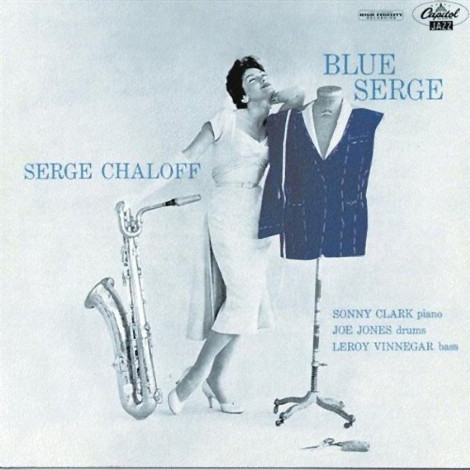
His next recording in March 1956 occurred after a booking with Sonny Stitt at Hollywood’s Jazz City. Blue Serge with its tip-top rhythm section (Sonny Clark, Leroy Vinnegar and Philly Joe Jones) is his masterpiece featuring classic standards like All The Things You Are, How About You and A Handful Of Stars. He takes a fresh and highly original look at Bob Hope’s old theme song Thanks For The Memory avoiding the tongue-in-cheek whimsy usually associated with it. His Ben Webster-like vibrato creates something far more profound and deeply moving.
A few months later he was diagnosed with cancer but after treatment he continued playing using crutches or a wheelchair. His last album was Four Brothers Together Again on 11 February 1957 with Herbie Steward, Zoot Sims and Al Cohn. Although sick he played with his usual fire and intensity but on some ensemble passages Charlie O’Kane had to take over on baritone.
Serge Chaloff died five months later on 16 July 1957 in Boston, his home-town.
In compiling this appreciation I would like to acknowledge the valuable help received from Bob Weir and the Jazz Institute in Darmstadt, Germany.”
Selected Discography
Serge Chaloff: Boston 1950 (Uptown 27.38)
Serge Chaloff: Boss Baritone (Proper Box 158)
The Complete Serge Chaloff Sessions (Mosaic MD4-147)
Woody Herman: Complete Capitol Recordings (Mosaic MD6-196)
Recommended Reading
Serge Chaloff: A Musical Biography & Discography by Vladimir Simosko.
Bouncin’ With Bartok: The Incomplete Works of Richard Twardzik by Jack Chambers.
Rat Race Blues: The Musical Life of Gigi Gryce by Noal Cohen & Michael Fitzgerald.
Woody Herman: Chronicles of the Herds by William D. Clancy.


