Showing posts with label Sjoerd Dijkhuizen. Show all posts

Tuesday, January 7, 2025

Swing Street - The Eric Ineke JazzXpress featuring Tineke Postma

 © Copyright ® Steven Cerra, copyright protected; all rights reserved.
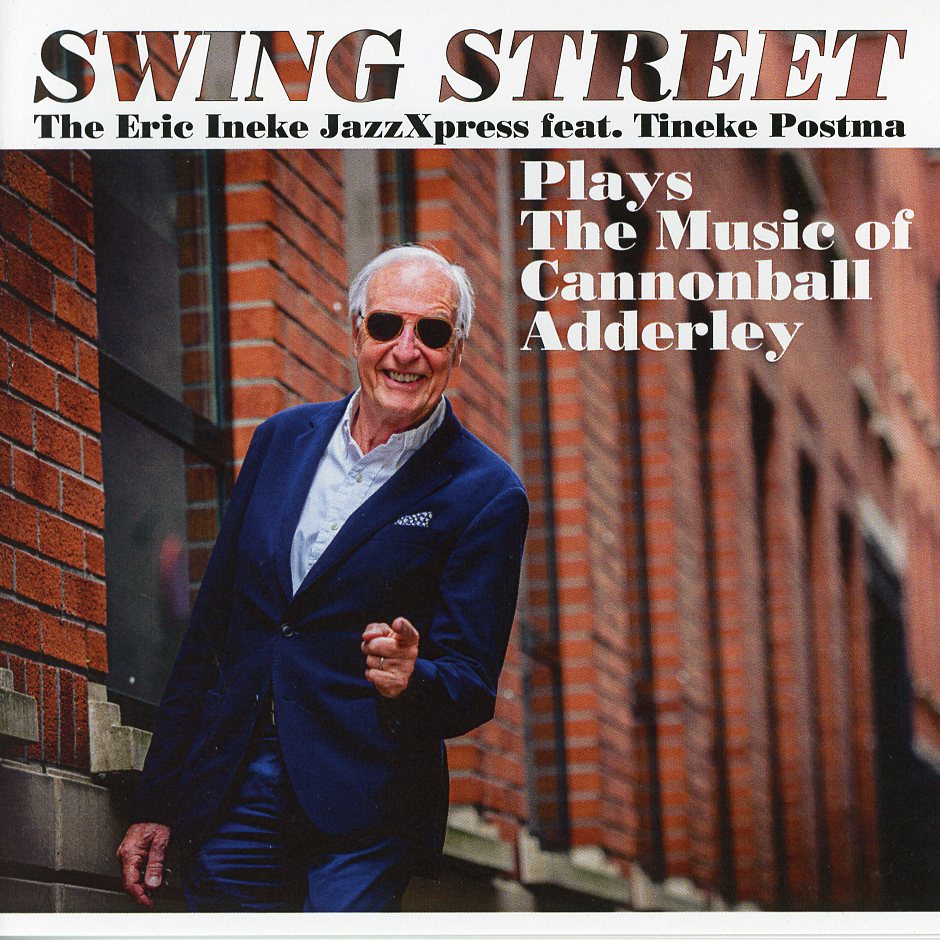

For those of you who like your Jazz served up in a straight-ahead, hard-bop style, then a musical feast celebrating this genre is on hand for you in Swing Street - The Eric Ineke JazzXpress featuring Tineke Postma [Timeless Records CDSJP 495].


For this recording, Eric’s JazzXpress, which turns 20 next year, has added the soprano and alto saxophone talents of Tineke Postma to perform a repertoire of music closely associated with the Cannonball Adderley quintet and sextet of the 1950s and 60s.


In addition to the superb soloing - Eric always leaves plenty of room on his recordings for his players to stretch out - each tune is masterfully arranged to give them a freshness and allow the band to put its own stamp on the material.


While the rhythm section of pianist Rob van Bavel, bassist Marius Beets and Eric on drums have been a part of the group from its inception along with tenor saxophonist Sjoerd Dijkhuizen, trumpeter Nico Schepers is new to the band. Tineke appeared on the group’s CD previous to this one - What Kind of Bird Is This? The Music of Charlie Parker.


This sextet’s configuration is similar to the one that the Adderley Brothers had in place which featured the “soulful brother” Yusef Lateef on tenor sax with a rhythm section of pianist Joe Zawinul, bassist Sam Jones and Louis Hayes on drums.


Regrettably this sextet was short-lived but they did leave us with three albums on Riverside Records: The Cannonball Adderley Sextet in New York Recorded Live at The Village Vanguard [RLP 404, 1962], Jazz Workshop Revisited: Cannonball Adderley Sextet [RM 444, 1963] and the Cannonball Sextet in Europe Riverside LP [RM 499, 1963]


Trombonist J.J. Johnson’s sextet with Freddie Hubbard on trumpet and Clifford Jordan on tenor sax, The Jazztet with a front line of Art Farmer [tp], Benny Golson [ts] and Curtis Fuller [tb] and drummer Art Blakey’s sextet which featured Freddie, Wayne Shorter on tenor and Curtis came into prominence for a brief period from the late 1950s to the mid 1960s. This instrumentation allowed these small groups to create a wide range of textures [sonorities] in their arrangements that produced ensembles with full, rich voicings.


Sadly, the economics of a declining Jazz audience by the mid-1960s made these groups too expensive to book and they were basically phased out, but not before leaving a wealth of terrific music in their wake.


Now, thanks to Eric, Tineke, Sjoerd, Nico, Rob and Marius, you can once again sample Jazz in a sextet configuration which includes new takes on the Cannonball Adderley Sextet Songbook as the band has reimagined each of the eleven original tracks tracks. 
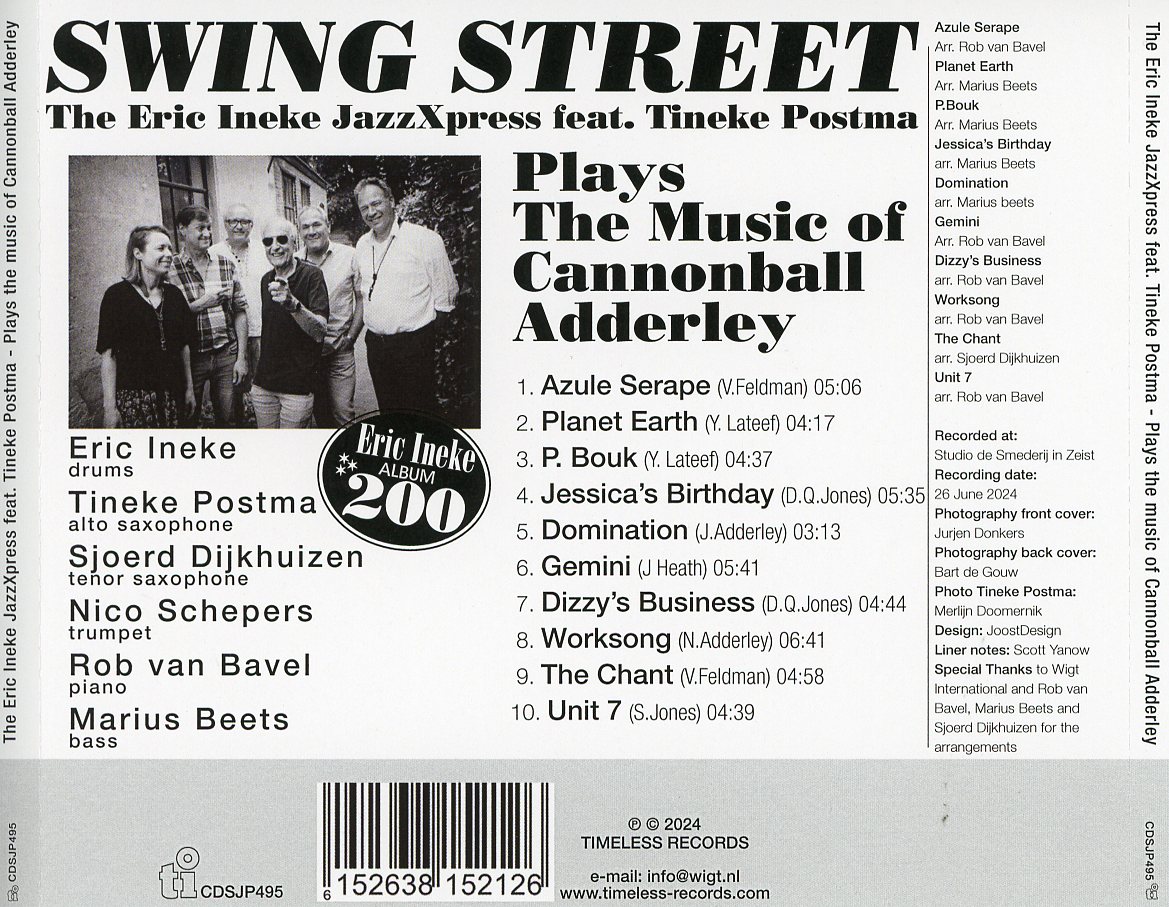


Rob van Bavel does the arranging honors on the opening track, Victor Feldman’s Azule Serape. The London-born pianist, vibraphonist and drummer was with Cannonball from 1960-1961 and contributed a number of compositions to the band’s book. 


On the Cannonball’s live album at The Lighthouse Café in Hermosa Beach California [where Victor was the resident pianist in Howard Rumsey’s All-Stars from 1957-59], Adderley introduces the tune this way: “I've been trying to figure out a long time what this name means for this tune that Victor Feldman wrote for us. This one is called "Azule Serape.” Now he’s from England and I know it's not English. It's something else. "Azule Serape." That’s what the next tune is.”


Rob’s arrangement approaches the tune as a sort of fanfare to open the album in a stirring and energetic manner. After the intro, Eric launches into an Afro-Cuban beat over which the band plays a staccato montuno which evolves into a series of Latin riffs. Rob then commences the melody on piano performing it in its original locked-hand fashion, the band comes in and swings the bridge and the whole thing gets the recording off in a rousing manner. Solos by Sjoerd, Nico, and Rob set the stage for four bar trades with Eric before the band segues the tune into a big finish.


Bassist Marius Beets does the arranging honors on Planet Earth and P. Bouk, both written by Yusef Lateef. The former features Tineke and a fine intervallic solo by Rob showing his interpretive range [think McCoy Tyner].


The latter was released on the 1963 Cannonball Sextet in Europe Riverside LP [RM 499], although it was first recorded by Yusef on his 1961 New Jazz LP - Yusef Lateef Into Something [NJLP 8272]. P. Bouk is an intriguing title and Yusef explains its meaning this way in Nat Hentoff’s notes to the New Jazz album: “It’s kind of an idiomatic language developed in Detroit that refers to a man’s idiom or “bag.” Now I can’t say that this tune sums up what’s in my bag because there is more than one thing in my bag, or rather, there ought to be.” Nat goes on to add: “The ingredients in Yusef’s bag which are primary in this tune is his commanding sense of swing, his gutsy forcefulness and his preference for economical clarity of design.”


Over an opening strummed bass ostinato which is amplified by Rob and Eric, Marius feeds into his arrangement of P. Bouk ingredients from his own “bag” that create a soaring statement of the novel features of the tune and then go on to serve as a launching pad for solos by all of the band members. Oscillating chords establish a vamp for Eric to stretch out over before the band takes the tune out with a full measure of “gusty forcefulness” which would have no doubt pleased Mr. Hentoff.


One thing you can always count on when listening to Eric’s bands is that they always SWING - and that quality is on display in the slow burn the band gives to its interpretation of Quincy Jones’ Jessica Birthday, which is another arrangement by Marius. Jazz played at a slower tempo requires a lot of control because nothing is slurred and everything is stated; clearly enunciated notation. No clichés are on display in the solos by the band members who seem to relish the chance to play out their ideas in a slower rhythmic context. The unison phrasing is clean and articulated which serves to give the slower tempo a nice bounce throughout.


Marius Beets closes out his turn on the arranging chair with a reworking of Oliver Nelson’s arrangement of Cannonball’s original Domination.


Tineke and Marius state the theme to Domination in unison which then relies on a series of countermelodies as contained in the original to set the piece in motion. This is small group orchestration at its finest and everyone had their reading chops on to make this one happen. 


Jimmy Heath’s Gemini, Ernie Wilkins’ Dizzy Business and Nat Adderley’s Work Song comprise the next three tracks; three very distinct tunes which Rob honors with three distinctive arrangements. 


Gemini, Jimmy Heath’s lovely use of a loping 6/8 to waltz time rhythmic pattern, features interesting interludes that Rob has voiced in such a way so as to create a contrast to launch the soloists with Nico, Sjoerd and Rob doing the honors.


Ernie Wilkins’ claim to fame was as a big band arranger and this orientation really shows in the way the melody to Dizzy’s Business is constructed with its punchy phrasing and pulsating rhythmic kicks and licks. An uptempo bash that finds all the band members in fine form, especially Sjoerd who does “the big horn” proud with a take-prisoner solo that is reminiscent of Yusef when he was on the Adderley band. The sextet-as-big-band is on tap on this one.


Next up is Nat Adderley’s Work Song which in later years he would introduce to his audience as “the tune that paid all my bills for a long, long time!” This 16-bar minor blues was one of the most requested tunes in the Adderley’s band repertoire and Rob gives it new life with a refreshing take built around a rubato statement of the melody that makes it even more expressive and emotional.


Marius then sets the tone for the JazzXpress’s interpretation by laying down a driving bass walk over which Tineke’s alto soars before brassman Nico takes over with a vigorous and muscular solo. Sjoerd and Rob get in on the fun before the “van Bavel express” shouts the tune out.


It’s impossible not to have fun playing Nat’s Work Song and this version by the JazzXpress shows why.


Next up is The Chant, another original by Victor Feldman which became the title for the eponymous Sam Jones Riverside album [RLP 9358]. Sam was the first and longest serving bassist with Cannonball’s groups so as you would imagine Sjoerd Dijkhuizen arranged this to feature Marius Beets skillful bass work. Rob joins in after Marius’ solo and the two lock in with Eric to form the driving rhythm section that makes the JazzXpress such a splendid straight-ahead Jazz band. Sjoerd jumps in with a powerful solo until the band returns and takes the tune to a righteous close.


Unit 7 by Sam Jones was Cannon’s closing theme. It’s a 12-bar blues with a bridge which Rob infuses with countermelodies to give the tune a wonderfully crisp sonority. Tineke steps up and steps out with a marvelous solo on alto that’s gotta have Cannonball smiling. Sjoerd follows with some Texas-tenor style phrasing in his solo - what Cannonball describes as a “moan within the tone.” Another fine unison interlude acts as a shout chorus before the band joyfully ends the tune.


As a note in passing, the CD comes with fine booklet notes by the Jazz journalist and historian, Scott Yanow, which provide further insights into the musicians and the music.


Swing Street is the seventh recording in my collection by Eric’s JazzXpress and each one is a gem replete with meticulous musicianship and joyous, swinging Jazz.


As Scott says in his closing remarks: “Swing Street succeeds at paying an affectionate and very musical tribute to the great Cannonball Adderley.”


Do yourself a favor and grab a copy.


You won’t regret it.


Saturday, August 15, 2015

The Ultimate Organic Tenor Groove Experience [From the Archives]


© -Steven Cerra, copyright protected; all rights reserved.


We put this feature together essentially to pay homage to the venerable tradition of the jam session.

As defined by Gunther Schuller in The New Grove Dictionary of Jazz, the jam session is:

“An informal gathering of jazz musicians playing for their own pleasure. Jam sessions originated as spontaneous diversions when musicians were free from the constraints of professional engagements; they also served the function of training young players in a musical tradition that was not formally taught and accepted in music schools and academic institutions until the 1960s.

In the late 1930s jam sessions came to be organized by entrepreneurs for audiences; this under­mined their original purpose, and by the 1950s true jam ses­sions were becoming increasingly rare.

However, in the 1970s and 1980s the concept of "sessions" has made a comeback among younger jazz musicians, especially those trained in con­servatories. An "open" session is one in which anyone who is more or less competent may take part. The so-called loft scene of the late 1970s in New York may also be seen as a quasi-commercial offshoot of the jam session. (B. Cameron: "Soci­ological Notes on the Jam Session," Social Forces, xxxiii (1954), 177) - GUNTHER SCHULLER “

And Paul F. Berliner, in his wonderfully informative, Thinking in Jazz, The Infinite Art of Improvisation, offers these observations about the jam session:

“As essential to students as technical information and counsel is the understanding of Jazz acquired directly through performance. In part they gain experience by participating in one of the most venerable of the community's insti­tutions, the jam session. At these informal musical get-togethers, improvisers are free of the constraints that commercial engagements place upon repertory, length of performance, and the freedom to take artistic risks. Ronald Shannon Jackson's grade school band leader allowed students to conduct daily lunch-hour jam sessions in the band room. "During those years, I never saw the inside of the school's official lunch room."

Ultimately, sessions bring together artists from different bands to play with a diverse cross section of the jazz community. "New Yorkers had a way of learning from each other just as we did in Detroit," Tommy Flanagan says. "From what I heard from Arthur Taylor, Jackie McLean, and Sonny Rollins, they all used to learn from just jamming together with Bud Powell and Monk and Bird. Even though Bird wasn't a New Yorker, he lived here a long time and got an awful lot from it."

Some sessions arise spontaneously when musicians informally drop in on one another and perform together at professional practice studios. Improvisers also arrange invitational practice sessions at one another's homes. Extended events at private house parties in Seattle "lasted a few days at a time," Patti Brown remembers, and they held such popularity that club owners temporarily closed their own establishments to avoid competing for the same audience. Guests at the parties "cooked food and ate, [then] sat down and played," Brown continues. Musicians "could really develop there. Sometimes they would really get a thing going, and they would keep on exploring an idea. You would go home and come back later, and it was still going on.... [Improvisers] some­times played a single tune for hours." Other sessions were similarly very re­laxed: "Everybody was in the process of learning. Some guys were better than others, but it was always swinging, and the guys went on and on playing. We played maybe one number for an hour, but nobody ever got bored with it.”

Jazz organizations such as the Bebop Society in Indianapolis and the New Music Society at the World Stage in Detroit, where Kenny Burrell served as president and concert manager, promoted more formally organized sessions. Others took place in nightclubs, especially during weekend afternoons or in the early hours of the morning after the clientele had gone. In Los Angeles, according to Art Farmer, opportunities abounded for young people. "During the day you would go to somebody's house and play. At night there were after-hours clubs where they would hire maybe one horn and a rhythm section, and then anybody who wanted to play was free to come up and play. Then these clubs would have a Sunday matinee session. We used to just walk the streets at night and go from one place to another."

Musicians distinguish some sessions in terms of the skills of participants. The New Music Society would have a group "the caliber of Elvin Jones, Barry Harris, Tommy Flanagan, and Kenny Burrell," and then they would have "the next crew of guys" like Lonnie Hillyer and his schoolmates, who rehearsed a couple of weeks in advance to prepare for their own session. The youngsters "wouldn't interfere" with those involving "the guys of high caliber." At times, the arrival of musicians from out of town intensified session activities—artists like Hampton Hawes and John Coltrane "who'd be working in some band and had that night off. It was a hell of a playing atmosphere going on there.”
.
Likewise in Chicago, musicians knew that the session "at a certain club down the corner was for the very heavy cats and would not dare to participate until they knew that they were ready," Rufus Reid recalls. As a matter of re­spect, "you didn't even think about playing unless you knew that you could cut the mustard. You didn't even take your horn out of your case unless you knew the repertoire." At the same time, naive learners did periodically perform with artists who were a league apart from them. David Baker used to go to sessions including Dexter Gordon and Wardell Gray "when they came to Indianapolis." He adds with amusement, "I didn't have the sense not to play with them."

Although initially performing at sessions in their hometowns, musicians from different parts of the country eventually participate in an extensive net­work of events in New York City, "mixing in with players from everywhere." In the late forties and fifties, they made their way each day through a variety of apartments, lofts, and nightclubs, where they sampled performances by im­promptu groups and joined them as guests during particular pieces, a practice known as sitting in. In addition to having pedagogical value, the sessions served as essential showcases. As Kenny Barron points out, "That's how your name got around." Count Basie's club in particular "was like a meeting ground" during Monday evening sessions, as was the renowned club Birdland, although the latter was difficult "to break into without knowing somebody.”  There were also well-documented sessions at Minton's Playhouse and Monroe's Up­town House in Harlem.

Tommy Turrentine's fondest memories of the mid-forties concern Small's Paradise Club "in Harlem.... Everybody used to come there." Spanning four musical generations, the artists included trumpeters Red Allen, Hot Lips Page, Idres Sulieman, Dizzy Gillespie, Miles Davis, and Clifford Brown; saxophon­ists Charlie Parker, Sonny Rollins, Jackie McLean, and Stan Getz; pianists Bud Powell, Walter Bishop Jr., Walter Davis, and Mal Waldron. The house band was led by Big Nick Nicholas, who knew "every tune that's ever been written." Nicholas was, in fact, an important teacher of the community for his role in challenging players to expand their repertories by constantly choosing unfamil­iar compositions on the bandstand. Within the context of such a rich and varied repertory, the improvised interplay, night after night, served as inspiring learning sessions for Turrentine and his friends. "That was Paradise University. You would hear so much good music each night that, when you went to lay down, your head would be swimming!"

Rivalry among the participants added spark to an already charged atmo­sphere. "During that time, there was somewhat of a mutual respect among the musicians, and they had cutting sessions. They would say, “I am going to blow so and so out.' It wasn't with malice. It was no put-down; it was just friendly competition." Turrentine goes on to describe actual events. "Maybe two tenor players would get up; maybe there would be about seven horn players on the bandstand. Everybody had the sense to know that saxophones was going to hang up there tonight — they was going to be blowing at each other — so we all got off the bandstand and let them have it. Maybe the next night, two trumpet players would be getting up there at each other; then there would be drummers. I have seen it many times. It was healthy really, just keeping everybody on their toes."

Interaction with an increasing number of musicians in these settings pro­vided aspiring artists with stimulus for their own growth as improvisers. Don Sickler speculates that one renowned trumpeter "became so great" because he was aware of the competition around him: "Booker Little was born just a few months before him, and Lee Morgan was just a little younger. He really had to work hard to keep up with that level of competition."

Of course, any instrument was generally welcomed in a jam session, but somehow, to my ears, at least, the tradition of the jam session is best exemplified by the sound of “battling” or “dueling” tenor saxophones.

Over the years, there have been many such pairings including Lester Young and Herschel Evans; Coleman Hawkins and Ben Webster; Illinois Jacquet and “Flip” Phillips; Don Byas and Buddy Tate; Dexter Gordon and Wardell Gray; Gene Ammons and Sonny Stitt; Al Cohn and Zoot Sims; Tubby Hayes and Ronnie Scott; Eddie “Lockjaw” Davis and Johnny Griffin; Frank Foster and Frank Wess; Pete Christlieb and Warne Marsh.

The title of this piece gets its name from two Dutch tenor saxophonists – Simon Rigter and Sjoerd Dijkhuizen – who along with guitarist Martijn van Iterson, organist Carlo de Wijs and drummer Joost Patocka – revived the jam session tradition with their appearance on August 18, 2006 at the Pure Jazzfest which was held at De Nieuwe Kerk in The Hague, The Netherlands.

For their performance at the Pure Jazzfest, the group adopted the name -  The Ultimate Organic Tenor Groove Experience – and I have absolutely no idea what the “organic” in the title is in reference to – sign of the times, maybe?.

By way of background, Simon and Sjoerd enjoy a major presence on the Dutch Jazz scene as both perform with The Jazz Orchestra of the Concertgebouw and with the Rotterdam Jazz Orchestra. Sjoerd can also be heard regularly as a member of drummer Eric Ineke’s JazzXpress.

Martijn van Iterson has his own quartet and often wroks with The Metropole Orchestra in Amsterdam.  Carlo has also performed with The Metropole Orchestra, Lucas van Merwijk’s Cubop City Big Band and alto saxophonist Benjamin Herman’s group to which drummer Joost Patocka also belongs.

Both in their late thirties, Sjoerd Dijkhuizen and Simon Rigter formed their own quintet as an outgrowth from their appearance together with the late Dutch pianist Cees Slinger on his "Two Tenor Case" recording. In addition to their work in The Jazz Orchestra of the Concertgebouw,” they are also a part of a group called "The Reeds,” a sax ensemble and rhythm section.

As  far as I can determine, Simon and Sjoerd in combination with Carlo, Martijn and Joost made only one public appearance together and that was at the 2006 Pure Jazzfest.

You can view images of all the members of The Ultimate Organic Tenor Groove Experience in the following video montage which is set to the group’s performance of Dexter Gordon’s Sticky Wicket.


As we’ve noted before, straight-ahead Jazz is alive and well – in Holland!

>