© Copyright ® Steven Cerra, copyright protected; all rights reserved.

"Tad Richards handles his subject with taste, intelligence, and love. His conclusions are logical and well-researched. This is a good addition to your library of books on Black popular music of the period."
- Billy Vera, American singer, songwriter, music historian, and leader of Billy Vera & the Beaters
"Jazz with a Beat shines a light on a music that was always a part of our consciousness, even if we didn't quite realize it, and gives us a whole new appreciation for it."
- Michael Jahn, founding rock music columnist for the New York Times
“So 1942 is as good a place as any to mark the beginning of this new music that was growing up, unheralded, alongside the controversial but publicized sound of bebop: the big band jazz of the 1930s being reconfigured and rearranged for the more flexible small groups of the 1940s, a new breed of soloists pushing the sound of swing in a more contemporary direction. But was the music they were playing jazz?”
- Tad Richards
I first “met” Tad Richards as a Facebook friend with a common interest in all things Jazz.
His Listening to Prestige [now out in Volume Four, 1959-1960] is a tutorial delight [replete with many of Tad’s fine drawings] which provides personal reviews in sequence of Bob Weinstock’s iconic albums featuring the music of many significant artists from the 1949-1971 era of Bop, Hard Bop and Soul Jazz.
As a big fan of his writing, I readily accepted his kind suggestion of a preview copy of his latest effort Jazz with a Beat: Small Group Swing, 1940 - 1960 which was published this year as an Excelsior Edition by the State University of New York Press. You can locate order information by going here.
Jazz with a Beat is the first book on the often overlooked but vitally important genre of small group swing jazz. Coming into being in the early 1940s, small group swing answered the need in the Black community for a form of jazz that was more accessible (and more danceable) than the new bebop. An adaptation of the big band Black swing (Erskine Hawkins, Jimmie Lunceford, Chick Webb) of the 1930s to small combos, and with a more vigorous beat for the new generation, this music developed and was beloved through the 1940s, continued to be enjoyed through the rock and roll years of the 1950s, and was a major influence on the soul jazz of the 1960s. Among the many hit artists portrayed in these pages are Illinois Jacquet, Louis Jordan, Big Jay McNeely, Joe Liggins, Nat "King" Cole, Red Prysock, Ruth Brown, Nellie Lutcher, Camille Howard, T-Bone Walker, and Ray Charles. Dismissed as "rhythm and blues," this music has been ignored by jazz historians. Jazz with a Beat honors this music as a legitimate genre of jazz and is a stirring evocation of an era. It should be of interest to lovers of jazz and Americana.
Tad offers more about how Jazz with a Beat came about and what’s on offer in its treatment of small group Jazz from 1940-1960 in the following INTRODUCTION.
© Copyright ® Tad Richards, copyright protected; all rights reserved.
“The 1950s were a remarkably robust era for jazz. Benny Goodman, Louis Armstrong, and Dizzy Gillespie were all anointed by the US State Department as goodwill ambassadors, bringing the sound of America to the world. Goodman jammed with the clarinet-playing king of Thailand, and Dave Brubeck, although not sponsored by the State Department, brought jazz behind the Iron Curtain. Early in the decade, Brubeck had brought jazz to college, opening up a vast new market, and as it drew to a close, he recorded the first million-selling jazz album, Time Out, in 1959. In that same year, Miles Davis recorded Kind of Blue, which would become the top-selling jazz album of all time.
Jazz was on television. Steve Allen's popular late-night and primetime shows frequently featured jazz artists (Allen himself was an accomplished jazz pianist); Stars of Jazz had a three-year run and won an Emmy; and a private eye show, Peter Gunn which used a jazz theme and regularly featured scenes with a jazz club as a backdrop, became so popular that soon jazz was the music that cued TV suspense, danger, or romance with sexual overtones. The movies also embraced jazz. Film composer Elmer Bernstein used a jazz motif for his score for The Man with the Golden Arm (1956). Peter Gunn made Henry Mancini one of Hollywood's most sought-after composers. Recognized jazz masters like Duke Ellington and John Lewis were commissioned to write scores for big-budget films.
Jazz festivals, most prominently the Newport Jazz Festival, were a new cultural phenomenon, with a documentary about the 1958 festival, Jazz on a Summer's Day, becoming a surprise hit. And the leading influencer of the day (although that term was still more than half a century away from popularity), Playboy magazine, began an annual jazz poll.
But then things changed. A gauntlet was thrown down by an album released on Atlantic Records in 1959: The Shape of Jazz to Come by Ornette
Coleman; it could not be ignored. Coleman was the most controversial, polarizing figure to come along in a long time. He was hailed, he was hated. Most of all, he was talked about. His music acquired the label of "free jazz"; others were playing it, most notably one of the most popular instrumentalists of the late '50s, John Coltrane. New stars in the free jazz firmament included Eric Dolphy, Albert Ayler, and Pharaoh Sanders. The floodgates were open. But only a tiny percentage of the public was following.
For many listeners, it was too weird, too experimental, too cacophonous.
At the same time, rock 'n' roll, dismissed as music for half-educated teenagers in the 1950s, became rock, a cultural phenomenon. The Playboy Jazz Poll became the Playboy Jazz and Pop poll, and Paul McCartney replaced Paul Chambers as a perennial poll winner.
But not every young jazz musician followed Ornette Coleman's siren song. Another new school of jazz was forming. Ray Charles had shown the way, and young musicians like Horace Silver and Jimmy Smith followed: jazz that was funkier, more immediate, more visceral, more danceable — "soul jazz."
The two schools coexisted within the pages of DownBeat and other periodicals that had begun to take jazz seriously as an art form. [Hammond B-3 organist] Jimmy Smith was as likely to get a five-star DownBeat review as Eric Dolphy. Soul jazz was a real thing, a niche music, but with a solid base of popularity — in the record stores, in the clubs, in colleges, in the Black communities, and also in the jazz media. Jazz had bifurcated and had done so successfully. It was a new phenomenon.
Except that it wasn't. The exact same thing had happened two decades earlier, and it was barely noticed. A second, more easily graspable genre of jazz developed alongside the more critically heralded bebop.
The received wisdom about jazz is this: it was "America's popular music" in the 1930s, but its popularity was dashed by the rise of the cerebral, undanceable bebop music of Charlie Parker, Dizzy Gillespie, and the other modernists. It became forever a niche music, never to achieve that popularity again. This is false for a couple of significant reasons.
First, jazz was always a niche music. The 1930s saw a surge in popularity of dance bands led by white bandleaders. Some of them, like Artie Shaw and Benny Goodman, were playing jazz, or "hot" music, as it was called at the time. Some bands, notably Glen Gray's Casa Loma Orchestra, employed brilliant white jazz soloists like Bix Beiderbecke and Frankie Trumbauer, but their charts were primarily "sweet" music for society dancing. Others, most notably the Glenn Miller Orchestra, which was immensely popular, are included when people talk about the popular heyday of jazz, but while Miller made an enduring contribution to American music, it wasn't exactly jazz. Granted, this can be argued. There's no one definition of jazz that fits all contenders, and I don't propose to argue every borderline case. I would put Jimmy Dorsey into the hot category and Tommy Dorsey into the sweet, and Tommy might well have agreed with me. When the brothers split in 1935 and Tommy formed his own band, he was more or less under orders from his management to cut out the hot stuff. Bing Crosby had been an early pioneer of jazz singing, the first white singer to absorb the lessons of Louis Armstrong but by the mid-1930s he had overtaken Rudy Vallee to become the premiere crooner of sweet ballads. I'm not going to haggle over exactly what the line is between hot and sweet music; I'll simply say that it was white dance bands, and not jazz, that dominated American music in the 1930s.
But the Black bands who had developed the music, whose pioneering work Goodman and Shaw and Beiderbecke had built on (Goodman hired Fletcher Henderson behind the scenes as an arranger; Don Redman wrote arrangements for Jimmy Dorsey and Harry James), remained a niche market, booked into Black venues, their records mostly marketed to and bought by Blacks. A look at the Billboard charts for the late 1930s verifies this. 1936 saw one record by a Black jazzman, Fats Waller's "It's a Sin to Tell a Lie." Benny Goodman was popular, and Tommy Dorsey's jazz combo, the Clambake Seven, had one hit, but for the most part the list is dominated by Eddy Duchin, Guy Lombardo, the sweet Tommy Dorsey, and the like. Waller had another hit in 1937, as did Duke Ellington; and Teddy Wilson, gaining fame as Benny Goodman's piano player, had two, with vocals by Billie Holiday.
While 1938 saw Chick Webb top the charts, largely due to his amazing new vocalist, Ella Fitzgerald, and her irresistible novelty record, "A-Tisket, A-Tasket," there was little else by Black musicians (Duke Ellington and Andy Kirk were the others). 1939 was all white, and almost all Glenn Miller (six of the top 12 tunes for the year); Benny Goodman and Artie Shaw had one top 20 hit each, and Glen Gray's Casa Loma Orchestra had two. The rest were dance bands with only the most tangential relation to jazz.
And this didn't change much in the 1940s. Hitmakers in 1941 were Glenn Miller, Freddy Martin, the Dorseys, and Horace Heidt. The years 1942-44 were anomalies, because the production of records was brought to a standstill by a strike against the record labels called by James C. Petrillo, the autocratic head of the American Federation of Musicians.
The companies could only release recordings hurriedly made before the strike date. As a result, no new acts were introduced. The product output was thin, but the names were the same, as was the melanin content of the musicians.
So throughout this era, jazz was a niche music, not "America's popular music," although some white jazz musicians like Goodman and Shaw were able to ride the bandwagon of swing. That didn't really change in the 1940s, although the emphasis switched from bandleader-as-star to vocalist-as-star, partly due to the changing economics of the era, partly to the musicians' strike which did not affect vocalists, and partly to the soaring popularity of Frank Sinatra.
But jazz changed. It changed quickly, and it changed dramatically. Some say it changed with one solo — Charlie Parker's improvisation in the Jay McShann orchestra's 1942 recording of "Sepian Bounce." McShann played classic Kansas City swing, but Parker's solo took that bluesy, danceable style, just for the space of one solo, in a whole new direction. The camel's nose was under the tent, and anywhere there was a jukebox, young musicians exhausted their supply of nickels listening to it. Parker’s improvisations on "Cherokee," in the McShann band's live performances, were similarly galvanizing a new generation of musicians, and the chords to "Cherokee" would not long after become the basis for Parker's bebop tour de force "Ko-Ko."
And curiously, at right around this same time, the swing era was being attacked from another direction. In 1940, sportswriter-actor-jazz buff Heywood Hale Broun went from New York to New Orleans and recorded a group of old-time jazzmen led by trumpeter Henry "Kid" Rena (pronounced Renay). This was the beginning of the rediscovery of the traditional New Orleans sound that had gone out of fashion, eclipsed by swing, dismissed as old hat. To the new champions of New Orleans-style music, it was the only real jazz. Swing was diluted, cheesy, fake. And within a few years, the bebop partisans were rejecting swing as old hat. The jazz wars were on in earnest, with poor old swing battered from both sides.
But there are a few things to keep in mind here. First, swing did not exactly curl up and die. It still had its fans, and they were still a healthy percentage of music lovers. The "real jazz" traditionalists were a cult. They were right about the importance of a music that should not have been forgotten, and they performed a valuable service, but they were never more than a small segment of the music-consuming public. The bebop partisans were the avant garde, and the avant garde is, by definition, ahead of the curve: a small, self-selected group.
So what was jazz? This was a question no one had thought to ask, let alone answer, until the "real jazz" traditionalists came up with an answer that satisfied no one but themselves. But it was a start. And in order to rebut them, it was necessary to come up with a more inclusive definition. But, as it turned out, not much more inclusive.
Jazz was inexorably changed by Parker and the other young musicians who created the new music that came to be known as bebop, and it was changed in more ways than one. The music made stringent demands on the listeners attention. It valued individual expression and virtuosity over a danceable groove. And it was made by musicians who consciously rejected the vaudevillian, dance-hall showmanship that had characterized Black music and musicians of the past. But not all jazz musicians, and not all Black audiences, were ready to follow the thorny trail to bebop.
Swing music, especially the big band swing music of the 1930s, had mostly run its course, as all musical styles do. Audiences had changed. The Depression was winding down. President Franklin D. Roosevelt's Lend-Lease Program, followed by the United States' entry into the conflict that soon came to be known as World War II, meant a dramatic upturn in manufacturing and new job openings that extended even to the minority communities traditionally hardest hit by a shrinkage in the labor market. There was a new audience looking for a new sound, and musicians were ready to give it to them.
Charlie Parker was twenty-two when he recorded "Sepian Bounce" in 1942, and that same year a nineteen-year-old jazz musician, Illinois Jacquet, hired the year before by Lionel Hampton, was tapped by his boss to play the solo on a new recording of "Flying Home," a tune written by Hampton and Goodman and originally recorded by Goodman's sextet. That recording had featured a memorable solo by guitarist Charlie Christian, so it was known to be a reputation-maker.
Jacquet played his first solo in a Lester Young style, then decided that for his second solo, he wanted to do something really different. Improvising on the fly, he started with a strongly emphasized note, then played the same note again, then again. How long could he keep it up? Nine more times, the same note, then a little coda, then back to it again, again the same note repeated twelve times, before picking up the melody again. The effect on listeners in 1942 was electrifying, but more immediately, Jacquet had electrified his bandmates. There's a heightened excitement when the ensemble swings back into action, and the recording climaxes with Hampton and trumpeter Ernie Royal trading single notes to keep that excitement going.
Also in 1942, a group called Louis Jordan and His Tympany Five had their first hit records on Billboard's Harlem Hit Parade chart. "I'm Gonna Leave You on the Outskirts of Town" went to number three, and it was followed with his first number one, "What's the Use of Getting Sober (When You're Gonna Get Drunk Again)." Jordan, an alto sax player and vocalist, had been with the Chick Webb Orchestra; when he started his own group (although he called them the Tympany Five, there were rarely exactly five members), he hoped to recreate the sound and the feeling of Chick Webb's ensemble with a small group. Jordan would go on to have one of the most popular Black groups of the 1940s.
So 1942 is as good a place as any to mark the beginning of this new music that was growing up, unheralded, alongside the controversial but publicized sound of bebop: the big band jazz of the 1930s being reconfigured and rearranged for the more flexible small groups of the 1940s, a new breed of soloists pushing the sound of swing in a more contemporary direction. But was the music they were playing jazz?
There's no one definition of jazz. The New Orleans traditionalists' "real jazz" hung on as late as 1962, when Samuel B. Charters and Leonard Kunstadt, in their book Jazz: A History of the New York Scene, made a distinction between swing and jazz. Louis Armstrong dismissed Dizzy Gillespie and the beboppers as "poor little cats who have lost their way," and Cab Galloway denounced the sound as "Chinese music." Later, Miles Davis would describe Ornette Coleman as "all screwed up inside." And it's hard to imagine anyone from an earlier era finding much common ground with Vijay Iyer. Probably the best definition of jazz is the least helpful, from an academic's perspective. It comes from Louis Armstrong: "If you have to ask what jazz is, you'll never know."
So I'm not going to argue the case, I'm just going to state it. This music, made by Black musicians for Black audiences beginning in the early 1940s, parallel to bebop, sometimes crossing paths with it, sometimes diverging, was jazz. But as "jazz" was being defined in this era, and during this period of competing definitions, one new genre of jazz found itself getting left out of every definition.
Strangely, the modernists and the traditionalists were more united than they themselves realized at the time. The traditionalists despised swing as a dilution of the real thing, watered down, smoothed out, its African American roots corrupted by saccharine Tin Pan Alley songs, pandering to the masses. The modernists saw themselves in the vanguard of a new art form, a music that was to be taken seriously as Art with a capital A, not one that pandered to the masses.
Gradually, an umbrella definition began to emerge. Real jazz was authentic. It was real because it was artistically pure, like bebop. It was real because it had authentic roots, like New Orleans jazz. Or it was real because it just was, because it was played by masters like Louis Armstrong, Count Basie, Duke Ellington, Benny Goodman, or Bix Beiderbecke. Pallid imitators like Artie Shaw or Glenn Miller were out (although Shaw has certainly since been let back in). It was real because authorities recognized by Metronome editors Leonard Feather and Barry Ulanov, both of whom would write highly regarded books on the subject, certified it as real.
One panel of authorities was assembled by Feather and Belgian jazz critic Robert Coffin, out of dissatisfaction with the philistinism of the readers' polls in DownBeat and Metronome. It would appear in Esquire and would be the first critics' poll: the authoritative poll, because, in Coffin's words, "We know who the real experts are."
Jack Kerouac would not have been considered one of those real experts, but he was a knowledgeable jazz aficionado, a regular in the early days of bebop at Minton's Playhouse in Harlem. In On the Road, his narrator Sal Paradise expresses his admiration for modern jazzers George Shearing, Dexter Gordon, Wardell Gray, and Slim Gaillard. In the most extended paean to jazz in the novel, Sal and Dean Moriarty head for "the little Harlem on Folsom Street" in Oakland, California.
Out we jumped into the warm, mad night, hearing a wild tenor-man bawling across the way, going "EE-YA! EE-YA! EE-YA!" and hands clapping to the beat and folks yelling, "Go, go, go!" Dean was already racing across the street with his thumb in the air, yelling "Blow, man, blow!" ... It was a sawdust saloon with a small bandstand on which fellows huddled with their hats on, blowing over people's heads, a crazy place ... the behatted tenorman was blowing at the peak of a wonderfully satisfactory free idea, a rising and falling riff that went from "EE-YA!" to A crazier "EE-de-lee-Yah!" and blasted along to the rolling crash of butt-scarred drums hammered by a brutal Negro with a bull neck who didn't give a damn about anything but punishing his busted tubs, crash, rattle-ti-boom, crash. Uproars of music, and the tenorman had it and everybody knew he had it. Dean was clutching his head in the crowd, and it was a mad crowd. They were all urging that tenorman to hold it and keep with it ... and he was raising himself from a crouch and going down again with his horn, looping it up in a clear cry above the furor. . . .
"Stay with it, man!" roared a man with a foghorn voice . . . "Whoo!" said Dean . . . Boom, kick, that drummer was kicking his drums down the cellar and rolling the beat upstairs with his murderous sticks, rattley-boom! . . . The pianist was only pounding the keys with spread-eagled fingers, chords, at intervals when the great tenorman was drawing breath for another blast—Chinese chords, shuddering the piano at every timber, chink and wire, boing! The tenorman jumped down from the platform and stood in the crowd ... he just hauled back and stamped his feet and blew down a hoarse, laughing blast, and drew breath, and raised the horn, and blew high, wide, and screaming in the air ... and finally . . . decided to blow his top and crouched down and held a note in high C for a long time as everything else crashed along.
The solo turns into a pas de deux between the tenorman and Dean, who is leaning into the bell of the horn and screaming exhortations, and ends in a Dionysian frenzy.
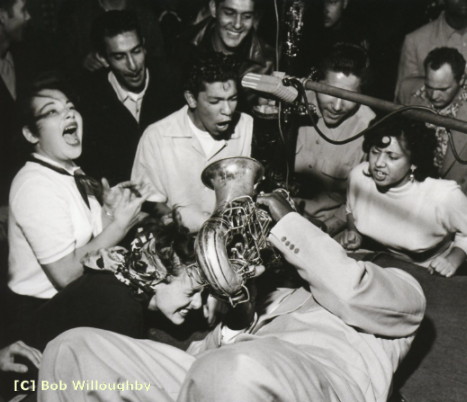
So who were Sal and Dean listening to? This would have been around 1948, when bebop was still struggling to gain acceptance on the West Coast, chiefly in Los Angeles—it would not have found its way to a "sawdust saloon" on Folsom Street (or more likely 7th Street) in Oakland. Sal and Dean would more likely have ended up in a club featuring Big Jay McNeely or someone like him. There's a famous photograph of Big Jay playing the saxophone lying on his back, while two young T-shirted white men lean over the bandstand to shout out encouragement; they could be Sal and Dean.
Dean is an overgrown juvenile delinquent engaged in a mindless pursuit of kicks, and he responds purely to the intensity of the moment; but Sal, although irresistibly drawn to follow "the only people for me ... the mad ones, the ones who are mad to live, mad to talk, mad to be saved, desirous of everything at the same time," is also serious about jazz, and he's always a scrupulous reporter on the scenes that Dean leads him into. Here he's sucked in by Dean's ecstatic response to the music, but he's also listening closely to what's being played. He hears the "EE-YA! EE-YA!" that draws Dean in, the driving intensity that Illinois Jacquet brought into the music, but he's also aware that the tenorman is developing a "wonderfully satisfactory free idea," the "EE-YA!" evolving into "EE-de-Iee-yah." He hears the crash of the drums but hears it develop into a rolling crash, punctuating a more complex "rattle-ti-boom." The piano player is playing "Chinese chords"—calling to mind Cab Galloway's definition of bebop. Sal is in his element, vicariously participating in Dean's breathless immediacy, but he is also in his own element, listening to jazz.
Why was this form of jazz, this updated swing, this jazz with a beat, not recognized as such at the time? It should have been. Big band swing had reached its zenith, and jazz audiences were ready for the next development in dance music. The big ballrooms, with a few exceptions, had become unprofitable, which meant that the big bands had lost their venues. Small groups were economically more practical, easier to keep together, and easier to travel with.
The big bands had generated and brought to the fore a number of virtuoso soloists: Lester Young with Count Basie, Illinois Jacquet with Lionel Hampton, Coleman Hawkins with Fletcher Henderson, Charlie Parker with Jay McShann, Louis Armstrong with his own groups. Other instrumentalists like Gene Krupa with Benny Goodman and Buddy Rich with Artie Shaw developed a following and started their own groups. The public's appetite for these crowd-pleasing virtuosi had been whetted. Vocalists were the most prominent. Frank Sinatra, once an afterthought in the Tommy Dorsey orchestra, was now an idol. On a somewhat smaller scale, the same was true of the instrumental soloists, and the small-group alignment was an ideal showcase for them.
So why did the small-group swing combos not command more critical respect? There are a couple of answers. First, they simply did not fit the narrative. They weren't the big swing orchestras, villains or heroes of the narrative, depending on one's point of view, or somewhere in between. They weren't the pioneers, the authentic voice of Americana, to be honored as a relic of the past. They weren't the heralds of a new age in American music, in which jazz was to take its place in the world of high art. But more than that, much of the answer lies, as is so often the case in American culture, with race. The jazz wars between the traditionalists and the swing merchants, between the progressives and the so-called moldy figs, was played out in the media, in pitched debates between the journalists, critics, and tastemakers who wrote about such matters. And those journalists, critics, and tastemakers were predominantly white.
The jazz of the 1920s and '30s had exploded into national prominence when white bands, going back as far as the Original Dixieland Jass Band, and continuing through Whiteman and Goodman and Miller, began playing it. Bebop was the creation of Black artists, but it drew into its nascent sphere white musicians like Al Haig, Stan Levey, and George Wallington, soloists like Stan Getz and Lee Konitz, and bandleaders like Stan Kenton. And to the mostly white critics who wrote about these culture wars and championed one side or the other, there were two kinds of jazz: swing and bebop. The new small-group swing records that were being made by Black performers for Black audiences were mostly ignored by the critical establishment, as were the small clubs in Harlem or Central Avenue in Los Angeles or 7th Street in Oakland. White guys like Sal and Dean were very much the exception, and they were hardly influencers.
But the music was happening, developing, taking on a life of its own, and not without influence on the larger jazz world. Even Ornette Coleman started out playing in a rhythm and blues band. The progressives, who ruled the critical day, stressed innovation and complexity, sometimes at the cost of drive and immediacy. The small-group swing combos, the rhythm and blues players, the purveyors of jazz with a beat, stressed that drive and immediacy, and they captured the hearts and the hips and the dancing feet of the day.
Illinois Jacquet, who had substantial careers in both fields, looked back on that time:
I didn't bother to read write-ups then, anyway; these things were never important to me. It was always the reaction of the people that I cared about. I've been playing among people all my life; I was a dancer once, and we've always been in show business. I always thought of the people before anybody.
But most of the things they accused me of doing, like laying on my back, I've never done. It was just that I created the excitement for the saxophone, and other players went from there, and they did everything else. I was labeled for the moving and walking and hitting the high notes at the time. And being in your twenties, man, you're going to do things — that's how it is.
Small-group swing originally was categorized on the Billboard charts as the Harlem Hit Parade, and then as Race Records, and finally as Rhythm and Blues, which was coined by Billboard editor Jerry Wexler, and is the name that stuck. Rhythm and blues, once dismissed by serious critics and music historians, has in recent years come to be accepted and praised as authentic Americana, sometimes under the name of "jump blues." But the term, and the charts, included a wide swath of music. Johnny Otis took notice of this in his book, Upside Your Head! Rhythm and Blues on Central Avenue, where he makes the distinction between musicians of "technical ability and jazz sophistication" and those in "the traditional blues field where another form of subtle sophistication was required (witness Muddy Waters, Lightnin' Hopkins, or Memphis Minnie), but [who] were usually not equipped to function in a big modern swing band. Players who could span the gap," Otis says, "such as T-Bone Walker, Ray Charles, and Danny Barker, were rare exceptions." In recent years, that umbrella has also come to include contemporary Black music which is called R&B.
For purposes of this book, the music we'll be discussing—music that is broadly classified as rhythm and blues but made by Otis’s musicians of "technical ability and jazz sophistication," the music which updated Black swing for a new era and smaller personnel—is "small-group swing."”


