Showing posts with label The Sound of Jazz. Show all posts

Saturday, May 13, 2023

The Sound of Jazz by Whitney Balliett [From the Archives]

  © Copyright ® Steven Cerra, copyright protected; all rights reserved.


Until the publication of Whitney Balliett’s essay “The Sound of Jazz” in the New Yorker [1983], very little of the background information was known by the general public about what is arguably the best program on Jazz in performance ever produced for TV as well as Whitney’s role in its development.


It’s a fascinating story from so many perspectives that I thought I’d share it with you as a remembrance of times gone by for some of the original makers of the music.


MP3 files of the program are available for download and used CD copies can still be found through various online sellers.


“The confusion about the soundtrack of "The Sound of Jazz," the celebrated hour-long program broadcast live on CBS television on December 8, 1957, began a minute or so before the program ended, when an announcer said, "Columbia Records has cut a long-playing record of today's program, which will be called The Sound of Jazz. It'll be released early next year." 


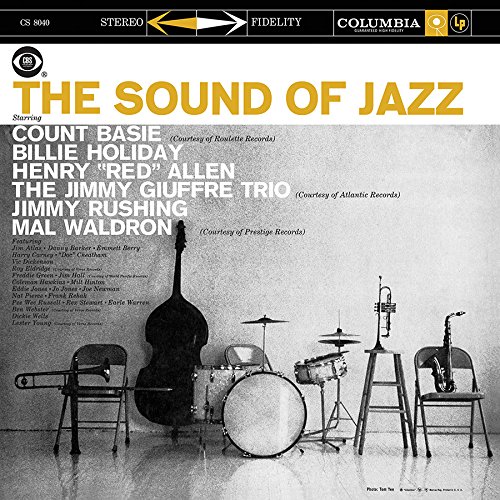
A Columbia recording by that name and bearing the CBS television logotype was issued early in 1958, but it was not the soundtrack of the show. It was a recording made on December 4th in Columbia's Thirtieth Street studio as a kind of rehearsal for the television production. It included many of the musicians who did appear on December 8th, and except for one number the materials were the same. Columbia probably made the recording as a precaution: a live jazz television program lasting a full hour (then, as it is now, the basic unit of television time was the minute) and built around thirty-odd (unpredictable) jazz musicians might easily turn into a shambles. It didn't. The soundtrack, which is at last available in its entirety — as The Real Sound of Jazz, on Pumpkin Records — is superior to the Columbia record in almost every way, sound included.


The Sound of Jazz has long been an underground classic, and a lot of cotton wool has accumulated around it. So here, allowing for vagaries of memory, is how the program came to be. In the spring of 1957, Robert Goldman asked me if I would be interested in helping put together a show on jazz for John Houseman's new "Seven Lively Arts" series, scheduled to be broadcast on CBS in the winter of 1957-58. I submitted an outline, and it was accepted. I invited Nat Hentoff to join me as co-advisor, and we began discussing personnel and what should be played. Our wish was to offer the best jazz there was in the simplest and most direct way — no history, no apologetics, no furbelows. But John Crosby, the television columnist of the Herald Tribune, had been hired as master of ceremonies for the "Seven Lively Arts," and we feared that he would do just what we wanted to avoid — talk about the music. We suggested listing the musicians and the tunes on tel-ops (now common practice), but Crosby was under contract for the whole series, and that was that. Crosby, it turned out, pretty much agreed with us, and what he did say was to the point. For the brilliant visual side of the show, CBS chose the late Robert Herridge as the producer and Jack Smight as the director. The excitement of the camerawork and of Smight's picture selection — he had five cameramen — has never been equaled on any program of this kind.


Here is the form the program finally took: A big band, built around the nucleus of the old Count Basie band, was the first group to be heard, and it included Roy Eldridge, Doc Cheatham, Joe Newman, Joe Wilder, and Emmett Berry on trumpets; Earle Warren, Ben Webster, Coleman Hawkins, and Gerry Mulligan on reeds,- Vic Dickenson, Benny Morton, and Dicky Wells on trombones; and a rhythm section of Basie, Freddie Green, Eddie Jones, and Jo Jones. This Utopian band, which Basie seemed immensely pleased to front, played a fast blues, "Open All Night," written and arranged by Nat Pierce, who did all the arranging on the show. Then a smaller band, made up of Red Allen and Rex Stewart on trumpet and cornet, Pee Wee Russell on clarinet, Hawkins, Dickenson, Pierce, Danny Barker on guitar, Milt Hinton on bass, and Jo Jones, did the old Jelly Roll Morton-Louis Armstrong "Wild Man Blues" and Earl Hines' "Rosetta." The group was a distillation of the various historic associations, on recordings, of Allen and Russell, of Allen and Hawkins, and of Stewart and Hawkins, with Dickenson's adaptability holding everything together. 


The rhythm section was all-purpose and somewhat in the Basie mode. Thelonious Monk, accompanied by Ahmed Abdul-Malik on bass and Osie Johnson on drums, did his "Blue Monk." The big band returned for a slow blues, "I Left My Baby," with Jimmy Rushing on the vocal, and for a fast thirty-two-bar number by Lester Young called "Dickie's Dream." Billie Holiday sang her blues "Fine and Mellow," accompanied by Mal Waldron on piano and by Eldridge, Cheatham, Young, Hawkins, Webster, Mulligan, Dickenson, Barker, Hinton, and Osie Johnson. The Jimmy Giuffre Three, with Giuffre on reeds, Jim Hall on guitar, and Jim Atlas on bass, did Giuffre's "The Train and the River," and the show was closed by a slow blues, in which Giuffre and Pee Wee Russell played a duet, accompanied by Barker, Hinton, and Jo Jones. Crosby introduced each group, and there were pre-recorded statements about the blues from Red Allen, Rushing, Billie Holiday, and Guiffre. (I found these intrusive, but Hentoff and Herridge liked them.) 


The show was held in a big, bare two-story studio at Ninth Avenue and Fifty-sixth Street, and the musicians were told to wear what they wanted. Many wore hats, as jazz musicians are wont to do at recording sessions. Some had on suits and ties, some were in sports shirts and tweed jackets. Monk wore a cap and dark glasses with bamboo side pieces. Billie Holiday arrived with an evening gown she had got specially for the show, and was upset when she found that we wanted her in what she was wearing—a pony tail, a short-sleeved white sweater, and plaid pants. There was cigarette smoke in the air, and there were cables on the floor. A ladder leaned against a wall. Television cameras moved like skaters, sometimes photographing each other. The musicians were allowed to move around: Basie ended up watching Monk, and later Billie Holiday went over and stood beside Basie.


The atmosphere at the Columbia recording session was similar. Many of the musicians had not been together in a long time, and a rare early-December blizzard, which began just before the session and left as much as a foot of snow on the ground, intensified everything. It also caused problems. Our plan had been to reunite the All-American rhythm section of Basie, Freddie Green, Walter Page on bass, and Jo Jones, but Page called and said that he was sick and that, anyway, he couldn't find a cab. (He didn't make the television show, either, and he died two weeks later.) Eddie Jones, Basie's current bassist, replaced him. Thelonious Monk didn't turn up, and that is why Mal Waldron recorded a four-minute piano solo, aptly titled "Nervous." 


There were various other differences between the recording and the show. Frank Rehak took Benny Morton's place on the recording, because Morton was busy. Harry Carney, a man of infinite graciousness, filled in for Gerry Mulligan, a man of infinite ego, because Mulligan insisted he be paid double scale, and was refused. Doc Cheatham solos on the Columbia session but only plays obbligatos behind Billie Holiday on the television show; he had asked to be excused from all soloing, claiming that it would ruin his lip for his regular gig with a Latin band. Lester Young provides obbligatos behind Jimmy Rushing on "I Left My Baby" on the Columbia record, and he also solos twice. He was particularly ethereal that day, walking on his toes and talking incomprehensibly, and most of the musicians avoided him. But he was intractable on Sunday during the first of the two run-throughs that preceded the television show. He refused to read his parts, and he soloed poorly. He was removed from the big-band reed section and was replaced by Ben Webster, and his only solo is his famous twelve bars on "Fine and Mellow"—famous because this sequence had been used so many times on other television shows and because of Billie Holiday's expression as she listens to her old friend, an expression somewhere between laughter and tears. Billie Holiday came close to not being on the show. A week or so before, word of her difficulties with drugs and the law had reached the upper levels at CBS, and it was suggested that she be replaced by someone wholesome, like Ella Fitzgerald. We refused, and were backed by Herridge, and she stayed.


It is astonishing how good the music is on "The Real Sound of Jazz." Billie Holiday and Red Allen and Jimmy Rushing are in fine voice. The big-band ensembles are generally dazzling. The solos are almost always first-rate. (Giuffre is dull, and Roy Eldridge is overexcited.) Listen to Dickenson's boiling, shouting statement on "Dickie's Dream," wisely taken at a slightly slower tempo than on the Columbia record, and to his easy, rocking solo on "Wild Man Blues." And listen to Rex Stewart, sly and cool, on "Wild Man" (he had recently emerged from a long semi-retirement) and to the way Jo Jones frames its breaks—suspending time, shaping melody, italicizing emotion. Some of the music on the show has not weathered well. Monk, surprisingly, sounds hurried and the Giuffre trio, which was extremely popular at the time, is thin and synthetic. And Pee Wee Russell swallows Giuffre in their duet. CBS never ran the program again, but it was shown at the Museum of Modern Art in the sixties, and there is now a copy at the Museum of Broadcasting.”



Tuesday, October 19, 2021

The Sound of Jazz by Whitney Balliett

 © Copyright ® Steven Cerra, copyright protected; all rights reserved.


Until the publication of Whitney Balliett’s essay “The Sound of Jazz” in the New Yorker [1983], very little of the background information was known by the general public about what is arguably the best program on Jazz in performance ever produced for TV as well as Whitney’s role in its development.


It’s a fascinating story from so many perspectives that I thought I’d share it with you as a remembrance of times gone by for some of the original makers of the music.


MP3 files of the program are available for download and used CD copies can still be found through various online sellers.


“The confusion about the soundtrack of "The Sound of Jazz," the celebrated hour-long program broadcast live on CBS television on December 8, 1957, began a minute or so before the program ended, when an announcer said, "Columbia Records has cut a long-playing record of today's program, which will be called The Sound of Jazz. It'll be released early next year." 


A Columbia recording by that name and bearing the CBS television logotype was issued early in 1958, but it was not the soundtrack of the show. It was a recording made on December 4th in Columbia's Thirtieth Street studio as a kind of rehearsal for the television production. It included many of the musicians who did appear on December 8th, and except for one number the materials were the same. Columbia probably made the recording as a precaution: a live jazz television program lasting a full hour (then, as it is now, the basic unit of television time was the minute) and built around thirty-odd (unpredictable) jazz musicians might easily turn into a shambles. It didn't. The soundtrack, which is at last available in its entirety — as The Real Sound of Jazz, on Pumpkin Records — is superior to the Columbia record in almost every way, sound included.


The Sound of Jazz has long been an underground classic, and a lot of cotton wool has accumulated around it. So here, allowing for vagaries of memory, is how the program came to be. In the spring of 1957, Robert Goldman asked me if I would be interested in helping put together a show on jazz for John Houseman's new "Seven Lively Arts" series, scheduled to be broadcast on CBS in the winter of 1957-58. I submitted an outline, and it was accepted. I invited Nat Hentoff to join me as co-advisor, and we began discussing personnel and what should be played. Our wish was to offer the best jazz there was in the simplest and most direct way — no history, no apologetics, no furbelows. But John Crosby, the television columnist of the Herald Tribune, had been hired as master of ceremonies for the "Seven Lively Arts," and we feared that he would do just what we wanted to avoid — talk about the music. We suggested listing the musicians and the tunes on tel-ops (now common practice), but Crosby was under contract for the whole series, and that was that. Crosby, it turned out, pretty much agreed with us, and what he did say was to the point. For the brilliant visual side of the show, CBS chose the late Robert Herridge as the producer and Jack Smight as the director. The excitement of the camerawork and of Smight's picture selection — he had five cameramen — has never been equaled on any program of this kind.


Here is the form the program finally took: A big band, built around the nucleus of the old Count Basie band, was the first group to be heard, and it included Roy Eldridge, Doc Cheatham, Joe Newman, Joe Wilder, and Emmett Berry on trumpets; Earle Warren, Ben Webster, Coleman Hawkins, and Gerry Mulligan on reeds,- Vic Dickenson, Benny Morton, and Dicky Wells on trombones; and a rhythm section of Basie, Freddie Green, Eddie Jones, and Jo Jones. This Utopian band, which Basie seemed immensely pleased to front, played a fast blues, "Open All Night," written and arranged by Nat Pierce, who did all the arranging on the show. Then a smaller band, made up of Red Allen and Rex Stewart on trumpet and cornet, Pee Wee Russell on clarinet, Hawkins, Dickenson, Pierce, Danny Barker on guitar, Milt Hinton on bass, and Jo Jones, did the old Jelly Roll Morton-Louis Armstrong "Wild Man Blues" and Earl Hines' "Rosetta." The group was a distillation of the various historic associations, on recordings, of Allen and Russell, of Allen and Hawkins, and of Stewart and Hawkins, with Dickenson's adaptability holding everything together. 


The rhythm section was all-purpose and somewhat in the Basie mode. Thelonious Monk, accompanied by Ahmed Abdul-Malik on bass and Osie Johnson on drums, did his "Blue Monk." The big band returned for a slow blues, "I Left My Baby," with Jimmy Rushing on the vocal, and for a fast thirty-two-bar number by Lester Young called "Dickie's Dream." Billie Holiday sang her blues "Fine and Mellow," accompanied by Mal Waldron on piano and by Eldridge, Cheatham, Young, Hawkins, Webster, Mulligan, Dickenson, Barker, Hinton, and Osie Johnson. The Jimmy Giuffre Three, with Giuffre on reeds, Jim Hall on guitar, and Jim Atlas on bass, did Giuffre's "The Train and the River," and the show was closed by a slow blues, in which Giuffre and Pee Wee Russell played a duet, accompanied by Barker, Hinton, and Jo Jones. Crosby introduced each group, and there were pre-recorded statements about the blues from Red Allen, Rushing, Billie Holiday, and Guiffre. (I found these intrusive, but Hentoff and Herridge liked them.) 


The show was held in a big, bare two-story studio at Ninth Avenue and Fifty-sixth Street, and the musicians were told to wear what they wanted. Many wore hats, as jazz musicians are wont to do at recording sessions. Some had on suits and ties, some were in sports shirts and tweed jackets. Monk wore a cap and dark glasses with bamboo side pieces. Billie Holiday arrived with an evening gown she had got specially for the show, and was upset when she found that we wanted her in what she was wearing—a pony tail, a short-sleeved white sweater, and plaid pants. There was cigarette smoke in the air, and there were cables on the floor. A ladder leaned against a wall. Television cameras moved like skaters, sometimes photographing each other. The musicians were allowed to move around: Basie ended up watching Monk, and later Billie Holiday went over and stood beside Basie.


The atmosphere at the Columbia recording session was similar. Many of the musicians had not been together in a long time, and a rare early-December blizzard, which began just before the session and left as much as a foot of snow on the ground, intensified everything. It also caused problems. Our plan had been to reunite the All-American rhythm section of Basie, Freddie Green, Walter Page on bass, and Jo Jones, but Page called and said that he was sick and that, anyway, he couldn't find a cab. (He didn't make the television show, either, and he died two weeks later.) Eddie Jones, Basie's current bassist, replaced him. Thelonious Monk didn't turn up, and that is why Mal Waldron recorded a four-minute piano solo, aptly titled "Nervous." 


There were various other differences between the recording and the show. Frank Rehak took Benny Morton's place on the recording, because Morton was busy. Harry Carney, a man of infinite graciousness, filled in for Gerry Mulligan, a man of infinite ego, because Mulligan insisted he be paid double scale, and was refused. Doc Cheatham solos on the Columbia session but only plays obbligatos behind Billie Holiday on the television show; he had asked to be excused from all soloing, claiming that it would ruin his lip for his regular gig with a Latin band. Lester Young provides obbligatos behind Jimmy Rushing on "I Left My Baby" on the Columbia record, and he also solos twice. He was particularly ethereal that day, walking on his toes and talking incomprehensibly, and most of the musicians avoided him. But he was intractable on Sunday during the first of the two run-throughs that preceded the television show. He refused to read his parts, and he soloed poorly. He was removed from the big-band reed section and was replaced by Ben Webster, and his only solo is his famous twelve bars on "Fine and Mellow"—famous because this sequence had been used so many times on other television shows and because of Billie Holiday's expression as she listens to her old friend, an expression somewhere between laughter and tears. Billie Holiday came close to not being on the show. A week or so before, word of her difficulties with drugs and the law had reached the upper levels at CBS, and it was suggested that she be replaced by someone wholesome, like Ella Fitzgerald. We refused, and were backed by Herridge, and she stayed.


It is astonishing how good the music is on "The Real Sound of Jazz." Billie Holiday and Red Allen and Jimmy Rushing are in fine voice. The big-band ensembles are generally dazzling. The solos are almost always first-rate. (Giuffre is dull, and Roy Eldridge is overexcited.) Listen to Dickenson's boiling, shouting statement on "Dickie's Dream," wisely taken at a slightly slower tempo than on the Columbia record, and to his easy, rocking solo on "Wild Man Blues." And listen to Rex Stewart, sly and cool, on "Wild Man" (he had recently emerged from a long semi-retirement) and to the way Jo Jones frames its breaks—suspending time, shaping melody, italicizing emotion. Some of the music on the show has not weathered well. Monk, surprisingly, sounds hurried and the Giuffre trio, which was extremely popular at the time, is thin and synthetic. And Pee Wee Russell swallows Giuffre in their duet. CBS never ran the program again, but it was shown at the Museum of Modern Art in the sixties, and there is now a copy at the Museum of Broadcasting.”


Sunday, May 2, 2021

A Fickle Sonance by Art Lange

 © Copyright ® Steven Cerra, copyright protected; all rights reserved.


Here’s one more essay from the www.pointofdeparture.org website, an online musical journal which is published and produced on a monthly basis by Bill Shoemaker and Troy Collins, respectively. I highly recommend that you visit their page and check out the archives which date back to 2005 for a wealth of interesting articles and information on Jazz and related topics as well as many interviews and essays of a general nature on all aspects of American culture.


This one is by Art Lange who is an adjunct professor at Columbia College in Chicago and who has had a long association with Jazz and the creative arts most especially from 1981-84 when he was Associate Editor, and from 1984-88, Editor, of Down Beat magazine. He also published and edited Brilliant Corners: a magazine of the arts, from 1975-77 and was a founding member, and was elected the first President of the Jazz Journalists Association.


I always associated the title of his essay - A Fickle Sonance - with a 1961 Blue Note LP of the same name by alto saxophonist Jackie McLean [1931-2006]. In his liner notes to the album, Ira Gitler defines the title as “a changing sound may be a simple definition.”


The implication is changeableness with sonance being a now obsolete term for a sound or a tune. 


See if you can identify how Art uses the meaning of the title of his piece in the following essay. Maybe what he is describing is that a fickle sonance is another way of saying Jazz?


“When an artistic experience truly and totally clicks with an individual, a special connection is made and a profound level of awareness is reached, one which stops time and renders it inconsequential. The proverbial light bulb goes on, or as Frank O’Hara once said in a poem, “Everything suddenly honks.” It might be a monumental painting like Picasso’s Guernica or a small Kurt Schwitters collage, a film like Citizen Kane or a Roadrunner cartoon, a Shakespeare play or a third grader’s haiku. The scope of the achievement doesn’t matter, what’s important is how it affects us personally, the impression that it leaves on our psyche, the way it makes us feel, and the understanding we take from it. When we connect with a piece of music in this fashion, the world looks and sounds different ever after.


Every jazz fan knows, or should know, The Sound of Jazz. Broadcast on the CBS television show The Seven Lively Arts in December 1957, it was in effect a relaxed, informal live concert featuring the reigning stars of mainstream swing—Count Basie, Billie Holiday, Coleman Hawkins, and a luminescent galaxy of supporting artists shrewdly handpicked by consultants Whitney Balliett and Nat Hentoff. But in addition to established swing players like Rex Stewart, Red Allen, Roy Eldridge, and Ben Webster, Balliett and Hentoff spiced the personnel with a few eccentric modernists—clarinetists Pee Wee Russell (was anyone playing as far out as early as the ‘30s?) and Jimmy Giuffre, and Thelonious Monk (still considered by many an outsider in ’57). To our great fortune, a decent videotape of the program was issued back in 1990. There have since been issued a couple of DVD transfers from Europe which I haven’t seen, but beware the DVD version from Music Video Distribution (MVD)—one entire segment, Monk’s appearance, has been removed, and the black and white visual contrast is so bad that faces are often washed out. And the faces of these great artists reveal as much about the emotion of the creative moment, and the pride and passion inherent in the process, as the music itself. For those of us born after World War II, filmed documentation like this is our only opportunity to have seen several generations of innovators at work, in the moment.


What makes The Sound of Jazz a classic is that it contains not just one but several of these undeniable time-negating moments. I suspect for most viewers one will be the sight of a gaunt but unbowed Billie Holiday offering an exquisitely phrased “Fine and Mellow,” especially the poignant moment when Lester Young stands to blow one soft, slow, simple blues chorus as Billie nods in empathy—two bodies sharing one musical heart. Ironically, Young’s face is on screen for just the first few measures of his solo (the rest of the time the camera lingers on the singer), and we see various shots of the other musicians throughout the performance, but his image otherwise appears only briefly at the song’s very beginning and very end. Though the other three saxophonists stand, he remains seated, seen from the back, bathed in shadow and unrecognizable. At this point in his life, suffering from the maladies that will consume him a little over a year later, he’s already a ghost; all that remains is his music echoing in the air.


Another classic moment, this one potentially confrontational, is when Count Basie literally gets in Monk’s face, sitting with casual audacity in the crook of the piano as if to say, “Okay kid, show me what you’ve got.” Monk of course, hidden behind shades, pays no attention and slices and stomps his way through an edgy “Blue Monk.” As he plays, reaction shots of Jimmy Rushing and Coleman Hawkins reveal various degrees of engagement, from bemusement to finger-snapping rapport, but it’s not until Basie’s face erupts in glee that the moment’s tension is released and we see an older generation willing to accept Monk’s abstracted chords and reconfigured rhythmic accents as part of the common vocabulary and not a foreign language.


Personally, I love the way Red Allen kicks off his ad-hoc group’s numbers with a “Watch it…whamp…whamp” and ends them with “Niiiice!” (And Pee Wee’s solo on “Wild Man Blues” is stunning.) But for me, the moment that clicks is the augmented Basie Band’s performance of Dickie Wells’ tune “Dickie’s Dream.” It is one of the most astonishing things I have ever seen. The performance is just over six minutes long, a sequence of solo after solo, but it is all of a piece, a single indivisible electrifying experience, a slice of life so real and so intense that it suspends the passing of time. It starts with Basie’s piano and the deceptively elfin Jo Jones behind the drums setting a deviously fast tempo with the tune’s introductory descending notes. The band kicks right in with Nat Pierce’s fierce orchestration of the minor-key theme that was originally recorded by Basie’s Kansas City Seven. What was in its 1939 incarnation simultaneously suave and mysterious here becomes rousing and suspenseful, a foreboding of potent things to come.


And they come quickly and without respite. Ben Webster emerges first from the ensemble with a gruff, almost antagonistic solo that serves as a challenge, a call-to-arms, to each of the players to follow. When he finishes, he nearly rips the tenor saxophone out of his mouth with a “take that!” gesture. Trombonist Benny Morton tries to sustain Webster’s vigor with cascading countermelodies, and trumpeter Joe Wilder substitutes multi-note flurries, but it’s the band’s riffing that keeps the music hot and the tension building. Gerry Mulligan’s baritone sax grabs a nice phrase from the mix to start his solo, as he sways and rides the waves of energy the band is feeding him. Trombonist Vic Dickenson’s slippery initial notes elicit shouts of joy from Wilder and saxophone section leader Earle Warren—and suddenly the camaraderie and spirit that is fueling the music is palpable. Next trumpeter Roy Eldridge enters full blast, then tries some intricate figures, but soars out of them with sizzling stratospheric shrieks, forsaking pitch for pure emotion—a gesture so shocking that subsequent trumpeter Emmett Berry’s only recourse is a brief return to melodic restraint. But this doesn’t last long, as Coleman Hawkins—eyes squeezed shut in concentrated effort—takes over and sails through the changes, his tenor sax growling more aggressively with each connected phrase. Dickie Wells, ever the imp, naturally takes the opposite tact, his trombone muted, sliding to and fro with cool insouciance (but notice how hard bassist Eddie Jones is working behind him), followed by Joe Newman’s likewise muted but tart trumpet, precariously balanced atop the momentum of a ruthlessly driving rhythm section.


The band drops out, leaving Basie to rebuild the tension once more, alternately stabbing at and clawing out chords, jolting with characteristic stride feel—I wonder if watching Monk just moments earlier inspired Basie to dissect the chords even more surgically than usual? The full band re-enters, punching and counterpunching, with stop-time chords visually punctuated by Jo Jones’ crisp, precise arm movements. Basie takes one final, tongue-in-cheek run up to the very tip of the keyboard, and the band shouts out one last relentless cadence until Warren cuts them off with a chop. In the next few seconds, the silence, as someone once said, is deafening.


No doubt, this was a once-in-a-lifetime event. They couldn’t have captured lightning in a bottle twice—and the proof is in the studio recording made during rehearsals four days earlier (and issued by Columbia instead of the actual soundtrack), which is fine in its own way, and includes memorable solos by Lester Young and Harry Carney, who were not part of the televised version. But what is it that makes the latter transcendent? I’m sure it has something to do with the power of group dynamics and the uniqueness of this particular personnel and these special circumstances. I have no illusion that a description of the music can substitute for or explain the drama and exhilaration of this experience. I wrote this for selfish reasons—looking for the right words has helped me come a bit closer to understanding why I get chills whenever I watch it. If this piques your interest enough to check it out yourself, so much the better. Just be prepared to lose all sense of time.”

Art Lange©2007