Showing posts with label Tony Williams. Show all posts

Sunday, February 21, 2021

Tony Williams: Two Decades of Drum Inspiration - by Paul deBarros

 © Copyright ® Steven Cerra, copyright protected; all rights reserved.
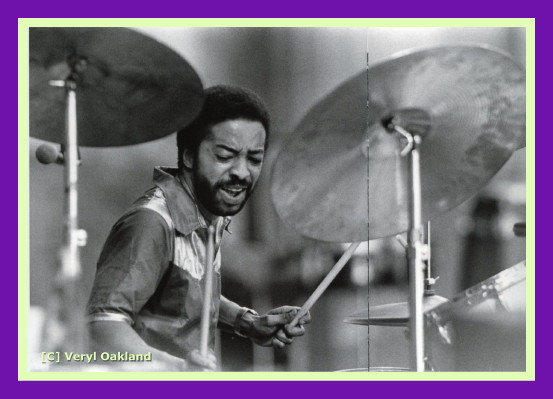

The editorial staff at JazzProfiles has previously written quite extensively about the late drummer Tony Williams [1945-1997] and you can locate a combined posting of these features by going here.


We recently came across the following interview that Paul deBarros did with Tony that was published in the November 1983 edition of Downbeat and we thought we would bring it up on these pages to have more of Tony’s views on drumming and music available in his own words on the blog.


Never one to be at a loss for words or timid about expressing his opinions, his brashness, assertiveness, and candor - none of which is meant pejoratively - are also reflected in his musical “personality.” 


After all, as Pops [Louis Armstrong] often stated: “Jazz is what you are.” Put another way, Tony’s style of drumming is bold, forceful and colorful so why would we expect him to be any less so in an interview?


“Tony Williams erupted onto the jazz scene in 1963, a 17-year-old prodigy with a full-blown, volcanic style of drumming that would blow hard-bop  lustiness  out the door. Williams' arrival was hailed with a great deal of fanfare. The week he came with Miles Davis to San Francisco's Jazz Workshop,  the   club   temporarily  relinquished its liquor license so the underage genius could play. I remember, because it was the first time I was allowed in as well. Williams played the drums that week at a level of energy and activity — not to mention volume — that was not only exciting, but liberating. Whirling from crash to ride to slack hi-hat, now pummeling, now tickling, now coaxing, he machine-gunned the bass drum, pulled low-pitched "pows" from the toms and jagged bursts from the snare as if his legs and arms were connected to four separate torsos. His complex, distinct style, which owed a lot to the floating time of Roy Haynes and thrust of Elvin Jones (Sunny Murray's unbridled freestyle was a simultaneous development rather than an influence), suggested that jazz drumming might exist as an adjunct to, as well as a support for, the rest of the band.


Williams stayed with Davis five years. In 1968, like Herbie Hancock and Ron Carter before him, Williams left Miles, smelling rock & roll in the air. Joining forces with keyboard man Larry Young and British guitarist John McLaughlin (whom Tony discovered, but Miles snatched into the recording studio first, for In a Silent Way), the drummer recorded a groundbreaking jazz-fusion trio album, Emergency, for Polydor (recently reissued as Once In a Lifetime, Verve), of psychedelic fervor and volume. For a while it looked as if Tony Williams was going to take the electric '70s by storm, as he had the acoustic '60s.


But it didn't turn out that way. At Polydor he suffered poor management, poor promotion and poor sales. Fans who had exhaled "far out" for Emergency dumped Turn It Over and Ego into the used-record bins. The critics lambasted him, crying, "Sellout." Williams, for all his bravado a vulnerable fellow, retreated, confused. From 1973 to '75 and again from 1976 to '79, he vanished as a leader. When he did come back, with Columbia, it was with the crisp, straight-ahead rock of Believe It, pumped full of hot air by a disco-ing promotional department. Jazz fans shook their heads, wondering what had happened to their young hero. After an exhibitionist tour de force, Joy of Flying, in 1979, on which he amassed everyone from Cecil Taylor to Tom Scott, Columbia dropped Williams in the middle of a seven-record contract. More than ever, he began to look like the Orson Welles of jazz, burst-ing into the world with creative energy only to make a long, agonizing finish. One critic, Valerie Wilmer, even went so far as to dismiss him as a showman.


But Wilmer, and others, weren't really paying attention. While it was true that Tony Williams hadn't come up with any project matching the creative vision of Emergency or the late-'60s Miles quintet (hard acts to follow), he had certainly held his ground, which is considerable. He is every bit as good a jazz drummer as he was 20 years ago, as his recent performance in Seattle with V.S.O.P. II attested. Besides, none of the other great jazz drummers — Max Roach, Art Blakey, Elvin Jones — has altered his style after its initial breakthrough. Williams' work in rock has been a mighty influence, right down to the current work of Journey's Steve Smith.


As for integrity, Williams has this to say to his critics: "People have this thing that if you like pop music, it's because of the money. My career will tell you I've never done anything for the money. Writers and critics and people in the jazz world think you cannot possibly like the Police because of the music, which is absurd. I do the things I do because they excite me, and the rest is a load of rubbish."


Williams continues to tour both in rock and jazz situations. In 1980, he played Europe with young Portland, Ore., fusion keyboardist Tom Grant and Missing Persons bassist Pat O'Hearn; in 1981 and '83 he toured with V.S.O.P. He plays on one track of Grant's Columbia album You Hardly Know Me, and on several with Wynton Marsalis, who replaced Freddie Hubbard in V.S.O.P.


In 1977, the drummer moved from New York to Marin County, north of San Francisco, where he lives in a country home with his girlfriend. Three days a week he drives to UC Berkeley, where he is studying classical composition with Robert Greenberg. When he is not composing fugues or studying counterpoint ("It's a mountain of work," says Williams), he is in the studio in San Francisco or busy catching up on some of the things he missed growing up a superstar: playing tennis, swimming, learning German and driving his Ferrari. Williams says the move to California has revitalized his creative life and helped him to get past the tangled 1970s.


Paul de Barros: You completely changed jazz drumming in the 1960s. Were you consciously aware at any certain point that you were doing something new?


Tony Williams: Not really. I guess I was aware that I was playing differently, but it was more of a thing that I was aware of a need, like if you see a hole, you think you can fill it. There were certain things that guys were not playing that I said, "Why not? Why can't you do this?"


de Barros: How important was Alan Dawson, your teacher in Boston, in your development of independence in all four limbs?


Williams: What I got basically from Alan was clarity. He had a lot of independence, but so did other people. I get this question about independence a lot, even from drummers, but they can't even be clear about their ideas. I mean, you hear them play something, and you say, "What was it that he played?" Or if they hear themselves back on tape, they say they thought they played good, but that it didn’t sound like that. So the idea is that when you play something for it to sound like what you intended, not to have a "maybe" kind of sound. So that's what I got from Alan, the idea that you have to play clearly


de Barros: Were you thrilled to be part of the Miles band in the '60s?


Williams: Well, when you're doing things it's hard to say, "Oh gee, this is going to be real historical sometime." I mean, you don't do that; you just go to the sessions, and 10 or 20 years later people are telling you that it was important. When you're doing it, you can't really feel that way.


de Barros: What is your relationship with Miles now?


Williams: Very friendly. I saw him this summer. I haven't heard the new albums. but when we played opposite him, I heard bits and pieces of the band, and Miles was sounding good. He's been practicing. I liked Al Foster [Miles' drummer] years ago, when I was with Miles.


de Barros: You've played with a lot of illustrious musicians. Being a drummer, you have to adapt to each one differently. Let's talk about some of them, say, beginning with Sonny Rollins and McCoy Tyner.


Williams: Sonny has a very loose attitude about things — the time, the whole situation. With McCoy I always felt like I was getting in his way, or that it never jelled. I felt inadequate. Actually, with both Sonny and McCoy, it's like you're playing this thing, and they're going to be on top of it.


de Barros: How about John McLaughlin and Alan Holdsworth?


Williams: Completely different. John is more rhythm oriented. He plays right with you, on the beat. He'll play accents with you. Even while he's soloing, he'll drop back and play things that are in the rhythm. Alan is less help, With Alan it’s like he's standing somewhere and he's just playing, no matter what the rhythm is,


de Barros: Wynton Marsalis and Freddie Hubbard?


Williams: Freddie plays the same kind of solo all the time. I get the feeling that if Freddie doesn't get to a climax in his solos, and people really hear it, he gets disappointed. With Wynton it's always different. I don't know what he's going to play. It's always stimulating.


de Barros: I gather you think Wynton Marsalis' manifesto about only playing jazz — and not funk or rock — is not that important?


Williams: He thinks it's an important attitude. That's what counts.


de Barros: A lot of fans and critics still find a contradiction in your playing what they see as oversimplified rock as well as the kind of complex jazz you played with Miles and you play now with V.S.O.P. II. What 's your reaction to that?


Williams: Well, first of all, just because it's jazz, doesn't mean it's going to be more complex. I've played with different people in jazz where it was just what you'd call very sweet music. No type of music, just because it's a certain kind of music, is all good. A lot of rock & roll is not happening. And a lot of so-called jazz,  and the people who play it, are not happening. Complexity is not the attraction for me, anyway—it's the feeling of the music, the feeling generated on the bandstand.  So playing in a heavy rock situation can be as satisfying as anything else. If I'm playing just a backbeat with an electric bass and a guitar, when it comes together, it's really a great feeling.


de Barros: You were quoted in Rolling Stone praising the drummer in the Ramones. Were you serious?


Williams: I don't remember the occasion, but I do like that kind of drumming, like Keith Moon, any drumming where you have to hit the drum hard; that's why I like rock & roll drumming.


de Barros: Sometimes so much of that music seems very insensitive.


Williams: It depends on what you're saying the Ramones are supposed to be sensitive to. Just because it's jazz doesn't mean it's going to be sensitive to. You're trying to evoke a whole other type of feeling with the Ramones. When I drive through different cities and I look up in the Airport Hilton and I see the sign that says, "Tonight in the lounge, 'live jazz'" — I mean, what the hell does that mean? I'm not saying everybody's like this, but I can see a tinge of people saying, "This is the only way it was in 1950, and we're going to keep it that way, whether the music is vital or not, whether or not what we end up playing sounds filled with cobwebs." When John Coltrane was alive, there were all kinds of people who put him down. But these same people will now raise his name as some sort of banner to wave in people's faces to say, "How come you're not like this?" These same people. That's the hypocrisy, and I find it very tedious.


de Barros: How important is technique?


Williams: You've got to learn to play the instrument before you can have your own style. You have to practice. The rudiments are very important. Before I left home, I tried to play exactly like Max Roach, exactly like Art Blakey, exactly like Philly Joe Jones, and exactly like Roy Haynes. That's the way to learn the instrument. A lot of people don't do that. There are guys who have a drum set for two years and say they've got their own "style."


de Barros: How can we prevent those kinds of guys from taking; up more room than they deserve?


Williams: (Laughing.) Well, we could pass a law.


de Barros: The Bad Drummer Ordinance?


Williams: Exactly. Anyone who does not study is shot! Seriously, though, it's a big responsibility when you play the drums, and a lot of guys don't want the responsibility, but they want to play the drums. The drummer is playing all the time. You can have a terrible band and a great drummer, and you've got a good band; but you could have great horn players, and if the drummer and the bass player aren't happening, you've got a terrible band.


de Barros: Is tuning important?


Williams: Yes, I hear drummers that have maybe 12 drums that all sound the same. If you closed your eyes, you wouldn't know where they were on the set. Or else you'll have guys where each drum sounds like it's from a different set. It's important that the drum set sounds like one instrument. Like, if you have a piano, you wouldn't want the C to sound like a Rhodes, the D to sound like a Farfisa, the E to sound like a Prophet. A keyboard is a uniform system; a trumpet is a uniform system ... drummers are out to lunch. On some of my drums, the bottom head is tighter than the top head. On other drums they're about the same. And on the bass drum the front head is looser than the batter side.


de Barros: Have you tried electronic drums?


Williams: Yeah! I tried the Simmons. The separation you get on tape is great. The programmability, the sound, the sequencing... it's another thing to do that seems very interesting. I have a DMX (electronic, programmable drum machine by Oberheim] at home.


de Barros: Will electronic drums be part of what you're doing in the studio?


Williams: Oh yeah, they already are.


de Barros: Can you say anything more about what direction your music is going?


Williams: The popular direction. I like MTV. I like the Police, Missing Persons, Laurie Anderson. I performed with her on a San Francisco date. It was great, I love the new Bowie album. Prince. I like the idea of writing lyrics, of putting images with words that evoke a scene on top of the music. I like Herbie's new album - [Herbie Hancock, Future Shock, Columbia 38814]. It's really happening.


de Barros: Are you interested in making a video yourself?


Williams: Sure. Growing up in this country, watching TV and movies, everyone would like to make a movie. It's a new thing to do. You know writers want to be painters; screenwriters want to be directors. Musicians want to make movies. Doing a project and having a lot of people like it and maybe listen to it on the radio, that appeals to me. What I'm trying to do is something that captures a lot of people's imaginations. If the result is I'm more famous, fine. But it's not like I'm after being a pop star.

dd Barros: You've said in the past that jazz should be popular, not an elitist art form. But isn't it about time Americans claimed jazz as their art form and started recognizing it with the kind of respect they give to European music?


Williams: That's a fine thought, but how much is that really going to do for musicians? I don't think society really recognizes classical music, anyway. It's all patronage, and grants, a certain class of people. Jazz was originally the music of the people in the streets and not in concert halls, so when you lose that, you suffer the consequences. There's nothing wrong with jazz being an art form, but it has a certain roughness and vitality and unexpectedness that's important. I guess I'm old-fashioned.”


Wednesday, August 26, 2020

Tony Williams - The Tony Scherman Interview

© -Steven Cerra, copyright protected; all rights reserved.


A LESSON FROM TONY WILLIAMS


“When I was a kid, for about two years I played like Max Roach. Max is my favorite drummer. Art Blakey was my first drum idol, but Max was the biggest. So I would buy every record I could with Max on it and then I would play exactly what was on the record, solos and everything. I also did that with Art Blakey, Philly Joe Jones, Jimmy Cobb, Roy Haynes, and all of the drummers I admired. I would even tune my drums just like they were on the record.


People try to get into drums today, and after a year, they’re working on their own style. You must first spend a long time doing everything that the great drummers do. Then you can understand what it means. Not only do you learn how to play something, but you also learn why it was played. That’s the value of playing like someone. You can’t just learn a lick; you’ve got to learn where it came from, what caused the drummer to play that way, and a number of things. Drumming is like an evolutionary pattern.”


Our recent re-posting of an earlier piece on the late drummer Tony Williams [1945-1997] generated a lot of interest including a very nice note from drummer Ed Soph who teaches at the University of North Texas admonishing us for not saying more about the role of Tony’s teacher Alan Dawson in helping to shape Williams’ exciting approach to drumming.


Ed also kindly sent along the “Lesson from Tony” that opens this feature.


The earlier piece on Tony also overlooked other aspects of his later career particularly his tremendous accomplishments as a composer, arranger and bandleader, the latter during a time in the mid-1980’s when very few new, modern Jazz quintets were being formed.


The following interview by Tony Scherman is intended to rectify some of these omissions.


Very sadly, five short years after the interview was conducted, Tony would be dead from complication following an appendix surgery.


March, 1992
Musician Magazine
Can’t Stop Worrying, Can’t Stop Growing: Tony Williams Reinvents Himself


“This may sound self-aggrandizing, but playing the drums was always easy for me. From an early age, it was so easy to figure stuff out it was almost embarrassing. I needed to prove to myself that I was deserving of all the praise, needed to feel that I'd accomplished something—that I had accomplished something, the person that I am. I needed to tackle something that was hard, that wasn't God-given, and see it grow. That's what writing music has been, and is, for me. I had to go get a teacher, I had to study composition for seven years. That was work. Writing music, that's work. Drumming has never been work, it's always been fun. It's still fun. So I could never put the word 'work' in my life, and how can you be a success to yourself if you've never had to work?"


As he enters middle age, Tony Williams looks less and less African American, more and more exotic, near-Eastern: Persian, Lebanese, Assyrian. In profile, his nose hooks luxuriantly. His big almond-shaped eyes are sleepy and liquid; their blank stare can be unnerving. He wears his hair semi-straightened now, brushed back into a stiff little ducktail, and with his lazy rolling gait and odd-shaped body—thick biceps, thick waist—he looks like an ill-tempered Buddha.


Tony Williams—a handful. He plays like the rushing wind, like an avalanche, like a natural disaster. People look at each other and start to laugh, he's so good, so loud, so unapologetically in their faces. There's nothing polite about Tony Williams's drumming, nor anything overly diplomatic about him. He's testy, suspicious, self-involved. Still, the gibe I've heard more than once—"the only thing bigger than Tony Williams's talent is his ego"—strikes me as untrue. Beneath the cold manner flickers a real vulnerability: unhealed wounds. I'll bet he's easily devastated. Something gnaws at this guy, some basic insecurity, and if it makes him difficult and defensive, it's also made him hungry to learn. How many drummers can write a fugue? Compose for string quartet? Organize a spectacularly tight five-man jazz group and write every bit of its thirty-song repertoire—sinuous, muscular, haunting pieces? Williams's composing hasn't yet approached the level of his playing (how many drummers could you non-fatuously call "the world's greatest"?), but his achievement is pretty amazing: He's willed a new facet of himself into being.


Back in 1963, Tony was already working hard, if somewhat in the dark, at composing. "When I was a kid I thought this was what you did: you worked at whatever there was to get better at. Being a good musician meant to keep studying, keep learning. You didn't just specialize. Even back then, the thing that drove me on was wanting to do more, to have a say, to create an atmosphere."


Herbie Hancock, a former prodigy himself, was a suave twenty-three to the kid's eager-beaver seventeen. "Tony was always calling me up: 'Hey man! What's happening!' and I'd think, 'Aw kid, don't bothah me!' and try to gracefully get him off the phone." Callow or not, the kid was an astonishing drummer. When the pair joined the Miles Davis Quintet that spring, says Hancock, "I very quickly went from thinking of Tony as someone who was a real good drummer for a kid to realizing he was a great drummer who happened to be a kid." Thirty years later, Hancock is still an intrigued Williams-watcher. "Tony Williams," he says, "is one of the most intelligent people I have ever known."


When Tony wrote the songs for his first album, 1964's Life Time, he played piano with two fingers, "one on his right hand," says Hancock, "one on his left. No chords really, just two lines, and I had to write out the notes for him. His writing was very raw. But I wasn't about to dismiss something because it was a two-fingered composition; knowing the kind of mind Tony had, I just wanted to not get in his way, to help him realize whatever he had in the back of his head. And I still think the compositions on those first two albums [Life Time and Spring] were great.


"Today he's mastered the vocabulary, but without losing the beauty of that rawness. He's got a full palette now, from angular and surprising to very singable, very beautiful in the conventional sense. My feeling is, he has really got the compositional approach down. Tony doesn't need to study with anybody, at least not for a long while! I'll put it this way. Wayne Shorter and Stravinsky are my favorite composers of all time. Tony is developing so quickly as a composer that he's already one of my favorite jazz composers, and maybe moving toward being one of my favorite composers, period. I absolutely like his pieces that much."


Miles liked them, too; the Davis Quintet's classic Sixties albums are sprinkling Williams tunes like "Pee Wee" and "Hand Jive." But for Tony, "writing always felt hit-and-miss: 'Maybe this'll work, maybe it won't, why won't it?'" He had taken sporadic private lessons in theory and harmony since the mid-Sixties; 1979, however, was a turning point. He'd left Manhattan for the San Francisco Bay Area (where he still lives) "feeling in a hole, in a rut; 1 felt like 1 wasn't doing what I had the talent to do: write music, have a band, have better relationships." He thought about quitting music. Instead, he started private lessons in composition, mostly with Robert Greenberg, a young composer and university professor.


"It was a regular course of study, like at a university. You do a lot of analyzing of other people's work: Mozart, Beethoven, Brahms. I started with species counterpoint, went to intermediate forms of counterpoint, like canons, then invertible counterpoint, like fugues, and on to larger forms of composition—minuet and trio, theme and variations, rondo, that type of thing. It's all about learning how to weave structure and melody into a composition." When a recharged Williams launched his quintet in 1986, some of the band's best pieces came straight from his exercise book—"Arboretum" was an assignment in counterpoint, "Clear Ways" in voice-leading. Tony left Greenberg three years ago; "the band started working so much, I couldn't do my lessons. But 1 plan to go back and pick up where I stopped."


Before 1979, Williams says, "I knew everything there is to know about harmony and theory. What I mean is, I had a good solid grounding in all that stuff. But I didn't know how to organize. You might know emotionally what you want to say, but then it becomes a matter of getting the material to move where you want it to. It's problem-solving. For me it was like, 'I know there's a problem here but I don't know what it is.' When I come up to a problem now, I can pinpoint it. On paper. I can look at it and say, 'Oh, that's the problem and it's because of this, this and this, so if I adjust this, take that out, move this in'... problem solved."


What kind of problem, how to resolve a chord? "No, not how to resolve a chord, that's easy. How to expand an idea. How to make it go somewhere and then return. My big problem used to be that I agonized over things. I'd get an idea and not know what to do with it. Now when I get an idea, I know what to do. Writing is just being able to, as Bob Greenberg used to say, push notes around. Make the notes do what you want them to do.


"Sometimes when I was studying I'd wonder, 'What the hell am I doing? Will there come a time when I'll use this stud'and say, "Oh, this is why you've spent six, seven years staying up and writing these lessons out and driving back and forth to Berkeley three times a week?" ' But my insides would tell me, 'This is what you should be doing.' And now I can say, 'Yes! This is why I was doing it.'"
"What's the payoff?"


Long pause... "The fact that you're here. How's that? See, not only am I not just a drummer, I'm not just a musician either. I'm a person. A lot of things that are valid for me aren't only in musical terms. The fact that you're here and we're talking about what I've written, it tells me all those lessons have paid oil, are bringing me attention, it shows me I've done things people are interested in."


"Well, I like the songs. They stay in my mind."


"I'm glad. And that's why I wanted to study. I wanted to be able to write songs the way 1 knew I could, to present music my friends would like to hear, that would make people feel different things.


"So making the decision to study was easy. I make that kind of decision a lot. Moving to California was another of those things my insides told me to do. And after I got to California I decided to take swimming lessons. ["He did? Tony learned to swim? Aw, that's beautiful!"—Hancock.] I wanted to be able to go to a swimming pool and not just stand and wade; I got tired of going by the deep end and being scared. Now I can dive into the deep end. When I was in New York I was in therapy. In California, I have a therapist. It's helped me look at parts of my life 1Ineed to look at. It's the same kind of process—I'm always challenging myself to get better."


"Tony's composition, 'Sister Cheryl,'" says Herbie Hancock—"the first time I heard that tune [in 1982, when he and Williams played it on Wynton Marsalis's debut] I was shocked. Suddenly there was no more guesswork; Tony could really write chord changes. But what amazed me was that it was in a style that had eluded him for a long time. You know whal Tony once told me? That he wanted to be able to write a tune anybody could sing, like a very natural kind of pop melody. Not that 'Sister Cheryl' is pop— it isn't—but it's catchy. Tony was always asking me what I thought of this or that tune that he wrote. See, I can write melodies people can sing. Tony could never do that, not till then. In many ways—though it's not all the same, and it's definitely Tony's writing—'Sister Cheryl' reminded me of 'Maiden Voyage.' It's one of my favorite compositions ever.


"The way he wrote it, you just move the bass line and the chord will change radically. It starts on a B-major chord, but using the second instead of the third. It's B, C-sharp, F-sharp. With so few notes in the chord, you get lots of flexibility. From B-major it goes to A-flat minor 7— and everything from that first chord fits with the second chord. Then you go to A with a B-major. That's the theme. Now, all these chords fit with the B, C-sharp and F-sharp of the first chord, so by changing the bass line you've changed all the chords, but kept the harmony hanging over from that very first chord. The melody moves, the bass moves, but the harmony stays the same; the outer part changes, the inner part doesn't. It's a nice piece of work."


"Tony's harmonies are like a breath of fresh air," says the Williams Quintet's fine pianist, Mulgrew Miller. "Remember, we're talking about a jazz composer who isn't himself a harmonic and melodic improviser. So his progressions may be a little unorthodox—Tony didn't learn jazz writing by playing 'Stardust.' The standard iii-vi-ii-V-I turnaround, there's none of that. You won't hear many 32-bar choruses either: as long as the song needs to be, that's how long he writes 'em. And the keys he chooses are somewhat unusual. 'Sister Cheryl,' that's in B-major. Outside of practicing scales, I'd never even played in B-major; it's mostly sharps. A piano player might fool around with something in B and say, 'Hmmm, I like this progression, I think I'll move it down to E-flat.' Not Tony— it's B.


"He's got a tremendous set of ears and he loves harmony; he loves the color of complex chords. Catchy melodies are one of his traits, but catchy melodies with complex harmonies. The chord progressions and chorus lengths are almost always unconventional. And that goes back to Wayne Shorter. Listen to Wayne's 'Nefertiti.' Most of his pieces with Miles were like that: simple melody, complex harmony. A piece of Tony's like 'Two Worlds' is so melodic, if someone heard only the melody, they'd have no idea what harmonic convulsions, what explosions, are going on underneath. Of all Tony's pieces, that's probably the meanest ("Every time I call 'Two Worlds,' " says Williams, "I see at least one guy scrambling for the sheet music"]: a lot of changes at a fast tempo, and they're complex changes, like G 9 to A-flat major 7 to B-flat 11 to B-minor flat 6th. The challenge to the improvisor is finding the continuity in all these changes that don't relate!


"I just think Tony hears something different from most people. He's got influences, like Wayne and Herbie and contemporary classical music, but mainly it just comes from being an inventive person. It's the same thing that lets him play the way he does. From what I hear, Tony was challenging the accepted forms right from his earliest days. Listen to those records with Eric Dolphy. It's clear that even at the age of eighteen he was an advanced thinker,"


Tony Williams lit his third fat cigar in two hours. "It's a mark of a good song when anyone can play it, when it's so well-placed on the paper that it doesn't need a special interpretation, a great artist, to make it sound good." Brushing back the hotel-room curtain, he stood surveying Central Park West. He was beautifully dressed in a loose shirt, baggy winter pants and gorgeous two-toned shoes; circling his comfortable middle was the same metal-studded belt he'd worn the day before for his maiden voyage on David Letterman's TV show.


"It's like when you hear a hit song being played by some guy in a Holiday Inn bar and you say, 'Yeah, that's a great song.' Last night Paul Shaffer played 'Sister Cheryl' and it was a real turn-on. The song sounded so good. Those are good players, but what I'm saying is, the song translates easily from one group, one medium, to another; it doesn't take my band to play it.


"Or there's 'Native Heart'—the fact that I wrote that song (the title track on Williams's newest album] just knocks me out. It's like someone else wrote it and I'm getting a chance to play it. I worked on that song four, five months, playing it every day on the piano. It was crafted, like fine leather, like shoes."


"Could you analyze it for me?"


"No, I don't think I'd like to do that. Anyway, I can't. I write the songs and then I forget about them. It's up to the other guys to learn them. I don't need to. I'm playing the drums. Unless I'm working on a song, I can't tell you its chords; I'd have to go back to the piano with the music and I'd be able to play it after an hour or so. Besides, when you're writing, you have certain little things inside that tickle you, and you don't want to give them away. They wouldn't feel special if you flaunt them; it's like saying, 'Oooh, look how clever I am!' These things are private, they're little gems to me."


"But they're what's interesting: the things underneath."


"Yeah, and I'm interested in keeping them underneath. All I did in 'Native Heart' was invert the idea."


"Of the melody—?"


"Sort of."


"—or the chords?"


"Right."


"Which?"


[Coyly] "I don't want to give away all my secrets here! They're precious things!" Finally he relents. "Okay, what happened was, I had this idea and I wanted to make a song out of it." He sings a simple little eight-bar version of the melody. "In itself it was just an idea, just a real short thing. So first of all I had to weave length into it." Setting out, he broke the phrase into two-bar chunks and put a one-bar rest between each. More important, he rewrote it, introducing a subdominant in the eleventh measure so the tune didn't resolve so quickly. "All I did was put in a few new notes. And then the second time (he phrase comes around, you go right to the five chord, the dominant—bang!—and it resolves. So I aired it out, fleshed it out, by putting in the subdominant.


"Okay, now I had to figure out, 'Where is this song going?' I had this two-note thing happening in the melody [D to A, a fifth]. Now, I deeply wanted the song to sound organic. So what I did was, I took that two-note phrase and gradually stretched it [to a sixth, F to D and then G to E] while slowing it down. Then 1 compressed it [accelerating it as it descends toward the tonic]—and when you compress a figure it brings a sense of resolution. So that was the work I did [in bars 25-33] to give the song a middle part, a so-called bridge, that sounded like it belonged, that was part of the opening melody." Just to strengthen the connection, Tony took a phrase from the fourth and fifth bars of the opening melody, turned the notes—B, C, D and B—upside down, and made this the last two bars of the middle: "a mirror, a reflective callback," as he puts it, of the opening melody.


All he needed now was an ending. "I was going to end it one way, with a little phrase that kind of drifts off. I decided that was too protracted, even though 1 liked the phrase." So he wrote another ending: the opening melody, but with a few new intervals and one brand-new note, an A-flat: "It's a piece of music, and a note, that's never been heard in the song before, so it really puts a cap on things. And then 1 said, 'Hey, wait a minute'—and I took that first ending, the one I'd loved but hadn't used, and made it the intro and outro. It was perfect there." And he had his song: a sultry, moodily swirling 45-measure composition, patiently teased from an eight-bar scrap.


"I think more about these kinds of things than I do about drums. 'Cause like I said, the drumming has never been a problem for me. That was the problem! I felt like all everybody wanted was this drummer, that Tony Williams was not there, that I didn't matter. And it caused me a lot of emotional pain.


"I'm not talking about fans, I'm talking about people I worked with. That was the pain, that if I weren't this drummer I wouldn't have these people as my friends. And 1 realized that was true. Everything that went on told me that. There I was in New York by myself—seventeen, eighteen, nineteen—and the only reason I was here was because I played the drums as well as I did. It was strange, very strange. In Miles Davis's band I was the youngest, the smallest and, as I felt, the least educated. I didn't feel good about myself. So that's to answer your question why would a person who's good at one thing want to be good at something else too. And those are valid reasons.


"I'd like to write things I wouldn't have to play. I'd like to write for certain orchestras. I've never been the type that needed to play drums in order to feel like a person. I choose to play, it's my desire to play. I'm not the kind of guy that goes around with drumsticks in his hands beating on things. I could live without drumming. There was a couple of years when I didn't play at all; I just hung out, lived off the rent from a house I own uptown here. Because I don't need the drums, I think I play belter. I respect them too much to use them as a crutch. When I sit down at the drums it's because I want to; it's like 'I'm here to be your friend.'


"The drums are my best friend. The drums are the only thing I've been able to count on totally, except my mother— and sometimes when she gets pissed off, boy, she can give me a look.... If it weren't for the drums, I wouldn't be here. But I can listen to the drums in my head. I mean, I rarely, in the last ten years, get the feeling to just go downstairs and play drums. I never practice. I can not play for a year and it'll only take me a night or two to get back to where I was. After thirty-six years, there's a certain level you won't never go below."


Which leaves him free to chase his new passion. Last autumn, in "one of the most thrilling experiences I've ever had," Williams performed his first extended composition, the fifteen-minute "Rituals: Music for Piano, String Quartet, Drums and Cymbals,” with the Kronos Quartet and Hancock. He's sniffing out the world of soundtracks: "I'd do basically anything, movies, TV, jingles, just to see how it came out." The quintet, finally getting its due as one of the best of jazz's small groups, is always digesting some new Williams piece, and he's also writing for an electric band (sax, guitar, keyboards, bass, and drums) he plans to start.


"The more I write, the easier it comes. And it's really a pleasure to be able to write something, have it make sense, and then play it: to have it be not just an exercise but something the other guys enjoy playing. That's more important to me than just being able to say 'I wrote this.'


"I'm really surprised I've had the emotional stamina to stay resilient. Especially considering how burnt out I was feeling maybe fifteen years ago. It took courage to put a band together when no one else was doing it, and to write all the music. I've had to put myself out there for the scrutiny of everyone, to write songs everyone would scrutinize and criticize and review and critique. That's something that's very scary. To have done it, and to have gotten the reaction I've had, has been very, very wonderful."


"But it shouldn't have been scary, you'd been writing for years."


"What do you mean 'shouldn't have been'? It just was. Like I said, my writing was not the kind of writing I would have wanted it to be. Now it is. But I had to trust that. So now, I've finally gained trust in these other parts of myself.


I’m not just ‘Tony Williams drummer.’ And that feels pretty neat.”

Friday, July 19, 2019

Louie Bellson and Tony Williams - Mutual Admiration

© Copyright ® Steven Cerra, copyright protected; all rights reserved.


This feature is from Veryl Oakland’s annotated series of his photographs in his book Jazz in Available Light and you can locate order information and more features from this compilation by visiting him on his website.


Sadly the story about the friendship between Louie and Tony and the high regard they had for one another despite their different approaches to drums is one that Ken Burns missed in his documentary about Jazz.


Instead, Burns preferred to -in the parlance of the times -  play the race card.


Here’s the accompanying text from Veryl’s piece about Louie and Tony - “Seemingly about as mismatched as two percussionists can be.”


“Berkeley, California


From a distance, it appeared to be a chance encounter: there, just off-stage at the 1978 Berkeley Jazz Festival, stood the wise sage and the young buck sharing a warm embrace.


Of course, both were drummers, so it wasn't exactly a revelation. After all, battery mates of every stripe have lots in common. But for any casual observer looking on, Louie Bellson and Tony Williams — born practically a generation apart — were seemingly about as mismatched as two percussionists could be.


It was only natural that their influences, tastes, and actual performance artistry would be dissimilar. Bellson made his bones solidly backing some of the most popular big bands of the swing era, particularly the Duke Ellington Orchestra, which adhered to the written scores. Williams, who represented the changing free/fusion period of jazz music styles, was the powerhouse teenage upstart hand-picked by Miles Davis for his second great quintet from the mid-1960s.


The longer I stood there watching, I realized there was nothing accidental about this meeting. The two continued to carry on a purposeful dialogue, thoughtfully engaging one another. Here were a couple of really close friends getting together once again to talk shop and share meaningful times.


Instead of concentrating on their differences, I began to think of the many attributes that made these artists such close musical soulmates: the pair, uniquely blessed with astonishing technique, shared the commonality of perfect time; both were astute listeners who always complemented their respective band members; and perhaps most importantly, the duo took special pride in being complete musicians, highly regarded for their considerable skills as serious composers and arrangers. Their respective leaders paid them the highest compliment by frequently playing, and recording, their works.


It was some time later, after reading his book, Louie Bellson Honors 12 Super Drummers: Their Time Was The Greatest, that I discovered just how strong of a bond existed between these two craftsmen. Bellson, who had helped revitalize the Ellington band in 1951, by prominently being featured center stage as the first percussionist to use two bass drums in his setup, talked about one of his initial encounters with the youngster.


Because Tony recognized that many other drummers — both in jazz, as well as in rock bands — were suddenly following in Bellson's footsteps, he remarked, "I'm getting two bass drums."


Louie, who considered Williams a natural player and a true original, told Tony, "Don't do it. You don't need it."


The elder time-keeper, who was a keen observer of new talent arriving on the scene, assured Tony that his playing style was unique and didn't require any equipment tampering. He was quick to rave about Williams being one of his personal favorites of all time. "Tony Williams gave us all a new approach to the drum set — a stylist who can swing hard and solo with great imagination."”


Top: Drummer Tony Williams unleashes a torrent of sound.

Bottom: Louie Bellson, leading his own big band, with guitarist Joe Pass looking on.


LOUIE PAUL BELLSON (Luigi Paulino Alfredo Francesco Antonio Balassoni)
drums, composer, leader, educator Born:July 6, 1924 Died: February 14, 2009


T1LLMON ANTHONY (Tony) WILLIAMS
drums, composer
Born: December 12, 1945
Died: February 23,1997