Showing posts with label ahmad jamal. Show all posts

Friday, November 17, 2023

11/24/2023 Record Day - Forthcoming Releases - "Ahmad Jamal - Live at The Penthouse 1966-68"

 © Copyright ® Steven Cerra, copyright protected; all rights reserved.


“Ahmad Jamal is a miracle!


He has the most powerful gift of anybody I have ever seen or known.


And he treasured it: he took care of it. His gift is profound, as is his faith, his belief in the creator, which is so profound. All of that and his discipline have made him the amazing artist that he is.


When I was a kid and I started playing the piano in Kingston, there were three things that stuck out to me. even when I was like 11,12 years old. 


First, I saw Louis Armstrong. I saw him and met him backstage at his show. Then, a year later. Nat King Cole came to Jamaica. I went to the concert. He was my hero at that time. And then one day when I was about 15 years old the radio was on. Radio Jamaica, one little humble station that played all different kinds of music. I heard this music coming over the radio and I saw the light. Every note was a prayer, a note coming from a higher place. My path became clear to me because I heard "Poinciana" coming through that speaker played by Mr. Ahmad Jamal. He is beyond description. First of all, a piano technique that was transcendent. In the classical world he would've been appreciated for his prodigious piano technique. But his sense of rhythm is deeply pulsating. It's so gut-bucket. It's so swinging. It's so sophisticated.


I was 14 years old in 1958. That's about the same time Miles Davis discovered Ahmad Jamal. And that's about the time there was public criticism of this man by people who didn't hear the magic or realize the magic. They started spreading this ridiculous idea that he's just a cocktail piano player. Somebody wrote that. No! This man was carving out masterpieces with every piece he did. Every piece he did was a perfect piece of art. Mr. Jamal is beyond category, beyond description. What he does expresses the spiritual in us. The only other musician I can think of who's inspired that sense of wonderment was John Coltrane because he was also a spiritual man.


When I first came to New York, I said to myself in my own private way that I would just treasure it if I could meet this man. Well, I met him in around 1967 Not only did I meet him. but he gave me his welcoming friendship. I spent a lot of time around him, hearing him discuss life. It was not just about music, but about his way of living, which was so deeply amazing and inspiring. His faith and the way he operated was so respectful; had such integrity. I'd ever seen this before in the so-called jazz world.


Every time I was in his presence, he treated me in a warm and friendly way. I have that. Inexplicably, people will talk about the superficial stuff. They miss the point. With Ahmad, it was always much deeper than those people realized. He is from another planet. Let's put it that way.


I have a sense of kinship and understanding with him. Just like with him. I love the pianism coming from the great classical masters. It could be Rachmaninov or Edvard Grieg or Chopin. I heard that. And that's some of my palette when I play. And this man is the master. He brings that classical pianistic approach into his raw powerful rhythm.


He's talked so proudly about his hometown of Pittsburgh and the hero - from Pittsburgh — that he has that I also have is Erroll Garner. 


Erroll Garner painted pictures when he was playing, he didn't just play notes. Ahmad Jamal is an orchestra by himself with those 88 notes. So was Erroll Garner. And another inspiration we share is Nat King Cole. So. Nat King Cole. Erroll Garner and yes, Art Tatum, who put his hand on Ahmad Jamal's shoulder when he was a teenager or even younger than that, because Tatum realized that he was going to be a great. Inspirationally. Erroll Garner. Nat Cole. Tatum. And inspirationally for Ahmad Jamal. It was those three and behind all of that, we received a powerful master; a man who can play two notes and send you to the moon.


I experienced the Miracle myself at 14 when I received the awareness of the magnificent gift when I heard his music coming through that small home radio speaker radio in Jamaica on that wonderful miraculous day in 1958.

Through Mr A.J., The Creator made me realize that there is a musical pathway to Heaven - I call it a musical moonbeam to Heaven, Yes, — something mystical and wonderful came to me that great day in 1958 - thanks to the miracle that is Mr A.J.”

  • Monty Alexander, Jazz pianist


As noted in an earlier feature about  Cal Tjader: Catch The Groove - Live at the Penthouse 1963-1967, the forthcoming “Black Friday” - November 24, 2023 - is a day to celebrate new releases, especially those involving the resurgent interest in vinyl editions with CDs of these albums generally following a few weeks later.


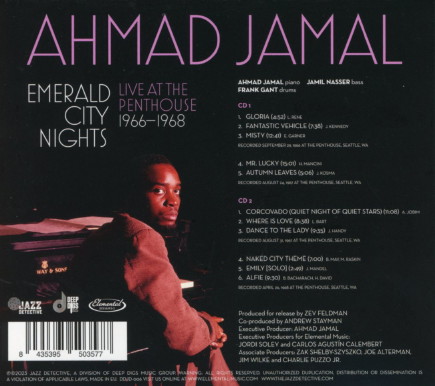
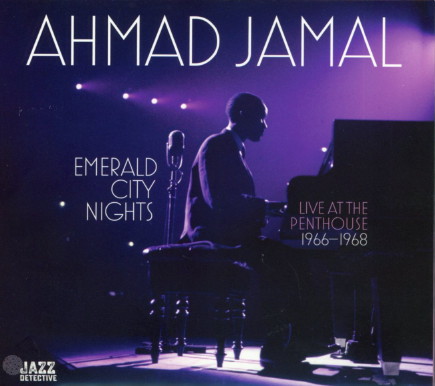
Another in this series is "Ahmad Jamal - Live at The Penthouse 1966-68" [DDJD -006]. It is produced by Zev Feldman and his Deep Digs Music in cooperation with Elemental Music and is a sequel to a previously released double CD set as described in the following press release.


Since I’ve been the fortunate recipient of preview copies of new Jazz recordings by some of these accomplished Jazz legends to be released on the upcoming Record Store day, I thought it might be fun and helpful to share the information on the media releases which accompanied them to make you aware of what could be the cause of a lessening balance in your bank account come November 24th!


From Ann Braithwaite/Braithwaite & Katz Communications


PRODUCER ZEV FELDMAN'S IMPRINT, JAZZ DETECTIVE, LAUNCHES THE THIRD AND FINAL 2-LP SET OF PREVIOUSLY UNRELEASED LIVE RECORDINGS BY AHMAD JAMAL


Following the superb initial two volumes. Emerald City Nights: Live at the Penthouse 1966-1968, captures spectacular performances by the master pianist's trio at the Penthouse in Seattle. Also available as a 2-CD set and download.


LP Release Date: November 24th CD Release Date: December 1st

Package includes reflections by Ahmad Jamal himself, interviews with fellow pianists Les McCann, Emmet Cohen, Monty Alexander, and Joe Alterman, and essays by producer Zev Feldman and journalist Eugene Holley, Jr., among others. The extensive booklet features rare photos by Don Bronstein, Chuck Stewart, and more.


Producer and music sleuth Zev Feldman's label, Jazz Detective, a division of Deep Digs Music Group, releases the third and final volume of the Ahmad Jamal sets: Emerald City Nights: Live at the Penthouse (1966-1968), featuring previously unreleased performances by master pianist Ahmad Jamal.


The 2-LP set will be issued on 180-gram vinyl transferred from the original tapes and mastered by the legendary Bernie Grundman. The music will also be available as a 2-CD set and download. The package was produced by Feldman and supervised by Ahmad Jamal himself shortly before his passing away in April of 2023.


Taking its name from Feldman's handle "the Jazz Detective" and reflecting his determined work unearthing hitherto unheard, award-winning treasures, the Jazz Detective label is an imprint of Deep Digs Music Group, a partnership with Spain's Elemental Music, with which Feldman has enjoyed a long professional relationship.


Feldman says, "It was an enormous thrill for me to work with Mr. Jamal, whom I've been listening to my entire life. He was a true original and beyond category. I couldn't be more proud of these releases."


Volume 3 offers the last batch of dazzling performances recorded at the intimate Seattle club The Penthouse by local radio host and live broadcast engineer Jim Wilke. Other magnificent live sets from the venue produced by Feldman have been released by Resonance Records (Wynton Kelly and Wes Montgomery, and the Three Sounds) and Reel to Real Recordings (Cannonball Adderley, Harold Land and the duo of Johnny Griffin and Eddie Lockjaw Davis).


The package includes an extensive booklet with new reflections by

Jamal about his work; photographs by Don Bronstein, Chuck Stewart and others; and essays by Zev Feldman, Jim Wilke, journalist Eugene Holley, Jr., Charlie Puzzo, Jr. (son of late Penthouse owner Charlie Puzzo), and Marshall Chess of Chess/Argo/Cadet Records (the label that released Jamal's bestselling, career-making albums in the '50s). The 1966-68 volume includes new interviews with fellow pianists Les McCann, Emmet Cohen, Monty Alexander, and Joe Alterman.


On the Penthouse recordings Jamal is heard in his three-piece element, backed by bassist JAMIL NASSER and drummer FRANK GANT.


In 1958, the pianist became a household name — a rare feat for a jazz pianist — with a pair of live trio recordings that soared into the top reaches of the American record charts. Ahmad Jamal Trio at the Pershing: But Not For Me, cut live in the lounge of Chicago's Pershing Hotel, reached No.3 nationally in the year of its release; its successor Ahmad Jamal: Volume IV, captured at the Spotlight Club in Washington, D.C. climbed to No.11.


In his overview of the National Endowment for the Arts Jazz Master, Kennedy Center honoree, and Grammy Lifetime Achievement Award recipient, writer Holley says, "Pittsburgh-born Jamal has achieved jazz immortality in a myriad of ways: A child prodigy trained in European and American classical traditions who was professionally working at 14, Jamal developed a protean and profound pianism that ingeniously melded pianist Art Tatum's swing-at-the-speed-of-sound and his hometown hero Erroll Garner's tender and torrid touch with Franz Liszt's boundless keyboard technique and the azure French Impressionism of Ravel and Debussy."


Though Jamal recorded prolifically in a variety of settings — his last album Ballades was a studio session recorded in 2016 which comprises solo and duo piano-bass recordings — he has always stated his preference for a live environment.


"There's no comparison between performing live and performing in a studio,” he says in the new Emerald City Nights collections. "That's art — performing remotely, not in the studio. It's all live, but remotely from the studio is a science and an art. If you can capture that, as some of us have, you always come up with spectacular things, in my opinion. Being in a studio has its constraints; has its difficulties. When you're performing remotely, away from the studio, it's a different thing altogether. All you need is a good engineer."


The many unique facets of Jamal's genius are lauded by other players in admiring testimony on this new release:


"I don't know of any musician who doesn't like Ahmad Jamal. Who else can you say that about? There's no other person who does what he does. It's his own music. That is, to me, the ultimate." LES McCANN


"The spirit of the way Ahmad approaches performing music inspired me to let music happen in whatever way it might, be it a rent party, or a hang, or a community event. It's different from the typical setting of the performer on stage and the audience listening. Ahmad's music works in any setting. It works in a club. It works in a speakeasy, in a hang. His concept can foster so many different types of human experience over, through, around and engaged-with. I model myself after that." EMMET COHEN


''Ahmad Jamal is a miracle! He has the most powerful gift of anybody I have ever seen or known. And he treasured it; he took care of it. His gift is profound, as is his faith, his belief in the creator, which is so profound. All of that and his discipline have made him the amazing artist that he is." MONTY ALEXANDER


"Dr. Jamal's music has always resonated deeply and has had a deep and important impact on my life. To me, what he gets out of the piano is just as much magic as it is music. After all, who else can make you hear the notes he's not playing?" JOE ALTERMAN


Thursday, April 27, 2023

Ahmad Jamal, measured maestro of the jazz piano, dies at 92 NPR Obituaries

 OBITUARIES

Ahmad Jamal, measured maestro of the jazz piano, dies at 92

Ahmad Jamal, pictured in 2016.

Rémy Gabalda/AFP via Getty Images

For most jazz performers, a song is part of a performance. For Ahmad Jamal, each song was a performance. Over the course of a remarkable eight-decade career, Jamal, who passed away Sunday at the age of 92, created stellar recordings both as an ambitious youth and a sagely veteran.

Jamal's death was confirmed by his daughter, Sumayah Jamal. He died Sunday afternoon in Ashley Falls, Mass., after a battle with prostate cancer.

Jamal's influence and admirers spread far and wide in jazz. For instance, Miles Davis found enormous inspiration in his work: In his 1989 autobiography, Miles, the legendary trumpeter said that Jamal "knocked me out with his concept of space, his lightness of touch, his understatement, and the way he phrases notes and chords and passages." Miles went on to record Jamal's "New Rhumba" on his classic 1957 recording Miles Ahead.

His contemporary admirers are just as fervent. Pianist Ethan Iverson, a founding member of the exceptionally popular trio The Bad Plus, said, "All of his pieces are theatrical and contained. In some ways the Bad Plus was an extension of his classic trio."


Pianist Vijay Iyer was just as adamant. "His sense of time is that of a dancer, or a comedian. His left hand stays focused, and his right hand is always in motion, interacting with, leaning on, and shading the pulse.

"He bends any song to his will, always open to the moment and always pushing the boundaries, willing to override whatever old chestnut he's playing in search of something profoundly alive."

Jamal was born Frederick Russell Jones in Pittsburgh on July 2, 1930. When he was 3 years old, his uncle challenged him to duplicate what he was playing on the piano, and the youngster actually could. He began formal studies of the piano at the age of 7 and quickly took on an advanced curriculum. He told Eugene Holley Jr. of Wax Poetics in a 2018 interview, "I studied Art Tatum, Bach, Beethoven, Count Basie, John Kirby, and Nat Cole. I was studying Liszt. I had to know European and American classical music. My mother was rich in spirit, and she led me to another rich person: my teacher, Mary Cardwell Dawson, who started the first African-American opera company in the country."

Jamal grew up in a Pittsburgh community that was rich in jazz history. His neighbors included the legendary pianists Earl Hines, Erroll Garner and Mary Lou Williams. As a youth, Jamal delivered newspapers to the household of Billy Strayhorn. When Jamal began his professional career at the age of 14, Art Tatum, an early titan of the keyboard, proclaimed him "a coming great." During a tour stop in Detroit, Jamal, who was born to Baptist parents, converted to Islam and changed his name.


His fluency in European classical music — Jamal disdained the term jazz, preferring American classical music as a descriptor for his work — was a highlight of his style. In a 2001 New York Times article, Ben Waltzer, a pianist and curriculum director at the University of Chicago, noted, "when we listen to his music, fragments from Ravel's 'Bolero' and Falla's 'Ritual Fire Dance' mingle with the blues, standard songs, melodic catch-phrases from bebop, and the 'Marseillaise.'"

This may not seem remarkable today, when most jazz musicians are conservatory-trained and well versed in art music, from Louis Armstrong to Iannis Xenakis and from Laurie Anderson to John Zorn. But Jamal was a youth when there were significant barriers to African Americans entering the academy. "In Pittsburgh, we didn't separate the two schools," he told Waltzer.

Jamal's style went well beyond a diverse range of source material; he expanded the borders and depth of improvisation. "Jazz improvisation is generally understood as a narrative melodic line composed spontaneously in relation to a song's harmonic structure," wrote Waltzer. "Jamal broadened this concept by using recurring riffs, vamps and ostinatos — tropes of big-band jazz that were employed as background accompaniment for featured instrumentalists — not just to frame solos, as many musicians did, but as the stuff of improvisation itself."

YouTube

In the early and mid-'50s, Jamal led various trios and quartets, before settling into a trio setting with bassist Israel Crosby and drummer Vernel Fournier. In 1958, they released the landmark jazz recording, At The Pershing: But Not For Me. It is one of the most popular and influential recordings in jazz history. It stayed on the Billboard Top 200 album chart for an astounding 108 weeks.

YouTube

Iverson said of the title track, "The classic Jamal Trio with Crosby and Fournier is one of the greatest groups of all time. 'But Not For Me' is a perfect three minutes. Literally perfect. There's nothing better."

The trio's version of "Poinciana" sparked the popularity of the recording, and it became a signature tune for Jamal. He told Wax Poetics, "It was a combination of things: Israel Crosby's lines, what I was playing, and Vernel—if you listen to his work on "Poinciana," you'd think it was two drummers!"

YouTube

Jamal visited Africa in 1959. Upon his return to Chicago, he had a failed venture as a club owner, then took a hiatus from recording in the early '60s. By the middle of the decade, he'd resumed recording and touring. His 1969 album, The Awakening, was widely hailed for its rendering of jazz standards and originals.

YouTube

His music was found in the soundtracks of movies like M*A*S*H and The Bridges of Madison County. In a 1985 episode of NPR's Piano Jazz, Jamal told host and fellow piano legend Marian McPartland that his favorite recording was "the next one." Then he allowed that the Pershing "was close to perfection." He also said that he continued to focus on ballads. "They are difficult to play," he told her, "it takes years of living to read them properly." In 1994, he was awarded a National Endowment for the Arts Jazz Master Fellowship.


He continued making stellar recordings into the past decade. His 2017 release, Marseille, was noted in the NPR Music Jazz Critics Poll.

YouTube

The recording featured all of the hallmarks that made Jamal a great pianist and bandleader, and the drummer Herlin Riley, like Fournier, was from New Orleans. It prompted Iyer to note that Jamal's lineage of New Orleanian drummers — Fournier, Idris Muhammad and Riley — suggests rhythm as a ritual or cultural cornerstone.

Jamal's work continued to impress other pianists. In 2014 Matthew Shipp told NPR's Karen Michel, "His imagination is so deep. One of the joys of listening to him is to see how his fertile imagination interacts with the material he does pick and recombines it into a musical entity that we've never heard. I mean, he is a musical architect of the highest order."

Waltzer added, "innovation in jazz can be subtle. Rather than reaching outward to create an overtly revolutionary sound, Mr. Jamal explored the inner workings of the small ensemble to control, shape and dramatize his music."

Wednesday, April 26, 2023

Ahmad Jamal - The Critics Speak


 AHMAD JAMAL: THE COMPLETE AHMAD JAMAL TRIO ARGO SESSIONS 1956-62 The jazz piano sage Ahmad Jamal, now into his eighth decade, earned his stature as a young man, more than half a century ago. The evidence resides in these recordings, some among the best known of his career and others previously unreleased. “But Not for Me,” a hit album recorded in 1958 at the Pershing Lounge in Chicago, comes alongside hours of other material featuring the bassist Israel Crosby and the drummer Vernel Fournier, Mr. Jamal’s rare co-equals in poise. Their chemistry as a trio attests to an exacting but searching intellect: among the unearthed gems is a session, five months after the Pershing, in which Mr. Fournier grafts his lilting “Poinciana” beat onto a version of “Love for Sale.” There’s one date with a string section, arranged and conducted by Joe Kennedy, and another featuring the trio augmented just by Mr. Kennedy’s violin and Ray Crawford’s guitar; those are pleasant but outmoded, and a bit overeager. By contrast the trio itself sounds effortless, and just about ageless. (Mosaic, nine CDs, $149, available only at mosaicrecords.com.)

Nate Chinen, The New York Times


"...Jamal is probably the most distinctive  jazz pianist since Theolonius Monk...(his) music was a constant theatre of surprise...tsunamis of sound suddenly rose up from nowhere, then dropped away to the merest tinkling at the top of the keyboard...  It was as intensely dramatic as it was emotionally tight-lipped...
 
(Jamal) is a pianist who never played a cliche (or anything approaching one)...Forget the term "small-group jazz."  The relatively complex structures and the dramatic shifts in dynamics, rhythm and mood made this "mini-orchestra jazz."
 
John Shand, The Sydney Morning Herald


"While the majority of jazz pianists make occasional visits to the edge, peer over, and then scurry back to safety, Ahmad Jamal lives there.  With stream-of-consciousness logic, Jamal reorchestrates conventional tunes, fracturing rhythms and harmonies with gleeful abandon."
 
THE NEW YORKER MAGAZINE, February 25, 2007


Ahmad JamalIn Search of…Momentum (Dreyfus)

Ahmad Jamal (www.ahmadjamal.info) is a true original, one of the greatest living jazz pianists. Yet for some strange reason, Jamal's work has been undervalued compared to more popular icons of the jazz keyboard. Perhaps his image as a pianist was flash-frozen by the mellow, laid-back majesty and telling silences of his famous late ‘50s performance of "Poinciana" (from Live at the Pershing & The Spotlight Club, now available on Jazz Hour/Qualiton), but this stunning new recording should go a long way towards hipping people to the breadth and depth of Jamal's vocabulary. In Search of…Momentum is a superbly recorded recital, done "live" in the studio employing a TL Audio Vacuum Tube Console (www.tlaudio.co.uk) and an Otari Radar 24-bit digital recorder (www.otari.com/products/RADARII), that showcases Jamal's expansive arrangements, commanding orchestral pallet and mastery of the trio format (featuring the great New Orleans drummer Idris Muhammad and bassist James Cammack) in a dizzying array of rhythmic/harmonic settings that gravitate somewhere between dancing celebrations and fulsome big band exultations, encompassing the entire history of jazz piano. On an all-encompassing performance such as "You Can See," Jamal's sets a lot of elements in motion: wonderful moving bass lines, punctuated by massive two handed block chords; then Jamal begins breaking down the rhythmic impulse into rocking vamps and swinging riffs, only to soar freely above the fray in a seemingly disconnected collage of consonant and dissonant ideas, alternatively dense and spare, voiced in brassy chorales and a spare tinkling of bells aglow in silence, when suddenly, BANG!!!—Jamal calls home the rhythm section with some convulsive, conclusive idea that reaffirms a sense of order…and being. As modern as all get out, yet deeply rooted in the two-handed, ten fingers play the whole damn keyboard Harlem stride milieu of founding fathers such as James P. Johnson and Willie "The Lion" Smith. The late vocalist O.C. Smith contributes a lovely cameo on "Whispering" and the manner in which engineer Paul Orofino depicts both the sound and capacious physical dimensions of the grand piano will be of particular interest to audiophiles and jazz fans alike (www.dreyfusrecords.com). The Dreyfus label is distributed in America by Koch Entertainment (www.kochint.com).


CHIP STERN


"1. Ahmad Jamal: "The Essence, Part 1(Verve). The rows of shocking diversions and risks on this new album by a 1950's master could be mistaken for the work of a younger, experimental-minded pianist."

Ben Ratliff, "The Living Arts", The New York Times


"No musician has had a more profound effect on the orchestral approach to small groups in the last 35 years than Ahmad Jamal...He showed people how to italicize and magnify elements of music that were taken for granted, how to organize the sound of a group around the drums and how to interchange the riff with the ostinato or the vamp...He is a virtuoso, but his innovations are found in his arrangements...."

Stanley Crouch, The Village Voice


"Ahmad Jamal is. to me, the most exciting, creative keyboard artist living."

John King, Melody Maker


"Given [Miles] Davis's great influence on other musicians, the cumulative effect has been incalculable; not only pianists with Miles, but everyone who has imitated them as well, reflect the works of Jamal to some degree."

Jazz, The Rough Guide - Penguin


"Jamal's principle contribution to the history of jazz is the trio. He brought a new concept, creating a form of collective improvisation that had a suppleness without precedent.

Adler & deChocquueuse, Passeport pour le Jazz


"Ahmad Jamal behaves like a true orchestra conductor. ..astonishing in a jazz trio!...Ahmad transforms himself into an enchanter of the keyboard--in the blink of an eye an allusion to Liszt or Debussy, marvelous versions of Coltrane, delicate pearls of melodies recreated at each touch, turbulent, orchestral, riding on incandescent rhythms."

la Nouvelle Republique, France


"Jamal's colorful harmonic perception has been too often overlooked. He characteristically builds parallel and contrary motion lines that move in and out of chordal substitutions and alterations that would probably frighten pianists of less harmonic senstivity...In his use of pedalpoint ostinato interludes as a method by which to build and release energized musical tension, Jamal has brought the bass and drums into an independent but highly functional role in his conception of the piano trio. He has always been one of jazz's foremost exponents of good songs."

Don Heckman, L.A. Times


"He has clothed the very avant-garde things he does with subtlety and a sound that entices the average jazz listener, rather than making him unconfortable.

Ralph J. Gleason, S.F.Chronicle


"Mr. Jamal, 66, is one of the figures that looms over the younger generation...he set an example for changing tempo and rhythm from which the younger musicians have borrowed. 'The Essence, part 1' is one of his best recordings in years..."

Peter Watrous, The New York Times


Ahmad Jamal is never banal.

Rachel Elkind, Record Producer


"Much of Jamal's music has almost a classical feel. His fluid runs up and down the keyboard owe as much to Horowitz as they doe to Teddy Wilson. He arranges his tunes in clearly defined sections, with sudden shifts in dynamics and tempo, and he directs his quartet as if he were conducting an orchestra...The true test of a musician, or any artist for that matter, is he compels your attention. Jamal makes you sit forward because you want to hear what comes next."

Matt Schudel, Sun-Sentinel, Fort Lauderdale, Florida


"a soloist who defies practically every convention of the jazz pianist's art. This is a man uninterested in playing easy backbeats while his sidemen indulge in extended solos, a musician whose mercurial improvisational techniques require an unusually nimble set of fingers...Startling chord clusters, outrageously elastic tempos, sharp dissonance between the hands, rhythmic ideas that ignore the meter of his sidemen--Jamal reveled in defying conventional approaches to the keyboard...the pianist manages to bring coherence to improvisations that shift constantly between swing rhythm and meterless playing, between single-note riffs and extended parallel chords in both hands."

Howard Reich, Chicago Tribune


"...the most architectonic of piano trios, perhaps the first to really explore the sounds of silence and make them sit up and sing."

Gary Giddens, The Village Voice


"...after I heard Ahmad's gig It really inspired me as to what jazz is really about (he does a lot of avant-garde things now, but never sacrifices the groove).  I'm still feeling that gig..."

Ben Waltzer, The New York Times 2011 - Induction into Downbeat Magazine’s 76th Reader’s Poll Hall of Fame


Tuesday, April 25, 2023

Ahmad Jamal - Darn that Dream


Featuring pianist Ahmad Jamal, Israel Crosby on bass and Vernel Fournier on drums.

With the passing of Ahmad Jamal on April 16, 2023, the editorial staff at JazzProfiles will post this week a series of new and archived posts about him as a memorial.

Sunday, April 23, 2023

Jazz Piano Innovator Ahmad Jamal Is Dead at Age 92 by Ted Gioia

Ahmad Jamal at Keystone Korner, SF 1980, photo by Brian McMillen (Wikimedia Commons)

Ted Gioia is known to Jazz fans from his many books on various aspects of the music which are chock-full of erudite and entertaining commentary and observations about Jazz and its makers.

But Ted’s interests have always been broad, both within music and without, and he has in recent years turned to the Substack subscription service as a platform to accommodate his masterful writing on a wider variety of topics.

Occasionally, he returns to “the subject is Jazz” as is the case with the following remembrance of pianist Ahmad Jamal [1930-2023] and each time he does, it serves as a reminder of why his insights on the subject are so prized.

You can locate this essay and others by Ted by visiting him at tedgioia@substack.com

© Copyright ® Ted Gioia, copyright protected; all rights reserved; used with permission.


“Other musicians have changed the sound of jazz in various ways. But Ahmad Jamal actually transformed time and space.

It sounds like I’m describing Einstein or Kant. But those aren’t inappropriate comparison points for this seminal pianist, who left us earlier today at age 92. He opened up an alternative universe of sound, freer and less constrained than what we had heard before. The rules of improvised music were different after he appeared on the scene.

Just consider the state of jazz piano when Jamal released his first recordings in the mid-1950s. There were superstars at the nightclubs and each one was like a human howitzer at the keyboard. Thelonious Monk played comping chords with the subtlety of a Floyd Patterson gazelle punch. Oscar Peterson exploded on the bandstand like General Patton’s Third Army marching into town. Dave Brubeck bludgeoned you with harmonies thicker than the Manhattan phone directory.

In their hands, jazz was a powerful hard-fisted idiom. Just to survive on this scene you needed intensity and toughness. And it required special fireworks to reach the top.

But then Ahmad Jamal sat down at the piano, and just floated over the beat. Sometimes he played almost nothing. Jazz fans had never heard this way of improvising before. “On some numbers, he will virtually sit things out for a chorus,” exclaimed critic Martin Williams—who struggled to figure out why it worked. “It appears that Jamal’s real instrument is not the piano at all, but his audience.” How else could you explain his way of captivating listeners while playing so few notes.

Nobody had used space and silence so effectively before. And his control of dynamics was just as impressive. Blessed with accompanists perfectly attuned to his vision—most notably in his trio with bassist Israel Crosby and drummer Vernel Fournier—he could bring the proceedings down to a whisper without losing any sense of swing or forward propulsion.


At first only jazz fans took notice, but with the release of At the Pershing: But Not for Me in 1958, Jamal started attracting a large crossover audience. This record stayed on the Billboard album chart for a stunning 107 weeks.

Once again, the critics were confused. Downbeat magazine complained that it was just “cocktail music.” But what they missed was how the whole jazz world was now shifting into Jamal’s orbit.

A few months later, Miles Davis released his Kind of Blue album, which still holds a unique spot in the annals of jazz more than 60 years later. And you can’t really give Ahmad Jamal credit for this timeless credit—but, in total fairness, I can’t imagine Miles going down this path without having studied Jamal’s 1950s work first.

If you look at everything Davis did up to that point, you fill find that he repeatedly added songs to his repertoire simply because Jamal had recorded them. And Davis’s choice of bandmates, especially pianists, was clearly shaped by his desire to emulate the Jamal sound. It’s no coincidence that Bill Evans was the other leading pianist of the day with a comparable vision of time and space—and that’s clearly part of the reason why he got the gig with Miles and could exert such a powerful impact on Kind of Blue.

The only mystery is why Miles never recorded an album with Jamal himself. That must have been one of the most obvious duet projects in the history of jazz—but it never happened. Yet in every other way, Davis paid frequent tribute to this artist.


Jamal had attracted other famous admirers during his early years. Born in Pittsburgh in 1930, he had started gigging at the young age of 14—and soon earned the praise of jazz virtuoso Art Tatum. His birth name was Frederick Russell “Fritz” Jones, but in 1950 he converted to Islam and adopted his new identity as Ahmad Jamal.

In a later interview with the New York Times, the pianist explained that he recited prayers in Arabic five times per day, starting at 5 A.M. His conversion had brought him “peace of mind,” he told the reporter, and had also stirred his interest in African musical traditions.

The success of his At the Pershing album was boosted by a hit single “Poinciana,” which would become the pianist’s signature theme. Others had recorded this song before Jamal, but he turned it into an unforgettable light groove vamp tune. In later years, when others played this song, they inevitably imitated the vamp created by this influential predecessor, who somehow got jukebox spins with a sophisticated jazz trio instrumental.


Jamal kept this crossover audience for the rest of his life. But he never took it for granted or coasted on past successes—in fact the quality of his work was impressive well into his late eighties. As recently as 2019, I picked his album Ballades as one of the 100 best records of the year.

The simple truth is that I never heard any record from Jamal that wasn’t distinguished. His biggest competition came from his own past work—and the many younger musicians who borrowed heavily from his piano conception. But even as later generations learned from Ahmad Jamal, he still stood out among any crowd of imitators.

His legacy is secure. And the recent release of previously unissued recordings from the 1960s suggests that we have not yet heard all he left on tape. I’m not sure any later pianist can transform the idiom as profoundly as Jamal did back in the day. But even if he is gone, musical time and space are different because of his intervention, and we are still free from the gravitational pull of the beat because of the example he set. To that extent we are all floating in his wake.

That’s probably what he intended. In one of his last interviews, Jamal was asked what he had left to accomplish. He answered: “I want to experiment with peace—I want to explore all the elements of peace. That’s the most important thing in my life.” He might have been talking about music, or he may have been describing a purpose beyond music and involving his influence on others. In either case, he hit the mark."