The following distinction between gut versus steel bass strings is an important one to keep in mind in terms of the extraordinary facility Jazz bassist were able to develop beginning with Scott LaFaro's work in 1958 with Victor Feldman's trio [and later, of course, with Bill Evans] and culminating 20 years later when Marc Johnson joined pianist's Bill Evans' trio.
The commentary below is drawn from Keith Shadwick's masterful Bill Evans: Everything Happens to me - A Musical Biography [2002],
It forms an introductory annotation to Chapter 56. Consecration: The Last Complete Collection of the Bill Evans Trio by Todd Barkan [Alfa Jazz ALCB- 3918-3925] in my recently published A Bill Evans Reader Volume 2 The Notes.
“It is perhaps instructive to listen to these tracks alongside the 1961 Village Vanguard recordings where freshness and mutual inspiration were dominant. The original trio had then not been together very long; neither had Evans been playing the repertoire into the ground. In the same way that playing with Miles Davis had been pivotal in Evans's career, his first trio was the first full flowering of his own artistic vision, and it happened to coincide with Scott LaFaro's extraordinary purpose and drive, constantly pushing and pulling Evans into new and different impulses and directions. This last trio had a cohesion and mutual interdependence equal to that of the first, even though it was utterly unlike it in character. Now, Evans was pushing everybody else. And while Johnson uses LaFaro as a model - as well as many contemporary bass players - his rhythmic approach is different, and his tone and timbre mark out a bassist growing up in a completely changed world for the jazz musician. A number of bassists had brought new levels of sustain and drive to the double-bass: technical developments on the instrument, as well as their own musical imaginations, meant they could now swap at will between staccato and sustained notes.
LaFaro lived during a time when jazz bassists were generally still using gut strings. This meant that there was less opportunity to produce natural "sustain" for a note - a problem shared by the guitar until amplification gave it a completely new lease of life in the 1940s. His technique was therefore built upon assumptions about the physical nature of his instrument that no longer applied to bassists of Johnson's generation. LaFaro sustained melodic ideas often by using techniques associated with classical acoustic guitarists: rapid note repetition to sustain a melodic curve, especially in the upper registers; occasional plunges into the instrument's lowest registers for dramatic effect; and long diatonic and scalar runs interspersed with well-worked pauses and ostinato patterns, often on asymmetric rhythms. LaFaro's timbre was also much more biting, more conversational, than that produced by later bassists. Steel strings and the discreet use of amplification revolutionised the bassist's role in jazz within a decade of LaFaro's death, as the work of Richard Davis, Eberhard Weber and Miroslav Vitous, among many others, demonstrated.
In a sense, and without diminishing Marc Johnson's talent or role, his impact on Evans's work was to make it sound more like a well integrated but orthodox late-1970s piano trio."
Winner of the 2025 Jazz Journalist Association Special Citation for Historic Writings, Steven Cerra is the author of anthologies on Gerry Mulligan, Bill Evans, Stan Kenton, Dave Brubeck, Shelly Manne, Jazz West Coast Readers Vols. 1-3, Profiles in Jazz, Vol.1, Jazz Drummers A Reader Vols. 1-2, Jazz Saxophonists A Reader, Vol. 1, 2 & 3, Jazz Piano A Reader, Vols. 1, 2 & 3, Jazz Trumpet A Reader Vols. 1 and 2, A Companion Celebrating The 100th Anniversary of the Jean Goldkette Orchestras, 1926-2026 and a Companion to Jazz Interpretations of Porgy and Bess. He also hosts the jazzprofiles.blogspot and cerra.substack blogs.
“Simultaneously, Evans took the next logical step in his sequence of unaccompanied piano recordings for Verve by cutting Alone, a recital entirely devoid of extra piano tracks. Recorded in September and October 1968, this may be seen as a logical extension of his search for further clarity of line and texture, as he had said in the liner notes to Further Conversations - but in his own notes for Alone he did not mention this…..
Certainly the music on Alone is much more unified and intense than that on Further Conversations from the previous year. Here, Evans does not have to consider embellishment, accompaniment or any other aspect of multiple piano tracks. He pares his playing to essentials and concentrates on his involvement with the music. Because of the absence of all other accompaniment, Evans can be as flexible as he needs to be and takes appropriate advantage. He adopts the simplest of approaches: exposition, improvisation, resolution. He also allows himself complete freedom of invention harmonically, rhythmically and melodically. Apart from his natural ability, the resulting power and logic is largely due to his certain vision and thorough preparation.
Talking to Marian McPartland just prior to the recording, Evans was in a decisive mood. "You can hear that I know exactly what I am doing," he said. "There's no doubt in my mind when I play. I know the reason for everything I do." As if ruminating on his upcoming solo sessions, he elaborated: "If you play too many things at one time, your whole approach will be vague. You won't know what to leave in and what to take out. I would say to a young musician: know very clearly what you're doing and why - play much less, but be very clear about it ... Take an idea - any idea - play it upside down, backwards, change the rhythm, and so on. Take any combination of notes that might occur to you and try to find 18 different ways of doing it." With a set of standard songs on Alone, he practiced what he preached.
As Evans attempts to penetrate the surface meaning of each tune he reaches different and deeper levels of meaning and inspiration, involving himself not only in any "message" a song might have but also in the beauties to be found in the study and redeployment of its components. Again in his album notes, Evans observes: "As you can readily see from the length of the tracks, I did get involved perhaps most successfully in 'Never Let Me Go'."22 Running for over 14 minutes, the song provides Evans with sufficient raw material to play himself through most of his own personal licks and cliches into fresh and invigorating musical waters. His inspiration is palpable. Other songs are given less magical transformations, but nothing from these sessions is wholly without its own small successes and surprises, the album being a formidable achievement at a time when Evans's relationship with Verve was winding down. Certainly Doug Ramsey in his Down Beat review agreed, making one especially prescient point. "When the dust subsides from the meaningless battles for recognition waged by so many of his contemporaries," wrote Ramsey, "[Evans] will still be there, playing his music as he hears it. And he hears it beautifully."”
Keith Shadwick, Bill Evans - Everything Happens to Me - A Musical Biography [2002]
“His playing on the Alone conveyed a feeling of unaffected nobility. Evans made no special effort to produce beautiful tone, but did so anyway — it was simply the way he played. There was much oscillation between keys a major third apart, except on the superbly paced "Never Let Me Go," which built and arched consistently in one tonality and unified mood. There are two "bonus" tracks on the CD release, chips off the workbench block that Evans would surely not have wanted to be issued — witness the disdain with which he casually finger-flicked the endings away, as if to say: No good, forget that one!
This LP won him his third Grammy award.”
Peter Pettinger, Bill Evans: How My Heart Sings [1988]
The Grammy Award-winning Alone was Bill Evans' first single piano solo album following in the footsteps of his 1963 Verve session Conversations With Myself (three pianos overdubbed) and his 1967 Further Conversations With Myself, also on Verve (two pianos overdubbed).
For this Compact Disc release, we have included two recently discovered, previously unreleased tracks. Track 6 is a medley of All The Things You Are (the abrupt beginning is as it exists on the original tape) and Joe Zawinul's beautiful waltz Midnight Mood. Evans' only other earlier interpretation of All The Things You Are was also done solo (for Riverside) and also did not see release until many years after it was recorded. The final track is an alternate take of A Time For Love.
Richard Seidel
The following are Bill Evans' liner notes from the original LP:
“Perhaps the hours of greatest pleasure in my life have come about as a result of the capacity of the piano to be in itself a complete expressive musical medium. In retrospect, I think that these countless hours of aloneness with music unified the directive energy of my life. At those times when I have achieved this sense of oneness while playing alone, the many technical or analytic aspects of the music happened of themselves with positive rightness which always served to remind me that to understand music most profoundly one only has to be listening well.
Perhaps it is a peculiarity of mine that despite the fact that I am a professional performer, it is true that I have always preferred playing without an audience. This has nothing to do with my desire to communicate or not, but rather I think it is just a problem of personal self-consciousness which had to be conquered through discipline and concentration. Yet, to know one is truly alone with one's instrument and music has always been an attractive and conducive situation for me to find my best playing level. Therefore, what I desired to present in a solo piano recording was especially this unique feeling.
As you can readily see from the length of the tracks, I did get involved perhaps most successfully in Never Let Me Go. It is difficult to make a qualitative judgment, however, since one always must be wary of falling prey to indulgence in a too subjective feeling unsupported by musical content.
My solo piano professional experience has been negligible and it is sad that this great tradition in jazz is in danger of extinction because of the prevalent public attitude relegating a single pianist to background for conversation or dinner.
Therefore, I hope that my playing has sufficient merit to carry the listener without distraction to the musical feeling I have strived to accomplish in these recorded performances.” - Bill Evans
“One of the musical tracks I often use in lectures is the 1956 recording “Concerto for Billy the Kid” by the composer and orchestra leader George Russell, who died this summer. Most people – even those who love jazz – have never heard it, yet it is an amazing performance, not five minutes long, which adapts piano concerto format to a sextet. The arrangement is based on a series of congruous scales or modes, rather than the usual harmonies, with the result that the band radiates a rattling dissonance while sounding far larger than it is. Most of the melodic figures are short, pulsing fragments, and they swing like mad. The highlight is an exhilarating piano cadenza created to introduce the as-yet-unknown Bill Evans (the eponymous Billy the Kid). In this section, Russell had Evans improvise on the chords of an old standard, and he hammers the keys as though his fingers were dancing mallets.
This recording invariably dazzles audiences, partly because it doesn’t sound a day older than tomorrow.”
- Gary Giddins, Jazz author and critic
“The challenge which is presented to the composer of modern music who has been traditionally educated is that of either refining and reshaping his traditionally learned techniques, or constructing new techniques that will enable him to capture and enhance the vital improvisational forces so abundantly inherent in much of the good music of today. To impose old orders and old techniques upon vigorous and willful young music is to burden and stifle it rather than to channel and lead it and be led by it.”
- George Russell, Jazz Composer, Arranger and Theorist
Every so often, I enjoy developing and sharing a piece about what’s going on in the music; a kind of follow along using the timings that accompany videos as the basis for keying your ears into what I’m hearing.
I mean, at some point, words become a poor substitute for describing what’s occurring in the music, but less so perhaps if what they are describing is actually linked to the music as it is playing.
Recently I came across a segment in a book about Jazz by Gary Giddins and Scott DeVeaux which is designed to serve as a textbook on the subject that did my work for me. Incidentally, the title of the book on the subject of Jazz is just that - Jazz - and its publisher W.W. Norton has made it available both as a trade edition and in a format with online interactive features.
The specific recording that they’ve annotated is Concerto for Billy the Kid which was composed by George Russell and appears his 1956 RCA The Jazz Workshop LP.
I have position the video below their timings and breakdowns and you can use the pause feature on the video and scroll their written explanation of the actual music under discussion.
“Among the major jazz figures in the bop and postbop eras, George Russell [1923-2009] is singular on two counts. First, he worked exclusively as a composer-bandleader, not as an instrumentalist; second, he devoted much of his life to formulating an intricate musical theory, published in 1953 and revised in 2001 as George Russell's Lydian Chromatic Concept of Tonal Organization, Volume One: The Art and Science of Tonal Gravity.” …
Russell was held in great esteem by the most advanced jazz musicians of the 1950s, and he surrounded himself with many of them, including John Coltrane and Max Roach. But he also had a good ear for raw talent. His most influential discovery was the pianist Bill Evans, whom he eventually introduced to Davis. Evans had appeared on a few record sessions yet was virtually unknown when Russell recruited him for Jazz Workshop. To showcase his immense talent, Russell conceived "Concerto for Billy the Kid." Evans's rigorous solo, coming to a head in his whirling stop-time cadenza, is far removed from the more meditative approach that later became his signature, but it remains one of his most compelling performances.
Working with only six musicians in this piece, Russell creates tremendous harmonic density. His clashing scales give the performance a dramatically modernistic edge, though he also uses a standard chord progression (from the 1942 Raye-DePaul standard "I’ll Remember April," an enduring favorite among jazz musicians) for the Evans sequence. In creating a capacious harmonic landscape that obliterates the usual tonal centers, Russell makes his sextet sound like a much larger ensemble. For all the dissonances, rhythmic change-ups, and fragmented melodies, the piece swings with a pure-jazz elan. The inventiveness of the composer and his soloists never wavers. After more than half a century, "Concerto for Billy the Kid" sounds not only fresh but avant-garde, in the truest sense of the term. It would sound modern if it were written and recorded today.
CONCERTO FOR BILLY THE KID
By George Russell
Art Farmer, trumpet; Hal McKusick, alto saxophone; Bill Evans, piano; Barry Galbraith, electric guitar; Milt Hinton, bass; Paul Motian, drums
LABEL: Victor LPM 1372; The Complete Bluebird Recordings (Lone Hill Jazz LHJ 10177)
DATE: 1956
STYLE: modernist small-group composition
FORM: original, including 32-bar AA' and 48-bar ABA
Introduction
0:00 - The drums begin by playing a Latin groove: a syncopated rhythm on the cymbals alternates with the bass drum on the main beats and the snare drum on the backbeat.
0:05 - Above the groove, two horns (muted trumpet and alto saxophone) play
two independent lines in dissonant counterpoint. The rhythms are disjointed and unpredictable.
0:09 - The horns become stuck on a dissonant interval—the major second, or
whole step. They move this interval up and down.
0:11 - Hinton enters on bass, doubled by piano, repeating two notes a
half step apart. (This bass line will remain in place for most of the introduction.)
0:15 - The horns play a descending riff that ends, once again, on a major second. This riff repeats at unpredictable intervals.
0:18 - The texture is thickened by a new line, played by the electric guitar.
0:24 - The horns switch to a new key and begin a new ostinato that clashes, polyrhythmically, with the meter. Evans (piano) and Galbraith (guitar) improvise countermelodies.
0:34 - The horns begin a new ostinato in call and response with the guitar.
0:44 - The ostinato changes slightly, fitting more securely into the measure. Evans adds complicated responses.
0:58 - Farmer (trumpet) removes his mute. The ostinato becomes a more engaging Latin riff, forming a four-bar pattern. Underneath it, Hinton plays a syncopated bass line.
1:11 - In a dramatic cadence, the harmony finally reaches the tonic.
1:13 - The drums improvise during a short two-bar break.
Chorus 1 (32 bars, AA')
1:15 A The rhythm section sets up a new Latin groove, with an unexpected syncopation on one beat. Evans plays a peculiar twisting line in octaves on piano, moving dissonantly through the chord structure.
1:22 - Over one chord, the piano line is more strikingly dissonant.
1:28 A’ As the chord progression begins over again, Evans's melody continues to dance above the harmonies.
Chorus 2
1:42 A The horns repeat Evans's line note for note. Underneath, Evans plays a
montuno—a syncopated chordal pattern typically found in Latin accompaniments, locking into the asymmetrical bass line.
1:56 A’
Transition
2:11 - The walking-bass line rises and falls chromatically, while melodic
themes are tossed between the instruments.
2:21 - The band returns to the Latin groove and the melodic ideas previously
heard in the introduction.
Chorus 3 (48-bar ABA, each section 16 bars)
2:28 A This new chord progression—based on "I'll Remember April"—begins
with an extended passage of stop-time. Evans improvises for four bars in a single melodic line.
2:31 - The band signals the next chord with a single sharp gesture while Evans continues to improvise.
2:35 - The band enters every two bars, with Hinton filling in on bass.
2:42 B The band's chords are irregular, often syncopated.
2:56 A Evans's improvisations are so rhythmically slippery that the band mis-plays its next stop-time entrance.
3:08 - A walking bass reestablishes a more conventional groove.
Chorus 4
3:09 A Evans plays a full chorus solo, featuring his right hand only.
3:23 B He distorts the meter by relentlessly repeating a polyrhythmic triplet
figure.
3:37 A He switches to a series of bluesy gestures.
Interruption
3:50 - The chorus is interrupted when the bass (doubled by piano) suddenly
establishes a new triple meter. Against this, the horns play a dissonant line, harmonized in fourths (quartal chords).
Chorus 5
3:55 A We return to the piano solo, a full five bars into this chorus.
3:58 - Evans joins with the drummer in playing sharp accents (or "kicks") on
harshly dissonant chords.
4:05 B Farmer takes a trumpet solo.
4:12 - Underneath, McCusick (alto saxophone) adds a background line, harmonizing with the guitar's chords.
4:19 A McCusick plays a melody previously heard in the introduction (at 0:34).
4:26 - The trumpet suddenly joins the saxophone in quartal harmonies, fitting
obliquely over the harmonic progression.
Coda
4:31 - As the bass drops out, the instruments revisit ideas from the beginning
of the introduction.
4:36 - The guitar begins a final upward flurry.
4:39- Evans plays the final gesture on piano.
The Jazz Workshop album which contains Concerto for Billy The Kid among its 12 tracks, received glowing reviews.
Critic Leonard Feather wrote of Russell, "Such men must be guarded with care and watched with great expectations."
The following is included in my BILL EVANS READER which is available exclusively on Amazon as a paperback and an eBook.
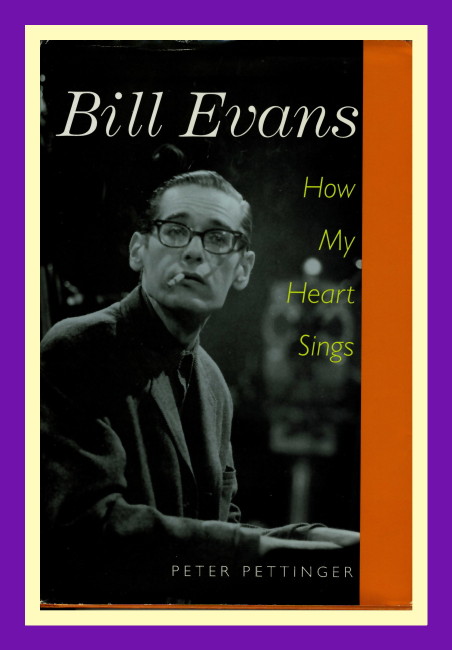
As a way of understanding and appreciating his music, it's always of interest to me to enter Bill’s world from different perspectives which brings me to the piece on Peter Pettinger’s biography BILL EVANS How My Heart Sings which was published by Yale University Press in 1998. A paperback copy remains in print.
Pettinger’s book is not a full blown, critical and discerning biography, rather it’s written more along the lines of Jerome Klinkowitz’s Listen Gerry Mulligan: An Aural Narrative in Jazz [1991] in which the recorded music forms the basis for observation and discussion.
Pettinger’s principal interest is in Bill’s music, more so than the man that made it.
Because the book is over 25 years old, it’s not easy to track down full reviews of it even with the help of internet search engines.
However, I’ve managed to find a couple, as detailed below, along with a slew of short commendations which follow the lengthy assessments by Terry Teachout and Terry MacDonald.
As Doug Ramsey explains in the introduction to his review in the JazzTimes, it might be a good idea to have your Bill Evans recordings handy as you read Peter Pettinger’s BILL EVANS How My Heart Sings.
“Bill Evans, one of the greatest creative musicians of the century, lived only to the age of 51. In the last half of his life, in a triumph of will and the creative impulse, he maintained iron discipline as an artist while he let heroin and cocaine drag him to destruction. His friend Gene Lees called Evans’ death “the slowest suicide in history.” Pettinger’s book weaves together analysis of Evans’ music with facts of his life before and after he became a narcotics addict. An English concert pianist and university music teacher, Pettinger died before the book was published.
The serious listener with a complete Bill Evans collection should set aside a few weeks to read this book, making time for frequent trips to the CD player or turntable. It would require discipline almost as great as Evans’ to ignore the urge to hear the recordings that Pettinger discusses as he tracks Evans’ progress through his brilliant career. Pettinger’s strength as a listener and analyst makes this an essential book about Evans, but is not the ultimate Evans biography. Pettinger does not explore in depth the pianist’s complex personality and his relationships with family, friends and fellow musicians. Still, even his dry recitations of facts and occasional speculation about behavior motives stir anyone who admires Evans’ music and recoils from the pain of the junkie existence he chose in his mid-twenties.”
September 13, 1998
Terry Teachout
New York Times
BILL EVANS
How My Heart Sings.
By Peter Pettinger.
Illustrated. 346 pp. New Haven:
Yale University Press. $30.
MANY jazz musicians resemble their music. Who could have looked more worldly-wise than Duke Ellington, or wittier than Paul Desmond? But sometimes a musician embodies a contradiction, and then you can read it off his face, just as you can see a fault line snaking through a tranquil landscape. Such was the case with Bill Evans. His shining tone and cloudy pastel harmonies transformed such innocuous pop songs as ''Young and Foolish'' and ''The Boy Next Door'' into fleeting visions of infinite grace. Yet the bespectacled, cadaverous ruin who sat hunched over the keyboard like a broken gooseneck lamp seemed at first glance incapable of such Debussyan subtlety; something, one felt sure, must have gone terribly wrong for a man who played like that to have looked like that.
Appearances are seldom deceiving to the clear-eyed observer, and Peter Pettinger writes frankly in his fine new biography of what was no secret to Evans's appalled colleagues: The most influential jazz pianist of the past half-century was addicted to drugs -- first heroin, then cocaine -- for much of his adult life. He picked up the habit in 1958 as a member of Miles Davis's sextet, and despite occasional interludes of sobriety, it stayed with him, finally leading to his death in 1980. Pettinger, who died last month, was an English concert pianist who began listening to Evans as a teen-ager. He is as interested in his playing as his private life; his book is packed with so much shrewd critical commentary that it reads at times more like an annotated discography than a biography. But ''Bill Evans: How My Heart Sings'' is also the first full-length biography of Evans, and most readers will doubtless pay special attention to the grisly particulars of what the writer Gene Lees, who knew him well, tersely called ''the longest suicide in history.''
The second son of a hard-drinking New Jersey printer, Evans had a conventional and uneventful youth. One of his sidemen would later speculate that ''his involvement with drugs (early on, anyway) was to get away from the fact that he really was a very American kind of guy. I think the drugs for him made him more mysterious . . . got him out of his background.'' Compounding the problem was Evans's awkward relationship with Miles Davis, who set the gold standard for hipness throughout the 1950's and who delighted in baiting the painfully shy pianist; as the only white musician in Davis's group, he was also acutely aware that many jazz fans thought him unworthy of sharing a bandstand with celebrated sidemen like John Coltrane, Cannonball Adderley, Paul Chambers and Philly Joe Jones.
One way for him to prove his authenticity was to do as Coltrane and Jones did (and as Davis himself had so famously done only a few years before). Though Pettinger skims over the details of Evans's plunge into the abyss of addiction, his biography contains more than enough horror stories to make the reader wonder how he managed to function at all, much less to forge a powerfully individual style that would leave its mark on virtually every jazz pianist to follow him. Perhaps most astonishingly, his playing became markedly more intense and probing in the last year of his life, not long after he switched from methadone to cocaine. It was as if he were racing himself to the grave. Late one night at a San Francisco club, Pettinger writes, Evans played Johnny Mandel's ''Theme From M*A*S*H,'' remarking that the song was also known as ''Suicide Is Painless.'' ''Debatable,'' he added dryly. Two weeks later, he was dead, leaving his friends to wonder what demons had driven him to so squalid an end.
Seacoast Jazz Society
Bill Evans: How My Heart Sings
by Peter Pettinger
Biographer Peter Pettinger is a pianist himself. Not a jazz musician, but a concert pianist, one who admired Bill Evans greatly and brought to his writing a special ability to articulate the nuances of the man’s music. Some would say—and did—that the author’s considerable emphasis on the academic and technical aspects of Evans’s discography came at the expense of a deeper examination of the brilliant artist’s painful and tumultuous life. Fair enough. But for a jazz reader interested in knowing more about the music of one of the most influential jazz pianists in the history of the music, and how Bill Evans’s musical concepts were formed and developed, Pettinger presents a valuable volume.
Nor does he in any way gloss over the personal side of his subject’s life, at the center of which, of course, was his 20-year addiction to drugs.
Bill Evans was born in Plainfield, New Jersey, in 1929. He was classically trained in piano and studied at Southeastern Louisiana University. After moving to New York in 1955, he worked with bandleader and musical theorist George Russell. He joined the Miles Davis Sextet in 1958, awkward, a little uncomfortable, the only white guy in the band, a fact that made him the object of regular heavy ribbing by his bandmates. His time with Miles was profoundly influential on Evans, both musically and personally. While the band was experimenting with modal jazz, Evans began his own experimentation—with heroin. His use of it continued, along with that of methadone and cocaine, for the rest of his consequentially abbreviated life, which ended at the age of just 51 in 1980.
After leaving Miles, Evans’s preferred musical unit was the piano trio, in which he worked almost exclusively for the rest of his life, and which garners most of the author’s attention.
Pettinger, a Brit, never met Bill Evans so lacked the opportunity to draw out of him details of his life and times that might intrigue and even titillate us. Instead, he relied on the pianist’s recorded works and personal history, the result a rewardingly illuminating portrait of the man and his music. Even jazz listeners who consider themselves fans of Evans are likely to discover aspects of him and his life that offer a greater understanding of both. And the author’s personal knowledge of music and of piano playing enable him to share with the reader a greater appreciation of Evans’s pianistic, harmonic and melodic brilliance. To Pettinger’s credit, he does this in a perfectly accessible way.
How My Heart Sings is not the whole story of Bill Evans, nor likely has one yet been written. It is, though, a good start and a good part of his story and should probably be considered required reading for admiring listeners of his music.
—Terry MacDonald
Title: Bill Evans: How My Heart Sings
Author: Peter Pettinger
Edition: Illustrated
Publisher: Yale University Press, 1998
ISBN: 0300071930, 9780300071931
Length: 346 pages
Bill Evans
How My Heart Sings
Peter Pettinger
Paperback
List Price: 18.95*
* Individual store prices may vary.
Description
This enthralling book is the first biography in English of Bill Evans, one of the most influential of all jazz pianists. Peter Pettinger, himself a concert pianist, describes Evans’s life (the personal tragedies and commercial successes), his music making (technique, compositional methods, and approach to group playing), and his legacy. The book also includes a full discography and dozens of photographs.
Praise For Bill Evans: How My Heart Sings…
"Pettinger understands what sets the pianist apart, and explains with a minimum of technical language and just enough musical transcriptions to get his key points across. . . This is an ideal companion for those who want to 'understand' Evans in the most important way, through listening."—Bob Blumenthal, Boston Globe
"Peter Pettinger writes frankly in his fine new biography of what was no secret to Evans's appalled colleagues: The most influential jazz pianist of the past half-century was addicted to drugs—first heroin, then cocaine—for much of his adult life."—Terry Teachout, New York Times Book Review
"[A] fine new biography . . . packed with . . . shrewd critical commentary."—Terry Teachout, New York Times Book Review
"Peter Pettinger sets out to catalog and explain Evans’ wide-ranging genius. . . . The making of every important Evans recording is discussed, and as he follows the extreme ups and downs of a career vexed by heroin addiction and other problems, Pettinger shows how the personal helped shape the artistic sensibility of this jazz innovator."—Tom Moon, Philadelphia Inquirer
"Pettinger . . . has thoroughly researched Evans’s life, reading the available literature and tracking down the pianist’s associates for commentary, and he has listened assiduously to the Evans catalog, which is no small feat given its enormousness."—Adam Bresnick, Wall Street Journal
"Pettinger provides a portrait of Evans that will serve as a foundation for further investigation of this quiet jazz giant. Recommended for jazz fans and music buffs."—Library Journal
"Pettinger is eminently qualified to assay Evan’s evolution as a pianist, and students of Evan’s music will no doubt enjoy the author’s references to Evan’s scores and academic excursions."—Publishers Weekly
"One of the most moving and informative jazz books of recent years. . . . For its sensitive sympathetic and insightful look at the artistry of Bill Evans, How My Heart Sings makes a valuable contribution."—Joel Roberts, All About Jazz
"This is the first biography of one of the most influential jazz artists ever to tickle the ivories. . . . [It] includes a full discography, dozens of photographs, and analyses of Evans’ expressive technique and compositional methods."—Paul Wilson, Bloomsbury Review
"The greatest strength of Pettinger's writing is that, analyzing Evans' recorded legacy, almost piece by piece, he tells how Evans did it—that is, what to listen for—in terms fully accessible to the lay listener. So this is not an exposé or analysis of a 'tortured' artist, but a fine music lover's reference about a nonpareil artist."—Booklist
"Reading How My Heart Sings, with Evans's eloquent, challenging music playing in the background, is a wonderful experience, there for the taking."—Larry Nai, Cadence
"Pettinger's approach is at once delightfully insightful and detailed in terms of musical analysis. . . . A much-needed addition to the growing list of respectable biographies of the greatest figures in the first century of jazz history. . . . An excellent choice for collections supporting studies of popular music at all levels."—Choice
"Peter Pettinger’s ambitious new volume is a concentrated work that aspires to fill a gap in jazz biography that has been left open too long. . . . A comprehensive endeavor and . . . a satisfying contribution. . . . Well-researched."—Michael Borshuk, Coda
"Indispensable. . . . The 40-page discography alone will be cherished as will the author's dogged research into the circumstances surrounding all important Evans recordings and trio personnel changes. . . . Through interviews with friends and colleagues, Evans own utterances and the author's insider knowledge of the piano, the book contains many insights into Evans' music."—Jeff Bradley. Denver Post
"[This book] is simply beautifully written and will probably become a model for future authors seeking to complete a classic biography."—Lee Bash, Jazz Educators Journal
"Accessible to non-musician and including a complete discography, Pettinger's book is highly recommended for Evans fans."—Jazz Insider
"Pettinger's strength as a listener and analyst makes this an essential book about Evans. . . . This fine book will be a part of the foundation for Evans scholars to come."—Doug Ramsey, Jazztimes
"[A] welcome full-scale biography."—Grover Sales, Los Angeles Times Book Review
"Beautifully written and researched. . . . It should be required reading for all who dabble with the elementary jazz sounds to the serious jazz pianists of today and, as Bill Evans himself would have said, those of tomorrow."—Richard Michael, Music Teacher
"The sad, rich, influential life of jazz pianist Bill Evans as told by fellow pianist Peter Pettinger, who certainly knows the score. Evans died in 1980, a slow suicide caused by drugs, malnutrition and self-neglect. But what a body of work he left behind (among it, 164 albums, not counting reissues). Dig it."—Bill Bell, New York Daily News
"In this through and very readable biography, Evans emerges as something of a hero for sticking to his aesthetic values in the face of commercial pressures and changing fads. This may be one reason why Evans remains a figure of great interest to jazz fans and musicians nearly twenty years after his death. . . . This biography is highly recommended."—Allan Chase, Notes
"Pettinger chronicles in detail Evan's endless search for empathy and expression of emotion within his perennial context, the piano trio, and his famous successes within that context. . . . How My Heart Sings is told with a simplicity and calm momentum that are reminiscent of Evan's music itself; it shows facility supported by scholarship and research."—Jon Rodine, Rain Taxi
"A thoroughly researched, well-written biography of the soft-spoken but troubled jazz pianist."—San Francisco Examiner Magazine
"A stark—yet refreshingly lyrical—document of a jazz pianist who said more with his music than with his indulgences."—Chet Williamson, Worcester Weekly
Selected as a 1998 Notable Book of the Year by the New York Times Book Review
Winner of the 1999 ASCAP–Deems Taylor Award in the Pop Books Category
"Peter Pettinger’s book on pianist Bill Evans is one of the best jazz biographies I have ever read. It is beautifully and lovingly written, meticulously researched, and filled with deep insight into Evans’s personality and musicmaking."—Barry Kernfeld, author of What to Listen for in Jazz
"This book is likely to become a classic. There is nothing quite like it in the history of jazz. A concert pianist looks at the work of a jazz pianist whom many authorities consider one of the greatest musicians of the twentieth century. Pettinger hears all sorts of subtleties as only a fellow pianist can. He is also a felicitous and interesting writer. This is a brilliant piece of extended analysis."—Gene Lees
Yale University Press, 9780300097276, 366pp.
Publication Date: August 11, 2002
About The Author
Peter Pettinger was an international concert pianist for more than twenty-five years. His many recordings include the Bartók sonatas with the violinist Sándor Végh, the Elgar sonata and a jazz album with the violinist Nigel Kennedy, and Elgar’s works for solo piano.