Showing posts with label chuck israels. Show all posts

Thursday, January 11, 2024

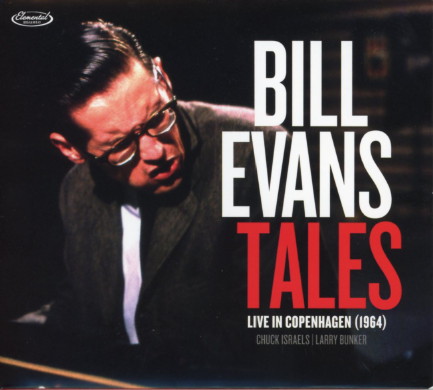
Bill Evans: Tales - Live in Copenhagen (1964) Elemental CD 5990445

 © Copyright ® Steven Cerra, copyright protected; all rights reserved.

"The 1964-'65 period is one of the richest in Bill's trio work. Granted, his work with bassist Scotty LaFaro from 1959 to 1961 was even more interactive, especially on Scotty's part, while Larry Bunker's brilliance in our trio has been largely overlooked. The integration of our trio was exceptional. The finesse of the ensemble playing and the intensity of Bill's expressive concentration— the way he combined his searing intellect and, at that point in his work, his need to communicate his emotional connection to the music through his playing—had reached a pinnacle."

- Bassist Chuck Israels as told to Marc Myers [Emphasis mine]


“When I joined Bill's trio, I was already aligned with his aesthetic world. What Bill was doing wasn't new to me. I was already in some fantasy, an internal fantasy, looking for and expecting that someday, I'd find music like that. When I heard Bill, instead of thinking, this was something new that I'd never imagined before, it was more as if I heard something that I'd imagined, but not in such a concrete way. He was the guy who was playing a kind of music that I thought might be possible, but he actually did it.


Bill's dynamics, nuances of touch, rhythmic variety were far beyond most jazz players' rhythmic language. All of those things simply entered into Bill's playing in ways that didn't seem to occur in a natural way to other jazz musicians. With Bill, you didn't notice they were there, they fit in so smoothly. I learned a lot about rhythmic overlays, cross-rhythms and multiple meters happening at once and how rhythmically vital that was. Larry Bunker said Bill was the most rhythmically inventive musician he ever heard. And I agree.

- Chuck Israels, bassist, composer-arranger, educator, bandleader


Before straying too far from the context that brought this delightful recording into existence, I thought you might like to read how it came about and, equally important, why Zev Feldman, its Producer, has assumed the role of a modern day Orrin Keepnews, Bill’s champion at Riverside Records at the outset of his career, in bringing to life important recordings by this legendary artist for Jazz fans of all ages to appreciate and enjoy.


THE TALE CONTINUES


“It's been an honor for me to work closely with the Bill Evans Estate over the past 13 years. This is the 11th release I've produced, working together with Bill Evans's son, Evan Evans. It's been tremendously exciting to see Bill's legacy passed along to another generation. His music transcends age. It's gratifying to see more and more people — both young and old — discovering his music. I'm proud to be a part of that discovery process.


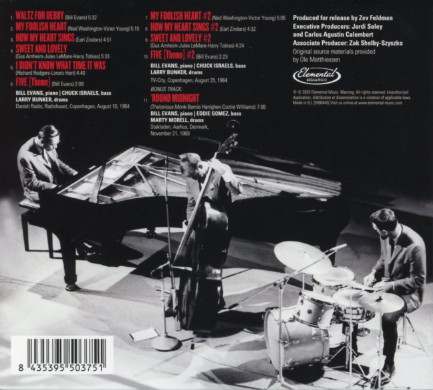
In the Winter of 2022,  I was contacted by my dear colleagues at Elemental Music, Carlos Agustin Calembert and Jordi Soley, about a collection of previously unissued live recordings of Bill Evans taped between 1965-1969 in Denmark. In April of 2023, we released Treasures: Solo, Trio and Orchestra Recordings from Denmark (1965-1969) in 3-LP and 2-CD editions, but what we weren't able to include in that collection was a separate recording that was very important and which is being brought to you with this release, Tales: Live in Copenhagen (1964). It captures Evans with bassist Chuck Israels and drummer Larry Bunker performing for Danish Radio in performances recorded at the Radiohuset on August 10th and on August 25th 1964 at TV-City in Copenhagen. There is also a bonus track, a November 21,1969 live recording of "'Round Midnight" from Studenterhus Aarhus in Starkladen, Denmark, that wasn't included in the Treasures release.


These 11 tracks are glorious; a gift for all of us to relish these many decades after Bill's physical departure from this earth. It's thrilling for me to see these recordings come out, extending a welcoming hand to jazz fans who are just exploring Bill Evans's music for the first time. Tales is a wonderful document that captures the spirit, essence and beauty of what Evans was all about.” - Zev Feldman


For me, this is a particularly welcomed recording because it features music by one of the least appreciated editions of the Bill Evans Trio; ironically, one that has to rank among the highest in terms of its overall level of musicianship.


Since his roughly 10 years association with Bill, both generally on the New York Jazz scene of the late 1950s and specifically as the bassist in his trio from about 1961-1967, Chuck has developed into one of the most instructive and eloquent writers on Bill’s music and the musicological elements that made it so unique. He has also gone on to become a premier educator and a composer-arranger of orchestral Jazz works. You can find out more about Chuck, his background, and his current activities by visiting his website.


Chuck played with Bill immediately following the death of iconic bassist Scott LaFaro and the long tenure of another Jazz master, bassist Eddie Gomez. This intermittent period found Bill in a searching mode both personally and professionally and as a result, he wasn’t always at his very best. As the other melodic and harmonic voice in the trio, Chuck deserves far more recognition for holding it together than he ever received.


Also contributing to both the high degree of musicianship of this particular version of the Bill Evans trio while not receiving the recognition he deserved for his contributions was drummer Larry Bunker about whom Chuck states:


“Larry Bunker was an extraordinary musician There was a transparency to the sound of Larry's playing. Larry was like a race car driver in terms of finesse. He was a very well-trained musician with impeccable hearing. He understood everything going on more than I did. I was embarrassed that the drummer knew more than I did at that time. I've since developed my musical, technical understanding to the point where it's a lot better now, but I was just a kid then. And here was this drummer, a few years older than I was, but boy, he would sit at the piano before Bill came in and say, "Hey, Chuck, is this what Bill plays?" and he would play stuff that sounded great.  I couldn't have done that. He was so wonderfully inventive, so wonderfully integrated into the rhythm Bill developed. He made enormous contributions to my way of thinking.”


Larry could do it all: he played drums in Gerry Mulligan’s quartet featuring Chet Baker and was the first drummer in Jeru’s sextet and tentette; he was the first call drummer for trumpeter Shorty Rogers’ quintet; played vibes for Henry Mancini on the scores of many of the Peter Gunn TV shows; was the drummer in Maynard Ferguson original big band; replaced Mel Lewis in Terry Gibbs’ Big Band when Mel went east to join Gerry Mulligan’s Concert Jazz Band; was the original drummer in Clare Fischer’s Big Band. He even played piano in one version of alto saxophonist Art Pepper’s quartet. 


Unfortunately, many of Larry's activities took place away from the “national” Jazz press which, at the time, was focused on the New York Jazz scene.


His skills as a drummer, percussionist and vibraphonist and his abilities to read and interpret music made him a first call, “A” lister among those brokers responsible for contracting musicians for work in the Hollywood recording studios.


Frankly he gave up a small fortune as a studio musician during the three or so years that he was on Bill’s trio.


Perhaps one reason why this version of Bill’s trio didn’t receive more recognition was due to the fact that it issued so few recordings.


Bill Evans at Shelly’s Manne Hole in Hollywood, CA, Bill’s last recording on Riverside, was recorded in May, 1963 and not released until 1966. The trio was represented on Verve’s Trio ‘65 which was recorded in February of that year. In between, Verve released a number of tracks on The Bill Evans Trio Live that were recorded on July 7 and 9, 1964 in performance at The Trident Club in Sausalito, CA several years after they were recorded when Bill’s contract with them was up because Bill did not approve of the music that was recorded during this engagement.


From a recorded history standpoint, this is not much to show from a trio made up of three paragons of Jazz on their respective instruments.


Neil Tesser offer’s this perspective on the July, 1964 performances in his notes to the Verve Boxed Set of Bill’s recordings:


“With Chuck Israels in the bass chair, this is what the Evans trio sounded like on a typical night. Evans did not approve this for release at the time, but Verve issued an LP from the session several years later (once Evans's contract was up). Listening to it now, one wonders why Evans didn't like it.


Israels speculates that there may have been drug-related changes in Evans's health at that time "This was an erratic period, and there were a couple of nights when he was absolutely unable to play.... [A]nd he may have [been] distracted by those problems and then didn't want to hear whatever [it was] in the recordings that reminded him of that. But I think the date is quite representative of the group's music, and Larry Bunker, as usual, plays like some kind of percussion angel."


More surprising in retrospect is the critical furor the album generated. John S. Wilson gave it three stars in down beat, opening his review with,


 "The more I hear of Evans, the more I become convinced that the propagation of the Evans mystique must be one of the major con jobs of recent years." 


The August 12 and 26, 1965 issues of down beat include numerous responses. Probably the most entertaining was from Charles C. Sords of Pittsburgh:


“Let me convey my congratulations to John S. Wilson who, with one stroke of his typewriter, has established himself as the most knowledgeable critic in jazz with his discovery of the great Bill Evans hoax. In one brief review, Wilson has exposed the large group of musicians and critics who think that Evans is a pianist of great originality, subtlety, and taste, as a bunch of tin-eared idiots.”


Aside from all of this wordplay among the critics, the great tragedy for all of us who knew what a brilliant trio Bill, Chuck and Larry formed was that the records of this trio that were issued hardly did justice to it. During their appearances at Shelly's Manne Hole [which was ten minutes away from my home], I practically lived there and left each night absolutely giddy from the level of musicianship that was on display. A musician friend who accompanied me on one occasion said as we were on our way home: “OK, you can exhale now!”


With all of this by way of background, Bill Evans Tales: Live in Copenhagen (1964) becomes even more significant because with it we finally have a chance to listen to these three magnificent musicians at their very best! [Chuck Israels elaborates further on why this is the case in his notes which follow.]


For as Marc Myers comments in his superb notes:


“You're holding in your hands the earliest known recording of Bill Evans performing in Europe. Recorded in the summer of 1964 during his first tour abroad with a trio, these 10 previously unreleased tracks were captured in Copenhagen, Denmark, with Chuck Israels on bass and Larry Bunker on drums. The tracks also are remarkable for being among the very finest works by this ensemble.”


And when you do “hold this recording in your hands,” you do so with a beautifully prepared six-pack that includes outstanding artwork, a bevy of first rate photographs of Bill, Chuck and Larry by Jan Persson, detailed insert notes by Marc Myers, Chuck Israels and Brandyn Bunker, Larry’s second wife, and tray plates containing information about each track and specific acknowledgments of all those who contributed to producing and making the recording.


In other words, another top-of-the-line, first-rate Zev Feldman production.


A special note of gratitude goes out to Jordi Soley and Carlos Agustin Calembert who provided the funding for the project.


Nothing beats listening to the music on a recording to form your own impressions of it.


Words can only go so far in describing it, but the written expression of those who performed the music can also enhance our appreciation of an album.


Bill and Larry are no longer with us but Chuck Israels is and he wrote this wonderful tribute to his time with both of them during the formative years of his career.


THE RHYTHM, THE RHYTHM AND THE RHYTHM 


CHUCK ISRAELS REMEMBERS BILL EVANS


I met Bill Evans in June of 1957. Gunther Schuller produced a Third-Stream concert at Brandeis University, where I was a student. I was playing with an extraordinarily good, professional-level trio of students — Steve Kuhn {who was a student at Harvard) and Ernie Wise (who later played with Bill and me. and was a student at Massachusetts School of Art). We'd been working in Boston, where we'd played concerts accompanying Stan Getz, Coleman Hawkins and others-It was completely unexpected in those days to find a professional-level trio of college students playing as well as we were playing. Musicians from New York, including Bill, would come to Brandeis for a week or so and would have meals at the student union and they'd find us there playing. That was when Bill first heard me.


Back then, I'd known about Scott LaFaro and met him once. Later, when Scotty heard me play, we became friends. I was at the Village Vanguard on that Sunday afternoon when those famous recordings were made with the trio, with Bill and Paul Motian and Scott.


Joe Benjamin, the bass player, also heard me play at Brandeis and used to send me jobs subbing for him. It was on one of those jobs working for Jerome Robbins's ballet company, Ballet U.S.A., in Europe. My friend, Paula Robison, a flutist who was a student at Juilliard (and who for many years has been celebrated internationally in classical music circles), knew Scott. Paula wrote me during my tour with Ballet U.S.A. in July of '61 and told me that Scotty


had died in an automobile accident. The tour lasted through the middle of October. I had the sense that I was probably the person Bill would call to replace Scotty and in fact, that's what happened. I got back from that tour and Paula said, "Here, call Bill," and I started to work with Bill and Paul Motian in November of 1961.


Scott was more of a virtuoso on the bass than I was. And I think his relationship with Bill was more competitive than mine. Scott thought of himself — and not incorrectly — as a more developed musician than I was when I joined Bill. My approach was simply to fit in. Most of that was pretty easy because Scott's approach and mine were fairly similar. We both played with a more varied rhythmic approach than had been the standard on the bass until then, although we weren't the only ones doing that.


The thinking when I started with Bill was, you can play quarter notes, you can play half notes, you can play dotted quarters and quarter-note triplets and you can play anything that fits the pulse and that makes a good counterpoint with the melody. You can make it all feel rhythmically propulsive and swinging, so why be restricted when music really doesn't need to be that restricted?


Even though Scotty's approach and mine were similar, Scotty had a busier sense of dialogue with Bill than I had. I was perfectly comfortable — more than comfortable — to do what I was doing. I didn't feel restricted at all. I was just so glad to be part of Bill's musical design: the texture of how that trio worked; how Bill planned the music; how he set it up so that you could fit yourself in with personal expression and freedom to find nuances and details that occurred to you. Bill would leave room for that to happen. I wasn't pushing as hard as Scotty was. I loved being in that trio. There have been few musical circumstances — maybe not any — that have felt quite like playing in the trio, especially with Larry.


There was a lot more space playing with Bill than with other people, more room for the bass. It's different from what it felt like to play with Bud Powell or Bobby Timmons in their trios. It was wonderful to play with Bobby Timmons. He was a terrific player and I was glad to be playing with Bobby and Ben Riley, both of whom I liked personally and I liked their playing. But what made that music work, didn't have as much variety as what made Bill's music work. I didn't waste a lot of energy thinking about what it was that I wasn't playing, because I was fitting in with Bobby's music. Once you're involved in the immediate experience, the absolute newness of playing in a good jazz band, there isn't a lot of room to think about what it is that you can't do. It's a specific kind of music that you have to fit in. The music draws you in a particular direction. Bobby Timmons's music drew me in a particular direction. Bud Powell's music was the basis for all of us. I had a great time being exposed to him, but unfortunately, by the time I played with him — and I played with him quite a bit in Paris in 1959 — he was really a shell of his former self. It wasn't as exciting and immediately creative as his earlier periods had been. Still, I consider myself lucky to have had a chance to play with him and with Kenny Clarke, who was a marvelous drummer.


Bill didn't play bass notes with his left hand most of the time. He mainly played the middle voices of chords with his left hand. He largely omitted the bass part. He'd sketch out for me what the bass parts should be and I'd play them. He'd take care of the middle and upper voices so I wasn't duplicating the same notes in the piano part. Bobby's and Bud's left-hand voicings included the bass notes most of the time. Bill was different. There was more space in Bill's playing.


Larry Bunker was an extraordinary musician. There was a transparency to the sound of Larry's playing. Larry was like a race car driver in terms of finesse. He was a very well-trained musician with impeccable hearing. He understood everything going on more than I did. I was embarrassed that the drummer knew more than I did at that lime. I've since developed my musical, technical understanding to the point where it's a lot better now, but I was just a kid then. And here was this drummer, a few years older than I was, but boy, he would sit at the piano before Bill came in and say, "Hey, Chuck, is this what Bill plays?" and he would play stuff that sounded great. I couldn't have done that. He was so wonderfully inventive, so wonderfully integrated into the rhythm Bill developed. He made enormous contributions to my way of thinking.


Listening to these recordings and comparing them to the records that came out earlier of the same material, I think these are better. There's a simple reason: They came later. For instance, when we recorded "How My Heart Sings" in the studio, it was one of the first times we played it. By the time these Danish recordings were made, we had played that piece over and over and over again. All of the music here were pieces we played night after night. You might think you'd get tired of a tune, but if it's a good piece, you become re-interested in it each time you play it. There's a new audience, a different circumstance and you play it with insight you've gained from playing it 20 or 30 or 40 or 50 times before. You know all the ins and outs of it, all the little side streets and back alleys that are hidden inside the music. And can take advantage of them in ways that don't occur to you when you first learn the piece.


As I listened to these recordings, they're really satisfying to me because I hear us at a level of comfort and understanding of what we're doing. That brings a great deal of freedom and expressive possibilities. We could skirt danger a little closer because we knew we had a grip on these things. There's a lot of risk that only comes when you're confident you'll be able to ski within the slalom gates. You'll get close to the edge, but you won't miss the gate. All in all, I think these are very high-level performances.


When I joined Bill's trio, I was already aligned with his aesthetic world. What Bill was doing wasn't new to me. I was already in some fantasy, an internal fantasy, looking for and expecting that someday, I'd find music like that. When I heard Bill, instead of thinking, this was something new that I'd never imagined before, it was more as if I heard something that I'd imagined, but not in such a concrete way. He was the guy who was playing a kind of music that I thought might be possible, but he actually did it.


Playing with Bill was important in shaping my musical life in the years that followed. I'm not looking for a revolutionary way of playing. I just want to play my music better and better; with some slight expansion perhaps. I like instrumental colors, I like writing for bands, I like creating slightly larger ensembles that have the same kind of interactive conversational contrapuntal musical textures that were in Bill's trio. What's it done for me? It's shown me the way, it's clarified for me how to get to a place I've always wanted to go.


Bill and I both had training in classical music. A lot of that discipline was completely applicable to our jazz playing. Neither of us was calculated about that. Bill's dynamics, nuances of touch, rhythmic variety were far beyond most jazz players' rhythmic language. All of those things simply entered into Bill's playing in ways that didn't seem to occur in a natural way to other jazz musicians. With Bill, you didn't notice they were there, they fit in so smoothly. I learned a lot about rhythmic overlays, cross-rhythms and multiple meters happening at once and how rhythmically vital that was. Larry Bunker said Bill was the most rhythmically inventive musician he ever heard. And I agree.


Whereas many jazz pianists' rhythm playing is pretty much all eighth notes, Bill's grooves were eighth notes and quarter-note triplets and triplets and triplets again and triplets divided in duples and duple eighth notes divided and assembled in groups of threes. And that's only really a simple, wildly oversimplified description of Bill's rhythmic vocabulary.


Bill's rhythmic approach was powerfully intellectual on the one hand, but so beautifully played and so integral to the way he thought and felt about music that I never experienced it as some kind of mathematical trick. But oh boy, does it sound interesting. And I always intuitively understood what he was doing. That was what made it possible for me to be the right bass player for him when Scotty died and Bill needed somebody. He certainly needed somebody who understood his rhythm. And while I was perhaps underprepared to understand the harmony and some other things about his music, I understood the rhythm and the way he wanted to have a complimentary, contrapuntal bass part in his trio. That part was so natural for me that I spent three months traveling around Europe thinking, "Well, I'll probably get back; I'll probably have this job." It might have been arrogant, but it turned out to be right. It's the rhythm, the rhythm and the rhythm — in that order — that made it possible.


I think the most interesting things about Bill are in his music, It may be interesting to know about any artist's personality away from their art, but what he's left us is his playing and the design he had for a jazz trio. It was unique and wonderful. There aren't many things I've done in my life that I can listen to over and over and over again with the same level of satisfaction that I get listening to the work Bill gave me the opportunity to do with him. And Larry was a big part of that too, because he was an absolute brilliant participant in that music.”


Excerpted from an interview with Chuck Israels conducted by Zev Feldman on November 16,2021


Tuesday, January 15, 2019

Bill Evans by Chuck Israels

© -  Steven A. Cerra, copyright protected; all rights reserved.


Chuck Israels is a composer/arranger/bassist who has worked with Billie Holiday, Benny Goodman, Coleman Hawkins, Stan Getz, Herbie Hancock, J.J. Johnson, John Coltrane, and many others. He is best known for his work with the Bill Evans Trio from 1961 through 1966 and his recordings with the Bill’s Trio include The Town Hall Concert; The Second Trio; Trio '65; Live at the Trident; Time Remembered; and Live at Shelley's Manne Hole. 


While somewhat technical in places, Chuck’s essay offers a number of insights into what made Bill’s style unique and how through hard work and application he developed the immediately identifiable sound that most Jazz musicians strive to achieve. I thought it might also serve to enrich your listening experience of Bill’s music and provide a gentle reminder to either revisit his recordings if you haven’t in a while or perhaps look into them if Bill’s music is new to you.

The professional life of pianist-composer Bill Evans spanned a period of twenty-five years, from 1955 to 1980, coinciding with the careers of many musicians who made major contributions to the art of American jazz: Miles Davis, John Coltrane, Julian Adderly, Philly Joe Jones (the last three worked with Evans in Miles Davis' group), as well as Jim Hall, Scott La Faro, Phil Woods, and many others. Each left his personal mark on music, but there are aspects of Evans' work that may prove uniquely significant. He was a pathfinder while others, claiming to be the avant-garde, trod all too familiar ground. Clifford Brown influenced the sound of almost every jazz trumpeter who followed him. Coleman Hawkins, Lester Young, Charlie Parker, John Coltrane, and Sonny Rollins have had similar influence on their musical progeny. The full influence of Evans' music has not yet been felt.


General reaction to Evans' work has centered on easily recognizable idiosyncrasies, with much attention given to his voicings and the entirely mistaken idea that he was not playing in meter. Few have gone deeper into his work to find the underlying principles. Superficial imitation of Evans' obvious characteristics only results in the loss of identity of the imitator. In contrast, a search for the universally applicable principles in his music provides a broad avenue for the pursuit of personal jazz expression. His greatest contribution to the development of jazz lies beneath the surface of his style, in his creative use of traditional techniques. Evans was quick to recognize parallel cases to his own in which he could apply his extensive knowledge of the music. He did this by melding the appropriate device to the situation at hand, drawing from a wide range of musical background and history and putting old ideas to work in new ways.

Evans' view about rhythm was a combination of the swing of Bud Powell with the more varied cross rhythms of Bartok and Stravinsky; he carried this synthesis to great lengths, achieving a rare subtlety of placement and drive. He would start an idea with a short rhythmic motive, repeat and extend it with increasing complexity, and end it in a burst of notes that resolved those complexities. In this, he was not limited to the basic jazz unit of the eighth note and its typical subdivisions. He used complex relationships, adding to the swing that comes from the more usual duple/ triple conflict in jazz by layering other duples and triples over the more basic ones. He did this with a supreme clarity and unerring sense of his rhythmic goal, which often revealed itself in an exciting resolution many measures after the start of the phrase.

The development of these rhythmic techniques can be traced in a long line from Louis Armstrong's performance of "West End Blues" through Lester Young and Charlie Parker, to some of the work of Lennie Tristano and Lee Konitz. These men clearly influenced Evans' sense of rhythm, but none drew on as many sources at once as he did. The integrity of this variety in Evans' playing was remarkable. Nothing sounded pasted on or eclectic; ideas filtered through him and emerged with deep conviction and he rarely did anything superficial.

Every great jazz musician has a highly developed sense of rhythm, which operates independently of the other musicians around him. He does not need any external input in order to keep time. Evans' internal clock was so well controlled that he could risk considerable rhythmic freedom at the same time that other musicians playing with him took risks of their own. It was rare when such adventurousness resulted in what musicians graphically refer to as a "train wreck." The incidence of dropped beats was remarkably small in Evans' playing, considering the number of opportunities there were for such errors in his daredevil rhythmic style. He actually welcomed the interplay of his colleagues' rhythmic ideas and was empathetic to what they were doing.

Another remarkable aspect of Evans' playing was his command of tone color. With fingers like pistons, poised a scant millimeter over the keys, he dropped into the depths of the action as if propelled by steel springs, or he would caress the keys with the stroke of a loving mother touching her baby's cheek. All dynamic gradations short of bombastic pounding were at his command, and he used them to express delicate nuances of melody, and to separate and distinguish various voices of the harmonic texture. In some important ways, Evans' harmonies consisted less of chords than of piling up of contrapuntal lines in which the tension and release between the melody and the secondary voices was exquisitely shaded by his control of pianistic touch. His legato line was unsurpassed by any other pianist. No note was released before its fullest time, giving his playing a richness that resulted from the momentary clashes of overtones as successive tones overlapped in the sounding board.

Evans' superficial imitators mistook this sound for the wash that comes from standing on the sustaining pedal. Critics pointing to Evans' influence on young pianists often confused over-pedaling with complex finger-work. His sound was in his fingers and the subtle linear aspect of Evans' harmony was Chopinesque just as his textural interjections were often derived from Rachmaninoff, Liszt, and Debussy. His bass lines were steeped in knowledge of Bach. The entire piano literature was open to his voracious pilferage. Yet everything was synthesized into an integrated style; wide open and broad enough for any musician to find references to his own particular sensibilities.

Evans once said that he strove for the improvisational freedom to change direction at any moment. When you realize the rigorous and unflinching logic with which he followed that principle, the enormity of the challenge begins to become apparent. A motive-thirds or fourths, for example-would move upwards through the chord progression, then, in an instant, down, then up, then down, continuing through a series of chords without an error or harmonic miscalculation. The choice of sustaining or abandoning a direction was always made according to aesthetic and expressive principles and never for the convenience of technical limitations. This gave Evans his spontaneity and great flights of fancy, and the ability to accompany, to follow another's musical direction in conversational sympathy. He could listen and put his responses at the service of another musician's creative impulse, and he could do this while maintaining the identity of the accompaniment, adapting his own musical motives to the direction of the soloist.

A characteristic part of Evans' keyboard aesthetic lay in the way he separated the main line from the accompanying texture by tone and touch, as well as in the more conventional jazz technique of keeping the melody active in the right hand while the left hand was playing chords. He would sometimes play a darkly colored inner voice as counterpoint to the brighter line of the melody. The technique was certainly pianistic but it was also orchestral in its effect, suggesting French horns against trumpets, or violas against flutes. Evans' playing was colorful, not in the usual sense of flash and mercurial change, but in the sense that control of timbre was an integral part of his playing. This was simply the way he heard music and when he played a harpsichord, the result was the same; different colors for different voices without using the harpsichord's various stops or manuals.

This ability to give different color and weight to different voices gave Evans' playing a textural variety not found in the work of more conventional jazz pianists. Often, a single line served as accompaniment to the improvisation in the right hand, establishing a three-voice textural hierarchy. The right-hand melody carried the primary interest, with the bass player's line next in importance. Against this, the third voice appeared in Evans' left hand, clear and separate, shading the other lines, emphasizing a poignant harmony or nailing down a contrasting rhythm. Occasionally (in the blues, for instance) this was done with as few as five chromatic notes, extracted from the changes. The remarkable thing about this was the clarity it produced; by eliminating voices from the chords, Evans brought out the melodic character of the secondary lines, making them respond to, as well as guide, the progress of the improvisation. This also allowed for the possibility of increasing textural density by adding voices to the chords in order to build intensity from chorus to chorus. Another result of this simplified left-hand texture was the freedom to choose more varied colors in the melodic realization of the harmonic progression. If the thrust of melodic development called for chromatic alteration of the harmony, it would not be in conflict with a complete and specific left-hand chord. Motivic or serial development could then take precedence over the more limited interpretation of the harmony that a fully spelled out chord would require.

Evans' approach to arranging music was equally individualistic and exacting. The melody of each standard tune was subjected to intense scrutiny until every harmonic nuance was found. Accompaniments were fashioned from standard progressions which were then carefully adjusted and fine-tuned to the contours of each melody. This was done in so complete a way, tat when the accompaniment was played without the melody, the notes that were most strongly evoked were always those of the original missing tune. These exacting progressions were repeated during the improvised choruses, so that the individual character of the piece was implicit in the solo. Obviously this is not the only way to integrate an improvised solo into a piece of music, but if followed to its logical conclusion, as it was by Evans, it can be a strong organizational element and a liberating one.

Another aspect of Evans' approach to phrasing and rhythm was not unique to him but was developed from the tradition epitomized by the work of Charlie Parker. The great majority of jazz forms are four square in nature; their phrase structure occurs in regular multiples of twos or fours. The eight-measure phrase is such a commonplace occurrence that few musicians give it much thought once they have internalized it in their formative years. What makes jazz phrasing and rhythm interesting and inventive is how it plays off unpredictable irregularities against the regularity of the under- lying forms. In this, Evans, like Parker, was a master. His phrases would start and end in ever-changing places, often crossing the boundaries between one section of a piece and another. In a thirty-two-measure form, for example, the last two measures are usually a kind of vacuum between choruses where the harmony cycles from the tonic to the dominant in order to be ready for the tonic that normally comes at the beginning of the next chorus. Jazz musicians call this a "turnaround." Many sophisticated improvisers save some of their best "licks" for such moments, partly because the harmonies fall into a limited number of patterns which recycle throughout the performance.

Evans' view of the turnaround was that it belonged to the following chorus, rather than to the one just ending. In practice this meant that a new idea introduced at the turnaround could be carried over into the next chorus. This simple conceit is hardly earth-shaking, but it had an electrifying effect on the ensembles. One could move from one chorus to the next with confidence, knowing whether a solo was continuing, building, or ending, by staying alert during the tumarounds. Evans made it a guiding principle to dovetail the joints of a song, making for smooth and interesting transitions. He was not alone in this practice, but he was a master of it and it made everyone who played with him feel comfortable.

Evans' compositions are each constructed around one main idea. "Re: Person I Knew" is built on a pedal point; "Walkin' Up," on major chords and disjunct melodic motion; "Blue in Green," on doubling and redoubling of the tempo; and "Time Remembered," on melodic connection of seemingly unrelated harmonic areas. Each piece is so committed to a central idea that a program of Evans' music is foolproof in its variety from composition to composition.

"Peace Piece" is an example of the depth of Evans' compositional technique. It is an ostinato piece, composed and recorded long before the more recent superficial synthesis of Indian and American music; in fact, it owes more to Satie and Debussy than to Ravi Shankar. The improvisation starts simply over a gentle ostinato, which quickly fades into the background. Evans allows the fantasy that evolves from the opening motive (an inversion of the descending fifth in the ostinato) more freedom than he would in an improvisation tied to a changing accompaniment. He takes advantage of the ostinato as a unifying clement against which ideas flower, growing more lush and colorful as the piece unfolds. Polytonalities and cross rhythms increase in density as the ostinato undulates gently, providing a central rhythmic and tonal reference. The improvisation becomes increasingly complex against the unrelenting simplicity of the accompaniment, until, near the end, Evans gradually reconciles the two elements. This effective use of form to communicate abstract feelings and ideas is one of the strongest aspects of Evans' work, and one that separates him from most jazz improvisers. His interest in other music that contained this strength guided him intuitively even when his conscious attention was on smaller details. Monk, Bud Powell, and Bela Bartok were equally masters of things Evans needed; he borrowed from them without regard to their source.

Evans had an uncanny capacity for concentration and profound expressivity. He considered his work to be "controlled romanticism," and he exercised this control with exquisite care. He knew when to give rein to his imagination and when not to risk losing his grip on the piece. Intellect and deep feeling co-existed in his music, giving the lie to the view that they are mutually exclusive. In this respect he was a perfect partner for Miles Davis, and their recorded collaborations remain monuments in the history of American music.

It is true that Evans worked in small forms. The thirty-two-measure song was his own back yard, and he never ceased to find new corners of it to explore. He played with a sense of discovery, even as he worked and reworked the most familiar territory. He had the great improviser's gift for creating spontaneous expressivity in the performance of a piece he had played hundreds of times. But Evans did achieve a high artistic goal; he raised the performance of the simplest song into a worthy experience in expressivity and communication. That he stayed inside the boundaries of the song form is more a reflection of how Evans saw himself than of his depth as a musician. He thought of himself as a man of ordinary gifts committed to honesty in his work. He shunned superficial embellishments he did not feel, and probed deeply into music he had learned well. To some, he sold his talent and his training short by not embracing greater projects, such as a symphony or an opera. When opportunities for large recording and writing projects presented themselves, he left them to others of lesser talent who rarely brought out his best performances. In that sense, he remained, to quote Gunther Schuller, a "cocktail pianist" all his life-in the same sense that Schubert was a "song writer."

Evans made two records in collaboration with guitarist Jim Hall, in which one performance in particular stands out as an example of the highest level of achievement in ensemble playing. Their improvisation on "My Funny Valentine" ranks among the great jazz duets, along with the classic Amstrong/Hines "Weatherbird." It has every quality of memorable chamber music. I cannot imagine a note or nuance that might be changed. It is as perfect, in its way, as a movement of a Bartok string quartet. But spontaneous and inspired as that performance is, it is clearly the result of careful preparation. The saving of the chromatic line for the second section of the tune, the pedal tone at the bridge, the exchange of roles in the opening and closing choruses, all indicate an agreement about details that could only come from thorough planning. This is a responsibility that Evans took upon himself, and once a musician has been exposed to his arrangement of a song, it is difficult to accept any other. He found the crevices in which to insert harmonic details that fit so beautifully that later hearings of the melody seem to call his harmonies to your ear. The effect is one of melody, bass line, and inner voices having a three-way magnetic attraction binding them to one another. Sometimes, as in "My Funny Valentine," Evans would leave something out for clarity, or bring it in at a more effective moment. By leaving the chromatic secondary line out of its usual place in the first and last sections of this song, he focused attention on its entrance in the second eight measures, and kept it from disappearing into a background drone.

The sphere of Bill Evans' influence is expanding but its ultimate growth depends on the further understanding of the many artistic truths in his music. Time, the exigent critic and generous healer, will dole out the legacy in judicious portions as we find ourselves better prepared to receive it.


Monday, March 26, 2018

Natural Flow - The Bill Evans Trio by John A. Tynan

© -  Steven A. Cerra, copyright protected; all rights reserved.


In the early 1960s, not too long after it first opened, pianist Bill Evans was a frequent visitor to drummer Shelly Manne’s - The Manne Hole, which was located on Cahuenga Blvd. just down the street from the original Catalina’s Jazz Club, in Hollywood, CA


After the tragic death of his close musical colleague, bassist Scott LaFaro, in July, 1961, Bill couldn’t bring himself to sit at the piano.


He just stopped playing, some say, for almost a year.


Shelly, who was one of the most sensitive guys on the planet and who was also a great fan of Bill’s music, thought perhaps a change of venue would be good for Bill and brought him out to “The Coast,” as it was then referred to by the cognoscenti, for a solo piano stint at his club.


At the time, Bill Evans was not as well-known to the wider Jazz public as he would become later in his career.  As a result, the audience for his last set at Shelly’s was often a musicians-only affair.


Due to reasons of proximity, preference and pleasure, Shelly’s was my hangout as a young, aspiring Jazz musician.


And thanks to Shelly’s generosity in allowing us in the back door sans cover charge, it was a place that I and my cohorts could visit often to fill-up on Coca Cola and plenty of great Jazz.


Bill occasionally joined us at our table, shared information about how he constructed or “voiced” chords, which was very unique at the time, and graciously answered what seems in retrospect to have been an unending stream of questions about “what he heard in the music.”


In time, Bill “healed” and began performing with a trio again, one that included Monty Budwig on bass and Shelly on drums. Later, Paul Motian, the drummer in Bill’s original trio came out from New York and a new trio was formed when bassist Chuck Israels came on board.


For a variety of reasons, some personal and some professional, Paul returned to NYC and Bill and Chuck played as a duo for awhile. In asking around about drummers, Chuck, at pianist Clare Fischer’s urging, suggested Larry Bunker and after that version of the Bill Evans trio had been in place for a few months is when the following interviews that formed this article in the June 17, 1965 edition of Downbeat took place.


“GOOD JAZZ, LIKE GOOD DRAMA, communicates through the inner force of
its conflicts. Art is composed of elements in conflict; good art results when these elements are synthesized by the individual artist or by a group into a creative unity.


Oscar Wilde observed that there is no art where there is no style and that there is no style where there is no unity— and unity is of the individual. Pianist Bill Evans, bassist Chuck Israels, and drummer Larry Bunker are currently demonstrating this truth with stunning consistency as the Bill Evans Trio.


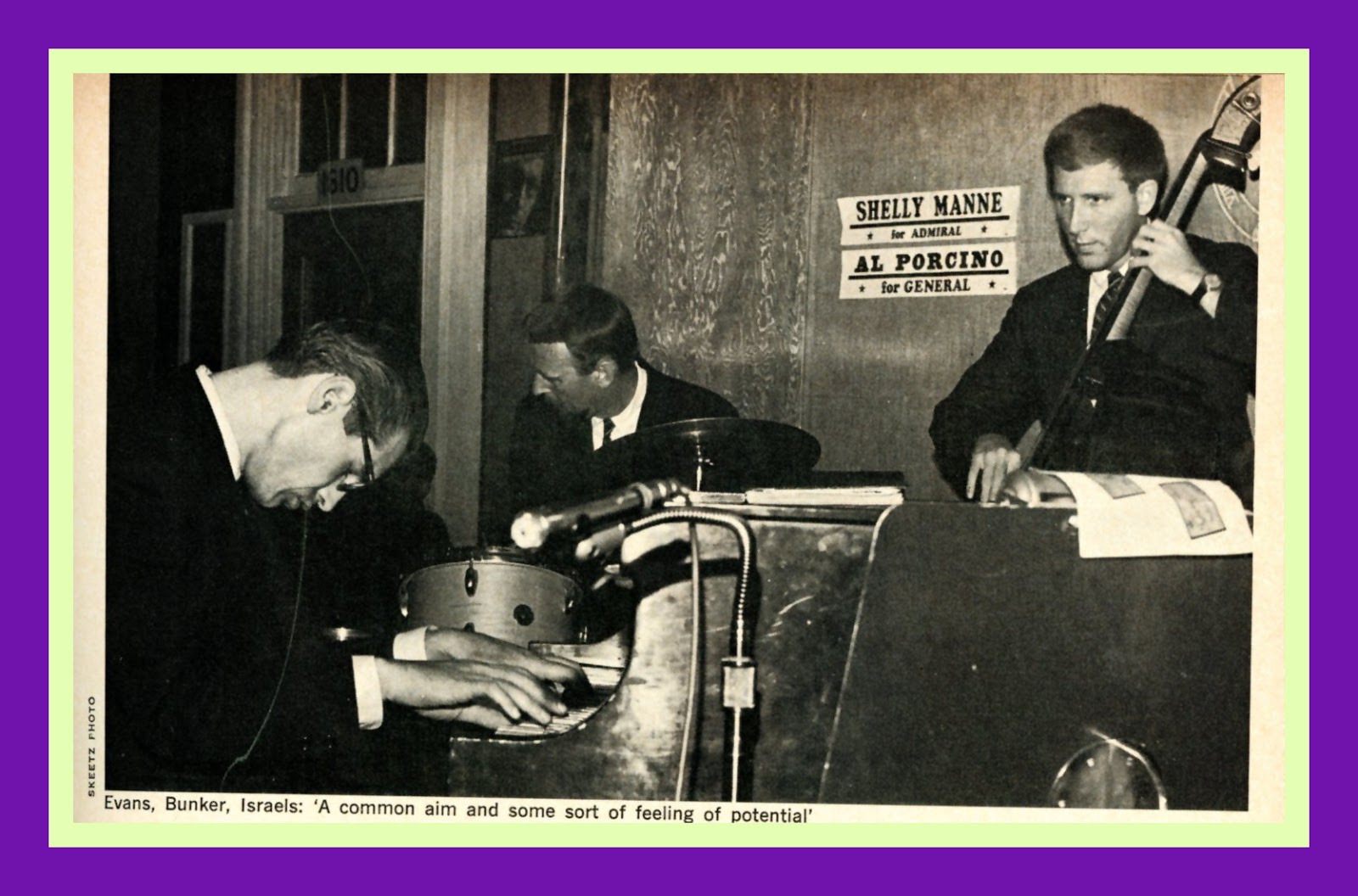
Recently at Shelly's Manne-Hole in Hollywood the three musicians discussed their work and its execution.


Evans, at 35, is grave of mien and sober of dress. Introverted at the keyboard, he plays with head bent to his inventions, seemingly oblivious to all but the secret messages running among piano, bass, and drums that emerge in musical translation as some of the most memorable jazz in our time.


What gives the trio its character, Evans said, is "probably a common aim and some sort of feeling of potential. The music develops as we perform. What you hear in a set has become that way through performance." The approach is pragmatic; something works out in the execution of a certain number, and it stays in the performance because it works.


The Evans philosophy is to the point: never impose any verbal conception of the music before the performance. Let everything happen through the playing.


"We've never rehearsed," the pianist said of the current trio. "We have discussed music collectively but never the specifics of a performance. I want the other guys to feel as I do — that the object is to achieve what we want in a responsible way. Naturally, as the lead voice in the group I might shape the performance, but to attempt to dictate . . . never. If the music doesn't coax a response, then I don't want a response. And this is the most natural course for a performance to develop."


Evans has been quoted elsewhere and at length on the subject of freedom in the playing of many considered avant-gardists in today's jazz. "Freedom is not license," he emphasized. "The idea is not to say, 'I feel frustrated tonight so I'm going to play frustrated,' but to feel that the thing is to be responsible to the music itself."


Of his own playing he averred, "I couldn't be more simple. In fact, if I could be, I'd like to do it." The simplicity, he explained, lies in "the conceptions of the felt forms and felt basics."


Reminded of Bunker's skill as a vibraharpist (he was one of Hollywood's top studio men on that instrument prior to joining Evans last year), the pianist described Bunker's playing as wonderful. But, he remarked, adding vibes to the trio also would add problems. "For the same reason," he said, "this is why I haven't added a horn. You see, in this trio format the fundamental musical principles are happening. There is a bass function, a melody function, and a rhythm function. So fundamentally the trio can develop in this direction."


Israels, he said, lends a feeling of a complete trio. "Three things are happening with each other all the time," Evans said. "Yet there's no imbalance."


Following the trio's current tour, Evans said, he wants to do some "serious work at home" and seek new material for the trio. The problem of playing and replaying a familiar repertoire he added is “to find freshness in it and to progress. Hence the constant desire on the part of all three musicians to find different vehicles for expression. As examples he cited Time Remembered and a number from his Conversations with Myself album, NYC's No Lark.


Finally, he noted the need for such new material is simply "out of consideration to the people who listen to us."


ISRAELS, 29, AND AS CONSERVATIVE of dress and demeanor as Evans if not as withdrawn a personality, has that great technical ability that has come to mark so many young bassists during the last decade and a half.
As articulate as the pianist, Israels described his role in the trio as "not a rhythm function."


"My voice is left open," he said, "because Bill doesn't play the bass in his left hand. So I mold the contour of my bass line to fit the character of the piece." Therefore, because Israels knows the harmonic nature of the piece, Evans knows he can leave out the bass voice on piano; Israels will fill it in.


"There are only a few other groups functioning like this," Israels declared, "Gary Burton's [on records], Gerry Mulligan's, and Stan Getz'. It's a way of leaving the bass player free and giving him a part in the ensemble."


How does this role fit Israels? How, in practice, does it satisfy him musically?


"When things are going well," he said, "say, one night in 10, Bill and I have a dialog going. When things are going really well, ideally — say one night in 30 — it's just perfect."


Expanding on the bassist's role in the Evans trio, Israels generalized for a moment. "There is an attitude prevalent," he said, "among a large group of naive musicians that self-expression is equivalent to following every trivial impulse when in fact these trivial impulses are not the essential characteristics of a person's artistic thought and feeling. I'm concerned with expressing myself, of course, but within my general artistic philosophy, which is governed by a musical language and vocabulary that I feel will communicate my deepest and most important feelings. That means you have to educate your impulses in terms of the musical language within which you choose to express yourself.”


"In relation to the group, there are moments when my role is secondary to Bill's. During this time there may be a breath or space or hole in the music that cries out to be filled in with two or three bass notes to complement Bill's thought."


In this context, the bassist explained, he thinks as an accompanist. "It doesn't detract from my feelings of artistic expression in a secondary role," he said. "Bill does what seems complementary to what I do and I to him. We try to complement each other."
"This, of course," he quickly added with a rueful smile, "is on an ideal plane. This is aside from the burden of personal problems, feelings, considerations, and so on."


On strictly a personal level he illustrated the point by confessing that that particular evening he felt his morale was sandbagged.


THE TRIMLEY BEARDED BUNKER is a 36-year-old Californian, the newest member of the trio, who approached the assignment uncommonly well prepared.


"Before I ever played with Bill," he said, noting his first job with Evans was a brief spell in 1963, "I'd spent about four years listening to everything he recorded. It got to the point where if I really wanted to listen seriously — not just background for conversation or at dinner — to music at home, it'd be to him. So when I first worked with him at Shelly's, it was like playing with an old friend. It was almost as if I'd been waiting for him to come along."


Working with Evans, Bunker said, has resulted in some remarkable empathy at times. They reached a point in their musical relationship then in which the drummer would develop a percussive pattern or response to fit something Evans might be playing, and each time the pianist hit that certain phase, Bunker would follow suit.


"After a while," Bunker said, "Bill refused to respond. We talked about it, and Bill explained why." The pianist felt such interplay impeded progress and genuine creativity by falling into a pattern, however seemingly fitting. Now, the drummer said with a shrug, if something is "happy" between him and Evans, so be it, let it happen.


Bunker's personal reaction to Evans' playing is unadulterated, unqualified enthusiasm.


"When he's really on," according to the drummer, "he's staggering. He probably makes fewer mistakes than any person I've ever heard on the instrument. I hear just about everything I want to hear in his playing. He's got everything — time, emotion, chops. He's like a computer."
Bunker confessed, however, that "in many areas I'm dissatisfied with my playing. I probably restrict myself more than Paul Motian [a former Evans drummer] did."


"Bill loves to sit down and cook," Bunker added, "and just have the time go for him. He's not interested in just being far out for its own sake. For myself, I keep trying to weed out a lot of the extraneous things from my playing. Bill can do that to you."


Bunker enjoys "generally very good" relations with Israels. "Chuck probably has certain weaknesses of his own, things that he's working on," Bunker said. "But we get along."


On the stand it's music time again. Autumn Leaves is whirled into a rapid interplay and fusing of sound, and the intensity of creation is almost painful.
Visually, Bill Evans is a hunched mass of back and shoulders to the audience, his face barely a foot above the keys, his concentration mentally and almost physically bearing down on his listeners.


Sometimes they don't understand. A sweet young thing, visibly bemused by it all but eager to please her date, was heard to remark after a particularly trying set: "Y'know, it makes you want to rub his back."”