© Copyright ® Steven Cerra, copyright protected; all rights reserved.
“[Billie] Holiday featured the composition at a Carnegie Hall concert, and over the next several years "There Is No Greater Love" occasionally appeared on bandstands and at studio sessions. But Miles Davis's recording of "There Is No Greater Love" from November 1955 and Sonny Rollins's version from his 1957 trio project Way Out West were more influential than any of these precedents in entrenching this piece in the set lists of modern jazz players.
The song is typically played at a relaxed medium tempo, but adapts easily to other pulses. The melody unfolds with a sense of pleasing inevitability — as is often the case with Isham Jones's compositions, which tend to avoid drama and surprising shifts, instead satisfying the ear with the natural, unaffected way the phrases connect to one another. This holistic quality to "There Is No Greater Love" also allows it to maintain its inner logic even when subjected to radical reworkings.”
- Ted Gioia - The Jazz Standards, A Guide to the Repertoire [2012]
Every so often a new recording comes along that just unfolds in a rollicking, swinging manner that get my fingers poppin’ and toes tappin,’
Nothing complicated by way of repertoire: some selections from the Great American Songbook and a smattering of tunes that have become Jazz standards that have familiar melodies which make it easy for my ears to follow what’s being improvised over these structures.
Besides their well known melodies, whatever the tempo, each track is played with an insistent beat and creates a forward motion to the rhythm often referred to as Swing.
Also helpful is the fact that the recording was made in performance with an energetic and enthusiastic audience appreciatively urging the musicians along.
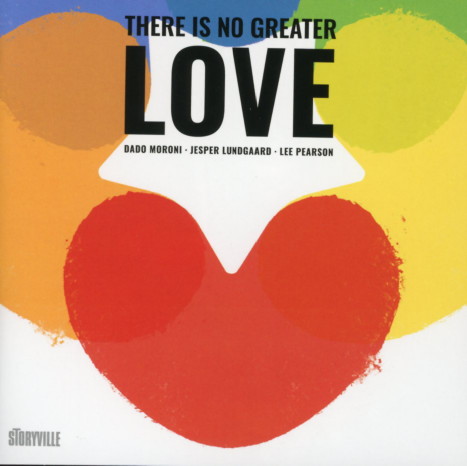
All of which comes together to make for the hour or so of satisfying music which can be found on the recently released Storyville CD There is No Greater Love [1018493].
Recorded live in Copenhagen at the famous jazzhus Montmartre on May 20-21, 2016 the recording features pianist Dado Moroni, bassist Jesper Lundgaard and drummer Lee Pearson.
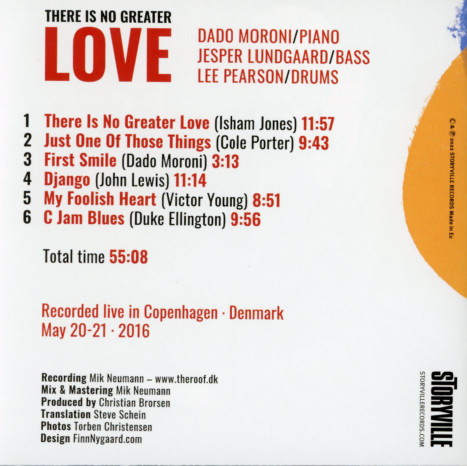
Here’s more about how this fine recording came about from Christian Brorsen’s insert notes. Christian was the producer and jazzhus Montmartre’s Musical Director from 2011-2016.
“The story behind this recording had its starting point in a series of concerts in honor of Danish bassist Niels-Henning 0rsted Pedersen, who would have been 70 years old in May 2016. NH0P was a virtuoso who took bass playing to a new level, both technically and musically - the importance of which
cannot be overstated in the history of jazz. A crucial period in his career was his collaboration with Oscar Peterson, who admired NH0P for his colossal creative energy and ability to instantly turn any musical idea into reality.
Our challenge was to find musicians capable of captivating an audience with this same musical mastery, pushing music that swings like mad to the brink of what is possible. And Dado Moroni, Jesper Lundgaard and Lee Pearson do precisely that. Listening to this recording, it's hard to believe their total preparation time was a couple of hours on the day of the concert. No rehearsal. Not even a sound check, just three musicians who quickly found a natural compatibility, thanks to decades of training in the great American piano-trio tradition.
Otherwise, the music speaks for itself. These are three equally gifted musicians who aren't shy about displaying their talent. The music flows effortlessly and is constantly creative - evidence that the band was definitely feeling good that evening. Many thanks to Dado, Jesper and Lee for (re)confirming that as a form of culture, jazz is absolutely alive and well. Also, a big thank-you to Mik Neumann for producing such a fine recording. It's almost like being there - again!
About the Musicians: Jesper Lundgaard (Denmark) was the natural choice as bassist for this trio. With his awesome technique, comprehensive overview and infallible rhythm, he has been a member of Tommy Flanagan, Duke Jordan and Horace Parian's trios, among others.
A generation younger than Lundgaard, Lee Pearson (USA) was brought up by Hank Jones and Kenny Barron. With his energy and humor, he is capable of igniting any trio. (American drummers seem to have a special knack for this!)
Pianist Dado Moroni (Italy) has played with NH0P, yet is by no means an Oscar Peterson clone. With his fertile creativity he has adapted elements of Peterson (and other American piano masters) to his own unique style and incorporated them into a "European" context. A spell-binding crowd-pleaser!
Christian Brorsen Producer and Jazzhus Montmartre's Musical Director - 2011-2016
We are also fortunate in being able to share with you some of the music from this recording so you can actually hear it rather than just read about it.


 The program on this CD consists mainly of standards, though Moroni contributes one original composition. It starts gently with a little heard but attractive Blossom Dearie piece Inside A Silent Tear. The tempo picks up with a sprightly version of Billy Strayhorn's All Day Long. This leads, logically enough, to the Duke's Come Sunday. On Stompin' At The Savoy Dado plays solo; Stompin' is usually performed as an up-tempo swinger, but Moroni gives it a slow, thoughtful treatment which explores every aspect of the venerable piece. The next track is a piano-and-bass duet, Moroni's tribute to another great pianist, Ahmad Jamal. Jimmy Cobb returns for another nod to the Duke. and there follows a gorgeous version of If I Should Lose You. The trio is then joined by Adrienne West who provides a flawless reading of the lovely but too seldom heard Kenny Dorham tune Fair Weather.
 As I wrote in my insert notes to the recording:
 “Italian pianist Dado Moroni, who is in the process of settling in New York [Dado lives in Genoa, Italy and maintains an apartment in New York], provides one of the album’s truly unusual delights. For his first recording with Ray Brown, the pianist does an all-out impersonation/tribute to Erroll Garner, complete with grunt. Compounding the wackiness is the fact that it’s a Garner take on John Coltrane’s Giant Steps! Ray starts with a slow statement of the theme on bowed bass with Moroni commenting quietly behind. Then, from out of a delirious nowhere, comes the Garner stuff which, after several loopy minutes, shifts gears into an up-tempo excursion more in keeping with the original tone of the piece. But with another shift, we’re back to Garner and Ray’s Arco bass. Moroni is clearly not awed by tradition new or old, and he and Ray just smile all the way through. The trio is up and cooking for My Romance, which demonstrates that the romance still has sparks.”
 Beginning with Dado’s early sideman dates, and concentrating on the ones he made as a member of the quintet co-led by George Robert – Tom Harrell, these are among some of the best Jazz recordings made in the 1980s. This point is re-emphasized by Dan Morgenstern, the well-respected Director of the Institute of Jazz Studies, Rutgers University, and the writer of the insert notes to all of the groups recordings beginning in 1987 with Sun Dance [Contemporary CCD-14037-2]:
 Yet, for Swiss-born George Robert, jazz is something that came quite naturally, from his home environment.. His American-born mother's love for jazz was shared by his father, five brothers and two sisters; the boys all played instruments, and formed a family band. George started piano at 8, took up clarinet at 10, and studied with Luc Hoffmann at a distinguished conservatory in his native Geneva.
 [Of the musicians in the band, George commented]: 'I've always admired Tom, both as a player and a composer, to have him next to me is a great inspiration', the leader said. The two horns get a beautiful blend, and have a very special way of interacting, notably in the interludes of collective improvisation that are a feature of the band. "Jimmy Woode introduced me to Dado in 1985, and since then, I've always worked with him. He's a wonderful pianist. His touch is just superb, and the way he comps is a rare gift." This young man moved to Amsterdam in 1986, and I've not the slightest doubt that we'll hear much from and about him. Bassist Reggie Johnson, with whom George had worked before, was the perfect choice. 'Reggie is an exceptional musician and the ideal bassist for us - we love him. And Bill has been a friend for a long time. I think he's one of the most musical drummers around." Goodwin's outstanding solo on the title cut proves that statement, and his experience as a record producer came in handy as well.
 In a varied program of uniformly excellent originals by Robert and Harrell, the band strikes a happy balance between ensemble and solo strength. The leader gets a fine, full sound from both his alto and soprano (he handles the latter with a fluency that reflects his clarinet training) and tells a story when he plays. So does Harrell, surely one of the most underrated and under-publicized trumpeters of our time (and quite a flugelhorn player, too). The rhythm section is a delight, with a real feeling for not only time but also dynamics, and works hand-in-glove with the multihued horns. …
 Two years later in 1989, the Robert-Harrell group was back with Lonely Eyes this time on GRP [1002]. Dan Morgenstern offered these insights about the band on this recording:
 The rhythm section is always finely attuned to its supporting tasks, which are far from routine this group deals with subtle rhythmic as well as harmonic demands-but it seems inaccurate to describe this dynamic triumvirate as a mere "rhythm section". The greatly gifted Moroni is not only a wonderfully sensitive and alert accompanist, but adds solo strength (his modal ballad Adrienne reveals talent as a composer as well). Reggie Johnson's impeccable intonation and rhythmic strength would be enough, but he also steps out as a soloist, and when he does, it's not in the obligatory manner of giving the bassist some, but with lucidly musical (and never over-long) statements. Master percussionist Bill Goodwin is always there, adding colors and textures to the quintet's overall sonic meld and providing the kind of absolute rhythmic security that allows everyone to relax and play without fear of falling off the wire.”
 And with the album’s title in mind, here’s what Johnny Dankworth wanted to say about Dado as contained in the CD’s insert notes:
 As we approach the second [2] category of Dado’s recordings – his trio work – it is interesting to observe that while he made his recording debut in 1979, he did not make his first trio Jazz recording until 1992. The occasion was the release of What’s New? on Splasc(h) records [CDH 378.2], and Italian based label. Interestingly, as of this writing, the recording was still available through Amazon.
 Heart of the Swing is swing personified as it abounds with delightful arrangements of standards such as Just in Time, There is No Greater Love and Charlie Parker originals such as Anthropology and Barbados which provide the listener with ample opportunity to hear Dado’s finger-popping inventions, Moriconi’s huge, booming bass sound and Bagnoli crisp and lighting fast technique. Moroni-Moriconi-Bagnoli play a repertoire that is exciting and engaging while producing an album of swinging piano trio Jazz.
 There’s more of the same by this exquisitely matched, powerhouse trio on Super Star Triok with a burning up-tempo version of What is This Thing Called Love, as well as, interesting treatments of standards including You’ve Changed and Love for Sale along with well-crafted versions of Jazz classics such as So What, Oleo and Ray Brown’s FSR [“For Sonny Rollins”]. There is even the tasteful introduction of Fender Rhodes electric piano and electric bass on a couple of tracks, a reflection of the interest in bringing different sounds into the music by the current generation of Jazz musicians.
 Let’s begin the third category of this piece with its focus on Dado’s more recent recordings as both leader and sideman, most of these occurring in his native Italy, by focusing on Ken Dryden’s review of three of them in
  Saxophonist Rosario Giuliani is a fast-rising star in European jazz. For his fourth Dreyfus CD Anything Else [Dreyfus Jazz FDM 46050 366982], he composed 9 of the 12 songs and is accompanied by Moroni, trumpeter/flugelhornist Flavio Boltro, bassist Remi Vignolo and drummer Benjamin Henocq. "Blow Out" is a percolating uptempo blues line showcasing the leader's fiery alto and Moroni's intense McCoy Tyner-like solo, followed by the relaxing samba "Danae." "Backfire" is reminiscent of the Phil Woods Quintet with Tom Harrelll because of its energy, though this propulsive bop vehicle has a soulful edge in spots. Giuliani's constantly shifting solo is driven by Moroni and the rhythm section's high-octane accompaniment. The ballad "A Winter Day" opens with Moroni's dreamy piano solo, then Giuliani and Boltro (on flugelhorn) trade choruses in this engaging, nostalgic theme. Giuliani switches to soprano sax for his lively AfroCuban-flavored "Conversation" and the sentimental ballad "My Angel." The two horn players breeze through Ornette's challenging "Invisible," though Moroni's fiendish "Three Angels" is almost as demanding. The pianist also contributed the lyrical "Hagi Mystery," another piece with a Caribbean flavor, featuring Boltro's rich flugelhorn and Giuliani's impassioned alto sax.
 Moroni and Enrico Pieranunzi are two of Italy's top keyboardists, so a duo concert like Live Conversations [abeat AB JZ 039] makes sense. Both men have tremendous technique, yet also have big ears, able to complement each other's improvised lines while avoiding the train wrecks that often occur when there's a personality mismatch. Their interpretation of Miles' "Solar" is unusual, incorporating a bit of stride and a long closing vamp to spice up this bop favorite. There's a brief bit of confusion as Sonny Rollins' "St. Thomas" is introduced with a bit of the standard "Someday My Prince Will Come" and their wild romp through this calypso favorite has a decidedly humorous air. The aforementioned Disney tune is up next, transformed from a quiet waltz into a turbulent blend of dissonant harmonies and Stravinsky-like chords topped by a surprise ending.
 A dazzling duo improvisation gradually leads into a stunning, somewhat ominous setting of "All the Things You Are," which segues into a more conventional version of "What is This Thing Called Love." The final track is a bit misleading: "Autumn Leaves" (the only tune listed), gradually unfolds from a dark improvisation into a bright performance with hints of Bill Evans. But this selection is actually a medley that detours into a dramatic workout of "Caravan" (yet also adding a brief, light-hearted lick from "Sweet Georgia Brown"), returning to the first theme and then engaging in an extended fast blues before gliding to a finish with a sly chorus of "Blue Monk."
 Magone [Dreyfus Jazz FDM 46050 369112] marks the debut recording as a leader for Belgian trumpeter/flugelhornist Bert Joris, a veteran member of the Brussels Jazz Orchestra. His potent rhythm section includes Moroni (who provides intuitive support for the leader in addition to his top drawer solos), bassist Philippe Aerts and drummer Dre Pallemaerts. Joris primarily focuses on his originals, delving into many moods. The brooding title track (an abbreviation of "Mother is Gone") is an emotional work; the trumpeter's solo is backed by dark, sparse piano and a rock-steady rhythm like someone pacing the floor, though Moroni's free- flowing bluesy solo steals the spotlight. Joris adds his mute for "Triple," a snappy, playful vehicle dedicated to his cat. The soft, lush ballad "Anna" (named for a young girl Joris once met) showcases his rich-toned flugelhorn. The perky bop line "King Kombo" evolved from two separate commissioned works. Moroni is heard on electric piano on two numbers, including his mellow "The Mighty Bobcat" and Joris' perky "Mr. Dodo." Joris is back on flugelhorn for the gut-wrenching interpretation of "I Fall in Love Too Easily." The last selection, "Benoit," comes from a 2005 concert, a Latin number showcasing the leader's muted trumpet.”
 Dado has also been a long standing member of drummer Roberto Gatto’s quintet as is reflected by his appearance on two albums: Deep [CamJazz7760-2] and Roberto Gatto jazzitaliano 2006 [Palaexpo 03].
 In addition to more of Dado’s sparkling improvisations, these albums under Gatto’s leadership find him in the company of some of Italy’s best musicians both old and new for as Ira Gitler, the notable and senior Jazz critic has commented: “Italian jazz musicians are the best in Europe and are world-class players.”
 Comprised entirely of six, exquisitely interpreted standards – The Nearness of You, Lover, I Hear a Rhapsody, Darn That Dream, Poinciana – and the title track original by Dado, Humanity is a "formidable disc which gives the listener an hour of music that is rich in intensity, lyricism and pathos.” [paraphrase of Maurizio Zerbo’s review of the disc in