© Copyright ® Steven Cerra, copyright protected; all rights reserved.

The editorial staff at JazzProfiles has previously posted about Jack Gelber’s play The Connection and the music that pianist Freddie Redd composed for the Broadway [NYC] production from the perspective of the West Coast version of it that we saw performed at the Ivar Theater in Hollywood, CA with Redd’s score performed by tenor saxophonist Dexter Gordon. You can locate that feature in the blog archive by going here.
In that piece we used, with his permission, the following excerpts from Ira Gitler’s insert notes to the Blue Note LP The Music from the Connection: Freddie Redd Quartet with Jackie McLean [[B2-89392].
“THE CONNECTION by Jack Gelber is a play about junkies but its implications do not stop in that particular circle. As Lionel Abel has stated in what is perhaps the most perceptive critique yet written about the play (Not Everyone Is In The Fix, Partisan Review, Winter 1960), "What adds to the play's power is that the characters are so like other people, though in such a different situation from most people."
The situation in which the four main protagonists find themselves is waiting for Cowboy (Carl Lee), the connection, to return with the heroin. These four, Solly (Jerome Raphel), Sam (John McCurry), Ernie (Garry Goodrow), and Leach (Warren Finnerty) are in attendance at the latter's pad with the bass player. One by one, the three other musicians drift in. They are also anxiously awaiting Cowboy's appearance. Also present, from time to time, in this play-within-a-play, are a fictitious playwright Jaybird (Ira Lewis), producer Jim Dunn (Leonard Hicks) and two photographers (Jamil Zakkai, Louis McKenzie), who are shooting an avant garde film of the play.
The musicians not only play their instruments during the course of the play but, as implied before, they also appear as actors. Some people have raised the question, "If they are actors, why are they using their real names?" Pianist-actor Freddie Redd, composer of the music heard in The Connection answers this simply by saying that he and the other musicians want recognition (and subsequent playing engagements) for what they are doing and that there would be no effective publicity if they were to appear as John Smith, Bill Brown, etc. Author Gelber concurs and says that having the musicians play themselves adds another element of stage reality.
When The Connection opened at The Living Theatre on July 15, 1959, it was immediately assaulted by the slings and arrows of outrageous reviewers, a group consisting, for the most part, of the summer-replacement critics on the local New York dailies. Although several of them had kind words to say about the jazz, none were explicit and one carper stated that the "cool jazz was cold" which showed his knowledge of jazz styles matched his perception as a drama critic.
A week later, the first favorable review appeared in The Village Voice. It was one of many that followed which helped save The Connection and cement its run. In it, Jerry Tallmer didn't merely praise the jazz but in lauding Gelber as the first playwright to use modern jazz "organically and dynamically", also pointed out that the music "puts a highly charged contrapuntal beat under and against all the misery and stasis and permanent crisis."
This, the music does. It electrically charges both actors and audience and while it is not programmatic in a graphic sense (it undoubtedly would have failed if it had tried to be) it does represent and heighten the emotional climates from which it springs at various times during the action.
The idea to incorporate sections of jazz into The Connection was not an afterthought by Jack Gelber. It was an integral part of his entire conception before he even began the actual writing of the play. If Gelber did not know which specific musicians he wanted onstage, his original script (copyright in September 1957) shows that he knew what kind of music he wanted. In a note at the bottom of the first page it is stated, “The jazz played is in the tradition of Charlie Parker." (The Connection is published by Grove Press Inc. as an Evergreen paperback book.)
Originally Gelber had felt the musicians could improvise on standards, blues, etc., just as they would in any informal session. When the play was being cast however, he met Freddie Redd through a mutual friend. Freddie, 31 years young, is a pianist who previously has been described by this writer as "one of the most promising talents of the '50s" and "one of the warmer disciples of the Bud Powell school". During the Fifties he played with a variety of groups including Oscar Pettiford, Art Blakey, Joe Roland and Art Farmer-Gigi Gryce, all of whom recognized his talent.
After he had gotten a quartet together at Gelber's request, auditioned for him and was given the acting-playing role in The Connection, Freddie told Jack of his long frustrated wish to write the music for a theater presentation. Armed with a script and the author's sanction, he went to work. In conjunction with Gelber, he decided exactly where the music was to occur. By familiarizing himself with the play's action, he was able to accurately fashion the character and tempo of each number. What he achieved shows that his talent, both the obvious and the latent of the '50s, has come to fruition. He has supplied Gelber with a parallel of the deep, dramatic impact that Kurt Weill gave to Brecht. His playing, too, has grown into a more personal, organic whole. Powell and Monk, to a lesser degree, are still present but Freddie is expressing himself in his own terms.
The hornman he chose to blow in front of the rhythm section and act in the drama, has done a remarkable job in both assignments. Jackie McLean is an altoman certainly within the Parker tradition but by 1959 one who had matured into a strongly individual player. His full, singing, confident sound and complete control of his instrument enable him to transmit his innermost musical self with an expansive ease that is joyous to hear. It is as obvious in his last Blue Note album (Swing, Swang, Swingin' — BLP 4024) as it is here or on stage in The Connection. As an actor, Jackie was so impressive that his part has grown in size and importance since the play opened.
During the early part of the run, Redd's mates in the rhythm section were in a state of flux until Michael Mattos and Larry Ritchie arrived on the scene. Mattos has worked with Thelonious Monk, Randy Weston, Max Roach and Lester Young among others. Ritchie came out of B. B. King's band to play with Phineas Newborn and later, Sonny Rollins. Together they have given the group on stage a permanence; the fusion of many performances' playing as a unit is evident here.”
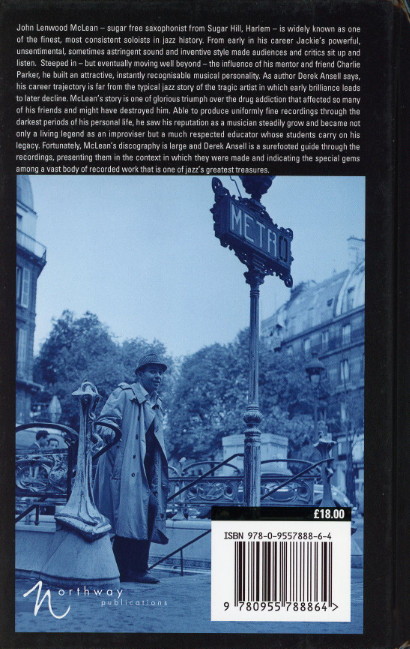
Recently I came across the following information in Derek Ansell’s Sugar Free Saxophone: The Life and Music of Jackie McLean [2012] that broadens the perspective of Jackie’s role in the production and performance of The Connection and I wanted to share it with you, as well as, post it in order to record it in the blog archives. You can purchase Derek’s excellent book from its publisher via this link.
In many ways, 1959 and The Connection could also have been labelled The Crossroads in Jackie’s career because some of his best Blue Note recordings would be created shortly before and after his appearance in the play and, of course, on the recording of Redd’s score.
But to compound matters, he was married with three children, had lost his cabaret card due to a conviction for narcotics possession [which made it impossible to work in NYC night clubs], and was about to appear in a play about Jazz musicians and drug addiction!?
“The irony would not have escaped McLean and his family on July 15th 1959 when the altoist began work as a musician and actor in Jack Gelber's highly controversial play The Connection. The Living Theatre in New York City presented the play about four jazz musician addicts waiting around in a seedy pad for their 'connection', a character called 'Cowboy*, to arrive. The four actors are joined from time to time by a playwright, a producer and two photographers and a sort of play within a play takes place as these latter characters are supposedly shooting an avant-garde film of the play
McLean, at this time addicted to heroin and not allowed to perform in jazz clubs in NYC, was allowed to appear on stage in a New York theatre, playing saxophone and acting and - yes, that's right - playing a jazz musician who is addicted to heroin. The music for the play had been designated by the writer Jack Gelber as being 'in the tradition of Charlie Parker'. By all accounts, Gelber would have been happy for the musicians on stage to play standards and various twelve bar blues concoctions but when pianist composer Freddie Redd was hired to lead the bop quartet on stage, he made it clear that he wanted to produce all new music, specially composed for the play. Gelber, who was very happy with this suggestion, promptly armed Redd with a script and that is how the music for The Connection was born.
McLean and Redd were old friends and had played together in clubs and concerts frequently. Although the rhythm section changed often in the first few months, it settled down when bassist Michael Mattos and drummer Larry Ritchie were recruited and they stayed, along with Jackie and Freddie, until the play ended its run. It is fascinating and instructive to go to YouTube on the internet and view the sample from the film of the play shown there. A slim, youthful-looking McLean can be seen and heard blowing alto in that emotive, blues inflected manner he had, with Redd pounding out the chords at the piano, and Mattos and Ritchie supporting on bass and drums. As the music plays, the action of the play, such as it is, continues. A photographer worries about running out of film for his avant-garde movie and various characters slouch around or sit looking vacantly into space, waiting hopefully for their fix to arrive. A second drummer sticks in hand but with no kit, apes every movement Ritchie makes, flourishing the air with the drumsticks. After a minute of silence and little stage activity an actor urges Freddie to 'play something' and the pianist launches into a new composition.
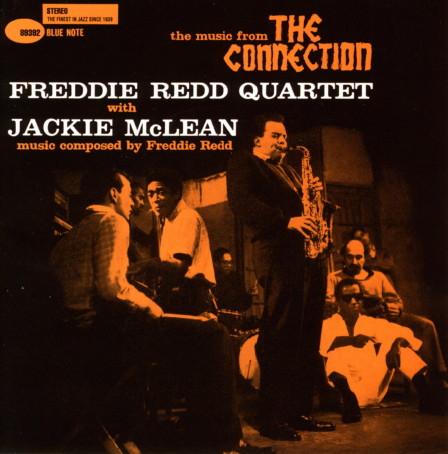
The music written for the play, which includes 'Music Forever', 'Wiggin" and 'Theme for Sister Salvation', is best heard on two discs first released in the early 1960s; The Music from the Connection by the Freddie Redd Quartet featuring Jackie McLean on Blue Note BST 84027, and an album featuring Redd, tenor saxist Tina Brooks (Jackie's understudy in NYC) and trumpeter Howard McGhee, reissued as Boplicity CDBOP 019. The play ran for more than three years and McLean was part of the company travelling to the UK in 1961. A production in California featured Dexter Gordon in the part Jackie played in NYC, Although harrowing as presented with all the realism that the actors and, particularly the musician-actors could inject into it, the play was a success. It shocked and worried a lot of people in the 1960s, people who went regularly to the theatre but didn't expect, at that time, the levels of realism that were presented to them.
'No, it was like that,' Jackie said in 1994. 'It was like that was a real hunk of life, that play It was way ahead of its time.' He went on to add, chillingly, that America later experienced widely the problems the play had predicted. And he added, perhaps tellingly, that when the company arrived in Britain, the play didn't work very well because there was no drug problem in the UK at that time. 'They had legalized drugs over there,' he told the interviewer and went on to say that there was no waiting for a connection to arrive in Britain because addicts could get drugs from their doctor. 'They had three drug convictions in the whole country' This statement prompts the obvious question, whatever happened to the enlightened attitude and laws of i960s?
This was a successful period in McLean's early years as a professional jazz musician and he acquitted himself well as an actor. Much of the credit for the play's success, however, must go first to Gelber and then to Redd for his high quality music score and, of course, to the rest of the quartet that played it night after night.
Aficionados will hear some of McLean's best solos of the period on the Blue Note Connection disc, recorded in February 1960. He is both brash and at times acerbic and, as always, there is that distinctive undercurrent of melancholy as in all his work at this time. Given that this was a result of his lifestyle, my only surprise, if that's the right word, about The Music from the Connection, would be that it is almost all bright and upbeat. A couple of dark, sombre minor compositions would surely have suited the mood and ambiance of the play? Only Freddie Redd can address that comment but it must be acknowledged that all the music from the play is memorable, distinctive and, of course, enhanced considerably by the solos of McLean and Redd and the rhythm backings.
* * *
The changes in McLean's mature style began in 1959 and possibly much of it was worked out as he played, night after night, in The Connection, working on the same Freddie Redd compositions but doubtless applying fresh variations over a period of nearly three years. He was always a restless, explorative soloist and, unlike most, unwilling to set a style and play it virtually unchanged for the rest of his life. The new sound of McLean was to be heard late in 1959 and much more in 1960. Perhaps by coincidence, some of his most advanced and probing solo work was caught in January 1959 when he recorded 'Blues Inn', 'Fidel' and 'Quadrangle', for Blue Note. In 1960, three tracks from a September 1st session were added to make up Jackie's Bag, which came out later that year on Blue Note BLP 4051.
The first three pieces show how much Jackie's writing had developed and matured. 'Quadrangle' is a fascinating composition which he admitted in 1962 (in the notes to Let Freedom Ring) did not fit easily with rhythm changes. When these tracks were recorded, however, he was in the process of working out new methods of writing and playing and the style here is not much removed from earlier attempts in this type of piece. Even so, the alto solo is intense, supercharged and swings like mad, courtesy of Jackie's own inbuilt sense of time and the driving, slashing rhythm section comprising Sonny Clark, Paul Chambers and Philly Joe Jones, one of the best units he worked with. 'Quadrangle' benefits from exceptional solos by McLean and Philly Joe with Clark laying out on this track. Listen to the pianist on ‘Fidel’ where he easily matches the invention and intensity of the leader. McLean stated in the liner notes to Jackie's Bag that he had written 'Quadrangle' four years earlier and it had been a style of writing he had been working towards for some time. 'I had some trouble at first putting chords on it for blowing on,' he continued, 'but I wanted to have a firm basis to play on, as well as those figures that came into my head.'
In the year and a half separating these two sessions, Jackie had begun playing modal music more frequently and had found other ways to interpret pieces like 'Quadrangle'. Playing on scales rather than the more conventional chord progressions was something that he had learned in Charles Mingus' Workshop bands in 1957 but it had not become common practice by 1960. Much of Mingus' practice at the time was forward looking and original but, as with all things, it took the general public and most other musicians a long time to catch up. The main thrust of inspiration for Jackie is most likely to have been Miles Davis’ groundbreaking Columbia LP Kind of Blue, recorded in March 1959 and beginning to gain momentum on its journey towards becoming the best-selling jazz record of all time. Davis, who pushed McLean to play standards and to study music thoroughly, also taught him to use space intelligently and effectively. So it should come as no real surprise that on the second session that made up the six tracks of Jackie's Bag, the altoist kicked off with ‘Appointment in Ghana' which uses a modal structure in the main phrase. As Bob Blumenthal noted in his insert for the updated CD release of Jackie's Bag in 2002, the practice of playing scales had not entered McLean's writing until this session.' It provided an alternative to standard harmonic sequences that McLean would apply to later performances of ‘Quadrangle', and that served him well in the more open approach he would soon document on such albums as Let Freedom Ring and One Step Beyond.
All that was in the future; in 1959 and through most of 1960-62, Jackie was developing as a major soloist and experimenting with new forms and methods of expression. By the time Jackie's Bag was released in 1960, he had already put out three good Blue Note LPs including New Soil and The Music from the Connection. Over that period of time his music had begun to move very slowly away from the solid hard bop of 'Quadrangle' towards more modal and challenging writing and playing such as we find on the six 1960 tracks that comprise the full, 2002 release of Jackie's Bag. Over the next two years it would change even more radically and dramatically but on the later tracks of this album he shared composition duties with the brilliant, ill-fated tenor saxophonist Tina Brooks. It was Brooks who played tenor on these tracks and the blend of his gospel-influenced, warm tenor and Jackie's often strident, slightly sharp, bluesy alto sound was wonderfully successful. Also featuring Blue Mitchell on trumpet, Kenny Drew on piano, Art Taylor at the drums and Paul Chambers as bassist on both dates, these selections really smoke and pulsate with vibrant modern hard bop solos.
Jackie's Bag turns out to be one of Jackie's most successful Blue Note albums of all and the others were all in the very good category. Perhaps it was the fact that the first session had only produced three good tracks that made this, eventually, the big success story that it became. When the later six tracks were added it offered stirring music from some of the best front-line and rhythm section players active at the time and, duly inspired by all of them, some of the very best McLean solos available to that date.
During the early 1960s Jackie recorded prolifically for Blue Note and other companies and his records offer a selection of standard but very adventurous hard bop, but also new music that is experimental and searching. From around this time it should have been obvious that McLean was not a musician to be put into any single category although it is true that the man who had followed, played with and shared a horn on occasions with Charlie Parker never abandoned his lifelong love affair with bebop.
On April 17th 1960, he headed to New Jersey for the Englewood Cliffs studio of engineer Rudy Van Gelder to record Capuchin Swing, (Blue Note 84038), with Blue Mitchell, Walter Bishop Jr., Paul Chambers and Art Taylor in support. It is another first rate release with tracks such as 'Francisco' and 'Condition Blue' outstanding. More Blue Note recordings followed in 1961, an important year if only for the release of two really exceptional albums: Bluesnik recorded in January of that year and A Fickle Sonance recorded on October 26th.
The end of that year saw two enthusiastic hard core followers of the musician, Dick Prendergast and Jim Harrison, staging a special concert, An Evening with Jackie McLean, at Judson Hall in NYC. These two, named by Ira Gitler in his sleevenotes to Fickle Sonance, had felt that the New York cabaret card restriction was grossly unfair and they staged this special event which included a table in the foyer displaying the covers of all the LPs featuring McLean as leader. Whether it had any effect on the NYC Police Department is unknown but surely unlikely It does show however the extent to which fans of the saxophonist were willing to go and how much they felt that his banishment from New York clubs was unreasonable. It also demonstrated just how well-known and appreciated he had become in the lives of jazz enthusiasts who, even though they could only hear him at theatres, at least had a fair number of recorded performances to enjoy.
Jackie McLean had made it in terms of recognition as a major jazz soloist and bandleader.”


