Showing posts with label duke ellington. Show all posts

Thursday, March 6, 2025

Part 3 -Duke Ellington - "The Hot Bach" by Richard O. Boyer

 © Copyright ® Steven Cerra, copyright protected; all rights reserved.


Few writers have depicted Ellington and his world as vividly as Richard 0. Boyer in "The Hot Bach," a three-part profile published in The New Yorker during the summer of 1944. ]Source: Richard O Boyer, "The Hot Bach-1," The New Yorker (24 June 1944), 30-34, 37-36,40,42, 44; "The Hot Bach-2," The New Yorker (1 July 1944), 26-32. 34; "The Hot Bach-3," The New Yorker (8 July 1944), 26-31].


Boyer not only interviewed Ellington extensively but traveled with the orchestra, observed rehearsals and performances, spoke with musicians, and jotted down overheard conversations. (In the text Boyer refers to himself as the "Boswellian friend of Duke's" and "friend with a historical turn of mind.") 

The result is a richly textured, candid portrait of Ellington offstage, out of the public eye.


Boyer deftly captures the group spirit of Ellington's musicians on the road, showing their extraordinary resilience in the face of monotony, physical discomfort, and racial discrimination. He highlights the important supporting roles played by Ellington's road manager Jack Boyd, his valet Richard Bowden Jones ("Jonesy"), and especially his writing partner Billy Strayhorn. Boyer's expert touch with description and dialogue brings to life scenes rarely observed by outsiders, such as activities before and after a typical dance job, and the collective working-out of a new piece in the middle of the night,


In this "jumpy atmosphere," as Boyer calls it, Ellington forms the calm center-patiently enduring a myriad of distractions, steadily making art out of chaos.


An abridged version of the article was included in Peter Gammond's Duke Ellington: His Life and Music (1958). Following is the complete text.


Remember, as you read this that it was written from the perspective of a racial context in 1944 America and does not reflect any of today’s sensibilities on the subject of race.


“Duke Ellington and the sixteen other men in his jazz band are rather surprised at the research that has been expended on bringing to light the drunks, hangovers, and frolics of their youth. The research has been done by earnest historians who are eager to determine the precise connection between dissipation and the creation of art. It is a source of mild regret to Duke and his colleagues that their escapades simply did not have that purple extravagance which is supposedly in the best tradition of jazz. Try as they would, Hugues Panassie, the French critic, and Robert Coffin, the Belgian critic, could not discover about Ellington and his band anything to match the attractive degeneracy of Buddy Bolden, a famous early cornettist and the Paul Bunyan of the jazz world, who kept himself so busy with the ladies that he had little time left for music, or of Leon Rappolo, an early clarinetist, who became insane from smoking marijuana, or even anything to equal the career of Bix Beiderbecke, another famous cornetist, who died in 1931 of drink. 


Ellington is apologetic. He feels that if he had only known years ago the artistic importance of his infrequent sprees he would have paid more attention to them and remembered more for posterity. He regrets that he did not know at the time that his befuddlement was the stuff of history. He can dredge up little for the archives, "I should have kept a diary," he says.


Ellington is also surprised at critics who claim in columns of rococo prose that jazz is the American equivalent of the glory that was Greece and the grandeur that was Rome. A few weeks ago such a critique was read to Duke, a tall, broad, coffee-colored man of forty-five, as he lolled on a cot in his dressing room at the Hurricane, a Broadway night club in which he and his band were playing an engagement. The author maintained that when New York is but a memory, or at best a forest of rusty steel ascending to a quiet sky, the perceptive archaeologist will be able to recreate American civilization if he is fortunate enough to find one Ellington record amid the deserted ruins. In the record's pulsing rhythms, the article said, he will hear the throb of long-stilled traffic, see the flash of neon signs, get some suggestion of the subway, and will understand, when a solo soars above the theme and then sinks back again, how the individual of the vanished past yearned for the stars but was limited to a banal earth. Duke listened impatiently. When the final sentence had been read, he said, "I don't know. There may be something to it. But it seems to me such talk stinks up the place."


In the field of jazz there is an exceptionally wide discrepancy between the art as practiced and the art as the writers write about it. The performers sweat, and may even rehearse, for every effect they get. The writers say that their music is as effortless as a bird's. The performers devote their lives to developing their technique. The writers present them as simple children of nature who blow their primitive souls out through their horns. The performers, most of whom spent the era of prohibition working in night clubs, know the world not only in terms of music but in terms of Mickey Finns and bouncers. The writers, who consider themselves intellectuals, range all the way from surrealist poets in Paris to Yale graduates on Fortune. 


Negro jazz musicians, who have found it best to take no part in the peculiar caprices of a white world, usually have nothing to say when they are told that there is a difference of opinion about whether they were the first surrealists, as is maintained in France. They view such assertions as just one more example of an inexplicable order which simultaneously gives them adoration and Jim Crow. They find it hard to reconcile life deep in the heart of Texas, where they must say "Yassuh, Boss," and life in Paris, where they have been told they are comparable to Bach, Beethoven, and Brahms. During a European tour of the Ellington band, the conductor of a Paris symphony orchestra once bowed to Johnny Hodges on the street and respectfully asked him for an explanation of his artistry on the alto saxophone. "I just lucked up on it, Bubber, I just lucked up on it," Johnny told him. The conductor, writing about the incident later, said, "It is a unique experience to stand before this black boy, and upon asking him to explain his amazing virtuosity, to be told, 'I just lucked up on it, Bubber.'" Duke himself got into the spirit of things when he was asked, in London, in 1933, "What is hot?" He replied, "Hot is a part of music, just as the root is part of a tree and the twigs and the leaves and the trunk. Hot is to music as a root, a trunk, a twig, a leaf is to a tree."


Despite Duke's own doubts, it is possible that the archaeologist of the future may be able to reconstruct something of the present from Ellington's music, if as is arguable, a composer's music does to some extent reflect his environment. For Duke's environment has been as American as a Model T Ford and, in a sense, as standardized. He spent his boyhood on the swarming tenement pavements in Washington, D.C., and his first job was jerking soda. He liked the pavements, and to this day he has an aversion to green because it reminds him of grass. "When I was eight," he says, "I decided that grass was unnatural. It always makes me feel sort of creepy. It reminds me of graves." From his early youth his days and nights have been spent, for the most part, far from grass, in cafes, cabarets, speakeasies, night clubs, drugstores, all-night lunch stands, hotel lobbies, railway depots, day coaches, subways, dance halls, movie theatres, dressing rooms, pool rooms, taxis, and buses. Duke sometimes says, "I've had three educations —the street corner, going to school, and the Bible. The Bible is most important. It taught me to look at a man's insides instead of the cut of his suit."


Duke sometimes thinks that it is good business to conceal his interest in the Bible, just as he conceals his interest in American Negro history. He doubts if it adds to his popularity in Arkansas, say, to have it known that in books he has read about Negro slave revolts he has heavily underlined paragraphs about the exploits of Nat Turner and Denmark Vesey. In public he usually sets his beige-colored face in a grin as wide as possible. He claims that the flashiness of his clothes is not self-gratification but rather a selfless effort to play up to the role the public expects him to assume, a claim his friends don't take too seriously. He has two general modes of dress — one for the public, which a member of his band has described as "very sharp and fly," one for rehearsing or composing. At work, he likes to wear a cheap hat, the brim turned up all around, a sports shirt without a tie, the points of the collar long enough to reach almost to his chest, brown suede shoes, a blue or maroon pullover sweater, and a sports suit so tailored that it makes him look slender. 


When he is leading his band at rehearsal, his expression varies between a grin, a pouty sleepiness in which every muscle droops and sags, and a fey daintiness. In this last mood he arches his eyebrows and has a coy look that is meant to be a silent appeal to his band for a delicate musical effect. As he plays the piano, his expression is often one of quizzical pleasure, as if he is surprised and delighted by the sounds he creates. "I really get wrapped up in it," Duke says. There are times when Duke laughs naturally and exuberantly; for example, when the boys in the band, sitting around a dressing room, are competing to see who can whistle the lowest note. "I knock myself out," he says. Then he truly seems the simple Afro-American without a care in the world. New acquaintances are always surprised when they learn that Duke has written poetry in which he advances the thesis that the rhythm of jazz has been beaten into the Negro race by three centuries of oppression. The four beats to a bar in jazz are also found, he maintains in verse, in the Negro pulse. Duke doesn't like to show people his poetry. "You can say anything you want on the trombone, but you gotta be careful with words," he explains.


Duke was born in Washington, in 1899, when Buddy Bolden was sounding on his cornet those uncouth notes which historians say were the beginning of jazz. While the new music moved slowly north from New Orleans, first to St. Louis and Memphis, then spreading out to Chicago, New York, and Europe, Duke was attending public school and, at his mother's instigation, taking lessons on the piano from a woman he insists was named Miss Klinkscale [Marietta Clinkscales]. He was christened Edward Kennedy Ellington, but he has been called Duke since he was twelve, when his elegance and aplomb began to attract the attention of his playmates. His earliest musical memory, he says, goes back to when, at the age of four, he heard his mother playing "The Rosary'' on the piano. "It was so pretty I bust out crying," he says. Duke occasionally speaks of his father as Uncle Ed. This is because Duke, who has only one sister and no brothers, had twenty-eight cousins who were so frequently around the Ellington house that Duke and his sister picked up the name. Duke's father worked for the Navy Department as a blueprint developer. "Uncle Ed sure provided for his family," Duke says. "We didn't want for anything."


When Duke was fifteen, he attended a rent party, which in Washington was called a "hop" or a "shout." The guests paid ten or fifteen cents to their host. On this occasion a man named Lester Dishman was at the piano. "He was terrific — really good," Duke says. "The piano jumped. The air shook. With his left hand he really yum-yummed, while with his right he played intricately woven melodic things. But fast!" After hearing Dishman, Duke went to all the rent parties he could and heard Clarence Bowser, Doc Perry, Louis Brown, Louis Thomas, and other gifted pianists. "Bowser's music was majestic," Ellington recalls. "I used to think, if only I could just get on to that 'Sticky Mack' style of his. They got three, four, five dollars a night. When they played at these shouts, they never had a thought in the world, drinking gin and playing and things getting wild, so that someday serious writers in Europe would investigate them, writing monographs and things.


"Doc Perry," Ellington continues, "taught me to read notes, not just spell 'em out." Duke composed his first piece shortly after hearing Dishman, while he was fifteen. It was during a summer vacation from high school. Duke remembers that he began by moving the family upright into his own room. It had a player attachment, and Duke commenced his studies by slowing down a roll of James P. Johnson playing his own "Carolina Shout." For a week Duke studied the anatomy of "Carolina Shout." "Then I locked myself in my room for two weeks and when I came out I had a shout of my own," Duke says. (A "shout" in this sense is a composition to be played at a rent party.) He had not yet named it a few weeks later when he got a job as a soda jerker in the Poodle Dog Café, an establishment near the Senators' ballpark, and in honor of this event he called it "Soda Fountain Rag." His early admirers thought he had written several shouts, for he played the piece first in blues time, then in waltz time, then straight, and finally what is now known as hot. "They never knew it was the same piece," Duke says. 

When the summer was over, Duke returned to high school, from which he graduated in 1917, when he was eighteen. While he was still in school, he got the notion that he might become a designer of advertising posters. He showed a certain amount of painting talent in class and won a scholarship to the Pratt Institute in Brooklyn for the study of commercial art. When the United States entered the first World War and Washington became a boom town, people there were so dance-crazy that jazz bands were in great demand, and Duke decided he could make more money by heading a band than he could as a commercial artist. He never used his scholarship to Pratt.


The first Ellington band consisted of Sonny Greer, a dapper, sporty young fellow who was and still is the drummer; Otto Hardwicke, a mild, dentistry gentleman who played the alto saxophone for Ellington, and still does; Charlie Irvis, trombone, now dead; Elmer Snowden, banjo, who now plays the guitar in another band; Arthur Whetsol, trumpet, now dead; and Duke, piano. Duke enjoys telling how he recruited Sonny, who was greatly admired by Ellington and the other young men in the band because he came from New York. "Sonny was a very fly drummer," Duke says, "but we wanted to be sure that he had really played in Harlem. He was playing in the pit band at the Howard Theatre in Washington and we waited on the street outside to grill him. I take the lead in conversation because I'm sure I'm a killer in my new shepherd's-plaid suit, bought on time. Sonny comes back at us with a line of jive on Harlem that lays us low. So we decide he's O.K. and he comes with the band." Duke was soon clearing as much as two hundred dollars a week. "As a result of prosperity," he says, "everybody in our band at that time became a juice hound, juice meaning any kind of firewater." Otto Hardwicke bought a car which the band called Dupadilly, and when Dupadilly broke down he bought one that was called Dear Me. During the next few years the band played in one small Washington cabaret after another, and in 1923 it moved to New York, where a young man named Bubber Miley replaced Arthur Whetsol. "Bubber was temperamental," Duke recalls. "He liked his liquor. He used to get under the piano and go to sleep any time he felt like it. In fact, all our horn blowers were lushies."


Duke, Sonny, and Otto (who holds that his name should be pronounced as if it were spelled O-toe) like to sit around and recall the golden days of their youth. All three have described in detail every hangover they can remember to those writers who want to believe that the pressure of jazz is so intense that young Negroes take to alcohol and dope in an effort to attain the proper mood to produce their fevered art, but their efforts to satisfy these writers are lame and they know it. Sonny sometimes sums up the distressing normality of their early days in New York by saying, "We scuffled around trying to make a buck, but we had a happy time. That's how it was." Occasionally he says, "Many's the time we split a hot dog six ways—but reluctantly." In a more mellow mood, he insists that they always ate as much as they could hold. "Duke drew people to him like flies to sugar," Sonny says. "Duke would turn on the old charm and then we would all eat." As a matter of fact, the band, which didn't get off to a particularly successful start in New York, lived for three months without visible means of support. They were supported, actually, by a legendary gentleman whom Duke refers to as "Mr. Gunion." "A Mr. Gunion," Duke says, "is any guy who throws his money around. Mr, Gunion supported us while we were spending most of our time hanging around, playing now and then, just for fun, at Harlem places like Mexico's, the Capitol Club, Barren's, and Smalls' Paradise." However, Mr. Gunion's support was precarious and at the end of the three months, Duke, Otto, and Sonny returned to Washington "to fatten up." As Duke, who values his food, recreates this happy occasion, he sounds like a Kentucky colonel remembering mint juleps on the pillared veranda. "We got to Washington on a Sunday morning," he says. "Otto went to his home, because he lived in Washington, and Sonny came home with me. I still remember the smell of hot biscuits when we walked in. There was butter and honey. My mother broiled six mackerel. There was lots of coffee. Uncle Ed got out the old decanter and we lay there drinking corn in the sunshine. It was nice."


The band reassembled in New York when they got news of a job at a place called the Hollywood Club, at Forty-ninth Street and Broadway. It was at this cabaret, later the Kentucky Club, that the Ellington band began to take on its permanent form. There it first went on the air, over national radio hookups, on early-morning sustaining programs, and there Bubber Miley, who was then the spark plug of the group, stamped his character on the band, by means of the growl of his trumpet and his gutbucket technique. The band's manner of playing came to be known as "the jungle style." It played at the Kentucky Club for four years and the only unpleasant events were four small fires, each of which managed to burn up Sonny Greer's drums.


It was during this period that Freddie Guy, a slim, light-brown guitarist, joined the band. He is still with it, and today he says, "I grew up with this little band, and if they're going to hell, I'm going, too. Been everywhere else with 'em. When my wife says, as we start on a trip, 'Please don't go,' I say, 'All right. Hand me my suitcase.'" Guy remembers that the Kentucky Club had a line of twelve girls and that everyone worked till he dropped, "Once you put your horn in your mouth, you didn't take it out until," he says. He waits for his listener to ask, "Until when?" Then he says, "Until you quit. Until period. You started at nine and played until."


While Duke was at the Kentucky Club, he began writing at the pace that has enabled him to turn out a total of more than twelve hundred pieces. In 1927, his last year there, he wrote, among other pieces, "Black and Tan Fantasy," "Creole Love Call," "East St. Louis Toodle-Oo," "Hop Head," "Down in Our Alley Blues," "Jubilee Stomp," "Black Beauty," "Blues I Love to Sing," "Birmingham Breakdown," and "The Creeper." [Only five of these tides were first recorded in 1927. The others date from 1926 (East St. Louis Toodle-Q, Birmingham Breakdown, The Creeper) and 1928 (Jubilee Stomp, Black Beauty).


Duke is proud of the fact that he never had any conservatory training. He likes to say, "I got most of my instruction riding around Central Park in a taxi." His instructor on these occasions was Will M[arion] Cook, who once broke his violin into pieces after reading an article in the Times calling him the greatest Negro violinist in the world. "What I've been trying to be," he explained, "is the greatest violinist, not the greatest Negro violinist." "Will never wore a hat," Duke says, "and when people asked him why, he'd say because he didn't have the money to buy one. They'd give him five dollars and then he and I would get in a taxi and ride around Central Park and he'd give me lectures in music. I'd sing a melody in its simplest form and he'd stop me and say, 'Reverse your figures.' He was a brief but a strong influence. His language had to be pretty straight for me to know what he was talking about. Some of the things he used to tell me I never got a chance to use until years later, when I wrote the tone poem 'Black, Brown, and Beige.'"


In 1927, the band went on the road under the management of Irving Mills, an agent who specialized in Negro entertainment. It was playing at a theatre in Philadelphia when the proprietors of the Cotton Club in Harlem, which was just about to open, decided that they wanted to engage it. They had been persuaded by Jimmy McHugh, who had written the score of the show that was to open the new club. Duke couldn't go because he had a contract with the owner of the Philadelphia theatre which ran for a week beyond the date of the Cotton Club's opening, and the owner declared with considerable heat that nothing on earth could persuade him to release Ellington. The Cotton Club people acted with the forthrightness that was characteristic of the prohibition era. They called Boo Boo Hoff, a friend and an underworld power in Philadelphia, and Boo Boo sent an emissary known as Yankee Schwarz to the theatre man. "Be big," Yankee Schwarz pleaded. "Be big or," he mumbled embarrassedly, "you'll be dead." The choice presented no dilemma to the theatre man, Duke's band arrived at the Cotton Club a few minutes before the opening. Because of their excitement and exhaustion, the musicians didn't play well that opening night. One of the proprietors, a man with an Irish soul, didn't respond to their music, which seemed to him jangling and dissonant. His customers didn't seem to enjoy it, either. Before the night was over, he grimly expressed a wish for something more melodic and McHugh rushed up to Ellington. "For God's sake!" he cried. "Play 'Mother Machree' or I'm a goner!" Ellington did the best he could with it.


Both Ellington and McHugh survived the opening, and after a shaky beginning, the band soon reached heights that some of its admirers say it has never surpassed. Duke played five years at the Cotton Club, and there many of the band's most famous men joined it. Tricky Sam Nanton, trombone, and Ham Carney, baritone saxophone, had already signed up at the Kentucky Club, and now Wellman Braud, bass; Johnny Hodges, alto and soprano sax; Barney Bigard, clarinet; Juan Tizol, valve trombone; and Cootie Williams, trumpet, made their appearance. The boys from Harvard and Princeton discovered the orchestra and made weekend trips to Harlem to hear it play. Soon it was said that Duke's music, chromatically rich and often containing two or three themes in a delicate balance, had so modified jazz that he had created a new-art form. Amid the prohibition frenzy that exploded each morning in the Cotton Club, there was always a serious little group of intellectuals who listened to "Mood Indigo," "The Mooche," "Awful Sad," "Sophisticated Lady," "Shout 'Em, Aunt Tillie," "Ring Dem Bells," "Cotton Club Stomp," "Flaming Youth," "Doin' the Voom Voom," and a hundred other Ellington pieces with a veneration heretofore reserved for Beethoven's Fifth.


"At first," Duke says, "I was happy. There were lots of pretty women and champagne and nice people and plenty of money." But some time in 1932, a year in which Duke made sixty thousand dollars, the life began to pall. The endless succession of drunks who demanded the right to drape their weaving bodies over him, whispering hoarsely in his ear, began to wear him down. He became moody. His friends started to worry about him. He frequently proclaimed that life was nothing but a racket, and he felt that he had things to say in music but that the commercialism of his trade was so overwhelming that he was not permitted to say them. "I'd bring something I thought was good to the music publishers," he recalls, "and they'd ask, 'Can an eight-year-old child sing it?' I'd bring something new to them and they'd say, 'This ain't what we're looking for. We want something like Gazookus wrote last week.' I'd see guys writing little pop numbers that were going over big. I didn't see why I should try to do something good. I thought I'd stop writing. Music publishers would come around with little tunes and say, 'If you'll put your name on it, we'll make it our Number One plug.' If something bad was plugged, it would go over better than something good that wasn't. I felt it was all a racket. I was on the point of giving up." Duke's mood in those days was so low that he was even irritated by his most ardent admirers, those who practically dedicated their lives to collecting and savoring the records that he and his band had been making ever since 1926. "One of these guys," Duke says, "would come up after you had played a number and say, 'Why did Barney hit an E-flat natural in the thirteenth bar? He didn't do it on the record.' If you did something new, it made 'em mad."


Duke's friends decided that a tour of Europe for him and his band might be the solution to the problem. The thought of such a thing alarmed Duke, who had an almost psychopathic fear of the ocean. His explanation was that when he was sixteen he had read a book about the suffering of those who went down on the Titanic. "What about icebergs?" he asked his friends. He was unconvinced when told that a collision was not inevitable. Nevertheless, Mills booked him and his band for a European tour, and they finally boarded the Olympic, bound for England, in the summer of 1933. Duke was full of foreboding. His anxiety grew when a passenger told him that at night the ship was steered not by human hands but by an automatic pilot. "I couldn't understand," Duke says, "how an automatic pilot could see an iceberg. I decided that I wasn't gonna take any chances by sleeping at night. I slept in the day and stayed up all night, but it was very lonesome." Duke tried to keep the band awake and alert through the dark hours by buying the boys quantities of a drink composed of Bass ale, brandy, and champagne, but the plan was self-defeating. One by one, Duke's companions would succumb to sleep, and by four or five in the morning he would find himself deserted. He would pace the deck miserably, waiting for daylight, when the robot helmsman would be relieved by a human being, who could see icebergs.


The reception Ellington got in England was vastly encouraging to him. A large crowd met him at the dock in Southampton and he was followed through the streets of London. He found that his desire to write sincerely, which he had felt was not appreciated, was understood and valued three thousand miles from the Cotton Club. He received an ovation when he walked out on the stage before his band to conduct a concert in London's Palladium. There were demonstrations at his concerts in Liverpool and Glasgow. He liked leading his band in "God Save the King'' and told a British reporter, "I am very sincere when I play the King," He and his band went on to France, where he found that he was considered the originator of one of the only two art forms that had stemmed from America. {The other was the animated cartoon, as developed by Walt Disney.) He heard for the first time that he and his band were surrealists, because their music rose from the unconscious rather than the conscious.


The event in Europe Duke enjoyed most was a party given by Lord Beaverbrook for the Prince of Wales, at which the Ellington band provided the music. "It was very ducky," Duke told reporters on his return to the United States. "We were way up, feeling mellow, the result of plenty of nectar." Duke says that King George, then the Duke of York, asked him to do a solo of "Swampy River," an Ellington composition. Duke did not recognize him and refused. "I gave him the light fluff," Duke recalls, "and said, 'You know, I never do solos.'' All in all, the present King had a bad time at the party. He had set his heart on going along with the band to a recording studio after the party to watch it make a record, but the Scotland Yard detectives wouldn't let him] They said there would be too big a crowd. "The Prince of Wales," Duke remembers, "wanted to show Sonny Greer how to beat those drums. We expected some Little Lord Fauntleroy stuff, but he really gave out some low-down Charleston."


When Duke returned to the United States in the fall, he felt better. He now was certain that there was a breed of folk the world over who listened to his records and knew what he was driving at. For two years, which he spent on tour, he was in fine fettle. Then, in 1935, his mother, to whom he had been very close, died and he fell into a state of depression again. He had always felt that he and his activities were the special concern of a benevolent God. In the face of this tragedy, he began to doubt it. He wondered whether his luck had permanently changed. It was then that he began wearing the little gold cross that always hangs around his neck. He read his Bible through three times in 1935 in an effort to regain his equilibrium. "I wrote 'Reminiscing Tempo' that year," Duke says. "It was one of my first ambitious things, was written in a soliloquizing mood. My mother's death was the greater shock. I didn't do anything but brood. The music is representative of that. It begins with pleasant thoughts. Then something awful gets you down. Then you snap out of it, and it ends affirmatively."


It took Duke some time to snap out of it. "When my mother died," he says, "the bottom dropped out. I had no ambition. Before that I'd compete with anybody. I'd say, 'You wanna fight? O.K., because I'm fighting for my mother and the money I get will go to her.'' When his father died, in 1937, Ellington suffered an emotional relapse and lost whatever ground he had gained. For a time he did almost no composing. In 1939, again at the urging of his friends, he decided to repeat the European cure. The band toured France, Belgium, Holland, Denmark, Sweden, and Norway, and once more Duke was restored. "You have to be a Negro to understand why," Rex Stewart, one of Ellington's trumpet men, once said. "Europe is a different world. You can go anywhere, do anything, talk to anybody. You can't believe it. You are like a guy who has eaten hot dogs all his life and is suddenly offered caviar. You can't believe it."

"Things have happened to me in such a way," Duke said on his return, "as to prove religion to me. I have stood alone and had things come out all right. I'm certain religion gives you strength. It makes you feel that if you are God's son you are strong and don't have to worry."


Duke has made nearly a million dollars in the last twenty years, but he has spent it as he made it. He has received about a half million in royalties from phonograph records; almost twenty million of his records have been sold. He has received a quarter of a million in sheet-music royalties. For one-night stands —dances and concerts — which have taken up most of the band's time in recent years, Duke collects between $1,250 and $2,000, depending on the attendance. He may gross as much as $10,000 a week from one-nighters, but the band's payroll and expenses are so heavy that he is fortunate if he breaks even on the road. Duke's men receive between $125 and $185 a week and expenses when traveling, while he draws $600, $250 from the current receipts, the remainder in the form of an allowance from the auditor—a white man named William Mittler —who handles all his financial affairs. He spends money lavishly, supports a good many hangers-on, lends money freely, gets it back infrequently, and is usually broke when the weekly pay day rolls around. In 1939, a year in which the band came out even, he took in $160,000; in 1940 he grossed $185,000, but his payroll had ascended from $80,000 to 198,000, and travel expenses had increased from $25,000 to $30,000. The following year he took in only $135,000 and ended up with a loss of $1,500, and in 1942 he grossed $210,000 and netted only $4,000. He is now under the management of the William Morris agency. In order to sell his records and sheet music, Duke must remain before the public even when it costs him money. He lost $18,000, for example, on a six-month engagement at the Hurricane in 1943, but he figured that it was a good investment because of the Broadway address and the free radio time and publicity.


Ellington lives in a large, airy apartment at 935 St. Nicholas Avenue. The furnishings, which include gold-and-blue rugs and tapestries from Sweden, are modern. He was married in 1918, but for the past fifteen years he has been separated from his wife, who lives in Washington. They have one son, Mercer, also a composer and now a sergeant in the Army. Occasionally, around four or five in the morning, when the band is in New York, the men go up to Duke's apartment and talk, drink, and eat until almost noon. Many of their remarks are apt to begin, "Do you remember when . . ." and the stories they introduce may concern anything from the time that Tricky Sam, after a good deal of schnapps in Copenhagen, joined a confusing Danish folk dance, to the time Harold Baker blasted out a trumpet solo to quell a riot on a boat on the Mississippi. Junior Raglin, as bulky as a football player and as black as Jack Johnson, may tell how he misplaced his bull fiddle in Boise, Idaho, and Rex Stewart is almost sure to speak of his experiences while trouping with Gene Bedini's "Peek-a-Boo" girl show through Pennsylvania when he was fifteen years old.


As the morning progresses, the gigantic Junior may confide his ambition to play the Italian harp in a symphony orchestra, and Jimmy Hamilton, Duke's intense young clarinetist, will probably become involved in an argument over his favorite instrument. "The clarinet," he will say, "is a very intelligent instrument." Nicknames are a good deal in evidence and it develops that Johnny Hodges is known as Rabbit, that Sonny is called Nasty, that Rex is known as Fatstuff, and that Otto Hardwicke is Professor Boozay. When Sonny and Otto join forces to roam Harlem in search of diversion, their nicknames change to Spruce and Juice. There is a lot of laughter and a lot of noise at these gatherings, but almost inevitably there are solemn interludes in which the men complain that the band can't get a radio sponsor because its members are Negroes. Duke thinks that winning the war will change this and much more. When he was working several months ago on a composition called "New World A-Coming," he liked to repeat the title and then say, "And I mean it."”


Monday, March 3, 2025

Part 2 -Duke Ellington - "The Hot Bach" by Richard O. Boyer

 © Copyright ® Steven Cerra, copyright protected; all rights reserved.


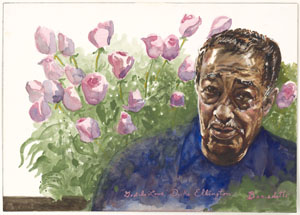
Few writers have depicted Ellington and his world as vividly as Richard 0. Boyer in "The Hot Bach," a three-part profile published in The New Yorker during the summer of 1944. ]Source: Richard O Boyer, "The Hot Bach-1," The New Yorker (24 June 1944), 30-34, 37-36,40,42, 44; "The Hot Bach-2," The New Yorker (1 July 1944), 26-32. 34; "The Hot Bach-3," The New Yorker (8 July 1944), 26-31]. [The painting of Duke is by the vocalist Tony Bennett.]


Boyer not only interviewed Ellington extensively but traveled with the orchestra, observed rehearsals and performances, spoke with musicians, and jotted down overheard conversations. (In the text Boyer refers to himself as the "Boswellian friend of Duke's" and "friend with a historical turn of mind.") The result is a richly textured, candid portrait of Ellington offstage, out of the public eye.


Boyer deftly captures the group spirit of Ellington's musicians on the road, showing their extraordinary resilience in the face of monotony, physical discomfort, and racial discrimination. He highlights the important supporting roles played by Ellington's road manager Jack Boyd, his valet Richard Bowden Jones ("Jonesy"), and especially his writing partner Billy Strayhorn. Boyer's expert touch with description and dialogue brings to life scenes rarely observed by outsiders, such as activities before and after a typical dance job, and the collective working-out of a new piece in the middle of the night,


In this "jumpy atmosphere," as Boyer calls it, Ellington forms the calm center-patiently enduring a myriad of distractions, steadily making art out of chaos.


An abridged version of the article was included in Peter Gammond's Duke Ellington: His Life and Music (1958). Following is the complete text.


Remember, as you read this that it was written from the perspective of a racial context in 1944 America and does not reflect any of today’s sensibilities on the subject of race.


“There are times when Duke Ellington exudes such calm contentment that a colleague, under the influence of the benign radiation, once murmured drowsily, "Duke makes me sleepy, like rain on the roof." His nerves and laughter are so loose and easy that members of his jazz band believe that they got that way because of his physical makeup rather than because of the quality of his spirit. "His pulse is so low he can't get excited," they explain. "His heart beat slower than an ordinary man's." Only something in the flow of the blood, they are sure, could explain a calm that has survived twenty-three years in the band business — years in which Duke and his seventeen-piece band have again and again clattered on tour from one end of the country to the other. Duke believes that his calm is an acquired characteristic, attained through practice, but whether acquired or inborn, it is his monumental placidity, which is only occasionally shattered, that enables Duke to compose much of his music in an atmosphere of strident confusion. 


Most composers, alone with their souls and their grand pianos, regard composition as a private activity. Often, when Duke is working out the details of a composition or an arrangement, the sixteen other members of his band not only are present but may even participate, and the occasion sometimes sounds like a political convention, sometimes like a zoo at feeding time. Ordinarily, Duke completes the melody and the basic arrangement of a composition before he tries it out on the band at a rehearsal; then, as he polishes, or "sets," the arrangement, he is likely to let the men in the band make suggestions in a creative free-for-all that has no counterpart anywhere in the world of jazz or classical music. Perhaps a musician will get up and say, "No, Duke! It just can't be that way!," and demonstrate on his instrument his conception of the phrase or bar under consideration. Often, too, this idea may outrage a colleague, who replies on his instrument with his conception, and the two players argue back and forth not with words but with blasts from trumpet or trombone. Duke, whom European music critics have called the American Bach, will resolve the debate by sitting down at his piano, perhaps taking something from each suggestion, perhaps modifying and reconciling the ideas of the two men, but always putting the Ellington stamp on the music before passing on to the next part of the work in progress. Duke sometimes quotes Bach. "As Bach says," he may remark, speaking about piano playing, "if you ain't got a left hand, you ain't worth a hoot in hell."


The band rarely works out an entire arrangement collectively, but when it does, the phenomenon is something that makes other musicians marvel. This collective arranging may take place anywhere — in a dance hall in Gary, Indiana, in an empty theatre in Mobile, or in a Broadway night club. It will usually be after a performance, at about three in the morning. Duke, sitting at his piano and facing his band, will play a new melody, perhaps, or possibly just an idea consisting of only eight bars. After playing the eight bars, he may say, "Now this is sad. It's about one guy sitting alone in his room in Harlem. He's waiting for his chick, but she doesn't show. He's got everything fixed for her." Duke sounds intent and absorbed. His tired band begins to sympathize with the waiting man in Harlem. "Two glasses of whiskey are on his little dresser before his bed," Duke says, and again plays the eight bars, which will be full of weird and mournful chords. Then he goes on to eight new bars. "He has one of those blue lights turned on in the gloom of his room," Duke says softly, "and he has a little pot of incense so it will smell nice for the chick." Again he plays the mournful chords, developing his melody. "But she doesn't show," he says, "she doesn't show. The guy just sits there, maybe an hour, hunched over on his bed, all alone." 


The melody is finished and it is time to work out an arrangement for it. Lawrence Brown rises with his trombone and gives out a compact, warm phrase. Duke shakes his head. "Lawrence, I want something like the treatment you gave in Awful Sad," he says. [Awful Sad, first recorded in 1928 featuring trumpeter Arthur Whetsol, had also been recorded for Victor in 1933 —when Brown was in the orchestra —but not issued.


Brown amends his suggestion and in turn is amended by Tricky Sam Nanton, also a trombone who puts a smear and a wa-wa lament on the phrase suggested by Brown, Juan Tizol, a third trombone, says, "I'd like to see a little ritard on it," Duke may incorporate some variation of one of the suggestions. Then he'll say, "Come on, you guys. Get sincere. Come on down here, Floor Show" - he is addressing Ray Nance — "and talk to me with your trumpet." In a moment or so the air is hideous as trombone and clarinet, saxophone and trumpet clash, their players simultaneously trying variations on the theme, Johnny Hodges suggests a bar on his alto saxophone, serpentine, firm, and ingratiating, and tied closely to Duke's theme. Harry Carney, baritone sax, may say it is too virtuoso for the whole sax section and clean it up a little, making it simpler. "Come on, you guys. Let's play so far," Duke says. As the band plays in unison, the players stimulate one another and new qualities appear; an experienced ear can hear Rex Stewart, trumpet, take an idea from Brown and embellish it a bit and give it his own twist. Duke raises his hand and the band stops playing. 


"On that last part —" he says, "trumpets, put a little more top on it, will ya?" He turns to Junior Raglin, the scowling bass player, and says, "Tie it way down, Junior, tie it way down." Again the play, and now the bray of the trumpets becomes bolder and more sure, the trombones more liquid and clearer, the saxophones mellower, and at the bottom there is the steady beat, beat, beat, beat, four to a bar, of the drums, bass and guitar, and the precise, silvery notes of Ellington on the piano, all of it growing, developing, fitting closer together, until Duke suddenly halts them by shouting, "Too much trombone!" Juan Tizol, a glum white man and the only player in the band who likes to play sweet, complains, "I think it's too gutbucket for this kind of piece. I'd like it more legit." He plays a smooth, clear curlicue on his valve trombone. "Well, maybe you're right," Duke says, "but I still think that when Sam gets into that plunger part, he should give it some smear." 


Again the band begins at the beginning, and as the boys play, Duke calls out directions. "Like old Dusty," he may say (Dusty is a long-dead jazz musician), and even as he says it the emphasis and shaping will change. Or he may lean forward and say to one man, "Like you did in The Mooche," or he may shout over to Carney, who doubles on the clarinet, "The clarinet is under Tricky too much!" As the music begins to move along, he shouts, "Get sincere! Give your heart! Let go your soul!" His hands flicker over the keyboard, sometimes coming in close together while he hunches his broad, quivering shoulders, one shoulder twisted higher than the other, an absorbed half-smile upon his face. At a signal from Duke, various players, with the theme now solidly in mind, will get up and take solos. He points at the soloist he wants and raises his right index ringer, and as long as the player doesn't get too far away from the theme, Duke lets him have his way. 


Perhaps two hours have gone by. The sky is getting gray, but the boys have the feel of the piece and can't let it alone. They play on and on, their coats off, their hats on the backs of their heads, some with their shoes off, their stocking feet slapping up and down on the floor, their eyes closed, their feet wide apart and braced when they stand for a solo, rearing back as if they could blast farther and better that way. Now Juan Tizol grabs a piece of paper and a pencil and begins to write down the orchestration, while the band is still playing it. Whenever the band stops for a breather, Duke experiments with rich new chords, perhaps adopts them, perhaps rejects, perhaps works out a piano solo that fits, clear and rippling, into little slots of silence, while the brass and reeds talk back and forth. By the time Tizol has finished getting the orchestration down on paper, it is already out of date. The men begin to play again, and then someone may shout "How about that train?" and there is a rush for a train that will carry the band to another engagement.


Duke enjoys the rhythm of a train as it rolls across the country and on one occasion he even scored it, putting notes on paper as he bounced and swayed along, listening to all the metallic variations of sound. He called the piece that resulted, Daybreak Express. The continental nature of Duke's profession is indicated by his itinerary for 1942. He began on January 1st in Kansas City, Missouri, and then, playing one-night stands and engagements that lasted as long as six weeks, rattled along to Junction City, Kansas; Omaha, Nebraska; Madison, Wisconsin; Waukegan, Illinois; Elkhart, Indiana; Chicago; Detroit; Canton, Ohio; Pittsburgh; Uniontown, Pennsylvania; Boston; Lawrence, Massachusetts; Portland, Maine; Worcester, Massachusetts; Boston, Toronto, Buffalo, Washington, Baltimore, Philadelphia, Pittsburgh; Moline, Illinois; South Gate, San Diego, San Francisco, Stockton, and Sacramento, all in California; Portland, Oregon; Vancouver; Seattle and Tacoma; Salem in Oregon; and then back to King City, Vallejo, San Jose, Los Angeles, and Ocean Park, in California; Salt Lake City, Denver, Chicago, Milwaukee, Chicago, Cleveland, Dayton, Fort Wayne, Chicago, St. Louis; Moberly and Kansas City, in Missouri; Topeka, Kansas; back once more to California to play at Long Beach, Los Angeles, Hollywood, Sacramento, Oakland, and San Jose; then to Salt Lake City, St. Louis, Omaha; Storm Lake and Fort Dodge, in Iowa; St. Paul, Madison, Chicago, Toledo, Cincinnati, Youngstown; Toronto and Kitchener, in Canada; down to Buffalo, Fort Dix, Philadelphia, Baltimore, Washington, Hartford, Bridgeport, Harnsburg, Columbus, and, on the last day of 1942, to Detroit.


Duke likes trains because, as he says, "Folks can't rush you until you get off." He likes them, too, because dining-car waiters know about his love for food and he is apt to get very special attention. His journeys are punctuated by people who shove bits of paper at him for his autograph. Not long ago, traveling between Cleveland and Pittsburgh on a day coach, a German refugee with sad, weak blue eyes who had once played chamber music in Stuttgart sat down next to Duke and asked him for his autograph, and the two men got into conversation. A friend of Duke's with a historical turn of mind happened to be along on the trip and took notes on what the two men said. The refugee knew little about jazz, but he did know that Stokowski, Stravinsky, and Milhaud had described Ellington as one of the greatest modern composers.


"You can't write music right," Duke said, explaining his methods of composition, "unless you know how the man that'll play it plays poker."


"Absolut phantastisch!" the German murmured. Duke seemed startled, then laughed.


"Vot a varm, simple laugh you haf," the refugee said enviously.


Duke laughed again. "No, what I mean is," he said, "you've got to write with certain men in mind. You write just for their abilities and natural tendencies and give them places where they do their best — certain entrances and exits and background stuff. You got to know each man to know what he'll react well to. One guy likes very simple ornamentation; another guy likes ornamentation better than the theme because it gives him a feeling of being a second mind. Every musician has his favorite licks and you gotta write to them."


"His own licks? Licks?" asked the refugee.


"His own favorite figures," Duke said. He looked out the window. "I sure hated to leave that chick," he said affably. "I'd just met her. She was all wrapped up for me. All wrapped up in cellophane."


"Please?" asked the German.


"I know what sounds well on a trombone and I know what sounds well on a trumpet and they are not the same," Duke said. "I know what Tricky Sam can play on a trombone and I know what Lawrence Brown can play on trombone and they are not the same, either."


"Don't you ever write just for inspiration?"


"I write for my band," Duke said. "For instance, I might think of a wonderful thing for an oboe, but I ain't got no oboe and it doesn't interest me. My band is my instrument. My band is my instrument even more than the piano. Tell you about me and music — I'm something like a farmer."


"A farmer that grows things?"


"A farmer that grows things. He plants his seed and I plant mine. He has to wait until spring to see his come up, but I can see mine right after I plant it, That night. I don't have to wait. That's the payoff for me."


"Mr, Ellington, how do you get those lovely melodic passages?"


"If you want to do a mellow cluster with a mixture of trombones and saxes, it will work very well," Duke said. "A real derby, not an aluminum one, will give you a big, round, hollow effect."


"A real derby?"


"A real derby."


"Not an aluminum derby?"


"Not an aluminum derby."


"phantastisch,” the exile said.


Duke laughed. He called to Sonny Greer, his drummer, sitting up ahead, "I sure hated to miss that chick," he said. "She was all wrapped up in cellophane."


The refugee's pale blue eyes stared steadily at Duke. "When inspiration comes, Mr. Ellington," he said finally, "you write, naturlich?"

"It's mostly all written down, because it saves time," Duke said. He seemed eager to get away, but the coach was crowded and there wasn't another place to sit. "It's written down if it's only a basis for a change. There's no set system. Most times I write it and arrange it. Sometimes I write it and the band and I collaborate on the arrangement. Sometimes Billy Strayhorn, my staff arranger, does the arrangement. When we're all working together, a guy may have an idea and he plays it on his horn. Another guy may add to it and make something out of it. Someone may play a riff and ask, 'How do you like this?' The trumpets may try something together and say, 'Listen to this.' There may be a difference of opinion on what kind of mute to use. Someone may advocate extending a note or cutting it off. The sax section may want to put an additional smear on it."


"Schmear?"


"Smear," Duke said.


Duke tried a few times to end the discussion, but the exile's questioning kept bringing him back to his exposition, and he was still explaining when the train pulled into Pittsburgh, where he and his band were to give a concert at Carnegie Hall. The hall is a resplendent place. It has tall, gray marble columns with gilt Corinthian capitals, and on its walls are inscribed the names of Schubert, Brahms, Bach, Beethoven, Mozart, and Chopin. As the band trooped through the building to the dressing rooms, Duke glanced at the list of his predecessors and remarked, "Boys, we're in fast company."


When the band is doing five shows a day in a movie house, Duke can take a hot, stuffy dressing room, often windowless and small, and give it the pleasant atmosphere of a neighborhood saloon. As soon as a show is over, Jonesy, his valet, who always wears a hat on the back of his head and a leather windbreaker, helps him undress and holds his red bathrobe up while he slips into it. Then Duke will lie down on a cot, a towel over his eyes to shield them from the light. Jonesy goes out to get him beer and sandwiches, and by the time he returns Duke is usually up playing a game of cassino with someone in his band. Other members of the band will keep walking in and out. "My honor is here. My honor is here,” Duke mumbles, as he examines his cards, in a voice that has the lulling drone of an electric fan. Sometimes he varies this refrain with the more firmly voiced observation, "I will now do something to straighten this out." 


He keeps the door of his dressing room closed, but even so there is always the presence of the mechanical voice in the movie, faint yet powerful, and, now and then, the brash canned music of the newsreel. Sometimes, too, down the corridor, the deep voice of Estrelita, the South American Bombshell, who is part of an act that occasionally travels with Duke, may be heard as she sings, "Doan be so hasty. Yo' kisses so tasty!" Jimmy Hamilton's clarinet is often heard as he walks up and down outside the room like a bagpiper, practicing Grieg or some other classical composer. Someone in Duke's dressing room will open the door and say, "Jimmy, can't you get those squeaky mice outta that reed? They musta built a nest in it." Jimmy, a solemn youth, will not reply. Duke, his big face relaxed, will say sleepily,"I think I'll rest my spine awhile," and lie down again on his cot. 


Billy Strayhorn will be working quietly over the score of some new tune in a corner. After a time a masseur will come in, and perhaps a newspaper reporter. Duke, his voice shaking as the masseur kneads him, will be interviewed as he lies naked on his cot. Recently a young reporter asked him what he had in mind when he wrote "Mood Indigo." "It's just a little story about a little girl and a little boy," Duke said. "They're about eight and the little girl loves the little boy. They never speak of it, of course, but she just likes the way he wears his hat. Every day he comes by her house at a certain time and she sits in her window and waits." Duke's voice dropped solemnly. The masseur, sensing the climax, eased up, and Duke said evenly, "Then one day he doesn't come." There was silence until Duke added, " 'Mood Indigo' just tells how she feels."


When the reporter left, Duke said, "Jesus, did you see the tears come into his eyes when I spoke about 'Mood Indigo'? That's what I like. Great big ole tears. That's why I liked Whetsol." Whetsol is a trumpet player now dead. "When he played the funeral march in 'Black and Tan Fantasy,' I used to see great, big ole tears running down people's faces." Duke chuckled. In such moods as this, Duke and the older members of his band are almost sure to talk about the musicians who played with them when the band began. Their conversation has something of the nostalgic, elegiac atmosphere that surrounds a group of old Yale grads talking about football players of other years. "Bubber Miley!" Duke exclaimed on one of these occasions. (Bubber, too, is dead.) "Bubber used to say, 'If it ain't got swing, it ain't worth playin'; if it ain't got gutbucket, it ain't worth doin.'' Freddie Guy, guitarist, was present and, as Duke went on to speak of great trombone players and great trumpet players, with never a word for the rhythm section, Freddie at last mumbled regretfully, "Duke sure love his brass! Duke sure love his brass!"


The world of jazz is sentimental. When Cootie Williams, another great trumpet player, left the Ellington band three and a half years ago to go with another band [Benny Goodman sextet], a composer who had nothing to do with either band [Raymond Scott] wrote a sad piece called "When Cootie Left the Duke." Duke still finds it hard to talk of Cootie's departure. Both Bubber and Cootie were known for their "growl" effect. Duke occasionally says, "Cootie gave the growl more beauty than anyone, more melodic magnificence. He had a sort of majestic folk quality. His open horn was wonderful — wonderful loud and wonderful soft. He had a hell of a style." Such adoring reminiscence sometimes bothers the newer members of the band. Juan Tizol once asked gloomily, at one of the dressing-room sessions, "What do you see in my playing anyway, Duke? I don't call myself a hot man anyway." There was a hurt tone in his voice. "Not for me. I take all my solos straight. Sweet style."


"Well, Juan," Duke said gently, "there are times when a writer wants to hear something exactly as it's written. You want to hear it clean, not with smears and slides on it. Besides, your style is a good contrast to the more physical style of Johnny Hodges."


"I play with a legit tone," Juan said, as though accusing himself of something rather unforgivable. "Duke, what is there about my trombone tone?"

"You get an entirely different quality," Duke said. "It's real accurate. So many look on the valve trombone as an auxiliary instrument, and it's your main instrument. That's a hell of an obligation. You got to live up to those valves and you do, Juan, you do. You know how many slide trombonists use the slide so they can fake, and when you object they say, 'Whatta ya think this has got on it —valves?'"


"If there was any room in legit, I'd still go back to legit," Tizol said. He seemed inconsolable. "I like legit because I could feature myself better in legit than in a jazz band. I don't feel the pop tunes, but I feel 'La Gioconda' and 'La Boheme.' I like pure romantic flavor. I can feel that better."


Duke said to the room at large, "Juan's got inhibitions. He won't ad-lib. Once, on the 'Twelfth Street Rag,' he did some ad-libbing. Only time he ever did."


Jack Boyd, Ellington's road manager, a small, brisk white man from Texas, knocked on the door and said, "Five is in, folks" — five minutes before the band was due onstage for another performance. Jonesy came in to dress Duke, and Tizol rose to go. "You're a hell of a good man, Tizol," Duke said, making a final effort to comfort his trombone. "We need a man who plays according to Hoyle. A guy who does only one thing but does it for sure, that's it."


"I'm only legit," Tizol said.


There are times when Duke's cheery calm is shaken and when his dressing room is more like a prison cell than a friendly saloon. A few months ago the

band arrived in St. Louis to play at the Fox Theatre. As the train pulled into the Union Station, Ellington's two white employees — Tizol and Boyd — immediately got a taxi and went to one of the town's good hotels. Duke and the band members got taxis only after an hour and considerable begging, since most of the drivers didn't want Negroes as passengers, and then they were taken to a rickety hotel in the Negro section. The next day, when the colored members of the band went out for lunch after the first performance, they couldn't find a restaurant in the neighborhood that would serve them. They didn't have time to get over to the segregated district before they were due on stage again. They returned to the theatre and arranged for a white man to go out to buy sandwiches at a drugstore. When the proprietor of the store. making inquiry, found that the sandwiches were for a Negro band, he refused to fill the order. A few minutes later the men went back to work, hungry, the curtain rose, and from the white audience out front there came a burst of applause. The crowd cheered, whistled, and stamped its feet. As the curtain. was going up, the dejection on the faces of the players vanished, and, as swiftly as an electric light is switched on, it was replaced by a look of joy. The music blared, Duke smiled, threw back his head, and shouted "Ah-h-h!," Rex Stewart took off on a solo that was greeted with fervor, and as he bowed, the musician next to him muttered out of the side of his mouth, "Bend, you hungry fathead! Bend!" Everything was flash and brightness until the curtain came down. Then the joy was switched off and there was just a group of angry, hungry Negroes arguing their right to food,


"Can't we eat in our own country?" Rex Stewart said.


"And my son is in the Army!" another man said.


"Are we prisoners or something?" Harry Carney asked.


The band milled around in the gloom backstage. "Gee," said Stewart, "I'd like to go to a valley hemmed in by mountains, just me myself. That would be Utopia." The manager of the theatre was called, and admitted that if the band was to work it should be allowed to eat. He arranged for food to be sent in. A few minutes later, Boyd was in a saloon overlooking the stage door when a man in the band came out and got into a taxi.


"Did you see that?" asked a woman on a stool at the bar.


"See what?" Boyd said.


"See that nigra get in that cab?"


"Well, he's a pretty nice fellow. He's a member of the Ellington band. Some people think he's a very great artist."


"A very great artist? Well, I don't know what you think, but I always say that the worst white man is better than the best nigra."


Duke tries to forget things like that, and if he doesn't quite succeed, he pretends he does. An hour after the show, Duke was introduced to a policeman who said enthusiastically, "If you'd been a white man, Duke, you'd have been a great musician." Duke's smile was wide and steady as he answered quietly, "I guess things would have been different if I'd been a white man."


Once Duke is aboard a train, soothed by the ministrations of admiring porters and dining-car waiters, he likes to relax and talk about his music. He is somewhat given to making set speeches and often, when he is asked if he can recall an incident, he remembers what he is in the habit of saying about it rather than the event itself. He enjoys telling how he happened to write any of his compositions. "In my writing," he said not long ago on a train, in the presence of his historian friend, "there's always a mental picture. That's the way I was raised up in music. In the old days, when a guy made a lick, he'd say what it reminded him of. He'd make the lick and say, 'It sounds like my old man falling downstairs' or 'It sounds like a crazy guy doing this or that.' I remember ole Bubber Miley taking a lick and saying, That reminds me of Miss Jones singin' in church.' That's the way I was raised up in music. I always have a mental picture."


He looked out the window at a drab village through which the train was speeding. A woman stood on a porch, holding a tablecloth which she seemed about to flourish. Before she completed her motion, she was out of sight. "I'd like to write something about that," Duke said. "You know, people moving in a train, other people standing still, and you see them for just an instant and then you rush on forever. Sometimes you look right into their goddam eyes. Seems for a minute like you know them. Then they're gone." He kept staring out the window. After a while he pointed at a tree and said, "Looks like a band leader." Again he was moodily silent. Then he suddenly said, Take 'Eerie Moan [recorded 1933], I wrote that in 1930, when I was at the Cotton Club. It's the voice of New York City. You're lying in bed all by yourself. The window is open. It's summer. If there was someone in bed with you, you'd be contented. But you're alone and it's very late and you listen and listen and you hear something out there that comes from millions of people sleeping, from manhole covers that give a double click as a taxi shoots over them, from tugboats far away when they whistle hoarse. You really don't hear anything single, just a kind of general breathing. You feel very alone. You moan and it seems like that's the sound you're hearing from all the city outside in the night. Only place you can hear it is New York City."


Boyd lurched down the aisle. Duke caught him by the arm. "What time have we got to catch the train tomorrow?" Duke asked. "Seven in the morning," Boyd said cheerfully. "God damn!" said Duke. "You can't sleep after the birds wake up, so you don't want anyone else to! You're not normal. You can't sleep after sunrise." Duke's voice was bitter. "You change that train or we won't get any sleep!" Boyd continued down the aisle, muttering to himself, and Duke mumbled, "He can't sleep after sunrise and he doesn't want anyone else to,"


Two young soldiers came up to ask for his autograph. After Duke had given it to them, they hung around to talk. "My favorite piece," one of the soldiers said, "is 'In a Sentimental Mood.'"


"It was one of those spontaneous things," Duke said. "It was after a dance at Durham, North Carolina, and they gave me a private party. Something was wrong with it. Two girls weren't speaking to each other. One girl had cut in on the other girl's guy and the other girl kept saying, 'Of all the people in the world! That she should take my man!' I was sitting at the piano, one girl on each side, and I'm trying to patch 'em up, see? And I said, 'Let's do a song' and that was the outcome, and when I finished they kissed and made up." Other passengers had become aware that Duke was talking about his music and a little group crowded around, its members occasionally clutching at each other and at the seats to steady themselves.


"How about 'Clarinet Lament'?" someone asked.


"It was just something for Barney to play," Duke said. Barney is Barney Bigard, a famous clarinettist who used to be with the band. "We sort of worked it out together. You sit down and try this and that and finally you run upon something and write it out."


"How about 'Awful Sad'?"


"It's a beautiful thing," Duke said. "Very little to be said beyond the title. After I wrote it I said, 'What'll I call it?,' and someone said, 'It's awful sad. I fingered it out on the piano. It was late at night. It had a beautiful part for Whetsol, a beautiful, tender part. It gives me a chill when I hear it."


Someone asked him about "Solitude" and he said, "I wrote it in Chicago in twenty minutes while waiting for a recording date. The other band, the one ahead of us, was late coming out and I wrote it while holding a sheet of music paper against a glass wall. When we went in, it was the first thing we made. The sound engineer was half crying. It filled everybody up. To make people cry, that's music at its highest. My songs had a tendency in those days to be laments. There was always that melancholy in them. You look at the same melancholy again and again from a different perspective."


Duke seemed to feel that the conversation had taken too somber a turn and he began speaking of his appetite, documenting his claim that it is national, even international, in scope. "I have special places marked for special dishes," he said. "In Taunton, Massachusetts, you can get the best chicken stew in the United States. For chow mein with pigeon's blood, I go to Johnny Cann's Cathay House in San Francisco. I get my crab cakes at Bolton's — that's in San Francisco, too. I know a place in Chicago where you get the best barbecued ribs west of Cleveland and the best shrimp Creole outside New Orleans. There's a wonderful place in Memphis, too, for barbecued ribs. I get my Chinook salmon in Portland, Oregon. In Toronto I get duck orange, and the best fried chicken in the world is in Louisville, Kentucky. I get myself a half-dozen chickens and a gallon jar of potato salad, so I can feed the seagulls. You know, the guys who reach over your shoulder. There's a place in Chicago, the Southway Hotel, that's got the best cinnamon rolls and the best filet mignon in the world. Then there's Ivy Anderson's chicken shack in Los Angeles, where they have hot biscuits with honey and very fine chicken-liver omelets. In New Orleans there's gumbo file. I like it so well that I always take a pail of it out with me when I leave. In New York I send over to the Turf Restaurant at Forty-ninth and Broadway a couple of times a week to get their broiled lamb chops. I guess I'm a little freakish with lamb chops. I prefer to eat them in the dressing room, where I have plenty of room and can really let myself go. In Washington, at Harrison's, they have devilled crab and Virginia ham. They're terrific things. On the Ile-de-France, when we went to Europe, they had the best crepes Suzette in the world and it took a dozen at a time to satisfy me. The Cafe Royal, in the Hague, has the best hors d'oeuvres in the world — eighty-five different kinds, and it takes a long time to eat some of each. There's a place on West Forty-ninth Street in New York that has wonderful curried food and wonderful chutney. There's a place in Paris that has the best octopus soup. And oh, my, the smorgasbord in Sweden! At Old Orchard Beach, Maine, I got the reputation of eating more hot dogs than any man in America. A Mrs. Wagner there makes a toasted bun that's the best of its kind in America. She has a toasted bun, then a slice of onion, then a hamburger, then a tomato, then melted cheese, then another hamburger, then a slice of onion, more cheese, more tomato, and then the other side of the bun. Her hot dogs have two dogs to a bun. I ate thirty-two one night. She has very fine baked beans. When I eat with Mrs. Wagner, I begin with ham and eggs for an appetizer, then the baked beans, then fried chicken, then a steak - her steaks are two inches thick — and then a dessert of applesauce, ice cream, chocolate cake, and custard, mixed with rich, yellow country cream. I like veal with an egg on it. Monseigneur's, in London, has very fine mutton. Durgin-Park's, in Boston, has very fine roast beef. I get the best baked ham, cabbage, and cornbread at a little place near Biloxi. St. Petersburg, Florida, has the best fried fish. It's just a little shack, but they can sure fry fish. I really hurt myself when I go there."


Duke's audience seemed awed at his recital, and he looked rather impressed

himself. "Gee," he said admiringly, "I really sent myself on that, didn't I?" Some of the passengers wanted to ask more questions, but Duke had worked himself up to the point of having to go to the diner. There, between bites, he resumed the discussion of his music with one of his new acquaintances, who had gone along with him. "Take 'Harlem Air Shaft,"' Duke said. "So much goes on in a Harlem air shaft. You get the full essence of Harlem in an air shaft. You hear fights, you smell dinner, you hear people making love. You hear intimate gossip floating down. You hear the radio. An air shaft is one great big loudspeaker. You see your neighbors' laundry. You hear the janitor's dogs. The man upstairs' aerial falls down and breaks your window. You smell coffee. A wonderful thing, that smell. An air shaft has got every contrast. One guy is cooking dried fish and rice and another guy's got a great big turkey. Guy-with-fish's wife is a terrific cooker but the guy's wife with the turkey is doing a sad job." Duke laughed. "You hear people praying, fighting, snoring. Jitterbugs are jumping up and down always over you, never below you. That's a funny thing about jitterbugs. They're always above you. I tried to put all that in 'Harlem Air Shaft.'"


It was dark outside now, and Duke looked out at the night. When he saw that the moon was up, he said, "Bomber's moon. I'm going to write a song about that." Duke's companion asked him about "Saturday Night Function." "That's from the old rent-party days," he said. "When I was young, I traveled around with a character named Lippy and with James P. Johnson, one of the world's great piano players. He really can play plenty of piano. I can still hear Lippy coming into a tenement at four in the morning and shouting, 'It's Lippy, and James P. is with me!' We'd be in bed and hear that ole click, clack, click of those triple locks and when they'd open up, Lippy would shout, 'Wake up everybody and dust off that piano so James P. can play!' Everybody would crowd around and James P. would milk 'em around, kind of teasing 'em when they asked for a piece, saying 'Is this what you mean?' and 'Or is this the number?' and then finally bang into it. That's real dramatic timing."


Duke lit a cigarette. "That's the way the whole world should be," he said.


"James P. was an artist and the people wanted to hear him at any hour. Now everybody wants to know your pedigree. I think I'll build a city like that. A guy has a new painting or a poem that he wants people to enjoy at four in the morning, and it's all right. I’ll have nothing but bungalows, so we can always knock on windows and walk in and sit down and start playing on a man's piano without offending anybody." He was silent for a moment and then said, "I like that city idea." He thought for a while. "I really like that city idea. I think I'll call it Peaceful Haven."


To be continued and concluded in Part 3.