© Copyright ® Steven Cerra, copyright protected; all rights reserved
“When I made my first visit to New Orleans, many years ago. The first thing I did was rent a car and drive to Buddy Bolden’s home. That’s how much I revere this building and what it represents. This was nothing short of a jazz pilgrimage and the Bolden residence on First Street was my destination.
I learned back when I was a teenager that Buddy Bolden was honored as the first jazz musician. But no recordings have survived (or perhaps were even made), so how much faith could I put in these legends? But the more I studied the early history of the music, the more convinced I was of Bolden’s central role in the music’s origins.
He was the pioneer who put all the ingredients together. He was the visionary who grasped the potential for combining (1) the syncopated rhythms of ragtime, (2) the bent notes of the blues (almost unknown in other major US cities back then), (3) the impassioned inflections of African-American church music, and (4) the instruments of brass bands and other traditional New Orleans ensembles. Even today, jazz continues to rely heavily on all four of those things, and Bolden was the mastermind who showed how they could fit together in a world-changing sound.”
- Ted Gioia, “The Scandalous Destruction of Jazz Landmarks in New Orleans,” Substack, 11.11.2022.
“A principal aspect of the first social and geographical settings of jazz, not yet fully documented, is the use of syncopated music at Negro funerals. Most historians, like many novelists who have been concerned with the colorful sociological roots of the music, have placed this custom almost exclusively in New Orleans. It would be more accurate to estimate that rhythmic funerals were taking place, some years before the turn of the century, all over the South, and indeed, wherever there was a substantial Negro population.”
- Leonard Feather, The Book of Jazz
“As a former colony, New Orleans followed the French fashion in military bands closely and became justly famous for them. …. What is the explanation for the pre-eminence and frequency of Negro bands in New Orleans? In addition to the close ties with France and the general popularity of brass bands, New Orleans had a special kind of organization to give them employment and an unusual tradition that welcomed their presence on a wide range of occasions. This combination helped to produce the first bands that began to swing…..
The special kind of organization was the secret society….
These secret societies, far more numerous than similar white organizations, laid the economic foundation for the Negro brass bands by offering intermittent but frequent employment for musicians. ….
More particularly, there was a tradition that led to the employment of brass bands at Negro funerals. With the mild exception of the Irish wake, there is nothing in the United States like a New Orleans funeral.”
- Marshall Stearns, The Story of Jazz
The last sentence in the above quotation from Marshall Stearns takes the more common view that the New Orleans Jazz Funeral with its employ of the city’s brass bands was unique to the Crescent City.
Leonard Feather’s assertion in the quotation just above it and throughout the following article is that syncopated brass band funeral processions were also happening in other cities, as well as, New Orleans and was one of the early ingredients in the development of Jazz elsewhere in the country at the same time that it was evolving in NOLA [today’s more common nickname for New Orleans].
In this centenary decade, the editorial staff at JazzProfiles has been attempting to look back and highlight some of the developments and individuals that helped to formalize Jazz, both artistically and commercially, beginning in the 1920s or, in some cases, even earlier in the 20th century.
Of the four ingredients listed in the above quotation by Ted Gioia, author of The History of Jazz and numerous other books on the subject, I think that the one that often gets overlooked in discussions about the evolution of this music is #4 “the instruments of brass bands and other traditional New Orleans ensembles.”
There is a bit of irony in this oversight because if you attend any American high school or college football game on an Autumn Friday or Saturday night, that brass band marching to the syncopated rhythms laid down by the drum corps is still very much in full view.
Indeed, if you are not certain of what syncopated rhythm means, just listen to the cadences the band’s drummers are laying down as the band marches in formation onto and off the field.
They have a two-beat feeling to them because they are based on the two feet - left-right, left-right - steps of the band members.
Brass bands in full flight generate lots of energy and excitement which is also a characteristic of Jazz. Is it no wonder, then, that Jazz appealed to the younger set of the “Roaring Twenties” as part of their efforts to dispel the misery and gloom of the preceding World War I years?
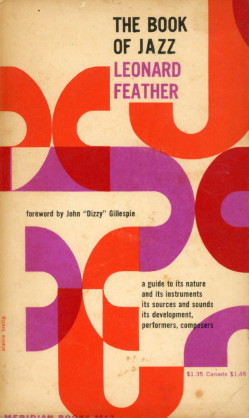
Brass bands are rarely talked about, let alone recognized as an important element in the formative years of Jazz, but there is an excellent treatment on the subject in the distinguished critic and author Leonard Feather’s The Book of Jazz [1959] and I thought I’d share it with you.
The chapter heading in Mr. Feather’s book is entitled Big Towns and Brass Bands which implies that New Orleans was but one of the many cities in the USA where Brass Bands played the syncopated ragtime music that would eventually be called Jazz. This is somewhat contrary to the “accepted wisdom” on the subject which views New Orleans as the sole birthplace of Jazz. As you will note from interviews conducted by Mr. Feather, many musicians feel that - “the New Orleans legend presents a one-sided story.”
Written in 1959 when most of the originators of the music were still alive and many were still performing, Mr. Feather’s interviews can be considered primary sources which sadly, are far and few between in the case of the principals associated with Early Jazz.
“People don't realize," says the trombonist and bandleader Wilbur De Paris, "that in the early days brass band and orchestral playing were very closely related. The musicians I remember from my childhood were mainly brass band men, because there weren't many jobs for strictly orchestra men." To De Paris, "orchestra" in this context refers to the dance band. Born in 1900 in Crawfordsville, Indiana, De Paris, who toured with his musician father from infancy, can recall many of the groups that played in the brass band style, in many parts of the United States, during his childhood. The conventional instrumentation included one or two cornets, a clarinet, a trombone, guitar, bass and drums. Their polyphonic interpretations, according to Louis Armstrong and others who heard them, had some qualities in common with the jazz of the later day.
The Negro bands played at picnics, rode in advertising wagons and frequently marched through the urban streets. White musicians were developing bands along parallel lines. Jack "Papa" Laine, who formed his first band in 1888 and claims to have been one of the first to perform ragtime, led the Reliance Brass Band, which played for parades and carnivals. The most widely publicized of the brass bands were all led by trumpeters or cornetists. The most powerful, both in the strength of his legend and in the reputed clarity and carrying power of his horn, was Charles "Buddy" Bolden, born in 1878 in New Orleans. Bolden, with whom music may have been a sideline (his other activities included the editing of a scandal sheet and the operation of a barber shop) organized what was possibly one of the first real jazz bands around the turn of the century. According to the tangled evidence available, Bolden played traditional themes that combined ragtime with brass band music in the first primitive statements of jazz; beyond any doubt, too, he played the blues, Bolden's fate, as it turned out, was neither fame nor fortune, but dementia praecox. He ran amuck during a parade, was committed to a state hospital and spent twenty-four years there, dying in 1931. Some of Bolden's contemporaries in brass were Freddie Keppard's Olympia Band, the Original Creole Band, and the Eagle Band, with Mutt Carey and Bunk Johnson.
There were many other areas far from New Orleans where this primeval jazz was being performed by brass band musicians. Asked whether he could recall some of them, Wilbur De Paris replied, "I've always felt that though New Orleans was a focal point of the South, most of the large cities in various parts of the country also made their contributions and helped to set styles. For instance, the type of trumpet playing that came to be identified later with Bix Beiderbecke was quite common in the Midwest among Negro musicians. I came from Indiana, and I can name half-a-dozen trumpet players who were playing that style. Charlie Hart, one of the trumpet men in a road show called 'Old Kentucky', was one; another was Frank Clay of Indianapolis, who led a military band as well as a theater pit orchestra. Then there were the Wolfscale Brothers, and Roy Pope, the Hoosier cornetist; and there were clarinetists like King Phillips, who wrote the King Phillips Rag and the Florida Blues. These were a blend of brass band and orchestra men, and they played dances; and they played jazz.
"There was a whole other school that should complement the New Orleans school, and that was the school I came up in. Basically, these men were better, musically and technically, than most of the New Orleans musicians. They got their foundation from amongst the teachers, Italian and German, across the country, throughout the Middle West. They were equivalent to jazz, and this wasn't necessarily the same thing that we know as ragtime. Jazz was growing up in different parts of the country without one part necessarily knowing what the other part was doing —that is, aside from these musicians that I came up with. We knew what was going on in other parts of the country because we traveled a lot, but a lot of people didn't know about New Orleans at all until much later."
A principal aspect of the first social and geographical settings of jazz, not yet fully documented, is the use of syncopated music at Negro funerals. [A recreation of one of these ceremonies, with the band playing solemn music on the way to the graveyard and stepping into a lively march on the way back, was presented as a prologue to the motion picture, Pete Kelly's Blues, released in 1956.] Most historians, like many novelists who have been concerned with the colorful sociological roots of the music, have placed this custom almost exclusively in New Orleans. It would be more accurate to estimate that rhythmic funerals were taking place, some years before the turn of the century, all over the South, and indeed, wherever there was a substantial Negro population.
Eubie Blake, a veteran ragtime pianist and composer, recalls that in the late 1880s and early '90s, when he was a child in Baltimore, funerals of this kind frequently took place. "Joe Blow would die, and maybe he belonged to some society, so they would get the money together and have a band for his funeral. Those fellows couldn't read, but they sure played ragtime on their horns on the way back from the graveyard—tunes like Bunch of Blackberrries. Those trombone slides would be going like crazy. My mother said that nothing but low people followed the parades, and she used to whip me because we played ragtime coming back from the graveyard.
"The bands in Baltimore had all the regular instruments, and they had alto horns, or peckhorns as we used to call them, and euphoniums. Charlie Harris was one of the fine musicians who played in those bands; in fact, he was my teacher, and sometimes when I was a kid and those fellows used to get $2 to go out and play an excursion, they would give me a dollar and I would play second cornet to Charlie.
"There were dozens of fine musicians who played ragtime in the parades and at the funerals. Trumpet players like Pike Davis and Preston Duncan; a musician named Emil Daverage, who played the euphonium. We called the music ragtime, whether it was a piano or a band playing. We never heard the word 'jazz’ until many years later, long after I came to New York."
W. C. Handy, the cornetist and band master later famous as the composer of St. Louis Blues, attests to the growth of jazz-related forms in many southern states during the 1890s. Born in 1873 in Florence, Alabama, he toured as a young man with Mahara's Minstrels, as cornet soloist and musical director. The following conversation took place in 1957 between Mr. Handy and the author:
Mr. Handy, when you were a young man, did you hear anything about the New Orleans musicians that jazz historians are writing about today, such as Bunk Johnson and Buddy Bolden?
No, I didn't hear about them, but I had associations with others; my best trombone player was from there, and I carried New Orleans musicians with me when I had a band in 1896 and '97 all over the United States.
Did the jazz musicians come from New Orleans, then, or from all over the South, or all over the country?
From all over the country. Fewer of them were from New York than any place. You could get them from Philadelphia, but you got your best musicians back in the '80s and '90s from Shreveport, Baton Rouge, Vicksburg, Jackson, Mississippi and Louisiana. Alabama had some, also Florida and Tennessee.
Don't you think that jazz and ragtime and the blues all had something in common and overlapped to some degree?
I think they are separate things in this: ragtime you played as it was written, but in jazz you had improvisation. And ragtime had very little melody — it was mainly rhythm. The blues had a good melodic line. But they did sometimes overlap.
Who were some of the musicians that you associated with Jazz, and where did they come from?
It would depend on what you call jazz.
I would like your interpretation of the word.
Well, I played with a fellow in Bessemer, Alabama, and they called him Lard Can Charlie and he made good jazz out of a lard can. See what I mean? I played with another fellow in Huntsville, Alabama. He played with a long iron pipe and the people would rather dance with him playing that iron pipe than with him playing string bass. So I've played with many novelty musicians. We had an E Flat comet player with Mahara's Minstrels, Elmore Dodd from Nashville, who filed his mouthpiece down so he could make an E Flat cornet sound like a piccolo, and that was a sensation. Even in the minstrel days we played music similar to jazz, but we didn't call it jazz. We called it faking. Just pick up a piece like A Hot Time in the Old Town Tonight and sporting house songs and put any interpretation we would want to put, but we didn't call it jazz — we didn't know anything about that word.
When did you first hear the word "jazz" used?
Not until I went to Memphis, after I had written the Memphis Blues. A book came out called The New Negro—J. A. Rogers wrote an article about me and this new music called jazz and gave me credit for it.
How about the early songs that you documented — did they come from New Orleans?
When I lived in Bessemer, Alabama in 1892 or '93, we used to sing a song, Careless Love, and they claimed that song came from New Orleans. But I moved to Kentucky, along the Ohio River, where I found that the governor's son had been killed over an unhappy love affair and the Negroes made up a song called You See What Careless Love Has Done. So Loveless Love floated down the Ohio River with roustabouts and down the Mississippi to New Orleans. Can you see what I mean? So much of our folk music just drifted on down the river — like Joe Turner. Joe Turner started in Memphis and I kept it alive, but it could have gone on down to New Orleans and been called something else, but the same tune in New Orleans was called Gain' Down the River 'Fore Long.
Do you think anything equivalent to jazz or ragtime was being played up here in the East around the turn of the century?
Well, some of our singers in certain illiterate churches were breeders of what we call jazz today. They put in their music, in their singing, something that instruments do today. So that when a boy got to be able to play clarinet or trumpet, he put into his music the same thing they put into the shout songs— not the spirituals.
Do you think this went on in churches all over America?
I wouldn't say all over America, but wherever slavery was practiced.
The Southwest, too, undoubtedly was a proving ground for the same syncopations and improvisations that had begun to prevail in other regions by the turn of the century. All around Texas, Oklahoma and neighboring states there were parade bands patterned along the traditional ragtime lines: a typical group was one in Oklahoma City that included Jim Bronson on clarinet, Andrew Rushing on trumpet (his son, born in 1903, is the ex-Basie blues singer, Jimmy Rushing), Millidge Winslett on trombone and George Sparks on peckhorn (E Flat horn).
The seldom-discussed role of the East in the creation of jazz is emphatically confirmed by one of Duke Ellington's early piano idols, Willie "The Lion" Smith. Born in 1897 in Goshen, New York, Smith recalls hearing jazz from early childhood and contests the theory that all its developments had drifted up from New Orleans, whose musicians were, he says, unknown to him and his contemporaries during the period up to and including World War I. The following conversation with "The Lion" took place recently in New York;
When and where do you remember hearing the first jazz played?
Well, they always played jazz. We had a famous club in New York called the Clef Club. That was the greatest club in the world.
How far back did that go?
Oh, man! That goes way back before the first World War; I was a member then and am still a member.
Were there any equivalents around here of the Bunk Johnsons and King Olivers of New Orleans?
Yes, we had guys around that could play the hell out of a horn. We had a trumpet player that was with me by the name of Major; later he was with the first Mamie Smith band. He was a pistol. We had another guy that gave everybody a fit in New York; his name was Jack Hatton, He was a cornet playing fool. He did all that growling like Bubber Miley and those guys tried to do later. Of course, that was long before phonograph records. There are musicians around who are 75 to 80 years old who used to be tops. We always had jazz bands; we had them at a place in Brooklyn called Goners. The guy who played piano there was called Kid Griffith and he wore tight pants ... a little, short good-looking guy. They had a jazz band—they had to have jazz bands. This was before the first war. I had a jazz band at LeRoy's before the war, too. It was a 12-piece band, and who do you think was singing there with me—Mamie Smith. Talk about jazz bands—My God! They had better guys playing jazz than a lot of these guys trying to play it, because those guys knew what they were doing.
Did you ever hear about the musicians from New Orleans?
I never heard of the guys—never heard of them. There were only two guys I saw from the West. One was a guy by the name of Johnny Williams, whose wife poisoned him. He was a better cornet player than Louis Armstrong ever thought about being, and anybody in the West will tell you that. He was from out West, but not from New Orleans. The only guy I knew to come from New Orleans was Louis Armstrong and the only time I saw him was when I went out there.
How about this legend about New Orleans' being the birthplace of jazz?
It's the writers. If you don't think I know what I'm talking about, just look in those books these fellows have written, and see guys like Danny Barker and all of them talking about the bands on the Mississippi riverboats. Man, they've got riverboats all over, right here in Haverstraw, New York. Ever since I can remember, there's been jazz played.
The kind of rhythmic qualities that came to be known as jazz were growing up all around the country, then?
That's right. Now you're hitting it. The rhythm — you know I've associated myself with synagogues and Baptist churches all my life and they had the greatest rhythm you ever heard.
How about the blues? Was that always around?
Always the blues, ha! hal
That wasn't always in the South, either?
No, sir. Here's one that'll kill 'em. The blues comes from the brickyards in Haverstraw, New York, where those colored people worked in the brickyards. They sang blues all day. Men older than I will tell you that.
Luckey Roberts, another ragtime pianist numbered among Duke Ellington's first influences, came to New York from Philadelphia in 1898 as a child actor in Uncle Tom's Cabin. Roberts' earliest recollections concern ragtime musicians, particularly pianists, who were active in the East and had converged on New York from at least a dozen states:
"There were some great piano players. There was Dude Finley from Florida, and One Leg Shadow, and One Leg Willie. They played all over the country. And Jack the Bear, whose real name was Jack Wilson; he was around Pennsylvania and Ohio. And Bud Howard out of Detroit—and did you ever hear of Benden Boots? He played fine piano and was out of Baltimore. Then of course Pike Davis and Preston Duncan on trumpets; Pike was one of the best attack men I ever heard. He came from Baltimore in one of the first groups that started reading music."
The "One Leg Shadow" mentioned by Roberts is Walter Gould, possibly the oldest living ragtime pianist. Born in Philadelphia in 1875, he told Rudi Blesh of even earlier performers: "Old Man Sam Moore was ragging the quadrilles and schottisches [both are forms of dancing] before I was born. He was born 'way before the war. He doubled on bass and piano." Now living in Albany, New York, "Shadow" in his eighty-third year is vocal and alert, as stubbornly convinced as most of his Eastern contemporaries that the New Orleans legend presents a one-sided story. "I begged Blesh not to believe all that stuff about everything happening in New Orleans," he said recently. "You know what started everybody believing that? Louis Armstrong and King Oliver coming from there, that's what did it. And yet when there were dozens of great musicians in the East, you couldn't find but two or three good piano players in the whole of New Orleans."
Evidently Gould's plea to Blesh did not go completely unheeded. The latter's first book, Shining Trumpets, placed a heavy accent on New Orleans; his second, four years later (They All Played Ragtime, 1950) receded a little from this position ("Eastern ragtime has as long and honorable an ancestry as the others ... it focused at first in Virginia and the Carolinas and then spread up into Maryland and down the coast into Florida, Georgia and Alabama."). By 1953 Blesh, at a seminar attended by jazz experts and anthropologists, spoke of Mississippi and Eastern Texas origins, of an Eastern Seaboard style that "didn't just start with Ellington and Henderson but came from something else," and added that he was "trying to deal with the assumption that jazz began only in New Orleans. I used to think so; I once wrote along those lines. I don't think so any longer."
Leonard De Paur recalls: "My mother, who was born around 1887, was completely conversant with jazz as it was practiced by nomadic bands such as the Jenkins Orphanage Band from Charleston, South Carolina. I remember when I was a child there these kids used to come up as far north as Trenton and just play on the street corners in the most nondescript uniforms you ever saw — some sort of jacket with brass buttons and pants with stripes. They would just stand around in a circle and the leader was somebody who could dance like hell—he didn't have to have any talent more than the ability to say 1, 2, boom! and then go into a routine of his own which would highlight the performances. But they did move around all over the country and they played the most positive ragtime you have ever heard.
My wife was from Charleston and she said she had known about this orphanage organization as a child there and my mother, when she first saw them, said, 'Oh, my God, there's Jenkins' Orphanage Band! I haven't seen them since I was a little girl.'
"This was strictly low-brow stuff—right-thinking people who went to church with starched neck bands on Sunday didn't admit to the existence of this type of thing, but there was an element which really lived on this music; and they played funerals — on the way and back from the graveyard in South Carolina. Even if the graveyard was right around the corner, they would have the band travel all over town advertising this funeral with this band doing what we now call tailgate trombone.
"But the boys who chronicled the development around New Orleans did a much more effective job than the people who were East, and it also seems that the whites were more aware of its value around New Orleans and they really did a job of promoting. There are evidences of this kind of activity that go back to the very time it was supposed to be incubating in New Orleans. I've heard Hall Johnson, in whose choir I used to sing, make the same comment. He came from a very literate family; he's from Georgia, and he knew of the existence of jazz very far back, and he is over seventy now. New Orleans just happened to get the publicity."
Eubie Blake told the author recently: "I'm 74 years old, and when I was a kid, around ten or eleven, this kind of music was already around then. I was playing it myself in Baltimore from 1898, and we called it ragtime." Blake, who came to New York soon after the turn of the century, confirms that jazz, both in its ragtime piano form and in musically similar brass interpretations, was a firmly established entity at that juncture, and that the musicians from New Orleans were practically unknown until about 1915, when Freddie Keppard visited New York with the Original Creole Band.
The picture that emerges from a synthesis of the statements cited in the preceding pages, of the recollections and revelations of ragtime historians and musicians from various centers, and of the constantly documented histories of the New Orleans musicians, can only point to one conclusion. Jazz, which by the first World War was an acknowledged and organized facet of the music scene, and which for many years has been localized and pinpointed by writers to a degree clearly at variance with the facts, is a child neither of Louisiana nor of Pennsylvania, owing no more allegiance to the Confederacy than to the Union. Jazz simply was born in the United States of America.”

