Showing posts with label eugene wright. Show all posts

Tuesday, December 26, 2023

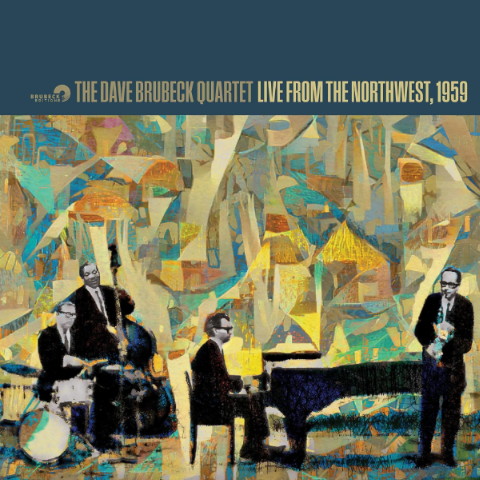
The Dave Brubeck Quartet Live from the Northwest, 1959

 © Copyright ® Steven Cerra, copyright protected; all rights reserved.


“During this period, these musicians spent more time together on stage, on the road, and in the studio than they did at home. Indeed, the group sometimes sounded like one entity playing four instruments, but of course Dave, Paul, Eugene and Joe were strikingly individual players too. Here, they play together like some mythological 4-headed jazz marvel responding to every musical gesture by each member of the group.”

- Chris Brubeck


For as long as I can remember, I got a new Dave Brubeck recording from a family member of a friend as a Christmas gift.


This year was no exception as a family member gifted me a copy of The Dave Brubeck Quartet Live from the Northwest, 1959.


A gentleman by the name of Doug Anderson brought this to the attention of the Brubeck family who issued it as part of its Brubeck Editions label - BECD-2310001.


It was recorded by the, for the times, on location wizard Wally Heider over two days and in two locations: The Multnomah Hotel on April 4, 1959; Clark College on April 5, 1959. Not surprisingly with Wally at the helm, the sound quality is absolutely brilliant.


This was the fourth year that what is often referred to as The Classic Quartet - Dave on piano, Paul Desmond, alto sax, Eugene Wright on bass and Joe Morello on drums - and their time together shows as the group was in fine form - “tight” in musician parlance.


The Brubeck brothers each took a turn at annotating the disc and you can find their comments below.


The group’s rendition of Dave’s Two Part Contention which premiered on the Dave Brubeck Quartet - Jay and Kai at Newport 1956 Columbia Recording [CL 932] is a particularly fine version which is highlighted by Joe’s driving beat using brushes behind Paul’s solo before switching to sticks to accompany Dave on his improvisation and then back to brushes for the “shout chorus.”


DARIUS BRUBECK


“Paul was frequently praised for his inimitable sound while Dave was just as frequently criticized for not sounding like other pianists. Dave's piano playing actually fills two roles: He constantly develops harmonies and textures that resemble large-ensemble arrangements, hence his famous block-chord-style.

On the other hand (literally, his right hand), linear excursions denote a piano soloist emerging from his imaginary big band to take a chorus or converse with Paul. (Listen carefully and you will hear Dave deep in the creative process, singing his solos and verbally inviting Paul into contrapuntal exchanges.) Dave's leadership, balancing dramatic thrust, freedom and formal discipline, is evident on every track.


An obvious example is "Lonesome Road," a meditation on solitude and the allegory of 'Everyman': birth, growth, socialization, busy activity winding down to a funeral march towards the end. The melodic phrase in the ambiguous polytonal coda is 'before you travel on' in the lyric. Breathe out, when it's finished.


Paul's solos on every number are exquisitely logical and free flowing with daring interval leaps and some witty quotes, swinging all the while over the rhythm section's rock-solid grooves. Paul and Dave knew each other so well that they had an intuitive sense of where the other one was going to go.”


DAN BRUBECK


“I had the pleasure of listening to this recording many times while working on it with Chris in the studio. I have never heard Joe Morello sound better; he is definitely in his absolute prime here and at the top of his game. Joe's creativity and chops on brushes and sticks are amazing. He kicks the quartet on "Basin Street Blues" like a big band drummer and displays dazzling up-tempo brushwork at the end of "Lonesome Road." The way Joe and Gene are locked in affirms why they are one of the most swinging rhythm sections ever. This LP is an absolute must for drummers who, like me, have been long-time admirers of the great Joe Morello.”


MATT BRUBECK


“One of the revelations in this recording  is the exuberant quality of Eugene Wright's playing as in the intricately braided lines of "Two-Part Contention." Even within the short forms such as "Saints" and "Basin Street Blues," he constantly improvises, rarely repeating himself. Live from the Northwest serves as a powerful illustration of how technically nimble Eugene was on the bass.


Overall, these excellent live Quartet recordings are warm and provide impressive sonic detail. It is fortuitous that these DBQ concerts were recorded on location by Wally Heider who subsequently went on to become a pioneer of remote recording and to establish legendary studios in San Francisco and Los Angeles, where he recorded many of the top albums of the 1970s.”


CHRIS BRUBECK


This remarkable live recording features four extraordinary musicians in top form, captured with exceptional sonic clarity by the groundbreaking audio engineer Wally Heider. Recorded on April 4,1959, in the popular Multnomah Hotel in Portland, Oregon and on April 5th in the auditorium at nearby Clark College, the Quartet was playing-in some of the repertoire for the upcoming Gone with the Wind [CL 1347] sessions later that month.


The rhythmic innovation and unprecedented success of Time Out, recorded only four months later, eclipsed the Quartet's signature mastery of spontaneous counterpoint that had fascinated their audience in the 50's. but here it is gloriously evident. Some jazz writers even speculated that Dave and Paul had a sort of ESP connection, however their shared musical experience was enough. During this period, these musicians spent more time together on stage, on the road, and in the studio than they did at home. Indeed, the group sometimes sounded like one entity playing four instruments, but of course Dave, Paul, Eugene and Joe were strikingly individual players too. Here, they play together like some mythological 4-headed jazz marvel responding to every musical gesture by each member of the group.”


Friday, January 8, 2021

Smith, Brubeck, Wright and Morello - Not A Law Firm - Part 2

 © Copyright ® Steven Cerra, copyright protected; all rights reserved.


“... Wright's sunny temperament lightened the mood by balancing out Morello's brooding, and the chemistry felt instantly right. Wright ironed out the problems with the role of bassist that Brubeck had identified in his "The DB Quartet—Principals and Aims'' document by turning them to his advantage. "I liked his solid bass lines that grounded that group," Brubeck wrote." "[It was] possible to play other tempos and do polyrhythmic things and he wouldn't budge from this grounded beat. Oftentimes Joe, on drums, would be playing a different counter-rhythm to what Gene was playing. Paul and I might be playing in a different rhythm from either of them. Gene would never budge [and] as it got further and further complicated .. . Joe would say [that] on a wild night the more complicated it got the bigger Gene's eyes got."


"Many bass players would have objected to having to play in such a restricted and demanding way," Brubeck continued— but Wright, a disciple of Walter Page and Jo Jones, quickly developed a working rapport and rhythmic empathy with Morello, and the two men began referring to themselves as the "Section." Brubeck reported Wright's cry of victory whenever he felt a groove lying naturally under his fingers—"I've got 'em, Joe"—and his mantra that staring at Morello's bass drum, rather than following the movement of his hands, helped shore the group up: "If my bass and your bass drum are together, nothing gonna move it."”

Philip Clark, Dave Brubeck A Life in Time


Turning now to the remaining, two recordings the late bassist Eugene Wright [5.29.23 - 12.30.2020] made between 1959 - 1961 featuring clarinetist Bill Smith with pianist Dave Brubeck and drummer Joe Morello, it’s important to keep in mind that the music on them was made at a time when modes [scales] were just beginning to replace chord progressions as the basis of improvisation on many Jazz tunes [and the subsequent recording of them].


The catalyst for this push was Miles Davis’ 1959 groundbreaking recording Kind of Blue. That same year, pianist Dave Brubeck’s “classic” quartet with alto saxophonist Paul Desmond added a second new element to the improvisation mix in the form of unusual or “odd” time signatures.


In the face of these new factors for the improvising soloist to deal with it became even more important to have a Gene Wright bass line anchoring the music as we stated in Part 1 of this piece because “Gene and his rock-solid, stay-at-home bassist “self” made it easier for Dave and Bill to wander all over the place seeking new and different ways to form Jazz expressions.


Dave Brubeck did the honors on the insert notes to The Riddle [Columbia CL 1454] and Bill Smith wrote them for Brubeck a la Mode [[Fantasy F-3301; OJCCD 200-2] and Dave is back again to annotate with the music on Near-Myth With Bill Smith: The Dave Brubeck Quartet [Fantasy F-8063; OJCCD 236-2] with commentary from Bill.


Brubeck a la Mode


“LEST THE COVER and title of this album leave the listener with the impression that this package contains ice cream, let me point out at once that the flavors contained herein are a result of various rarely used musical modes, rather than the more common major and minor. 


The recipes for these various flavors are not necessary for an enjoyment of the final product, but for those who are interested I shall include a brief description of the modes employed. To avoid technical terminology, I have placed after each title the tones of each mode as they would be if one played them only on the white keys of the piano, for example, the E—E after Soliloquy refers to a mode which one may play by starting on E and playing a scale using only white keys up to the E an octave above. It is readily apparent that the unusual half-step between the lowest two tones and the whole step between the upper two make this as different from a major scale as E major is from E minor. Each of the other modes I have used (D-D, F-F, G-G, and A-A) have equally unique characteristics.


As in all my jazz writing, my aim has been here to present simple frameworks for improvisation, with the bulk of the responsibility for success resting on the shoulders of the performing musicians. For this reason, I enjoy very much having the opportunity to work with such sympathetic and sensitive spirits as Brubeck, Morello and Wright. 


For example, the Soliloquy which I mentioned before was presented to Dave as a simple two-measure harmonic scheme with the suggestion of a thematic line. The end result is a spontaneous interpretation by Dave of my original suggestions. Likewise, in Catch as Catch Can, the general formal scheme and the recurring theme are written; the final realization is mostly a result of improvisation. I am, in a way, in the position of a playwright who suggests plots, moods, characters, etc., but leaves most spoken lines to the actors themselves. I have listed below the tunes in the order in which they appear in the album with a brief description of each:


1.  Dorian Dance (D—D) An up-tempo tune in which the piano and clarinet "mirror" each other, that is, each ascending movement in the piano is reflected by a descending motion in the clarinet and vice versa.


2.  Peace, Brother (G—G) Features a sermon by Gene Wright with a few interjections by Dave and myself.


3.  Invention  (D—D)  After Joe sets up a rhythmic pattern, two-part counterpoint between clarinet and piano.


4.  Lydian Line (F—F) A lightly swinging ballad in which the last bars of the bridge change to 3/4 before returning to the original 4/4.


5.  Catch Me If You Can (A—A) Presents a theme in the piano which is imitated four beats later by the clarinet. After an improvised section, the piano again presents the theme which is imitated two beats later by the clarinet. Another improvised section and the theme enters in the clarinet one beat after the piano. In the last section, the clarinet finally catches up with the piano, and they play the theme in unison, but now alternating two measure phrases with the drums.


6.  Frisco Fog (E—E) A slow blues with suggestions of a fog horn and surf courtesy of Wright and Morello.


7.  The Piper (G—G) A 36-measure tune in a folk style.


8.  Soliloquy (E—E) Features Dave's piano with an able assist from Gene.


9.  One for the Kids (C Major) Dedicated to the Brubeck and Smith kids (all nine of them). The basic motive of the tune should be familiar to all.


10.  Ballade (D—D) Features the clarinet in a rondo-type construction.


BILL SMITH


Cover photo was by Bob Willoughby ably assisted by Nick King. The scene was shot at WIL WRIGHTS in Los Angeles and the ice cream and other goodies were furnished by them. All compositions were written by BILL SMITH who is in Paris (France) studying and writing and tasting wines.

JOE MORELLO and EUGENE WRIGHT were the other members of the quartet that recorded this album during the merry months of May and June, 1960.


Near-Myth With Bill Smith: The Dave Brubeck Quartet


“Near-Myth is a further collabora-lion between Bill Smith and Dave Brubeck, coming after Brubeck a la Mode (OJCCD-200-2). All ten compositions here are from Smith's pen and are connected in that notes, phrases, and even parts of the songs are used in other of these mythologi-cally titled pieces. Smith's lucid clarinet is featured along Brubeck's inventive piano, Gene Wright's beatful bass, and the uplift of Joe Morello's drums. Smith and Brubeck had a special musical relationship, quite apart from the Desmond/Brubeck connection. As Brubeck says, "Near-Myth is a typical Smith concoction of humor, whimsy, classical references, and jazz."”

A SESSION with Bill Smith is always an adventure. He leads you down paths not usually traversed by jazz musicians and points out lively possibilities en route. Bill's imagination is contagious. When he flew over from Italy last winter to appear at a concert of Electronic Music (another phase of this many faceted musician) we had but a few hours to rehearse and to record an album together. On the first meeting, he handed us the lead sheets and set forth his plan of a series of tunes based on mythological characters. 


Immediately ideas began to germinate. We walked into the studio the morning of March 20, 1961 and came out that evening with a finished album and a deep sense of satisfaction that we had succeeded in making a "different" jazz LP. In addition to interesting music, which I expect and take for granted in Smith's performances, we had recorded several colorful effects unique to jazz. Nothing in the album was electronically "gimmicked" for special effect. What was performed in the studio was produced by extending the natural capabilities of the instruments. These same strange effects can be reproduced in live concerts anywhere. A recent (July 7, 1961) "Time" article, reporting on a Smith Concert in Palazzo Pio, Rome, stated: "A virtuoso on his instrument. Smith also likes to push his clarinet above top "C" or to engage in a series of strangely manipulated double and triple stopping."


As an example of "Times's" inference, the high, piercing sound of "Pan's Pipes" is produced with the aid of a mute, an age old device long associated with strings and brasses, but so far as I know never before used by a clarinetist: rarely have I heard any clarinetist, except Bill, play more than one note simultaneously on his instrument — unless it was a mistake! On this recording we not only hear two or more notes simultaneously, but also so precisely controlled that they sound within the exact chord.


The piano on "Apollo's Axe" achieves a weird sound through the sympathetic harmonic vibrations of the piano strings, or in one instance by Morello hitting tympani sticks against the strings. Also, I tried deliberately to modify my usual touch in order to get a different effect.


Since we first met when Smith and I were students of Darius Milhaud in 1947, Bill has always evinced a strange, but not necessarily incompatible, mixture of whimsy and intellectualism. (For example, his first recorded composition was "Schizophrenic Scherzo", The Dave Brubeck Octet, Fantasy 3239).


Near Myth is a typical Smith concoction of humor, whimsy, classical reference and jazz, performed by the composer himself on clarinet and my usual rhythm section of Joe Morello (drums) and Gene Wright (bass).

Bill is quoted in Time as saying "Jazz forms are usually stereotyped, like a housing project with houses all alike. We want to change the number of rooms and the size and placement of the windows and doors."


I think on this album Bill Smith opens some new swinging doors.”

DAVE BRUBECK      August 1961


Comments and Observations:


1.  THE UNIHORN (W. O. Smith)

No relation to Lena Home.

2.  BACH AN' ALL . (W. O. Smith)

A combination of good ol' time wine fest with a touch of Bach-ish counterpoint and harmony.

3.  SIREN SONG  . (W. O. Smith)

Inspired by the siren bird-girls who lured sailors to their death with their singing.

4.  PAN'S PIPES  . (W. O. Smith)

When the object of Pan's desires transformed herself into a reed to avoid his advances, he cut several of the reeds and made them into a set of pipes. Perhaps this is the trouble referred to in the second chorus?

5. BY JUPITER (W. O. Smith)

This one started out by Smith but ended up by the great Jupiter himself.

6. BAGGIN' THE DRAGON (W. O. Smith)

After a few ominous roars the boys throw their shafts straight to the mark, leaving the dragon to die after several last opera variety gasps.

7. APOLLO'S AXE (W. O. Smith)

Lacking a magical lyre, Dave plays his usual axe in an unusual manner.

8.  THE SAILOR & THE MERMAID (W. O. Smith)                 

Suggests a romantic escapade in which the sailor, the clarinet, of the  first two choruses, is joined by the mermaid, the piano, playing the Siren Song in the last one.

9.  NEP-TUNE  (W. O. Smith)

Features Gene in the guise of the Sea King.

10. PAN DANCE  (W. O. Smith) 

A sprightly dance by all.


"Perhaps not a Hollywood extravaganza, but—A NEAR MYTH"


To underline the magical aspect of some of the numbers, several new instrumental techniques have been employed. In Pan's Pipes a clarinet mute is used in the first and last choruses and makes it possible to end on an E, four notes above the highest note of the normal clarinet range. In the ending of Siren Song two and more clarinet notes are played simultaneously. Piano harmonics are used in the opening and closing of Apollo's Axe, and in Baggin’ the Dragon timpani sticks are used on the strings of the piano.


To add to the musical unity of the album the opening 4-note figure is utilized in several of the numbers. There are further interrelationships, such as the use of the Siren Song at the conclusion of the Sailor and the Mermaid, the anticipation of the opening three notes of the Siren Song in the ending of Bach an' All, and the derivation of the three-measure drum pattern of Bach an' All from the closing piano, clarinet, and bass figures of Unihorn.

W. O. SMITH Paris, France August 1961


Monday, January 4, 2021

Smith, Brubeck, Wright and Morello - Not A Law Firm - Part 1

 © Copyright ® Steven Cerra, copyright protected; all rights reserved.


I’m often asked what the source is for my blog postings or, how do I decide what to post about?


I never know how to answer that question mainly because the inspirations are so varied. They seem to come from so many sources.


As a case in point, the recent passing of bassist Eugene Wright [5.29.23 - 12.30.2020] brought to mind three recordings that he made between 1959 - 1961 featuring clarinetist Bill Smith with pianist Dave Brubeck and drummer Joe Morello.


Given the myriad recordings Gene was on with the “classic Dave Brubeck Quartet” with Joe and alto saxophonist Paul Desmond, you might ask why these three relatively obscure albums [one of which has never been issued on CD] came to mind?


And my answer would be, “I don’t know, they just did.”


So much for “the method” of  how I prepare features for the blog.


What I DO KNOW is that the music on all three of them is delightful, especially given the contrast of Bill’s magnificent clarinet playing to Paul Desmond’s equally magnificent alto sax playing and I commend all three of them if they are new to you.


As usual, Gene is his rock-solid, stay-at-home bassist “self” which makes it easy for Dave and Bill to wander all over the place seeking new and different ways to form Jazz expressions.


In tandem with Morello [talk about MAGNIFICENT], Gene and Joe made-up one of the most swinging Jazz rhythm sections that no one ever talks about.


The first of these, three recordings was issued on Columbia in 1959 as The Riddle [CL 1454] and it has sadly never been issued as a single CD by Sony.


Notes by DAVE BRUBECK 


"To me, "Hey, Ho, Nobody at Home" is more than the folk song this album uses as its basic theme, but the tune itself is evocative of friend Bill, poking his head into my living room, singing out, "Hey, anybody home!" And you know exactly who it is (who else greets you in such a way?) even though you haven’t seen him for two years since he left for Paris or Rome. He is a friend who stays close even after years of separation. 


In the summer of 1959 our paths crossed again in Lenox, Mass. This time it was I who did the "Hey Ho-ing," because I had heard that Bill was living in the woods somewhere near Tanglewood [Stockbridge and Lenox in the Berkshire hills in western Massachusetts]. One evening we were engulfed in a sudden summer deluge and I thought of the still unlocated Bill, camping somewhere out in the woods and how he might be in need of warm food, fire and friends.  I drove down to the lake campground someone had pointed out to me as a lakeshore site reserved for Tanglewood personnel. I drove the car down to the end of the dirt road and honked my horn, hollering, "Bill Smith" as loudly as I could; and suddenly, floundering out of the wet shrubbery emerged a laughing Bill, yelling, "It's me! It's me! I'm here. Don't go 'way!" 


One glance and I could see that this boy needed dry clothes and a hot meal, so we took him back with us to Music Inn, where my family and I had made our summer headquarters. That same night we began rehearsing this album.


I was intrigued with the idea Bill presented to me—a jazz LP which was basically variations on a single theme, but so skillfully devised that the listener is scarcely aware of the direct relationship. The idea of unity in an LP should intrigue jazzmen, and Bill has given us one solution to the problem by relating all the themes. This is the first riddle of the album: to discover the thematic relationship of each of the tunes. The second riddle is to detect which parts of the music are written, and which are improvised. Almost everyone who has heard this album (including Joe and Gene, our own rhythm section) has had difficulty separating the composed from the improvised sections. I take this as a real compliment, because good jazz composition sounds as though it were really improvised, and good improvisation should sound as though it was as well thought out as a composition. I think the integration of the composed and improvised

parts have been very successful. Although Bill and I do not work together regularly, and, in fact, had not played together for years, a musical rapport from previous years still existed.


I think we were able to understand and feel each other's style because we have known each other for 14 years now, and have worked together from widely divergent circumstances from "joint jobs" to studying with Milhaud, playing in the old Octet, and even teaching at U.C. extension. It was fun to be back together


Over the years I have watched Bill grow in all fields of achievement as a composer. He has developed into one of the finest "legit" clarinetists and was selected as a member of the Fromm Chamber Music Players for his ability to play modern classical works It was in this capacity that he was at Tanglewood. This same high quality of musicianship carries over into his jazz, which I find exciting, original and very personal. As a teacher, composer, arranger, classical instrumentalist and jazz performer he ranks with the best in each field and that is a broad area for any one man to cover adequately, let alone well.


Recording a session with Bill  Smith is not like going to a studio and playing the blues, or standards, or “originals” based on standards. Bill uses 9 bar phrases and odd chord progressions that keep you on your toes. They at first seem unnatural, because they are out of the usual pattern, but soon you begin to see how they fit into the overall design, and they open up new areas for improvisatory explorations. When I first saw chord sequences Bill expected us to improvise on my first reaction was to want to change everything to a sequence more natural to me. Then I recalled how some of my own tunes had been received by other Jazz musicians with the comment

 "Nobody can improvise on those changes.” And a few years later those same tunes like The Duke and In Your Own Sweet Way turned up in the Jazz repertoire of many groups who can now play them as naturally as any other tune. It just takes time to adjust to change. When Bill confronted me with the same problem, I had the same reaction. And that's exactly what it is — REACTION. If jazz is to progress some of us must venture away from the soft cushion.”


Part 2 on Brubeck a la Mode [Fantasy F-3301; OJCCD 200-2] issued in 1960 and Part 3 on Near-Myth/Brubeck-Smith [Fantasy F-8063; OJCCD 236-2] issued in 1961 to follow.


Tuesday, November 24, 2020

Dave Brubeck Quartet Zurich 1964

© -Steven Cerra, copyright protected; all rights reserved.


"You can't understand America without understanding jazz, and you can't understand jazz without understanding Dave Brubeck". (1)


"Most Jazz lovers probably remember the first time this music got into our bones. For me, that happened as a child when my father, whom I barely knew, came to visit me for about a month. And in the few weeks I spent with him one of the things he did was to take me to my first jazz concert to see Dave Brubeck in Honolulu, Hawaii, in 1971. And I did not realize at the time the impact that it had, but the world that that concert opened up for a ten year-old boy was spectacular. And I was hooked." (2)


President Barack Obama


(1) John F. Kennedy Center for the Performing Arts, Washington, December 6, 2009. honoring Dave Brubeck for exhibiting excellence in performing arts on his 89th birthday, and broadcasted nationwide on CBS on December 29,2009


(2) White House, Washington, April 30, 2016, International Jazz Day, remembering his very first impressions as a Jazz fan


Continuing on the subject of favorite recordings, the following feature is on my latest to fall into this category and I’ve had it for less than a day, but in this short period of time, I’ve already played in through three times as I worked on this piece.


“Locked in” might be considered an understatement for a group that played together on a regular basis for 12 years from 1956-1968, but there are few better examples of the David Brubeck Quartet’s cohesive insistency than the music they recorded in performance at Kongresshaus, Zurich, Switzerland on the evening of September 28, 1964.


And what makes this music even more compelling is the outstanding audio quality of this recording.


Brubeck chromatic escapades and rhythmic displacements; Desmond’s dry martini sound and improvised flights of fancy; Morello’s crackling snare drum and exploding bass drum; Gene Wright’s stentorian tone and metronomic bass lines - all have never been so vividly captured on record, even in the studio!


The recording itself is an experience and then there is the music on it. The program for the evening is a combination of originals from the various “impressions of” and “time out” Columbia LPs, exquisite takes on Pennies from Heaven and You Go to My Head and the inevitably climatic Morellian drum solo on Shimawa, all of which come together to form a Jazz concert masterpiece.


Yvan Ischer further documents this special evening in the following liner notes to Dave Brubeck Quartet Zurich 1964 [TCB 0422 Swiss Radio Days Jazz Series No. 42 . You can locate order information about the CD at www.tcbrecords.com


DAVE BRUBECK QUARTET-ZURICH 1964
The Air and the Earth


Two chords with a touch of Debussy-like impressionism, a brief but very delicate and engaging introduction by Dave Brubeck and the concert immediately brings you to a world of magic conjured up by one of the most beautiful sounds in the history of music: Paul Desmond's alto saxophone, which transcends his own song "Audrey" from the very first notes. But before embarking into the music, we may need a little flashback.


At the time of this recording in 1964 in Zurich, the collaborations between Dave and Paul were not new and had known many nights and early mornings wrapped in the haze of Pall Malls and the vapors of Dewar's. the saxophonist's two key trademarks...  The pair had first crossed paths in 1944 in a military musical context where they jammed for quite some time, starting off with "Rosetta". Desmond was taken with the fact that this strange piano player appeared to plav only extremely bizarre but very intriguing chords. And when he went up to Brubeck at the end of the evening saying "Man! You grooved me with those nutty changes!", Dave, whom Paul would later refer to as "the Indian", funnily replied: "White man speaks with forked tongue."


They later met again and interacted around 1949-1950. Then, Paul, who in turn had hired Dave, cut his pay in half one evening in order to gamble in nearby Reno... which naturally somewhat froze Brubeck's feelings towards Desmond. Not long after the disagreement, Paul left California and joined pianist Jack Fina's group for a stint in New York. However, when he heard a radio broadcast featuring the trio of his buddy Brubeck, a premonition appeared like a warning light in his head and he made the decision to contact Dave about forming a quartet. Dave, who had chosen to live a quiet life as a model father, started by forbidding his wife lola to let Paul step foot in the house if he should stop by unannounced... But the day Paul did decide to show up at the front door, Dave was in the middle of hanging out the children's diapers in the backyard, lola let Paul in, Dave expressed annoyance at the intrusion but, bit by bit, he allowed himself to be convinced; this was especially because Paul promised the young parents to babysit whenever they needed a bit of time to themselves... with the result that, until he was 12, young Michael Brubeck, to whom Paul left his saxophone after his death, believed that Paul was his uncle!


And thus one of the most stunning musical collaborations came to be in 1951 with the creation of the Dave Brubeck Quartet! The convergence of two totally opposite personalities and two utterly incompatible lifestyles... and yet... they understood, (almost) at once, just like the song says, that they "could make such beautiful music together". And so Brubeck the professor and Desmond the poet opportunistically decided to set out a deal to reunite their musical paths. It was thus contractually decided that the agreement forbade Brubeck from ever firing Desmond, it ensured Brubeck's status as group leader, and gave Desmond twenty percent of all profits generated from the quartet! The greatest part in all this being that even though the contract had been drafted, Brubeck was the sole signatory, since Desmond never cared to sign it back! Which never prevented Brubeck from being true to his word.


Indeed, the quartet lived an exceptional musical story from 1951 until 1967, enjoying tremendous success. Even after the group officially broke up as the result of different plans by the two men, Bru and Paul met up again for new tours and occasional glorious reunions. That said, a quartet is formed of four individuals and it is important not to belittle the essential contribution of the rhythm section, Gene Wright-Joe Morello. This version of the group certainly had the best balance, the strongest swing and the best interaction of any of the Brubeck quartets! For the Zurich concert, moreover, the sound quality of the recording is so good that the drums and the double bass have rarely before been so present and strikingly transcribed. This lets us discover the nuances and variations in volume in the playing of Joe Morello, the utterly captivating drummer. By the way, when his future leader hoped to hire him, as he was "on vacation" from Marian McPartland's trio, Joe replied quite frankly to Brubeck's proposal: "I heard a few of the pieces you did recently and a metronome could do that... so you know, Dave, I would go with you, but only if you feature me." And Dave, who felt that this new drummer could change the course of his musical career, did more than just keep his promise, since at the beginning of their collaboration, Desmond himself was upset by the fact that Morello was getting so much exposure. And it took a bit of diplomacy and a number of months of Brubeck trying, until the drummer and the alto player finally became not only comrades on the stage but also lifelong friends, according to Dave. As for Gene Wright, he was suggested by Morello, who personally felt that he could build up an ideal partnership with this "senatorial" companion. And it was indeed the drummer who invented the nickname "The Senator (from Bulgaria)" during a brief verbal sparring match as a joke on an airplane trip, when he made up the place from which his companion hailed. This nickname was the source of several colorful anecdotes for Gene, who would become the organizer and technical manager for the quartet when on tour, so that often he was welcomed in picturesque little countries as a real "Senator", together with all the honors and fuss due to his rank!


Moreover, the presence of Gene Wright in the Brubeck quartet was not socially innocent at a time when racial mixes were not always seen in a positive light, despite the efforts initiated by Benny Goodman as early as 1935, when he welcomed Lionel Hampton and Teddy Wilson to complete his quartet with Gene Krupa. The year 1959 was also special in this regard: four records or historical musical albums in different Jazz styles each included a unique racial "oddity" who truly displeased the four groups' fans. If the "Senator" was the only black member of Brubeck's group, Jimmy Knepper was the only white man with Mingus, as was Bill Evans with Miles Davis and Charlie Haden with Ornette Coleman. Each of these groups put out a stunning album for this milestone 1959 vintage: "Mingus Ah Hum" from the great Charles, "Kind of Blue" from Miles, "The Shape of Jazz to Come" from Ornette and, of course, the legendary album "Time Out" from the Brubeck quartet. If mentioning this racial "exception" is necessary, it helps recalling that Brubeck always had a firm and remarkable attitude when faced with attacks where he was the victim in the field. Years later, he remembered very well that kind of sad experiences during an interview with a host at BBC4: "We were playing a university and they said, "You can't go on stage with an African-American." I said, "Then we're not going on stage." The students were stamping on the floor up above the dressing room,and the louder and wilder it got, the more concerned the president of the college was getting. So he told me, "You can go, but you have to put your bass player way in the back, where he won't be too noticeable." When we walked on stage, the audience just went wild. They were so happy. And for the second tune. I told Eugene, "Your microphone is broken. Come out here and play your solo and use my microphone, in front of the band." Eugene didn't know I was plotting all this, but he came out front and we tore that place up. It was so wonderful."


For the Zurich concert we are talking about, there was no need for this type of plotting and right on from the very first notes, the ambiance was perfect and the bond between the four musicians was enlightening. Throughout the concert, there was even an exemplary quality to the perfect balance achieved among the four artists. Desmond's solos, always airy and dreamy, are marked with a natural sense of invention. Brubeck, after some nice accompanying dialogue with Desmond's alto, regularly threw himself into long sequences in heavy block chords, pushed to the edge by both the Senator and Morello in top-notch form. And when the pianist started developing up ideas, he always controlled his improvisation and mastered his solos with percussive and impressive precision. In addition, throughout the concert you could witness an impressive number of murmurs or groans of approval among the members of the trio, which expressed how these four gentlemen were in the midst of experiencing a grand evening together. Without wanting to itemize every detail that took place, because your ears will perfectly do the work for themselves, it is still important to point out the excellent balance and superb rhythmic variety among the pieces chosen that night, reproduced here in their entirety, except for of an initial rendition of "Take the 'A' Train" that was meant a bit like the warm-up piece. On the set list were two standards, "You Go to My Head" and "Pennies from Heaven", the latter allowing the two main soloists to show what tradition meant to them; "Shimwa" is by Joe Morello, who had been a violin virtuoso as a child before devoting himself to an instrument that struck him as a revelation. Largely so also because of serious vision problems that Joe would have to face throughout his life; three songs are by Brubeck, the intriguing "Cable Car", the dynamic "Thank You" and the remarkable "Koto Song", which literally enthused the audience; and finally, the inevitable "Take Five" by Paul Desmond himself and the sublime "Audrey", co-written by Paul and Dave and which reflected Desmond's true veneration for Audrey Hepburn, whom he considered the ultimate woman. So much so that when the actress was playing in a nearby theater in New York, Brubeck, half-amused and half-annoyed, but nevertheless resigned, would adjust the timing of the sets so that Paul could slip out of the club during a break, run two blocks to the theater exit and secretly admire Audrey as she was swallowed up into her limousine... Years later, long after Paul and Audrey's passing, Brubeck was told by the comedian's husband that she would listen to this piece ad infinitum and that she loved walking through her garden at sundown humming her "Audrey"... But Paul never got the chance to know it...


To tell the truth, the "Audrey" version from this Zurich concert may well be one of the most beautiful ever performed by the four band members Paul Desmond, Dave Brubeck, Gene Wright and Joe Morello. And after you have listened to it for a few times, since this song leaves you with a haunting taste for more, it would no longer come as a surprise if you were to find yourself humming this gentle tune somewhere in your garden or in any other poetic - or desmondish - place….”


Yvan lscher
Journalist - Producer / RTS - Radio Television Suisse
Swiss Radio Days Jazz Series Consultant
July 2016


The following youtube will provide you with a complete listening of the CD.