© Copyright ® Steven Cerra, copyright protected; all rights reserved.
Ithaka
BY C. P. CAVAFY
TRANSLATED BY EDMUND KEELEY
As you set out for Ithaka
hope your road is a long one,
full of adventure, full of discovery.
Laistrygonians, Cyclops,
angry Poseidon—don’t be afraid of them:
you’ll never find things like that on your way
as long as you keep your thoughts raised high,
as long as a rare excitement
stirs your spirit and your body.
Laistrygonians, Cyclops,
wild Poseidon—you won’t encounter them
unless you bring them along inside your soul,
unless your soul sets them up in front of you.
Hope your road is a long one.
May there be many summer mornings when,
with what pleasure, what joy,
you enter harbors you’re seeing for the first time;
may you stop at Phoenician trading stations
to buy fine things,
mother of pearl and coral, amber and ebony,
sensual perfume of every kind—
as many sensual perfumes as you can;
and may you visit many Egyptian cities
to learn and go on learning from their scholars.
Keep Ithaka always in your mind.
Arriving there is what you’re destined for.
But don’t hurry the journey at all.
Better if it lasts for years,
so you’re old by the time you reach the island,
wealthy with all you’ve gained on the way,
not expecting Ithaka to make you rich.
Ithaka gave you the marvelous journey.
Without her you wouldn't have set out.
She has nothing left to give you now.
And if you find her poor, Ithaka won’t have fooled you.
Wise as you will have become, so full of experience,
you’ll have understood by then what these Ithakas mean.
C. P. Cavafy, "The City" from C.P. Cavafy: Collected Poems. Translated by Edmund Keeley and Philip Sherrard. Translation Copyright © 1975, 1992 by Edmund Keeley and Philip Sherrard. Reproduced with permission of Princeton University Press.
Before Jazz became elevated to THE ARTS, it remained for many years something to be played and listened to as a form of entertainment.
It was to be enjoyed and savored and not interpreted and analyzed to the point of distraction.
In recorded form, it was sometimes relegated to the role of easy listening, background music; something you put on to accompany you while you made dinner, or while enjoying a glass of wine with a friend or, with the advent of audio portability, while sipping an iced tea as you relaxed in the chaise lounge on the patio with a crosswords puzzle on your lap and a boom box at your side.
The form of Jazz used for purposes of rest and relaxation was usually music played at a slow tempo featuring ballads from the Great American songbook and/or original compositions with themes designed to be played quietly in a measured sort of way.
Your ear was “in-and-out” of the music; sometimes listening attentively; sometimes, abstractedly. The sonority of the music took you on a journey; it revealed itself slowly, each time affording different delights depending on where your ear happened to fall.
This “easy listening music” could be orchestral or played by small groups or voiced by a single instrument.
Jazz performed this way need not sound apathetic; you can play quietly and still play with intensity. Put another way, Jazz can be played softly and still burn.
Surprisingly, or perhaps not, over the years, quiet Jazz recordings become some of the most often played in a collection because they fit many circumstances and don’t demand our constant attention.
Yet, it would be wrong to think of music performed in this manner as somehow being less prized than Jazz which is upbeat and energetic.
In a way, we know balladic Jazz better because it unfolds slowly and grants us more time to appreciate its artistry.
Sadly, there isn’t a lot of quiet beauty Jazz being recorded these days. The emphasis seems to be more on Jazz played at explosively fast tempos, or Jazz which showcases incredible instrumental technique or Jazz that incorporates elements from World Music, or Jazz that emphasizes that artist’s original compositions, or - [fill-in-the-blank].
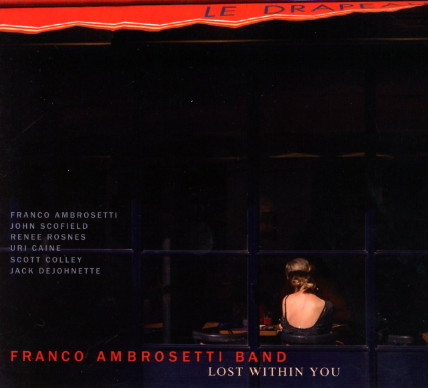
Which brings me to Franco Ambrosetti’s Lost Within You which is due out on CD on Unit Records [UTR 4970] on January 29, 2021 as both a CD and a download and which it’s press release lovingly describes as a “beguiling ballads album.” You can watch a trailer about the recording by going to www.unitrecords.com.
It is an enchanting recording and an appealing one, as well, especially for all the reasons described above. The music envelopes you, it wafts over you and you feel it along with hearing it. It doesn’t demand your attention, it requests it. But once you’ve given it permission to enter your mind, you’ll find yourself enamored and engaged in Jazz that is designed to bring beautiful melodies and inspired solos quietly into your consciousness.
Ambrosetti explains how the conception for Lost Within You came about:
"As a young man, my goal was to play fast," recalled the Lugano native. "Then slowly but surely I started to discover ballads, and Miles Davis was one of the great inspirations for that. From listening to Miles play ballads I started to understand and I was able to go inside the ballad and play these long notes that he was playing. Miles showed me how you stretch the notes out like you're really singing or crying, and I think I can express my feelings better that way."
Ambrosetti's "less is more" approach to ballads has served him well for five decades.
The sleeve notes for the recording are by Bill Milkowski who is an experienced and knowledgeable observer of the Jazz scene both past and present. We asked Bill if we could share his annotations with you as part of this blog feature and he graciously consented.
© Copyright ® Bill Milkowski, copyright protected; all rights reserved; used with the author’s permission.
“At 78, Franco Ambrosetti is easily the most elegant man in the room. Poised, refined, charming, conversant in five languages - one being the language of jazz - he is the very embodiment of 'suave.' A man of means who carries himself with an abundance of confidence and grace rather than swagger, he also happens to possess a remarkable gift for conveying heartfelt emotion through his horn. And like one of his role models, Miles Davis, the iconic Swiss trumpeter-composer and bandleader is indeed a beautiful singer of songs, as he so capably demonstrates on Lost Within You, his third recording for Unit Records and 25th overall as a leader.
“Concentrating strictly flugelhorn, Ambrosetti digs deep on a beguiling program of ballads, pulling heartstrings on poignant pieces like Horace Silver's "Peace" and McCoy Tyner's "You Taught My Heart to Sing," the delicate Bill Evans-Miles Davis composition "Flamenco Sketches" and the enduring classic, "Body And Soul." Accompanied once again by an all-world crew of pianist Uri Caine, bassist Scott Colley, guitarist John Scofield and drummer Jack De-Johnette (all of whom appeared on his 2019 Unit Records outing, Long Waves) and joined on five songs by pianist Renee Rosnes, Ambrosetti imbues these nine tunes with a golden tone, his signature lyricism and a depth of feeling that comes directly from the heart. Mastering ballads, said Franco, is something that came much later in his career.
"As a young man, when I was playing in my father's quintet at age 23, my goal was to play fast," recalled the Lugano native. "I loved Clifford Brown and I just wanted to play a lot of notes. I grew up on bebop, it was in my DNA, so I had absolutely no fear and no problem playing fast notes. But my father used to tell me, 'You play a ballad in a very correct way, but I miss the feelings. There's nothing from the inside.' But then slowly but surely, I started to discover ballads, and Miles Davis was one of the great inspirations for that. From listening to Miles play ballads I started to understand and I was able to go inside and play these long notes that he was playing. Miles showed me how you stretch the notes out like you're really singing, or crying. And I think I can express my feelings better that way."
Ambrosetti's "less is more" approach to ballads has served him well for five decades. That refined approach was particularly evident on 2018's lavish orchestral production, The Nearness of You. and it plays out in sublime fashion again on Lost Within You,
The collection opens on a delicate note with Jack DeJohnette in a rare turn on piano, providing a sparse intro to Horace Silver's aptly-titled "Peace." His notes resonate and hang in the air before Franco enters at the 1:30 mark, joining in a stark piano-flugelhorn duo. Bassist Scott Colley emerges at the 2:43 mark and guitarist John Scofield makes his presence felt with a potent solo at the 4:42 mark as DeJohnette comps forcefully behind him before launching into his own soulful solo. Franco's graceful, warm-toned solo culminates in a stirring cadenza.
With Rosnes on piano and Colley on bass, Ambrosetti fairly sings the Cy Coleman-Joseph McCarthy torch song "I'm Gonna Laugh You Right Outta My Life," a tune popularized by Nat King Cole in 1955. Renee and Scott each deliver heartfelt solos on this elegiac number.
The program shifts to a more buoyant mood with Franco's Latin-tinged "Silli in the Sky," a piece he had originally written for a theater production of Harold Pinter's "The Lovers" that his actress wife Silli performed in. Scofield's flowing guitar solo here adds bite to the proceedings, spurring Franco to some daring flights of his own. Then on Dave Grusin's "Love Like Ours," he takes his time, emphasizing those Miles-influenced long notes on an especially lyrical reading of the romantic number previously recorded by Diane Schuur, Steve Tyrell and Barbra Streisand.
The wistful "Dreams of a Butterfly" opens with a fragile ascending figure that Ambrosetti doubles with pianist Ce before DeJohnette settles into an insinuating New Orleans flavored "Poinciana" groove on the kit. Franco delivers some of his boldest playing on his solo here while Caine contributes a brilliant solo. The inspiration for this Ambrosetti original came from a Jorge Luis Borges story. As the composer explained, "There was a man who dreamt to be a butterfly. And when he woke up, he didn't know whether he was a man that dreamt to be a butterfly or the other way around. And this gave me inspiration once I sat at the piano and I came up with this opening line, which is like a Butterfly that flies."
Their relaxed take on Johnny Green's "Body and Soul," a Broadway show tune popularized in a 1930 Louis Armstrong recording before Coleman Hawkins put his enduring stamp on it in 1939, opens with a light salvo from DeJohnette before Franco enters with heart-wrenching long tones from his flugelhorn. As the 11-minute piece develops, DeJohnette showcases his inimitable loose swing factor and remarkable instincts on the kit, spurring Ambrosetti, Caine and Colley to some spirited stretching in their respective solos.
Benny Carter's "People Time" is a melancholy number performed with graceful restraint by the trio of Ambrosetti, Caine and Colley. Uri offers a magnificent solo here while Franco alternately pulls at heartstrings with long burnished tones and invigorates with daring intervallic leaps and flurries into the high register.
Rosnes brings a luminous quality to a zen-delicate reading of "Flamenco Sketches," the innovative modal closer from Miles Davis' 1959 classic. Kind of Blue. That tune was the result of some impromptu magic in the studio, as Ambrosetti explained. "Jack had played piano on Horace Silver's 'Peace', which was the last tune of the first day. And as we were packing up to go home, he started to play 'Flamenco Sketches.' And just like that we decided to record it. Jack left the piano to go to the drums and Renee sat down at the piano, and it happened in one take."
They open the McCoy Tyner-Sammy Cahn tune, "YouTaught My Heart to Sing." on a tender note before shifting to a lightly swinging feel for Scofield's solo section. The piece then alternates between swing and ballad feels behind searching, expressive solos from Scofield and Rosnes. Franco's golden long tones put an exquisite bow on the proceedings.
Throughout the three days of sessions, the leader was very mindful of letting intuition play into the proceedings. As he explained, "Musicians of this caliber, you want them to play what they are. We think the same way so I trust them completely."
Trust and communication were the watchwords of this enchanting collection of ballads by Ambrosetti, one of Europe's living jazz masters, and his world-class crew.”
Bill Milkowski
Bill Milkowski is a contributor to Downbeat. Jazziz and Absolute Sound magazines. He is also the author of Michael Brecker: Ode to a Tenor Titan [Globe Pequot/Backbeat].
Perhaps the following excerpt from ANTJE HÜBNER Hubtone Press Release is a fitting way to encapsulate and conclude what’s on offer in Franco Ambrosetti’s Lost Within You.
“The leader imbues each of the nine tunes on Lost Within You with a golden tone, his signature lyricism and a depth of feeling that comes directly from the heart. Combining all of those inherent qualities with a masterful sense of storytelling, he is able to pull heartstrings throughout the affecting program.”
If you are looking for a Jazz recording that compliments and complements your quiet time moods during your metaphorical “Ithaka journey,” you might want to bring the music on Franco’s Lost Within You along with you.


