© - Steven A. Cerra, copyright protected; all rights reserved.

For about two years in the late 1950s, I had the pleasure of hanging out with pianist/vibist Victor Feldman and trombonist Frank Rosolino who were then regular members of bassist's Howard Rumsey’s Lighthouse Cafe All-Stars in Hermosa Beach, CA.
These were my formative years in Jazz and I always thought of the many nights at I spent at the club listening to set after set of the Lighthouse All-Stars as my “undergraduate education.”
The drummer with the All-Stars at that time was Stan Levey When I mentioned to him something about lessons, he turned me over to Victor saying: “He even knows the name of the rudiments.” [Stan was just being defensive as he was self-taught and not all that technically conversant with “drum speak.” He just played his backside off instead.]
As to Victor's skills as a drummer, I soon found out that before he turned to vibes and piano, Victor had been a World Class drummer [think Buddy Rich - Yes, he was that fast].
The closing time for the club was 2:00 AM, but on weekdays, most of the patrons were gone by midnight. At the witching hour, the musicians sometimes congregated in the back of the club to relax, have a smoke and conduct Jazz 101 with aspiring, young musicians before playing a last set.
Often, Jazz 101 consisted of war stories and one night while I was sitting in the back of the club with Victor and Frank Rosolino, Victor told a heart-breaking tale of the “lost tapes” he had made a few years earlier with a rhythm section of Hank Jones on piano, Bill Crow on bass and Kenny Clark and Joe Morello on drums [they split the two, recording sessions].
Before leaving Woody Herman’s Big Band and settling in with Howard Rumsey’s Lighthouse All-Stars for a three year stint beginning in 1957, Victor had made a prior arrangement to record an album for Keynote Records and set about making arrangements for the date. Bassist Bill Crow tells the tale of this ill-fated Feldman, Keystone recording session in his book From Birdland to Broadway [New York: Oxford University Press, 1992, pp. 119-120].
“One night [in 1955] a young man sat at the Hickory House bar listening and smiling as we played [the Marian McPartland Trio featuring Bill Crow on bass and Joe Morello on drums]. When our set was finished, he introduced himself as Victor Feldman. The talented English vibraphonist had just arrived in New York, and had come to meet Marian. He said he liked the way Joe and I played together.
‘I’m doing an album for Keynote,’ Victor told us, ‘and I’d like you guys to do it with me. I’ve already sort of promised it to Kenny Clarke, so I’ll have him do the first date and Joe the second. I’ve got Hank Jones on piano.
Both dates went beautifully. Victor had written some attractive tunes, and he and Hank hit it off together right away. We couldn’t have felt more comfortable if we’d been playing together for years. Victor was glad to have the recording finished before he left town to join Woody Herman’s band.
The next time I ran into Vic, he told a sad story. The producer at Keynote had decided to delay releasing the album, hoping Victor would become famous with Woody. But the next Keystone project ran over budget, and when he needed to raise some cash, the producer sold Victor’s master tapes to Teddy Reig at Roost Records. Vic came back to New York, discovered what happened, and called Reig to find out when he planned to release the album.
‘Just as soon as Keystone sends me the tape,’ said Reig.
Vic called Keystone to ask when this would take place, and was told the tape had already been sent. A search of both record companies offices failed to locate the tape, and as far as I know it was never found. It may still be lying in a storeroom somewhere, or it may have been destroyed.
Since Keystone announced the album when we did the date, it was listed in Down Beat in their “Things to Come” column, and that information found its way into the Bruyninckx discography, but now that Vic and Kenny are both gone, that music exists as a lovely resonance in the memories of Joe, Hank and myself.”
Frank and I were horrified. “Some Christmas present,” Frank said, reflectively. He went on to say: “That better not happen with the tapes from the session we just finished.”
The recording session that Frank was referring to occurred on December 22, 1958 and while the outcome was not as irrevocable as was the case with the never-found tapes of Victor’s Keystone tapes, it DID happen that the Rosolino tapes were also, never released, at least, not until almost thirty years later [Frank died in 1978].
In 1987, Fantasy acquired the tapes from the December 22, 1958 Rosolino session and finally released them on LP as Frank Rosolino: Free For All [SP-2161]. The date was also released on CD in 1991 [Specialty Jazz Series OJCCD 1763-2].

Leonard Feather explains the story this way in his insert notes to the CD.
“Surprises of the kind represented by this album are as rare as they are welcome. The appearance of a hitherto undocumented album by Frank Rosolino makes a valuable addition to the discographical annals of an artist whose memory is cherished by admirers around the world.
His career seemed, on the surface, to have been reasonably successful. Born in Detroit in 1926, he came up through the big band ranks, playing with Gene Krupa, Bob Chester, Herbie Fields and Georgie Auld, then leading his own group in Detroit before joining Stan Kenton in 1952.
Two years later, he settled in Southern California and became, for several years, a regular in Howard Rumsey's Lighthouse All Stars in Hermosa Beach. His free-wheeling, extrovert style did not conform to the then prevalent image of West Coast jazz as tightly organized, laid back and somewhat derivative.
Moreover, Rosolino was known from the early days as an incurable comic, whose bop vocal on "Lemon Drop" with the Krupa band marked his first appearance on film. As Benny Carter once commented, "Frank was a fantastic musician, but behind that cut-up personality was a troubled man. He was like Pagliacci.”
Frank made his recording debut as a leader with a 1952 session for the short lived Dee Gee label. There were other dates for Capitol, Bethlehem and Mode, but by the mid-1960s the only available Rosolino album was a Reprise set that featured him mainly as a comedy singer. The existence of the present volume was unknown except to those who had taken part in it — and, particularly, the man who produced it, David Axelrod.
"Frank and I were excited about this album," Axelrod recalls, "because it was going to be the first hard bop album recorded and released on the West Coast. We wanted to get away from that bland, stereotyped West Coast image. We worked for weeks on planning the personnel and the songs. The results were terrific. It was a great disappointment to us both that the record, for reasons we never understood, wasn't released."
Rosolino confirmed this view in a letter he sent to Specialty some nine months after the session. "I feel it's the best album I have ever recorded; everyone who was on the date feels the same. I've played the dub for numerous musicians and they all think it's just great."
Harold Land, whose tenor sax shared the front line with Frank's trombone, was already well established as a proponent of the more vigorous California sound; he had toured with the Max Roach-Clifford Brown Quintet in 1954-5 and went on to lead various combos in addition to working, off and on ever since 1955, in the Gerald Wilson Orchestra.
Victor Feldman, who had arrived from England in 1955 and settled in Los Angeles after touring with Woody Herman, has worked for many years in studios, often playing mainly percussion and vibes, but his jazz reputation (primarily on piano) is a formidable one. Two years after these sides were made he joined Cannonball Adderley; in 1963 he recorded and gigged with Miles Davis.
Stan Levey, one of the foremost bebop drummers of the 1940's, played with everyone from Dizzy and Bird to Herman and Kenton, then joined the Rumsey group at the Lighthouse. By 1972, tired of boring studio jobs, he gave up playing in order to concentrate on his growing success as a commercial photographer.
Leroy Vinnegar, born in Indianapolis, settled in Los Angeles in 1954 and has worked with innumerable groups led by Stan Getz, Shelly Manne, Jimmy Smith, Shorty Rogers, Buddy Collette, and the Crusaders.
Typical of Frank Rosolino's ingenuity is the opening cut; he tackled Love for Sale in 6/4, moving into a fast 4/4 for the bridge. His own solo and Land's establish immediately that this is a tough, no-holds-barred blowing session.
Twilight is a beguilingly pensive example of Victor Feldman's talent as a composer.
There is no improvisation here until the solo by Land, who also plays under Frank's eloquent excursion.
Frank deals with the melody, while Harold offers appropriate fills on Henry Nemo's Don't Take Your Love From Me. Note the easy moderate beat sustained behind Frank's solo, the typically inventive Land outing, and Feldman's evolution from single note lines to chords.
Chrisdee, an original by Stan Levey, was named for his sons Chris and Dee and is a bebop line based on a cycle of fifths, with a somewhat Monkish bridge. After Frank and Harold have adroitly negotiated the changes, there is a series of fours, with Leroy walking a passage and Stan in a couple of brief solo statements.
Stardust is Rosolino throughout, a masterful example of his approach to a well-worn standard into which he breathes new life. The verse is played slowly, the tempo picks up a bit for the chorus, and the beat is later doubled, with Frank's sinuous lines growing busier before he closes it out on the dominant.
Frank composed Free Fall the album's title tune as a funky blues theme that offers 24 bars to Leroy, four choruses (48 bars) to Frank, three to Harold and two to Victor before the theme returns, ending with a suddenness that was typical of the hard bop era.
Frank worked out the routine on There is No Greater Love, an Isham Jones standard that dates back to 1936 and is as much in use as ever at jam sessions a half century after its debut. The unison horns kick it off at a bright pace,- after Harold's and Frank's solos, Victor gets into a single-note bop bag.
Finally, Frank's own Sneakyoso provides the quintet with an ingenious vehicle, its attractive changes providing good opportunities for Frank to work out. Note the fine comping Victor furnishes for Harold Land before taking over for his own solo. The two horns engage in an exchange with Stan Levey before the head returns.
All in all, this is a superior, even superlative example of the genre of music it represents. Frank was right to be so proud of it. Talking to Stan Levey while preparing these notes, I was not surprised when he remarked: "I never heard anyone else quite like Frank. He put into his music much more than he ever achieved out of it. I remember this session well, and I'm happy it's being made available."
Sadly, Frank did not survive to see its release. … [He died under tragic circumstances] in November of 1978 …..
Free for All is a very welcome reminder of an exceptionally gifted artist who left us much too soon.”
Leonard Feather, 1986 (Leonard Feather is the Los Angeles Times jazz critic.)
Who knows Maybe one day, someone will find the tapes of Victor’s 1955 session for Keystone and I can change the title of this piece from “lost” to “found.”


 Listening to the three tracks by the Jay and Kay Quintet on this LP, I “met” J.J. Johnson for the first time and it was love-at-bass-clef on my part. I had heard Kai Winding earlier on some Stan Kenton 78’s that a friend loaned me, but it was a new experience for me to hear his big, open sound in a small group setting.
 Here’s what Günter Schuller has to say about the Kenton trombones and Kai Winding:
 Although the section’s personnel changed often over the decades, it retained its astonishing stylistic consistency, not only because of stalwarts such as Milt Bernhart and Bob Fitzpatrick held long tenures in the orchestra, but because incoming players, such as Bob Burgess and Frank Rosolino and a host of others, were expected to fit into the by-then-famous Kenton brass sound.” [op. cit., p. 637; paragraphing modified].
 A few years later, when my family moved to Southern California, I was introduced to the other half of my preferred Jazz trombone tandem when I visited The Lighthouse Café in Hermosa Beach, CA and I heard the inimitable Frank Rosolino perform as part of Howard Rumsey’s Lighthouse All-Stars [LHAS].
 “As the BOP REVOLUTION spread, solo instruments other than the trumpet, alto sax, and piano began to echo the doctrines of Parker and Gillespie. The trombone, largely a rhythm instrument in the dawn of jazz before it was granted true solo privileges, had never been played in the swift, extremely legato, eighth-note style that J.J. Johnson introduced in the mid-forties. Since that time there have been few new trombonists who haven’t shown some manifestation of Johnson's style in their playing.
 But what I did know was how much I enjoyed listening to the sound that both J.J. and Frank produced on the trombone.
 More background about the development of Frank’s incredible facility on trombone can be found in the following from Ted Gioia, although the source for the citation changes to his West Coast Jazz, Modern Jazz in California: 1945-1960 [New York: Oxford University Press, 1992]:
 What an album! I still have the original LP and it is a miracle that it plays given the number of times a needle has cut through the vinyl.
 This recording is a composite snapshot of everything that was going on in the Jazz world of its time [1960/61] from the modal sounds of Miles’ Kind of Blue to the hard bop infusion of gospel and blues into bebop, to the ¾ time craze and minor harmonies preferred by the “My Favorite Things” John Coltrane quartet to the next generation of up-and-coming, front line soloists as represented by Hubbard, Jordan, Walton and Heath.
 As Teo Macero points out in the liner notes to the LP, “When J.J. finished composing In Walked Horace, he exclaimed, ‘Look what I’ve done! It’s Horace Silver.’” The medium tempo tune is based on “Rhythm Changes” and contains the total surprise of Clifford Jordan taking over in the middle of a Freddie Hubbard chorus and continuing it as though nothing had happen! J.J.’s “solo” on the tune consists of trading 8’s, then 4’s, then 2’s and then 1’s with Tootie Heath before Cedar ends the soloing with one of his perfectly crafted solos based on evenly spaced eight-note phrases with more than their share of funk.
 The best summary one could offer for J.J.’s music and playing on J.J. Inc. is contained in Steve Turre’s closing insert notes paragraph:
 In the late 1950’s, listening to Frank Rosolino play trombone night after night at the Lighthouse, and later at other venues in and around Hollywood, was an experience I’ll never forget. The man was a phenomenally inventive instrumentalist.
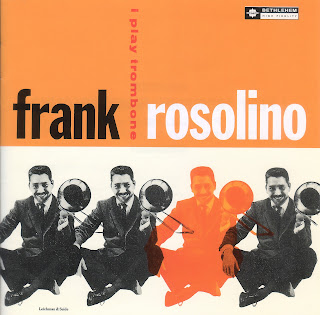 and the Russ Garcia arranged Four Horns and a Lush Life [BCP-46; released as a Japanese CD by Toshiba-EMI, TOCJ-62052],
 Although I did not own any of them at the time, I was even fortunate enough to hear some of the 10” and 12” LP’s that Frank recorded for Capitol under the “Kenton Presents Jazz” banner all of which have been collected and subsequently released as Mosaic Records MD4-185:
 With outstanding arrangements by Bill Holman, trumpeter Sam Noto and alto saxophonist Charlie Mariano joining Frank on the front line and a brilliant rhythm section of Pete Jolly [p], Max Bennett [b] and Mel Lewis [d], it is regrettable that these recordings didn’t have a wider distribution thus giving Frank a greater national exposure.
 Love for Sale opens the album with the melody played behind Stan Levey’s 6/8 Latin figure that resolves into a wickedly fast, double-timed 4/4 bridge. The blowing takes place in a slower, medium tempo and Frank’s and Harold Land’s solos "… establish immediately that this is a tough, no-holds-barred blowing session” [Leonard Feather’s liner notes].
 Many years later, after all of the East Coast versus West Coast nonsense had died down, I saw J.J. [who had, by then, been in Hollywood for a number of years writing for TV and the movies] sitting with Frank at Donte’s, a Jazz club and musicians hang-out in North Hollywood, CA. It was early in the evening before the set began and the two were having a quiet dinner together.