Showing posts with label freddie redd. Show all posts

Monday, March 29, 2021

Freddie Redd - The Thespian

© -Steven Cerra, copyright protected; all rights reserved.

Freddie Redd died on March 17, 2021. He would have been 93 on May 29th. The editorial staff at JazzProfiles is re-posting this piece as a tribute to this memory.


“Freddie Redd has an endless imagination for melody.”
- Mabel Fraser, Jazz author

“Freddie Redd is a real master of melody. He has a lot more to say than many composers. He hears music in longer forms. All his compositions are long."
- Don Sickler, Jazz musician

“Unlike most professional jazzmen, Freddie didn't take up an instrument until quite late in his teens. Around 1946, when he was in me Army, Freddie began to pick up me piano on his own. After being discharged, he heard Bud Powell [on 52nd Street in NYC]. ‘Bud really got me started. I'd never heard a pianist play quite like that—the remarkably fluent single lines and the pretty chords. In time, Thelonious Monk got to me too. Actually, however, I've been influenced by many things I've heard on a lot of instruments. What I do is try to piece together what stimulates me into my own way of feeling things musically.’"
- Nat Hentoff


In his insert notes to Shades of Redd [Blue Note 21738], Nat Hentoff further explains that “... since his emergence as composer of the score for Jack Gelber's harrowingly exact play, The Connection (Blue Note 4027), Freddie Redd has finally been gaining some of the recognition that has eluded him for much of his playing career. Freddie also plays the taciturn pianist in the play with convincing effect. Although he hopes to work again in the theatre, Freddie remains essentially a jazz player-writer, and this album underlines his growth as a composer of vigorously expressive jazz originals. … Freddie's long association with the play had led to his being dubbed "The Thespian" by Joe Termini, the owner of The Jazz Gallery and The Five Spot in New York, and Freddie chose the nickname for the title of the opening tune.”

Hence, too, the title of this piece.


The Mask of Janus, the two faced Roman God is often associated with theatrical performances. Janus is the God of beginnings and transitions, and thereby of gates, doors, doorways, passages and endings. He is usually depicted as having two faces, since he looks to the future and to the past. The Romans named the month of January after him in their calendar.

The structure of Freddie Redd’s The Thespian seems to fit perfectly into the easy duality represented by the Mask of Janus. It sounds like it’s two tunes, but it is really only one which is played at a faster tempo when it is repeated. The solos and the closing refrain stay in the faster tempo. It almost as though the musicians are practicing the tune at the slower tempo to figure out the fingerings on their respective instruments, how to phrase the melody and how the chords lay, before bringing the tune up to the meter it is supposed to be played in.

It takes a lot of skill to write something that sounds well when the phrasing is exaggerated and also when played in an up tempo.

Freddie once remarked: “I like pieces that I can elongate." The Thespian is certainly that - a stretched out composition.

When I think of Freddie, the image that comes to mind is that of a skillful composer who plays okay piano; kind of like Tadd Dameron, who has been featured in a number of postings on these pages, recently. For as Richard Cook and Brian note about Freddie’s piano playing in their Penguin Guide to Jazz on CD, 6th Ed.: “Redd is a player who hasn't been able to fall back on an absolutely secure playing technique.”

One would think that having made three albums for Blue Note -  The Connection, Shades of Redd, and Redd’s Blues [4037] - would merit more than a passing reference in Richard Cook’s “history” of the label, but that’s all you’ll find on page 137.


Mabel Fraser gives this  more detailed overview of Freddie’s career and his approach to music in these insert notes from his 1985 Uptown recording entitled Lonely City [UPCD 2730]:

"Music is like oral history. It's all born out of an inspired feeling." Freddie Redd's inspiration synthesizes Charlie Parker, Bud Powell, Thelonious Monk, Tadd Dameron and John Coltrane. His music, however, has its own special resonance, its own mystique, its own creativity. He never thinks about who influenced him, although he acknowledges teachers and artists who inspired him "always leave something with you. You try and find yourself. They just point the way."

Somewhat like alchemy. Redd can transform a few notes into musical touchstones. "I hear a little phrase which gives me the feeling of someone. Dameron, for example. I just hear it. And I write what I hear.  I like pieces that I can elongate."

A lot of his music is like that. The cohesion among the notes sometimes gives an impression of intricacy, yet later we find ourselves humming the tune quite easily. The long melodic lines, the formats of the tunes, the memorable lyric evoke a musical combination of art and poetry. He is such a rich composer.

And yet commercial success has eluded him. "I never went after it. My motivation was the music. It took me wherever it was going to take me."

Freddie Redd himself is hard to categorize. He's a maverick, of sorts. Born in New York City on May 29, 1928, Redd grew up in Harlem. A late starter, he only began playing the piano at 18. He "sat down and played things by ear. Then I learned about chords and how they were connected." He also taught himself music notation. His "first job ever" was with Papa Jo Jones, the former Count Basie drummer, in New York in early '49, Later that year he played with Oscar Pettiford. During those days in New York, "you got to know everyone pretty well. Monk, Bird, Powell." He met Charlie Parker at the studio of an artist-Friend. Redd had fallen asleep by the fire and "woke up and there was Bird, looking down, laughing." He also met Bud Powell. Both were sporting similar hairstyles. Redd "hated barbers I wouldn't cut my hair, so I had the first Afro in the Village."

In the early 50's, he played with Cootie Williams, Coleman Hawkins, Joe Roland, The Art Farmer-Gigi Gryce Quintet, and in '54, Art Blakey. His first recording was for Prestige in '55 and in '56 he toured and recorded in Sweden with Tommy Potter, Joe Harris, Benny Bailey and Rolf Ericson. The tour had been arranged for some Swedish and American All Stars by a Swedish radio broadcaster working in New York. "A mutual friend, knowing a replacement was needed, asked me. I was available. The very next day I had my passport."

When Redd returned to the US, he settled in San Francisco, where he composed a "series of impressions of that city," recorded as San Francisco Suite (Riverside) in '57.


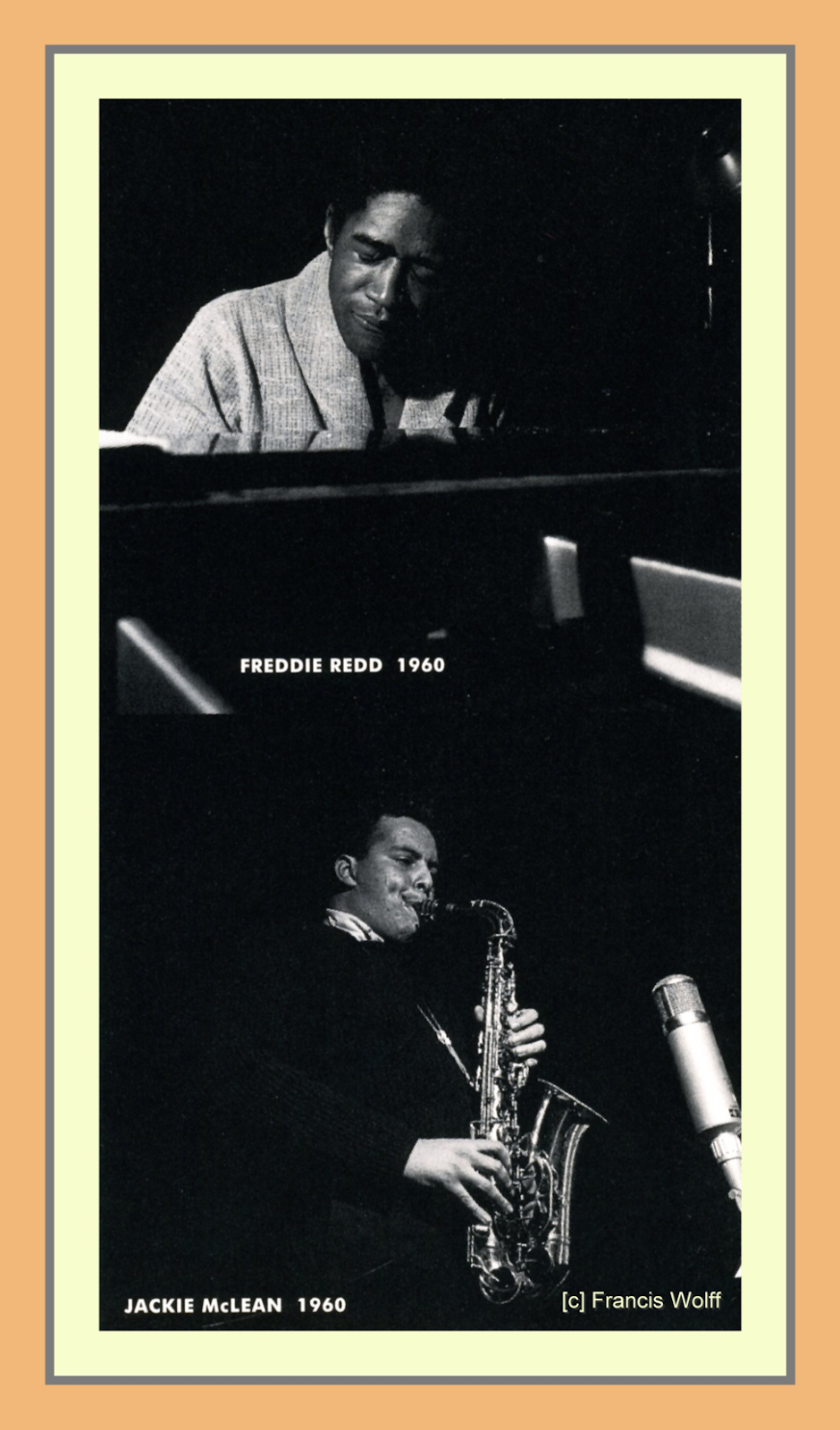
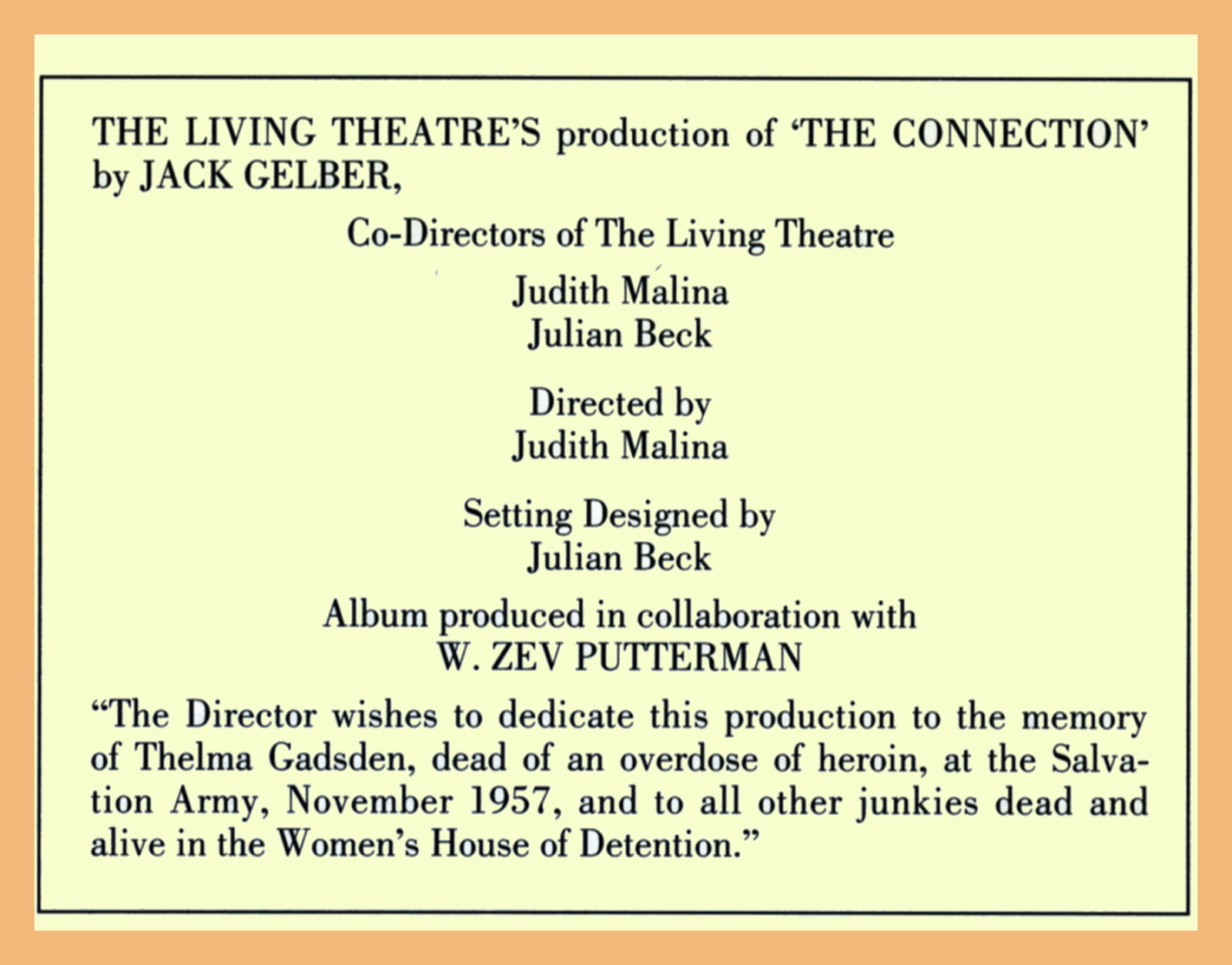
Redd's reputation as a jazz composer grew when he wrote the original score for the 1959 off-Broadway hit "The Connection." "I was living on First and Bowery in a loft. The Five Spot, later a famous jazz club, was a few blocks away Gary Goodrow, o tenor sax, and I sessioned there together. He became involved in acting and told me that Jack Gelber, the author of the play, was looking for o musician-writer. We met, I wrote the music in a short space of time and Gelber liked it." The play, about the misery of junkies waiting For the 'connection,' owed part of its success to the avant-garde use of the musicians. Freddie Redd, Jackie McLean, Michael Mattos and Larry Ritchie actually took part in the play as actors and musicians. The Connection, the jazz event of 1959-60, was later made into a movie, using the same musicians. Redd recorded two LPs of The Connection, one on Blue Note and one using the alias 'I Ching' on Felsted.

Throughout most of the 60's and 70's, Redd lived in Europe, "because of the environment over there. We were considered artists. There was employment opportunities." He stayed in London for two years with The Connection, then moved through France and Germany. Although he played "everywhere," he only recorded a trio session Under Paris Skies (Future) in 1971.

In the late 70's, Redd returned to the US, and while living in Los Angeles he recorded Straight Ahead in '77 (Interplay Records), picked by Swing Journal in Japan as one of the best jazz records of the year. Although he continued playing, his main interest was composing. "As a professional, you have to make records and a presentation of yourself. But I never bothered. I wanted to create." The need to survive led him to many odd jobs, for "there is very little subsidy for artists in the US." He moved to Jackson, Mississippi as "an artist in residence" for a musical project that never materialized.

Redd then turned up in Washington DC in '84. He "was booking talent and playing at Woody's on the Hill near Howard University, with Philly Joe Jones, Bill Hardman, and Junior Cook." Redd contacted producer Bob Sunenblick at Jeff Barr's suggestion. Barr, a noted jazz record dealer and writer for Jazz Times, had earlier brought up Redd's name as a musician deserving contemporary recognition. Bob agreed and by mid-84, when Redd was in Washington DC where Barr lived, the three cooperated in renting a piano and setting up rehearsal space. Redd then began working on the music for Lonely City.

In New York, Bob contacted Don Sickler, arranger of many Uptown record sessions and trumpeter-arranger for Philly Joe Jones' band, Dameronia. Redd composed the tunes and Sickler wrote the arrangements. Sickler considers Redd a "real master of melody. He has a lot more to say than many composers. He hears music in longer forms. All his compositions are long." Redd stayed at Sickler's house in New York and they spent many hours playing together while Redd worked out the music. Consequently, he developed a great feeling for Don’s musicianship. …

The history of jazz is full of valid musicians who proved to be as ephemeral as their music. Freddie Redd should not be in that category. With his simple melodies and lilting poetic tones, Redd's talent radiates on this record. His concepts, his sound, have an exciting touch and a haunting quality. He should be considered one of the great living masters.”


Wednesday, March 4, 2020

The Connection - Freddie Redd and Jackie McLean by Ira Gitler

© -Steven Cerra, copyright protected; all rights reserved.


Growing up a Jazz fan on the Left Coast “back-in-the-day,” finding Blue Note LPs was like going on a hunt for buried treasure.


The major labels like Capitol, Columbia, Decca and RCA all had large, national distribution budgets and their recordings along with Los Angeles and San Francisco based labels like Pacific Jazz, Contemporary and Fantasy were readily available.


But this wasn’t the case with New York based labels specializing in Jazz such as Blue Note, Prestige and Riverside.


One had to really search around to find record stores that carried these labels and when you eventually did, they were often priced at a premium and in short supply.


As things got better for Alfred Lion and Francis Wolff at Blue Note with more of their LPs becoming successful sellers, the distribution seemed to flow more smoothly and an increasing number of record shops started to carry the label.


My main source for discovering shops that carried Blue Note LPs was the musicians’ grapevine which I would check every Friday when I went to the Local 47 Musicians Hall in Hollywood, CA to pick up my checks.


One day I struck “blue gold” when a musician buddy hipped me to a well-stocked store in the historic West Adams section of Los Angeles which is located south of Hollywood and west of downtown Los Angeles.


During my first foray to the shop, I think I spent the better part of a week’s salary on Blue Note records featuring the Horace Silver Quintet, Art Blakey and the Jazz Messengers and a host of other prominent Blue Note recording artists.


On another of my, by now, regular weekly visits to the shop I picked up the Blue Note LP The Music from the Connection: Freddie Redd Quartet with Jackie McLean [[B2-89392] with Jackie on alto sax, Freddie on piano, Michael Mattos on bass and Larry Ritchie on drums.


I had been a fan of Jackie McLean’s music for some time, but I knew hardly anything at all about Freddie Redd’s music and the details of Jack Gelber’s play.


Ira Gitler’s informative and insightful insert notes to the recording changed all of that.


We recently wrote to Ira and asked his permission to present on these pages his original liner notes to The Music from the Connection: Freddie Redd Quartet with Jackie McLean.


He graciously agreed to allow them to be posted to the JazzProfiles blog with the proviso that anyone also wishing to publish them in any form or fashion seek his consent before doing so.


At the conclusion of Ira’s writings, you’ll find a video tribute to Jackie Mclean which has as its audio track Theme for Sister Salvation from Freddie Redd’s score to The Connection.


Like Leonard Bernstein, I came away from the play whistling this theme and I haven’t forgotten it since.


© -  Ira Gitler, copyright protected; all rights reserved. Used with the author’s permission


THE CONNECTION by Jack Gelber is a play about junkies but its implications do not stop in that particular circle. As Lionel Abel has stated in what is perhaps the most perceptive critique yet written about the play (Not Everyone Is In The Fix, Partisan Review, Winter 1960), "What adds to the play's power is that the characters are so like other people, though in such a different situation from most people."


The situation in which the four main protagonists find themselves is waiting for Cowboy (Carl Lee), the connection, to return with the heroin. These four, Solly (Jerome Raphel), Sam (John McCurry), Ernie (Garry Goodrow), and Leach (Warren Finnerty) are in attendance at the latter's pad with the bass player. One by one, the three other musicians drift in. They are also anxiously awaiting Cowboy's appearance. Also present, from time to time, in this play-within-a-play, are a fictitious playwright Jaybird (Ira Lewis), producer Jim Dunn (Leonard Hicks) and two photographers (Jamil Zakkai, Louis McKenzie), who are shooting an avant garde film of the play.


The musicians not only play their instruments during the course of the play but, as implied before, they also appear as actors. Some people have raised the question, "If they are actors, why are they using their real names?" Pianist-actor Freddie Redd, composer of the music heard in The Connection answers this simply by saying that he and the other musicians want recognition (and subsequent playing engagements) for what they are doing and that there would be no effective publicity if they were to appear as John Smith, Bill Brown, etc. Author Gelber concurs and says that having the musicians play themselves adds another element of stage reality.


When The Connection opened at The Living Theatre on July 15, 1959, it was immediately assaulted by the slings and arrows of outrageous reviewers, a group consisting, for the most part, of the summer-replacement critics on the local New York dailies. Although several of them had kind words to say about the jazz, none were explicit and one carper stated that the "cool jazz was cold" which showed his knowledge of jazz styles matched his perception as a drama critic.


A week later, the first favorable review appeared in The Village Voice. It was one of many that followed which helped save The Connection and cement its run. In it, Jerry Tallmer didn't merely praise the jazz but in lauding Gelber as the first playwright to use modern jazz "organically and dynamically", also pointed out that the music "puts a highly charged contrapuntal beat under and against all the misery and stasis and permanent crisis."


This the music does. It electrically charges both actors and audience and while it is not programmatic in a graphic sense (it undoubtedly would have failed it if had tried to be) it does represent and heighten the emotional climates from which it springs at various times during the action.


The idea to incorporate sections of jazz into The Connection was not an afterthought by Jack Gelber. It was an integral part of his entire conception before he even began the actual writing of the play. If Gelber did not know which specific musicians he wanted onstage, his original script (copyright in September 1957) shows that he knew what kind of music he wanted. In a note at the bottom of the first page it is stated, “The jazz played is in the tradition of Charlie Parker." (The Connection is published by Grove Press Inc. as an Evergreen paperback book.)


Originally Gelber had felt the musicians could improvise on standards, blues, etc., just as they would in any informal session. When the play was being cast however, he met Freddie Redd through a mutual friend. Freddie, 31 years young, is a pianist who previously has been described by this writer as "one of the most promising talents of the '50s" and "one of the warmer disciples of the Bud Powell school". During the Fifties he played with a variety of groups including Oscar Pettiford, Art Blakey, Joe Roland and Art Farmer-Gigi Gryce, all of whom recognized his talent.


After he had gotten a quartet together at Gelber's request, auditioned for him and was given the acting-playing role in The Connection, Freddie told Jack of his long frustrated wish to write the music for a theater presentation. Armed with a script and the author's sanction, he went to work. In conjunction with Gelber, he decided exactly where the music was to occur. By familiarizing himself with the play's action, he was able to accurately fashion the character and tempo of each number. What he achieved shows that his talent, both the obvious and the latent of the '50s, has come to fruition. He has supplied Gelber with a parallel of the deep, dramatic impact that Kurt Weill gave to Brecht. His playing, too, has grown into a more personal, organic whole. Powell and Monk, to a lesser degree, are still present but Freddie is expressing himself in his own terms.


The hornman he chose to blow in front of the rhythm section and act in the drama, has done a remarkable job in both assignments. Jackie McLean is an altoman certainly within the Parker tradition but by 1959 one who had matured into a strongly individual player. His full, singing, confident sound and complete control of his instrument enable him to transmit his innermost musical self with an expansive ease that is joyous to hear. It is as obvious in his last Blue Note album (Swing, Swang, Swingin' — BLP 4024) as it is here or on stage in The Connection. As an actor, Jackie was so impressive that his part has grown in size and importance since the play opened.


During the early part of the run, Redd's mates in the rhythm section were in a state of flux until Michael Mattos and Larry Ritchie arrived on the scene. Mattos has worked with Thelonious Monk, Randy Weston, Max Roach and Lester Young among others. Ritchie came out of B. B. King's band to play with Phineas Newborn and later, Sonny Rollins. Together they have given the group on stage a permanence; the fusion of many performances' playing as a unit is evident here.


The first music heard in the play is introduced by a mute character named Harry (Henry Roach) who comes into Leach's pad early in the first act with a small portable phonograph on which he plays Charlie Parker's record of Buzzy. Everyone listens religiously. When the record is over, Harry closes the case, and leaves. With this, the musicians commence to play Buzzy (not heard here) but are interrupted by Jaybird who rushes up on stage exclaiming that his play is being ruined by the junkies' lack of co-operation. After some argument, he leaves and the quartet begins to play again. This is Who Killed Cock Robin? The title was suggested by Warren Finnerty because the rhythmic figure of the melody sounds like that phrase which he, as Leach, screams in his delirium when he is close to death from an overdose later in the play. It is an up tempo number, yet extremely melodic as most of Freddie's compositions are. In the composer's words, "It is intended to plunge the music into the action of the play and to relieve the tension of the confusion which had begun to take place."


McLean and Redd solo, urged on by the rhythm section which features Larry Ritchie's dynamic drumming.


One of the devices employed by Gelber is having his main characters get up and solo like jazz musicians. Sam, a Negro vagabond junky goes on at length, promising to come out into the audience at intermission and tell some of his colorful stories if they will give him some money so that he can get high until he goes to work on a promised job. As he finishes, he lies down and asks the musicians to play. They respond with Wigglin', a medium-tempo, minor-major blues which Redd explains, "accentuates Sam's soulful plea to the audience. It is humorous and sad because we suspect that they know better."


This is effective "funk" that is not self-conscious or contrived. Jackie and Freddie are heard in moving solos; Michael Mattos has a short but effective spot before the theme returns.


The last piece in Act I is detonated by Ernie's psychopathic out-burst. Ernie is a frustrated saxophonist whose horn is in pawn. He sits around bugging everyone by blowing on his mouthpiece from time to time. In his "confession" he digs at Leach. In turn, Leach ridicules his ability and laughs at him for deluding himself into thinking he is a musician. Music Forever calms the scene and in Freddie's words, "expresses the fact that despite his delusions, Ernie is still dedicated to music."


The attractive theme is stated in 2/4 by McLean while the rhythm section plays in 4/4. Jackie's exhilarating solo at up tempo shows off his fine sense of time. He is as swift as the wind but never superficial. Freddie, whose comping is a strong spur, comes in Monkishly and then uses a fuller chordal attack to generate great excitement before going into some effective single line. The rhythm section drives with demonic fervor. This track captures all the urgency and immediacy that is communicated when you hear the group on stage. In fact, throughout the entire album the quartet has managed to capture the same intense feeling they display when they are playing the music as an integrated part of The Connection.


The mood of Act II is galvanized immediately by the presence of Cowboy who has returned with the heroin. Jackie comes out of the bathroom after having had his "fix" and the musicians play as everyone, in their turn, is ushered in the bathroom by Cowboy. The group keeps playing even when they are temporarily a trio. In this
album they are always a quartet. Since this is the happiest of moments for an addict, the name of the tune is appropriately Time To Smile. Freddie explains, "The relaxed tempo and simplicity of the melody were designed to have the audience share in the relaxing of tensions."


The solos are in the same groove; unhurried, reflective and lyrical.


In order to escape from a couple of inquisitive policemen, Cowboy had allied himself with an unwitting, aged Salvation Sister on the way back to Leach's pad. While everyone is getting high, she is pacing around, wide-eyed and bird-like. Sister Salvation, (Barbara Winchester), believes Cowboy has brought her there to save souls. She sees some of them staggering and "nodding", and upon discovering empty wine bottles in the bathroom thinks this is the reason. She launches into a sermon and Solly makes fun of her by going into a miniature history of her uniform. The music behind this is a march, heard here in Theme For Sister Salvation. When she tells them of her personal troubles, the junkies feel very bad about mocking her. This is underscored by Redd's exposition of a sadly beautiful melody in ballad tempo. Here, in the recorded version, McLean plays this theme before Freddie's solo. Then the march section is restated. The thematic material of this composition is particularly haunting. I'm told Leonard Bernstein left the theater humming it.


Jim Dunn is in a quandary. Jaybird and one of the photographers have rendered themselves useless by getting high. The chicks that Leach supposedly has invited have not appeared. Leach asks Freddie to play and the group responds with Jim Dunn's Dilemma, a swiftly-paced, minor-key theme. Redd especially captures the feeling of the disquietude in his two-handed solo.


From the time of the first fix, Leach has been intermittently griping that he is not high. Finally Cowboy gives him another packet as the quartet starts to play again. He doesn't go into the bathroom but makes all the preparations at a table right onstage. The tune O.D., or overdose, is so named because this is what Leach self-administers. Where in the play the music stops abruptly as he keels over, here the song is played to completion. McLean is again sharp, clear and declarative. Redd has another well developed solo with some fine single line improvisation.


I first saw the play the week it opened. My second viewing was in March 1960. To my amazement, I found myself injected into The Connection. As the musicians left the pad of the supposedly dying Leach, they reminded one another that "Ira Gitler is coming down to interview us for the notes."


The above is just a small part of why The Connection helps The Living Theatre justify its name. Gelber's dialogue, which still had the fresh feeling of improvisation on second hearing, is one of the big reasons. Another large one is Freddie Redd's score. Effective as it is in the play, it is still powerful when heard out of context because primarily it is good music fully capable of standing on its own.


—IRA GITLER”