Showing posts with label george handy. Show all posts

Thursday, August 27, 2026

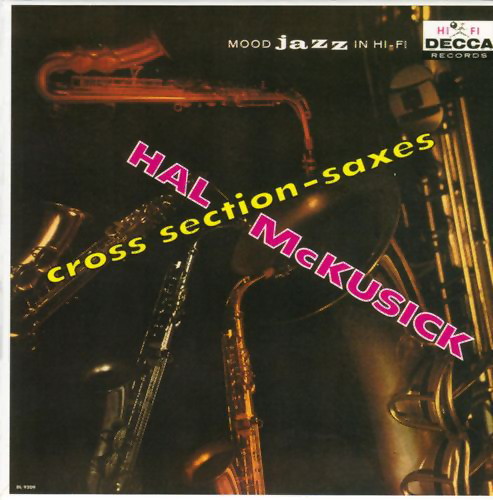
Hal McKusick - Cross Section-Saxes

 © Copyright ® Steven Cerra, copyright protected; all rights reserved.


Interview with Hal McKusick


“Composer and alto saxophonist HAL McKUSICK, born 1924 in Medford, Massachusetts, plays most saxophones, clarinets, and flutes. He was a member of the orchestras of Boyd Raeburn, Claude Thornhill, Woody Herman, Benny Goodman, Dizzy Gillespie, and Charlie Barnet. In the later 1950s he made recordings with George Russell, Art Farmer, Al Cohn, Manny Albam, Jimmy Giuffre, Gil Evans, among others, and appeared on the 1959 album Lee Konitz Meets Jimmy Giuffre. From 1958 to 1972 he was a staff musician for CBS in New York. His compositions for Boyd Raeburn, his own groups, and others show an original avant-garde sensibility. Today he teaches and performs on Long Island in New York, and makes fine handcrafted furniture.”

- Andy Hamilton, Lee Konitz: Conversations on the Improviser’s Art [2011]


Hal McKusick

ALTO SAXOPHONE

Born 1 June 1924

McKusick was a section-player in many big bands in the 40s and early 50s, but he's best remembered as a studio man who led some interesting dates of his own for a number of different labels in the latter part of the 50s. His RCA set The Jazz Workshop (1956) was recorded contemporaneously with George Russell's of the same title, and features material by Russell, Jimmy Giuffre, Gil Evans and others: a quietly compelling record with some starkly challenging music, although Triple Exposure (Prestige, 1957) and Cross Section: Saxes (Decca, 1958) also have some fine and rewarding music. McKusick's own playing was soft-toned and wryly inventive. After this burst of activity, though, he doesn't seem to have recorded again as a leader, although he still did studio work into the 70s and carried on playing into the 90s with small groups. He is also a pilot.”

- Richard Cook’s Jazz Encyclopedia


“McKusick, Hal [Harold Wilfred] (b Medford, MA, 1June 1924). Alto saxophonist. He first worked as a sideman and a principal soloist with a number of big bands, including those of Les Brown, Woody Herman (both 1943), Boyd Raeburn (1944-5), the guitarist Alvino Rey (1946), Al Donahue, Buddy Rich, and Claude Thornhill (1948-9). During the 1950s he played with Terry Gibbs (1950-51,1955-6), Bill Harris  (1952), and Elliot Lawrence (1952-7), and also worked as a studio musician and led his own groups. In 1958 he joined the staff of CBS in New York, but continued to perform and record as a freelancer. McKusick is noted for his experiments in the 1950s with novel time signatures, modes, and counterpoint; the influence of Lester Young may be discerned in his delicate tone and phrasing, both well suited to the cool-jazz style.”

- DIANNA RHYAN in Barry Kernfeld, Ed., The New Grove Dictionary of Jazz [1995]


I’ve wanted to bring up a Substack feature on multi-woodwind and reed specialist Hal McKusick [1924 -2012] for sometime be I couldn’t seem to find a starting point until I recently listened to a CD collection that contained Hal McKusick - Cross Section-Saxes which was originally released in 1958 as a Decca LP.


Hal was not only a fine soloist and an excellent arranger in his own right, but also an excellent interpreter of the work of other arrangers. In this case, George Russell, Jimmy Giuffre, Ernie Wilkins and George Handy who did some very intriguing work with sax sections on Hal McKusick - Cross Section-Saxes.  


On some of the tracks on this album, the sax arrangements sound like a forerunner to Med Flory and Buddy Clark’s Supersax, a sax section that came to prominence in Los Angeles in the 1970s playing unison and harmonic versions of Charlie Parker’s classic Bebop repertoire replete with his iconic, original solos.


This album is also of interest because it is one of the earliest to feature the work of pianist Bill Evans before his association with Miles Davis and his twenty year career as the leader of his own trio.


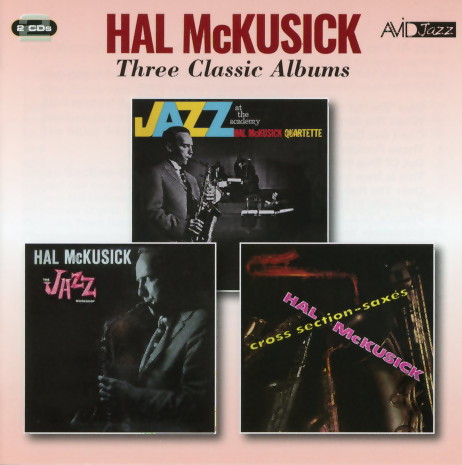
The details about this recording are discussed in full in the following liner notes by George Russell, Jimmy Giuffre, Ernie Wilkins, George Handy and Burt Korall and they are also contained in the booklet that accompanies Hal McKusick: Three Classic Albums - The Jazz Academy, Jazz Workshop, Cross Section-Saxes [Avid AMSC-1167]. Interestingly, each of the composers talks about the work of other composers on the album in a way that illuminates special features of their singular style of composing and/or arranging. Burt provides a summation.


“When the jazz musician no longer seeks out fresh avenues of expression, he shrivels on the vine. Of necessity, the creative artist must be refreshed and revived at frequent intervals. He must be challenged; it is essential to his continued vitality. Obviously, it is too easy to be trapped, to wallow in a comfortable groove, turning away from the more creative, and indulging in the pleasure or success of the moment.


Whether or not the jazzman becomes lax is dependent, in varying degrees, upon two things: talent and temperament. Those who are content to reach a comparatively modest level of accomplishment, and to exploit the attendant feeling of mastery over material and a sense of case for their own sake, are numerous. Fortunately for jazz, however, there are more musicians who are not content with the fulfillment of today and keep building for a more fruitful tomorrow. Musicians of this genre are acutely aware of the symptoms of stagnation, avoid the pitfalls manifest in jazz and themselves, and remain "alive", musically. These are the people that prevent jazz from suffering from an acute case of "tired blood."


Hal McKusick, since his stay with the adventurous Boyd Raeburn orchestra in the 'forties, when he collaborated with arranger-composer George Handy in the writing of some noteworthy compositions - Yerxa, Tonsillectomy, etc. - and was one of the more enthusiastic subscribers to the modern manner of playing fathered by Lester Young and developed by Charlie Parker, Dizzy Gillespie, T. Monk, Kenny Clarke - the Minton's- 52nd Street coterie - has found psychological and financial sustenance following the challenging paths in the jazz woods.


"A continuing sense of growth as a musician and as a person is of utmost importance to me," says McKusick. "I feel that very little can be gained by doing the same sort of things over and over, especially if there's no more to be learned by doing them. " I don’t wish to imply, however, that the jazzman should flit indiscriminately from one thing to another without adequate preparation, or that he should grow compulsively rather than naturally; but I do want to emphasize that standing still in jazz can only become an unfortunate habit.


"It is for this reason that I generally try to vary my activities, to have my albums project something of the extensiveness, the variety that is jazz; each one of them calling for something different from the players and myself,


McKusick has done "free-blowing"' sets, where the disciplines and general sense of interest are dependent upon improvisation. Altering the emphasis, other McKusick programs have placed stress on incorporating free-blowing in a "lightly" arranged framework. As of late, Hal has veered to what he considers a most fruitful set-up-a close interrelation between the writer and the players; the writing in the latter situation, ranging from the deceptively simple to the more complex, according to the composer's bent. The value of the performances is, once again, relative to the invention, the interpretive strength of the players; but the organizational elements basic to scoring render a more overt sense of form of a written score that tends to inhibit the jazz blower" Yes and no. It could well inhibit individuality if the writers had no understanding of the needs of the jazz player. However, the writers involved in this album, through their experiences in jazz, have come to realize that the player must be given a chance to play, and/or be challenged by the feel, the variety and unity of the writing. In essence allowance must be made for the player to contribute meaning to the work, not only on the group level, but as an individual as well.” -GEORGE RUSSELL


“Composer-arranger George Russell realizes this. Like the jazz soloist, George creates compositions and arrangements that underline adventure and flexibility, the basic and not so basic.


Russell feels that he, too, is an improviser. Discussing jazz composition he said, "Given a set of musical facts, he (the writer) can, in the same way a soloist improvises on chords, improvise upon musical facts pertaining to his composition and produce a swinging, logical, vital-sounding piece of music. Improvisation on various levels is an integral part of jazz.


In the process of composing music over the years, George has evolved his "Lydian Concept of Tonal Organization," encompassing the whole of composition - the consonant (tonality) and the dissonant (atonality). There is dissonance in his work, but always in relation to a tonal center. As Russell said to Jack Maher in JAZZ TODAY: "I feel that writing tonally, in many ways, is more of a challenge. The limitations of tonality force you to look and feel harder for the endless variations that exist."


In the manner of Duke Ellington, Russell emotionally and scientifically measures the capabilities of his instrumentation and the artists he is dealing with, writing for the player and the unit, rarely overextending himself, for he always seeks to fully understand all the elements with which he is working. This is something he tried to do even in his fledgling period as a writer for Dizzy Gillespie, Benny Carter and Charlie Parker.


Russell, at 35, has been over a decade in finding himself. Through self examination and study, he has come to a point in his development when forging his own message is possible. Relatively unheralded today, his future is fraught with possibility.


The Russell contributions are played by Hal McMusick, alto: Art Farmer, trumpet; Bill Evans, piano: Milt Hinton, bass; Charlie Persip, drums: and Barry Galbraith, guitar.


YOU'RE MY THRILL - Russell maintains the identity of the song without adhering too closely to its melody or form. "I tried to compose on the song," said Russell. Perhaps the chief recommendation of this arrangement is that the written ensemble lines move well and in a most natural manner. The solos follow as release for the tension set up by the lines; the interweaving of both add to the pulsing feeling of the selection. Speaking for the soloists, Hal succinctly commented: "George sets you up his own way, and makes you play."


STRATUSPHUNK is a medium-tempoed blues that intimates atonality though it maintains an essential tonality-Blues in F. The prime motif is a bass line built on the interval of a minor seventh that is picked up by trumpeter Farmer, then further enlarged upon by the ensemble. Piano and drums drop out for the first six or eight bars of each solo, after which the full rhythm section plays in double-time, and then reverts back to straight time, thus establishing a variety of rhythmic tensions and enriching this deceptively inornate, well organized opus.


Russell seems to follow an emotional plan: By building from the opening bass line through ensembles to solos, diversifying his rhythmic and melodic colors and buoyantly supporting soloists along the way, Russell logically reaches climaxes, and then returns, in progressive steps, to bare essentials - bass line in close.


END OF A LOVE AFFAIR is an apt illustration of the degree of inner organization of Russell's writing. One is aware of planning, the form of the arrangement, but the loose, natural quality of the work never makes that knowledge any more than a convenience.


Opening with a 32 bar verse, a colorful affair notable for shifting rhythms and clever handling of melodic elements, the emphasis changes in the theme sections to the more straightforward as Russell underlines "the romantic feeling and a definite sense of swing." The general flow of the solos is aided by the "dancing feel" of the rhythm section headed up by drummer Charlie Persip.” - JIM GIUFFRE


“The challenge to the players is continued in the work of the next writer to be considered. Jim Giuffre, the man and the musician, functions as he feels he must. A product of the mainstream of jazz, the man who wrote Four Brothers for the Woody Herman Orchestra, played tenor in the tradition of Lester Young for Woody, Buddy Rich and other bands, has come to know himself, and now feels a good deal of security concerning his concepts.


Indeed, Jim has taken hold over the last few years. By organizing his thinking and his life, he has managed to free himself of the shackles of influence, and has gone his own way. His writing exhibits individuality and is identified by "low volume, gentleness and restraint, which makes more clear attitudes often not found in jazz: pensiveness, compassion, even meditation. Because of those same three major elements, his music makes the relationship between other musical forms and jazz more evident, since the relationships arc not obscured by the

overwhelming power and intensity representative of most jazz performances."


Giuffre's music shows an express concern for American folk elements: a closeness to the blues, spirituals, the feeling of the land and people of this country. It is a personal, earthy kind of music.


Not inhibited or circumscribed in his writing, Giuffre does not hesitate to make use of devices or techniques native to musical forms other than jazz. No matter what techniques or materials he incorporates into a composition or arrangement, however, one never gets the feeling that he is grafting anything alien onto the body of the work. On Jim's three efforts here, his objective was to set three distinct moods, sustaining the basic flavor of each tune by developing a long line throughout; the balancing of the instruments generally, utilizing each instrument as a "contributing" melody instrument, fundamental to his method.


Hal McKusick is heard on bass clarinet and alto on the Giuffre selections. Art Farmer is the trumpeter: Bill Evans is at the piano; Paul Chambers, bass; and Connie Kay, drums.


The treatment of Yesterday brings out the essential sadness and yearning of the tune, ascertains a deep blues feeling and spots Connie Kay playing finger cymbals throughout. Sing Song is a Giuffre spiritual, notable for building continuity and a close interrelation of the instruments in the development of one basic motif.


Tranquil, somewhat pastoral. It Never Entered My Mind is representative of the Giuffre sound and sense of beauty. A feeling of completeness -that of a vignette well told - is this selection's essential strength. The McKusick and farmer solos, Hinton's sustained excellence, and Connie Kay's sensitive cymbal work are certainly to be noted.” - ERNIE WILKINS AND GEORGE HANDY


“The remaining four selections - Whisper Not, Now's The Time, La Rue, The Last Day Of Fall -were arranged for sax section (and rhythm) by Ernie Wilkins or George Handy. Stress was placed on dynamics, blend and feeling in the performance of these arrangements. (Ed. note: the compounding of these three elements in sax section work today is certainly a rarity.)


"The sax players were selected for their ability to work in a section," McKusick pointed out. "We aimed for a feeling of unity, a togetherness that is best illustrated by the sax sections of the early Benny Goodman band, and the Basie crew that recorded "Jump The Blues Away," over a decade ago."


Ernie Wilkins, a long-time sax section inhabitant (Earl Hines, Count Basie) before he began to arrange and compose on a full-time basis, comes well equipped to write for reeds. Always a writer closely identified with techniques and source material in jazz, Ernie feels the future lies within the idiom itself, not in amalgamation with elements native to other musical forms.


Though consistently aligned with Basie by critics, (he's been writing for the band since 1951) this association is not all there is to the man. In recording projects of his own, equally reflective of his jazz roots. Ernie has shown he can voice a message of his own, without the "fashioned for Basie" trademark.


For this program, Ernie arranged Benny Golson's beautiful jazz melody, Whisper Not, and the Charlie Parker blues, Now's The Time, complete with scoring Parker's memorable solo for full sax section. Both are the work of a craftsman acutely aware of the possibilities of his material


Ever so "experimental" when writing for the Boyd Raeburn band in the 'forties, "often echoing Bartok and Stravinsky and Debussy," as Barry Ulanov phrased it, 38 year old George Handy has consolidated his thinking in the last decade. Much of the dissonance of his life has become consonance; his music, just as authoritative as before, like the man, has become more settled.


George has become more traditional. His maturation has allowed him to really deal in jazz terms. He is just as thoughtful and clever as in the past, but now is more flexible, and can write for all situations. His two scores for this set, La Rue and The Last Day Of Fall, reveal a more swinging Handy than his old fans will remember. The former is a line written by the late Clifford Brown; the latter, a "Handy capture" of the improvisations of one of our leading jazz tenormen.


On the four aforementioned titles, Hal McKusick and Frank Socolow are heard on altos; Dick Hafer, tenor and Jay Cameron, baritone. Bill Evans is at the piano; Connie Kay, drums; and Paul Chambers, bass.


In summation, the most valid thing to say is that this program has a point of view. It is an expression of the musicians and the writers and their need to pump fresh life into the body of that which they love and obviously respect. With people of this kind - the restless, the adventurous yet well-rooted-lies the future of jazz. If for no other reason, this cross section of jazz thought is important.” - BURT KORALL


Thursday, June 13, 2019

George Handy by Jeff Sultanof

© -  Steven A. Cerra, copyright protected; all rights reserved.


Jeff Sultanof, is an arranger, composer, saxo­phonist, and music editor. In addition to his original work, among his other, notable achievements are the reconstructing and editing of the scores of Robert Farnon as well as the editing for publication of a number of the scores of Gerry Mulligan and Gil Evans.
Jeff also has editions available through www.ejazzlines.com. He is also the author of the recently published Experiencing Big Band Jazz: A Listener's Companion [Rowman and Littlefield]
Jeff was an occasional contributor to Gene Lees’ Jazzletter until Gene’s passing in 2010. He wrote the following essay on the relatively obscure arranger, composer and pianist George Handy for the May, 1997 edition of Jazzletter. Having been a fan of George’s music for many years, the editorial staff at JazzProfiles wrote to Jeff and requested his permission to post his narrative about George to the blog and he very kindly granted it.


The photos that populate Jeff’s piece and the video that you will find at its conclusion were not part of the original publication.


© -  Jeff Sultanof; used with the permission of the author; copyright protected; all rights reserved.


"George Handy by Jeffrey Sultanof
May 1997 Jazzletter

2014 Introduction

I am very appreciative of Steven Cerra reminding me that I wrote this essay about one of the great composers of the mid-twentieth century, George Handy. Such musicologists as Ben Bierman have written about Handy, but he remains a figure few big band enthusiasts know.

I have resisted extensive revision of this article, and except for a few words and factual corrections, this article stands as is. The discography has been dropped due to the availability of all of the tracks discussed here; it has been replaced by an afterword.

A special thanks to my late colleague Gene Lees, who gave me the opportunity to write for an American publication, coached me, and helped me to become a better writer.

On April 10, at St. Peter's Church on East 54th Street in New York City, about a hundred and twenty-five people assembled to pay tribute to a man whose name has been forgotten by the jazz world at large. If you are a serious big-band fan, or were a musician working or listening to the latest sounds in 1945-46, George Handy's name will loom in memory. You may love or hate the music he created, but if you’ve heard it, you've never forgotten it.

One of my pleasures is sharing music with people, particularly those who have heard a lot of music and have pretty developed tastes. Big-band fans are a special treat for me. Some of them surprise me by telling me they were "into" the new jazz sounds of the mid-forties before any of their friends. Other will even have happy memories of seeing big bands at the Strand or Paramount theaters. I like to play Boyd Raeburn recordings for them. Most have never heard George Handy's versions of “There's No You,” “Temptation” or “Out of This World,” and these recordings usually have them utterly fascinated. When I played these recordings for musicians during my college days, they lit up in delight at these three-minute gems.


Ray Passman organized the event at St. Peter's. Raeburn vocalist David Allyn assembled the band, which included such musicians as Jerry Dodgion, Dean Pratt, Leo Ball, Loren Schoenberg, Wayne Andre, Ted Nash, Jimmy Madison, Bill Crow, Danny Bank, and, on lead alto, Hal McKusick, who'd come in from Sag Harbor to honor his former roommate's memory. Judy Scott had the unenviable job of singing Handy's tough arrangements — unenviable for the good reason that she and most of the band had never seen this music before, sight-reading it on the spot. George Handy's music is a body of work that I least expect can be sight-read effectively, but the results were well-intentioned and, on the whole, rather good. And those who attended had a wonderful time listening to the reminiscences of Allyn and McKusick. Bill Kirchner delivered a thoughtful appreciation of George, and Handy's widow Elaine thanked us all for coming and honoring George's memory. It was a chaotic but special evening.

The service sent me right back to the original recordings. Once again I reminded myself of the two-year period in which a major American composer expressed himself through a dance-band instrumentation. I had the same feelings when I first heard these recordings twenty-seven years ago, and thought the same thoughts when I was sitting in St. Peter's listening to much of this music played under Allyn's direction. What a human tragedy; what a tragedy for American music.

For George Handy was an original voice when American music needed him the most. He arrived at an important crossroad when some writers for big band were trying to blend classical music and jazz. Certainly this had been attempted before. Milhaud, Copland, Sowerby, Gruenberg, Carpenter, Stravinsky, and other "classical" composers had tried and for the most part given up. But the younger compos­er-arrangers for big bands had extensive backgrounds in concert music study and usually a wider musical vocabulary than those who came before them. Handy was blessed to write for an ensemble that embraced the most modern of big-band musics — several months before Stan Kenton began his Progressive Jazz period — and Handy’s work had a level of maturity that permitted him to express himself fully. Pete Rugolo, Ralph Burns, and Paul Weston all came to hear Raeburn's band and admired Handy tremendously. But the band was too controversial for many listeners, and its recordings received poor distribution. Fortunately, the bulk of Raeburn's library (and the bulk of Handy's lifework) was recorded for radio transcriptions and programs intended for overseas broadcast to servicemen. Since 1972, this music has been easier to hear than it was when it was first performed. And the scores survived, stored for many years in three cardboard boxes in a basement in Long Island. Unusual and at times eccentric, Handy's music still sounds fresh and original.

George Hendleman was born in Brooklyn in 1920. His mother was his first piano teacher, and George went on to study at Juilliard and New York University. He also studied privately with Aaron Copland, which, he said, "did neither one of us any good." The standard jazz reference books tell us that he played with Michael Loring in 1938 and Raymond Scott in 1941, and in 1944 he joined Raeburn's organization.

Boyd Raeburn, born October 27, 1913, in Faith, South Dakota, had a downright bizarre career as a bandleader. His original ensemble was a pretty bad mickey-mouse group headquartered in Chicago and toured the Midwest states. In 1939, he changed musical direction and led a swing band, but, like many territory bands, it sounded like a lot of other groups. In 1942, he hired Gerry Valentine and Budd Johnson to write the band's book. June Christy sang with this edition under her original name, Shirley Luster.

By 1944, an almost completely new band was playing in Washington, D.C. This was a fabulous unit, with such musicians as Johnny Bothwell, Earl Swope, Serge Chaloff, Sonny Berman, and Don Lamond. Ed Finckel, George (The Fox) Williams, Milt Kleeb, and Handy (who came aboard in May) wrote wonderful arrangements. Then Handy met singer-comedienne and film star Betty Hutton, who got him a job at Paramount Pictures. The band continued to tour and was clearly rising toward great heights when Finckel left to join Gene Krupa. In desperation, Raeburn called Handy in California. His timing was fortuitous, as Handy had grown to hate writing for motion pictures. He rejoined the band in mid-1945.

Handy's arrangements from 1944 are well-written and already show a unique imagination — try “Who Started Love?” — but his compositions and arrangements during his second period with the band are in a class by themselves. Handy started off straightforwardly enough with such originals as “Tonsillectomy,” “Forgetful,” “Rip Van Winkle,” and “Yerxa,” the titles on the band's first record date with Ben Pollack's Jewell label on October 15, 1945. “Tonsillectomy” is an innocuous swing tune perfect for dancing. “Forgetful” is burdened by a sub-par lyric by Jack Segal; Handy had the misfortune or bad judgment to write several songs with Segal, all with wonderful melodies and less-than-wonderful words. “Forgetful” is the first opportunity we have to sample the direction in which Handy would go. An unusual introduction, at times quite dissonant and loud, goes in and out of tempo, finally leading into an impressionistic background for the vocal by David Allyn. Even the ending is rather strange, with trumpets singing out a mocking ‘nyah-nyah’ figure. Except for Red Norvo's “Smoke Dreams,” this was perhaps the most unusual big-band recording with a vocal up to that time. “Rip Van Winkle” is a cute little song and a great record; if Pollack's label had enjoyed decent distribution, this probably would have been a hit. “Yerxa” is an Ellingtonian Johnny Hodges-style feature for Hal McKusick's alto saxophone, harmoni­cally ambiguous at times (reportedly the melody is based on an exercise McKusick used to play). Attempts to dance to it would have been futile, given that the band goes into double time for two bars.

These records caused quite a stir among musicians when they were originally released. I've heard arrangers say that they were proud possessors of well-worn original copies. Not only were the arrangements terrific, but the band's personnel was strong. Such musicians as Si Zentner, Ray Linn, Britt Woodman, Wilbur Schwartz (Glenn Miller's lead clarinetist), Harry Klee, Lucky Thompson, and Dave Barbour all played with Raeburn during George Handy's tenure with the band.

But Raeburn was having trouble keeping the band working. He subsisted on limited touring, radio transcriptions, and recordings for the U.S. Government.


Because of the Armed Forces Radio Service, many live recordings of all types of music were distributed for re-broadcast to overseas servicemen. In producing a series called One-Night Stand, they preserved sustaining (unsponsored) radio broadcasts of many bands, especially during periods when such ensembles could not make commercial records. Because of two recording bans ordered by American Federation of Musicians head James Caesar Petrillo, the years 1942 through 1944 and ten months of 1948 would be almost entirely a musical blank without these broadcasts.

In addition, AFRS created its own series. The one closest to the heart of many jazz fans was the Jubilee program, where bands led by Benny Carter, Harry James, Earl Hines, Benny Goodman, Count Basie and Jimmy Mundy performed. The Billy Eckstine band's best performances were recorded for Jubilee.

Raeburn did three shows for the Jubilee series, including one for which Handy conducted his “Jazz Symphony in Four Movements.” The first movement later became the Raeburn theme, “Dalvatore Sally.”

“Dalvatore Sally” was featured on the band's next commercial record date, February 5, 1946. By now, time and tempo changes, dramatic dissonant introductions, and polytonal backgrounds for vocals were hallmarks of his arrangements for the band. Historians have cited the influences of Stravinsky, Ravel, and Debussy. My ears also detect Prokofiev, Shostakovich, and Ives, a composer Handy might have heard since the music of this controversial figure was being championed by Bernard Herrmann on radio and John Kirkpatrick in the concert hall. Kirkpatrick gave the first public performance of the “Concord Sonata” for piano, a work that is still challenging listening.

Handy's arrangement of “Temptation” is quite far out; Ginny Powell (Mrs. Raeburn) was the band's female vocalist, and very few singers could have done as well with this setting as she did.

According to David Allyn, the arrangement of “I Only Have Eyes for You” was written the night before the session, so that Allyn would have something to record. If a Handy arrangement could be considered laid back, this is it. But it supports Allyn's voice beautifully.


The bulk of Handy's best work for Raeburn was preserved on non-commercial sources. On Jubilee, such arrangements as “Picnic in the Wintertime,” “There's No You,” and “Memphis in June” were recorded. “Picnic in the Wintertime” is a stunning arrangement that includes quotes from “Jingle Bells” throughout, and the orchestral effects Handy uses warrant close study. As complex as it is, it is not difficult to sing to. “There's No You” quotes from “Clair de Lune” in such a subtle way that the listener might miss it. This is another piece that has so much in it that I hear new things these many years later. “Memphis in June” is a masterpiece. Handy created a subtle, beautiful setting for Ginny Powell that enhances Hoagy Carmichael's rural imagery of an afternoon in the south. Carmichael recorded this song himself on the long-defunct ARA label, but he loved Raeburn's version and obtained a copy of the radio transcription. Also on transcription is Handy's arrangement for Allyn of “Out of This World,” another masterpiece.

Raeburn was well-liked in the business and, reportedly Duke Ellington and Harry James invested money in the band. Had Raeburn had the personality of Stan Kenton, one of the great salesmen in big band history who also led one of the most controversial ensembles in American music, he might have made a success of the band.

By August, when the band was playing at the Club Morocco, there was trouble brewing. According to Dr. Jack McKinney, who wrote a book about the Raeburn band that has never been published, Ginny Powell was not happy with Handy's arrangements and insisted that her husband take a more active role in setting the band's musical direction. Raeburn, caught in the middle, ultimately sided with his wife. Handy quit, and the band's esprit de corps would never be the same.

Handy moved on. He wrote music for Buddy Rich, Bob Chester, Benny Goodman, and Alvino Rey. Few of these arrangements were ever played publicly, though Rey recorded Handy's composition “Stocking Horse” for radio transcription. It later turned up on a Hindsight LP. “Stocking Horse” is another mini-tone poem, beautiful­ly realized. Even though it did not have the dissonance of his Raeburn work, this piece could only have been composed by George Handy. Unfortunately, “Stocking Horse” has six trumpets parts, all equally important, and few bands are equipped to play it.

Handy had another major opportunity when Norman Granz commissioned him to write five minutes of anything he wanted for an album to be titled “The Jazz Scene.” This limited edition album of twelve-inch 78s was an ambitious undertaking for Granz, who did not yet have his own label and could only record musicians who were not contracted to other labels. On October 15, 1946, an orchestra was assembled to record Ralph Burns' “Introspection” and Handy's “The Bloos.” It took five hours to get the performance that was finally released, and even that performance is a little scrappy. But what music! At times satiric, ironic, and yet subtle, this work is another incredible tour de force that must be heard many times to be appreciated. It is the most unusual version of the blues I've ever heard.


But it was not released for three-and-a-half years, and by then Handy's career had lost its momentum. In a sketch by Granz, Handy is quoted as saying that "the only thing (sic) worthwhile in my life is my wife Flo and my boy Mike. The rest stinks, includ­ing the music biz and all connected."

We know nothing of Handy until in the mid-1950s he made two albums for an RCA subsidiary called label X, which later became Vik. “Handyland U.S.A.” is a pretty straightforward small-group date which seems to have been recorded in a hurry.  For “Handy, by George” Handy wrote for a ten-piece ensemble. The music is fascinating, clearly the work of a gifted composer. Ultimately, it did not matter. When RCA killed the Vik label in 1957, it deleted the entire catalogue.


Handy wrote some wonderful music and played piano for Zoot Sims on albums for ABC-Paramount and Riverside, but by 1960 he was a forgotten man. He continued to write, primarily for the New York Saxophone Quartet.

But nothing that was heard widely. Judy Scott told me that she asked Handy to write arrangements for her when she performed in the Catskill Mountains. Somehow the Borscht Belt and Handy make a strange pairing, but George lived most of his later years near Monticello, New York, with his second wife, Elaine Lewis. One of his last pieces was an adaptation for big band of a movement of one of his saxophone quartets, which he called “Worry? No. Waltz!.” It was played at the concert of the Raeburn band's music by the Mike Crotty band at the Smithsonian Institution in 1980. A proposed New York concert of Raeburn music by Crotty's ensemble never happened.

There is a strange footnote to all this. In 1980, a man named Bill Schremp marketed many of the Raeburn scores. He placed an ad for these in the musicians' union newspaper. When I saw this ad, I bought copies of all the arrange­ments listed and made my own scores from the parts.

Seeing that this large order came from Warner Bros., where I was then music editor, Schremp called me and was surprised to find he was talking to a twenty-six-year-old big-band arranger/historian who knew the Raeburn recordings intimately. Schremp had high hopes for his publishing company, because he believed there was a market for this music for high school and college stage bands. I was skeptical. Raeburn’s was hardly a ‘name’ band, and this music needed extensive rehearsal if bands were to play it at all.

Like Raeburn, Bill pressed on, believing that the incredible wealth of music he was making available would make his venture a success. He subsequently added works from the Elliot Lawrence, Sauter-Finegan, and Ray McKinley libraries to his catalog. For the first time, important pieces by Johnny Mandel, Tiny Kahn, Gerry Mulligan, Eddie Sauter, and Ed Finckel were available, as well as the work of younger talents such as Mike Crotty and Bill Kirchner, whom Schremp raved about. The band directors in the main could not have cared less. Schremp's sales were poor indeed, and his company did not last long. An ironic postscript to all of this came from a conversation with Raeburn’s son, Bruce Boyd, now affiliated with Tulane University. Bruce told me Schremp never had any rights to distribute this music, and Bruce never knew about it until after Schremp’s company went out of business. Bruce still has the Raeburn library.

I doubt that there will ever be a large audience for the music of George Handy, just as there is a select audience for that of one of his contemporaries, Robert Graettinger. But there is no question that Handy's music will continue to stir the imagination of anyone who makes its acquaintance. He was a unique voice in a cookie-cutter field. In my own case, his music showed one way that disparate musical styles could co-exist when many still believe that they could not. His music will continue to inspire arrangers of tomorrow, those at least who seek it out and give it a chance.

In that sense, it was not in vain.

Afterword - 2014

Back in 1997, I included a discography, which is now unnecessary. MP3s are now available for most if not all of the performances discussed in this article. CDs are still available as well.

Except for a handful of pieces, most of Handy’s work for Raeburn exists as original parts as played by the musicians. I have written out scores of these compositions and arrangements, and they will hopefully be published sometime soon by Jazz Lines Publications. “The Bloos” was published by Margun Music, and is now available from Music Sales.

A loose end. Handy and Jack Segal wrote a song called “If Love Is Trouble” that was recorded by Johnny Hartman with the Dizzy Gillespie Orchestra. For years it was assumed that Handy wrote the arrangement, even though it is not in his style. It is now generally acknowledged that Jimmy Mundy is the arranger of this recording.

Happy listening!!!

— Jeff Sultanof"