Showing posts with label herb geller. Show all posts

Monday, February 18, 2019

"The Great Herb Geller"

© -Steven Cerra, copyright protected; all rights reserved.


“Another true professional is Herb Geller. He has that special sound of the older altoists like Benny Carter. But the lines and the phrasing are modern. Like Bud Shank he was also typecasted as a West Coast player but he burns from the first note on, also a musician beyond category. His knowledge of standards is amazing. He knows a lot of obscure standards that very few people play. He is a modest man who looks like a retired English office clerk but he is a monster of an alto player. He has a superb timing and a great swing feel. He likes steady drummers which I can imagine if you worked for drummers like Shelly Manne. So with Herb I am really nailing the time down while keeping it lightly. With the Rein de Graaff Trio and trumpet player John Marshall we recorded a Gigi Gryce project. Herb did a tremendous job on researching all of the music and transcribed a lot of the original arrangements from records. The recording came off beautifully. He is a real gentleman and working with him is a great pleasure.”
Eric Ineke, in The Ultimate Sideman


"Herb Geller is a monster."
Johnny Mandel, composer


Gene Lees Ad Libitum &
Jazzletter
September 2005


The Great Herb Geller


“From time to time, one hears some talking head on television decrying the effects of the Internet. One of the laments is that it isolates people and makes them lonely. This is, to use a term from the 1930s (or earlier), pure hooey. On the contrary, it lets people, especially older people, establish and maintain contact, and it has a peculiar ability to create and sustain friendships. This happened to me most recently with the great alto saxophonist Herb Geller, whom I had admired for years yet never met. That is because he has lived for more than forty years in Germany, and he is not as well known in America as he deserves to be. He comes back from time to time but never long enough to consolidate a beachhead before he returns to Hamburg, where he has had a long career playing with and arranging and composing for the Norddeutscher Rundfunk, that is to say the North German radio and television networks. The German networks don't just play records, they put musicians on staff in both symphony orchestras and jazz bands, both big and small, doing far more for this music than American broadcasting has ever dreamed of doing. He also has had a busy career teaching and, in the months of his vacation time, playing gigs all over Europe.


"Herb Geller is a monster," composer Johnny Mandel said recently.


Herb was born in Los Angeles on November 2, 1928, and was playing with Joe Venuti by the same he was eighteen.


Herb said, "In 1946,I was going to L.A. City College. I was taking a course for musicians on how to play in the studios, play all sorts of different styles. There was a guy named Dick Pierce who started a band, using a lot of these musicians. He had some arrangements made. Copies of Lunceford style things. He wanted me to play tenor. He had a friend who wanted to play lead alto. I was not fond of his concept, although he was a competent player.


"Stan Getz came to town. He had just left Benny Goodman. He wanted to put in his Los Angeles union card. At that time, you had to live there six months without doing certain kinds of studio or recording work. You could do occasional things. Club dates. But you couldn't work in a steady job. This leader said he wanted to put Stan Getz on the solo tenor and me on the second tenor. I said, 'Yeah, that's cool. I'm not much of a tenor player anyway.' So Stan came in and we become good friends. I said, 'I'd really like to take some lessons from you.' He had an apartment, he and Beverly, his first wife, near Western and Santa Monica. I went to the place and Stan asked me who I liked on tenor. And I said I'd been listening to Ben Webster and Coleman Hawkins and Chu Berry. He said, 'Uh-uhn. Listen to Lester Young.' I spent three or four hours there. We drank some wine. He'd show me things. 'Here's a lick that I practice.' He showed me some minor chromatic thing." Herb sang it. "Stan said, 'Learn that.'


'"Okay, great.' At that time he was holding his tenor like Lester Young, out to the side. He showed me all these things, and then he said, 'No, you need another mouthpiece. Here, take this one.' He gave me a mouthpiece and said, 'Here, that will get you that Lester Young sound.'


"He and Beverly had a child, no money. I was living at home with my parents. I said, 'How much money for the lesson?' He said, 'Nothing.' He spent all that time with me and even gave me a mouthpiece. And I think it was the best lesson I ever had in my life about how to play jazz.


"Another time, I was visiting London. I had just finished a little tour, and Tubby Hayes was on it. We were good friends. I wasn't working, I was just there for a few days and I wanted to see some show. Tubby said, 'Where are you staying?' I told him the name of the hotel, somewhere around Piccadilly. He said, 'Come and stay at my house. My girlfriend just left me, and I've got a whole big house.' I moved into his house.


"That night he was going to play at Ronnie Scott's club. I went to the club. And Stan Getz was there. He was playing somewhere else. And he immediately came up to Tubby and said, 'Hey, let's hang out tonight. Let's go to the Playboy Club.' I was on a limited budget, and Tubby didn't have any money. I said, 'I don't think that's such a good idea.' Stan said, 'Come on, I'll pay your way.' So we went. He paid the admission. He said, 'You guys want to gamble?' He gave us each ten pounds. I went to the roulette table and bet on black. It came up red about four times, and I was out. And Tubby lost his at the craps table. We stayed out till late, just talking. To me, Stan was one of the most generous, nicest people, plus an idol. To me he was the epitome of a great jazz musician."


"Yes," I said, "and he left Beverly, strung out, in Los Angeles in a motel room with no food for herself or the baby. A friend called Stan in New York and told him the condition she was in and said he should do something about it, and Stan said he would and he had her declared an unfit mother and took the child from her.


"She was Buddy Stewart's sister. Dave Lambert was like their older brother. Stan strung her out on heroin and then abandoned her. In 1962 in New York, Bill Rubinstein, whom I met when he was Carmen McRae's pianist, took me to some bar in the Village. You could hear someone singing in a back room, and I said, 'Who the hell is that?' Bill said, 'Come on back and I'll introduce you.' It was Beverly. She was about thirty-six as I recall, but her teeth were gone and she looked sixty. God! Could she sing. But Dave never forgave Stan for what he did to her. Nobody ever hated Stan Getz the way Dave Lambert did."


Herb said, "I saw her once in New York. She had no teeth."


I have known only three musicians who actually liked Stan Getz: Johnny Mandel, Lou Levy, and Herb Geller. When I made the mistake of saying to drummer Kenny Washington, whose mind is a well-stocked encyclopedia of jazz history, that I'd met only a handful of jazz musicians I disliked, he said gleefully, "Who are they?"


"Well," I began, "Stan Getz


"Yeah, but he's on everybody's list," Kenny said.


So what Herb told me about Stan is about the best I ever heard of him, although there is one thing about Stan I admired: he was the only man I ever knew who managed to cheat Norman Schwartz.


Herb moved to New York in 1949, and performed and recorded with the glorious Claude Thornhill band.


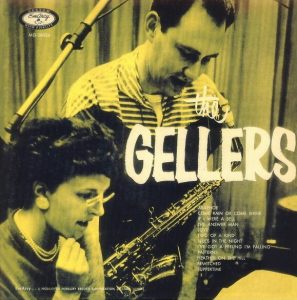
In New York he met pianist Lorraine Walsh, who had been playing with the Sweethearts of Rhythm. Herb took her away from all that in 1951 by marrying her and whisking her off to Los Angeles, where she performed with Shorty Rogers, Red Mitchell, Stan Getz, Dizzy Gillespie, and Charlie Parker. Herb worked with Maynard Ferguson (1954-56), Shorty Rogers, Bill Holman (in 1954,  and then again from 1957-59), and his own quartet. In 1952, Herb played with Billy May's big band. In 1955, Lorraine and Herb made an album called The Gellers with Red Mitchell and Mel Lewis.


Herb said, "Nesuhi Ertegun wanted to record me in New York. He said, 'Think of a project.' And I said that whatever it was, I wanted Scott LaFaro on it. My favorite pianist was Hank Jones. At that time a lot of people were doing show albums. I had seen Gypsy, It had a great score. Jule Styne did the music, Stephen Sondheim did the lyrics. I said, "How about doing the music from Gypsy? And Nesuhi said, 'Okay.' I started writing and I told Hank Jones that I needed a trumpet player and a drummer, and he said, 'Get my two brothers.' So Scotty was thrilled about that.


"I'm walking down the street, down Broadway, and I ran into this girl, black girl. She said, 'Herb, don't you remember me? I sat in with Shelly's band when you were in Milwaukee. And I sang.' I said, 'Oh yeah!' She was a fantastic singer. I told her I was doing a show album and she should sing a couple of the tunes. I called Nesuhi and told him and he said, 'Okay, I'll take a chance.'


"I rehearsed with her. I showed her the four tunes and she learned them immediately. We were recording the whole thing in two days. I got there the first day and Elvin Jones was not there."


"Oh oh," I said. Elvin had that reputation.


"I called up and he was still sleeping. I said we could rehearse the girl until Elvin got there. And she spoke in a whisper. She said, 'I lost my voice.' Her husband, who was a trumpet player, said, 'Every time she gets into the studio, she loses her voice. But don't worry about it. I know how to fix it.' He disappeared for about ten minutes and came back with a small bottle of vodka. And she took it right down, the whole bottle. And her voice was back. But she couldn't sing!


"The second day, I was really under the gun. I had to catch a flight at 7 o'clock that evening, pick up my car, and drive to Las Vegas, because I was opening that night at the Flamingo Hotel with Louis Bellson's band. I'd never played with the band before. The band was playing in the lounge, and Louis said, 'I've got five or six arrangements featuring you.' He'd had them written for me.


"So I was under a lot of pressure that day. And Elvin Jones didn't show up again. He came about an hour late. There was one song called Some People. I love it but it's the hardest tune I ever played. The harmony moves very fast at that tempo. At the end of about an hour and a half, Hank said, 'I have to leave. You told me the date was only three hours long.' I had promised Nesuhi we wouldn't go overtime. So Hank split. So we did one song without piano. There was one song, the Cow Song. I asked Scotty if he could do it solo. It was a little high, but he did it beautifully. Billy Taylor came in for the last tune, and we finished the date.


"I get to the airplane and make the flight to L.A. I get in my car to go to Las Vegas. At that time there was no freeway. It was July. I get out on the desert and I get a blowout. It seemed like it was 150 degrees. I changed the tire and went a few more miles and another tire blew out. The heat had just exploded the tires. And I'm stuck in the middle of the desert. I hadn't slept, and I kept thinking about the record date.

"I hitch-hiked. I got a ride to a gas station. The guy said he could get the tire in about two days. I called Louis Bellson. We were supposed to start at eight. It was now about six in the evening. He says, 'Don't worry. Pearl is going to pick you up. Tell me where you are exactly.'


"There was no air conditioning in this place, just a fan. I got a bottle of wine. Then this big Cadillac pulls up. Hey, honey chile. Pearl drove me to the motel, I took a shower and shaved and hit the stage. The first number was Just One of Those Things at a tempo like this." He tapped out a very fast tempo. "I soloed all the way through on an arrangement I had never played before.


"They were two of the most hectic days of my life. And that's the story of the Gypsy album."


Lorraine Geller died of pulmonary edema, the consequence of severe asthma, at the age of thirty on October 13, 1958.


"After she died," Herb said. "I went through a very bad time. Depression and drugs and whatever. I just didn't have a great desire to live. I was always working. I never was out of a job. But I didn't want to play any more. I put our house up for sale.


"I was working at a strip tease club. When I didn't have a good gig, I could always work there. And one night a lady I knew called me and asked, 'Are you playing somewhere tonight?' I said, 'I'm playing at a club.' It was a place called The Pink Pussycat on Santa Monica Boulevard. She said, 'A good friend of yours wants to drop by, and he wants to surprise you.' I said, 'Okay.' I was in the middle of Night Train and in walked Stan Getz.


"All kind of jazz musicians played there. The people there liked me. I knew all the tunes. Lorraine had worked with Stan. Stan and I were talking, and he said, 'Herb, you should go to Europe.'


"I said, 'I might do that.'


"He said, I’ll tell you what I'll do. Go to Copenhagen. I know some people there.” He lived there for a while. He played at a club called the Montmartre. That was the jazz club. He said, I’ll write the people and tell them that you're coming.' He wrote the letter, which was very nice. We were very good friends.


"The house finally was sold, and I sold my car. I bought a one-way ticket to Copenhagen. And two days before I was to leave, I got a call from Benny Goodman to go to South America. I cashed my ticket in. I flew to New York and we rehearsed and we went on tour in South America. We ended up in Sao Paulo, Brazil. And every night I was going to a club and jamming. It was a dance place, but they were playing bossa nova and light jazz. The owner was a piano player. He said, 'If you were staying here, you could play here all the time.' I said, 'Well I've got no reason to go back. I can stay. Will you pay me so much money per week?' He said, 'Yes.' The rest of the Goodman orchestra left. Mousey Alexander was the drummer. Buck Clayton, Arvell Shaw and Bob Wilber were on that band. I said good-bye and they went back to New York.


"I stayed in Sao Paulo for close to two months. And I got tired of it. It was New Year's Eve and I got very depressed. They were playing bad music that night, and I didn't even play. I just sat there. I said, I’m leaving.' I cashed my couple of Benny Goodman checks and I booked a boat on the Italian line, the Julio Cesar. I had to go to Rio for a couple of days. The boat was sailing from there to Naples. Just before I was to leave, this guy who was the manager of a Brazilian comic approached me. They were going to do a show in Portugal. He said, 'Get off the boat in Lisbon, and work with us for two weeks, and you can make a little money.'


"I got off at Lisbon, and the people arrived to do the show a couple of days later. We started to play. It was January, and it was ice cold. We played in the pit with gloves on. I was supposed to go on the stage and play a rock-and-roll number with this comic. I refused to do it. The worst thing was that the band was so out of tune. We couldn't get in tune because of the cold. I got back to the hotel, and I said to the night manager, 'Is there a plane leaving for Paris?' He said, 'Yes, there's one leaving at eight o'clock.' I said, 'Book me a ticket.'


"In the morning, just as I was leaving, I ran into the manager who booked me. He said, 'Where are you going?' I said, 'Sorry, man, I just can't do it.' He was very nice and even suggested a nice hotel I could stay at in Paris.


"I got to Paris. And I looked at the newspaper and Kenny Clarke and Kenny Drew were playing at the Blue Note. I went to the club that night, and Kenny Drew said, 'Hey, we've got some gigs coming up. Do you want to do them, in a quartet?' So I started working immediately. Then I was doing a radio show for a while, and I was in Paris four or five months."


They played a concert in West Berlin.


Herb said, "The Wall had gone up about a year before. In the band were some very good musicians, and there was a great band at Sender Freiess Berlin, which translates Radio Free Berlin. Nat Peck was in the band, and Benny Bailey. And Joe Harris, who had been the drummer with Dizzy Gillespie, and Ake Persson, marvelous trombone player from Sweden, and Ack Van Rooyen and his brother Gerry Van Roy en. Ack plays trumpet and fluegelhorn, and Jerry was the arranger and composer for the band. Ack is still very active but Jerry is retired with Parkinson's. They said, 'Why don't you join the band here?' They said it's great here, spies and intrigue, and all kinds of things going on.


"There were two radio stations sending propaganda into the east, that one and RIAS in the American sector. That stands for Radio in the American Sector. Francy Boland and Ake Persson were in the RIAS band. Francy was mostly writing. I gave up my apartment in Paris and moved to Berlin, which is where I met my wife. Her maiden name is Christine Rabsch. Her father was a music professor and a close friend of Paul Hindemith. We met in September, 1962, got married in December, and the baby was born in July. Figure it out. We've been married for forty-three years.


"I was in Berlin for three years, and then I had a falling out with the contractor, who was being paid by the radio. He wasn't a hundred percent honest. He owed me some money for some things he had promised. I quit, and we were getting ready to move back to Los Angeles with our baby girl. Then I got a telephone call from a dear friend of mine, Rolf Kuhn, the clarinet player. I knew him from New York. He was sort of a protege of Benny Goodman's. He said, 'I'm leaving the Hamburg radio orchestra and I've recommended you to take my place.'


"I said, 'We're leaving for Los Angeles, but we haven't got our tickets yet.' He said, 'Well come to Hamburg.' So I went there for five days and did an audition, and they hired me. That was in 1965.

"Leo Wright replaced me in the SFB band, and later Carmel Jones and Al Porcino came into that band. Sad to say that both stations no longer have big bands.

"So instead of going to Los Angeles, we moved our furniture and everything to Hamburg. It was more money than I was making in Berlin. We worked for nine months a year but we were paid for thirteen. All medical bills for the whole family, including dental, were covered. Glasses! Hearing aid!" He laughed. "It was a good gig! And every year we got a raise to compensate for inflation."


Soon he was also teaching. He became a professor at the Hamburg and Bremen conservatories, teaching composition and arranging, among other things.
"I had started playing the flute. There was a drunken American soldier in a club, and he needed some money, and he sold me his flute. I started practicing three or four hours every day. I thought, If I go back to L.A., it gives me a good double. I played clarinet, but I had never played flute. And then they told me I could arrange for the orchestra in Hamburg and make extra money. I'd written only a few arrangements in my life. And here was a chance to develop my arranging skills. And composing also. So I figured I'd stay a couple of years and get my flute chops and learn the oboe and the English horn. And get a bass clarinet, everything to compete in L.A.


"So I got very busy. And every year, during our summer vacation, we'd visit L.A. All the studio guys said things were bad and nobody was working. I'd always made several recordings a week while I was in L.A., film backgrounds and whatever. They said, 'What kind of job do you have?' and I told them, and they said, 'Stay there! Can you get us on the gig?'


"The Vietnam war was on. I said, 'I'm not going to stay here and pay taxes for that.


"So I went back to Hamburg. After five years, they said, 'You can't have this contract any more.' I had a contract with extras, the same as Rolf Kuhn. I conducted the orchestra eleven times a year. I had four combo productions and fifteen solo titles. I'd write an arrangement, get paid for it, play the solo, get paid for it, conduct the band, get paid for it. Above and beyond the salary. Then they said, 'You can't have the contract any more. You either join the band as a regular member, but you're on the highest pay scale, or you have to leave.' And the Viet Nam war was getting worse, so I said, 'I have to make a choice. Either Richard Nixon or Willie Brandt.' I chose Mr. Brandt, because I really liked him. So we stayed, and our second son was born, and we bought a house."


As Herb and I talked, I kept noticing that he spoke like someone else I knew. It was really disconcerting me and then I got it. He talks quite a bit like my almost-lifelong friend the bassist Hal Gaylor. I told Herb that. Herb said:


"This is a coincidence. I was doing a tour of Ireland. There's a legendary Irish guitar player."


"Louis Stewart?" I asked.


"You got it," Herb said. "Did I tell you this story?"


"Nope. I just know who he is."


"Well the agent said, 'I've got three days for you in Ireland. I've got all the musicians for you everywhere except Ireland, and the promoters are going to get you those.' I said, 'Is there any chance I can play with Louis Stewart?' Because I'd heard so much about him. And there was a pause and the woman said, 'I never want to hear that name again.'


"The first gig was okay. For the next two gigs, Louis Stewart was to join us. The second night, the promoter, an amateur tenor player, wanted to jam with us, so we had to play the tunes he knew. It was rather depressing.


"Meanwhile, I heard the story of what had happened. The agent had booked Louis Stewart on a tour and he was the leader and he didn't like the rhythm section and after about the third gig, he disappeared. Nobody knew where he was; he was hidden somewhere. And that's why she didn't want to hear the name again.


"Well on my third gig with him, we were playing at the Bank of Ireland at the Fine Arts Center in Dublin. Beautiful hall. This time we were going to play some real tunes. I pulled out some things I thought didn't require any rehearsal. We were in a small wardrobe. There was a piano there. And there was a big sign saying, 'Smoking not allowed. We have smoke detectors.' And Louis Stewart was sitting underneath the sign, smoking a cigarette. I said, 'Louis, we go on in a few minutes. And the sign says No Smoking.' He said, 'Oh don't worry about it, man.'


"Now he lived in Dublin and had played here before. We go on the stage and the first tune we play is The Red Door, Zoot Sims' tune. I played the melody and did some choruses. No piano. He starts playing a solo. I look over at him. And smoke is coming out of him. And all of a sudden it started smelling bad. I tried to be real cool. I said, 'Louis, you're on fire, man.' He said, 'Don't worry about it, man, don't worry about it.' And he finishes his choruses. He had a lit cigarette in his pocket, and it burned a big hole in his jacket. He was very calm about it. We played the rest of the gig, and everything was cool.


"We were going from the second gig to the third. We were driving. I'm telling a story about a little band I had together in Cincinnati, Ohio. He said, 'Who was in that band?' I said, 'I had a guitar player named Billy Bean.' And all of a sudden he gets hysterical. He says, 'Billy Bean! That's my favorite guitar player.'"


"That's the connection," Herb said. "I really liked Billy Bean, but I had never thought of him with such lofty praise.


I said, "Yeah, Hal Gaylor loved him."


"Louis said, 'What happened to him?' And I said, 'I have no idea.' Well, I get back to Hamburg. About a week later, I get a letter from a man named Seth Greenberg. He said, 'I'm writing a biography on Billy Bean, and I'm sending you some pictures to download.' One of them was with Hal Gaylor. I recognized Don Payne in one of them. I told the guy, 'I really can't tell you much. I worked with him one summer for about six weeks in Cincinnati, Ohio, in 1960. He was a great player. And this guy said, 'Billy gave up on life about thirty years ago and just stays home.' I said, 'Can you give me his telephone number?' He gave me a number. I tried it about twenty times. There was never any answer. Once I got a busy signal. That was encouraging. Scotty worked with him too. Billy had worked with Tony Bennett."


"So had Hal. And Hal and Billy Bean had a trio with Walter Norris on piano. I believe Walter is living in Berlin."


"He is," Herb said. "I saw Walter two months ago. I played a gig there. My daughter was with me and we went to his house for dinner. He doesn't play much any more."

Herb said, "I compose a lot. I sit there and I'll get an idea. I'll write it out and edit it and edit it. Then I'll say, 'Okay, let's see what it sounds like on the saxophone.' Transpose up quick.


"Even if a tune is not finished, you should try to finish it somehow. And then I can always go back and correct it. I can write a tune in ten minutes and then edit for a month. I'll transpose it for alto, and think, 'Oh my gosh, this is much better.' I'll immediately find things to do that improve it, although on the piano I thought it was perfect." He laughed. "But somehow, you put the horn in your mouth, and the way I breathe and the way I live changes it. I make a quick note of it on the computer."


I said, "I have a theory that anyone who plays more than one instrument plays the second one with the influence of the first. And since Scott LaFaro played saxophone before he took up bass, that may to some extent explain his melodicism. Oscar Peterson played trumpet, and I think you can hear it in the playing, that bright projection. Bill Evans played flute. Bob Magnusson played French horn before he played bass. Jack DeJohnette played piano before he played drums. John Guerin played tenor before he played drums. I think what you hear is the conception of the other instrument."


Herb said, "I heard a solo album by Hank Jones, playing like Tatum. He was doing his own thing, but it was like a tribute to Tatum. I didn't know he could play like that."


"I heard Jimmy Smith do the same thing at a party at Sarah Vaughan's house. He was playing piano, and he sounded so much like Tatum."


"Jimmy Smith, the organ player?"


"Yep. Piano was his original instrument. He said, 'Well, that's my Art Tatum imitation for the evening,' and walked away from the piano."


Herb said, "I'm not a fan of organ. Two years ago I played an event for Ken Poston [Los Angeles Jazz Institute]. And I was very good friends with Benny Carter."


"Oh. Dear dear Benny," I said.


"I finished my set. It was like a jam session. And I walked out, and a car pulled up, and it was Benny Carter and his biographer, Ed Berger. And Benny said, 'I came here especially to hear you.' And I said, 'Well, you missed it.' We sat together for the next set and there was an organ and it was very, very loud. And it was hurting me, and I was concerned for Benny's health. Benny said, 'Herb, did you ever make any records with organ?' I said, 'I think I made one. I sat in once with Wild Bill Davis in Atlantic City.' He said, 'I did two records — the first and last. I never did it again.'"


I said, "It's an instrument that can overpower anything with its loud pedal."


"Yeah," Herb said, "You can't compete with it."


I said, "I'll tell you a story about that. Joe Mooney was a good friend of mine. He was playing a gig and singing, and you know how softly he sang. Remember his Nina Never Knew with Sauter-Finegan? Well that night, it was a rich, loud crowd and the gig was in a very noisy club somewhere on Central Park South. And Joe gave up singing that night, since nobody was listening, and just played organ, and he kept raising the level with that pedal in order just to be heard. And at the end of the set, he sat down with me, and said, 'Well, I didn't shut them up, but I sure had them crescendo-ing like hell.'"


"He played accordion too," Herb said.


"And piano. A lovely, sweet, gentle man. I never knew anyone who bore misfortune with so little lament. He had been crippled by polio and he was blind, and yet he remained a really funny cat. I remember when he moved back to Florida from New York, he said, 'If this is the Apple, there's a worm in it.' And when I asked him if he had a swimming pool in Florida, he said, 'No, I'll just go out and dive in the dew on the grass.'


I came to know Herb Geller when Alastair Robertson, the proprietor of the small British Hep label, told me that he was producing an album by Herb Geller of some of the songs of Arthur Schwartz. I suppose somebody else may have done that before, but I don't know about it. And I have always admired Schwartz, ranking him close to Jerome Kern as one of our greatest melodists. The recording was to include Dancing in the Dark, I'll Be Tired of You, Alone Together, I See Your Face Before Me, Come A-Wandering with Me, By Myself, Haunted Heart, A Gal in Calico, I Guess I'll Have to Change My Plan, You and the Night and the Music, They're Either Too Young or Too Old, Oh But I Do , Something You Never Had Before, Something to Remember You By, and That's Entertainment.


Listening to it, I realized I hadn't heard Herb Geller in years. Whitney Balliett once aptly defined jazz as the "sound of surprise." But listening to this CD, one might add that it is also the sound of discovery, which of course can be the cause of the surprise. Herb Geller gets into phrases and whole tunes in unexpected ways. Herb is absolutely individual. He sounds like no else, and no one sounds like Herb. He has a unique approach to inflection, a full tone, and a slow romantic vibrato, whether he is playing alto or soprano saxophone, which he does on I'll Be Tired of You, By Myself and I Guess I'll Have to Change My Plan. And of course he's inexhaustibly inventive.


He is abetted in the enterprise by a lovely British rhythm section that includes John Pearce, piano, who has worked with Jack Parnell, Robert Farnon, Conte Candoli, Art Farmer, Eddie Daniels and Peggy Lee. The bassist is Len Skeat who had worked with Ruby Braff, Scott Hamilton, Joe Newman, and Bob Wilbur. The drummer is Bobby Worth. It's a lovely, sensitive rhythm section.


When I played the CD for Roger Kellaway, he looked shocked at the opening phrase of Dancing in the Dark, and said after barely a moment's pause: "It's joyous! It's such joyous music!" And after a minute more, "And such romantic music. It's so inventive, and so effortless. There's no sense of trying. He has complete command and doesn't even have to think about it.


"That's what we all strive to achieve."


At the end of November, 1993, Herb was automatically pensioned from the NDR on 60 percent of salary. "December 1 was my first day of freedom !" he said.


"I've done a few things there since then. I subbed for a week for the second altoist, and I was honored with a concert for my seventieth birthday, and a few years ago I did a concert for them with Charlie Mariano.


"In October I'll be doing a concert for them, playing the solos on the Marty Paich arrangements for the Art Pepper Plus Eleven album."


One can only hope that it is recorded and, eventually, released. We have heard far too little of Herb Geller in recent years on this side of the Atlantic.”

[Herb died in 2013 at the age of eighty-five]


Monday, February 19, 2018

Herb Geller - A Career Retrospective by Noal Cohen

© -Steven A. Cerra, copyright protected; all rights reserved.
Noal Cohen maintains a Jazz history website replete with a number of discographies of important Jazz artists and he is also the co-author along with Michael Fitzgerald of Rat Race Blues: The Musical Life of Gigi Gryce that is now available in a second edition.
You can locate more information about both via the following links:
The following blog posting, which is as an adaptation from another format, is presented with the author's permission.

© -Noal Cohen, copyright protected; all rights reserved; used with the author's permission.

Introduction
Although saxophonist Herb Geller (1928-2013) is remembered mainly for his significant contributions to the 1950s West Coast jazz scene, he actually spent the bulk of his professional career living and performing in Europe. A native Californian, he gained recognition through recordings with Shorty Rogers, Chet Baker, Maynard Ferguson, Clifford Brown and a series of highly regarded sessions for EmArcy Records under his own leadership, often in the company of his wife, the pianist Lorraine Walsh Geller. (They married in 1952.)
But the tragic death of Lorraine in 1958 at the age of only 30, due to complications of asthma, sent him into an emotional tailspin from which it would take years to recover. Their one year-old daughter Lisa, born with serious health problems, was adopted by his sister, an additional traumatic event that, at least, allowed Geller to continue to work. At the suggestion of Stan Getz, and while living temporarily in Sao Paulo, Brazil following a tour with Benny Goodman, he made the decision in 1961 to give Europe a try and initially landed in Paris; however, it would be Germany, Berlin (SFB (Radio Free Berlin) Orchestra) and finally Hamburg, where Geller would settle, eventually carving out an enviable career with the North German Radio Network (NDR). Although Geller had not planned to permanently relocate, the financial security and benefits the NDR position offered were too generous to turn down. He remarried and had two children, Olivia and Sam, with his second wife, Christine, whom he had met shortly after arriving in Germany.
Wolfgang Schlüter, Birdland Club, Hamburg, Germany – unknown date
Geller performed with the cream of European musicians including Friedrich Gulda, George Gruntz, Peter Herbolzheimer, Ack and Jerry van Rooyen, Rolf Kühn and Nils Lindberg as well as visiting Americans such as Art Farmer, Slide Hampton, Chet Baker, Johnny Griffin, Stan Getz, Phil Wilson, Joe Pass and Bill Evans. There were also some notable fellow ex-patriots with whom he collaborated, namely Kenny Clarke, Kenny Drew, Jiggs Whigham, Charlie Mariano, Walter Norris and Al Porcino. And the NDR ensembles – the “Bigband,” “Studioband” and “Dance and Entertainment Orchestra” – were populated with some of Europe’s most talented jazz artists and writers. Among these, mention must be made of vibraphonist/percussionist Wolfgang Schlüter (b. 1933), highly regarded in Germany but little known in the US and a frequent session-mate of Geller’s over the years.
It was at the beginning of his NDR tenure in 1965 that Geller added additional woodwind instruments to his armamentarium including piccolo, flutes, oboe and English horn. While this was an effort to increase his versatility in the new work environment, his jazz flute turned out to be a major complement to his established saxophone skills. The soprano saxophone was added in 1968 and he would frequently alternate the higher pitched horn with the alto in the years following, applying his rich tone and sparkling conception to a very difficult instrument.
Unfortunately, many of Geller’s European recordings have never been issued. The INA (French National Audiovisual Institute) in France has made some of his Paris appearances in the early 1960s available as audio and video downloads from their website; however, few of the countless sessions he participated in during his 28-year stint at the NDR studios in Hamburg (1965-1993) as performer, composer, arranger, and conductor have seen the light of day except for unauthorized recordings made by collectors dubbing radio broadcasts.
Regrettably, but not surprisingly, Geller’s decision to become an ex-patriot and devote the bulk of his musical efforts to largely unissued radio and television studio sessions has caused him to be somewhat forgotten in his home country. It is the purpose here to present some of the highlights of his European years that may not be well known or sufficiently appreciated. But before getting into that, let me say a few words about my personal experience with him and how our relationship developed.
My first exposure to him occurred through the US recordings mentioned above, now 60 years old, although like all great music, they stand the test of time well and still sound fresh and creative. Among the many “West Coasters” in vogue at the time, his playing had a special attraction for me because of its fluidity, solo construction and emotional appeal. I also appreciated his stylistic ties to both Charlie Parker and Benny Carter, an approach that, in my opinion, set him apart from other saxophonists of the 1950s. There was a fire in his early playing that remained a recognizable attribute right up to his final performances in 2012.
In 2011, I decided to compile a detailed discography of Geller as part of my effort to shine light on certain artists I have always felt were worthy of greater recognition. As a point of reference, my subjects also include saxophonists Gigi Gryce, Lucky Thompson, Frank Strozier and Bob Mover. Unfortunately, I never got to interview Geller, but during the course of my work, we exchanged many emails that often contained amusing and enlightening comments and I have taken the liberty of quoting several of them herein (his words in italics). During the period of our electronic correspondence, Geller suffered several bouts of pneumonia, some of which required hospitalization.
In placing Geller’s European career in perspective, it should be noted that he often accepted work in musical genres well outside the jazz realm including pop, rock, klezmer, cabaret and even some electronic sessions. About some of these, he commented: I did several recording sessions with various rock groups. They usually consisted of me alone with earphones. They were strictly ‘take the money and run’ affairs. Usually I did not know if I was playing with musicians or machines.These recordings, details of which are nearly impossible to obtain, are not included in the discography nor are they discussed here.
Geller’s European professional history is immense and space limitations preclude a thorough examination of his oeuvre; however, I have selected a number of sessions that while somewhat under the radar, in many cases are commercially available (although I make no guarantee finding them will be easy). The complete discography covering this period can be found here.
The Jazz aux Champs-Élysées (JACE) All Stars – Paris, April-July 1962
Sayton 1005
Before moving to Germany, Geller made a number of radio appearances on the RTF (Radiodiffusion-Télévision Française) radio show Jazz aux Champs-Élysées hosted by pianist Jacques “Jack” Diéval (1920-2012). In all of these, the pianist’s trio mates, bassist Jacques Hess and drummer Franco Manzecchi, were present and a frequent guest, in addition to the saxophonist, was the trumpeter Sonny Grey (1925-1987). Originally from Jamaica, Grey spent most of his career in Paris as a capable hard bop player. He organized a big band for which Geller contributed an arrangement of his own composition “Scotch Squatch.” The few extant recordings of Grey’s ensemble have been reissued by Fresh Sound Records. Grey can also be heard on the recently issued (2016) Larry Young in Paris: The ORTF Recordings (Resonance Records) from 1964 and 1965.
Other participants on these broadcasts included trumpeter Bernard Vitet, tenor saxophonist Francois Jeanneau and vibraphonist Dany Doriz. The material performed was largely familiar standards and some bebop/hardbop chestnuts like Jimmy Heath’s “C.T.A.,” “Crazeology” by Charlie Parker and Benny Harris and Bobby Timmons’s “Moanin’.” The quintet with Grey, however, covered a relatively infrequently heard Thelonious Monk composition, “Brake’s Sake,” which debuted on a 1955 Signal Records session led by Gigi Gryce.
Geller offered these comments on his work with Diéval and more: We were doing a show called Musique des Champs Élysées and presenting it over several major cities in Europe. We also did a radio studio production once a week. We always played as a quintet. There was a fine trumpet player named Sonny Grey in the group. I also did some things in the Blue Note in Paris where I played with Kenny Drew, René Thomas (guitarist), Lou Bennett, Pierre Michelot and Kenny Clarke. I have a videocassette of a TV recording there. Also I did a recording for the West Berlin SFB (where I played for three years before Hamburg). I was the leader for a session, did the writing and the band consisted of Donald Byrd, Dexter Gordon, Francy Boland, Joe Harris, Ake Persson and Juergen Ehlers (bass) and it is possible it is in the archives of SFB. It was 1964 or 1965. I did an arrangement of Hoagy’s ‘Blue Orchids’ featuring Dexter.
None of Geller’s recordings with Diéval has been issued on CD but can be downloaded from the INA website as audio files after an account has been established.
NDR Jazz Workshops 1962-1982
The NDR broadcasts included a series of “Jazz Workshops.” This long-running series was established in 1958 by Hans Gertberg, a theatrically trained radio personality and director. Austrian saxophonist Hans Koller was the program’s first musical director. Over the years, an impressive list of European and American musicians participated in the broadcasts, many of which featured original compositions and arrangements and covered a broad range of genres, some of the material being quite adventurous. Unauthorized recordings of many of these programs have circulated among collectors for years. Herb Geller participated in nine of the workshops representing a diversity of musical settings, the first two taking place before he was formally employed by NDR:
Workshop No.
Date
Leader
26*
June 29, 1962
various
29
March 27, 1963
various
46
June 24, 1966
Bill Smith
61
March 28, 1969
Albert Mangelsdorff & Charles Tolliver
64**
November 28, 1969
Slide Hampton
71
April 30, 1971
Peter Herbolzheimer
76 (see below)
February 14, 1972
Herb Geller & Bill Evans
156
December 12, 1980
George Gruntz
170
April 2, 1982
George Gruntz
*Geller contributed an arrangement of one his compositions to this workshop: “Feeling Certain,” based on the chord changes of George Gershwin’s “That Certain Feeling.” On composing, he offered the following: I wrote several songs based on chord sequences: I did one on ‘High On a Windy Hill,’ on ‘Deep In a Dream’ and on ‘You Go to My Head,’ all of which have interesting progressions. When composing one has to start somewhere – a rhythm, a melodic motif, a title or a chord sequence.
**Geller contributed a suite to this workshop entitled “Let Me Play the Lion Too” which is made up of several familiar themes. About this he commented: I had several productions in my first contract with the NDR. For the small group sets I was asked by the producer (Michael Naura) to do some American folk songs. I found a book with many choices and found 8 songs that were doable with some new harmonies. These were recorded. Later I was asked by the producer (Hans Gertberg) of the Jazz Workshop series to write a suite where I would play 8 different instruments (four flutes, oboe, English Horn and 2 saxes); somehow I ignored the clarinet. That suite [“Let Me Play the Lion Too”] was the result using the previous songs. It was almost a circus act. I don’t know where the animal title came from.
Early Bird Jam Session – June 7, 1965
Jacques Diéval Trio at the Early Bird Jam Session
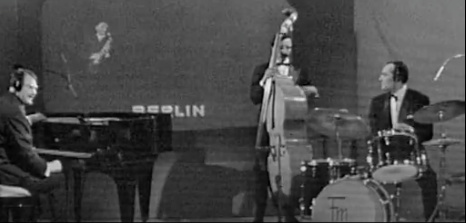
In an unusual and for the time, technologically challenging session, Jacques Diéval assembled an international aggregation of horn players joining his Paris-based trio in a performance of Lester Young’s blues “Jumpin’ with Symphony Sid.” The novel feature here involved the guests all performing in different locations (listed in solo order): Geller (alto sax) in Berlin, Jacques Pelzer (flute) in Brussels, Dino Piana (valve trombone) in Rome, Johnny Dankworth (alto sax) in London, Luc Hoffmann (alto sax) in Geneva and Billy Byers (trombone) in New York City. The television broadcast was part of the Jack Diéval Presents show. Video of this performance is available from the INA website.
In response to a question about this unconventional gig Geller commented: I do remember that. I think we did that gimmick a couple times while I was in Berlin. That was the same rhythm section [Diéval, Hess, Manzecchi] we used for all my associations with Diéval.
Art Farmer – Hamburg Souvenirs: People – December 1, 1965
This radio broadcast comprises an appealing collection of standards and, in a reflection of pop trends of the time, versions of “People” by Jule Styne and Bob Merrill from the show Funny Girl and Lennon and McCartney’s “Hard Day’s Night.” The program was performed by a sextet led by Art Farmer (1928-1999) on flugelhorn, with Geller on alto sax and flute, Wolfgang Schlüter, vibraphone, Michael Naura, piano, Eberhard Leibling, bass and Jimmy Pratt, drums. All of the arrangements are by Geller who commented: The Art Farmer production was the first thing I wrote for the NDR after taking the job. This session is not commercially available but unauthorized recordings have circulated.
Baden Powell – Grandezza on Guitar – December 10-11, 1971
CBS 80 141
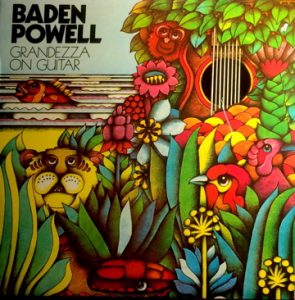
Geller’s only encounter with the Brazilian guitarist Baden Powell de Aquino (1937-2000) finds him only on flutes, but the music is samba at its best. Except for Ervin Drake’s “It Was a Very Good Year” (an alto flute/guitar duet), all the material was composed by Powell. The accompanists are Eberhard Weber on bass and Joaquim Paes Henriques on drums. About these sessions Geller commented: I remember I played flute and alto flute and Eberhard Weber was on bass and neither Baden nor the drummer could speak English or German, so it was a little complicated. The LP that resulted, Grandezza on Guitar, was issued on the European CBS (80 141 (1974); 22026 (1976)) and Japanese Epic (ECPM 107 (1974)) labels, but there seem to be no US releases and no CD reissues.
The Bill Evans Encounter – February 12 & 14, 1972
Bill Evans and Herb Geller, NDR Studio, Hamburg, Germany, Feb. 12, 1972
The only documented collaboration of Geller and piano master Bill Evans (1929-1980) took place as part of the NDR Jazz Workshop series mentioned above. Of great interest here is the filming of the rehearsal for the actual live performance two days prior to the event at the NDR studios by director Werner Schlichting and cinematographer Klaus Brix. According to Geller: They [Bill Evans Trio] arrived in Hamburg from New York, checked in at their hotel and [were] brought immediately to the Funkhaus. Geller (on flutes) is observed rehearsing his compositions “Sao Paulo,” “Northern Trail,” “Quarter Tone Experiments” and “Waltz of Dissension” with Evans, bassist Eddie Gomez and drummer Marty Morell. There is also an incomplete version of “What Is this Thing Called Love” with Geller on alto sax. The video has been issued on Jazz Shots (Sp.) 2869088 (2009 DVD) and the audio on Turning Point TUP 133282 (2012 CD).
The concert (NDR Jazz Workshop No. 76) took place on February 14, 1972 with the Evans trio playing several pieces before being joined by Geller on flute and alto flute. All the Geller compositions on the rehearsal video are performed along with another of his works entitled “Stockenhagen.” The concert has been issued on the Turning Point CD but no video of it seems to exist. In view of the quality of the music produced at this event, it seems a shame that Geller and Evans never again recorded together.
Dusko Gojkovic and the NDR Studio Band with guests Dexter Gordon, Slide Hampton and Horace Parlan – May 18, 1974
Here is the NDR Studio Band in live concert at the Fabrik club in Hamburg. Serbian-born trumpeter Dusko Gojkovic (b. 1931) is the leader with tenor saxophonist Dexter Gordon (1923-1990), trombonist Slide Hampton (b. 1932) and pianist Horace Parlan (b. 1931) on board as featured artists. Gojkovic, Hampton and George Gruntz contribute arrangements as does Geller who is responsible for a chart on the Jule Styne-Sammy Kahn standard, “I Guess I’ll Hang My Tears out to Dry,” a feature for Gordon. Geller himself solos on alto sax on Gruntz’s “Drinking Song,” soprano sax on Duke Ellington’s “Saturday Night Function” and Luis Russell’s “Jersey Lightning” and flute on Gojkovic’s “Latin Haze.” This concert has been issued on Gambit (Sp.) 69304_2 (2008 CD) as Dexter Gordon: The Complete Hamburg Concert 1974.
Herb Geller – An American in Hamburg: The View from Here – January 13, 1975
Nova 6.28332
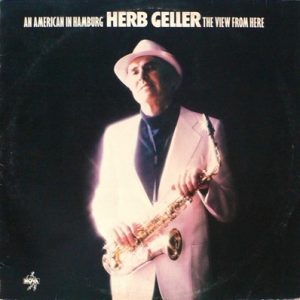
Geller’s only excursion into fusion and electronic music was undoubtedly inspired by trends of the 1970s and resulted in his first album as a leader since the Gypsy recording for the Atco label in June of 1959. With overdubbing, synthesizers and funk rhythms, it was certainly a major departure from the bebop/hard bop settings he had favored up to this point and, as it turned out, a stylistic approach he never returned to as a leader. All of the writing is his and four of the titles feature vocals with politically charged lyrics, three handled by the wonderful Mark Murphy and one by a singer named Earl Jordan, at the time a member of the Les Humphries Singers, a Hamburg-based vocal ensemble. This seems to be Jordan’s only appearance on a jazz recording. He made one LP under his own name, Jordan, on the British Sovereign label.
The international band that Geller assembled for this project was an impressive one with Palle Mikkelborg on trumpet, Wolfgang Schlüter on vibraphone, Philip Catherine on guitar, Rob Franken and Gottfried Boettger on keyboards, Lucas Lindholm on bass and Alex Riel on drums. Geller himself is heard on soprano, alto and tenor saxophones as well as flute and alto flute. The four vocal tracks “Rhyme and Reason Time” (the Jordan feature), “Sudden Senility,” “The Power of a Smile” and “Space al la Mode” were also recorded as instrumental versions. One other instrumental, entitled “Title Wave,” would surface on other recordings as “Cosmopolitan Meetings.” As one would expect, the performances are all flawless but at the same time frustrating because the fusion genre feels inconsistent with the leader’s more traditionally oriented attributes.
The results of this session were issued in Germany as a double LP on Nova (Ger.) 6.28332DX (1975) which included both the vocal and instrumental tracks. In the US, five of the titles were issued on Atlantic SD 1681 (1975) and later, Discovery DS 874 (1983), as Rhyme and Reason, single LPs lacking the instrumental versions of the vocal tracks. The full session is also available on Tramp (Ger.) TRCD 9024 (2013).
Herb Geller Quartet live in Siegen – November 24, 1984
By the mid-1980s, Geller began to appear more often on his own, away from the NDR studios. He appeared at the Jazzclub Oase in Siegen, a city 440 km. south of Hamburg, at the end of 1984, with a capable trio led by pianist Hartmut Sperl including Bernd Wolf on bass and Achim Bräuer on drum. Geller leads the group through a couple of sets of standard material this night that were recorded and issued on two Circle (Ger.) LPs, Hot House(241184/30) and Fungi Mama(241184/34). The twelve tracks, with the leader stretching out on alto sax in a relaxed atmosphere, are definitely worth a listen if the LPs can be found. There appear to be no CD reissues.
Herb Geller and Nils Lindberg – How ‘Bout It – November 11, 1985
Bluebell 197
Recorded in Stockholm, this septet session, led by the versatile Swedish pianist/composer/arranger Nils Lindberg, features Geller prominently on both alto and soprano sax. The rest of the band is made up of Markku Johansson on trumpet, Torgny Nillson on trombone, Joakim Milder on tenor sax, Jesper Lundgaard on bass and Rune Carlson on drums. Geller contributes two of his own compositions, “How About It” (aka “The Order”) based on the chord sequence of the standard “How About You” and “Stand Up Comic” (aka “Otto, der Film” – based on the chord structure of Jerome Kern’s “Nobody Else But Me”) written with both Lenny Bruce and the German comedian Otto Waalkes in mind. The latter performance along with that of Benny Carter’s “When Lights are Low” and a haunting ballad by Lindberg entitled “Shall I Compare Thee to a Summer’s Day” find Geller alone with the excellent rhythm section. This material was issued on Bluebell (Swd.) BELL197 (1986 LP) but apparently never reissued on CD.
Birdland Stomp No. 1 – Live in Hamburg – January 24 & 25, 1986
Enja 5019
There are two Geller albums called Birdland Stomp, the title taken from a Geller composition based on the chords of “Stompin’ at the Savoy” and named for a Hamburg jazz club that opened in 1985. This is the first and more obscure, a live outing at the Birdland club with the saxophonist backed only by Red Mitchell on bass and a guitarist named Michael Melzer (or Meltzer) about whom little seems to be known. The liner notes to the LP describe him as “a young, self-taught guitarist from Hamburg ‘who also works at the post office.’” Although a fine player, able to negotiate difficult material like Benny Carter’s “Summer Serenade,” the briskly paced title song, and the leader’s “The Princess,” this is apparently Melzer’s only recording. It should be noted that Geller was more than happy to mentor and provide instruction to young musicians in the Hamburg area having an inclination towards straight-ahead jazz and taught at the Hochschule für Musik there. His students included saxophonists Ernst “Fiete” Felsch (alto), Lütz Buchner (tenor) and Edgar Herzog (baritone).
Throughout the performances, Mitchell is featured prominently, the trio interacts cohesively and the absence of a drummer is no hindrance to solid swing throughout. On one track, “Come Rain or Come Shine,” we hear a vocal by Harold Smith, a Hamburg-based singer, drummer and percussionist originally from the West Indies.
Five titles from these two nights were originally issued on Enja (Ger.) 5019 (1987 LP) and a Japanese CD reissue in 2008 (VQCT 10011) added two more, “Hot House” and “Straight, No Chaser.”
Chet Baker – The Last Great Concert – April 28, 1988
Enja R2 79650
Chet Baker died on May 13, 1988, at the age of 58, after falling from the window of a hotel in Amsterdam. About two weeks before that tragic event, he appeared in Hannover, Germany with the NDR Big Band under the direction of Austrian-born trombonist, composer and teacher Dieter Glawischnig (b. 1938) in what became known as “The Last Great Concert.” This concert was recorded and issued on the Enja label, the tracks distributed over two LPs and CDs: The Last Great Concert – My Favourite Songs (R1/2 79600) and The Last Great Concert, Vol. II – Straight from the Heart (R1/2 79624). The entire concert is found on Enja (Ger.) R2 79650 (1994 CD).
Geller was in the band and solos on Monk’s “Well, You Needn’t” arranged by Horst Mühlbradt and Miles Davis’s “Sippin’ at Bells” arranged by Jörg Achim Keller. He also appears with Baker in a sextet including guitarist John Schröder, pianist Walter Norris, bassist Lucas Lindholm and drummer Aage Tanggaard performing George Shearing’s “Conception” (Geller solo), Dave Brubeck’s “In Your Own Sweet Way” and the Lane-Harburg standard “That Old Devil Moon,” the last title unissued.
Herb Geller – A Jazz Song Book – June 23-24, 1988
Enja 6006-2
Recorded at the NDR studios in Hamburg, this excellent quintet session, with tributes to some of his musical heroes, finds Geller on both alto and soprano again in the company of guitarist Schröder and pianist Norris with visiting Americans Mike Richmond on bass and Adam Nussbaum on drums. All the material was composed by the leader: “Cosmopolitan Meetings” (aka “Title Wave” from the January 13, 1975 fusion session), “For Chet” (aka “Chet Baker/Chet and the Devil”) “For Joe” (aka “Joe Albany”), “The Law,” “The Groove and I” (aka “Mr. Music” for Al Cohn), “How About It” (duet with Norris), “Little Big Sam” and “L.A. Daze.” This material was issued on Enja 6006-2 and a subsequent CD (R2 79655) that included an additional track, Geller’s beautiful bossa nova “Landscape,” dedicated to saxophonist Harold Land. This album was a precursor to his 1995 Musical Autobiography CD on the Fresh Sound label (see below).
Benny Carter All Star Sax Ensemble – Over the Rainbow – October 18 & 19, 1988
MusicMasters CIJD 60196Y
Geller made several visits to the US after settling in Germany. The first recording session back home took place in New York City in 1988 and was led by his idol, Benny Carter. It certainly was an honor and pleasure to have been included in this project along with the stellar line up of Jimmy Heath and Frank Wess on tenor saxophones and Joe Temperley on baritone. The fine rhythm section present was made up of Richard Wyands on piano, Milt Hinton on bass and Ronnie Bedford on drums. Four of the compositions and all of the arrangements were Carter’s who shared section lead duties on alto with Geller. This session was issued on MusicMasters CIJD 60196Y (1989 CD).
Ed Berger, the session producer and Carter’s manager and biographer, comments about Geller in the liner notes: “A powerful soloist and indefatigable lead player, Geller returned to the US especially for this date, calling the trip ‘the greatest vacation I ever had!’” Berger offered some additional comments in an email: “Many of the five-part sax soli were written by Benny right before the session (especially ‘Ain’t Misbehavin’’) so they hadn’t rehearsed them, which led to a lot of discussion and trial and error before each take. Herb, in trying to be helpful, had a lot to say, but it was all well-meaning. Benny didn’t seem to mind at all… Benny liked Herb, who visited him at his home in LA a couple of times while I was there. [One] time (in 2002, the year before Benny died) I was visiting, and Benny suddenly said, ‘Why don’t we go hear Herb Geller this evening?’ Herb was leading a group at a club at LAX. So we drove down there, and as we walked in Herb happened to be playing Benny’s ‘Key Largo’ although he had no idea Benny was coming. Herb was very moved, stopped playing, and made a speech about Benny. He couldn’t believe it!”
Herb Geller and Benny Carter at the Over the Rainbow recording session – Photo by Ed Berger
Birdland Stomp No. 2 – Barcelona Studio – May 24-25, 1990
Fresh Sound FSR-CD 174
The second Geller album title Birdland Stomp resulted from a session recorded in Barcelona where Geller had assembled an outstanding international quartet including pianist Kenny Drew from the US (but living in Copenhagen), Niels-Henning Ørsted Pedersen from Denmark and British drummer Mark Taylor. The group reprises the title tune and performs Charlie Parker’s blues, “Cheryl,” two standards and a five-part “Ellington & Strayhorn Medley.” These titles were issued on Fresh Sound (Sp.) FSR-CD 174 (1991).
Drummer Taylor, now based in New York City, was 28 at the time and occasionally played gigs with Geller. In a 2016 telephone interview, he recalled that on the day following this session the quartet was augmented by trumpeters Roy Hargrove and Gerard Presencer and the resulting sextet recorded another entire album that, for reasons unknown, has never been released. Taylor also remembered Geller’s intense but futile attempts to induce Drew to stop smoking.
Herb Geller with Nick Weldon (piano) and Peter Ind (bass) at the Bass Clef, London, April 1990 – Photo by Brian O’Connor
Herb Geller with the SDR Big Band led by Manny Albam – May 24, 1992
Intercord IRS 973.401
Manny Albam (1922-2001) was an arranger for Maynard Ferguson’s 1956 big band of which Geller was a member. They also collaborated on Albam’s 1957 Jazz Greats of Our Time, Vol. 2 project for Coral Records. In 1992, they reunited for a concert in Stuttgart when Albam was a guest conductor of the SDR Big Band (South German Radio now called SWR – Southwest Radio) that was recorded and issued on Intercord (Ger.) IRS 973.401 (1993 CD). Over the years, many world-class artists have appeared with this ensemble including Frank Foster, Clark Terry and Phil Woods. All the arrangements are Albam’s and Geller solos on soprano sax on “My Inspiration” and alto sax on “I Love You” (the Cole Porter song), “Lush Life,” “Caravan,” “Embraceable You” and two Albam originals.
NDR Big Band – Bravissimo and Bravissimo II – Joe Pass and Jiggs Whigham – November 27, 1992
Act 9232
Although I indicated that few of the NDR archival recordings had been issued, two authorized CDs did emerge on the German Act label containing selected performances of the big band with guest artists called Bravissimo: 50 Years NDR Bigband (Act 9232-2; 1996) and Bravissimo II: 50 Years NDR Bigband (Act 9259-2; 1998). Geller solos on several of the included tracks such as Lex Jasper’s arrangement of Horace Silver’s “Sister Sadie” recorded when guitarist Joe Pass was the featured guest and trombonist Jiggs Whigham, conductor in a November 1992 concert. Some of Geller’s arrangements are also found on these two CDs.
Back in LA – The Herb Geller Quartet – August 5-6, 1993
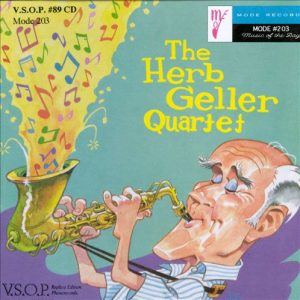
V.S.O.P. CD 89
The first recording Geller made in the Los Angeles area after relocating to Germany, this quartet session features Tom Ranier on piano, John Leitham on bass and the great Louie Bellson on drums. Geller had played in Bellson’s big band on several occasions. Four of the leader’s compositions are covered, “Chromatic Cry,” “Bankin’ on Bank” (aka “Celebrating Bird” – for the session producer Dick Bank), “Midnight Memories” and “Stand-Up Comic” (aka “Otto der Film”). Jimmy Rowles replaces Ranier on Rowles’s lovely ballad “The Peacocks.” Geller is heard here on both soprano and alto saxophones. This session was issued on V.S.O.P. 89CD (1994).
Herb Geller Quartet – Herb Geller Plays The Al Cohn Songbook – July 11-12, 1994
Hep 2066
About a year later, Geller was again in Los Angeles this time to record a tribute to Al Cohn. The band retains Ranier and Leitham but Paul Kreibich replaces Bellson on drums. Vocalist Ruth Price is heard on three titles, the leader’s “Mr. Music” (aka “The Groove and I”), the only piece on the album not composed by Cohn, “High on You” with Price’s lyrics and “The Underdog” (aka “Ah Moore) with Dave Frishberg’s lyrics. We are treated to a woodwind bonanza as the versatile Ranier is heard on tenor sax, clarinet and bass clarinet complementing Geller’s alto and soprano saxes. Cohn’s “Pensive” is performed as an alto sax/piano duet. This session was issued on Hep (Eng.) 2066 (1996 CD).
Jan Lundgren Trio with Herb Geller – Stockholm Get-Together – September 11-12, 1994
Fresh Sound 5007
Not long after retiring from the NDR, Geller travelled to Stockholm for a studio session with Swedish pianist Jan Lundgren (b. 1966) and his trio: Lars Lundstrom on bass and Anders Langerlöf on drums. The saxophonist prided himself on his knowledge of both The Great American Songbook and the substantial legacy of works written by jazz musicians. Here we find an impressive array of tunes from both categories as well as two of his own compositions, reprises of “Bankin’ on Bank” (aka “Celebrating Bird”) and “Landscape.” This session was issued on Fresh Sound FSR 5007 (1996 CD).
Herb Geller – Playing Jazz: The Musical Autobiography of Herb Geller – January 16-17, 19-20, 1995
Fresh Sound 5011
At the age of 65, Geller decided to document his life and career by composing a jazz-based musical. This project grew out of the aforementioned tributes he wrote for three of his influences after their deaths: Joe Albany, Chet Baker and Al Cohn. He incorporated these pieces into a musical memoir entitled Playing Jazz that was recorded by the NDR and performed at a festival in Redondo Beach, California in October of 1994.
In January of the following year, he reassembled the formidable Los Angeles trio of Ranier, Leitham, and Kreibich to record this 19-part suite. The quartet was supplemented by two narrators and four vocalists who tell Geller’s story from childhood through his European years, covering personal and professional triumphs and tragedies along with his musical philosophy. This has been issued on Fresh Sound (Sp.) FSR 5011 (1995 CD).
Herb Geller Quartet – I’ll Be Back – April 23-24, 1996
Hep 2074
Back in Hamburg, Geller recorded with his quartet at the time comprised of Ed Harris, guitar, Thomas Biller, bass and Heinrich Köbberling, drums. Of note here is the inclusion of three parts of his “Josephine Baker Suite,” “I’ll Be Back,” “A Bitter Dream” and “Too Little Time.” This suite was commissioned as part of a show called Josephine For a Day that played in Frankfurt in 1994. As always, the choice of material is impeccable, here including such gems as “A Handful of Stars” by Ted Shapiro and Jack Lawrence, his only soprano sax outing, Cole Porter’s “Dream Dancing” and “One Morning In May” by Hoagy Carmichael and Mitchell Parish. This session was issued on Hep (Eng.) 2074 (1998 CD).
Herb Geller Quartet – You’re Looking at Me – February 25-26, 1997
Fresh Sound 5018
Less than a year later, on another trip home to Los Angeles, Geller recorded the entire “Josephine Baker Suite” with Jan Lundgren on piano, Dave Carpenter on bass and Joe La Barbera on drums. Other notable covers include “Orson” by Ellington and Strayhorn, “Summer Night” by Harry Warren and Al Dubin, Cole Porter’s “All Through the Night” and the title tune, a Bobby Troup composition – hardly overdone material. “Restless” by Sam Coslow and Tom Satterfield is performed as a soprano saxophone/piano duet. This session can be found on Fresh Sound (Sp.) FSR 5018 (1997 CD).
Herb Geller & Brian Kellock – Hollywood Portraits – October 5, 1999
Hep 2078
A film lover, Geller did two Hollywood tributes, the first a duo with Scottish pianist Brian Kellock (b. 1962) recorded in Wembley, England. For this project Geller composed twenty new pieces, each one bearing the name of a famous actress, from Marlene Dietrich to Grace Kelly; from Mae West to Judy Holliday – a comprehensive catalog of beautiful and talented women. His soprano sax is heard on five of the pieces, the rest on alto. The moods, tempi and meter vary with some delightful waltzes included and the players are on the same wavelength throughout. Geller related how one of the songs came to be: I had composed a jazz waltz for my wife and called it “Christine”. It played on the radio and my wife did not recognize it so I wrote another waltz called “The Waltz I Wasted On Her” or “The Wasted Waltz.” “Christine” became “Greta Garbo” in the Hollywood Portraits CD. I do not remember which instrument I did it on in Holland but I played it on soprano for the NDR.
Geller’s melodic tendencies as both composer and soloist are demonstrated in this unique collection issued on Hep (Eng.) 2078 (2000 CD).
Herb Geller Quartet – To Benny and Johnny: With Love from Herb Geller – June 16-17, 2001
Hep 2084
Another trip to Los Angeles and another tribute project, this one pays homage to both Benny Carter and Johnny Hodges. Here Geller is backed to perfection by the recently deceased pianist Hod O’Brien (1936-2016), bassist Chuck Berghofer and again, drummer Paul Kreibich. The material is divided between compositions of Carter and those of Ellington and Strayhorn with which Hodges was associated and is a treasure trove of some of the best songs the jazz legacy has to offer and ones not covered that frequently. Of note is Carter’s elegant “Souvenir,” here given a touching performance by the quartet. O’Brien is the perfect stylistic match for Geller but apparently, this is the only time the two recorded together. Of the fourteen tracks, the leader is heard on alto sax on all but two, “Morning Glory” and “Dancers in Love.” “I Didn’t know About You” is an alto sax/piano duet and the brief “Twelve by Two for Squatty Roo,” Geller’s variation of the Hodges classic “Squatty Roo,” finds him backed only by Berghofer. This session was issued on Hep (Eng.) 2084 (2002 CD).
On February 22, 2002 in the Hamburg NDR studios, a very similar tribute was performed in concert where Geller was joined by Charlie Mariano on alto, pianist Jan Lundgren, bassist Jesper Lundgaard and drummer Alex Riel. At one point during the event, Geller speaks by phone with Benny Carter in America before the ensemble performs a medley of Carter’s songs.
Geller’s last commercial American recording took place on September 6, 2003 in Los Angeles, a recreation of the Mel Torme-Marty Paich dectet sessions of the 1950s featuring vocalist/trombonist Eric Felten with arrangements by Brent Wallarab. This was issued on V.S.O.P. 113CD (2004).
Herb Geller in Los Angeles, 2002 – Photo by Ed Berger
Herb Geller & Charlie Mariano – Halle Opera House 2002 – February 17, 2002
Hep 2096
Originally from Boston, saxophonist Charlie Mariano (1923-2009) spent time in the 1950s on the West Coast scene and like, Geller, eventually relocated to Germany. At the Opera house in Halle, Germany, the two veterans got together for a concert where they were backed by Geller’s able Hamburg-based accompanists pianist Burkhard “Buggy” Braune and bassist Thomas Biller, but no drummer. Of the thirteen titles performed, the two altos are both present on eight and the contrast in styles is striking. Mariano is clearly the more adventurous, often venturing into the altissimo range of the horn. Geller, on the other hand, takes a more conventional rhythmic and harmonic approach but swings more fervently. At times the two engage in simultaneous improvisation. The material performed is largely comprised of standards with no original material from either. Nine of the performances, taken from two sets of the concert, have been issued on a double CD: Hep (Eng.) 2096 (2011). As noted above, Geller and Mariano also performed a concert tribute to Johnny Hodges and Benny Carter in Hamburg five days after this event.
Herb Geller with The Roberto Magris Europlane – Il Bello del Jazz– August 28 & 30, 2003
Soul Note 121395-2
Geller made several appearances with the Trieste-based pianist Roberto Magris (b. 1959), another perfect stylistic partner for the saxophonist. In 2003, the two joined forces in a Trieste studio along with Croatian guitarist Darko Jurkovic, German bassist Rudi Engel and another Trieste native, Gabriele Centis on drums. The pianist contributes three original compositions, “No Sadness,” “Il Bello del Jazz” and “Parker’s Pen” while Geller offers his swinger “Stray Form” and a waltz entitled “Deception.” Yet again, the Great American Songbook is mined for seldom-heard gems such as “A New Town Is a Blue Town” by Richard Adler and Jerry Ross from the show The Pajama Game, “Here I’ll Stay” by Kurt Weill and Alan Lerner from Love Life and “Pretty Women” by Stephen Sondheim from Sweeney Todd. This session was issued on Soul Note (It.) 121395-2 (2006 CD).
A live appearance at the Novosadski Jazz Festival in Serbia on November 19, 2009 features the quartet of Geller, Magris, Slovenian bassist Nikola Matosic and Italian drummer Enzo Carpentieri recorded and issued on An Evening with Herb Geller & the Roberto Magris Trio: Live in Europe 2009, JMood 012 (2014 CD). This CD also includes two tracks from a club appearance by the same quartet in Vienna a couple of weeks later.
Herb Geller Quartet and Duo – Plays the Arthur Schwartz Songbook – November 15 & 19, 2004 and March 22, 2005
Hep 2089
Recorded in London with Geller backed by the trio of John Pearce on piano, Len Skeat on bass and Bobby Worth on drums, three sessions produced recordings of no less than seventeen Arthur Schwartz songs, mostly those with Howard Dietz as lyricist. The leader plays soprano sax on “Then I’ll Be Tired of You,” “By Myself” and “I Guess I’ll Have to Change My Plans,” alto on all the rest, two of which, “A Shine on My Shoes” and “How Sweet You Are,” are duets with Pearce. This material is issued on Hep (Eng.) 2089 (2006 CD).
Al Porcino Big Band & Herb Geller – May 12, 2005
ABB 003
Geller’s association with the great trumpeter Al Porcino (1925-2013) goes all the way back to the Jerry Wald orchestra in 1952. They also played together in the bands of Shorty Rogers and Bill Holman. Porcino moved to Germany in 1977 where he organized a big band and in 2005, Geller guested with the ensemble at a concert in Ingolstadt. The varied program includes arrangements by Tiny Kahn, Bob Brookmeyer, Joe Timer, Frank Wess, Bill Holman, Don Piestrup, Benny Carter, Marty Paich and Johnny Mandel. Geller is heard on six of the sixteen issued tracks that are found on ABB (Ger.) 003 (2006 CD).
Geller provided the following amusing anecdote regarding Porcino’s band: An interesting thing about the Porcino recording: He had an arrangement of one of my favorites, ‘Warm Valley.’ It was arranged by Marty Paich, featuring baritone sax by Bill Hood. Somehow Marty got something wrong. The original (Duke [Ellington]) was in Bb with the bridge going to E major. It is the only song I know that puts the release up an augmented 4th. Marty wrote it in C but instead of going to Gb he put it in F (a 4th up). I told Al about it and he lent me the score to correct it. I put the bridge in the proper key and printed out the entire chart and mailed it back along with the new score. I was told later that the next time it was performed by Al, half the band played the original and half the new version. I suppose that was the last time it was played.
Rein de Graaff Trio with Herb Geller & John Marshall – Blue Lights: The Music of Gigi Gryce – July 10, 2005
Blue Jack BJJR 042
The Dutch pianist Rein de Graaff (b. 1942) has always been an admirer of saxophonist/composer/arranger Gigi Gryce (1925-1983) and in 2005, Gryce’s 80th birth anniversary year, assembled a quintet focusing on his music. Herb Geller assumed Gryce’s role on alto sax and John Marshall (b. 1952), another ex-patriot American who moved to Cologne, stood in for a number of trumpet masters working with Gryce in the 1950s including Clifford Brown, Art Farmer, Donald Byrd and Richard Williams. Bassist Marius Beets and drummer Eric Ineke, both frequent de Graaff collaborators, rounded out the ensemble which appeared at the North Sea Jazz Festival two days before the studio recording was done.
Nine Gryce compositions were revisited including his three most recorded pieces, “Minority,” Social Call” and “Nica’s Tempo.” We also are treated to the minor blues “Blue Lights” and two exquisite ballads, “Evening in Casablanca” and “Reminiscing.” In general, the quintet adheres to Gryce’s arrangements as found on the many recordings he made in the 1950s for the Prestige, Riverside and Columbia labels under his own name, with Art Farmer and as co-leader (with Donald Byrd) of the “Jazz Lab.” This session was issued on Blue Jack (Du.) BJJR 042 (2005 CD).
Prior to this project (2002), Geller and de Graaff recorded a live duo album, Delightful Duets 2, issued on Blue Jack 022 (2004 CD).
Herb Geller + Eleven Play Modern Jazz Classics – October 6, 2006
On March 14, 1959, Geller was part of the band backing alto saxophonist Art Pepper on four tracks of the highly regarded Contemporary Records album Art Pepper + Eleven: Modern Jazz Classics. The arranger was Marty Paich (1925-1995) a friend and colleague of Geller’s going back to 1954 in Los Angeles. Geller revisited these classic charts on several occasions, assuming Pepper’s role as leader and main soloist: I did that production 4 times. The first time was in Long Beach for Ken Poston, the second Time for the BBC with Jiggs Whigham conducting in a studio, the third time was in Frankfurt with Conte Candoli and the Hessischer Rundfunk Orchestra with Jörg Achim Keller conducting and finally in Hamburg where I also conducted.
The last of these concerts took place in 2006 at the Hamburg Fabrik Club with a 13-piece ensemble that added vibraphonist Wolfgang Schlüter to the original instrumentation. Whereas Pepper played alto and tenor saxophones and clarinet on the original recordings, Geller opts for alto and soprano saxes. The band includes three of Geller’s students, saxophonists Fiete Felsch, Lutz Büchner and Edgar Herzog. The drummer on this occasion was the American Danny Gottlieb in a relatively rare (for him) straight-ahead context. This live date has not been issued although bootleg copies have circulated.
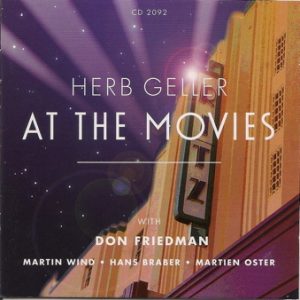
Herb Geller – At the Movies – March 26, 2007
Hep 2092
Geller’s second Hollywood tribute would be his last session as a leader for an established label and was recorded in Zeist, The Netherlands with the recently deceased piano legend Don Friedman (1935-2016), German bassist Martin Wind and Dutch drummer Hans Braber. This quartet was touring Germany and Holland at the time of the recording. Although Geller and Friedman had met in Los Angeles in the early 1950s, this was the only time the two recorded together. On three titles, the Dutch guitarist Martien Oster is added.
The program involves fourteen movie themes, some well-known standards like the eponymous “Laura” and “I Wish I Knew” (from Diamond Horseshoe) and others more obscure such as a medley from Taxi Driver. “Call Me Irresponsible” from Papa’s Delicate Condition is a Geller-Wind duet while “The Bad and the Beautiful” finds Friedman and the leader engaging in a dialogue. Geller is on alto sax throughout. This session was issued on Hep (Eng.) 2092 (2007 CD).
Bassist Chuck Berghofer and Herb Geller at the Lighthouse Cafe in Los Angeles – date unknown – Photo by Larry Israels
Herb Geller and Barack Obama
Geller was a great admirer of Barack Obama and was inspired by the hope and progress his 2008 candidacy and subsequent election represented. He wrote and recorded two tributes, one entitled “Obama Bound” (September 2008) and another, “Diplobamacy” (March 2009), both of which can be found on YouTube but have never been issued. Here are his comments: The YouTube song was ‘Obama Bound.’ Originally I used the melody of ‘Alabama Bound’ with my lyric but was informed the rights were not granted so I wrote the new melody and recorded it again. I also did another YouTube thing called ‘Diplobamacy.’ I did ‘Diplobamacy’ about two months after Barack was sworn in. A friend, Swen Kohlwage, has a small studio in Altona which is part of Hamburg. As you can see, there is no piano there. On the ‘Obama Bound’ YouTube production, Buggy Braune played keyboard, the singer was Robbie Smith [son of Harold Smith – see above] and the drums and bass were synthesized by me. I am not sure of the date but it was around September 2008. On ‘Diplobamacy,’ the drummer was Derek Scherzer; bassist, Phillip Steen; keyboard, Buggy Braune. The singer was Kai Podak.
On November 2, 2008, just days before the election, Geller performed “Obama Bound” with the NDR Big Band at a Hamburg concert in honor of his 80th birthday. Parts of this concert have been issued on a privately produced CD, Klaus Scholz Private Jazz Archives (Ger.) CDKSCD 0900 – Herb Geller Wird 80: Birthday Party At NDR’s Rolf Liebermann Hall(2009).
Conclusion
Geller continued to perform while dealing with serious health issues including lymphoma. The last recording he made appears to be a live concert in Hamburg, in June of 2012. He cut quite a swath during his half-century in Europe, a taste of which I hope this discographical synopsis has provided. He was a multi-talented artist with abilities as a fluent and recognizable soloist on several woodwind instruments, a composer and arranger, educator and with an encyclopedic knowledge of the jazz repertoire, he strove for perfection in all his musical endeavors. While much of his oeuvre remains buried in the archives of the NDR, there are still many projects that saw the light of day and are definitely worth exploring. I hope the reader will have a listen.
Sources:
Myers, Marc. Interviews with Herb Geller done in 2010 and published on the JazzWax website.
Jack, Gordon. Fifties Jazz Talk: An Oral Retrospective, Oxford: The Scarecrow Press, 2004, pp. 88-98.
Lind, Jack. Herb Geller’s European Rebirth, DownBeat, January 3, 1963, p. 23.
Stewart, Zan. Saxman Geller Makes the Long Journey Home, Los Angeles Times, July 30, 1993.
Stewart, Zan. Working in a World of Unheard Wonders, Los Angeles Times, August 8, 1997.
Kohlhaase, Bill. Abroad Base, Los Angeles Times, June 5, 1998.
Heckman, Don. Geller’s German Gig Lasts a Lifetime, Los Angeles Times, June 15, 2001.
Geller, Herb. Email exchanges with the author between August 2008 and December 2012.
Berger, Ed. Email to the author, December 2, 2016.
Taylor, Mark. Phone call with the author, December 23, 2016.
Information from the NDR Archives provided by a source wishing to remain anonymous.