© Copyright ® Steven Cerra, copyright protected; all rights reserved.

“Throughout a prolific career spanning seven decades Lee Konitz has usually chosen to showcase his talents within the confines of a small ensemble – often a very small ensemble. There are numerous duo recordings with Sal Mosca, Red Mitchell, Hal Galper, Jimmy Rowles and Gil Evans etc. Trios too have frequently been his modus operandi with Sonny Dallas - Nick Stabulas, Dick Katz - Wilbur Little, Harold Danko - Jay Leonhart and Don Friedman - Attila Zoller. All of which made his decision to organize a nine-piece group in the mid-seventies somewhat surprising.
Because of its similar size, the Konitz nonet has sometimes been compared to what became known as the Birth of the Cool ensemble. Miles’ group with its fragile, almost ethereal textures was essentially a scaled-down version of Claude Thornhill’s orchestra complete with french horn and tuba. Lee’s nonet with its wide-ranging repertoire was a far more extrovert affair. The instrumentation which was actually suggested by David Berger was also quite different – two trumpets, two trombones (one doubling bass trombone), alto doubling soprano, baritone, piano, bass and drums.
Returning to New York in May 1976 from a short European tour with Warne Marsh, Konitz recorded with Buck Clayton and then Chris Connor before getting together with Jimmy Knepper and David Berger to discuss plans for his nonet. He was living on West 86th Street at the time and Stryker’s which had opened in 1972 was his local club. The nonet started playing there and for the next 18 months or so they appeared quite regularly once or twice a week. The club did not have a piano so Ben Aronov had to bring in an electric instrument. They also performed at the Tin Palace, a little known club in the Bowery. Apparently nobody was paid very much (usually just cab fare) but Lee managed to keep the same core of players throughout the residency. In an interview for Jazz Journal (December 1996) he told me that he could not afford to pay for arrangements but Sy Johnson, Jimmy Knepper, David and Kenny Berger and Sam Burtis were all happy to write for the band without a fee. Kenny Berger recently told me that musicians at the time were willing to donate their services for a worthwhile project because there was still enough decent paying work available elsewhere. Today it would probably be different.
- © - Gordon Jack/JazzJournal; copyright protected, all rights reserved., used with permission. Jazz Journal June 2015.
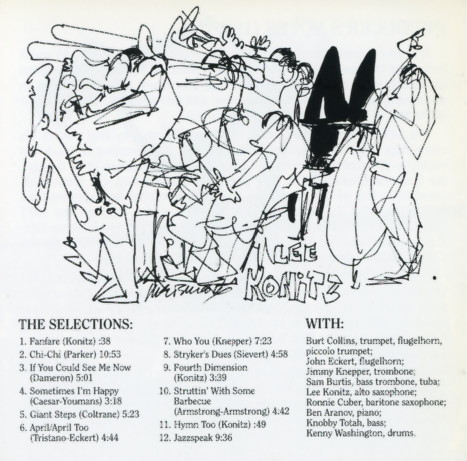
I, too, was surprised to see alto saxophonist performing in the context of this larger group in the mid-to-late 1970s but was delighted to re-discover it as a result of my Cuber Quest [an effort to listen to Ronnie in new surroundings] following the passing of Ronnie Cuber - baritone saxophonist par excellence - on October 7, 2022.
Gordon Jack goes on to say in his JazzJournal piece:
“Their next visit to the recording studio a year later was even more impressive (Chiaroscuro CRD 186). A particular feature of the date is the way famous solos have been orchestrated into many of the selections: - Louis Armstrong‘s 1927 Struttin’ With Some Barbecue; Charlie Parker’s 1953 Chi Chi; Lester Young and Slam Stewart’s 1943 Sometimes I’m Happy and John Coltrane’s 1959 Giant Steps have all been seamlessly woven into the charts. The leader once said, “A great solo doesn’t care who plays it” - a philosophy probably inspired by his friend and mentor Lennie Tristano who used the study of classic instrumental solos as a teaching aid. A highlight here is Konitz and Ronnie Cuber performing Coltrane’s choruses in unison on Giant Steps, the harmonic minefield originally inspired by Have You Met Miss Jones? By now the hugely talented Cuber had replaced Kenny Berger on baritone and after the leader he was the most heavily featured soloist. His ballad feature If You Could See Me Now is alone worth the price of the CD.”
Acting on Gordon’s advice, I tracked down Lee Konitz Nonet (Chiaroscuro CRD 186) and boy am I glad I did both for the reasons that Gordon mentions regarding Cuber’s magnificent playing, but also because the album is a gem in terms of everyone’s playing on the date and the exquisite small band arrangements written for this instrumentation by Sy Johnson, Jimmy Knepper, David and Kenny Berger and Sam Burtis.
Here’s more information on the recording which is followed by some videos featuring tracks from the album:
PRODUCER'S NOTES (1977)
“I suspect it would be safe to say that Lee Konitz has worked in as great a variety of instrumental combinations as any jazz musician; at least since Buddy Bolden. There are the solo albums (you know, a real solo album, with no accompaniment at all) duets, trios, quartets, up the line to big bands and a couple with lush string accompaniments. This new record features Lee leading a nonet, a very workable number of instruments, but it is a combination that has been rarely used, particularly with the combination of instruments found here. Sure, there have been bands with nine players. Bennie Moten in 1926, for example, and today there are any number of ensembles with nine musicians, from dreary augmented dixieland bands to the equally dreary jazz/rock variety. But there's not another exceptional nine piece jazz band out there right now, one with great arrangements, in many cases crafted for the instrumentalists in the band. Shades of Ellington.
Lee's nonet has been working in New York for a little over a year at a place uptown called Stryker's. The club lets Lee and his guys play a couple of nights a week (when Lee's not on the road) and Stryker's management should be congratulated for the opportunity they've provided. I'm particularly grateful because the band had a year of rehearsal before it set foot in my studio (and also a record under its belt, on Roulette, which I highly recommend).
In a recent review of the aforementioned record it was suggested the news around town in 1977 was Lee's nonet. I couldn't agree more. It was news because it was not the usual Monday night hand, of which there are a few around town, all playing magnificently, but in many cases, not having a particularly individual stamp, except for the soloists in them. Lee's nonet has an individual stamp, it being an updated, slightly augmented version of the Miles Davis band of the late forties, the one that lasted about ten minutes, but which seemed to influence everyone who had ears. I seem to recall, the alto voice in that hand was a guy named Konitz. Funny coincidence. Perhaps if Miles ever decides to come out of retirement, he should walk up the street to Stryker's and mess around with this group. He'd probably enjoy it and frighten everyone to death.
In any event, this band is special. The arrangements were provided by Sy Johnson and Lee, and for the date they chose a nice mixture of standards and originals. To me the outstanding effort is on Chi-Chi, the old Parker piece. Everyone got cooking pretty good and it ran over about five minutes. This was the first take and Lee thought we ought to have a shorter version. The band did it, keeping strictly to the arrangement. On playback it was apparent the ten minute take was the real one; much in the same way relaxed, extended performances of the Goodman band always sound so much better than the studio versions.
Maybe the next thing will be to record this band live but that will have to wait until next year, when Lee gets back from his European sojourn, plus dates in North Africa and other assorted locations. And who knows, the talk of 1978 will probably still be this nonet.”

And here’s the text of Lee talking about the nonet from the Jazzspeak track that closes the recording:
“Hi, I’m Lee Konitz and I’d like to speak a bit about the history of this band and I would be pleased to talk about the people involved and the idea that motivated this nine-piece band.
I had thought at some point that this would be an opportunity for me to do some writing, some arranging that I hadn’t done too much of before and I spoke to Jimmy Knepper and with David Berger, David is a Duke Ellington scholar, who has been conducting Wynton Marsalis’ Lincoln Center Band for a long time.
Actually David was responsible for suggesting the instrumentation and there was a club across the street from where I live on 86th Street called Stryker’s which allowed the band to work there one or two nights a week for about a year, year and a half.
This is the way you can build a band by meeting every week. No one was paid too much, cab fare maybe and some for drinks.
The people looked forward to playing and never missed those nights. Jimmy Knepper for one, unless there was a great gig. Writers volunteered to contribute music to the band. I wrote some things, not as much as I was hoping to, but Sy Johnson was one of the main people. He has a facility of writing fast and well and coming to rehearse the music and bringing it back next time all corrected. Jimmy Knepper wrote some things, and David Berger and Ronnie Cuber and Kenny Berger and it was a very nice experience for everyone for that year-and-a-half.
And then when the opportunity to play every week kind of subsided, I lost interest in playing the same music over and over again. When we were meeting week after week people were contributing new music which kept it always interesting from that standpoint.
The configuration of the band as you might have heard is two trumpets doubling on flugelhorn, two trombones with Sam Burtis doubling bass trombone, and two saxophones, baritone and me playing the alto and sometimes soprano and three rhythm.
At some point, I thought of adding a tenor to have more of a saxophone section, but I’ve enjoyed this kind of unusual ensemble and the power of the brass section that gives it a big band kind of feeling in a small band setting.
Because of the lack of pay, I thought it was a great opportunity to give everyone a chance to stretch out and play; after playing the arrangement, play some extended solos.
So that was fine and then I realized I was sitting most of the time listening to everyone else play. It got to the point that this was one of the reasons why I gave up the band.
The other reason was getting eight answering machines every time I called for a rehearsal or a job.
We played two festivals in Belgium and Holland and it cost a fortune to bring the band over.
This album begins with a little Fanfare that I wrote; after the fact, I wished I’d stretched that out a little bit. It was kind of nice.
And then I had written out Charlie Parker’s choruses on Chi-Chi; Jimmy Knepper wrote the arrangement, and the one for If You Could See Me Now.
Tim Morgan, a student of mine, wrote the arrangement on Sometimes I’m Happy and included Lester Young’s solo and Slam Stewart’s solo. Actually that’s Slam’s solo coupled with a tag that Prez played.
Sam Burtis wrote the arrangement of Giant Steps and we play some of Coltrane’s chorus on that. The line by Lennie Tristano was incorporated into April/April Too and then Jimmy Knepper contributed the arrangement on his original Who You.
Sy Johnson arranged Stryker’s Dues and Fourth Dimension was my chart.
Struttin’ with Some Barbecue is my arranged dedication based around Louie Armstrong’s solo which I wrote out for all the horns that wanted to play it and Hymn Too is another piece I wrote as a closer.
It’s really a powerful tribute to play a great solo like Louis’ on Struttin’ and use all the different instruments.The same with Charlie Parker’s choruses on Chi-Chi they have the same thing with the full band playing them and giving them a new kind of weight.
I always say that a great solo doesn’t care who plays it.
I have never had any thoughts of resuming this kind of structure because I now realize that my main interest now is in improvising and I need as much opportunity as possible to do that so I prefer to work in duet, trio and quartet situations which is what I’ve been doing since 1977.
Many people had a chance to play in the band and look forward to it. The people in the nonet who wouldn’t miss playing in it unless some big job came along are Jimmy Knepper, Burt Collins and Sam Burtis. The rhythm section had the people in it that changed most frequently.
Unfortunately, Stryker’s didn’t have a real piano so the pianists had to bring in an electric one.
We were fortunate to play at the Vanguard a few times so the piano wasn’t an issue there. In fact, one night, Chick Corea and we had some nice arrangements that Sy Johnson had made of a few of his tunes and I asked Chick to sit in. I had my tape machine with me, but when I pressed the start button it had no batteries!
Jimmy Knepper had mentioned this young drummer that lived up in Staten Island - Kenny Washington - who I think was 17 at the time.
I said, fine, bring him in.
Jimmy had no doubts; he could be a little bit critical of people but he raved about this guy.
Kenny came in at the age of 17 and read all this music and swung the band just the way you’d like it. He played a little bit loud sometimes and I had mentioned something to him about checking out Mel Lewis and that became a big inspiration for him.
I might mention that there are 4 CDs of that year-and-a-half of the nonet’s existence. In addition to this one on Chiaroscuro, there’s Live at Laren [Soul Note], Yes, Yes, Nonet [SteepleChase] and The Lee Konitz Nonet [Roulette].
The band obviously was well-documented for that short-period of time.
The fact that the people involved in this project were so enthusiastic to play some creative music may have indicated a lack of activity at the time for some of these musicians.
But I always knew that there was a high degree of interest in the band because there was a long line of interested musicians who wanted to get on the band as subs.
If I had to conjecture how many people made up that nonet over the course of rehearsals and performances during that year-and-a-half, I would have to say that over 90 musicians or 190!
But I was always there!!”

