Showing posts with label les mccann. Show all posts

Monday, January 8, 2024

Lou Rawls with Les McCann LTD. - Stormy Monday

 © Copyright ® Steven A. Cerra, all rights reserved.


“Not too long ago, a survey was made to determine the most recognized voice on earth. Lou Rawls' voice came in third (after Howard Cosell and Muhammed Ali, if you must know). Unless you want to count Ali's one venture into recording, "Stand By Me" as Cassius Clay on Columbia in the 60's (I don't know whether to thank Mitch Miller or Clive Davis for that one), this means that Lou Rawls possesses the most well-known singing voice in the world.


And why shouldn't he? A twenty-five year string of hit singles, like "Dead End Street", "Tobacco Road", "You're Good Thing (Is About To End)", "A Natural Man", and his #l bestsellers, "Love is A Hurtin' Thing" and "You'll Never Find Another Love Like Mine" have kept that voice consistently on every jazz, R&B and pop radio station there is. Constant touring, both one-nighters and stints in Las Vegas, and TV appearances, including his annual telethon for the United Negro College Fund, have insured continued high visibility. And let's not forget "When You Say Bud..."[beer commercial].


But back in 1962, when this album was made, Lou's rich baritone was unknown, except to a lucky few gospel music fans and Hollywood hipsters who'd caught his act at local night clubs like P.J.'s, The Troubadour, Shelly Manne's Manhole or Brother's on Santa Monica and Vine. A year earlier, Capitol A&R man Nick Venet had heard Rawls at Pandora's Box and signed him to the label. One stillborn single emerged before Lou had the brainstorm to do an album of blues and jazz standards, backed by then up-and-comer Les McCann and his trio, who were performing nearby at the Bit on Sunset Boulevard.


Both arriving in Los Angeles in 1958, Lou and Les were part of a clique of talented cats which included at one time or another Gene McDaniels, Larry Williams, Johnny "Guitar" Watson, the highly influential Jesse Belvin and Sam Cooke, who took over as leader of this pack after Belvin died with his wife Jo Ann in a 1960 car crash. McCann rose to a degree of fame in the late 60's on Atlantic with McDaniels' angry political diatribe "Compared To What" and the jukebox jazz hit "Cold Duck Time" with saxophonist Eddie Harris.


Lou's friendship with Sam Cooke went back to Chicago, where they were schoolmates, singing the latest doo-wop tunes by the Dells or the Spaniels in the lavoratory — to get the best echo.


Sam went off to sing lead with the Soul Stirrers and Lou sang with such local gospel quartets as the Teenage Kings of Harmony and the Holy Wonders. In the mid-50's, Lou helped Sam drive to L.A. for the National Baptist Convention where he was asked to join the Chosen Gospel Singers as their new lead singer.


After a while, J. W. Alexander, tenor and manager of the Pilgrim Travelers, asked Lou to replace their two lead singers who had recently retired from the group, causing their label, Specialty, to lose interest in recording them. Alexander took them to Bob Keane, who'd had great success on his Keen label with Sam Cooke's "You Send Me", ironically after Specialty had passed on it, giving Sam his walking papers (to this day Specialty founder Art Rupe says that letting Sam go was the biggest mistake he ever made).


With Rawls at the lead, the Pilgrim Travelers cut passionate sides such as "A Soldier's Plea" and "Talk About Jesus" for Keane's Andex subsidiary as well as a couple of pop songs as the Travelers.


Lou's first solo record, "Love, Love, Love" b/w "Walkin' For Miles", on Herb Alpert and Lou Adler's short-lived Shardee label didn't sell, but it got him in the game; a record release enabled him to get gigs at clubs up and down the Coast, sometimes making two and three a night in his old '47 Plymouth.


Ask Lou Rawls about influences and he'll rattle off a list of the great Black baritones of the 40's and early 50's who he heard on Chicago disc jockey Al Benson's radio show, broadcast from the window of his record shop: Billy Eckstine, Arthur Prysock, Al Kibbler, Nat "King" Cole, Percy Mayfield, the Pilgrim Travelers' Jesse Whitaker and Bullmoose Jackson, who sang and played saxophone in Lucky Millinder's band, before recording a string of hits under his own name for King Records. Although remembered today for his novelty/risque material like "Fare Thee Well, Deacon Jones" and "Big Ten Inch Record", Bullmoose's biggest records in the 40's were smooth ballads like "I Love You, Yes I Do" and "All My Love Belongs To You."


The songs Lou chose for this, his first album, included a number of standards from the blues lexicon. "They Call It Stormy Monday (But Tuesday's Just As Bad)", taken uptempo here, was a smash in 1947 by its creator, T-Bone Walker, who virtually invented the electric blues guitar style. Lou's pronunciation of the word "God" in Billie Holiday's "God Bless the Child" is straight out of the Baptist church. "See See Rider", credited to Ma Rainey, has been around so long that it seems as if it's always been here. 50's recordings of it were by Chuck Willis and LaVern Baker.


Also out of the church comes Lou's uses of his falsetto, a la Louis Jordan in the letter's 1941 fave "I'm Gonna Move To The Outskirts Of Town", as well as on the Leroy Carr warhorse "In The Evening When The Sun Goes Down," Lou says he gave up falsetto when so many other singers, like Johnny Mathis and Adam Wade, started using the device. Our loss, he does it so well here. " 'Tain't Nobody's Business", which Lou and Les swing so relentlessly, is another one of those tunes that Adam and Eve must have sung. Previous versions include: Bessie Smith, Billie Holiday and the smash hit of 1949 by Jimmy Witherspoon on Supreme.


Reissue producer Michael Cuscuna has chosen three previously unreleased bonus cuts from these sessions for the CD version: "Blues ls A Woman", "A Little Les Of Lou's Blues" and an alternate take of "Stormy Monday."


There you have it, the album that got all the hipsters talking about Lou Rawls in the beginning of his career. But it was just a matter of time anyway. With a voice like his, even the squares couldn't ignore him for long.”                                                                     - Billy Vera


Friday, November 24, 2023

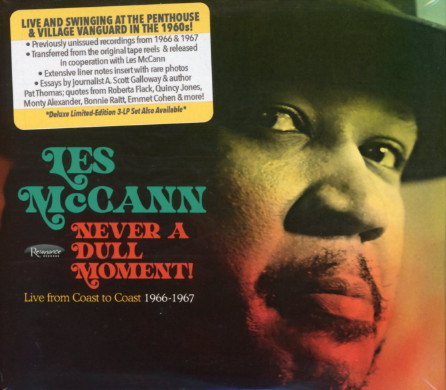
11/24/2023 Record Day - Les McCann: Never a Dull Moment

 © Copyright ® Steven Cerra, copyright protected; all rights reserved.

Both The Bit, a club that pianist Les McCann often performed at in the early 1960s and Dick Bock, the owner of Pacific Jazz records, were “a bit off the beaten path.” [horrible pun intended].


The club was not in Hollywood per se, nor was it quite on The Sunset Strip. It was between the two as you exited Hollywood to the west along Sunset Blvd. You had to know exactly where it was located [along a short curving pathway off of Sunset at the corner of Gardner], because when it first opened, there was no signage directing you to the club.


Les played The Bit quite often in the early 1960’s. His soulful, bluesy and funky style of playing really appealed to the younger Jazz audience who were becoming especially put off by the rapid changes going on in mainstream Jazz at that time.


As Ted Gioia described it:


“Jazz was like one of those newspaper chess problems: move from bop to free in ten moves. Change was the byword.”


As is often the case with change, some of it had a positive effect on Jazz, but there were also disastrous consequences as well.


In a way, the soul and funk movement was a step to the side for Jazz or, if you will, a look backward at its rhythm and blues roots.


Dick Bock at Pacific Jazz records became the West Coast equivalent of Alfred Lion and Francis Wolff and their New York-based Blue Note Records in his attempt to add elements of the soulful gospel music of the sanctified southern Baptist Church to the hard bop then prevalent on the Jazz scene.


And no one was better at “signifyin’” and tesifyin’ than pianist Les McCann. His music was very straight-forward and very direct. You could clap your hands to it, snap your fingers or stomp your feet.


Many musicians criticized Les because of the emotional appeal of his music, the fact that it was commercially successful, and that it was often limited to Blues in B-flat and Blues in E-flat. To which Les responded: “My music makes people happy and the bread [money] I make from selling albums keeps me happy. What more do you want?”

- The Editorial Staff at JazzProfiles


"I think that Les McCann was able to reach beyond our insular jazz community and reach everyday people outside on the street or in a bar or wherever. It's one of the most difficult things to do — to maintain your integrity as a musician and also reach everyone. Very few musicians have been able to do that in the history of the music."

- Emmet Cohen, Jazz pianist


As noted in earlier features about  Cal Tjader: Catch The Groove - Live at the Penthouse 1963-1967, Ahmad Jamal - Live at The Penthouse 1966-68 [DDJD -006], and Wes Montgomery and The Wynton Kelly Trio Maximum Swing The Unissued 1965 Half Note Recording [Resonance HCD-2067]  “Black Friday” - November 24, 2023 - is a day to celebrate new releases, especially those involving the resurgent interest in vinyl editions with CDs of these albums generally following a few weeks later.


Since I’ve been the fortunate recipient of preview copies of new Jazz 

recordings by some of these accomplished Jazz legends to be released on the upcoming Record Store day. I thought it might be fun and helpful to share the information on the media releases which accompanied them to make you aware of what could be the cause of a lessening balance in your bank account come November 24th!


Here’s the press release for Les McCann: Never a Dull Moment - Live from Coast to Coast 1966-1967 [Resonance HCD-2066] from Ann Braithwaite/Braithwaite & Katz Communications:


NEVER A DULL MOMENT! - LIVE FROM COAST TO COAST (1966-1967), NEW LES McCANN TRIPLE LP, SET FOR RSD BLACK FRIDAY RELEASE

BY RESONANCE RECORDS


Deluxe Package Features Essays by A. Scott Galloway and Pat Thomas,

Remembrances from Quincy Jones, Roberta Flack, Bonnie Raitt, Monty Alexander, Roger Kellaway, Emmet Cohen, Nathan East and more!

Previously Unseen Photos - Massive booklet with many rare and previously unpublished photos by Lee Tanner, Jean-Pierre Leloir, Christian Rose and Les McCann himself


Tomorrow, September 23, is the 88th birthday of pianist/vocalist Les McCann, one of the most revered and influential figures in soul-jazz. The milestone is heralded by today's announcement that a new album, Never A Dull Moment!- Live from Coast to Coast (1966-1967), is set for release this upcoming RSD Black Friday (November 24). The new album, a limited edition three-LP set, includes 1966 performances at Penthouse Club in Seattle and at New York's Village Vanguard the next year.


Between 1960 and 1966, McCann toured relentlessly and had played on more than two dozen full length records released by Pacific Jazz and Limelight. His performances at the Penthouse in Seattle in 1966 and at New York's Village Vanguard in 1967 were captured on tape, and soon these historic recordings, totaling almost 2 hours and 20 minutes, will be the focus of Resonance Records efforts for RSD Black Friday. Never A Dull Moment! is presented with sound restoration by George Klabin and Fran Gala and was mastered for vinyl by Bernie Grundman. It was produced for release by Zev Feldman and George Klabin.


The Penthouse sides were recorded on January 27 and February 3, 1966 with bassist Stanley Gilbert and drummer Paul Humphrey, and on February 10, 1966 with Tony Bazley on drums. McCann's band for the tracks recorded at the Village Vanguard on July 16, 1967 featured Leroy Vinnegar (bass) and Frank Severino (drums). The Penthouse recordings were originally recorded for Jazz After Hours, as heard on KING-FM with host Jim Wilke with the enthusiastic participation of the club's impresario Charlie Puzzo.


It's noteworthy that the music from the Village Vanguard was captured by Resonance founder and co-president George Klabin more than 56 years ago. He used a portable Crown 2-track tape recorder and mixed the material as it was being performed. "We were just waiting for the right moment to give these historic recordings a proper release and the occasion of the master’s 88th birthday seemed like the way to fulfill that vision in time for RSD Black Friday," stated Klabin. There's also a bonus track "(Back Home Again In) Indiana," recorded at the Penthouse on August 15, 1963 with bassist Victor Gaskin and drummer Tony Bazley.


The package is enhanced by insightful liner notes, including Resonance co-president's Zev Feldman's introductory commentary, as well as extensive essays by Pat Thomas and A. Scott Galloway. Both journalists have been part of McCann's inner circle for years and had earlier contributed written pieces that appeared in Invitation to Openness: The Jazz & Soul Photography of Les McCann 1960-1980, first published by Fantagraphics in 2015. The Never A Dull Moment! package also includes rare images from noted photographers Lee Tanner, Christian Rose and Jean-Pierre Leloir, as well as first person testimony by a range of notables including Roberta Flack (whom Les McCann "discovered" at a Washington, DC venue and brought to the attention of Atlantic Records), Monty Alexander, Roger Kellaway, Bobby Lyle, contemporary jazz pianists Joe Alterman and Emmet Cohen, Bonnie Raitt, Nathan East, McCann's long standing manager Alan Abrahams, and the artist himself.


Les McCann wrote, "When my manager, Alan Abrahams, told me that there were some recently uncovered recordings that have never been released before from the '60s, I was really curious if they were any good. People were always sending me cassettes that they have come across over the years and the sound was usually shit. When I was informed that these live recordings were from the Penthouse in Seattle (a cool venue), and also from the Village Vanguard in New York (a really cool venue), I held my breath . . . then I heard them and I said 'Daaamn!' People who know me know that I never planned for the future, but when you deal from the heart, you have no fear and Never A Dull Moment! - Live from Coast to Coast 1966-1967 shows that beautifully."


Roberta Flack: "Les and I found each other in the musical world of the tumultuous '60s. Les heard deeply what I was saying and his recommendation of me to Atlantic Records was a pivotal moment in my career. He is a giant in my world of music — a limitless creator, inspiration and friend."


Quincy Jones: "Les McCann has been a musical force of nature since he burst on the scene in the early 60's. Whenever I heard him live or on record, he always did the unexpected and now the 'unexpected' has happened again. These recently recovered live recordings from 1966-1967 are Les in his favorite trio format. If you're a fan of jazz, your collection will be incomplete without this collection by one of the best."


Monty Alexander: "Les is one of those guys who was completely identifiable, but he also played a music that made people deliriously happy. And he was a big influence on me. Just like all the gospel piano players, like Ray Charles. He's so unique. And on a personal level, it's all because of Les that I made my first album."


Emmet Cohen: "I think that Les McCann was able to reach beyond our insular jazz community and reach everyday people outside on the street or in a bar or wherever. It's one of the most difficult things to do — to maintain your integrity as a musician and also reach everyone. Very few musicians have been able to do that in the history of the music." Never A Dull Moment! - Live from Coast to Coast (1966-1967)


Thursday, November 12, 2020

"On Time" - With Les McCann and Joe Pass

© -Steven Cerra, copyright protected; all rights reserved.


As Kirk Silsbee alludes in the excerpts from the sleeve notes to the Les McCann and Joe Pass Pacific Jazz On Time recording [PJ A916] that follow this introduction, both The Bit, a club that pianist Les McCann often performed at in the early 1960s and Dick Bock, the owner of Pacific Jazz records, were “a bit off the beaten path” [horrible pun intended].


The club was not in Hollywood per se, nor was it quite on The Sunset Strip. It was between the two as you exited Hollywood to the west along Sunset Blvd. You had to know exactly where it was located [along a short curving pathway off of Sunset at the corner of Gardner], because when it first opened, there was no signage directing you to the club.


Les played The Bit quite often in the early 1960’s. His soulful, bluesy and funky style of playing really appealed to the younger Jazz audience who were becoming especially put off by the rapid changes going on in mainstream Jazz at that time.


As Ted Gioia described it:


“Jazz was like one of those newspaper chess problems: move from bop to free in ten moves. Change was the byword….


As is often the case with change, some of it had a positive effect on Jazz, but there were also disastrous consequences as well.


In a way, the soul and funk movement was a step to the side for Jazz or, if you will, a look backward at its rhythm and blues roots.


Dick Bock at Pacific Jazz records became the West Coast equivalent of Alfred Lion and Francis Wolff and their New York-based Blue Note Records in his attempt to add elements of the soulful gospel music of the sanctified southern Baptist Church to the hard bop then prevalent on the Jazz scene.


And no one was better at “signifyin’” and tesifyin’ than pianist Les McCann. His music was very straight-forward and very direct. You could clap your hands to it, snap your fingers or stomp your feet.


Many musicians criticized Les because of the emotional appeal of his music, the fact that it was commercially successful, and that it was often limited to Blues in B-flat and Blues in E-flat. To which Les responded: “My music makes people happy and the bread [money] I make from selling albums keeps me happy. What more do you want?”


As indicated at the outset of this piece, here are some additional perspectives on Les and his music from Kirk Silsbee’s sleeve notes to On Time.


“[Pianist] Hampton Hawes melded gospel with bebop in his piano playing, While Horace Silver, Bobby Timmons and other East Coast pianists used gospel devices in their essentially bop-rooted styles, Les McCann may have been the first to add jazz devices to an essentially gospel-rooted style. "'You know," contends [pianist] Mike Wofford, "I always thought that Les single-handedly created a genre: that gospel/blues school of jazz piano. I don't think he ever gets credit enough for being the innovator he was."


McCann was quite popular around LA, both through his Pacific Jazz albums and his tenure at The Bit, It was a legendary coffeehouse and jazz room on Sunset Boulevard at Gardner, in West Hollywood. The late and celebrated walking bassist Leroy Vinnegar and drummer Ron Jefferson made up McCann's original trio. He observes, ‘Leroy and Ron were like all my trios back then: they worked for the groove. They were a solid foundation, unwavering. I've seen a lot of guys try to copy all of Leroy s little nicks and bumps without getting to the highway. They don't understand that Leroy had the whole highway!’


McCann, with his gospel-rooted style, was the point man for Pacific Jazz's "Soul-jazz" platoon (which included The Jazz Crusaders, Richard ‘Groove’ Holmes, tenor saxophonist Curtis Amy and organist Paul Bryant).


‘Dick always had suggestions,’ states McCann. ‘He was the first one who asked me to sing. That's why when he suggested Joe, I was open to it. Dick often put ptople in the studio together to sea what would happen. His idea was: let's open the door...’


While Pass was clearly a guest on the date, he was certainly a welcome one. He added a bop-derived musical sophistication absent from most soul-jazz recordings of the period.”


Yours Is My Heart Alone is one of my favorite tracks from On Time. It is usually rendered as a slow ballad, but Les, Joe, Leroy and Ron add some soulful, “down-home” elements to it and take it at a medium tempo which turns the tune into a real swinger.


You can check out their version Yours Is My Heart Alone on the following video tribute to Les and Joe.


Sunday, July 14, 2019

"On Time" - With Les McCann and Joe Pass [From the Archives]

© -Steven Cerra, copyright protected; all rights reserved.


As Kirk Silsbee alludes in the excerpts from the sleeve notes to the Les McCann and Joe Pass Pacific Jazz On Time recording [PJ A916] that follow this introduction, both The Bit, a club that pianist Les McCann often performed at in the early 1960s and Dick Bock, the owner of Pacific Jazz records, were “a bit off the beaten path” [horrible pun intended].


The club was not in Hollywood per se, nor was it quite on The Sunset Strip. It was between the two as you exited Hollywood to the west along Sunset Blvd. You had to know exactly where it was located [along a short curving pathway off of Sunset at the corner of Gardner], because when it first opened, there was no signage directing you to the club.


Les played The Bit quite often in the early 1960’s. His soulful, bluesy and funky style of playing really appealed to the younger Jazz audience who were becoming especially put off by the rapid changes going on in mainstream Jazz at that time.


As Ted Gioia described it:


“Jazz was like one of those newspaper chess problems: move from bop to free in ten moves. Change was the byword….


As is often the case with change, some of it had a positive effect on Jazz, but there were also disastrous consequences as well.


In a way, the soul and funk movement was a step to the side for Jazz or, if you will, a look backward at its rhythm and blues roots.


Dick Bock at Pacific Jazz records became the West Coast equivalent of Alfred Lion and Francis Wolff and their New York-based Blue Note Records in his attempt to add elements of the soulful gospel music of the sanctified souther Baptist Church to the hard bop then prevalent on the Jazz scene.


And no one was better at “signifyin’” and tesifyin’ than pianist Les McCann. His music was very straight-forward and very direct. You could clap your hands to it, snap your fingers or stomp your feet.


Many musicians criticized Les because of the emotional appeal of his music, the fact that it was commercially successful, and that it was often limited to Blues in B-flat and Blues in E-flat. To which Les responded: “My music makes people happy and the bread [money] I make from selling albums keeps me happy. What more do you want?”


As indicated at the outset of this piece, here are some additional perspectives on Les and his music from Kirk Silsbee’s sleeve notes to On Time.


“[Pianist] Hampton Hawes melded gospel with bebop in his piano playing, While Horace Silver, Bobby Timmons and other East Coast pianists used gospel devices in their essentially bop-rooted styles, Les McCann may have been the first to add jazz devices to an essentially gospel-rooted style. "'You know," contends [pianist] Mike Wofford, "I always thought that Les single-handedly created a genre: that gospel/blues school of jazz piano. I don't think he ever gets credit enough for being the innovator he was."


McCann was quite popular around LA, both through his Pacific Jazz albums and his tenure at The Bit, It was a legendary coffeehouse and jazz room on Sunset Boulevard at Gardner, in West Hollywood. The late and celebrated walking bassist Leroy Vinnegar and drummer Ron Jefferson made up McCann's original trio. He observes, ‘Leroy and Ron were like all my trios back then: they worked for the groove. They were a solid foundation, unwavering. I've seen a lot of guys try to copy all of Leroy s little nicks and bumps without getting to the highway. They don't understand that Leroy had the whole highway!’


McCann, with his gospel-rooted style, was the point man for Pacific Jazz's "Soul-jazz" platoon (which included The Jazz Crusaders, Richard ‘Groove’ Holmes, tenor saxophonist Curtis Amy and organist Paul Bryant).


‘Dick always had suggestions,’ states McCann. ‘He was the first one who asked me to sing. That's why when he suggested Joe, I was open to it. Dick often put people in the studio together to sea what would happen. His idea was: let's open the door...’


While Pass was clearly a guest on the date, he was certainly a welcome one. He added a bop-derived musical sophistication absent from most soul-jazz recordings of the period.”


Yours Is My Heart Alone is one of my favorite tracks from On Time. It is usually rendered as a slow ballad, but Les, Joe, Leroy and Ron add some soulful, “down-home” elements to it and take it at a medium tempo which turns the tune into a real swinger.


You can check out their version Yours Is My Heart Alone on the following video tribute to Les and Joe.