© Copyright ® Steven Cerra, copyright protected; all rights reserved.
“Even during his ten successful years with Decca Records from 1941-1950, Hampton claimed that “all the time I was tuned into what Norman Granz was doing and he was doing it right.”
“We were playing the Boogie Woogie, which is the mother and father of Rock - you know with that heavy beat - and we had that powerful brass section blowing out. People were just absolutely out of their minds, you understand.”
- Lionel Hampton
“The infant Lionel was infected by the rhythm virus while attending Birmingham’s Holiness Church with his maternal grandmother.”
- Brian Priestley
“Lionel Hampton, apart from being a great jazz artist in his own right is probably the greatest catalytic agent that I know of in jazz for making other artists play well when they play with him, both [sic] for the inspiration he provides, the ideas he gives forth and, above all, the tremendous beat he generates in his playing, and, curiously, by his very presence in the room. Most jazz artists will confess that playing with Hampton is one of the most stimulating experiences they could possibly have.”
- Norman Granz [in liner notes to the Clef LP The Lionel Hampton Quintet—the first 12-inch release of four of the performances gathered here, including the whiplash seventeen-minute version of "Flying Home" from 1954, featuring Hampton, Oscar Peterson, Ray Brown, Buddy Rich, and Buddy DeFranco]
Looking back on the career of Norman Granz [1918-2001], it’s amazing how much controversy it generated, especially given all he did for the music and its makers, beginning with his first Jazz at the Philharmonic [JATP] tour in 1944 and everything that followed until his “official” retirement in 1964. [Norman would later come out of retirement to do special favors for his Jazz friends on many occasions including founding the Pablo Records label when his old buddy Dizzy Gillespie couldn’t find a label willing to record him.]
Myriad JATP tours in between, numerous recordings of Jazz greats on his Clef, Norgran, and Verve labels [including many treasures by Charlie Parker, Dizzy Gillespie and Art Tatum], the personal management of such stars as Ella Fitzgerald and Oscar Peterson which helped make them both millionaires, and countless contributions to racial integration and social justice along the way, and yet, upon the announcement of his retirement, he was lambasted by the critics.
Leonard Feather accused Granz of being perpetually enveloped in a “pessimistically cynical shroud,” Dan Morgenstern said of him, “Norman was never interested in keeping up with where the music was going, only his type of Jazz,” and Nat Hentoff held Norman partially responsible for the “increasingly bleak state of Jazz” in the summer of 1964 [along with “the overly intellectual influences of West Coast Jazz; Dave Brubeck; soul music; the dwindling nightclub scene, the success of FM radio and the proliferation of Jazz LPs”!!].
But the musicians who benefitted from Norman’s largess tell another story:
Dizzy Gillespie - “The importance of JATP was the first class treatment of Jazz Musicians.”
Herb Ellis - “Norman played a bigger role than you might think. He’d have Roy Eldridge and Coleman Hawkins. Their styles blended so he put them together. Then he had Stan Getz and Dizzy Gillespie. Thank God, he knew about music. He knew the main thing was the groove.”
Roy Eldridge - "What impresses me about Norman is that everything he's achieved, he's gotten by himself. Like most of us musicians, he had to start from scratch to get things going. But he broke through. . . . He made sure the cats got a decent living. He was the first to break down all that prejudice. He put the music up where it belongs. They should make a statue to that cat, and there's no one else in the business end of the music business I would say that about."
J.J. Johnson - "Let's face it, jazz is a part of show biz." Some of us don't like to recognize that, but it really is. We're in the business of entertaining people. A guy pays ten or twelve bucks to come into a club, he wants to be entertained, maybe on a different level than a guy who comes into a club and wants to see tap dancers or snake charmers. But it's all entertainment. It's all business, in the sense that it is the entertainment business."
Buddy DeFranco - “Norman gave you a latitude, free reign, gave you a choice of playing the way you want to, the way you felt it.” Granz "made sure everyone was treated equally, that everybody got the best treatment, the best hotels, the best services, and the best transportation." DeFranco was one of the few interviewed for this book to provide specifics on the financial advantages of working with JATP. Normally, the clarinetist's agent booked a single concert date for his group for $1,500. DeFranco would give $225 off the top to his agent, and after paying for the group plus transportation, he might wind up with $600 or $700 for the night's work. Granz paid him around $1,200 per night and picked up all expenses for his accommodations and transportation. [This quotation, as are the others that proceed it, are all drawn from Tad Hershorn, Norman Granz: The Man Who Used Jazz for Justice [2011]
The title of this blog feature represents another tip of the hat to Norman because without his inspired genius, these recordings with Lionel and Oscar would have been lost to posterity instead of being a part of it.
Lionel Hampton and Oscar Peterson had never worked together before September of 1953, but over the next year these two masters of swing made up for lost time in a grand style. Their quartet and quintet sessions of 1953 and 1954 resulted in some of the most memorable small group recordings of Hampton’s long and illustrious career - and in all of Jazz’s.
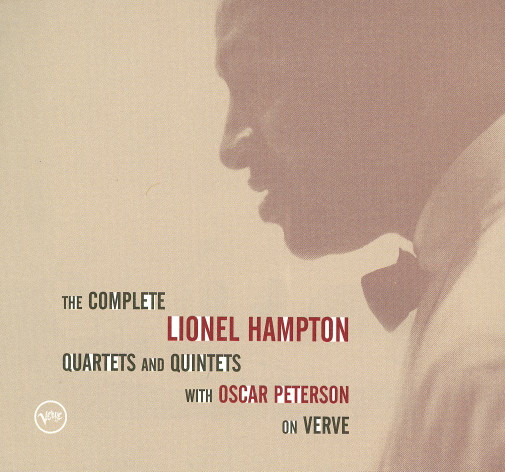
This deluxe, 5-CD package of The Complete Lionel Hampton Quartets and Quintets with Oscar Peterson on Verve [314-559-800-2] includes: over 6 hours of music; most tracks on CD for the first time; photographs by noted jazz photographer Herman Leonard; reproductions of original-LP cover art; a specially designed color poster; 50-page booklet with essays by two of the world's most respected jazz critics - a comprehensive overview of Hampton's life and career by Brian Priestley and an evaluation of the music heard here by Francis Davis plus 2 previously unissued tracks.
Here are Brian Priestly’s notes about Hamp and his career.
© Copyright ® Brian Priestley; copyright protected; all rights reserved; used with the author’s permission.
“It’s unusual in the closing months of the Millennium to be writing about a musician born in the first decade of the Twentieth Century yet still active. It's even more unusual that the musician, by comparison with recently deceased elders such as Doc Cheatham or Benny Waters, has earned a place in jazz history through more than simple seniority.
Lionel Hampton can truly be called a pioneer because of his musical achievements. The initial circumstances may have been serendipitous, as with many important discoveries in a variety of fields, but Hampton was indisputably the person who turned the vibraphone into a source of melodic improvisation.
The more you stop and think about this, the more unlikely it seems. Given that the brass family of trumpets, trombones, and tuba-style bass instruments had, by 1920, a head start in what became the jazz field, what instruments could be expected to join them? The clarinet was extending its military-band role into a more free-flowing contribution, and the relatively cumbersome saxophone might have been seen as a contender, especially by anyone who heard the early Sidney Bechet. The piano had already gained a leading role in ragtime (displacing the more limited banjo) while the guitar, with a secure foothold in the blues area, was just waiting to be amplified in order to compete with the brass. But vibraphone?
The answer lies in the growing size and importance of the drum kit (or traps set, as it was then called). Drummers were mostly seen by Jazz Age fans as aiding the visual impact of an ensemble, and percussionists who played up to that image were responsible for bands being described as "five musicians and a drummer". Relatively few of them initially appreciated the crucial difference they could make to an outfit's ability to play together for the greater enjoyment of both listeners and dancers (honorable exceptions being New Orleans natives such as Baby Dodds, Zutty Singleton, and the Original Dixieland Jazz Band's Tony Spargo, aka Tony Sbarbaro). In addition, drummers eventually realized that mallet instruments not only could shine in the novelty repertoire of the 1920s, but could also play jazz.
Hampton always credits the influence of Jimmy Bertrand, the drummer with Chicago's Vendome Theater house band, who later gave the teenage Hampton some lessons. In his autobiography, Hamp (New York, Warner Books, 1989), he said of Bertrand: "I learned from him how to please an audience. He was the favorite musician there, the star of the grand finale. He'd do a great solo, then he'd throw his sticks in the air, and the house lights would go off and all you'd see was a spectacular light show, from his drums."
But Bertrand was also adept at the xylophone and used the instrument in some of his studio work, even on records with blues singers Ma Rainey and Blind Blake. This knowledge must have fueled Hampton's bravado the day Louis Armstrong asked him if he could play the vibes. In his words, "I was a young kid, full of confidence, and I said 'Sure.'" He had never even touched the instrument before that day in Los Angeles, October 16, 1930, but he wound up introducing it to jazz discography.
Prior to that, Hampton was merely a swinging drummer who also sang a little, knew his way around a piano (thanks to informal tuition from Jelly Roll Morton), and had learned xylophone and marimba as a member of the famous Chicago Defender youth band. That was around 1923, when the Hampton family had been in Chicago for four years (they moved from Birmingham, Alabama, although Hampton had been born in Louisville, Kentucky, on April 20,1908). Even before the move to Chicago, the infant Lionel was infected by the rhythm virus while attending Birmingham's Holiness Church with his maternal grandmother. He could still remember, more than sixty years later, the three female gospel singers at the church's Chicago branch. (There's an interesting parallel with one of Hampton's most famous alumni, Charles Mingus, who also learned the rhythmic fundamentals of African-American music as a child in the Holiness Church.) He also recalled how he was first taught the drumming rudiments by a Dominican nun, Sister Petra, as a student at the Holy Rosary Academy in Collins, Wisconsin.
The most important influence of his Chicago years, however, was his uncle Richard Morgan (later the consort of singer Bessie Smith), through whom the youngster met Smith; pianists Jelly Roll Morton and Earl Hines; cornetists King Oliver, Louis Armstrong, and Bix Beiderbecke; and many others. Had Hampton wanted to take up a life of crime, he could have had a great mentor, for Uncle Richard was manufacturing and distributing bootleg liquor for Al Capone. But our hero's head was turned by music and, as well as meeting and hearing the greats, he started playing drums with others of his generation intent on becoming musicians, such as bassist Milt Hinton and alto saxophonist (and teenage bandleader) Les Hite. Hite encouraged Hampton at age sixteen to follow him to California because, as Hampton later noted, "I was already playing with a heavy afterbeat, getting that rock & roll beat that wouldn't even get popular until the 1950s."
During the second half of the 1920s, Hampton established himself in Los Angeles as a dynamic drummer. After recording several sides in 1929 and 1930 with Paul Howard's Quality Serenaders (which included a future Ellington star, trombonist Lawrence Brown), Hampton, along with Brown, found himself in Hite's band backing the irrepressible Armstrong for several months on his first visit to the West Coast. This led, as we have seen, to Hampton's debut on vibes and to other record sessions, including one on which he and Armstrong share a humorous dialogue exchange.
Working nightly with Armstrong added significantly to the drummer-vocalist-and-now-vibraphonist's desire to entertain the audience while retaining solid musical substance, and subsequent recorded vibes solos demonstrate that he studied Armstrong's methods of building an improvisation to a logical climax. Hampton was soon in a position to lead his own group, but staying on the Coast in those days was not the way to become nationally famous.
However, when Benny Goodman returned in 1936 to Los Angeles's Palomar Ballroom, where he and his big band had scored a success the previous year, he also sat in on clarinet with Hampton's group at the Paradise Club, recorded with him and, a couple of months later, invited him to become an added member of his racially integrated trio. Working with Goodman, drummer Gene Krupa, and pianist Teddy Wilson provided musical stimulation of a high order, exposure with the most popular young band in the country, and a high-profile role in breaking the ban on black and white musicians appearing on stage together. Hampton contributed the kind of raw excitement previously associated with Armstrong, and as a result, within a few months, he was asked to lead a series of all-star recordings that still enjoy a high reputation for small-group swing. Two of these sessions in 1939 included a new Goodman sideman, Charlie Christian, who did for the guitar what Hampton had done for the vibes and also provided a further influence on his improvisation.
After four years in the spotlight, Hampton set out to form his own group again (with Goodman as a shareholder), but this time it was a full-sized big band, which achieved a huge hit with "Flying Home", featuring a classic improvisation by tenor saxophonist Illinois Jacquet. Describing the musical policy of the band to me, Hampton said, "We were playing the boogie-woogie, which is the mother and father of Rock — you know, with that heavy beat — and we had that powerful brass section blowing. People just were absolutely out of their minds, you understand." As early as the start of the Fifties, the band gave a further boost to the development of rock & roll by becoming the first name band to use the electric bass guitar, played by Roy Johnson and then by Monk Montgomery. Even though he cut down to a smaller touring group in the Sixties, Hampton has always been open to re-forming the large band whenever the opportunity arises.
In the course of these activities, Hampton has discovered and featured an extraordinary number of significant musicians. Even the shortest short list would include the aforementioned Jacquet and Mingus, guitarist Wes Montgomery, tenor saxophonist Dexter Gordon, and singers Dinah Washington, Joe Williams, and Betty Carter. Quincy Jones, Clifford Brown, and Art Farmer worked with him simultaneously, in the trumpet section of the band he took to Europe immediately after the first quartet session reissued here.
For all the stimulus of carrying such eager young musicians in the ranks (a policy he has continued to maintain), Hampton was nevertheless challenged in a new way by the open-ended situation encouraged by producer Norman Granz. Unlike the sessions he had fronted in the Thirties, which usually featured six- to ten-piece groups, here it was just him and a rhythm section.
Even during his ten successful years with Decca Records, from 1941 to 1950, Hampton claimed that "all the time I was tuned in to what Norman Granz was doing, and he was doing things right. He recorded a lot of black musicians when they wouldn't have been recorded elsewhere." Certainly, at this period, Granz was busy rescuing the studio careers of Billie Holiday, Count Basie, Roy Eldridge, and Dizzy Gillespie; Hampton himself had not recorded for nearly two years when he joined Granz. Taking advantage for the first time of the space afforded by LPs, and of the sterling backing of the Oscar Peterson Trio and drummer Buddy Rich (plus, on one occasion, the challenge of the equally fluent clarinetist Buddy DeFranco), Hampton lets it all hang out as never before. Generating the same excitement as he did when fronting the big band, he marries his flawless technique with a characteristic he said his grandmother had already noted in his pre-teen years: his exuberance.
Hampton's percussive style, and the way he weds it to the rhythmic background, may be a virtuosic long-distance extension of what African musicians did with a balafon, the original marimba. But even when drawing on the impetus of his big-band rhythm team and its heavy brass section, Hampton always tended to be the main attraction. Baritone saxophonist Pepper Adams, who first played with the band at sixteen and took part in later all-star reunions, once said sardonically, "Rehearsing with Lionel means sitting around watching him rehearse his solo on 'Flying Home'," but the point is that he is always capable of coming up with some new variation, as the one on disc four indicates. Throughout this set, one's attention is drawn to his endless melodic variation, his ear for passing harmonies (often showing an interest in the whole-tone scale beloved of Thelonious Monk) and the incessant rhythmic drive that informs even his ballad playing.
Hampton's appetite for music-making rings out loud and clear. By 1960, the prudent management and financial expertise of his wife, Gladys, meant that he no longer needed to appear in public constantly. But, thankfully, there were always new audiences to conquer, to delight with his decorations and bludgeon with his beat. My own unforgettable first experience of the band dates from that early rock & roll era, and we listeners were left so limp and exhausted that my schoolfriend's sense of the ridiculous ("Better go home and dig some Modern jazz Quartet!") made it clear that this was where it was at. The same realization hit a European festival audience thirty years later when, although they had been kept waiting more than four hours as the band was re-routed due to bad weather and then driven to the gig by bus, the energy displayed on stage by the 81-year-old Hampton erased all memory of the delay.
It's worth mentioning in passing that, for the past three decades, Hampton has been involved in charitable activities and other good works, such as the sponsoring of housing projects and political fund-raising. (His first appearance at an inaugural ball, though, dates back to President Harry Truman, all of fifty years ago. Perhaps that's why he's been referred to as "the Vibes President".) Even when shorn of the band and the need to entertain a live audience, his playing alone earns such praise a hundredfold. There's no better place to appreciate that than here.”
- Brian Priestley, November 1998


