“... the Kenton bands from the late 1960s until his death in 1979 sounded different and I could never quite figure out why until I found some possible explanations in Michael Sparke’s seminal - Stan Kenton: This Is An Orchestra [2010].
In sharing these excerpts from Michael’s Kenton book, I plan to use them as a point-of-departure for a multi-part feature covering the Kenton bands and their recordings during the last decade or so of Stan’s career [he died in 1979].
- The editorial staff at JazzProfiles
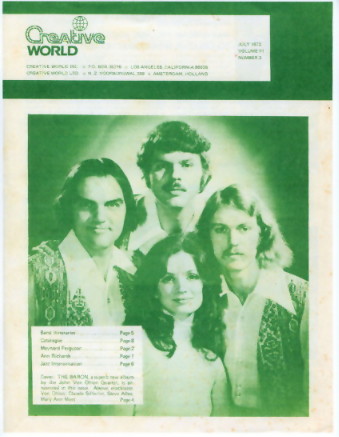
The Creative World of Stan Kenton [1970]
‘The truth is, none of the few remaining touring bands of the Seventies, whose leaders roamed the land like the sole remaining dinosaurs of an almost-extinct species, were quite the same as they had been in their younger days. Conditions were so totally different the decline was inevitable, especially as age and illness took its toll. But it is also true, many talented musicians worked for Kenton in the Seventies, and a lot of significant music was played. The listener who ignores this last decade will be the loser.’
- Michael Sparke, Stan Kenton: This Is An Orchestra [2010]
“As the decade [of the 1960s] came to a close it was clear the status quo between leader and record label was no longer tenable. By common consent Kenton and Capitol decided to call it quits, and their contract (which actually ran until May 26, 1970) was quietly revoked. There was no bad feeling on either side, proven by Stan's unique arrangement with Capitol whereby he was able to lease his deleted recordings from the company to sell by mail-order LPs on his own Creative World label, a name derived from his long-time slogan, "The Creative World of Stan Kenton." The first seven-album release, ranging from City of Glass to Kenton's Christmas, was announced in Down Beat dated September 18, 1969.
For Kenton, losing the backing of the record company that had supported, protected, and promoted him for 25 years was rather like detaching the umbilical cord. Most artists flit from label to label with abandon, but Capitol had been Stan's home, his rock for most of his recording career, and to lose that shelter at 58, and be cast adrift in a world growing ever more hostile to everything he represented in music and the arts, was shattering. But Kenton had always thrived on new adventures, and the success of his own record label was a challenge to strive for. After several years of virtual stagnation, Stan's Creative World would grow in future years, and together with a revitalized, permanent orchestra, would catapult Kenton into the Seventies, and see him regain his place as the leading trendsetter in the advancement of big-band jazz.
Whatever the comparative limitations of these later Kenton Bands …” Most fans just welcomed the fact that Stan had returned to music with a concert Jazz orchestra.” Dances were consigned to a sideline category, something made possible only because of the increasing number of college bookings, usually combined with an afternoon clinic. The downside was this youthful audience would inevitably be reflected in the band's repertoire and style. Every artist is attracted by the nectar of applause, and wants to be loved by their audiences, and Kenton was no exception. Stan knew he had to engage the youngsters attracted to currently popular rock rhythms, and had to incorporate this in his music, while retaining enough of his traditional trademarks not to alienate his older fans. It was a difficult tightrope to walk, and he probably succeeded in satisfying many listeners only part of the time.
So, dependent upon your age and inclination, there were many pros and cons associated with the new band, but overall the outlook was brighter than for many years. As John Worster put it, "The band was now a full-time thing in Stan's mind. The musicians knew it, and it was infectious. It was a more totally serious venture on everyone's part."
Musicians from the Seventies often feel like the underdogs, because they know they played good music well, yet in general it is the earlier bands that are most often feted and remembered. In moments of honesty, however, many will admit they understand and endorse this comprehension. The truth is, none of the few remaining touring bands of the Seventies, whose leaders roamed the land like the sole remaining dinosaurs of an almost-extinct species, were quite the same as they had been in their younger days. Conditions were so totally different the decline was inevitable, especially as age and illness took its toll. But it is also true, many talented musicians worked for Kenton in the Seventies, and a lot of significant music was played. The listener who ignores this last decade will be the loser.
At least Mike Vax will endorse the last couple of sentences above, even if some other comments leave him seething! Of all the alumni, Vax remains one of the staunchest Kenton supporters, commenting, "The day that Stan gave me the encouragement to play lead trumpet in his band, at the 1960 summer clinic, changed my life forever."
Mike achieved his goal in 1970, leading the high-powered trumpet section of Jim Kartchner, Dennis Noday, Warren Gale, and Joe Ellis, Of his team, Vax claimed Warren Gale to be the most significant soloist in the band: " If ever there was a fiery jazz trumpet player that was perfect for the Kenton band it was Warren. I don't know that Dennis Noday is a great lead player in terms of consistency and swing, but he's certainly the loudest trumpet player I've ever played with. If he wanted to he could bury me, and I'm pretty loud. But he never did—I had him to rest on.
"Dick Shearer was the most important person on the band. I think that Stan felt about him like a son. Dick was a good soloist, even though he didn't play any jazz. Very rarely did he ever improvise much. Most of 'Bon Homme Richard' was written, and he would play it pretty much the same every night, which really contradicted what Stan liked from his soloists. But the thing is, the way Dick played trombone, that was the Kenton sound. Dick's trombone was derivative of all the great Kenton lead players, going all the way back to Kai Winding. But sometimes the person who's the end of a legacy, becomes the culmination of the legacy, so I think Dick was the greatest lead trombone player of them all."
Shearer himself spoke well of both saxophone soloists, Quin Davis on alto and Richard Torres tenor, telling me, "Torres was always very concerned about his health, he'd walk out with a sweater and top-coat protégé. Von Ohlen resembled an even more dynamic Dee Barton but with more contemporary technique, and had similarly started out on trombone, only switching to the percussion on which he was entirely self-taught at age 17, after hearing the inspirational Mel Lewis with the Stan Kenton orchestra.
Musicians in the band were themselves quick to recognize John's qualities:
Mike Vax: "John Von Ohlen was just perfect for Stan Kenton. John could swing, but he loved doing the more way-out things as well. The Levy time-charts were nothing to John—real easy."
Dick Shearer: "John never had a dull moment, he was always extremely bright. The minute we got on the stand, no matter how he felt, or how long we'd traveled, he got right in there. He would lift the band up all the time—he had such spirit. A very musical drummer, and a very strong player."
John Worster: "John to me was just amazing. Music is everything in the world to John. Music is 100%. It's a religion with him. He's eliminated a majority of other things from his thinking: he quit drinking, and almost has excluded women from his life. Everything just to make more room for music. It's really amazing—his ability to devote himself that completely. That's why he was so easy to play with." (All quotes to author, October 4, 1976)
John Von Ohlen: "We take the money for riding the bus. The music we play for free!" (Crescendo, November 1971)
For about 12 years, from the New Concepts of Artistry in Rhythm band [1952] until the mid-1960s I followed the goings-on of Stan Kenton’s Orchestra through its many iterations.
Mostly through its recordings, but also through the occasional concert appearance, the evolution of the orchestra in terms of personnel and its music was constantly on my “radar screen.”
Although the big band era was largely over by the 1950s, there was a pool of musicians seasoned in large group environments still available for Stan to be able to restock various, future versions of his orchestra. The band’s sound was influenced by a variety of composers and arrangers that wrote for it and, in so doing, changed its musical “personality” under Stan's watchful eye [ear?].
Thanks to the beauty of long-playing records, I even caught up to the band’s 1940’s origins as the music on its 78rpms from this era was reissued on them.
I was living in Los Angeles when the band morphed into the Neophonic Orchestra and performed a series of concerts at the Dorothy Chandler from 1965-67, I missed these concerts [I was out of the country for much of 1965].
Subsequently, the Kenton band essentially went missing as it became a part-time affair while Stan recovered from the disappointing commercial failure of the Neophonic Orchestra and concerned himself with family matters.
And then, as if out of nowhere, it was back; fully reformed and appearing at an extensive schedule of concerts, many to do with clinics held on college campuses around the country.
But the Kenton bands from the late 1960s until his death in 1979 sounded different and I could never quite figure out why until I found some possible explanations in Michael Sparke’s seminal - Stan Kenton: This Is An Orchestra [2010].
In sharing these excerpts from Michael’s Kenton book, I plan to use them as a point-of-departure for a multi-part feature covering the Kenton bands and their recordings during the last decade or so of Stan’s career [he died in 1979].
The Creative World of Stan Kenton [1970]
“Several prominent jazzmen had dabbled briefly with their own record labels in the past: Gillespie with Dee Gee, Herman on Mars, Mingus and Debut. All had quickly found it unprofitable, and had sold out to an established company. Even Sinatra and Reprise had finally succumbed. Kenton had the advantage of access to his entire back catalog, on lease from Capitol and Decca Records, plus a highly loyal if relatively small fan-base on which to build. Even so, Kenton LPs were not prone to fly off the shelves, and Stan knew that more than anything else it was personal appearances that stimulated record sales. The time had come to form a new orchestra!
"The band was really just thrown together, you know," commented drummer John Von Ohlen. But how it was thrown! Stan was no longer able to afford high-profile names, but with [trombonist] Dick Shearer's help he assembled a band of largely untried youngsters whose technical skills and reading ability were the equal of more experienced musicians, and whose ensemble playing was more accurate and energetic than any other permanent, touring orchestra of the period.
At the same time, the band assumed a rougher, less polished "edge" than that associated with earlier orchestras. In better times, musicians had risen through the ranks of lesser groups until they were good enough to join the big-name bands. Youngsters with special promise learning on the job, like Bob Cooper or Bill Holman or Marvin Stamm, had been surrounded by older, accomplished veterans from whom they could learn and take advice. Now, the training grounds provided by second-grade bands no longer existed, and the men moved straight from music school into one of the few touring bands that still remained, such as Stan Kenton, Woody Herman, or Buddy Rich.
They were often highly proficient players, but lacked maturity and experience, especially essential to play meaningful solos with style and substance.
Kenton (himself approaching the age when many retire altogether) explained the solo dilemma best of all: "The problem is these guys are often young and immature, and haven't had the opportunity to grow. They fail to develop continuity, and they play something out of context that could fit into any tune. They know their chords, they're very well schooled, but they lack the taste that comes with experience. Playing solos should be like telling a story, it's got to have a beginning, and it has to develop and serve a purpose, and then it has to die. Players like Zoot Sims and Lee Konitz and Charlie Parker, when they played 'Body and Soul,' they played 'Body and Soul,' they didn't just play a lot of jibber-jabber." Nor was the position improved by the fact most arrangements coming into the new book were concert-length, extending far beyond the old three-minute playing time encouraged by Capitol, permitting the soloists to stretch out at lengths rarely allowed in the past.
But the problems extended beyond the solos, though few went as far as tenor sax alumnus Kim Richmond, who comments, "The bands [during the Seventies] used almost all college students, and the intonation-suffered tremendously. I stopped buying the recordings of the band because I was so disappointed in that."
Jiggs Whigham had his own explanation: "The bands of the Seventies didn't have the same sound. It may have had something to do with the changing times, something the Germans call 'Zeitgeist.' Sociologically there had been a breakdown in respect for authority, and this is reflected in the changing styles of music. You cannot separate music from the time in which it is created. The mores of the time color society and its culture, and the Seventies were not as disciplined as earlier times."”
“Stan really wasn’t concerned about swinging at all. He wanted to hear colors in sound. Lots of colors and dynamics; anything associated with an orchestra, not a band. He got what he wanted because that’s what it always sounded like.”
- Dick “Slyde” Hyde, trombonist
Howard Lucraft: “Stan asked me to write some original compositions for the mellophonium band. In 1961, I scored a half-dozen things for their Las Vegas opening. They rehearsed them, Stan loved five out of the six, and threw out only one. Golden Earrings was one of the arrangements. Another was called Alta Drive, named after the street Stan lived on in Beverly Hills. It was a feature for saxophonist Sam Donahue. With his harmonics on the horn, Sam could play higher than even the trumpets. I was very pleased when Stan introduced me from the audience at the Riviera Lounge where they opened in Las Vegas
One thing should be said the about the actual instrument, the mellophonium. A complaint from everyone involved has always been that they were never in tune. I don't think it was a flaw of the instrument itself. Stan and Johnny Richards, who wrote a majority of those arrangements, would always write for the horns very high, which I disagreed with. They'd be in the French horn register, in high, unison lines. That's where part of the problem lay. I wrote for the instrument in the middle register, whether alone or in harmony. They didn't take this into consideration. That's just my opinion, but that's why I think the mellophoniums were out of tune.”
- Howard Lucraft quotation in Steven Harris, The Kenton Kronicles
In their ever-continuing effort to honor the memory of Stan Kenton and his recorded music, Bill Lichtenauer, the owner operator of Tantara Productions recently released Mellophonium Memoirs - Stan Kenton Orchestra [TCD-1133/October 2017].
The CD is comprised of 19 tracks derived from performances at five venues over a period of two years beginning in June, 1961 and continuing through to June, 1963.
As is denoted in the CD title, the focus of these cuts is on music by the Kenton band that incorporated another layer of brass instruments - the mellophonium; a continuation of Kenton’s constant quest for neophonics - new sounds.
By way of background, Stan explained in a CBS radio interview: "At the beginning of the 1960, I became very restless with the sound that the band was getting. Johnny Richards and I both agreed it was time to work over the instrumentation of the band. We felt the development of new instruments and new tonal colors was long overdue."
Stan’s first thoughts were to expand the saxophone section, deleting the alto altogether, and have Gabe Baltazar on soprano lead. Stan experimented with a section of up to ten players, but unsurprisingly this proved unsuccessful.
So Stan then gave Gene Roland carte blanche to find a new brass instrument to add to the orchestra, and Gene put together a team of four E-flat (alto) trumpets, an idea that was also nixed, because according to Stan, "It was impossible to distinguish any difference between them and the conventional B-flat trumpet section. We then tried the miraphone — something in the order of a German cornet — but we quickly abandoned that because of the muddled sound it produced. And after experimenting for two days with flugel horns, we were ready to give it up completely."
Finally, the Conn instrument manufacturers at Elkhart, Indiana, learned that Stan was interested in locating a new brass instrument, and came up with a possible solution. Since the mid-Fifties, initially at mellophone player Don Elliott's request, they had been working on a new version of the mellophone, which had the bell facing forward, rather than the traditional backward direction.
Conn's rather radical invention featured trumpet-style valves, but with the circular tubing of the mellophone and a forward-facing French horn bell, and thus had something in common with all three instruments. Pitched in the key of E-flat, the Conn people called their hybrid the mellophonium.
In consultation with Johnny Richards, Stan convinced Conn that if he was to feature their new instrument, they had to change the tuning slide to play in the key of F, which delivered a more distinctive sound. It also rendered the instrument almost impossible to play in tune, but Kenton was insistent, and conscious of the invaluable publicity Stan's use would bring their horn, with some misgivings Conn made the necessary alterations. Other than that adaptation, stories that abound to this day that Stan "invented" the mellophonium himself are totally untrue.
As Kenton himself said, "We had them send some instruments to us, and Johnny Richards and I became terribly excited with the sound of the mellophonium. It had an identity of its own, it was something that bridged the gap between the trumpets and the trombones, and we started to look for players.”
The following insert notes by Kenton authority Michael Spake provide more detail on the unique quality of the Mellophonium Memoirs - Stan Kenton Orchestra [TCD-1133] recordings.
Michael Sparke is the author of Stan Kenton, This Is An Orchestra, a Stan Kenton biography, which is available from Tantara Productions, select bookshops and internet suppliers, and directly from its publisher, The University of North Texas Press.
“Never have the opinions of the fans differed more from those of the musicians, than in the case of the Mellophonium Orchestra. Audiences loved the new instruments. The musicians almost to a man hated them - even those called upon to play the strange-looking contraptions with the big bells. Bob Fitzpatrick's memorable quote has become part of Kenton folklore: "They sound like a bunch of stampeding, pregnant elephants!" Even Bob Curnow would say: "I know we were happiest when our [trombone] section was seated as far away from the mellophoniums as possible."
The reason was that the mellophoniums consistently played out of tune, and the cause of that was Stan Kenton. Manufacturers Conn had produced their new instrument in the key of E-flat, but to obtain the distinctive sound and the volume he required, Stan insisted this be changed to the key of F. Conn were hesitant, but the publicity to be gained from the Kenton orchestra featuring their hybrid instrument was too great to be ignored, and they reluctantly complied. Kenton reasoned correctly that so long as the four mellophoniums were in tune with each other, audiences would not notice any faults. But the musicians were acutely aware, and voiced their displeasure at every opportunity. As Gabe Baltazar explained, "When you're playing within the band, you hear things differently from what the audience hears."
Unhappiest of all were the trumpet players. Long regarded as 'top dogs' in a jazz orchestra, they were the loudest section, the most exciting, the icing on the cake. Now they had to suffer the nightly humiliation of being effortlessly topped by the mellophoniums, as their unique sound rose above the combined ensemble to highlight each thrilling orchestral climax. Conversely, the boss was ecstatic. Stan liked BIG, and the new instruments not only added a bright, new sound to the music, they looked impressive on the stand. As far as Kenton was concerned, the meltophoniums were here to stay.
Mainstays in the section which played the Moonlight Gardens [Coney Island Park, Cincinnati, Ohio] in June 1961 were ex-French horn player Dwight Carver on lead, and "Street Scene" soloist Gene Roland. Along with composer Johnny Richards, Roland had been in on the project from the very beginning, and was renowned for his ability to play most any instrument you cared to name. "Basically, Gene played in a blues style," reflected Gabe Baltazar. "He was not a fast, technical player, but he used a lot of blue notes, and he flowed easily, not like a bebop player. He was like a Lester Young of the mellophonium."
Dances remained a vital part of the itinerary in 1961, and Stan wrote the first set of ballads himself, emphasizing the mellophonium section sound. "I loved playing Stan's charts like 'All The Things You Are'," said Ray Florian. "They were so beautiful and full of emotion, they brought tears to your eyes while you were playing them." But overall, the musicians preferred the lighter, looser dance arrangements of Lennie Niehaus, who wrote extensively for the new band. "I really loved Niehaus' writing on tunes like 'It Might As Well Be Spring'," said Carl Saunders. "It was so melodic, and Lennie blended the mellophoniums with the other sections so well, that we sounded kinda nice at times."
Johnny Richards may have been a less prolific writer than Niehaus, but John brought something special to every chart he arranged, and the score from Leonard Bernstein's "West Side Story" was one of his greatest achievements. Of the ten orchestrations, Stan's preferred choice was probably "Maria", though as here, he sometimes omitted his piano part altogether, perhaps choosing to sit back and simply revel in Johnny's mellophonium-driven orchestration.
But two of this band's finest achievements came not from the regular arrangers, but from independent writers, Marty Paich and Bill Holman. Many may agree that this is a definitive recording of "My Old Flame". The high-note shrieks of Sam Donahue's often over-the-top tenor add great excitement, in contrast to the under-stated trumpet lamentations of Marvin Stamm. The chart's symphonic structure combines with the band's fiery performance to create a work unique to the Kenton orchestra.
But if ever a chart caught Stan's attention, it was Bill Holman's "Malaguena". "One of the best arrangements ever written," opined Carl Saunders. Complete with all the passion, drama, and grandeur that Kenton most admired, the piece was featured at concerts until the end. Holman recalled that, "Stan asked me to write 'Malaguena'. He had the mellophoniums, so that added a theatrical layer, and the tune itself is kind of theatrical, so I took my cue from that, and said, 'Well, this can't be a swing chart, this is something different.' And I was newly in love, and I just poured all my emotions into it"
There was general agreement that the mellophoniums operated best in unison, rather than as a solo instrument. That is, until Ray Starling came along. Born in England in 1933, Ray had moved with his family to America when he was 16, and uniquely regarded the mellophonium as his primary instrument. Kenton appointed him lead player during band rehearsals in March 1962, and moved Dwight Carter to a different chair in the section.
"Ray Starling really felt the mellophonium was his voice," said Joel Kaye. "He was just so bold, so authoritative. Ray loved the mellophonium, and he played it like he loved it, you could tell. Ray's technique far outstripped Gene Roland's, and he had such a catalog of ideas that he could execute, any time. Ray was very conscious of the intonation, and he had the discipline and comfort level on the instrument where he could really do things. His solos were truly outstanding, and he was a real spirit."
The band was roaring at Michigan State University in August 1962, and the solos bring a fresh force into two favorite compositions. On "Blues Story" Bob Fitzpatrick tries to show that anything a mellophonium can do, a trombone can attempt as well, but it's the down-home, bluesy tenor sax of Charlie Mariano that impresses. Charlie doesn't really have a tenor player's tone, he was more at home on alto, but his solo brims over with passion and 'soul. Starling follows, his control enabling him to bring forth startling sounds that no other mellophonium player would even attempt.
Marvin Stamm is exceptional on "Waltz Of The Prophets", his playing an extension of the jerky tones of the theme, a succession of jumpy notes that nevertheless flow into a compelling stream of sound. Starling opens low-key, but soon develops into an exciting unpredictability that fully justifies Carl Saunders’ opinion that "Ray Starting was full of music. He could emphasize the lyrical side of the mellophonium, or he could solo with fire and intensity. He filled up his horn with music, and I thought he was great." Kenton agreed, telling me: "Ray Starling is a very talented writer, a great mellophonium player, and a monster pianist. Ray walks around on top all the time -he's wild!" The special bonus track "What Is Love ?", probably recorded circa 1964 in New York, has no Kenton connection, but provides proof of Ray's piano skills, and a talent Stan neglected to mention: the ability to carry a tune vocally. Like a lot of gifted jazz players, Starling had a pleasing voice, and knew about pitch, and remaining in tune. A truly multi-talented musician!
The 1963 titles come from Brant Inn, Canada, and include songs by Stan's last full-time vocalist. The guys in the band adored Jean Turner. Intelligent, soft-spoken and charming, off-stage Jean was somewhat shy, causing the men to feel fiercely protective towards their star singer, especially as she had to endure all the slings and arrows directed towards black artists in 1960s America.
On-stage was another matter, and Jean sang with an authoritative ease and style which attracted both audiences and band-members alike. After two years with Kenton, Jean sang briefly with Harry James, but instead of pursuing a solo career, turned her back on show business in favor of a private, family life (in Denmark for a few years and now on the West Coast). We are the losers, because as John Worster said: "Jean was so special! It was just unfortunate that Nancy Wilson, also a Capitol Records artist, hit it big just the year before, because to me Jean was very similar - only BETTER!"
Brant Inn's bluesy TUXEDO JUNCTION is not the more familiar Gene Roland orchestration, but was written instead by Lennie Niehaus. Joel Kaye confirmed he has a copy of the chart with Lennie's signature at the top, adding : "It was written after the Tropicana date, but before Stan formed the mellophonium band." Most pre-1961 titles were not rescored to feature the new horns, though some, like PEANUT VENDOR, would include a mellophonium solo. Lennie is also the writer of 1961's upbeat BEGIN THE BEGUINE. "I didn't want to be the mellophonium soloist," Tony Scodwell reflected, "but there was truly no-one else. I managed to put some licks together that came out pretty nice, but I was never at ease playing the jazz chair." The Brant Inn date holds many treasures, not least Jiggs Whigham's jaunty solo on ARTISTRY IN BOSSA NOVA, a fitting conclusion to over an hour of mellophonium magic.
During the Seventies, Stan often said how much he'd like to bring the mellophoniums back, knowing full well he lacked both the finances to pay four extra salaries, and the energy to supervise their integration. Instead , we have the recorded legacy of those three magnificent years from the Sixties, when Stan accepted all the challenges thrown up by the mellophonium orchestra, and won. In the words of Dwight Carver, "It was really another of those innovational experiments that only Stan Kenton would have the balls to do."”
— Michael Sparke, London, October 2017
The following audio-only Soundcloud track features the Mellophonium Band’s exciting version of Bill Holman’s arrangement of Malaguena.
Kenton 70's music had many things in common with the bands of other eras including great soloists, great section leaders and a select number of arrangers who played a key role in shaping the orchestra's identity.
But one thing that was different about Stan’s music during this period was the infusion of Rock ‘n Rock into the band’s book of arrangements.
In this chapter from his definitive Stan Kenton: This Is An Orchestra, the erudite Kenton-scholar Michael Sparke explains how this development, or, at least an attempt to do so, came about.
Kenton Goes Rock
(1973-1974)
“Bob Curnow was 31 when he joined the Kenton organization, ten years older than his first stint with the mellophonium orchestra in 1963, but still a young man. He was certainly young enough to have been influenced by the fusion music that had actually worked both ways, with a few of the rock bands like Chicago and Blood, Sweat and Tears injecting a little from the jazz idiom into their arrangements. Much as Bob might have preferred to get straight into writing for the band himself, his first, full-time task was to ensure the survival of Creative World Records.
At the same time, Bob's impossible instructions from Stan were to expand the label by recording other artists, so that CW was not dependent solely upon the Kenton orchestra. But Curnow had neither the experience, nor (more importantly) the finances to groom the better pop artists who helped subsidize the jazz and classical catalogs of the major companies; and popular jazz stars were not only expensive, but generally contracted to other labels. Curnow had little option but to feature new jazz talent, but if anything sells slower than established jazz groups it is little-known names, and after some few releases by such as Les Hooper and John Von Ohlen, this part of the project was abandoned, leaving Bob free to concentrate on obtaining a "hit" record by Kenton himself.
In consultation with Curnow, Stan was persuaded this could best be achieved through "fusion," a combination of jazz that he hoped would retain the regular fans, and rock to involve the younger generation. In other words, the music was to be dumbed down. Stan had little choice if Creative World was to remain operational, but at the same time his musical instincts resisted the change, so that he was never 100% committed. To live in two musical worlds at the same time is a precarious existence, but some artists had achieved the near-impossible, Miles Davis being the prime example.
Over the summer of 1973 the character of the band changed considerably. As Stan looked to implement his new policy, he commissioned Gene Roland to come up with a rock-oriented album while retaining the Kenton sound, seemingly overlooking (or possibly forgetting) Gene's previous failure at the same task. Although he traveled with the band for three months, Roland's glory days were long behind him, and he was no more successful in 1973 than he had been in 1966. Most of Gene's output was unceremoniously dumped, and only two titles made it onto the new album now coming together. "Those Roland compositions were not up to his earlier standard," observed Bob Curnow, "and that's why you don't hear them any more." But whether "Blue Gene" and "Country Cousin" were any worse than the other titles on 7.5 on the Richter Scale is a matter of opinion. Hank Levy hit "rock" bottom with "Down and Dirty," and even Hanna's band vocal version of "It's Not Easy Bein' Green" is embarrassingly bad. The two big "hits" were both melodically dire film themes: Curnow's "Live and Let Die" and Dale Devoe's adaption of "2001" retitled "2002—Zarathustrevisited" for copyright reasons.
7.5 on the Richter Scale was produced by Bob Curnow and largely conducted by Hank Levy, with seemingly minimum Kenton participation. "The album was done in a very hurried fashion in one of Wally Heider's small studios," commented Curnow. "It was a low-budget deal, and a lot of the music had never been played before the session, and that band was not at its strongest sight-reading. The change in style arose out of the Company's poor financial state—we were looking for something that would sell."
And set amongst all this dross was a single jewel that shone like a gem, an oasis in a desert wasteland. Marty Paich's vision of "Body and Soul" was orchestrated in the same classical style as his previous "My Old Flame," an almost cruel reminder in this setting of how fine the music of Stan Kenton could sound. "A beautifully crafted work of art," opined Mike Suter. "When 100 years down the road Kenton is rediscovered, 'Body and Soul' will be the representative of the last decade. It's fitting!"
There's a wicked irony in the fact Stan had set up Creative World in order to enjoy the freedom to record the music he wanted, and now economics were forcing him to compromise just as he had at Capitol. Although Stan's lack of judgment (the sacking of Clinton Roemer in the States, and the floundering Dutch subsidiary in which he held a 51% stake) was partly to blame, the band was now very dependent on university and college bookings. Every artist likes to bask in audience approval, and the rock charts created more enthusiasm from the kids than "Body and Soul" ever did. As final proof (if any were needed) that junk always sells better than serious music, Audree Coke confirmed: "7.5 on the Richter Scale was an attempt to appeal to a younger audience, and is turning out to be the biggest seller we have ever had."
Like most of us, Stan Kenton frequently changed his mind. In 1948 he had told Down Beat that strings produced a thrilling sound, but were definitely not for his band. In 1950 he had fronted the Innovations Orchestra, featuring a full 16-piece string section. The following quotes to me are also set two years apart:
Stan Kenton, February 22, 1973: "I've always felt that jazz is jazz and rock is rock, and I never felt that we should get into playing rock music."
Stan Kenton, February 6, 1975: "Rock rhythms are more exciting than the old-fashioned jazz rhythms. Rock rhythms have become fused with jazz, they're part of today's music, and there's no going back now."
But again like most of us, Kenton sometimes said things that were expedient rather than what he really believed. So was it a case that Stan had genuinely changed his mind, or more that he was making the best of a bad job? Lillian Arganian asked Hank Levy, who had already done more than anyone to introduce rock into the band, for his opinion. "He didn't believe in it that much," said Hank.
Trombone player Howard Hedges also told the story that whenever Levy submitted a chart that had "rock feel" written on it, Stan would rehearse the music and say he liked it, but would subsequently pass. Hank discovered that if he retitled the SAME CHART and inserted "Latin feel" instead, the music would make it into the book.
Some of the young musicians naturally liked the rock influence more than others. In Peter Erskine's view, "A good number of Hank's charts did employ 'backbeats.' Hank specified 'Jazz/Rock' and we played it as such, for better or worse—but the man's writing should not be indicted. Hank Levy was a lovely gentleman, and I know that Stan cherished their musical association."
A different view of Levy's music (and much closer to my own) was offered by Mike Suter: "Hank was a wonderful man. I loved him dearly— and loved is the word I have chosen after careful consideration. He was totally committed to jazz and jazz education. But he was NOT a good composer or arranger. His gimmick was time charts. For Kenton he stuck pretty much with 5/4 and 7/4 time signatures, probably at Kenton's request. But I've played many of his more 'adventurous' pieces, and they all share the same deficiencies as those he wrote for Kenton: they're predictable, forced, harmonically weak, and unimaginative. I hate to say all this because he was such a great guy. So incredibly supportive. But he was a college-level writer at best. That Kenton recorded so much of his music reflects just how far the band had declined in those last years."
At best, Stan's commitment to rock was half-hearted. "For one thing," observes Suter, "rock is a rhythm-based music led by the guitar, and the Kenton band had only three full-time rhythm players—drums, bass, and Latin percussion—but no guitar and only an occasional piano. Therefore any true rock was impossible. Both Stan and Hank were from an older generation, and neither had any real understanding of rock. In my opinion, Bob Curnow proved best at melding rock and Kenton."
The prospect of Stan Kenton playing rock piano was as preposterous as Benny Goodman trying to switch from swing to bop 25 years earlier, so Hank Levy and Dick Shearer tried to convince Stan to hire a younger pianist who would add the textures of electronic keyboards to the band. As Mike Suter recalls, "Stan was playing less and less, so many of the jazz players were looking for more support, and Hank had a kid he was high on who played synthesizer. Hank and Dick hatched the idea that this kid should join the band and play keyboard parts—synthesized piano on traditional tunes and more modern sounds on our version of rock—when Stan chose not to play.
"According to Dick, Stan wouldn't entertain the idea. Dismissed it out of hand. The fans would never accept another piano player. Stan simply said 'No,’ and that was it. Hank kept on to Stan, but Dick dropped out after the first time Stan said 'no.' Dick recognized the tone and stopped. He knew it was pointless —and maybe even dangerous—to continue. In my view and Dick's, the idea had merit. Synthesized sounds would have helped the inadequacies of what Hank wrote and called rock, and would have aided Curnow's music the most, because Bob was the best at reshaping music from the rock idiom to fit Stan's style. I don't remember Dick mentioning whether Curnow played any part in the effort to add a keyboard player. Personally, I'd bet Bob stayed out of it—no evidence, just a gut feeling."
Curnow confirmed he had no knowledge of the move at all, adding, "I never felt the necessity for a second pianist, and even if I had felt the need for electronic keys of some kind, I would NEVER have mentioned it to Stan. One didn't 'discuss' things with Stan very often. You made your (hopefully) well-thought-out suggestion, and then waited for his decision."
So (thankfully in my opinion—and that's phrasing it mildly!), the Kenton band never became a rock band, though it went far enough to alienate some older fans, but not far enough to really enthuse the rock generation. At concerts, the contemporary music like "2002" and "Live and Let Die" was interspersed with more traditional Kenton music, resulting in the very real danger that in trying to please everyone, you end up fully pleasing no one. Stan returned for an extensive tour of Europe in September 1973, its relative failure (especially in Germany) being attributed to "over-exposure"—this was the second visit to England in the same year—rather than a failure to connect with its core audience.
As often happened after an overseas tour, personnel changes took place once the band returned Stateside, among them John Park, who was forced to leave following a heart attack on October 10, soon followed by saxists Kim Park (John's step-son) and Mary Fettig, who had formed a relationship that allegedly resulted in pregnancy. Also given notice was Dale Devoe (trombone), whom Stan appreciated more for his writing than his playing. "2002" had been a sizable hit for the band, though it was the bossa nova-ish "Love Theme from The Godfather" that was the more musically attractive. Dale was a youngster just getting started, and probably wasn't best pleased that Stan had considerably simplified his arrangement when recording the 7.5 album, so that it emerges as effective but over-bland. Much more cutting-edge Kenton was Dale's "El Cordobes" (named after the Spanish bull-fighter) which Stan never saw fit to record. But Dale's biggest hit was "Roy's Blues" for Roy Reynolds, which remained in the book to the end. From Devoe's own account in Steven Harris' invaluable book The Kenton Kronicles, Dale's stay in the band was short but not always sweet, and he perhaps fits Bill Fritz' comment as well as any, that "The tragedy lies in the minds of those who join the band with great expectations, and end up dwelling on what might have been."
From producing one of CW's top sellers, Bob Curnow moved to one of its weakest: Solo—Stan Kenton without His Orchestra. Even the ever-prudent Audree Coke admitted, "The Solo album is selling rather slowly." The truth was, the fans had always adored Stan despite, rather than because of, his instrumental abilities, because as a jazz pianist Kenton didn't even reach the starting gate. There were literally hundreds of piano players in the business with more jazz feeling and rhythmic sense than Kenton brought to the keyboard.
By the Seventies, as his fingers stiffened, Stan was featuring his "concerto" piano style most extensively. Arrangers found their charts were more likely to be accepted if they included a piano solo, often as an introduction to the piece. Audiences appreciated this "hors d'oeuvre," an appetizer, knowing that the orchestra would soon come roaring in, and Kenton basked in this warm glow of affection. But remove the "main course"—the band—and an audience would soon have grown restless. Stan Kenton and his orchestra could fill New York's Carnegie or London's Festival halls. But be honest, how many "bums on seats" would a Stan Kenton Piano Recital have filled?
There had been suggestions for a Kenton piano album for many years, but Stan had always deferred, perhaps sensing it wasn't his greatest strength, and also because he invariably tensed up and became very apprehensive when recording solos. By all accounts Kenton suffered agonies during the sessions, and a hilarious compilation of out-takes that includes Stan's many expletives is a mind-boggling prize among serious collectors. Bob Curnow relates: "I remember when we first went to record at United and Western, the studio was in darkness, but a light from the control room was focused on this nine-foot grand—this big, black, Baldwin piano—and as Stan saw it he said, 'I feel like El Cordobes walking into the ring, and that's the bull!' And it was quite an experience, a real eye-opener. Some things Stan played beautifully, and some things he played terribly. A lot of times he didn't even remember his own compositions, and I had to go out and find the sheet music for things like 'Theme to the West.'"
For Kenton to record an entire album without even rhythm support was certainly a brave—some might say foolhardy—venture on his part. There's very little "jazz" on the completed album, and even then you are by no means hearing the music as Stan played it, as Curnow explains: "It was very hard. We recorded something like 11 hours of music, and then I took the tapes and edited those 11 hours down to 42 minutes. Every note on the album is Stan's, but it's a real patchwork quilt of many takes over many days on quite a few of the cuts. My memory tells me there were well over 150 intercuts and edits in the final album. I worked on it for an entire month before going back into the studio to put together the master. What a labor of love, with an emphasis on the LABOR part!"
The best summary of Solo that I have seen comes from Ed Bride on Kentonia: "To me, the Kenton solo album is more of a personal statement than great jazz piano-playing. You hear melodies of compositions that were played by the big band, and you get to think about what might be going on in his mind. He's talking to us. It's more personal than musical, at least to me."
The next musician to cause the greatest stir after John Park was also an alto sax player. Tony Campise joined in March 1974, the most "avant-garde" soloist the band had ever featured (and that includes Jay Daversa), giving rise to strong pro and anti opinions both inside and outside the orchestra. Kenton allowed Campise complete freedom of expression, and featured him at concerts on such disparate titles as "Inner Crisis" and "Street of Dreams" (from rock to ballad). I asked Stan how he found Tony compared with Park: "Campise's an exhibitionist and Park isn't. Campise has such tremendous technique he can't help but use it, and sometimes he plays too much. He'd take a lot of wild chances and scare guys to death, the things he'd get going on that horn. But he didn't play with the taste that Park played with."
Dick Shearer continues, "Campise probably knew more about saxophone than anyone I've ever heard in my life. Technically he knew how to do everything, and he could change styles: if he wanted to sound like Johnny Hodges or Lee Konitz or whoever, he could do that very easily. There were times when he'd be playing he'd do something like that just for the fun of it. Every time he played you didn't know what was going to happen. Tony had no inhibitions, whatever he felt, whatever he wanted to do, he did it. His lead playing was always fine, but I'm less sure whether his solos always fitted the style of the band.
"Tony was popular with the public, and sometimes he'd get these ethnic-type things going, where he'd talk like a Japanese, or he'd do his Mexican imitation. And he could literally talk backwards. He could speak what sounded like nonsense into a tape recorder, and when you played it the other way it came out as, 'Yes, my name is Tony Campise.' Tony's the type of person who could hear a language once or twice, and have the pronunciation down, whether or not he understood what was said."
Despite Campise's strong personality, Mike Suter insists this was the "John Harner band." John played lead trumpet through 1974-75, and according to Suter: "Brought phrasing and dynamics back to Stan's music. John willed the band to excellence and personally burnished the rough edges. I wish I knew how he did what he did, but I don't have a clue. He would decide to make a change, and somehow through his sound we were aware that a change was coming, and be ready. I'm afraid Stan's ambiguity towards John prevented him from recognizing his talent until it was too late. Great lead players only come along a few times, and Stanley blew it."
Following a successful if less than overwhelming tour of Japan in April, the band plunged into a brace of new scores written by Bob Curnow, a very diverse talent whose skills ranged from the traditional Anthems music to the fusion charts he saw as the best way for Stan to make contact with the younger generation. Bob's original concept had been an album featuring the music of Chicago, and another from Blood, Sweat and Tears, but Stan was never fully convinced. While he could endorse translating classical composers like Wagner into the Kenton idiom with composure, rock groups carried a certain stigma that he found impossible to overcome. Kenton ended up advising Bob to use some music by both groups on a single LP, and even that should be filled out with some original Curnow compositions. One senses Stan's lack of conviction from his comment (displaying more optimism than realism), "We used music made popular by Chicago because we felt it would call attention to the band and gain a lot of the younger listeners—and we've begun to believe now that we didn't have to do it, because the kids are coming to us in droves anyway."
Even post-Kenton with his interest in Pat Metheny's music, Curnow never wrote pure rock; at most his music might be described as "fusion," and the centerpiece of the Chicago album ("Chicago Suite III") veers towards jazz. As Mike Suter phrased it, "Bob was the best at melding rock and Kenton. He squeezed the music into the Kenton mold, writing great arrangements, let's say 85% Kenton and 15% rock, that worked. At the same time, the music itself, regardless of the arrangements, doesn't have the 'drama' that a Kenton piece should have." While I might quarrel slightly with Mike's percentages, he is right that the music isn't really strong enough to support Bob's imaginative arrangements, so that a sense of total fulfillment is lacking. Music from rock groups might be a workable basis to sell records, but it was never going to replicate the great Kenton achievements of the past. And the Chicago music had the disadvantage of seldom being played in public, according to Curnow because, " 'Chicago III Suite' was a very complicated piece of music. They played it for just a few months after the recording, and then stopped because Stan would get lost, and it'd get all screwed up. Stan was aware he wasn't as sharp any longer, and he couldn't do it justice. And that's why in the Seventies he allowed the arrangers to conduct their own things on the recording sessions whenever possible."
Kenton's deterioration since his operations was highlighted by Mike Suter: "The Stan Kenton I knew in 1974 was very different from the man I knew in 1963. His health problems had taken a huge toll. He still loved being a bandleader, standing in front of his brainchild. He still loved the Clinics, which to him wasn't just a way to rake in a few extra bucks—his belief and leadership in jazz education was for real. He even still loved the road. But he no longer had the drive, the energy, to be the front-running innovator he once was. He no longer drove the band as in earlier years; now the band drove him."
More to the taste of Kenton traditionalists (and possibly Stan himself) were the two Curnow original compositions, which showed no trace of rock influences. "First Child" is a sombre, sololess work, dedicated, Bob said, to his first-born son, replete with all the majesty one associates with Kenton music. "Rise and Fall of a Short Fugue" is more experimental, with weird Campise flute, written, Bob said, because "Stan wanted something which he could play every night and conduct differently. Originally the piece was constructed in such a way that there were different directions to work through, so that Stan could change tempos, appoint different soloists, and bring out the backgrounds behind the soloists at his bidding. That piece could comfortably go ten or twelve minutes, and be pretty interesting." But this recording is over all too quickly in just four, and the basic concept worked no better than it had with Russo's "Improvisation," resulting in the title soon being dropped from the repertoire.
Much was clearly expected from Curnow, as illustrated by these quotes to me:
Stan Kenton: "Bob Curnow is basically a brilliant composer and conductor, and he shouldn't be wasted running Creative World—he's got too much to say." (February 6, 1975)
Dick Shearer: "He's my brother! I think Bob is the new Johnny Richards—he's marvelous!" (February 18, 1975)
Audree Coke: "Bob is remarkable. He is talented, intelligent and totally creative, and he writes specifically and correctly for the Kenton band. Bob is the logical successor to Pete Rugolo." (February 19, 1975)
I asked Curnow why it didn't happen, and his simple explanation was that Stan eventually found him most indispensable running Creative World successfully, and there was no time to write as well, so the Chicago album was Bob's swan-song. (Two further titles were recorded in 1975, but left on the shelf.) Stan returned to relying on his two reliables Levy and Hanna (especially Hank) and a sprinkling of other writers, but never found anyone to replace Maiden. Fusion was lost in the shuffle, but Stan had no great ideas to replace it with, so that the band lacked a clear direction. It's a real potpourri on Fire, Fury and Fun, a pretty meaningless album title itself, and since Curnow's idea was to fashion an LP featuring the band's soloists, something drawing attention to that concept might have been more explanatory.
Stan's thematic piano is prominent (though not really a headlined soloist) on Levy's "Quiet Friday" (not so hushed during its rockier moments) and Hanna's "Montage." I appreciate Hanna's ballads are not universally regarded with the same admiration I have for them, but "Montage" is one of Ken's finest achievements, a dark, brooding work with a powerful theme that builds to a dramatic orchestral climax. Conducted by Curnow in Hanna's absence, the initial arrangement has been considerably simplified for recording purposes, yet still presented problems on the date. The recording log shows it took 14 takes to perfect "Montage," and Stan became tetchy, afraid the session would run into overtime he couldn't afford. During a break, Shearer gave Suter the nod to switch from tuba to bass trombone, because (said Mike), "The tuba part was just impossible, but in the end we never played 'Montage' again as good as we got it on the record." And they never went back to playing the original, superior orchestration again either!
The remaining pieces are more legitimately solo features, the "fun" presumably intended to come from Tony Campise's voice and flute on "Hogfat Blues," if you find pig-like noises masquerading as music amusing. A much more musical score comes from veteran arranger Chico O'Farrill for the conga drums of Ramon Lopez. Ramon told me he chose Chico based on his previous writing for Stan and Machito, and that he specified the congas should melt in and out of the music, rather than just being percussive. Chico slows the tempo mid-piece for a short piano spot which cleverly leads into the closing section, and as Lopez notes, "We made only two takes, and the band played so great we left it at that. Stan didn't like the original title 'Hit and Rum' [Ramon's favorite tipple], and elected to put my name on it instead."
The album's big hit was "Roy's Blues," which according to composer Dale Devoe experienced changes to its structure along the way. A basic blues chart of no great melodic worth, it was one of the few Seventies titles to really take the public fancy. Reynolds started out on baritone sax as heard here, the tone of which I preferred to the tenor he adopted in January 1975. Both Reynolds and the band soon grew tired with the monotony of the piece, and Suter relates, "We tried Roy on a lot of other charts, but none were as effective. Roy played 'Yesterdays' a few times, and it was beautiful. But the audiences didn't want to be touched, they wanted to be thrilled. The band was still playing it in '78, and the crowds still ate it up. It got one of the biggest reactions every night."
Peter Erskine certainly displays a great deal of "fire" on "Pete Is a Four-Letter Word." The piece is orchestrally structured, and is certainly not an endless drum solo, though whether Levy's score is better musically than Rugolo's for Shelly Manne almost 30 years earlier is a matter of opinion. "I think the feature was Stan's idea," said Erskine, "but I had no input into the chart's design or form, and it wasn't an easy tune to play—a bit 'left-handed' rhythmically. Typical procedure for the band at that time was to play a piece a couple of times (at most) in concert before the recording session, then go into the studio and scramble like crazy to get a decent take for the album, and then begin playing it nightly until the album came out."
Under these conditions, considering the inexperience of most of the band and Stan's loss of vigor since his illnesses, it's not surprising producer Bob Curnow worked under pressure. In a comment that showed how much Stan's attitude had changed since earlier times, Bob explained: "The Creative World albums were hard, especially in the post-production stage, because I had to go in and mix-out all the clams, and some of the solos were troublesome. More time should have been put into the recordings, and Fire, Fury and Fun was done in just two days: the band was in and out of the studio because they left Chicago after that real fast. Stan really left everything in my hands. He rarely expressed any interest in anything like the art-work or liner notes. On the sessions he rarely interfered or said anything. He'd leave it to me to decide whether we needed another take, and I always pushed for one more. I wanted that extra something that wasn't there yet, and that nearly always turned out for the best."
This look at Kenton’s music is to be continued and concluded in Part 8.