Showing posts with label pepper adams. Show all posts

Sunday, December 24, 2023

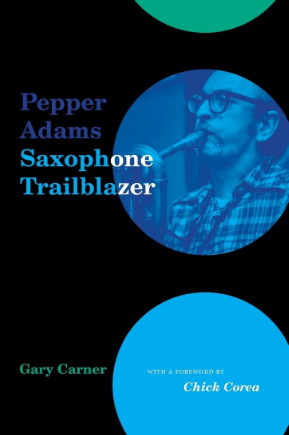
Pepper Adams - Part 3 - Pepper Adams Saxophone Trailblazer by Gary Carner

 © Copyright ® Steven Cerra, copyright protected; all rights reserved.

"On the baritone sax, he was the greatest we've ever had." 

- PHIL WOODS, alto saxophonist


"He was a rare genius on the horn." 

- PHILIP LEVINE, Poet Laureate of the United States 2011-2012


“Ya gotta be original, man.”

— Lester Young


“How many musicians out there are really different?”

— Ran Blake


“Because jazz demands that musicians find their own sound and stamp their performances with a singular individuality, those who succeed in music tend to be distinctive, singular individuals.”

—John Gennari


"Gary Garner's loving tribute to Pepper Adams finally delivers some justice to the man and to the whole range and span of his too short and underappreciated but brilliant career."                             

 - Ben Sidran, author of Talking Jazz: An Oral History


"Having known and worked with Pepper from 1955 until he left us, reading this biography makes you feel that you are there with him. His humor, wit, and devotion to music are all written about in a way that Pepper himself would have loved. Gary Garner has kept this story real."                                  — David Amram, author of Vibrations:

The Adventures and Musical Times of David Amram


This feature is intended to bring my earlier work on the career of the late baritone saxophonist Pepper Adams [1930-1986] up to date by focusing on Gary Carner’s 2023 biography - Pepper Adams Saxophone Trailblazer.


Gary’s work on Pepper has long been considered definitive by the Jazz community at large


Parts 1 and 2 in my series were begun in 2009, a year after the blog was first published, and they didn’t have the benefit of Gary’s extensive research on Pepper’s life and music.


Later revisions of the two-part feature on Pepper did have access to Gary’s Pepper Adams’ Joy Road: An Annotated Discography which was published in a paperback format in 2013. As one reader has asserted, this book was “so much more than just a discography.”


The back cover of the work concurs and further explains:


Pepper Adams' Joy Road is more than a compendium of sessions and gigs done by the greatest baritone saxophone soloist in history. It's a fascinating overview of Adams' life and times, thanks to colorful interview vignettes drawn from the author's unpublished conversations with Adams and other musicians. These candid observations from jazz greats about Adams and his colleagues' reveal previously unknown, behind-the-scenes drama around legendary recordings made by David Amram, John Coltrane, Dizzy Gillespie, Elvin Jones, Thad Jones, Charles Mingus, Thelonious Monk, Duke Pearson, and many others.


All types of sound material — studio recordings, private tapes and broadcasts, film scores, audience tapes, and even jingles—are listed, and Adams' oeuvre is pushed back from 1956 to 1947, when Adams was sixteen years old, before he played baritone saxophone. Because of Garner's access to Adams' estate, just prior to its disposition in 1987, much new discographical material is included, now verified by Adams' date books and correspondence. "-


Since Adams worked in so many of the great bands of his era, Pepper Adams' Joy Road is a refreshing, sometimes irreverent walk through a large swath of jazz history. This work also functions as a nearly complete band discography of the Thad Jones-Mel Lewis Orchestra, the most influential big band of its time, Adams was a founding member and stayed with the band until a year before Jones left to relocate in Denmark. Finally, Garner charts the ascent of Adams as an original, yet still underappreciated, composer, one who wrote forty-three unique works, nearly half of them after August 1977, when he left Jones-Lewis to tour the world as a soloist. Pepper Adams' Joy Road, the first book ever published about Pepper Adams, is a companion to the author's forthcoming biography on Adams.”


Ten years later, in the Introduction to Pepper Adams Saxophone Trailblazer, Gary gives a detailed explanation about how he went about his work in preparing and presenting his biography of Pepper.


“On September 28, 1986, our first wedding anniversary, my wife Nancy and I attended Pepper Adams's memorial service at St. Peter's Lutheran Church in New York City. Adams had waged a courageous battle against an aggressive form of lung cancer that was first diagnosed in March 1985 while he was on tour in Sweden. On that somber yet bright Sunday afternoon, St. Peter's ash-paneled, multi-tiered sanctuary, tucked under 915-foot-tall Citicorp Center, was packed with friends, musicians, and admirers. Reverend John Garcia Gensel presided over the service and many jazz greats performed and paid their final respects.


Adams was a friend of mine, but I knew him only during the last two years of his life. We first met in 1984, while he was recovering from an auto accident that had kept him immobilized for six months. Then afterwards, while separated from his wife, he was diagnosed with the illness that would take his life. Although a miserable time for him, it was an exciting ride for me. I was a twenty-eight-year-old grad student, a passionate jazz fan and record collector, who was trying to interest a jazz musician in working with me on an oral history to satisfy my thesis requirement at City College of New York. Adams, I soon learned, was an ideal subject: a major figure who, from the late 1940s onward had played with virtually everyone in jazz.


Because he was homebound that summer, we met several times in Brooklyn, discussing his career, listening to music, and once going out for lunch and running some errands. Our conversations yielded eighteen hours of documentation, captured by my trusty Sony microcassette recorder. The depth and historical sweep of his recollections were stunning. I knew right away that I had the makings of a valuable co-authored autobiography. But seven months later his cancer was diagnosed. Because cancer treatments and international travel made our autobiographical project an impossibility,


I decided that writing a full-length biography would be the more sensible approach. When Pepper was home between gigs, I watched football games with him while going through documents, eating pizza, and dubbing copies of his cassette tapes. Although I was trying to gather as much information as I could in the little time that remained, it was improper to pry about the minutiae of his life. Despite my curiosity, I had to respect the fact that he felt lousy, and his leisure time was sacrosanct.


The following summer I moved to Boston to further my studies and Adams research. No longer able to visit, we stayed in touch by telephone and postcards that he sent me from the road. Our final conversation took place eight months later, only a few weeks before his death. In August 1986, when Adams was bedridden and under the watchful eye of a home-health aide, I called to see if there was anything I could do for him. His caretaker answered and asked me to hold for a moment. While I paced anxiously for at least five minutes, Adams somehow dragged himself to the telephone. In a sentence or two he acknowledged that time was short, thanked me for calling, and hung up. That was right around the time that Dizzy Gillespie called him on Mel Lewis's behalf to say that Thad Jones, one of Pepper's dearest friends, had just died of cancer in Copenhagen.


A year later, once I began interviewing Adams's colleagues for this book, I spent a memorable afternoon with pianist Tommy Flanagan, Ella Fitzgerald's longtime music director. One of the last to see Pepper alive, he wanted me to know that transcripts of my Adams interviews were stacked on Pepper's nightstand days before he died. Flanagan told me that at one point, while he was perched on the edge of Adams's bed, Pepper awoke and tried to push those interview materials towards him. As if Flanagan was brushing crumbs off a tabletop with the backside of his fingertips, he accentuated his story by imitating Peppers feeble attempt to move the heavy pile of papers in Tommy's direction.


As you can imagine, I was overcome by the implications of Adams's gesture. At first, I was astounded, something I must have communicated via my astonished gaze and stunned expression. Then my heart sagged, and eyes watered, as I realized that our months of work together had comforted Pepper at the end of his life.


Flanagan's interview was one of more than 250 I conducted. Repeatedly, interviewees affirmed Adams as a complex individual — a hero, a genius, a model of grace, an intellectual, a virtuoso stylist — yet someone also very hard to read. The contradictions they depicted intrigued me. Adams, they said, was an unworldly looking sophisticate, a white musician who sounded

like a black one, and an exuberant saxophonist who was soft-spoken and mild-mannered off the bandstand. Many told me of his unprecedented agility on the baritone, that he played it like an alto. Before Adams, baritone sax was a cumbersome, fringe instrument. Today, because of his innovations, it is no longer viewed as a novelty.


Throughout his career, Adams told interviewers that the baritone's low pitch was like his speaking voice. He felt this, to some extent, explained his affinity for the horn. But more can be divined from his adoption of the instrument. For one thing, he greatly prized originality. Becoming a baritone saxophonist in the late 1940s gave him an opportunity to create a unique style on an infrequently heard instrument. Like Duke Ellington, whom he greatly admired, Adams believed he could similarly stand apart from everyone else.


Paradoxically, despite enhancing the idiom and securing his place in history, Adams's fealty to his instrument also hurt him. The public's disregard for low-pitched instruments and his resultant status as a sideman prevented him from both fronting his own band and recording far more albums as a leader, particularly any with widespread distribution. Moreover, refusing to double on bass clarinet disqualified him from studio work that could have helped financially when jazz gigs were sporadic.


When I began collaborating with Adams, I knew he was a superb instrumentalist but had no idea of the breadth of his contribution, how much his colleagues adored him, nor the degree to which his life intersected with some of the greatest poets, writers, painters, and musicians of his time. Thanks to our working relationship, the door to the international arts community burst open for me right after his death. As a result, I have had the remarkable privilege of speaking with so many of his esteemed colleagues, all of whom honored my interest in such a deserving artist.


Without a doubt, my interviewees are the heart and soul of this book. You will read some of them speaking, at times with surprising tenderness, of their fondness and admiration for Adams. His death was a significant loss, and their remembrances of his last few years are filled with sentimental accounts, sometimes with them breaking into tears. Besides helping me grasp the totality of Pepper's character and accomplishments, Adams's friends have given me a profound sense of interconnectedness with the jazz world. I'm grateful for their kindness and support, particularly when writing this book seemed insurmountable.


Despite Peppers eagerness to share aspects of his career with me, he was reluctant to discuss his personal relationships or his time in the US Army.

Radio appearances and magazine articles, too, were of little use regarding his private life. So, I had to start from scratch.


Unraveling the complexities of such an enigmatic individual, plus digesting his thousands of hours of recordings, conceptualizing a narrative structure that suited his life, and transferring my personal observations and mountain of data into prose, took me thirty-seven years. Discounting some promising fits and starts, I waited until I felt ready to write the kind of book he deserved. That began in April 2017, after I gave a series of lectures about him, including a memorable residency at Utah State University.


Because chronological storytelling is hackneyed and outmoded, I always intended to write the book thematically. As Milton Lomask has argued, "The cradle-to-grave approach in biography is strictly a literary convention. Only in biographies and never in life do we get to know another human being in that consecutive fashion ... No human life is so tidy, so uncomplicated, that you can construct it by simply reciting the events of it in sequence."


Biographer Leon Edel expressed the same point of view: "Biography need no longer be strictly chronological, like a calendar or datebook."

Lives are rarely lived that way. An individual repeats patterns learned in childhood, and usually moves forward and backward through memory. . . . 

Chronological biography tends to fragment and flatten a life. A chronological recital of these facts reads like a newspaper; we jump from one item to another, and the items seem unrelated. . . . The task and duty of biographical narrative is to sort out themes and patterns, not dates and mundane calendar events which sort themselves.


After writing a few chapters with that in mind, it occurred to me that Adams's life would best be rendered in two parts. I decided to entitle the first half of the book "Ascent" to delineate his early years in Detroit and Rochester, New York, while becoming a virtuoso. "Dominion" could then cover the remainder of his life as a full-fledged musician based in New York City.


I further resolved that divulging Adams's death within this prologue freed me from ending the book with his demise, yet another banality. Insofar as "Ascent" could mostly proceed topically from Pepper's youth to his relocation in New York, I decided to defy common practice by beginning "Dominion" with a full account of Adams's terminal illness, then work my way back thirty years to his arrival in New York. Going backward, a device often found in cinema, not only struck me as a writing challenge, but seemed consistent with Adams's distaste for cliché. Emboldened by historian Doris Kearns Goodwin, who regretted not crafting her Lyndon Baines Johnson biography in reverse-chronological order, I liked how inverting "Dominion" circled me back to 1956, setting up my conclusion (chapter twelve).


Before I began writing, my years of research allowed me to comprehend Detroit's jazz culture and socioeconomic history. I was interested in understanding its automobile economy, profound racial problems, and illustrious jazz history. I was most curious about the extraordinary postwar "band of brothers," that clique of world-class jazz musicians who descended on New York City in the mid-1950s and reinvigorated the music.


Regarding Rochester, New York, where Adams attended public school, I wanted to know how that city came to be, why its economy was better off than the rest of the country during the Great Depression, and what took place there during World War II when Adams was a teenager. New York City's jazz scene in the 1950s and '60s, of course, intrigued me. I especially wanted to understand how jazz cross-pollinated with other arts and Adams's place within that world.


Inasmuch as biography is "a portrait in words of a man or woman in conflict with himself, or with the world around him, or with both," I sought to understand my subject's personality traits, strengths and weaknesses, how he behaved with others, and the inner myths he guarded and outer myths he promulgated. I wanted to explore his genealogy, learn about his childhood, get my arms around his relationship with women, and penetrate the veil of secrecy about his mother and tenure as a soldier. I strove to grasp why, despite his exceptional gifts and the universal respect he received from his colleagues, he wasn't financially successful. Was it because of his instrument, the way he conducted himself, or other factors?


Undoubtedly, writing about Adams satisfied my wish to contribute something tangible to the music I love. But truth be told, my work over the years morphed from a passionate hobby to a raison d'etre. After building pepperadams.com, in 2012 I produced a five-CD box set of Adams's entire oeuvre. The anthology was co-branded with Pepper Adams' Joy Road: An Annotated Discography. A sixth CD, produced separately, featured big-band arrangements of ten of his tunes. Now, with this companion study I, at long last, have fulfilled my original promise to him and myself.


Please visit the Instagram page (instagram.com/pepperadamsblog) that serves as the repository of Adams photographs and documents. More importantly, whether you are encountering him for the first time or are already hip to his career, be sure to listen to his glorious saxophone playing, some of which is posted at YouTube and pepperadams.com.”


As the back page of the paperback declares:


“Pepper Adams is more than a definitive biography of Park "Pepper" Adams (1930-1986). The culmination of thirty-seven years of research, it's a fascinating account of Adams's life and times, thanks to colorful vignettes drawn from the author's 250 unpublished conversations with Adams and other esteemed musicians. These candid observations about Adams and his colleagues reveal previously confidential aspects of Adams's complex personality, his many outstanding achievements, and little-known facts about musicians with whom he worked, such as Thad Jones, Miles Davis, Charlie Parker, John Coltrane, Elvin Jones, Charles Mingus, Stan Kenton, Duke Ellington, Bobby Timmons, Wardell Gray, Dizzy Gillespie, Thelonious Monk, and others. Musicians, jazz fans and collectors, and readers who enjoy a hero's journey will be intrigued by Adams's extraordinary intelligence, the extent of his influence, the reverence he commanded, and his struggle to be rewarded as the unique stylist that he was throughout his career. Moreover, readers will be enlivened by the author's unique approach to biography, in which storytelling moves thematically, sometimes in reverse chronological order.”


For order information please click this link.


Saturday, October 12, 2019

Reflectory: The Life and Music of Pepper Adams by Gary Carner

© Copyright ® Steven Cerra, copyright protected; all rights reserved.


“Looking back, my journey has been an extraordinary blessing. On one level, Pepper Adams’ music has immeasurably enriched me. Moreover, writing about him has satisfied my inveterate wish to contribute something tangible to Jazz, the music that I love more than anything. But on a deeper level, my work has morphed from a passionate hobby to a raison d’etre. Along the way I’ve gotten to know so many Pepper Adams admirers, for whom he was a sage and musical beacon. Their friendship and support have given me a profound sense of interconnectedness with the world for which I am truly grateful.” 
- Gary Carner

Visitors to these pages may be familiar with author and discographer Gary Carner’s earlier efforts on behalf of the late, stellar baritone saxophonist in the form of his Pepper Adams’ Joy Road: An Annotated Discography.

Now comes notification of his full-length biography on Pepper - Reflectory - which ideally will be available for download on his website by Christmas or early 2020 at a price of $9.99 for Chapters 1-3, and a year later, $9.99 for Chapters 4-10. As you read, both halves will include links to all the music examples. 

Gary commented that “Interested buyers can purchase the book at pepperadams.com for sure. I haven't selected the publisher yet, so I don't know where else it may be available. Amazon is a possibility.”

Gary has very kindly allowed the editorial staff at JazzProfiles to share the following introductory chapter on these pages.

Prologue 

“On September 28, 1986, our first wedding anniversary, my wife Nancy and I attended Pepper Adams’ memorial service at St. Peter’s Lutheran Church in New York City. Adams had waged a courageous battle against an aggressive form of lung cancer that was first diagnosed in March, 1985 while he was on tour in Sweden. On that somber yet bright Sunday afternoon St. Peter’s ash-paneled, multi-tiered sanctuary, tucked under the 915-foot-tall Citicorp Center, was packed with friends, musicians and admirers. The Reverend John Garcia Gensel presided over the service and many jazz greats performed and paid their final respects. 

Pepper Adams was a friend of mine but, sadly, I knew him only during the last two tumultuous years of his life. At that time, still recovering from a horrible leg accident that kept him immobilized for six months, Adams was separated from his wife and diagnosed with the cancer that would kill him. Although it was an undeniably miserable time for him it was, conversely, quite a fascinating ride for me. I was a 28-year-old grad student; a passionate jazz fan and record collector who was trying to find a jazz musician interested enough to participate with me on an oral history to satisfy my thesis requirement. 

Fortunately, because Adams was still recuperating at home, he had time to indulge me. What an ideal subject! Here was a major soloist who played with virtually everyone in jazz from the late 1940s onward yet hadn’t received the acclaim that he deserved. At our first interview in June, 1984 he was so gracious and prepared, so articulate and engaging, when retelling the events of his life. 

We met several times at his home in Brooklyn that summer. Eventually I amassed eighteen hours of tape-recorded interview material. Because Pepper’s recollection of his childhood and early career was so stunning in its depth and historical sweep I strongly felt that I had the makings of a valuable co-authored autobiography. 

Then, seven months later, Adams’ cancer was diagnosed. I visited him at St. Luke’s Hospital in Manhattan, when he began his chemotherapy regimen, and I saw him perform whenever he had a gig in New York. On one occasion, between sets at the Blue Note, I saw him bark at a pianist whom he misperceived was harassing him for a job. At Far and Away, a club in nearby Cliffside Park, New Jersey, I heard the suffering pour out of him during a stunning ballad performance that brought me to tears. 

Because his medical treatments and international travel schedule made our autobiographical project an impossibility, I decided that writing a full-length Pepper Adams biography would be the more appropriate undertaking. When Adams was home, either convalescing or in between gigs, I watched football games with him while going through documents and dubbing copies of his tapes. Although I was trying to gather as much information as I could in the little time that was left, it was improper for me to pry about the minutiae of his life. Despite my youthful curiosity I had to respect the fact that his cancer treatments made him feel awful and he was fighting to stay alive. 

In the summer of 1985 I moved three hours away to Boston. No longer able to visit with him nor catch any of his gigs we stayed in touch by telephone. Late that year I somehow learned that he had an upcoming four-night stint in bitterly cold Minneapolis. Concerned about his well-being, I urged a friend to attend as a courtesy to me. Thankfully, Dan Olson caught one of the performances and also taped both sets. During intermission he said hello for me, bought him a beer, and the two had a chance to chat at the bar. 

My final conversation with Pepper took place in August, 1986, only a few weeks before his death. Bedridden at home and under the watchful eye of a home-health aide, I called to see if there was anything I could do for him. His hospice caretaker answered and asked me to hold on for a moment. While I paced anxiously for at least five minutes, Adams somehow found the energy to drag himself to the telephone. In a sentence or two he acknowledged that time was short, thanked me for calling, said a final goodbye, and hung up. That was right around the time that Dizzy Gillespie called Adams on Mel Lewis’ behalf to say that one of Pepper’s dearest friends, the trumpeter Thad Jones, had just died of cancer in Copenhagen. 

About a year later, once I began interviewing Adams’ colleagues for this book, I spent a very memorable afternoon with the pianist Tommy Flanagan, Ella Fitzgerald’s longtime music director. I was meeting him for the first time and was completely star-struck. One of the last people to see Pepper alive, Flanagan especially wanted me to know that the transcripts of my Adams interviews were stacked high on Pepper’s nightstand just days before he died. At one point, while sitting next to Adams on the edge of his bed, Flanagan told me, Pepper awoke and tried feebly to push my interview materials towards him. As if he was brushing crumbs off a tabletop with the backside of his fingertips, Flanagan intensified his story by imitating Pepper’s debilitated attempt to move the heavy pile of papers in Flanagan’s direction. 

As you can imagine I was completely stunned by the many implications of Adams’ gesture. At first I was astounded, something that I must have readily expressed to Flanagan by my astonished gaze and frozen expression. Then my heart sagged and my eyes watered as I became increasingly aware that our months of work together somehow comforted Pepper at the very end of his life. 

During the next few weeks, as Flanagan’s story continued to wash over me, I noticed that I was taking my role as Pepper’s biographer a lot more seriously. As the proud guardian of Adams’ legacy, acutely aware of how important it was to Adams that his work carry on after him, my research acquired renewed vigor. Surely my resolve to do this book and all the other Pepper Adams projects that have preceded it was strengthened. But truth be told I’ve wanted to tell his story since that memorable Saturday afternoon when I conducted my first interview with him that completely changed my life for the better. 

Flanagan’s interview was one of more than 250 that I conducted, mostly in the late 1980s before my daughter was born. Over and over again my interviewees affirmed Adams as a complex individual — a hero, a genius, a model of grace, an intellectual, a virtuoso musician and stylist — yet someone also very hard to calibrate. The contradictions that they depicted equally fascinated me. Adams, they said, was an unworldly looking sophisticate, a white musician who sounded like a black one, and a dynamic, commanding saxophonist who was soft-spoken and mild-mannered off the bandstand. 

Many told me of his unprecedented agility on the baritone, how he “played it like an alto.” Before Adams the baritone sax was a cumbersome, fringe instrument rarely played outside of a big band. Today, because of his innovations, the baritone with a rhythm section is commonplace and no longer viewed as a novelty. 

Throughout his career Adams told radio interviewers that the pitch of the baritone was similar to his speaking voice. He felt that this to a certain extent explained his affinity for the instrument. But much more about him can be divined from his adoption of the baritone sax. For one thing, he greatly prized originality. Becoming a baritone saxophonist in the late 1940s gave him an opportunity to create a completely unique style on an infrequently heard instrument. Like Duke Ellington, whom he greatly admired, Adams could similarly stand way apart from everyone else. 

Paradoxically, despite enhancing the idiom and securing his place in history Adams’ fealty to his instrument also hurt him. The public’s inherent bias against low-pitched instruments and his status as a sideman stood in the way of him fronting a band or recording far more albums as a leader, particularly any with widespread distribution. As the pianist Roland Hanna once asked, Who knows what Pepper might have achieved had he instead chosen the tenor saxophone? 

Throughout his career Adams was exclusively a baritone saxophonist for hire. Refusing to double on the bass clarinet disqualified him from studio work that could have helped him immeasurably during the 1960s, when jazz gigs were sporadic. He never experimented with other instruments nor taught the saxophone (except an anomalous lesson here and there, or master classes sponsored by educational institutions). Always the fierce individualist, Adams’ lack of pragmatism interfered with other aspects of his life. 

When I began collaborating with Pepper Adams I knew that he was a superb instrumentalist but I had little idea of the breadth of his contribution, how much his colleagues adored him, or the degree to which his life intersected with so many of the greatest poets, writers, painters and musicians of his time. Much to my delight, because of our working relationship, the door to the international arts community burst open for me right after his death. I have had the remarkable privilege of speaking with so many of his esteemed colleagues, all of whom honored my interest in such a deserving artist. 

Undoubtedly, excerpts from my 250 taped interviews with Adams’ associates are the heart and soul of this book. You will read some of them speaking, at times with surprising tenderness, of their fondness and profound admiration for Pepper Adams. His death was a significant loss for them, and their remembrances of his last few years in particular are filled with sentimental accounts, sometimes with them breaking into tears. 

It was my interviewees who helped me answer so many of my pressing questions and, ultimately, grasp the totality of Adams’ character and many achievements. Their thoughtful responses — respectfully given quite a bit of space throughout Part One — allowed me to fill in many of the gaps left over from my interviews with Pepper. Despite his eagerness to share many aspects of his life he was reluctant to discuss his personal relationships, his time in the U.S. Army, or his heartfelt feelings about himself or others. Though Adams’ radio appearances and the magazines articles about him were of some help about his career, they too were of little use about his private life. For the most part I had to start from scratch. 

Thus, much like a fine Bordeaux, bringing this book to maturity took many years. To unravel the complexities of such a very private, enigmatic individual, put into perspective a lifetime of work, conceptualize a narrative structure that suited his life, and then transfer my mountain of data and personal observations about him into prose took me 36 years. I intentionally waited until I was finally ready to write the kind of book that I felt he deserved. That began in April, 2017 after I gave a series of lectures about him in Utah. 

Before I began writing, many years of research allowed me to finally comprehend Detroit’s jazz culture and socio-economic history. I was especially interested in understanding the growth of its automobile economy, its profound racial problems, and its illustrious jazz history dating back to the 1920s. As a friend of the underdog, I wanted to exhume some of the Detroit musicians who contributed significantly to its jazz scene but remain completely unknown. I was most curious about what it was that produced the extraordinary, postwar “band of brothers”: that clique of world-class jazz musicians who descended on New York City in the mid-1950s and so thoroughly reinvigorated the music. 

Regarding Rochester, New York, where Adams grew up, I wanted to know how the city came to be, how its economy was much better off than the rest of the country during the Great Depression, and what took place there during World War II when Adams was a teenager. I was equally curious about its jazz culture and the influence of the Eastman School of Music. The New York City jazz scene of the 1950s of course intrigued me too. More than just recounting Adams’ gigs and living arrangements, I wanted to understand how jazz cross-pollinated with the other arts, and define Pepper’s place within it. 

Mostly, however, I wanted to understand my subject: his personality traits, his strengths and weaknesses, how he filled a room, how he behaved with others, and what myths he created or believed about himself. I wanted to penetrate the veil of secrecy about his mother and his time in the army. I wanted to learn about his childhood, research his genealogy, and get my arms around his relationship with women. I wanted to grasp why, despite his exceptional musical gifts and the universal respect that he received from his colleagues, he wasn’t financially successful. Was it mainly because of the instrument that he played or was it due to the way he conducted himself or other factors? 

Looking back, my journey has been an extraordinary blessing. On one level, Adams’ music has immeasurably enriched me. Moreover, writing about him has satisfied my inveterate wish to contribute something tangible to the music that I love more than anything. But on a deeper level, my work has morphed from a passionate hobby to a raison d’etre. Along the way I’ve gotten to know so many Pepper Adams admirers, for whom he was a sage and musical beacon. Their friendship and support have given me a profound sense of interconnectedness with the world for which I am truly grateful. 

Knowing Adams personally and working on this demanding project has brought me as close to genius as I’m likely to experience in my lifetime. 
After researching his life, collecting his recordings, overseeing pepperadams.com, and unearthing his wonderful compositions for six recording sessions, in 2012 I produced a five-CD box set of Adams’ entire oeuvre. Featuring newly commissioned lyrics to his seven magnificent ballads, it was co-branded with my book Pepper Adams’ Joy Road: An Annotated Discography. Now, with this companion volume I at long last fulfill my promise to him and myself. 

Half biography and half musical study, this book is the culmination of more than 45 years of work. I’m extremely fortunate that John Vana, an alto saxophonist and ardent Pepper Adams fan, agreed to co-author Part Two. We first met in late 2013 at Western Illinois University, where he invited me to speak. Soon after my visit I asked him to write a major piece on Pepper’s early style for a proposed anthology. Not long afterwards John started requesting that I send him, bit by bit, every Pepper Adams LP, cassette and videotape in my collection. Clearly, listening only to Adams’ early recordings wasn’t enough. He wanted to examine Pepper’s entire output. Eventually, on a long drive from Atlanta to Orlando it occurred to me that John’s piece would likely cover some of the same terrain that I’d be exploring. Considering the demands of my day job, wouldn’t it be better for me to focus exclusively on the biography and have John (with my input and editorial oversight) write the second half? The anthology might not even happen, I pointed out, so what better place for his study? 

Our twofold aim, dear reader, is to showcase an important person who lived an extraordinary life and to contextualize his many unique contributions to Twentieth Century music. As you work your way through the book we urge you to listen to Pepper’s glorious saxophone playing. For the most part Chapters Five, Seven and Eight discuss what I consider to be Adams’ greatest recorded achievements. Additionally, a few of his early pre-1956 recordings are covered in Chapter Three. Eventually you will likely discover that some of my favorites diverge from those covered in Part Two that John Vana felt best illustrated important aspects of Pepper’s style. This independent approach was designed to extend the breadth of our study and give both of us a chance to more thoroughly express our points of view. Whether you are encountering Pepper Adams for the first time or are already hip to his career, be sure to enable the music links that are embedded throughout the text. Many of these extraordinary performances have never before been made available to the public. As always, thanks so much for your interest in Pepper Adams.” 

Gary Carner 
Braselton, Georgia 2020

Saturday, June 9, 2018

Pepper Adams - An Interview With Gene Lees

© -Steven Cerra, copyright protected; all rights reserved.


When Adams is at his peppery best - furious, angry, pouring into the horn a wealth of fiercely felt emotion - it brings to mind his nickname while on the Kenton band. As bandmate drummer Mel Lewis puts it: “We called him ‘The Knife’ because when he’d get up and blows, his playing had almost a slashing effect on the rest of us. He’d slash and chop and before he was through he’d cut everybody down to size."


After a prolonged primary exposure to baritone saxophone in the form of Gerry Mulligan’s light and airy sound, Pepper Adams’ tone on the instrument was something of a revelation the first time I heard it.


Deeper, darker, growly - Pepper’s sound took a bit of getting used to but what I got right away was how facile and dexterous he was in creating improvised lines on the cumbersome instrument.


Pepper’s ideas just flew out at you in an inexhaustible stream of creativity.


And lest you doubt where he was coming from, Phil Woods once described Pepper as “... a Bebopper down to his socks.”


Over the years, Pepper became one of my favorite Jazz musicians and I eagerly sought out opportunities to hear him in person or on record.


Here’s an interview that Pepper gave to Gene Lees in 1963.


“THERE is something professorial about him. He is inclined to tweeds, usually a little rumpled. Brown-rimmed glasses and an extremely high forehead give him a look of perpetual slight surprise, and he seems to be peering at things intently, trying to figure them out.


He is Pepper Adams, and there is nothing professorial about him except his intelligence and his catch-all brain, one of the most retentive in jazz.


He is a holdout. One could call him a rebel, except that it doesn't quite fit. He seems like a conservative— but that doesn't quite fit either, because what he is conserving is rebelliousness—at a time when most jazzmen have lost it.
Most men of his generation have gone into the studios in search of decent livings with which to raise their families. Adams stays on the road and struggles to make ends meet. A married man wouldn't be able to do it, but Adams at 32 seems to be a confirmed bachelor.


"I admit my attitude is unusual," he said recently. "I'm in the business because I like music. If you can't play music, why be in the business?


"That's the one reason I've never settled in New York. I require a forum from which to play. In other words, if something like Donald Byrd's little band came up, I'd go out with it immediately. It was a starvation band, but it was a good one."


The reference was to a group with which Adams played for a couple of years. It was billed as the Donald Byrd-Pepper Adams Quintet. It never made money, and Byrd went into debt trying to keep it going. Those who heard it — and too few people did, which is why it went under —  thought it was one of the most stimulating groups in the business.


It is significant that Adams refers to it as "Donald's group," when it recorded under their two names. Thus far, Adams has been disinclined to assume the responsibility of leadership. In this he is like Paul Desmond — a star soloist who has never really wanted his own group. For years Adams was willing to play Desmond to Byrd's Dave Brubeck. But Byrd doesn't have a group now — he is teaching at the High School of Music and Art in Manhattan — and so Adams is on his own. Inevitably, he's thinking of forming a group. "Thad Jones and I have been discussing the possibility for years," Adams said.


And that, too, is significant. Jones is from Detroit. Whenever Adams mentions a musician with whom he has close rapport, that musician is probably a fellow Detroiter, as Byrd is. The Detroiters in jazz have a curious local loyalty. Hearing one of them talk, one would think that jazz was invented in an abandoned tool shop of the Ford Motor Co. and that no one but Detroiters had really got the hang of playing it yet.


The Detroit group includes the Jones brothers (Hank, Thad, and Elvin), Tommy Flanagan, Paul Chambers, Barry Harris, Billy Mitchell, Lucky Thompson, Kenny Burrell, a reed man named Bill Evans who saved everyone a lot of confusion by changing his name to Yusef Lateef, and one Sylvester Kyner, who quite understandably changed his name too — to Sonny Red.


Why do they stay so closely in touch with each other? Partly it is because they are old personal friends — Adams and Byrd, for example, have been close since their middle adolescence.


"But it isn't only a personal thing," Adams said. "You find a lot of similarity in the Detroit players. They're all good, thorough musicians who know what they're doing. And you'll notice that they're all players with a strong personal conception.

"I think you'll find, too, that all the Detroit players are very proficient in their knowledge of chords. That doesn't necessarily mean that they're chordal players, but they do have this knowledge."


Adams, it will be noted, is the only white member of the Detroit School. (Donald Byrd once said dead-pan to an interviewer: "Pepper and I met in the midst of a Detroit race riot." The interviewer dutifully wrote it down.) In the period when Adams was growing up, he found himself attracted musically to what young Negro musicians in Detroit were doing — and ignored by most of Detroit's white musicians.


"I find even to this day," Adams said, "that saxophone players in the Stan Getz vein are offended by my playing. Not that they necessarily find it good or bad — just offensive.


"Harry Carney and economics influenced me to play baritone. I was working in a music store when I was 15, and I had a chance to buy a good used baritone cheap."

Carney, whom Adams met when he was 12, influenced him in the sound he uses — "specifically, in the breadth of sound."


"It is a sound that fits better the character of the instrument," he said. "But it also fits better what I want to do. You have a pretty wide-open field with the saxophone. Who is the authority for what is the correct sound? You can listen to Prokofiev's Cinderella Suite, played by the Moscow Symphony, with Prokofiev conducting, and hear in the tenor solo a sound that is laughably bad. But it is what Prokofiev wanted — the intention is humorous — which is often the case with saxophone in classical orchestras.


"Coleman Hawkins' sound fit what he wanted to do? and Lester Young's sound— even though it got him laughed out of the Fletcher Henderson Band when he first came to New York — fit what he wanted to do.


"My sound fits what I want to do.


"It's easier to get mobility with a lighter baritone sound, similar to that of tenor. If you play a fast run with a full sound, it's likely to sound like a run on the piano with the sostenuto pedal down.


"To make the run clear, you have to lightly tongue every note — to get the proper separation of notes. If you were doing it on tenor, or playing with a lighter baritone sound, you would not have to tongue it; the keys would articulate for you, generally speaking. The need to lightly tongue the notes makes the timing element more critical.

"You know, if you're used to baritone, and you pick up a tenor, it sounds so damn shrill you scare yourself. It's not all psychological, either — the sound coming back to you lacks some of the overtones, and so it's lighter than the sound someone out in front of you is hearing.


"When Wardell Gray and I worked together in Detroit, we used to trade instruments. It worked very well, because we got used to each other's horns. Also, we used very similar mouthpieces and reed setups."


THE EARLIER likening of Adams to Paul Desmond was not casual. There is something oddly similar about them, in their attitudes to work  (both would prefer simply to walk onstage and play in a good group, the responsibility for which is in someone else's hands), in their scholarship (both are voracious readers), in their politics (both are saddened Stevensonian Democrats, though Adams these days is revealing his Detroit nationalism in calling himself "a Walter Reuther Democrat"), and even in their persistent bachelorhood. Neither has ever broken his ties with his hometown: although both live in Manhattan when they're off the road, they maintain mailing addresses at their parents' homes — Desmond's in San Francisco, Adams' in Detroit.


But they are most alike in their humor, which is discursive and shot through with improbably obscure references. They have never met, yet the following nonstop passage, elicited by a question about Adams' background, could, in its style, have come from Desmond:


"Leonard Feather's Encyclopedia of Jazz states that I was born in Highland Park, Illinois . I was really born in Highland Park, Michigan, which was discovered when I was inducted into the Army in 1951. I went to the Detroit city hall for my birth certificate and was advised that I didn't qualify. I evidently had not been born in Detroit, as I had always assumed. By simple deduction, I arrived at the conclusion that I must have been born in Highland Park.


"Highland Park is one of two enclave communities which are bounded on all sides by Detroit, except where they are bounded by each other. The other is Hamtramck, fabled in Polish song and story and one record by Gene Krupa, who is also Polish.

"Hamtramck has no place in my chronicle, since I wasn't born there, but I thought you would like to know. I was, as I mentioned, born in Highland Park.


"Highland Park is something of a misnomer, since it is not a park and it is no higher than any of the rest of the flat land around Detroit. According to a Corey Ford book published in the 1920s, the lowest mountain in the world is Mt. Clemens, Mich., which attains a height of six feet above lake level.
"I regret that I was not born in Highland Park, Illinois, as Mr. Feather's estimable encyclopedia asserts, because it is a somewhat higher-class community than Highland Park, Mich. Perhaps it is injudicious of me to make this observation. The city fathers of Highland Park, Mich., are a pretty salty bunch. They made Detroit detour a proposed expressway and go around them."


Adams' life in jazz also has been discursive. Recently, for example, he worked with Lionel Hampton for four months — "the longest I've been on a big band in about seven years." He was having trouble finding work; the slow withering away of jazz clubs had affected him as it has everyone else in jazz.


"Lionel had 12 straight weeks of work," Adams said. "I felt I owed it to my creditors to accept the job."


Since leaving the Hampton band ("it's more correct to say the band left me — Lionel went to Japan with a small group"), Adams has taken an apartment in New York, the first he has had anywhere in about three years. Does this indicate that he will at last follow so many of his colleagues into the studios?


"I wouldn't find any satisfaction in it," he said. "When I lived in Los Angeles, I was making all kinds of records and more money than I've ever had in my life. But as soon as I got my card in Local 47, I left, and I haven't been back since."


For a detailed look at Pepper’s career, you might wish to checkout Gary Carner’s Pepper Adams Joy Road: An Annotated Discography which we covered in this linked book review.