© Introduction Copyright ® Steven Cerra, copyright protected; all rights reserved.

One of the most discerning features differentiating the music of modern Jazz from the New Orleans and Swing era Jazz that preceded it is the lack of vibrato. This was true irrespective of the instrument.
With the advent of Bebop and beyond, the quivering tone which was the mark of distinction during Jazz’s early years was no longer de rigueur. It went the way of four beats to the bar played on the bass drum.
One of my earliest friends in Jazz was trombonist Jim Trimble. His Dad - Kenny Trimble - was a featured trombonist with the Lawrence Welk Orchestra. I can remember a number of arguments between the two as Kenny called out to Jim “sweeten it a bit,” meaning, add some vibrato to his tone, while Jim would get this derisive look on his face as if to say, “Yeah, right!”
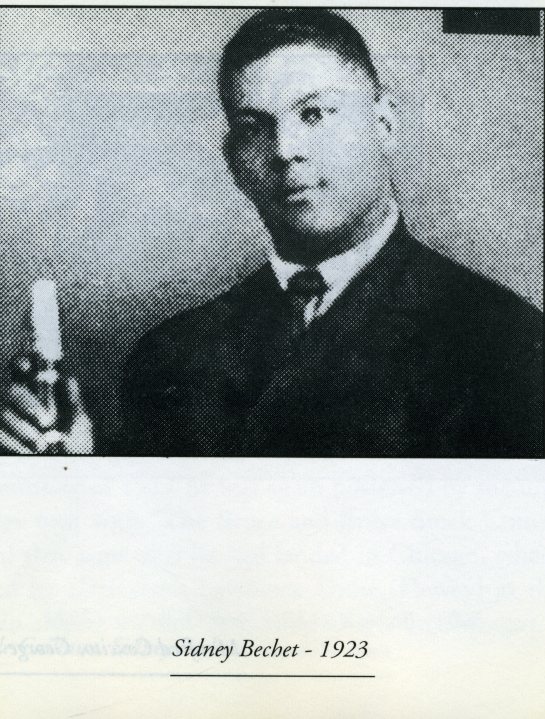
With regard to vibrato, perhaps a basic reason why modern Jazz saxophonists shunned the soprano sax for so long was that its most noted practitioner was Sidney Bechet, who played the instrument with what some referred to as a “nanny goat vibrato.”
A few years after Bechet’s death in 1959, John Coltrane took up the instrument, playing it in a vibrato-less manner that helped revive interest in the horn on the part of some modern Jazz saxophonists.
“There have been times through the years when some critics have commented dourly on Bechet's vibrato, finding it too wide and overbearing. This reaction is palpably a matter of taste and temperament. I've never found his vibrato annoying, and find it, in fact, a quite natural vocalized part of his expressiveness. With all that heat coming through a technique and conception that, after all, began in an era when vibrato was the most natural concomitant of jazz imaginable, I'm only surprised that the vibrato sometimes doesn't erupt volcano-like and swallow us all — colleagues, record and listeners alike.”
— NAT HENTOFF, Jazz author and critic
“Sidney Bechet was one of the most potent and powerful instrumental voices in the history of jazz. He has been called the first great jazz soloist, and rightly so (as long as we keep in mind that there were pianists, men such as Jelly Roll Morton and James P. Johnson, who'd developed full-fledged solo styles on their instrument before horn players came into their own). When young Duke Ellington heard him in 1923, it was a revelatory experience: "I have never forgotten the power and imagination with which he played," he wrote almost 50 years later.”
-Dan Morgenstern, Institute of Jazz Studies, Director Emeritus
The story that follows is an excellent example of what Ray Bradbury, in commenting about his own evolution as a writer, referred to as “Making Yourself as You Go.”
For Sidney Bechet’s Jazz Life, this would at times include performing as a circus act, owning and operating a restaurant and becoming the proprietor of a tailor shop!
Sadly, often a somewhat forgotten figure in terms of the celebration of the early origins of Jazz, if there ever was a universal Jazz Master, Sidney Bechet would rank near the top in the Jazz Saxophone category.
The following piece is a rare article from the archives of Downbeat magazine.
© Copyright ® George Hoefer, copyright protected, all rights reserved, the author claims no right of copyright usage.
(Ed. Note Sidney Bechet is the 24th musician to be profiled in Down Beat's Bouquets to the Living series.)
By GEORGE HOEFER Chicago, Downbeat 12.14.1951
—“This man could be elected Mayor of Paris tomorrow if he wanted to run. Crowds actually follow him in the streets. Why, I was never so amazed in all my life to find a countryman of mine virtually the toast of France, and I had hardly ever heard of him. It was so embarrassing in French society not to know all about this fabulous musician.
“Right here and now I'm going to learn something about jazz. Please give me all the Sidney Bechet records you have.” This was spoken by a Chicago society matron in a music shop after spending the summer of 1950 in Paris.
Sidney Bechet, New Orleans-born jazz pioneer, owns a villa outside Paris at 8 Rue Pierre-Brassolette Grigny, where he has been working on his autobiography. He feels a need for a true explanation of jazz music, the history of which has been simultaneous to his own life span, but derivations of which he has traced back to his grandfather’s time.
He says a better understanding of jazz is required, since the critics have gotten it all tied up with houses of ill repute. He wants to explain why people who hate jazz pat their feet when they hear it.
Wrote Ballet
Originally Sidney’s work was finished in the form of a ballet in which jazz was depicted as a feeling. The strength of this feeling was enhanced by visual appreciation. The ballet was once accepted for production but Sidney did not like the way it was to be done, so he took it away, and now plans to complete it in book form. His new format will include the many original numbers he composed for the ballet.
His new tentative publisher advised him to put more names in the book, as every name mentioned means another copy sold. When he returns to Paris after his current American tour he will revise the text to include more names and tell the story of his recent marriage.
Bechet, like Armstrong, has become legendary during his lifetime. He has had one of the most fabulous and colorful careers of any jazz musician living or dead. His great reputation was made as a leader of a long line of New Orleans clarinetists, but today is world renowned as the virtuoso of the soprano saxophone, an instrument he alone features.
Whole Band
When Sidney sings out on his soprano he is a whole band by himself. His New Orleans clarinet style with long, slow, melodic phrases is combined with a fast trumpet lead effect when using the heavier-voiced soprano. He effectively adapts his chosen instrument to fine blues playing, making full use of its range and contrasts of tone between low and high register. Bechet possesses a truly “hot” intonation and an intense vibrato.
Any soloist who dares to get entangled in a “carving contest” with Sidney is in for a frustrating disappointment. This happened a couple of years ago at the Paris Jazz Festival when bopper Charlie Parker, the great alto soloist, got involved in trading choruses with Bechet. Even if the Parisian crowd hadn’t been on the Dixie side, Bird would have had considerable difficulty in matching the vibrant avalanche of exciting sound Bechet is capable of putting down when aroused.
Bunk Johnson once worked a week with Sidney in Boston, an association that ended abruptly when Bunk, tired of Sidney outblowing him, remarked, “Hey, Pops, put that sewer pipe down and let me blow awhile.”
One-Man Feat
As stated above, Bechet is a by himself, a fact that he literally illustrated when engineer John Reid, then at RCA Victor, worked out a one-man-band record where Sidney played clarinet, soprano, tenor, piano, bass, and drums. The sides, Blues of Bechet and The Sheik of Araby, on Victor 27485, demonstrate the versatility of the self-taught genius. It was accomplished by using a pair of earphones and adding one instrument to the others while listening to playbacks of the previous renditions until the whole thing was together.
Bechet’s interest in the soprano sax dates way back to 1919, while he was playing clarinet accompanied by the late great Tony Jackson on piano at Chicago’s Pel inn. One day he heard a record called Bull Frog Blues by the Six Brown Brothers, a saxophone sextet. One of the saxes included was a soprano and Sidney became interested in the powerful tone coming from the instrument. A short time later he saw a curved soprano in a pawn shop window and bought it. He was sorely disappointed with it, after a couple of weeks of experimenting with the horn he wasn’t able to get any volume or tone out of it. The horn was soon returned to the hockshop; he realized later it was defective.
Had One Made
Later in the year while with Marion Cook’s concert orchestra in London, he had a straight soprano made up to his special order. “I was delighted with the resulting full, round tone, and its power and volume in the low register compared with the thinness of the clarinet. He felt much more familiar with the new horn and from that point on he favored it until today he plays it exclusively. He performed in Chicago last September on an old American horn but recently in Paris he was presented with a new French make. This latter horn has been cut down three times so far as the pitch has not been to Sidney’s liking.
Sidney was born in the Creole section of New Orleans on May 14,1897. He is, therefore, a contemporary of Louis Armstrong and Zutty Singleton. Due to his early start in music, the jazz historians have written about him as though he came along with such men as Keppard, Big Eye Louis Nelson, Bunk Joineon, and even Buddy Bolden. This has led to an erroneous impression that Bechet is much older than he actually is, but it is true he played with most of the- jazz pioneers of his early youth.
First Languages
His current love for France is understandable when you take into consideration his first languages were Creole and French, with the latter taught to him in his elementary school. The music language came along naturally after watching and hearing the musicians playing in wagons advertising dances, prize fights, picnics, and political campaigns. He also paid a great deal of attention to the brass bands with circuses and in all the parades of the day. It was on these occasions that he heard Buddy Bolden.
One of Sidney’s older brothers. Dr Leonard Bechet, now a dentist in New Orleans, bought a second hand clarinet held together with elastic bands and chewing gum and began taking lessons on it, when Sidney himself was only 6. Baby brother began to sneak the instrument out of the house and experiment with it under the front porch When he was finally discovered, his experiments were developed to such an extent that he amazed everybody with his musical prowess.
His brother was so disgusted with his own inability to match young Sid that he turned the instrument over to him to keep. Afterwards things began to happen in rapid order with Sid showing up in music circles all over town. Freddie Keppard was playing a lawn party during Sidney's eighth year and discerned a wellplayed clarinet accompanying his band coming from the parlor of the house Upon investigation he found Sidney playing away and
asked him to come out and sit in with the band.
Taught Correct Method
George Baquet heard him playing and gave him an old clarinet of his own, a clarinet exercise book to teach him the correct method of fingering. Sidney had already developed his own technique and it was many years before he was able to change to the conventional method. He also never bothered to learn sightreading, and even today depends on his phenomenal memory for the notes and ideas that he plays.
Even at the age of 10, when he played his first professional engagement in New Orleans’ Storyville district, he had discovered he had the knack of knowing intuitively what came next after hearing a bar or a couple of notes of the melody.
Brother Leonard had switched to trombone after Sid took over the clarinet
And in 1907 he organized the Silver Bell Band with Joe Bechet on guitar; Sidney Desvigne, cornet, and Adolf DeMassiliere, drums The next year Sidney was in Buddy Petit’s Young Olympians, and the next year he continued up the ladder as replaced Big Eye Louis in the main Olympia Band.
Finally he attained the top rung in 1911 when Lorenzo Tio Sr. left the Eagle Band and Sidney replaced him. Now he was in the big time at the age of 14, sponsored by the Eagle’s cornet star, Willie (Bunk) Johnson, who picked him up and delivered him home on the Saturday nights the Eagle played for dancing at the Masonic Hall.
Met Louis
Sidney learned to play a fair cornet during this association with Bunk, and it was during this period that he became acquainted with Louis Armstrong, a fact that probably caused him to give up any idea he might have had regarding becoming a cornetist.
In 1913 he joined Jack Carey’s Uptown band for a spell until an opening became available with the Olympia Band when George Baquet and Keppard went to California. Bechet worked with Joe (King) Oliver and trombonist Zue Robertson in this band. After the war started in 1914 an economic depression hit New Orleans and jobs were less plentiful. Sidney’s good friend Louis Wade signed up to play with a traveling stock company through Texas and Sid went along, doing a comedy act and playing clarinet solos featuring his ability to take his instrument apart playing the separate sections. Clarence Williams was also a comedian with the show.
By 1916, Sidney was back in New Orleans gigging around town with King
and others. When Storyville was closed in 1917, Sidney and pianist Louis Wade joined the Bruce and Bruce Stock company and toured Alabama, Georgia, Ohio. and Indiana. By fall they landed in Chicago and Sidney quit to join up with a group of Crescent City jazz men at the Deluxe cafe that included clarinetist Lawrence Duhe, Freddie Keppard, Minor Hall, and others.
The band split when Duhe got a better job at the nearby Dreamland and Keppard stayed at the Deluxe. Sidney and Duhe got King Oliver up to play with them, Bechet doubled during this period with Eddie Venson’s band at an after-hour spot called the Royal Gardens. One night Sidney got the wrong pay envelope and found out Duhe was making more money so he went back to the Deluxe with Keppard. During 1919 the Royal Gardens closed and Sidney replaced this late job with another at the Pekin with Tony Jackson.
Joined Cook
Will Marion Cook, who had brought his Southern Syncopated concert orchestra to Chicago, heard Bechet at the Pekin and offered him a job. Sid joined for $60 a week and went east to New York, where he worked with Tim Bryman’s band at Coney Island, while Cook lined up a European tour. Sidney made his first crossing to England in late 1919 when Cook finally left. He had to up Sidney's salary to $200 a week to get Bechet to make the trip. Cook had a concert group of 36 pieces, of which 20 were banjos, and its specialty was spirituals and group singing. Sidney played clarinet solos on blues numbers, and was featured in the concerts at the Philharmonic Hall in London.
After he obtained the soprano, an arrangement of Song of Songs was especially made for him to perform on his new horn. When the Cook group finally broke up, Sidney and Benny Peyton got a job in London’s Embassy Club where the Prince of Wales and Ernest Ansermet came often to hear them. In the fall of 1920 they took the group to Paris and played several spots there. They made a recording of High Society and Tiger Rag for Columbia in London but it was never issued.
Armistice Day, 1921, Sidney arrived back in New York and started playing gigs with Ford Dabney and finally joined a show where he played a Chinese character part and soloed on clarinet and soprano.
Bessie Smith was a young blues singer featured in the same show. Sidney played an accompaniment for Bessie when she did an audition singing Sister Kate for Okeh but it was never released and Bessie wound up with Columbia records instead.
By 1924, Bechet was active in recording with Clarence Williams’ Blue Five, composing songs, and playing for five months in Duke Ellington’s orchestra at the Kentucky club. The tunes were published by Fred Fisher, Inc., including Pleasure Mad, Do That Thing, Foolin’ Me, and Broken Window. The royalties from these tunes enabled him to open up a restaurant on Lenox avenue named the Club Bash. Many musician friends still call Sidney “Bash.”
The spot folded in 1925 and Sidney joined the Black Revue, which included Claude Hopkins and Sidney in the pit band and Josephine Baker on the stage This show headed for Europe playing Paris, Brussels, and finally broke up in Berlin in 1926
Back with Bennie
Bechet next got together again with Benny Peyton and they took a band on tour of Russia playing Moscow, Kiev and Odessa where Sidney was billed as “The Talking Saxophone.” A strange meeting and resulting friendship took place in Moscow. Sidney met for the first time Tommy Ladnier, a New Orleans musician of his own age. Tommy was working in Russia with Sam Wooding’s orchestra.
After the Russian tour Sidney went to Berlin and rejoined Louis Douglas' Black and White Revue He led the 14-piece white and colored band featured with the show. This musical unit had representatives from four or five nationalities and toured throughout Europe. About this time Sidney was made an American representative to the World’s Fair of Music at the famous Beethoven hall at Frankfurt-au-Main.
Bechet made his first connection with bandleader Noble Sissle when he joined him in Paris in July, 1928. This association was to last on and off for many years. While in Paris at Les Ambassadeurs Sidney bought a double E flat bass sax which he played in the Sissle band. Bechet has always had a flair for unusual and different instruments. On some of the Clarence Williams Blue Five sides he played a sarrusophone, a cross between a bassoon and bass sax. He also made a blues accompaniment playing guitar at one time, so he had considerable experience with different modes of playing music before he made the famous one-man-band side.
Talked-Of Incident
It was in 1928 in Paris that the “trouble” incident that is frequently mentioned among jazz people took place. It involved a shooting scrape in Joe Zelli’s Royal Box in Montmartre. A woman was involved and Sidney was deported. He went to Berlin and got a job in the famous Haus Vaterland.
Sissle wired Bechet from New York in 1930 and Sidney returned home to play for another spell in the Sissle aggregation. That summer the Sissle unit went back to Europe and no sooner had it arrived back on the continent when Sidney returned to the Haus Vaterland in Berlin, and in time, again hooked up with the Black and White Revue for an extensive tour of Europe.
History again repeated itself when Sissle wired Sidney in the winter of 1930-31 to come back to New York and join his band. A salary tiff in late ’31 again broke up the Bechet-Sissle relationship and then Sidney played at the Nest with an old New Orleans associate, Lorenzo Tio Jr., who played clarinet and alto. Next he spent a few weeks with Duke Ellington in Philadelphia working with Johnny Hodges on soprano. Hodges recorded The Sheik a short time after and the Bechet influence is quite discernible.
Joined with Ladnier
Tommy Ladnier left the Sissle band in 1932 and started a period of Bechet-Ladnier bands playing around in New York spots. It was at this time that the famous New Orleans Feetwarmer records were made for Victor.
By the end of 1933, the depression had really caught up with the jazz musicians and Bechet opened a tailor shop at 128th street and St. Nicholas Avenue Sidney pressed while Tommy Ladnier shined the shoes. This situation lasted a year until Sissle again called and Sidney toured the United States with him for the next four years.
The beginning of his current career as a virtuoso soloist can be said to have started in October, 1938, when he left Sissle for the last time and opened at Nick’s in Greenwich Village, fronting the Spirits of Rhythm.
For a while at first there were many disappointments and jobs with rubber checks. His chief joy during these years was a big Cadillac he hardly had the money to operate.
There was one summer spent playing up at Fonda, N. Y.. where a Communist camp was located. They wanted Sidney to attend the meetings in the daytime, but he definitely refused, saying “I can't see anything in that stuff. Instead of the early bird getting the worm, they want the early bird to cut up the worm and give away the pieces.’’ It was strictly a job for Sidney, playing nightly for the camp members at the Log Cabin at a good salary. There was a long spell early during his current period that he led a small combo in a spot in Springfield, Ill.
Many Dates
Finally his name and musical stature grew to the point where he had many recording dates, jobbing gigs, and appearances at concerts, enough to keep him going comfortably. He played a long time at Jazz Ltd. in Chicago and at Ryan’s in New York.
He started living in France regularly after going over there in 1949 to appear at the Jazz Festival. Bechet has been married three times. His first marriage took place in New York back around 1923-24. This ended in divorce in 1929. His next step in matrimony took place in June, 1935, when he married Marilouise Crawford in Chicago. This lasted until about 1942.
His most recent marriage was world news last summer. Back in 1928 he met German-born Elizabeth Ziegler at Frankfurt. She was a dresser with the show in which Sidney starred at that time. He promised to divorce his wife back in the States, which he did in ’29. but by that time the romance had cooled and Miss Ziegler married a Frenchman she later divorced.
More than 20 years later when Sidney was back in France he saw her photograph by chance in a newspaper and renewed acquaintance by correspondence. Last August they were married amid much fanfare at Juan-Les-Pins, France. After the civil ceremony, a New Orleans style wedding procession went from the Antibes town hall to the Vieux Colombier night club where Sidney was playing.
Parade
Leading the parade were two ancient automobiles carrying a 30 foot sax while 200 jazzmen played. The French Riviera had rarely seen such a celebration with jazz fans from Paris, including the “existentialists,” French comedienne Mistinguette, jazz dancers and hundreds of fans. Sidney led La Marche Nuptiale on his soprano sax.
This fall Sidney returned to the States, leaving Elizabeth in charge of the villa, to play a series of engagements across the country. He wants to get down to New Orleans for some “gumbo,” a visit with his brother Leonard, and to get some work done on his teeth.
No Ailments
He feels pretty good and the stomach ailment that plagued him at Jazz Ltd. several years ago went away when he drank a pitcher of medicine he was required to take to line his stomach for X-ray. He was only supposed to take one glass and since he was immediately better he refused to have the x-ray taken. So far no additional treatment has been necessary.
The return home has not all been pleasant. A couple of years ago he left AWOL from Jazz Ltd. in the midst of an engagement. He later returned to talk things over and agreed! to play there again before playing another Chicago spot. A lawsuit was entered against him when he opened at the Blue Note.
He is finding world fame has its drawbacks. A strange girl knocked on his hotel room door in Chicago and thrust a baby in his arms saying “It’s yours,” and started to cut out. After he got this straightened out, one of his ex- wives sent word she had some unpleasant things to discuss.
Most Sincere
Bechet has had an exciting and colorful career and throughout the years he has probably been the most sincere jazzman of all. His goal is to express himself in his playing and feels that the old feeling of music is nothing but life, and through New Orleans music he wishes to bring back an expression of life, his life.
He feels that no artist can do more than that.”